Has the Crypto Market Bottomed? Here's What Institutions Think

marsbitPublicado em 2026-06-17Última atualização em 2026-06-17

Resumo

The crypto market is in a period of significant debate, with leading institutions offering differing views on whether a bottom has been reached. Three prominent firms have published detailed analyses: * **Galaxy Digital** argues Bitcoin has **not yet bottomed**. Their analysis of 13 historical indicators across six dimensions (valuation, profit-taking, miner pressure, etc.) shows only four are fully met. They project a potential bottom range between $30k and $54k. * **NYDIG** states a bottom is **possible but not likely**. While metrics are close to historic bear market extremes, they note the absence of a classic panic-selling event. They also suggest increased institutional adoption may have structurally altered the market cycle, potentially leading to a shallower downturn. * **Standard Chartered Bank** asserts the **bottom has already occurred** at around $59k. They cite two key factors: potential US-Iran diplomatic progress and the anticipated SpaceX IPO, which they believe absorbed capital and caused ETF selling pressure that is now subsiding. They forecast a year-end price target of $100k. Despite the surface-level disagreement, the reports share critical common ground more valuable for long-term investors: 1. All three believe the market bottom will form **within this year**. 2. All agree the current price is **closer to the bottom than to previous highs**. 3. All maintain a **bullish long-term outlook** for Bitcoin and a new cycle. The core takeaway is tha...

Author: Matt Hougan, Chief Investment Officer, Bitwise

Compiled by: Chopper, Foresight News

Over the past two weeks, three crypto research institutions I follow closely—other than Bitwise—have all published in-depth reports addressing the same question: Has the crypto market bottomed?

  • Galaxy Digital: Bitcoin Has Not Bottomed, Data Points to a Potential Bottom Range
  • NYDIG: What Factors Are Suppressing Bitcoin's Price Action
  • Standard Chartered: The Market Bottom Has Already Occurred

These three reports are comprehensive, containing vast amounts of data and complete logical reasoning, and are worth reading in full. However, if you are looking for a simple, unified answer, you might be disappointed: the judgments given by these three authoritative institutions are completely different.

Has the Market Bottomed?

  • Galaxy Digital: No
  • NYDIG: Possibly, but unlikely
  • Standard Chartered: Already bottomed

Let's now break down the core logic of each institution one by one.

Three Institutions, Three Views

Galaxy Digital

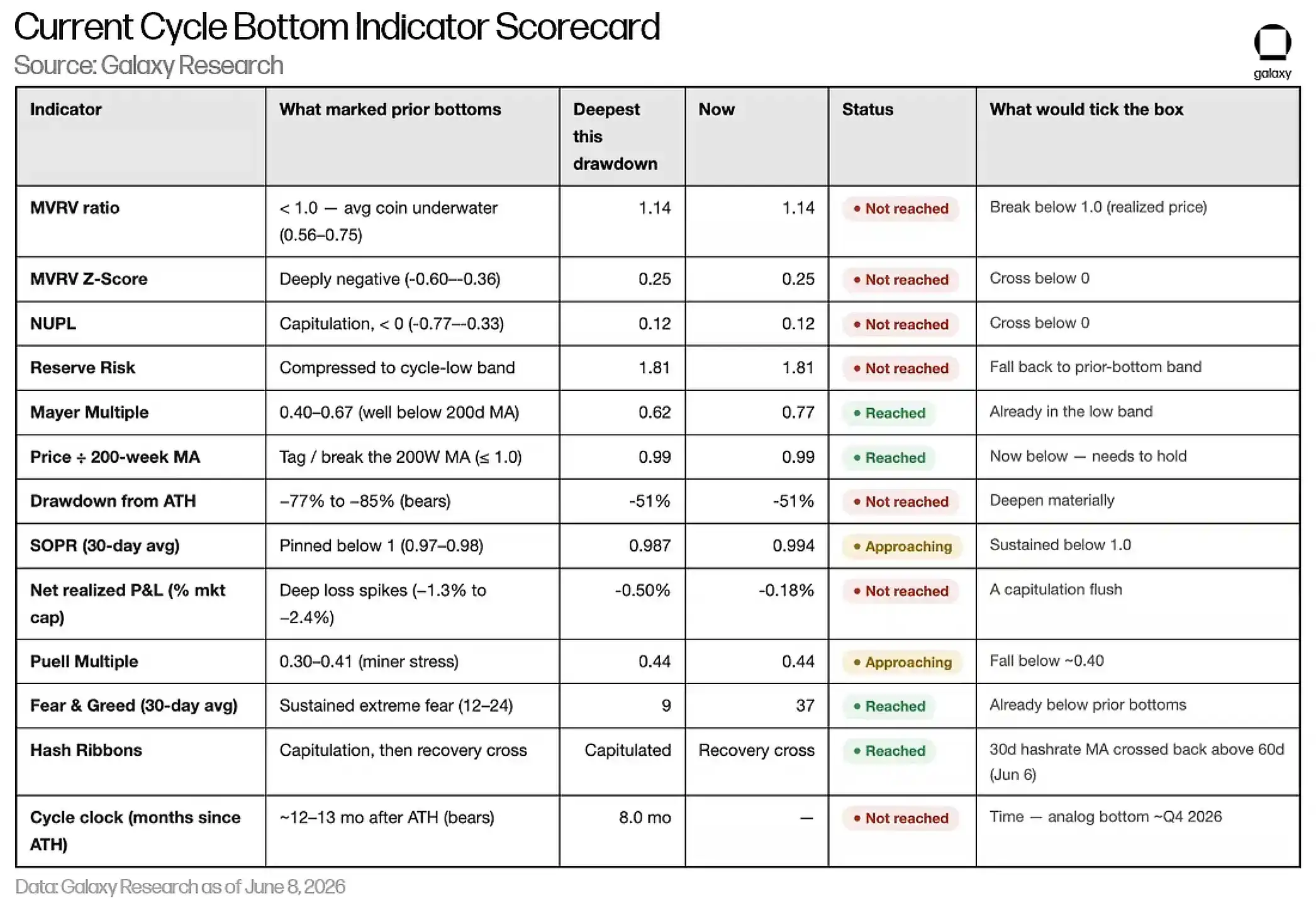
Galaxy Digital reviewed Bitcoin's complete 17-year price history and summarized 13 indicators that tend to appear simultaneously when the market truly bottoms out. These indicators cover six dimensions: valuation, profit-taking sell-offs, miner pressure, trend, bull/bear cycles, and market sentiment. Long-term Bitcoin investors will be familiar with these indicators, including the 200-week moving average, the Fear & Greed Index, and the Mayer Multiple.

Galaxy found that currently only 4 indicators are fully met, 2 are partially met, and the remaining 7 have not triggered bottom signals. The report concludes that Bitcoin's bottom range for this cycle is between $30,000 and $54,000, with a neutral baseline bottom between $40,000 and $46,000.
NYDIG

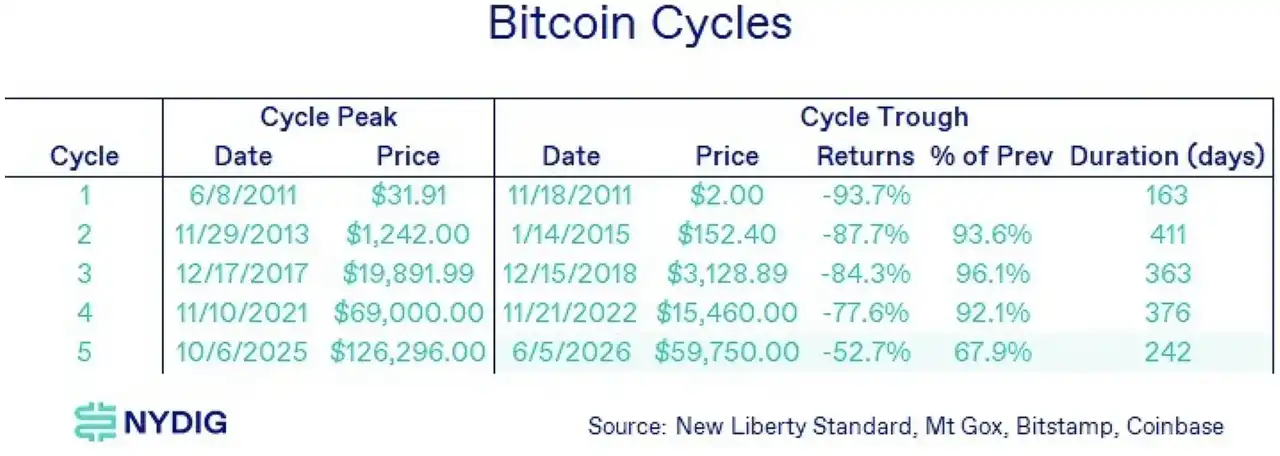
NYDIG also employs a multi-indicator comprehensive analysis framework, comparing the current market with historical cycles and evaluating the market state from dimensions such as the duration of the maximum drawdown and holder profit/loss (known to Bitcoin users as 'MVRV', the ratio of market capitalization to realized value).

NYDIG believes that current indicators are very close to the extreme ranges seen at historical major bottoms, but the hallmark comprehensive panic sell-off seen in previous major bear markets has not yet occurred. At the same time, the report introduces a variable: institutional capital inflows have fundamentally changed Bitcoin's cycle logic from the ground up. This cycle's correction might be shallower than historical bear markets. From this perspective, the bottom may have already occurred.
Standard Chartered

Standard Chartered is not uniformly bullish on Bitcoin. Back in February when Bitcoin was at $67,000, the bank lowered its full-year price forecast, warning that prices could fall to $50,000, citing weaker macroeconomics and continuous selling pressure from Bitcoin ETFs.

However, last Friday Standard Chartered updated its view, identifying $59,000 as the bottom for this price action. The two main logics supporting this view are: the potential for a U.S. diplomatic agreement with Iran; and the highly anticipated SpaceX IPO. Standard Chartered believes that a significant number of ETF holders sold Bitcoin earlier to raise funds for participating in SpaceX's listing, and this selling pressure will gradually subside. Standard Chartered's latest forecast is that Bitcoin will challenge $100,000 within the year.

The Consensus Among the Three Reports Far Outweighs the Divergence

You might wonder what effective information can be extracted from three reports with completely opposing views. In fact, the underlying consensus among the three reports far outweighs the surface divergence. For long-term investors, the conclusions on which they agree are far more valuable than their disagreements:

  • All three judge that the market bottom for this cycle will occur within this year;
  • All three believe the current price is closer to the bottom than to the previous highs;
  • All three are consistently optimistic that Bitcoin will experience another bull market in the future.

At the time of writing, Bitcoin's price is around $67,000. One report claims the $59,000 bottom has already occurred, one sees a potential drop to $50,000, and another gives a neutral baseline bottom of $43,000. But the core conclusion is highly unified: the bottom will definitely be reached this year.

This is the key point long-term investors should focus on most. Whether the bottom lands at $40,000, $50,000, or $60,000, the difference is actually limited; what truly matters is whether Bitcoin can subsequently surge to $100,000, $200,000, or even a million dollars. As long as it reaches those levels, entering a long-term position at current prices offers considerable profit potential.

A highly ironic phenomenon in the current market is that everyone is obsessing over whether the market has bottomed, while overlooking a more important question—whether the top has already appeared. In my view, as long as the peak has not yet arrived, Bitcoin holds value for long-term allocation.

The core logic supporting Bitcoin's long-term value not only remains intact but is continuously strengthening: government debt continues to accumulate worldwide with no effective solution in sight; inflation constantly erodes the real purchasing power of wealth; public trust in centralized institutions like governments and banks continues to decline; the global digitalization process keeps accelerating; Bitcoin's trading and investment channels are continuously improving; the early crypto-native generation is aging, with their assets and industry influence growing simultaneously.

Of course, potential risks remain in the market, including threats from quantum computing and tightening global regulation. But overall, the current situation is better than during any previous crypto winter.


Perguntas relacionadas

QWhat are the three different views on whether the crypto market has bottomed, according to the research reports mentioned in the article?

AGalaxy Digital believes Bitcoin has not yet bottomed. NYDIG sees a possibility but thinks it's unlikely. Standard Chartered Bank states the market bottom has already occurred.

QWhat is the core logical framework Galaxy Digital uses to assess if the market has bottomed?

AGalaxy Digital uses a framework of 13 indicators across six dimensions: valuation, profit-taking sales, miner stress, price trends, bull/bear cycles, and market sentiment, such as the 200-week moving average, Fear & Greed Index, and Mayer Multiple.

QWhat specific price range does Galaxy Digital identify as the potential bottom for Bitcoin in this cycle?

AGalaxy Digital identifies the potential bottom range for Bitcoin as $30,000 to $54,000, with a neutral base case bottom of $40,000 to $46,000.

QWhat key reason does Standard Chartered Bank give for reversing its earlier bearish view and now claiming the bottom has been reached?

AStandard Chartered Bank's reversal is based on two key logics: the potential for a US diplomatic agreement with Iran, and the anticipated SpaceX IPO, which they believe caused selling pressure from ETF holders that is expected to subside.

QDespite their differing views on the exact bottom, what major consensus do all three research reports share?

AAll three reports agree that the market bottom will occur within the current year, that current prices are closer to the bottom than the previous highs, and that Bitcoin will experience a new bull market in the future.

Leituras Relacionadas

Blood Loss of $55 Million Selling 3,588 BTC, Strategy Becomes a Literal Scumbag

On July 6th, Strategy (formerly MicroStrategy) disclosed in an SEC filing that it sold 3,588 Bitcoin (BTC) between June 29th and July 5th for approximately $216 million, at an average price of ~$60,200. This marked the company's largest net sale since initiating its Bitcoin strategy in 2020 and its first institutionalized reduction of its core holding. The sale resulted in a realized loss of about $54.8 million, as the selling price was below its average cost basis of ~$75,476 per BTC. The proceeds were used to pay preferred stock dividends and replenish USD reserves. This move follows a new "Digital Credit Capital Framework" approved on June 29th, authorizing the sale of up to $1.25 billion in Bitcoin. The sale consumes roughly 17% of this authorized amount in its first week. Strategy's foundational narrative, built by founder Michael Saylor, was a commitment to "never sell" Bitcoin. The recent institutionalized selling framework and these substantial sales represent a significant shift from that original promise. While the amount sold is only 0.4% of Strategy's total holdings of 843,775 BTC, the action challenges the premium at which its stock (MSTR) trades relative to its Bitcoin holdings. Investors had priced in the "never sell" narrative. The company now faces a contradiction: it sells Bitcoin at a loss to pay dividends on the preferred stock it issued to fund Bitcoin purchases. Saylor has framed selling as a tool for future strategic purchases, but each sale erodes the credibility of the original commitment, potentially threatening the premium valuation of MSTR shares.

Foresight NewsHá 55m

Blood Loss of $55 Million Selling 3,588 BTC, Strategy Becomes a Literal Scumbag

Foresight NewsHá 55m

Dialogue with Yihui Capital, SoundAI Technology, Ling Universe, and Zhongbo Jili: Opportunities and Challenges in the AI Smart Hardware Track

On June 28, 2026, an event titled "New Opportunities in AI Hardware: The Battle for Interactive Entry Points Begins" was held in Beijing. It featured a report from ITJuzi and discussions with experts from SoundAI, Ling Universe, One Reed Capital, and Zhongbo Juli on the opportunities and challenges in China's AI hardware sector. Key report findings highlight the sector's intense activity: 327 out of 431 startups founded post-2023 have secured funding, with 179 investments in H1 2026 alone. The landscape is dominated by embodied intelligent robots, while wearable tech like smart rings and AI glasses shows rapid growth. Geographically, Shenzhen leads, leveraging its superior hardware supply chain, followed by Beijing and Shanghai. The overarching trend is for companies to focus on micro-innovations within specific scenarios rather than reinventing foundational technology. Industry leaders shared several critical insights: 1. **Balancing Innovation & Market Readiness**: Entrepreneurs face the "hammer looking for a nail" dilemma. Success requires balancing technical capability with user acceptance, cost control, and incremental design improvements rather than chasing disruptive innovation. 2. **Competitive Landscape**: The future interactive entry point may not be a single super-device but a mix of universal terminals and specialized, scenario-specific hardware. While large companies have ecosystem advantages, startups can win by deeply targeting vertical markets and specific user groups. 3. **Core Challenges & Business Models**: Key hurdles include deep understanding of AI models and navigating non-transparent hardware supply chains. Viable business models may involve selling hardware at cost and generating revenue through software subscriptions, but this requires tight control over both hardware BOM and model inference costs. 4. **The Road to Commercialization**: The ultimate test is market validation—achieving sales growth and sustainable cash flow. Companies must find the right application scenario, use edge computing effectively, and close the loop from technology to commercial success. 5. **The Future of Interaction**: Proactive, context-aware interaction is the next frontier, though it's currently limited by issues like model hallucinations and environmental perception. The near-term focus should be on identifying target users and creating a coherent experience in specific domains, such as health wearables. In summary, to succeed in the competitive AI hardware arena, companies must strategically choose their niche, build a team with the right geographical advantages (e.g., leveraging Shenzhen's supply chain), and most importantly, execute a flawless commercialization strategy that translates technology into market-accepted products and sustainable business growth.

marsbitHá 1h

Dialogue with Yihui Capital, SoundAI Technology, Ling Universe, and Zhongbo Jili: Opportunities and Challenges in the AI Smart Hardware Track

marsbitHá 1h

Trading

Spot
活动图片