Author: Matt Hougan, Chief Investment Officer, Bitwise
Compiled by: Chopper, Foresight News
Over the past two weeks, three crypto research institutions I follow closely—other than Bitwise—have all published in-depth reports addressing the same question: Has the crypto market bottomed?
- Galaxy Digital: Bitcoin Has Not Bottomed, Data Points to a Potential Bottom Range
- NYDIG: What Factors Are Suppressing Bitcoin's Price Action
- Standard Chartered: The Market Bottom Has Already Occurred
These three reports are comprehensive, containing vast amounts of data and complete logical reasoning, and are worth reading in full. However, if you are looking for a simple, unified answer, you might be disappointed: the judgments given by these three authoritative institutions are completely different.
Has the Market Bottomed?
- Galaxy Digital: No
- NYDIG: Possibly, but unlikely
- Standard Chartered: Already bottomed
Let's now break down the core logic of each institution one by one.
Three Institutions, Three Views
Galaxy Digital
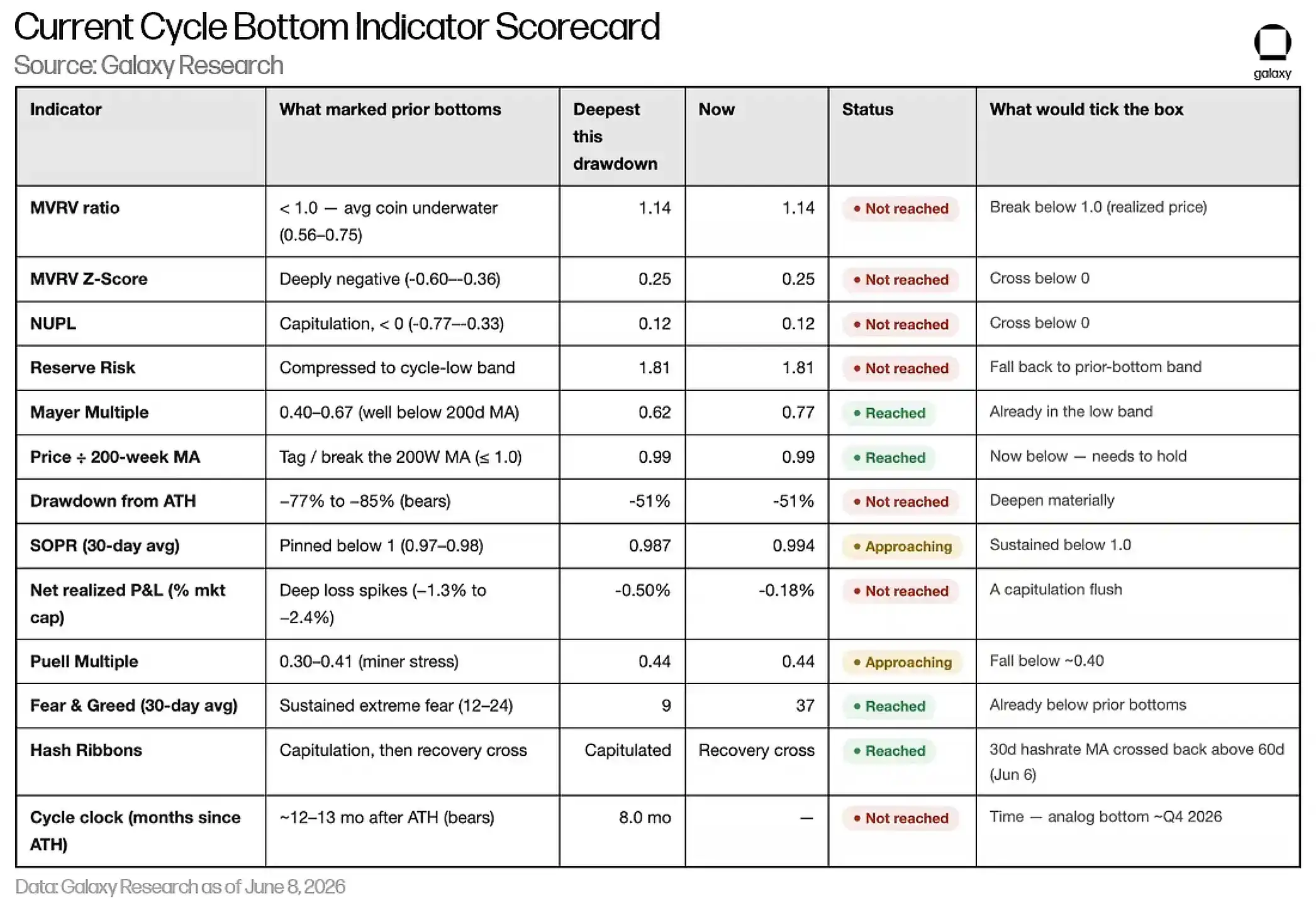
Galaxy Digital reviewed Bitcoin's complete 17-year price history and summarized 13 indicators that tend to appear simultaneously when the market truly bottoms out. These indicators cover six dimensions: valuation, profit-taking sell-offs, miner pressure, trend, bull/bear cycles, and market sentiment. Long-term Bitcoin investors will be familiar with these indicators, including the 200-week moving average, the Fear & Greed Index, and the Mayer Multiple.
Galaxy found that currently only 4 indicators are fully met, 2 are partially met, and the remaining 7 have not triggered bottom signals. The report concludes that Bitcoin's bottom range for this cycle is between $30,000 and $54,000, with a neutral baseline bottom between $40,000 and $46,000.
NYDIG
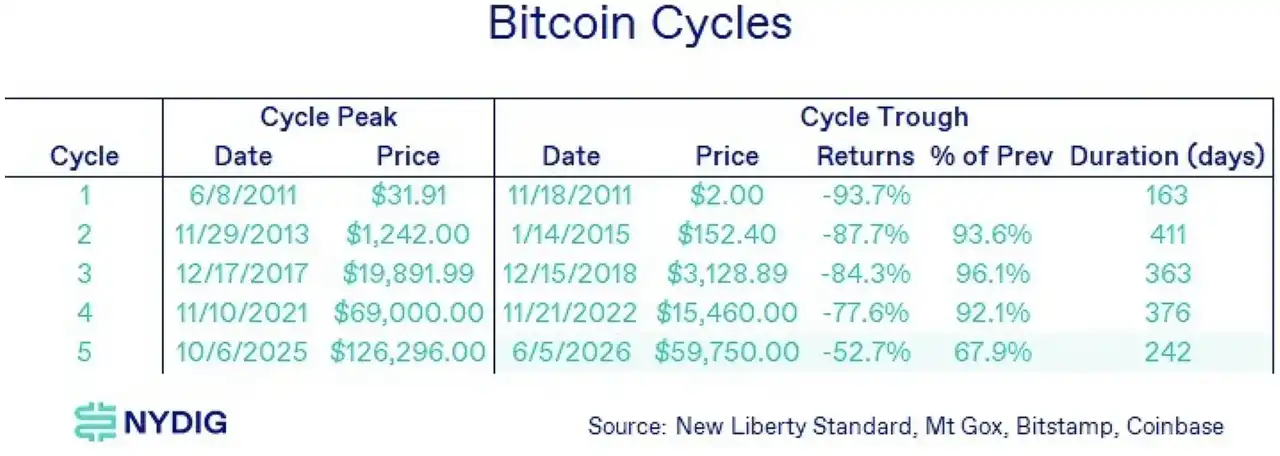
NYDIG also employs a multi-indicator comprehensive analysis framework, comparing the current market with historical cycles and evaluating the market state from dimensions such as the duration of the maximum drawdown and holder profit/loss (known to Bitcoin users as 'MVRV', the ratio of market capitalization to realized value).
NYDIG believes that current indicators are very close to the extreme ranges seen at historical major bottoms, but the hallmark comprehensive panic sell-off seen in previous major bear markets has not yet occurred. At the same time, the report introduces a variable: institutional capital inflows have fundamentally changed Bitcoin's cycle logic from the ground up. This cycle's correction might be shallower than historical bear markets. From this perspective, the bottom may have already occurred.
Standard Chartered
Standard Chartered is not uniformly bullish on Bitcoin. Back in February when Bitcoin was at $67,000, the bank lowered its full-year price forecast, warning that prices could fall to $50,000, citing weaker macroeconomics and continuous selling pressure from Bitcoin ETFs.
However, last Friday Standard Chartered updated its view, identifying $59,000 as the bottom for this price action. The two main logics supporting this view are: the potential for a U.S. diplomatic agreement with Iran; and the highly anticipated SpaceX IPO. Standard Chartered believes that a significant number of ETF holders sold Bitcoin earlier to raise funds for participating in SpaceX's listing, and this selling pressure will gradually subside. Standard Chartered's latest forecast is that Bitcoin will challenge $100,000 within the year.
The Consensus Among the Three Reports Far Outweighs the Divergence
You might wonder what effective information can be extracted from three reports with completely opposing views. In fact, the underlying consensus among the three reports far outweighs the surface divergence. For long-term investors, the conclusions on which they agree are far more valuable than their disagreements:
- All three judge that the market bottom for this cycle will occur within this year;
- All three believe the current price is closer to the bottom than to the previous highs;
- All three are consistently optimistic that Bitcoin will experience another bull market in the future.
At the time of writing, Bitcoin's price is around $67,000. One report claims the $59,000 bottom has already occurred, one sees a potential drop to $50,000, and another gives a neutral baseline bottom of $43,000. But the core conclusion is highly unified: the bottom will definitely be reached this year.
This is the key point long-term investors should focus on most. Whether the bottom lands at $40,000, $50,000, or $60,000, the difference is actually limited; what truly matters is whether Bitcoin can subsequently surge to $100,000, $200,000, or even a million dollars. As long as it reaches those levels, entering a long-term position at current prices offers considerable profit potential.
A highly ironic phenomenon in the current market is that everyone is obsessing over whether the market has bottomed, while overlooking a more important question—whether the top has already appeared. In my view, as long as the peak has not yet arrived, Bitcoin holds value for long-term allocation.
The core logic supporting Bitcoin's long-term value not only remains intact but is continuously strengthening: government debt continues to accumulate worldwide with no effective solution in sight; inflation constantly erodes the real purchasing power of wealth; public trust in centralized institutions like governments and banks continues to decline; the global digitalization process keeps accelerating; Bitcoin's trading and investment channels are continuously improving; the early crypto-native generation is aging, with their assets and industry influence growing simultaneously.
Of course, potential risks remain in the market, including threats from quantum computing and tightening global regulation. But overall, the current situation is better than during any previous crypto winter.