Hardcore Breakdown of Polymarket's Fee Formula: How Did the Extreme Rate of 90+% Pop Up?

Odaily星球日报Publicado em 2026-04-01Última atualização em 2026-04-01

Resumo

Polymarket, a prediction market platform, recently faced backlash due to unexpectedly high transaction fees, with some users reporting fees as extreme as 94.8%. The issue stemmed from a temporary change in the fee calculation formula. The platform initially used an "old formula": fee = C × p × feeRate × (p × (1 - p))^exponent. However, a brief update to an "abnormal formula" removed a critical "× p" term, becoming: fee = C × feeRate × (p × (1 - p))^exponent. Since share prices (p) are always less than $1, this omission drastically increased fees, especially for very low-priced shares (near $0.001), as the fee was no longer scaled by the price. An exponent value of 0.5 in certain markets ("Weather" and "Economy") further exacerbated the curve, leading to the extreme rates. Polymarket quickly responded by implementing a "new formula": fee = C × feeRate × p × (1 - p), effectively setting the exponent to 1. This change significantly reduced fees, particularly for extreme price points, bringing maximum fees down to around 5%. The article advises users to avoid high fees by using limit orders (which are free and even offer a 20-25% maker rebate) or the platform's "Split" function to indirectly establish positions instead of market orders.

Original | Odaily Planet Daily (@OdailyChina)

Author | Azuma (@azuma_eth)

Polymarket suddenly found itself in a fee controversy.

Last night, multiple community users discovered that they were charged abnormally high fees when trading on Polymarket, resulting in significantly reduced actual shares received or profits compared to before.

An overseas user, Frosen(@frosen), even posted a screenshot showing that when trying to place an order for 100 shares at a price of 0.1 cent in an "Economy" market, the potential winning profit displayed on the Polymarket frontend was only $5.2 (normally it should be $100) — corresponding to an outrageous fee rate of 94.8%!
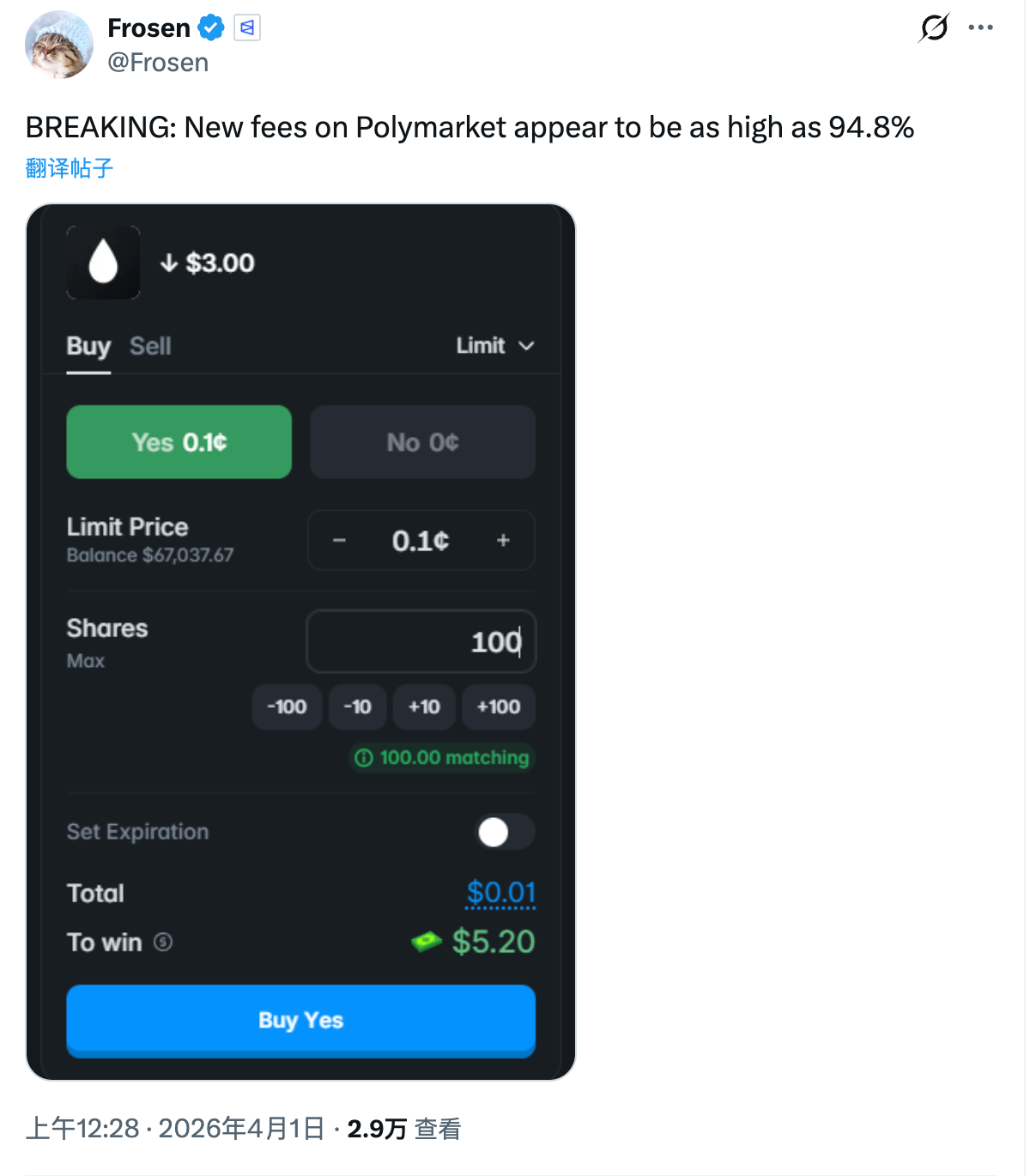
What's going on? Is Polymarket that desperate for money? According to official disclosures from Polymarket and community investigations, Odaily found that the direct cause of this unexpected situation is that Polymarket modified the platform's fee formula last night.

In short, Polymarket changed the formula versions three times last night:

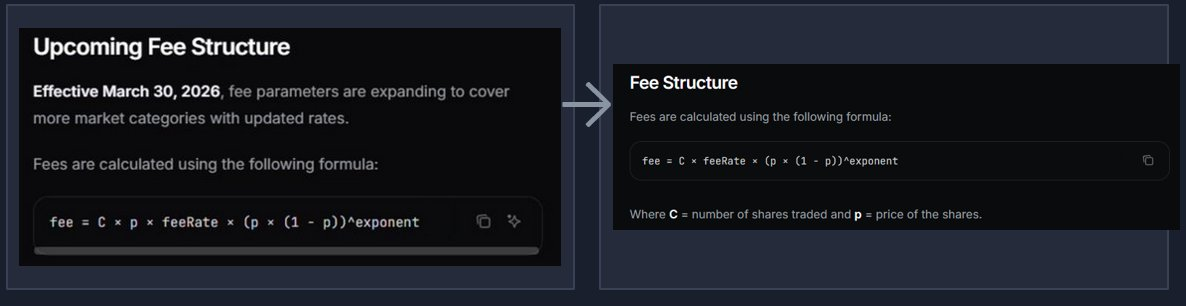
  • First, the "Old Formula": fee = C × p × feeRate × (p × (1 - p))^exponent;
  • Then the first change, the formula that caused the unexpected situation (referred to as the "Anomalous Formula"): fee = C × feeRate × (p × (1 - p))^exponent;
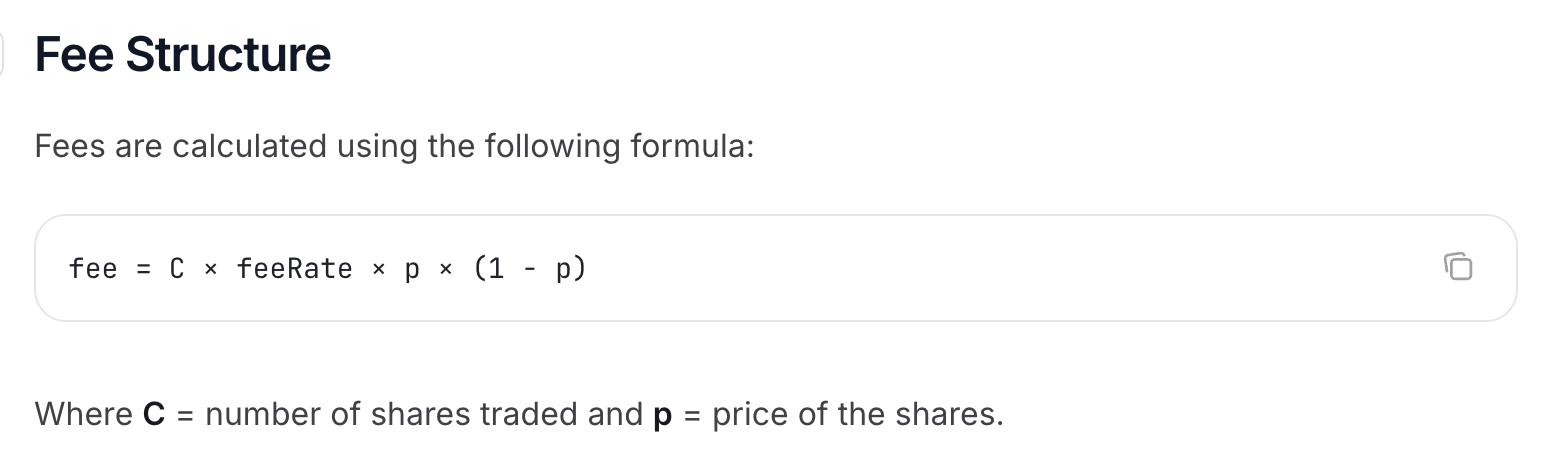
  • After realizing the issue, Polymarket made a correction, resulting in the current version's "New Formula": fee = C × feeRate × p × (1 - p);
  • It's important to note that in all three formulas, C refers to the number of shares traded, p refers to the price of the shares traded, and feeRate and exponent are variables.
Deconstructing the Anomalous Formula: How Did the Outrageous 94.8% Fee Rate Happen?

You don't need to worry too much about the mathematical details. By comparing the "Old Formula" and the "Anomalous Formula," you can simply see that the latter only removed a " × p" (this is the multiplication symbol, not a lowercase X) compared to the former, meaning it ultimately multiplied by the share price one less time.

Since the price of all shares on Polymarket is always less than $1, this would inevitably cause the overall fee to increase. The lower the share price, the more pronounced the increase in the fee due to one less multiplication — when the share price is close to 0, it could lead to very absurd fee rates.

As for how outrageous this fee could become, it also depends on the variable ^exponent, which exists in both the old and anomalous formulas. ^exponent directly translates to "raised to the power of exponent"; this variable is mainly used to control the steepness of the fee curve.

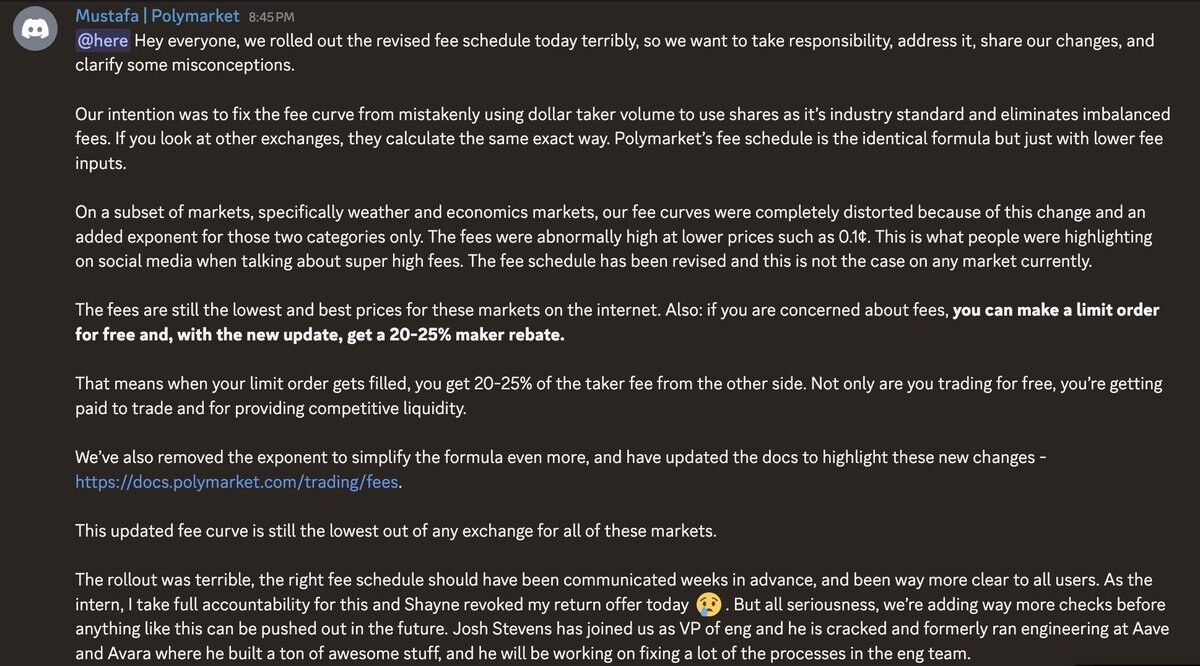
According to Mustafa, an official from Polymarket, the anomalous formula last night only introduced the exponent in the "Weather" and "Economy" market categories (other markets could ignore this variable by setting the parameter to 1). Furthermore, according to disclosures by overseas KOL Quant Chad(@Autonomous_Chad), the exponent parameter set for these two major markets at the time was 0.5.
Now, back to Frosen's case, plug the corresponding numbers into the anomalous formula: fee = C × feeRate × (p × (1 - p))^exponent. It is known that C equals 100, meaning Frosen wanted to order 100 shares; p equals 0.001, i.e., $0.001 (0.1 cent); exponent equals 0.5, meaning perform an exponentiation operation on (p × (1 - p)); the final fee rate is 94.8%.

Throwing this directly to AI allows us to inversely deduce that the feeRate level at the time was 0.03, and also reconstruct the detailed formula calculation Polymarket performed for this order.
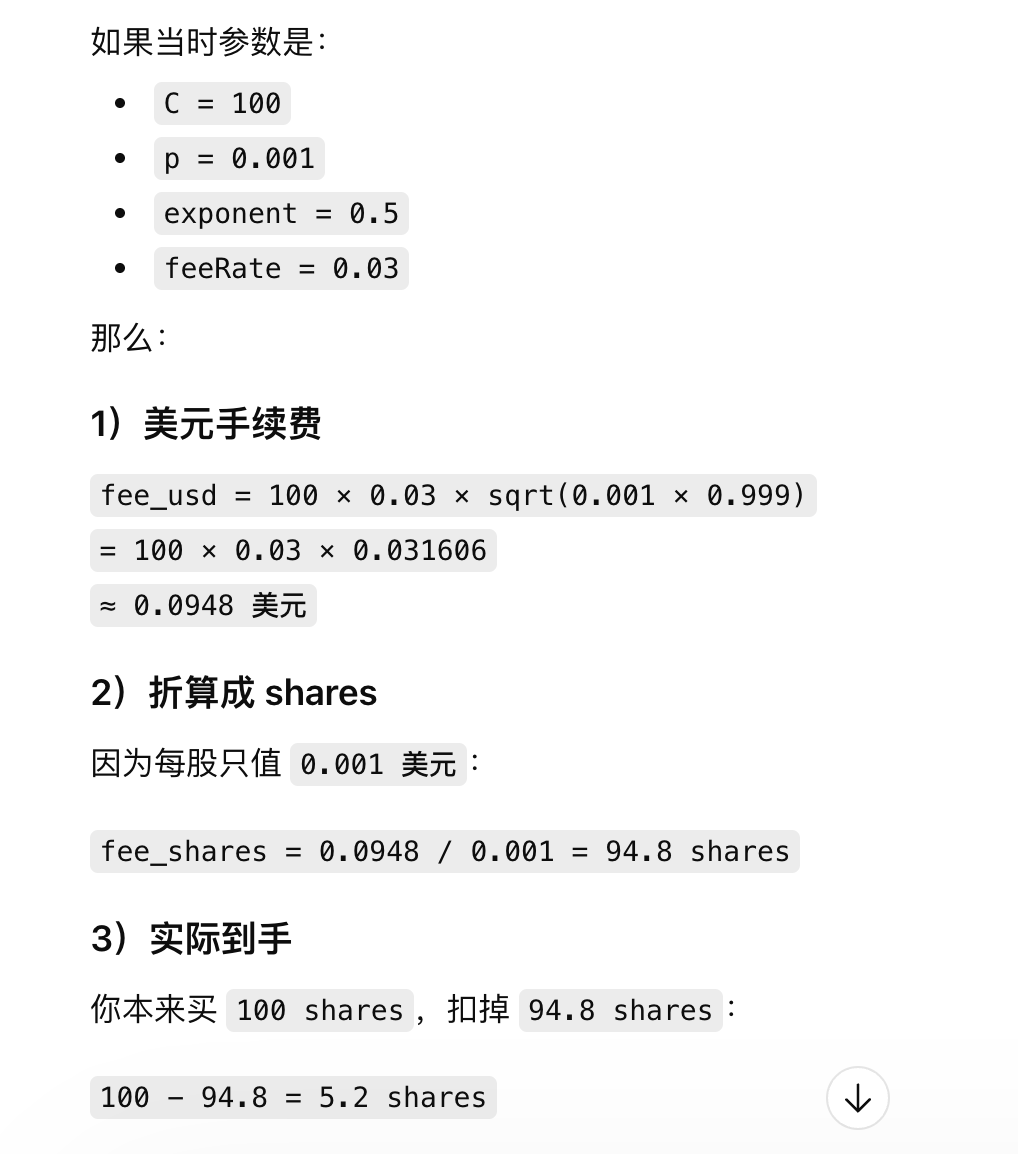
Simply put, based on the anomalous formula, Polymarket calculated that the fee for this order should be $0.0948. Since Polymarket deducts fees for buy orders by directly deducting the corresponding value in shares, and the share price at the time was only $0.001, it meant deducting 94.8 shares. Therefore, Frosen ultimately received only 5.2 shares, and even if the prediction was correct, the potential profit would only be $5.2.

Polymarket's Remedial Measures

Shortly after the abnormal fee issue emerged, Polymarket quickly responded by changing the formula to the current version: fee = C × feeRate × p × (1 - p). Compared to the anomalous formula, the new formula removed the "^exponent" — essentially, it increased the exponent parameter in the anomalous formula fee = C × feeRate × (p × (1 - p))^exponent from 0.5 to 1.

In the anomalous formula, the effect of ^exponent was to perform an exponentiation operation on the data set p × (1-p). In the actual operational context of Polymarket, the theoretical result range of p × (1 - p) is between "0.000999 - 0.25" — the closer p is to 0.5 (share price closer to $0.5), the closer this data set is to 0.25; the closer p is to 0 or 1 (share price closer to $0 or $1, with extremes at $0.001 and $0.999), the closer this data set is to 0.000999.

Within the range of "0.000999 - 0.25", regardless of the value taken, when the exponent parameter is increased from 0.5 to 1, it directly reduces the final fee result in the formula operation, i.e., lowers the overall fee.

More importantly, this reduction has a more pronounced inhibitory effect on the abnormally high fee rates near extreme low prices — when p × (1-p)=0.000999, the fee under the new formula is only about 3.16% of the fee under the anomalous formula, equivalent to a reduction of about 96.84%; whereas when p × (1-p)=0.25, the fee under the new formula is 50% of that under the anomalous formula.

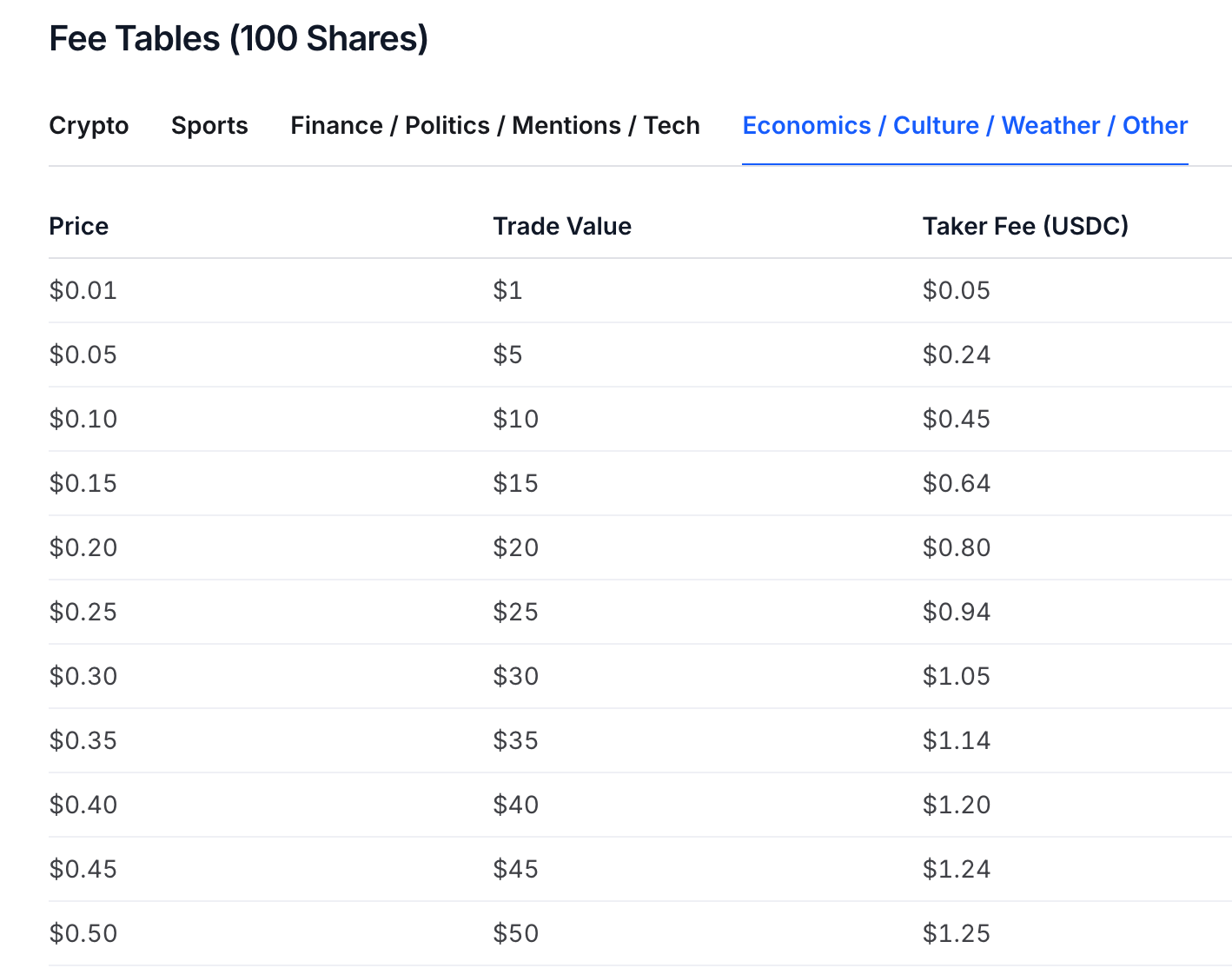
As shown in Polymarket's official documentation, after the new formula was implemented, the fee rate at extremes in the "Weather" and "Economy" market categories has now been reduced to 5%.
How Can Retail Users Avoid Fees?

I know most users can't be bothered to look at the formulas above but are still concerned about Polymarket's current fee issues.

Regarding this, Mustafa mentioned in the official Discord: "If you are worried about fees, you can place limit orders for free, and after this new update, you can also get a 20%-25% maker rebate — this means that when your limit order is filled, you will receive 20%-25% of the taker fee paid by the counterparty. So not only are you trading for free, but you can even get paid by trading and providing competitive liquidity."

So change your habits. Try to avoid taking orders directly. Switch to using limit orders more often. You can also try using Polymarket's Split function more to indirectly build a position by placing a reverse limit order to sell the other side of shares.


Perguntas relacionadas

QWhat was the direct cause of the unusually high fees on Polymarket as described in the article?

AThe direct cause was a modification to Polymarket's fee formula. The platform changed to an 'abnormal formula' which removed a '× p' (multiplication by the price) from the previous formula, causing fees to increase significantly, especially for shares with prices near zero.

QWhat was the specific 'abnormal formula' that caused the issue, and how did it differ from the old one?

AThe 'abnormal formula' was: fee = C × feeRate × (p × (1 - p))^exponent. It differed from the old formula (fee = C × p × feeRate × (p × (1 - p))^exponent) by removing one multiplication by the share price (× p).

QHow did the 'exponent' parameter in the formula contribute to the extreme 94.8% fee rate in the user Frosen's case?

AThe exponent parameter, set to 0.5 for 'Weather' and 'Economics' markets, made the fee curve steeper. For a share price (p) of $0.001, the calculation (p × (1 - p))^0.5 resulted in a very high fee, which when deducted from the low-value shares, led to the effective 94.8% rate.

QWhat is the new, corrected fee formula that Polymarket implemented after the incident?

AThe new formula is: fee = C × feeRate × p × (1 - p). This is equivalent to setting the exponent parameter to 1 in the previous abnormal formula structure, which significantly reduces fees, especially for shares with extreme prices.

QWhat advice does the article give to users who want to avoid paying high fees on Polymarket?

AThe article advises users to place free limit orders instead of market orders. Additionally, users can utilize Polymarket's Split function to indirectly build a position by placing a limit order to sell the other side of the trade. Limit orders also qualify for a 20%-25% maker rebate on the taker's fee.

Leituras Relacionadas

Qualcomm Chip Price Hike Deals a Blow to Android Phones

Qualcomm has officially announced a new round of price increases for its entire chip portfolio, effective September 1. The hikes, reaching up to 18% for the flagship Snapdragon 8 Elite Gen 6 Pro, follow similar moves by MediaTek, intensifying cost pressures on the already strained smartphone industry. CEO Cristiano Amon confirmed the plan, citing the need to offset rising industry-wide costs and restore declining profit margins. Qualcomm's Q3 FY2026 results showed a 25% drop in net profit, with mobile revenue plunging 20% year-over-year, hitting its lowest level since 2021. The surge in AI computing demand has led memory manufacturers to prioritize HBM production, creating a shortage in general-purpose DRAM and NAND Flash chips. Their prices soared by 93%-98% and 55%-60% respectively in Q1 2026, causing the memory cost share in smartphones to jump from 10%-15% to over 30%. Coupled with the soaring cost of advanced nodes like TSMC's 2nm and packaging, overall chip costs have reached historic highs. These upstream pressures are forcing downstream smartphone brands like Xiaomi, OPPO, and vivo to cut orders for mid-to-low-end models by up to 20% and use cost-saving measures like older chipsets. Reportedly, the Snapdragon 8E5 will be repurposed as a "long-lasting" chip for sub-brand phones in H2 2026. Amid this cost crisis, the Android market remains sluggish. Q2 2026 smartphone shipments in China fell 4.3% year-over-year, marking five consecutive quarters of decline. Major Android brands saw market share drop, while Huawei and Apple, with their in-house chip advantages, gained share. Qualcomm is diversifying into automotive and IoT sectors to reduce reliance on smartphones, but these new segments cannot yet fill the mobile revenue gap. Industry observers warn that the full impact of component cost hikes will hit in the second half of 2026, likely leading to higher-than-expected price increases for Android flagships and a further contraction in the Chinese smartphone market.

marsbitHá 54m

Qualcomm Chip Price Hike Deals a Blow to Android Phones

marsbitHá 54m

Breaking: GPT-5.6 Prices Slashed Effective Today

OpenAI has announced significant price cuts for its GPT-5.6 model API, effective immediately. The entry-level **GPT-5.6 Luna** sees the most drastic reduction, with input prices dropping 80% to $0.20 per million tokens and output prices falling to $1.20 per million tokens. The mid-tier **GPT-5.6 Terra** is reduced by 20%, now costing $2.00 (input) and $12.00 (output) per million tokens. The flagship **GPT-5.6 Sol** maintains its original price but introduces a new **Fast mode**, offering speeds up to 2.5 times faster for double the cost. The company attributes these price reductions to efficiency gains achieved through **GPT-5.6 Sol's own involvement in optimizing its production systems**. The model assisted in rewriting GPU kernels and improving speculative decoding, leading to a 20% reduction in end-to-end service costs and over 15% improvement in token generation efficiency. OpenAI emphasizes this process remained human-led. A key focus of the降价 is to lower the barrier for running **AI agent workflows**. By making the capable, tool-calling Luna model significantly cheaper, OpenAI aims to enable more frequent use in cost-sensitive, high-volume tasks like code review and monitoring. This creates a potential feedback loop: model-assisted efficiency gains lead to lower costs, which enables broader agent deployment, which in turn drives further optimization. The new pricing and features will also apply to Codex and ChatGPT Work subscriptions. The changes intensify competition in the large language model market, with OpenAI directly challenging rivals like Anthropic to respond.

marsbitHá 1h

Breaking: GPT-5.6 Prices Slashed Effective Today

marsbitHá 1h

Trading

Spot
活动图片