Hands-On Guide to Participating in CZ-Supported predict.fun

Odaily星球日报Publicado em 2025-12-19Última atualização em 2025-12-19

Resumo

Odaily Planet Daily introduces predict.fun, a prediction market platform founded by dingaling, a former Binance employee, and backed by CZ and YZi Labs. Launched on December 17, the platform airdropped initial points to eligible users, including BNB Chain meme traders and Aster participants. Unlike traditional prediction markets like Polymarket, predict.fun allows users to earn additional yield on funds used for predictions. The step-by-step guide includes: registering on the website, checking airdrop eligibility by wallet address, depositing at least $10 to unlock a referral link, sharing the invite on Twitter, verifying the tweet, and trading to unlock points (e.g., $500 trading volume for 200 points). Only event betting counts toward trading volume. The platform emphasizes user engagement and integrated yield generation.

Original | Odaily Planet Daily (@OdailyChina)

Author | Asher (@Asher_ 0210)

On December 17, dingaling, the founder of the prediction market platform predict.fun, announced on X that the platform is officially open and has airdropped initial points to Meme traders on BNB Chain, Aster participants, and active users of various prediction markets.
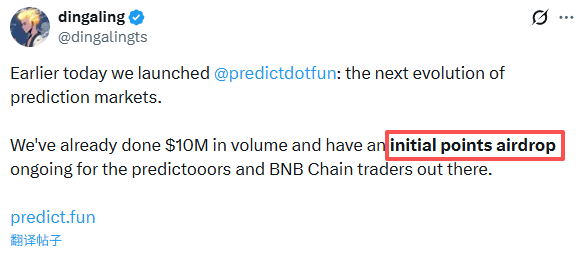
Unlike traditional prediction markets such as Polymarket and Kalshi, predict.fun has introduced a key innovation: funds used for predictions are no longer idle but can simultaneously generate additional returns during the prediction period.

It is worth mentioning that on December 4, Binance founder CZ posted on X, stating that the founder of predict.fun had worked at Binance several years ago and that the project was incubated by YZi Labs and received "investment" (for more details, read: CZ Reconciles and Joins Forces, dingaling Returns to the Prediction Trend with predict.fun).

Next, Odaily Planet Daily will guide you step-by-step through the interactive experience of participating in predict.fun.

Step-by-Step Participation Tutorial

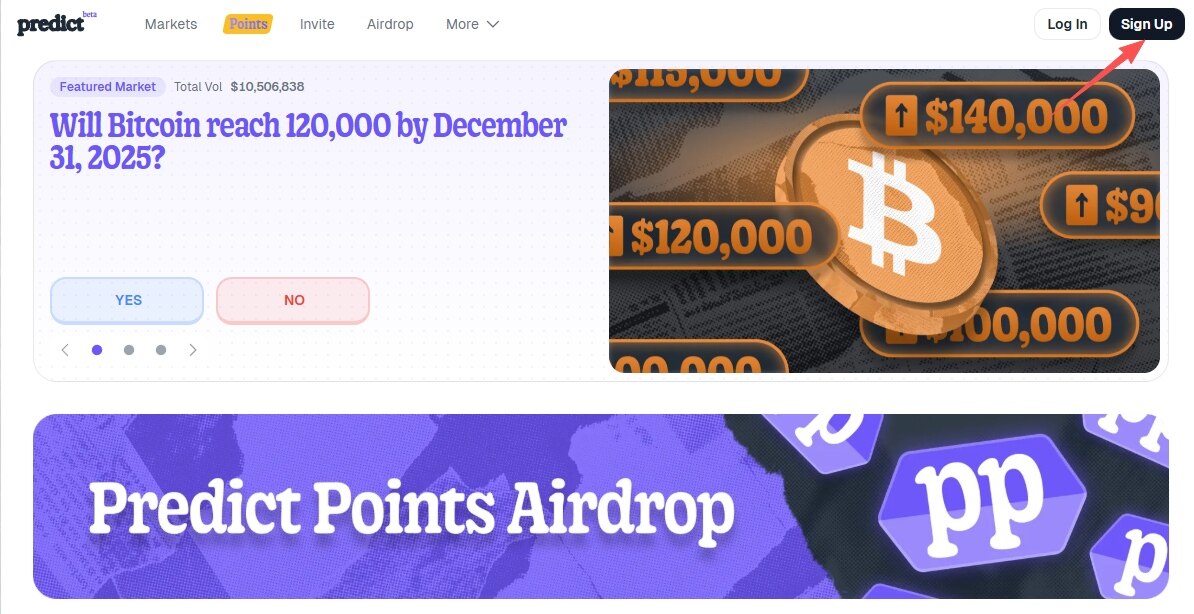
STEP 1. After logging into the project’s official website (link: https://predict.fun/), first-time users should click "Sign Up" to register and log in.
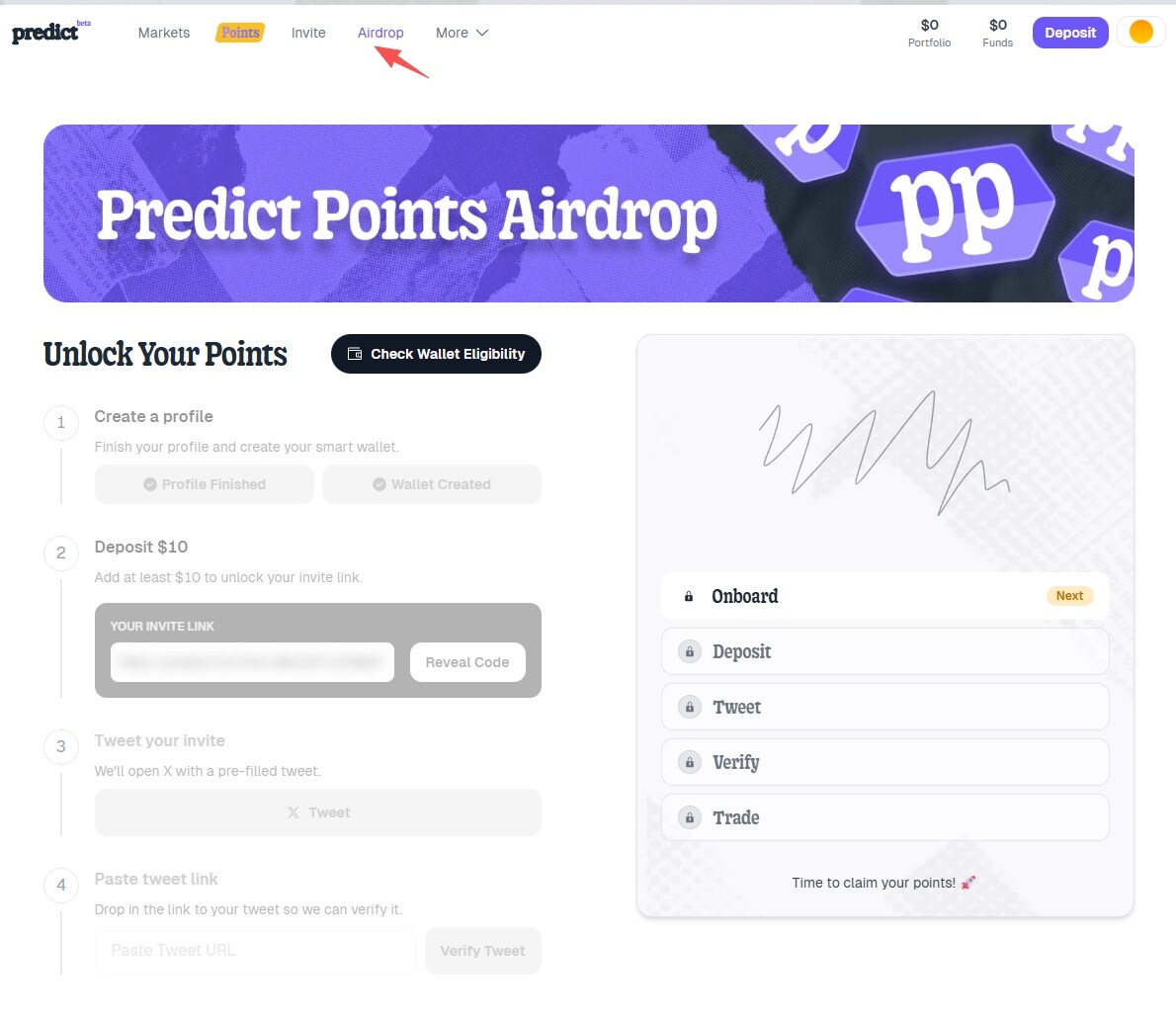
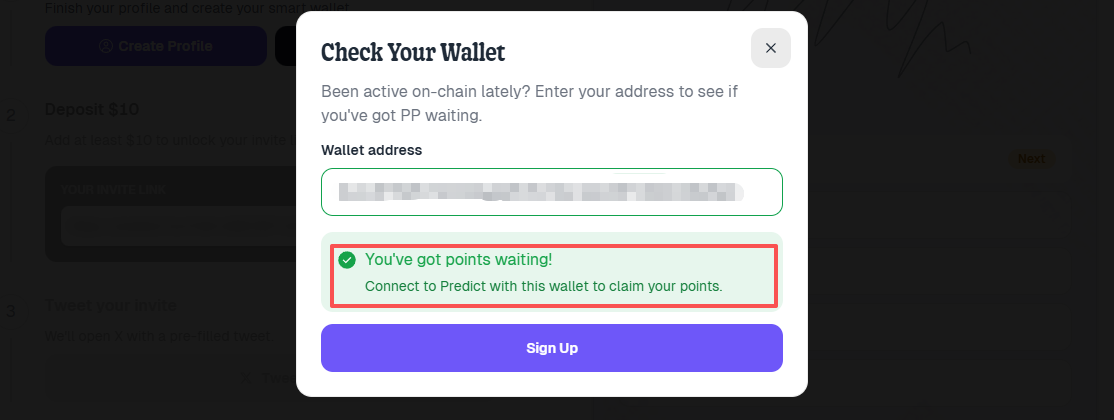
STEP 2. Click on "Airdrop" at the top to check airdrop eligibility: on the page, click "Check Wallet Eligibility" and enter your wallet address to view (as shown in the prompt below, indicating eligibility).
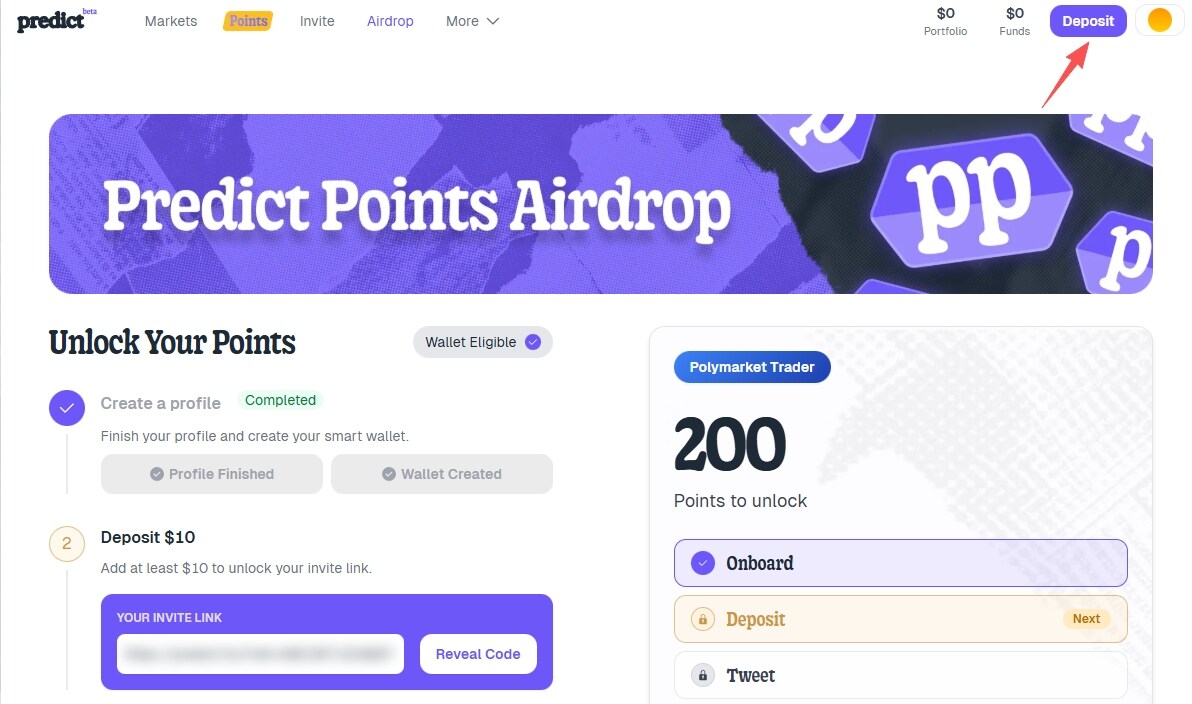
STEP 3. If eligible, click on "Deposit" at the top to deposit at least $10 into the platform and unlock your personal referral link.
STEP 4. Click "Tweet" in step 3 to share the referral tweet. The system will automatically generate a personal referral tweet, or you can edit the content yourself.
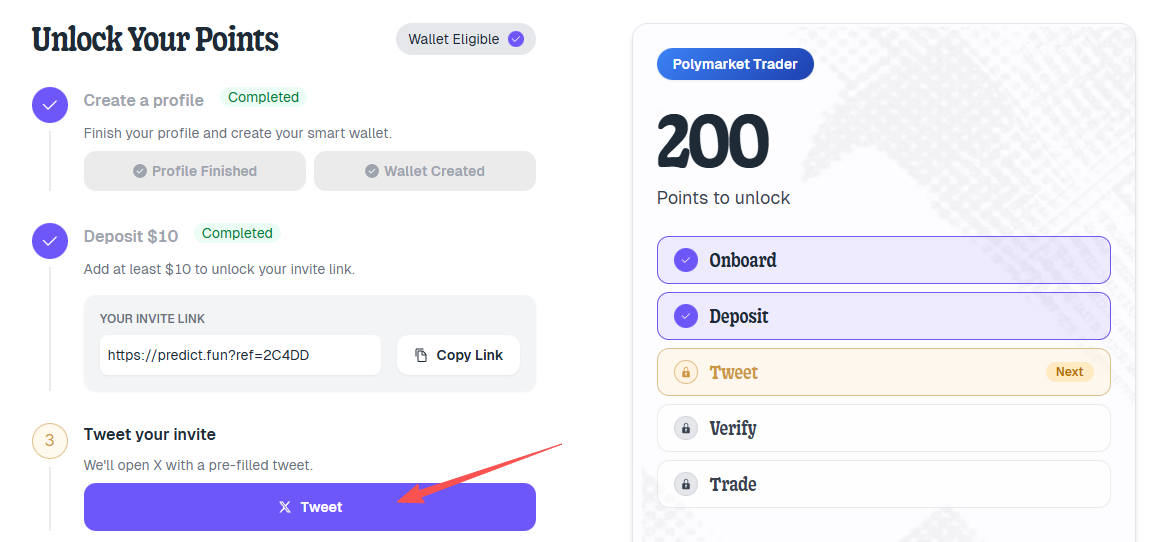
STEP 5. Fill in the link to the published referral tweet and click "Verify Tweet" to complete verification.

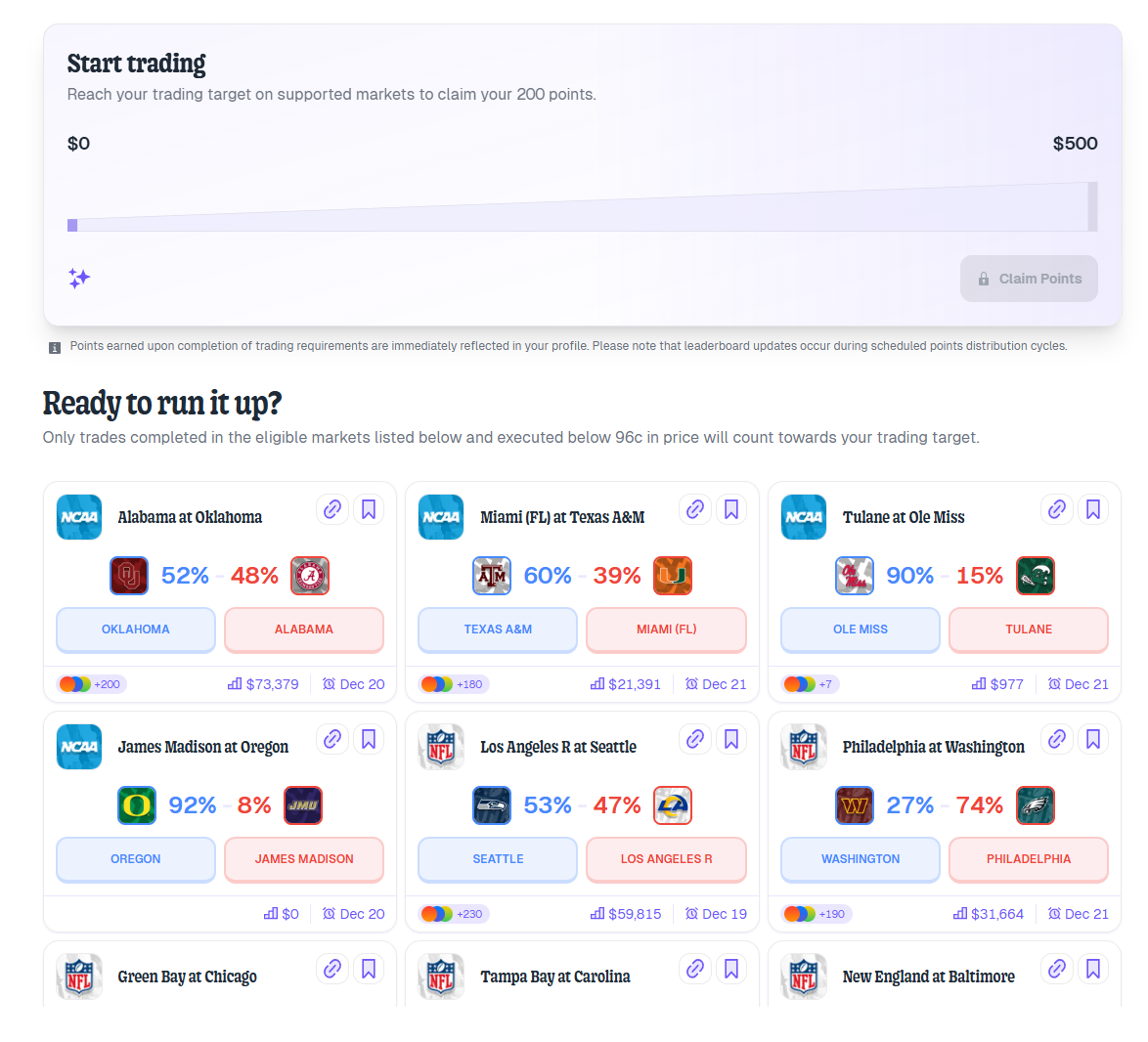
STEP 6. Unlock personal points by trading on the platform. As shown in the image, the account needs to complete $500 in trading volume to unlock 200 points. Note that only event-based bets count as valid trades.
Criptomoedas em alta

Perguntas relacionadas

QWhat is the key innovation of predict.fun compared to traditional prediction markets like Polymarket and Kalshi?

Apredict.fun allows users' funds to generate additional yields during the prediction period, unlike traditional platforms where funds remain idle.

QWho is the official launch of predict.fun announced by on X platform?

AThe official launch was announced by predict.fun's founder, dingaling, on the X platform.

QWhat is the minimum deposit required to unlock a personal referral link on predict.fun?

AA minimum deposit of at least $10 is required to unlock the personal referral link.

QWhich user groups received the initial airdrop of points from predict.fun?

AThe initial points airdrop was distributed to Meme traders on BNB Chain, Aster participants, and active users of various prediction markets.

QWhat is the relationship between CZ and predict.fun's founder as mentioned in the article?

ACZ mentioned that predict.fun's founder previously worked at Binance several years ago, and the project is incubated and invested in by YZi Labs.

Leituras Relacionadas

Sam Altman's ChatGPT Parenting Method Stirs Controversy

Sam Altman, CEO of OpenAI, recently faced significant backlash after sharing a concept for using ChatGPT to manage family life. He suggested feeding the AI family schedules and children's interests to generate a personalized morning podcast for car rides, covering topics from soccer games to birthdays alongside news for parents. The post, intended to showcase a "cool" AI application, was widely criticized online. Critics, including "Gravity Falls" creator Alex Hirsch, argued the idea undermined genuine parent-child interaction, with Hirsch's rebuttal—"You could just... talk to your kids?"—gaining far more engagement than Altman's original post. This incident highlights a perceived contradiction in Altman's persona, who has previously expressed the pain of missing time with his child while now proposing AI-mediated conversations. This is not Altman's first promotion of AI-assisted parenting; he has previously described using ChatGPT as a 24/7 parenting encyclopedia for newborn care questions. However, the latest suggestion—having AI script family conversations—crossed a line for many, shifting his image from an anxious new dad to primarily an OpenAI promoter. The controversy coincides with OpenAI's strategic push into the "family AI" space, as evidenced by hiring a family product manager and shifting user demographics toward older parents. While AI can efficiently manage schedules and information, the strong public reaction underscores the sensitivity of applying AI to core human relationships. Critics emphasize that AI should assist with logistical tasks to free up time for family, not replace the empathy, spontaneous connection, and shared experiences that define genuine caregiving. The debate points to crucial boundaries for AI in the home, where efficiency is less important than authentic human connection.

marsbitHá 11m

Sam Altman's ChatGPT Parenting Method Stirs Controversy

marsbitHá 11m

Just Now, OpenAI's Largest Pre-trained Model Doug Exposed

On August 9, X user ChrisGPT reported that OpenAI is advancing a new large-scale pre-training model codenamed **Doug**, which is said to be its largest such project to date and distinct from GPT-6. ChrisGPT later suggested GPT-6 is likely Astra, a model OpenAI recently paused due to safety concerns, with Doug potentially launching by November. This aligns with a July 9 research memo from SemiAnalysis, which stated OpenAI has overcome pre-training issues and is actively developing a much larger model codenamed Doug. If accurate, this signals a potential shift: after nearly two years of relying primarily on post-training, reinforcement learning (RL), and inference-time compute for capability gains—evidenced by models like o1, o3, and the GPT-5 system—OpenAI may be restarting large-scale foundational model scaling. The backdrop includes competitive pressure from Google's Gemini 3 release in November 2025, which reportedly prompted internal focus at OpenAI. In December 2025, The Information reported OpenAI was developing a pre-training model codenamed **Garlic**, which showed promising results and incorporated key bug fixes. This project reportedly paved the way for an "even bigger and better model"—likely Doug. In summary, Doug may represent OpenAI's return to significant base model scaling, building on resolved pre-training challenges and aiming to push capabilities beyond the limits of the current GPT-4o-era foundation enhanced by advanced post-training techniques.

marsbitHá 32m

Just Now, OpenAI's Largest Pre-trained Model Doug Exposed

marsbitHá 32m

OpenAI Researcher: We Don't Read Papers Anymore

An OpenAI researcher's remark that top AI labs "no longer read papers" sparked widespread discussion, highlighting a deepening crisis of trust in academic publishing. This sentiment followed exposure of questionable practices in an ICLR paper, where exceptional results were linked to undisclosed "tricks." A large-scale "experimental review" by SAI of 168 Oral papers from ICML 2026 revealed severe reproducibility issues. Of the 105 papers fully replicated, only 8 successfully verified over 80% of their claims, with a median verification rate of just 28-30%. Common problems included non-runnable code, missing files, incomplete documentation, and results mismatching those reported. Some papers even relied on now-offline models, making verification impossible. Specific cases involved an 8x inflation in claimed trained parameters and missing evaluation models from released code. Verifying a single ICML Oral paper had a median cost of around $8,900, with 17 exceeding $100,000. This creates a perverse incentive: flawed research carries high rewards (citations, jobs) with minimal risk of exposure, as verification is prohibitively expensive or impossible without code. While industry researchers at well-resourced labs may rely less on papers due to internal experiments and resources, academic and early-career researchers remain heavily dependent on publications for PhD applications, faculty positions, and entry into top labs. This creates a paradoxical system where papers are increasingly distrusted as reliable knowledge sources yet retain their gatekeeping value in career advancement. The situation underscores a critical need for systemic reforms to ensure scientific integrity and reproducibility in AI research.

marsbitHá 41m

OpenAI Researcher: We Don't Read Papers Anymore

marsbitHá 41m

Trading

Spot

Artigos em Destaque

Como comprar FUN

Bem-vindo à HTX.com!Tornámos a compra de FUNTOKEN (FUN) simples e conveniente.Segue o nosso guia passo a passo para iniciar a tua jornada no mundo das criptos.Passo 1: cria a tua conta HTXUtiliza o teu e-mail ou número de telefone para te inscreveres numa conta gratuita na HTX.Desfruta de um processo de inscrição sem complicações e desbloqueia todas as funcionalidades.Obter a minha contaPasso 2: vai para Comprar Cripto e escolhe o teu método de pagamentoCartão de crédito/débito: usa o teu visa ou mastercard para comprar FUNTOKEN (FUN) instantaneamente.Saldo: usa os fundos da tua conta HTX para transacionar sem problemas.Terceiros: adicionamos métodos de pagamento populares, como Google Pay e Apple Pay, para aumentar a conveniência.P2P: transaciona diretamente com outros utilizadores na HTX.Mercado de balcão (OTC): oferecemos serviços personalizados e taxas de câmbio competitivas para os traders.Passo 3: armazena teu FUNTOKEN (FUN)Depois de comprar o teu FUNTOKEN (FUN), armazena-o na tua conta HTX.Alternativamente, podes enviá-lo para outro lugar através de transferência blockchain ou usá-lo para transacionar outras criptomoedas.Passo 4: transaciona FUNTOKEN (FUN)Transaciona facilmente FUNTOKEN (FUN) no mercado à vista da HTX.Acede simplesmente à tua conta, seleciona o teu par de trading, executa as tuas transações e monitoriza em tempo real.Oferecemos uma experiência de fácil utilização tanto para principiantes como para traders experientes.

375 Visualizações TotaisPublicado em {updateTime}Atualizado em 2026.06.02

Como comprar FUN

Discussões

Bem-vindo à Comunidade HTX. Aqui, pode manter-se informado sobre os mais recentes desenvolvimentos da plataforma e obter acesso a análises profissionais de mercado. As opiniões dos utilizadores sobre o preço de FUN (FUN) são apresentadas abaixo.

活动图片