
Hackers and Scammers Stole $4 Billion in Cryptocurrencies in 2025

RBK-cryptoPublicado em 2026-01-13Última atualização em 2026-01-13

Resumo

In 2025, hackers and fraudsters stole over $4 billion in cryptocurrencies, a 34.2% increase compared to the $3.01 billion stolen in 2024, according to analytics firm PeckShieldAlert. The total damage exceeded $4.04 billion, with $2.67 billion (a 24.2% annual increase) attributed to hacks and $1.37 billion (a 64.2% increase) to fraud cases. A strategic shift was noted towards a rise in scams utilizing social engineering methods, such as psychological manipulation to trick victims into revealing confidential information, which accounted for 12% of the losses. The most significant single incident was the $1.4 billion hack of the Bybit exchange in February of the previous year. An additional 22% of losses came from scams, including 'rug pulls' and pseudo-crypto investment schemes. Another key change was the increasing share of centralized services among the affected platforms. Their share of losses grew from just over 35% in 2023 to around 45% in 2024, and exceeded 70% in 2025. Only about $334.9 million of the stolen funds were frozen or returned during the year, a decrease from the $488.5 million recovered in 2024.

Damage to crypto industry participants increased by 34% compared to 2024

Due to hacks and fraud with cryptocurrencies in 2025, more than $4 billion was lost, according to analysts at PeckShieldAlert. According to their data, this is 34.2% more than in 2024, when $3.01 billion worth of cryptocurrency was stolen.
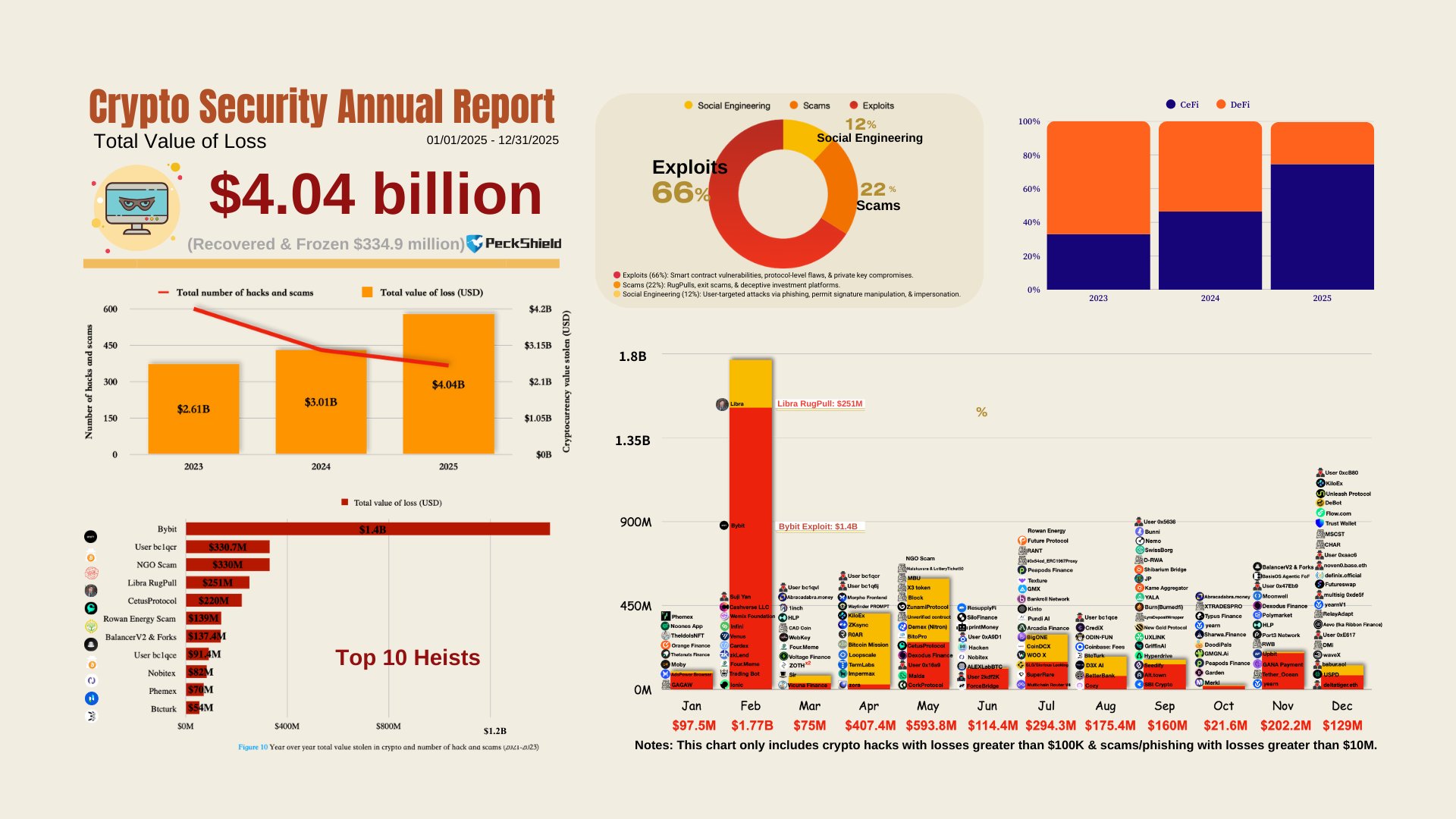
Damage from hacks and fraud with cryptocurrencies in 2025. Source: PeckShield

The total damage in 2025 exceeded $4.04 billion. Of this, $2.67 billion came from losses due to hacks (a 24.2% year-on-year increase) and $1.37 billion was attributed to cases of fraud (a 64.2% increase).

RBC-Crypto Telegram Channel — subscribe and stay up to date with the most important and relevant news about cryptocurrencies.

Join the RBC-Crypto forum on Telegram to discuss news and trends in the crypto world.

The report emphasizes that a strategic shift is occurring — the number of thefts using social engineering methods (psychological techniques and manipulations that force the victim to disclose confidential information that the attacker could use to steal funds) is growing. Analysts attributed 12% of the losses in 2025 to incidents where such methods were used.

66% of the total damage came from hacks, the most serious being the theft of $1.4 billion from the Bybit exchange in February of last year. Another 22% of losses came from scams, including "rug pulls" (when developers withdraw liquidity at the price peak) and pseudo-cryptoinvestments.

Another important change was the increase in the share of centralized services among the affected platforms. If in 2023 they accounted for just over 35%, in 2024 it was already around 45%, and in 2025 — over 70%.

Over the year, only about $334.9 million of the stolen funds was frozen or returned. PeckShield noted a decrease compared to 2024, when $488.5 million was recovered.

Cardano Founder: Trump's Policy Pushed Suburbs Away from Cryptocurrency

Former New York 'Bitcoin Mayor' Faces Charges in Crypto Fraud

The First Bitcoin Transaction Was Executed 17 Years Ago. Who Received These Coins

Perguntas relacionadas

QHow much was stolen in cryptocurrencies due to hacks and fraud in 2025 according to PeckShieldAlert?

A$4 billion was stolen in cryptocurrencies in 2025.

QWhat was the percentage increase in losses from crypto hacks and fraud in 2025 compared to 2024?

ALosses increased by 34.2% in 2025 compared to 2024.

QWhat was the largest single crypto theft incident mentioned in the report for 2025?

AThe largest single theft was the $1.4 billion hack of the Bybit exchange in February of the previous year.

QWhat significant shift in attack methods did the PeckShield report highlight for 2025?

AThe report highlighted a strategic shift towards an increase in the number of scams using social engineering methods, which accounted for 12% of the losses.

QWhat percentage of the total losses in 2025 were attributed to centralized services?

AOver 70% of the total losses in 2025 were attributed to centralized services.

Leituras Relacionadas

$292 Million KelpDAO Cross-Chain Bridge Hack: Who Should Foot the Bill?

On April 18, 2026, an attacker stole 116,500 rsETH (worth ~$292M) from KelpDAO’s cross-chain bridge in 46 minutes—the largest DeFi exploit of 2026. The stolen assets were deposited into Aave V3 as collateral, causing $177–200M in bad debt and triggering a cascade of losses across nine DeFi protocols. Aave’s TVL dropped by ~$6B overnight. This legal analysis argues that KelpDAO and LayerZero Labs share concurrent liability, with fault apportioned 60%/40%. KelpDAO negligently configured its bridge with a 1-of-1 decentralized verifier network (DVN)—a single point of failure—despite LayerZero’s explicit recommendation of a 2-of-3 setup. LayerZero, which operated the compromised DVN, failed to secure its RPC infrastructure against a known poisoning attack vector. Both protocols’ terms of service cap liability at $200 (KelpDAO) or $50 (LayerZero), but these limits are likely unenforceable due to unconscionability, gross negligence exceptions, and potential securities law invalidation (if rsETH is deemed a security under the Howey test). Aave’s governance also faces fiduciary duty claims for raising rsETH’s loan-to-value ratio to 93%—far above competitors’ 72–75%—without adequately assessing bridge risks, amplifying the systemic fallout. Practical recovery targets include LayerZero Labs (a registered Canadian entity), KelpDAO’s founders, auditors, and identifiable Aave governance delegates. The incident underscores escalating legal risks for DeFi protocols, infrastructure providers, and governance participants.

marsbitHá 21m

$292 Million KelpDAO Cross-Chain Bridge Hack: Who Should Foot the Bill?

marsbitHá 21m

Insider Trading in War: 5 People Involved, the Highest Earner Was Arrested

On April 24, the U.S. Department of Justice arrested U.S. Army Special Forces Staff Sergeant Gannon Ken Van Dyke for insider trading related to the capture of Venezuelan President Nicolás Maduro on January 3. Van Dyke allegedly profited over $400,000 by placing bets on a prediction market, Polymarket, using insider knowledge of the covert operation. According to the indictment, Van Dyke registered an account (0x31a5) on December 26 and made a series of bets predicting Maduro’s capture and U.S. military involvement in Venezuela. He withdrew most of his funds on the day of the operation and attempted to obscure his tracks by transferring assets through crypto and brokerage accounts. This case marks the first time the DOJ has prosecuted insider trading on Polymarket. PolyBeats had previously identified five suspicious accounts, including Van Dyke’s—the highest earner—in January. The other accounts, with profits ranging from $34,000 to $145,000, remain under unofficial scrutiny but have not been charged. Their lower profits, indirect access to information, and unclear legal boundaries may complicate prosecution. Polymarket has since strengthened its market integrity rules, explicitly prohibiting trading based on confidential or insider information. Van Dyke’s arrest, nearly four months after his trades, signals increased regulatory attention and the persistent traceability of blockchain-based transactions.

marsbitHá 23m

Insider Trading in War: 5 People Involved, the Highest Earner Was Arrested

marsbitHá 23m

Bitwise: Bullish on Bitcoin's Performance in the Second Half of the Year, AI and Regulation Will Spark a New Altcoin Season

Bitwise CIO Matt Hougan and Research Lead Ryan Rasmussen express strong bullish sentiment on Bitcoin's long-term prospects, suggesting that its $1 million price target may be too conservative. They argue Bitcoin serves a dual role: as digital gold and a potential global settlement asset, especially amid declining trust in traditional monetary systems. Despite a weak Q1 2026 where nearly all crypto assets and prices saw double-digit declines, the analysts remain optimistic due to strong forward-looking catalysts, including institutional adoption via Bitcoin ETFs from major firms like Morgan Stanley and Goldman Sachs. Geopolitical instability, such as Iran’s mention of using Bitcoin for international payments, increases the value of Bitcoin’s “out-of-the-money call option” as a non-political, global settlement currency. This enhances its appeal beyond a mere store of value. . Additionally, Hougan highlights that a clearer regulatory token framework under current SEC leadership, combined with AI efficiency gains and high-performance blockchains, could fuel a new “altseason” by late 2026. This may lead to a wave of legitimate, value-capturing token projects, unlike the earlier ICO boom. . Bitwise also announced an Avalanche ETF, citing its unique architecture and rapid growth in real-world asset (RWA) tokenization, which has surged 10x to nearly $30 billion in two years. The firm believes Layer 1 blockchains are still early in their growth cycle, with significant potential ahead.

marsbitHá 1h

Bitwise: Bullish on Bitcoin's Performance in the Second Half of the Year, AI and Regulation Will Spark a New Altcoin Season

marsbitHá 1h

Trading

Spot
Futuros

Artigos em Destaque

Como comprar 4

Bem-vindo à HTX.com!Tornámos a compra de 4 (4) simples e conveniente.Segue o nosso guia passo a passo para iniciar a tua jornada no mundo das criptos.Passo 1: cria a tua conta HTXUtiliza o teu e-mail ou número de telefone para te inscreveres numa conta gratuita na HTX.Desfruta de um processo de inscrição sem complicações e desbloqueia todas as funcionalidades.Obter a minha contaPasso 2: vai para Comprar Cripto e escolhe o teu método de pagamentoCartão de crédito/débito: usa o teu visa ou mastercard para comprar 4 (4) instantaneamente.Saldo: usa os fundos da tua conta HTX para transacionar sem problemas.Terceiros: adicionamos métodos de pagamento populares, como Google Pay e Apple Pay, para aumentar a conveniência.P2P: transaciona diretamente com outros utilizadores na HTX.Mercado de balcão (OTC): oferecemos serviços personalizados e taxas de câmbio competitivas para os traders.Passo 3: armazena teu 4 (4)Depois de comprar o teu 4 (4), armazena-o na tua conta HTX.Alternativamente, podes enviá-lo para outro lugar através de transferência blockchain ou usá-lo para transacionar outras criptomoedas.Passo 4: transaciona 4 (4)Transaciona facilmente 4 (4) no mercado à vista da HTX.Acede simplesmente à tua conta, seleciona o teu par de trading, executa as tuas transações e monitoriza em tempo real.Oferecemos uma experiência de fácil utilização tanto para principiantes como para traders experientes.

596 Visualizações TotaisPublicado em {updateTime}Atualizado em 2025.10.20

Como comprar 4

Discussões

Bem-vindo à Comunidade HTX. Aqui, pode manter-se informado sobre os mais recentes desenvolvimentos da plataforma e obter acesso a análises profissionais de mercado. As opiniões dos utilizadores sobre o preço de 4 (4) são apresentadas abaixo.

活动图片