
Hackers and Scammers Stole $4 Billion in Cryptocurrencies in 2025

RBK-cryptoPublicado em 2026-01-13Última atualização em 2026-01-13

Resumo

In 2025, hackers and fraudsters stole over $4 billion in cryptocurrencies, a 34.2% increase compared to the $3.01 billion stolen in 2024, according to analytics firm PeckShieldAlert. The total damage exceeded $4.04 billion, with $2.67 billion (a 24.2% annual increase) attributed to hacks and $1.37 billion (a 64.2% increase) to fraud cases. A strategic shift was noted towards a rise in scams utilizing social engineering methods, such as psychological manipulation to trick victims into revealing confidential information, which accounted for 12% of the losses. The most significant single incident was the $1.4 billion hack of the Bybit exchange in February of the previous year. An additional 22% of losses came from scams, including 'rug pulls' and pseudo-crypto investment schemes. Another key change was the increasing share of centralized services among the affected platforms. Their share of losses grew from just over 35% in 2023 to around 45% in 2024, and exceeded 70% in 2025. Only about $334.9 million of the stolen funds were frozen or returned during the year, a decrease from the $488.5 million recovered in 2024.

Damage to crypto industry participants increased by 34% compared to 2024

Due to hacks and fraud with cryptocurrencies in 2025, more than $4 billion was lost, according to analysts at PeckShieldAlert. According to their data, this is 34.2% more than in 2024, when $3.01 billion worth of cryptocurrency was stolen.
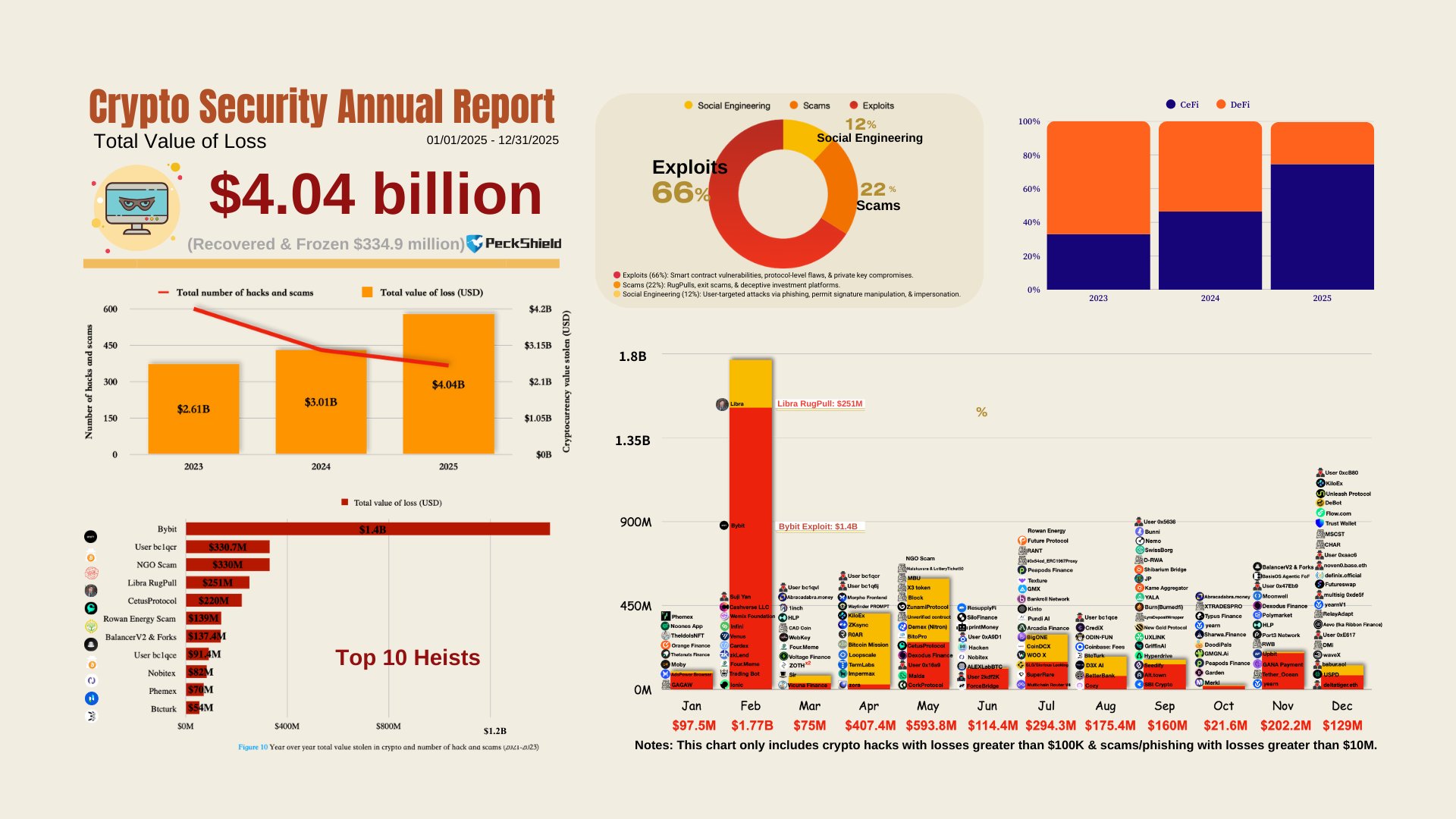
Damage from hacks and fraud with cryptocurrencies in 2025. Source: PeckShield

The total damage in 2025 exceeded $4.04 billion. Of this, $2.67 billion came from losses due to hacks (a 24.2% year-on-year increase) and $1.37 billion was attributed to cases of fraud (a 64.2% increase).

RBC-Crypto Telegram Channel — subscribe and stay up to date with the most important and relevant news about cryptocurrencies.

Join the RBC-Crypto forum on Telegram to discuss news and trends in the crypto world.

The report emphasizes that a strategic shift is occurring — the number of thefts using social engineering methods (psychological techniques and manipulations that force the victim to disclose confidential information that the attacker could use to steal funds) is growing. Analysts attributed 12% of the losses in 2025 to incidents where such methods were used.

66% of the total damage came from hacks, the most serious being the theft of $1.4 billion from the Bybit exchange in February of last year. Another 22% of losses came from scams, including "rug pulls" (when developers withdraw liquidity at the price peak) and pseudo-cryptoinvestments.

Another important change was the increase in the share of centralized services among the affected platforms. If in 2023 they accounted for just over 35%, in 2024 it was already around 45%, and in 2025 — over 70%.

Over the year, only about $334.9 million of the stolen funds was frozen or returned. PeckShield noted a decrease compared to 2024, when $488.5 million was recovered.

Cardano Founder: Trump's Policy Pushed Suburbs Away from Cryptocurrency

Former New York 'Bitcoin Mayor' Faces Charges in Crypto Fraud

The First Bitcoin Transaction Was Executed 17 Years Ago. Who Received These Coins

Criptomoedas em alta

Perguntas relacionadas

QHow much was stolen in cryptocurrencies due to hacks and fraud in 2025 according to PeckShieldAlert?

A$4 billion was stolen in cryptocurrencies in 2025.

QWhat was the percentage increase in losses from crypto hacks and fraud in 2025 compared to 2024?

ALosses increased by 34.2% in 2025 compared to 2024.

QWhat was the largest single crypto theft incident mentioned in the report for 2025?

AThe largest single theft was the $1.4 billion hack of the Bybit exchange in February of the previous year.

QWhat significant shift in attack methods did the PeckShield report highlight for 2025?

AThe report highlighted a strategic shift towards an increase in the number of scams using social engineering methods, which accounted for 12% of the losses.

QWhat percentage of the total losses in 2025 were attributed to centralized services?

AOver 70% of the total losses in 2025 were attributed to centralized services.

Leituras Relacionadas

STRC's First Financial Report Post-Depegging, How is Strategy Restoring the Capital Flywheel?

On July 31, 2026, Bitcoin treasury company Strategy released its Q2 financial report. Despite a 6.9% year-over-year increase in revenue to $122 million, the company recorded a substantial net loss of $8.22 billion, primarily due to $8.32 billion in unrealized losses from Bitcoin holdings. While Strategy's core Bitcoin strategy remains intact—its holdings grew 11% to 843,775 BTC—the company is undergoing a fundamental shift in its capital model. Following the de-pegging of its key financing tool, the STRCoin (STRC), from its $100 target in May, Strategy has pivoted from a one-directional "raise funds, buy Bitcoin" cycle to a more dynamic, multi-asset capital management approach. A key part of this new framework is the "Monetization Program," through which Strategy has sold approximately $218.4 million worth of BTC to bolster liquidity. The company's top priority is repairing STRC's peg, committing not to issue discounted shares until it returns to its target range. It has initiated a $1 billion buyback program for discounted digital credit securities, having repurchased $28.9 million face value of STRC so far. Management aims to restore the peg around September 8, 2026. Strategy now actively manages a matrix of assets: Bitcoin (for accumulation or strategic sales), USD cash reserves (now at $3.75 billion), common stock (MSTR), and digital credit securities like STRC. This allows for tactical moves like repurchasing discounted debt or equity to capture value. The future success of Strategy's "capital flywheel" hinges on two factors: the short-term ability to successfully re-peg STRC to restore market confidence in its digital credit system, and the long-term price trajectory of Bitcoin, upon which its entire investment thesis ultimately depends.

Odaily星球日报Há 7m

STRC's First Financial Report Post-Depegging, How is Strategy Restoring the Capital Flywheel?

Odaily星球日报Há 7m

With Two Consecutive Quarters of Losses, Coinbase Must Rely on Paths Beyond Trading

Coinbase posted its second consecutive quarterly net loss of $359 million on $1.22 billion in revenue for Q2, highlighting its vulnerability to crypto market cycles where weaker prices and lower volatility reduce user trading. However, the report also reveals a strategic shift in its business model. Despite a 25% quarter-over-quarter decline in global spot trading volume, Coinbase increased its market share to a company-record 10.3%. This suggests its position as a compliant U.S. on-ramp is strengthening even in a cooler market. A key development is the diversification of revenue streams. Transaction revenue fell to $599 million, nearly equaling subscription and services revenue of $555 million. Stablecoin services, generating $292 million, are becoming a crucial revenue "floor." This income, derived from interest on the $20 billion average USDC balance held on its platform, is less tied to daily trading activity. Furthermore, while spot trading volume dropped significantly, derivatives volume held steady at $1.03 trillion. Coinbase is pushing to integrate spot, stablecoin, and derivatives liquidity to create a more interconnected and sticky ecosystem for users. The GAAP net loss includes non-cash expenses like stock-based compensation and crypto asset valuation changes. Its adjusted EBITDA remained positive at $208 million for the 14th straight quarter, indicating core operations can cover ongoing costs. The company is also reducing expenses to manage the downturn. The central question moving forward is whether Coinbase's growing market share, stablecoin revenues, and expanding product integration can sufficiently offset the inherent cyclicality of its core trading business during future market contractions.

marsbitHá 22m

With Two Consecutive Quarters of Losses, Coinbase Must Rely on Paths Beyond Trading

marsbitHá 22m

In the Age of Artificial Intelligence, We Need 'Magicians,' Not 'Managers'

In the AI era, leadership must shift from management to magic. As knowledge rapidly expires, value shifts from what leaders know to what they can facilitate. Traditional "inside-out" management, driven by internal experience, is giving way to "outside-in" thinking focused on external opportunities, customer needs, and disruptive change. The core challenge is fostering new ideas that may invalidate existing knowledge. While technologies like steam, electricity, and AI provide the "skeleton" for innovation, it is human vision—connecting technology to customer dreams—that creates magic. Historical figures like Richard Arkwright and Eldridge R. Johnson succeeded not by inventing core technologies, but by reimagining work and business models from the outside in. Leaders must transition from controllers to "architects of flourishing." Their role is to design environments where empowerment, creativity, and adaptive learning thrive. This involves granting autonomy, fostering partnerships, and building resilient systems that scale innovation. Critical leadership qualities now include judgment, creativity, and the ability to learn continuously rather than relying on static expertise. Therefore, cultivating future leaders requires a focus on timeless fundamentals, humanities for broader perspective, and social acuity, rather than over-specialization in quickly outdated technical skills. The future rewards those who respond to the unseen and create conditions for better answers to emerge. Leadership in the AI age is less about having all the answers and more about enabling others to discover them—creating organizations where people explore, imagine, and thrive.

marsbitHá 57m

In the Age of Artificial Intelligence, We Need 'Magicians,' Not 'Managers'

marsbitHá 57m

Trading

Spot

Artigos em Destaque

Como comprar 4

Bem-vindo à HTX.com!Tornámos a compra de 4 (4) simples e conveniente.Segue o nosso guia passo a passo para iniciar a tua jornada no mundo das criptos.Passo 1: cria a tua conta HTXUtiliza o teu e-mail ou número de telefone para te inscreveres numa conta gratuita na HTX.Desfruta de um processo de inscrição sem complicações e desbloqueia todas as funcionalidades.Obter a minha contaPasso 2: vai para Comprar Cripto e escolhe o teu método de pagamentoCartão de crédito/débito: usa o teu visa ou mastercard para comprar 4 (4) instantaneamente.Saldo: usa os fundos da tua conta HTX para transacionar sem problemas.Terceiros: adicionamos métodos de pagamento populares, como Google Pay e Apple Pay, para aumentar a conveniência.P2P: transaciona diretamente com outros utilizadores na HTX.Mercado de balcão (OTC): oferecemos serviços personalizados e taxas de câmbio competitivas para os traders.Passo 3: armazena teu 4 (4)Depois de comprar o teu 4 (4), armazena-o na tua conta HTX.Alternativamente, podes enviá-lo para outro lugar através de transferência blockchain ou usá-lo para transacionar outras criptomoedas.Passo 4: transaciona 4 (4)Transaciona facilmente 4 (4) no mercado à vista da HTX.Acede simplesmente à tua conta, seleciona o teu par de trading, executa as tuas transações e monitoriza em tempo real.Oferecemos uma experiência de fácil utilização tanto para principiantes como para traders experientes.

682 Visualizações TotaisPublicado em {updateTime}Atualizado em 2026.06.02

Como comprar 4

Discussões

Bem-vindo à Comunidade HTX. Aqui, pode manter-se informado sobre os mais recentes desenvolvimentos da plataforma e obter acesso a análises profissionais de mercado. As opiniões dos utilizadores sobre o preço de 4 (4) são apresentadas abaixo.

活动图片