Government Shutdown Fears Trigger 2% Crypto Dip, But Bitcoin Hyper Remains Unshaken

bitcoinistPublicado em 2026-02-10Última atualização em 2026-02-10

Resumo

Fears of a U.S. government shutdown triggered a 2% decline in the broader cryptocurrency market, causing a liquidity crunch and risk-off sentiment. Major assets like Bitcoin and Ethereum saw sell-offs as investors de-risked amid regulatory delays and economic uncertainty. However, the Fear and Greed Index moved into Neutral, indicating underlying market equilibrium. Despite the downturn, on-chain data reveals capital rotation into infrastructure projects with fundamental utility, particularly Bitcoin Layer 2 solutions. Bitcoin Hyper ($HYPER) emerged as a standout, raising over $31 million in its presale. The project integrates the Solana Virtual Machine (SVM) with Bitcoin’s base layer, enabling high-speed smart contracts and sub-second transactions while leveraging Bitcoin’s security. This addresses Bitcoin’s scalability limitations and attracts developer interest with Rust-based dApp deployment. Whale accumulation has been significant, with several wallets purchasing over $1 million worth of $HYPER during the dip, signaling strong institutional confidence. The token’s staking mechanism and short vesting period aim to reduce post-launch sell pressure. Priced at $0.0136754, $HYPER represents a utility-focused investment narrative decoupled from short-term macro volatility.

Trusted Editorial content, reviewed by leading industry experts and seasoned editors. Ad Disclosure

Quick Facts:

  • ➡️ The crypto market is down roughly 2% due to fears of a U.S. government shutdown, causing a short-term liquidity crunch and risk-off behavior in major assets like BTC and ETH.
  • ➡️ Despite the downturn, smart money is rotating out of correlated assets and into infrastructure plays that offer fundamental utility, specifically in the Layer 2 sector.
  • ➡️ Bitcoin Hyper leverages the Solana Virtual Machine to bring high-speed smart contracts to Bitcoin, securing over $31M in funding by solving the network’s scalability bottleneck.
  • ➡️ Large-scale wallet accumulation during a market dip signals strong institutional conviction in the Bitcoin L2 narrative over short-term macro noise.

Global crypto markets have retracted by roughly 2% in the last 24 hours, largely due to escalating fears of a U.S. government shutdown.

It’s a classic setup: when Capitol Hill gridlock threatens federal operations, risk assets usually face immediate sell-pressure. Crypto is no exception. Bitcoin ($BTC) has slipped below key support, and Ethereum ($ETH) is mirroring the downturn as institutional desks de-risk before the legislative deadline.

Good news, though, the Fear and Greed Index is now pushing into Neutral.
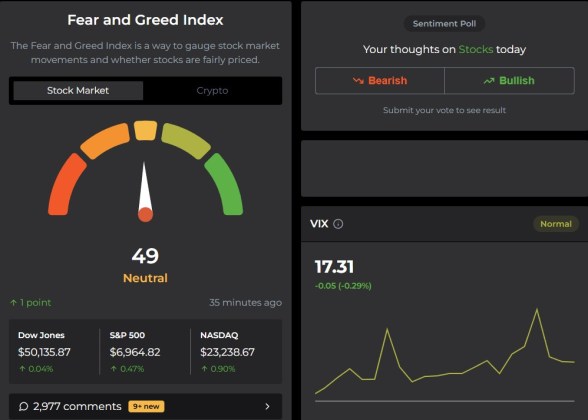
That matters. The correlation between traditional finance (TradFi) macros and crypto price action is sitting at a local peak right now. Investors aren’t necessarily bearish on the tech; they’re terrified of liquidity crunches.

When government operations stall, economic data releases get delayed and regulatory clarity vanishes. The result? A ‘wait and see’ paralysis that drains volume from order books. Just look at the sea of red across the top 100 tokens, it’s a clear flight to safety.

Dig a bit deeper into the on-chain data, though, and you’ll spot a divergence. While the macro-correlated majors stumble, capital isn’t actually leaving the building. Instead, it’s rotating into infrastructure plays that operate independently of immediate regulatory noise.

Smart money is seeking a ‘flight to utility’, assets solving fundamental scalability issues regardless of the macro environment. Bitcoin Hyper ($HYPER) is leading this counter-trend charge, attracting serious inflows while the broader market hesitates.

Learn more about Bitcoin Hyper here.

Bitcoin Hyper Brings High-Speed SVM Tech To The Old Guard

While Bitcoin remains the pristine collateral of the crypto world, its utility as a transactional layer is severely limited by 10-minute block times.

Frankly, the lack of native smart contract capability is a headache developers have dealt with for a decade. That’s the specific bottleneck Bitcoin Hyper addresses (and it explains why the project is decoupling from general market sentiment).

By integrating the Solana Virtual Machine (SVM) as a Layer 2 solution on top of Bitcoin, the protocol offers a combo investors find hard to ignore: Bitcoin’s ironclad security with Solana’s blistering speed.

The interest here is driven by the ‘execution layer’ thesis. Developers have been itching to build high-speed DeFi and gaming platforms secured by Bitcoin for years, but the base layer’s rigid scripting language made it nearly impossible. Bitcoin Hyper fixes this with a modular architecture. It uses Bitcoin L1 for final settlement while employing a real-time SVM L2 for execution.
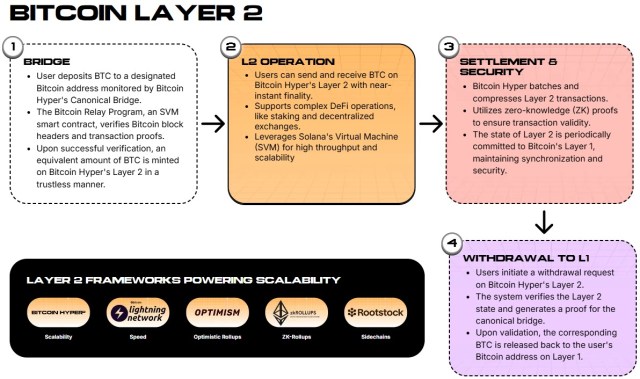
This allows for sub-second finality and negligible transaction costs, effectively solving the ‘Blockchain Trilemma’ for the crypto king.

For devs, it’s a zero-friction environment. They can use Rust, the industry standard for high-performance dApps, to deploy applications tapping into Bitcoin’s trillion-dollar liquidity.

Plus, a Decentralized Canonical Bridge ensures trustless transfers between layers, removing the centralization risks we often see in wrapped token bridges. This utility-first approach acts as a hedge; even when prices dip, the demand for faster, cheaper transactions doesn’t disappear.

Buy $HYPER here.

Whales Accumulate $HYPER As Presale Crosses Major Milestone

This split between the market’s 2% dip and Bitcoin Hyper’s ($HYPER) trajectory shows up clearly in the funding numbers. While retail traders panic-sell majors, sophisticated investors are quietly accumulating positions in this pre-market infrastructure.

According to the official presale page, Bitcoin Hyper has already raised $31.3M a number that suggests high conviction from early backers despite the external gloom.

Smart money behavior is often the canary in the coal mine. Etherscan records show that 3 whale wallets have accumulated over $1M in recent transactions. The largest buy, a chunky $500K, happened on Jan 15, 2026.

This accumulation during a ‘risk-off’ period highlights a specific appetite for Bitcoin Layer 2 protocols. Whales appear to be positioning themselves for the Token Generation Event (TGE), betting that the SVM-on-Bitcoin narrative will outperform legacy altcoins once market sentiment stabilizes.

With tokens priced at $0.0136754, the entry point looks primed for those hunting asymmetry. The protocol also pushes for long-term holding via a staking model offering immediate APY after TGE, paired with a short 7-day vesting period for presale stakers.

This structure is designed to reduce post-launch sell pressure (a common pitfall). In a market paralyzed by government shutdown fears, $HYPER offers a narrative that doesn’t depend on congressional budgets.

Buy $HYPER here.

The information provided in this article is for educational purposes only and does not constitute financial advice. Cryptocurrency investments are volatile and carry a high risk of loss. Always conduct your own research before investing.

Editorial Process for bitcoinist is centered on delivering thoroughly researched, accurate, and unbiased content. We uphold strict sourcing standards, and each page undergoes diligent review by our team of top technology experts and seasoned editors. This process ensures the integrity, relevance, and value of our content for our readers.

patrubogdan

Follow

Full Profile

Related Posts

Dogecoin Tries to Hold $0.09370 – Is 2026 the Doge Year or Will $MAXI Take Over?

US Debt Spiral Eyes $39T: Why Bitcoin Hyper ($HYPER) Is The Hedge to Watch

Crypto Exchange Backpack Targets Token Launch Soon, as BMIC Fires Up Quantum Defense

Ethereum Foundation Backs SEAL Initiative as LiquidChain L3 Protocol Gains Traction

Vitalik Buterin Outlines Ethereum’s AI Future, While SUBBD Token Targets the Creator Economy

Binance Dominates Trump’s USD1 Supply as Bitcoin Hyper Breaks Records

Perguntas relacionadas

QWhat is the main reason for the 2% dip in the crypto market mentioned in the article?

AThe main reason for the 2% dip is escalating fears of a U.S. government shutdown, which caused a short-term liquidity crunch and risk-off behavior among investors.

QDespite the market downturn, which sector is attracting smart money investments according to the article?

ASmart money is rotating into infrastructure plays, specifically the Layer 2 sector, which offers fundamental utility and operates independently of immediate regulatory noise.

QWhat specific technology does Bitcoin Hyper use to address Bitcoin's limitations?

ABitcoin Hyper uses the Solana Virtual Machine (SVM) as a Layer 2 solution to bring high-speed smart contracts and sub-second finality to the Bitcoin network.

QHow much funding has Bitcoin Hyper's presale raised, and what does this indicate?

ABitcoin Hyper's presale has raised $31.3 million, indicating strong conviction from early backers and institutional investors despite the broader market downturn.

QWhat on-chain behavior suggests strong institutional interest in Bitcoin Hyper during the market dip?

AOn-chain data shows that large-scale whale wallets have accumulated over $1 million in $HYPER, with the largest single buy being $500,000, signaling strong institutional conviction.

Leituras Relacionadas

Must-Watch Events Next Week|CLARITY Act Could Face Senate Vote; SpaceX, Circle to Report Earnings (8.3-8.9)

**Summary: Key Events and Developments to Watch (August 3-9)** The upcoming week is marked by significant financial disclosures, key legislative deadlines, and notable product updates. **Major Financial Events:** Several companies are scheduled to release their Q2 2026 earnings. American Bitcoin (ABTC) will report on August 3, followed by SpaceX and Hut 8 Mining Corp. on August 4, and Circle on August 5. Notably, a significant portion of SpaceX shares (up to 12% of total shares) will be unlocked on August 6 following their earnings release. **Key Legislative Deadline:** The U.S. Senate faces an August 7 deadline to secure 60 votes for the CLARITY Act, a bipartisan bill aiming to establish a federal regulatory framework for cryptocurrencies. The Senate may hold a full vote on the bill during the week. **Economic Data:** The U.S. July Non-Farm Payrolls report will be released on August 7, providing crucial labor market data. **Technology & Product Updates:** * **Shutdowns:** DeFi portfolio tracker Zapper and wallet app Ctrl Wallet will cease operations on August 3. * **Upgrades:** LayerZero will deprecate its v1 relayers on August 3. XRP Ledger's new version 3.3.0, featuring five new functions, is expected next week. * **AI:** Elon Musk announced that the advanced Grok 4.6 AI model is set for release around August 7. * **Bitcoin:** The BIP-110 forced signaling for a potential Bitcoin network change is scheduled to begin around August 8. **Other Notable Events:** Chinese robotics firm Unitree Tech has set its preliminary price inquiry for its IPO for August 5. South Korean exchange Upbit will delist AQT and AERGO tokens on August 3.

marsbitHá 1h

Must-Watch Events Next Week|CLARITY Act Could Face Senate Vote; SpaceX, Circle to Report Earnings (8.3-8.9)

marsbitHá 1h

Stocks Are Plummeting More Sharply Than Cryptocurrencies. Where Has the Money Gone?

Stock Markets Plunge Deeper Than Cryptocurrencies: Where Did the Money Go? In late July, Seoul's Kospi index triggered circuit breakers for two consecutive days, plummeting over 40% from its June high. The collapse was led by heavyweight stocks like SK Hynix, whose record profits still disappointed investors, and devastating leveraged ETFs, with one major product losing over 83% of its value. This signaled a global, forced deleveraging targeting the most crowded trades. Interestingly, while stocks exhibited extreme volatility akin to crypto markets, Bitcoin rose nearly 15% in July after a prior steep drop. Analysis shows the money fleeing equities did not flow into Bitcoin. Instead, Bitcoin had already absorbed its sell-off in May-June, when U.S. spot Bitcoin ETFs saw historic outflows. The true safe-haven beneficiary was gold, whose price rose over 20% year-on-year, highlighting a decoupling between Bitcoin and gold as "digital gold." The sell-off was a targeted unwinding of leveraged positions in tech and semiconductors, accelerated by broker-dealer risk management and shifts in the AI narrative, including new competition from Chinese memory chipmakers. The retreat path was clear: from high-valuation tech stocks to cash and U.S. Treasuries, then to gold. For Bitcoin to attract sustained institutional inflows, conditions like eased global liquidity pressure, a "soft-landing" Fed rate cut, and U.S. regulatory clarity via legislation like the stalled CLARITY Act are needed. Currently, Bitcoin is not a safe haven but an already-cleared asset. Its low correlation with tech stocks, however, makes it a potential diversification play for institutional portfolios once the storm passes. The money isn't here yet, but the positioning is underway.

marsbitHá 1h

Stocks Are Plummeting More Sharply Than Cryptocurrencies. Where Has the Money Gone?

marsbitHá 1h

In Conversation with Ray Dalio: We Are Currently in an AI Bubble, with 1% of My Portfolio in Bitcoin

Ray Dalio, founder of Bridgewater Associates, warns in an interview that the current AI boom shows classic bubble characteristics, which could lead to significant economic downturns as seen in past cycles like 1929 or 2000. He explains that speculative enthusiasm, fueled by debt and overvaluation, often precedes a crash when rising rates or taxation force asset sales, causing widespread losses and recession. Dalio also outlines his "Big Cycle" theory, describing an approximate 80-year pattern where widening wealth gaps, massive government deficits, and shifting geopolitical power (like China's rise) create internal conflict and global instability. He emphasizes that we are in a late-cycle, transitional phase where traditional powers like the US and UK face decline. For personal wealth protection, Dalio advises diversification beyond cash into assets like stocks, bonds, real estate, and particularly gold, which he prefers over Bitcoin. While he holds about 1% of his portfolio in Bitcoin as a non-printable hard asset, he views gold as more secure from technological or governmental threats. Regarding AI's impact, Dalio believes it will disproportionately benefit capital owners, worsening inequality by replacing both physical and cognitive labor. He suggests that human intuition and emotional intelligence, combined with AI, will be key for future workers. On taxation, Dalio argues that wealth taxes are impractical and risk triggering asset sell-offs, reducing productive investment. He points to the UK as a cautionary example of debt, low productivity, and political strife. Geopolitically, Dalio foresees a more regionalized world, with the US showing weakness in prolonged conflicts like with Iran, akin to past imperial declines. The ideal outcome, he suggests, is coexisting powerful blocs (e.g., Americas, China-Asia Pacific) without major war.

marsbitHá 5h

In Conversation with Ray Dalio: We Are Currently in an AI Bubble, with 1% of My Portfolio in Bitcoin

marsbitHá 5h

Trading

Spot
活动图片





