Government Shutdown Fears Trigger 2% Crypto Dip, But Bitcoin Hyper Remains Unshaken

bitcoinistPublicado em 2026-02-10Última atualização em 2026-02-10

Resumo

Fears of a U.S. government shutdown triggered a 2% decline in the broader cryptocurrency market, causing a liquidity crunch and risk-off sentiment. Major assets like Bitcoin and Ethereum saw sell-offs as investors de-risked amid regulatory delays and economic uncertainty. However, the Fear and Greed Index moved into Neutral, indicating underlying market equilibrium. Despite the downturn, on-chain data reveals capital rotation into infrastructure projects with fundamental utility, particularly Bitcoin Layer 2 solutions. Bitcoin Hyper ($HYPER) emerged as a standout, raising over $31 million in its presale. The project integrates the Solana Virtual Machine (SVM) with Bitcoin’s base layer, enabling high-speed smart contracts and sub-second transactions while leveraging Bitcoin’s security. This addresses Bitcoin’s scalability limitations and attracts developer interest with Rust-based dApp deployment. Whale accumulation has been significant, with several wallets purchasing over $1 million worth of $HYPER during the dip, signaling strong institutional confidence. The token’s staking mechanism and short vesting period aim to reduce post-launch sell pressure. Priced at $0.0136754, $HYPER represents a utility-focused investment narrative decoupled from short-term macro volatility.

Trusted Editorial content, reviewed by leading industry experts and seasoned editors. Ad Disclosure

Quick Facts:

  • ➡️ The crypto market is down roughly 2% due to fears of a U.S. government shutdown, causing a short-term liquidity crunch and risk-off behavior in major assets like BTC and ETH.
  • ➡️ Despite the downturn, smart money is rotating out of correlated assets and into infrastructure plays that offer fundamental utility, specifically in the Layer 2 sector.
  • ➡️ Bitcoin Hyper leverages the Solana Virtual Machine to bring high-speed smart contracts to Bitcoin, securing over $31M in funding by solving the network’s scalability bottleneck.
  • ➡️ Large-scale wallet accumulation during a market dip signals strong institutional conviction in the Bitcoin L2 narrative over short-term macro noise.

Global crypto markets have retracted by roughly 2% in the last 24 hours, largely due to escalating fears of a U.S. government shutdown.

It’s a classic setup: when Capitol Hill gridlock threatens federal operations, risk assets usually face immediate sell-pressure. Crypto is no exception. Bitcoin ($BTC) has slipped below key support, and Ethereum ($ETH) is mirroring the downturn as institutional desks de-risk before the legislative deadline.

Good news, though, the Fear and Greed Index is now pushing into Neutral.
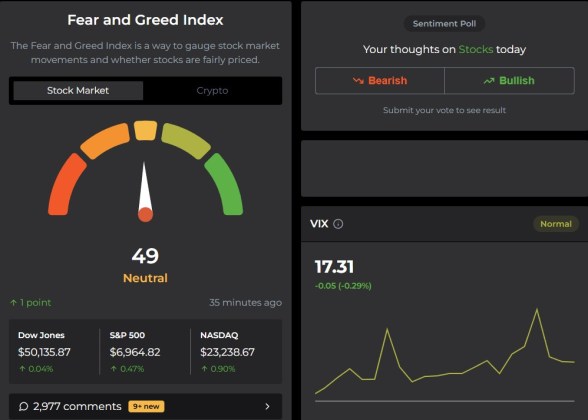
That matters. The correlation between traditional finance (TradFi) macros and crypto price action is sitting at a local peak right now. Investors aren’t necessarily bearish on the tech; they’re terrified of liquidity crunches.

When government operations stall, economic data releases get delayed and regulatory clarity vanishes. The result? A ‘wait and see’ paralysis that drains volume from order books. Just look at the sea of red across the top 100 tokens, it’s a clear flight to safety.

Dig a bit deeper into the on-chain data, though, and you’ll spot a divergence. While the macro-correlated majors stumble, capital isn’t actually leaving the building. Instead, it’s rotating into infrastructure plays that operate independently of immediate regulatory noise.

Smart money is seeking a ‘flight to utility’, assets solving fundamental scalability issues regardless of the macro environment. Bitcoin Hyper ($HYPER) is leading this counter-trend charge, attracting serious inflows while the broader market hesitates.

Learn more about Bitcoin Hyper here.

Bitcoin Hyper Brings High-Speed SVM Tech To The Old Guard

While Bitcoin remains the pristine collateral of the crypto world, its utility as a transactional layer is severely limited by 10-minute block times.

Frankly, the lack of native smart contract capability is a headache developers have dealt with for a decade. That’s the specific bottleneck Bitcoin Hyper addresses (and it explains why the project is decoupling from general market sentiment).

By integrating the Solana Virtual Machine (SVM) as a Layer 2 solution on top of Bitcoin, the protocol offers a combo investors find hard to ignore: Bitcoin’s ironclad security with Solana’s blistering speed.

The interest here is driven by the ‘execution layer’ thesis. Developers have been itching to build high-speed DeFi and gaming platforms secured by Bitcoin for years, but the base layer’s rigid scripting language made it nearly impossible. Bitcoin Hyper fixes this with a modular architecture. It uses Bitcoin L1 for final settlement while employing a real-time SVM L2 for execution.
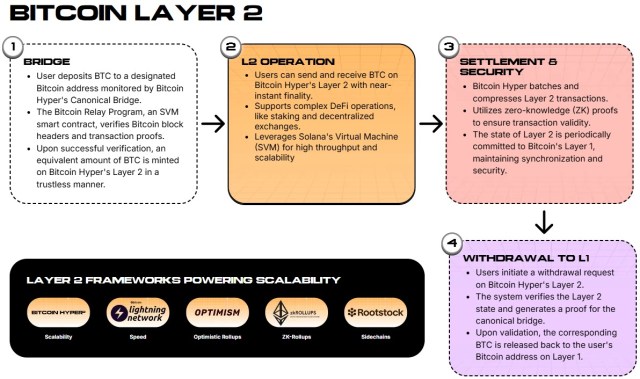
This allows for sub-second finality and negligible transaction costs, effectively solving the ‘Blockchain Trilemma’ for the crypto king.

For devs, it’s a zero-friction environment. They can use Rust, the industry standard for high-performance dApps, to deploy applications tapping into Bitcoin’s trillion-dollar liquidity.

Plus, a Decentralized Canonical Bridge ensures trustless transfers between layers, removing the centralization risks we often see in wrapped token bridges. This utility-first approach acts as a hedge; even when prices dip, the demand for faster, cheaper transactions doesn’t disappear.

Buy $HYPER here.

Whales Accumulate $HYPER As Presale Crosses Major Milestone

This split between the market’s 2% dip and Bitcoin Hyper’s ($HYPER) trajectory shows up clearly in the funding numbers. While retail traders panic-sell majors, sophisticated investors are quietly accumulating positions in this pre-market infrastructure.

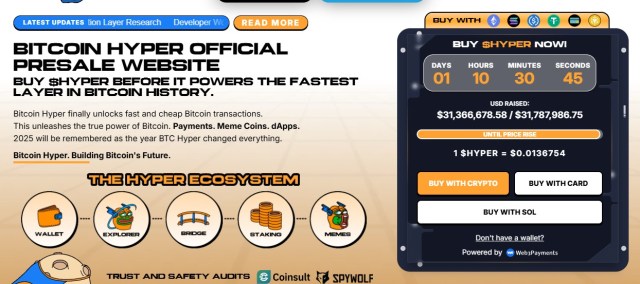
According to the official presale page, Bitcoin Hyper has already raised $31.3M a number that suggests high conviction from early backers despite the external gloom.
Smart money behavior is often the canary in the coal mine. Etherscan records show that 3 whale wallets have accumulated over $1M in recent transactions. The largest buy, a chunky $500K, happened on Jan 15, 2026.

This accumulation during a ‘risk-off’ period highlights a specific appetite for Bitcoin Layer 2 protocols. Whales appear to be positioning themselves for the Token Generation Event (TGE), betting that the SVM-on-Bitcoin narrative will outperform legacy altcoins once market sentiment stabilizes.

With tokens priced at $0.0136754, the entry point looks primed for those hunting asymmetry. The protocol also pushes for long-term holding via a staking model offering immediate APY after TGE, paired with a short 7-day vesting period for presale stakers.

This structure is designed to reduce post-launch sell pressure (a common pitfall). In a market paralyzed by government shutdown fears, $HYPER offers a narrative that doesn’t depend on congressional budgets.

Buy $HYPER here.

The information provided in this article is for educational purposes only and does not constitute financial advice. Cryptocurrency investments are volatile and carry a high risk of loss. Always conduct your own research before investing.

Editorial Process for bitcoinist is centered on delivering thoroughly researched, accurate, and unbiased content. We uphold strict sourcing standards, and each page undergoes diligent review by our team of top technology experts and seasoned editors. This process ensures the integrity, relevance, and value of our content for our readers.

patrubogdan

Follow

Full Profile

Related Posts

Dogecoin Tries to Hold $0.09370 – Is 2026 the Doge Year or Will $MAXI Take Over?

US Debt Spiral Eyes $39T: Why Bitcoin Hyper ($HYPER) Is The Hedge to Watch

Crypto Exchange Backpack Targets Token Launch Soon, as BMIC Fires Up Quantum Defense

Ethereum Foundation Backs SEAL Initiative as LiquidChain L3 Protocol Gains Traction

Vitalik Buterin Outlines Ethereum’s AI Future, While SUBBD Token Targets the Creator Economy

Binance Dominates Trump’s USD1 Supply as Bitcoin Hyper Breaks Records

Perguntas relacionadas

QWhat is the main reason for the 2% dip in the crypto market mentioned in the article?

AThe main reason for the 2% dip is escalating fears of a U.S. government shutdown, which caused a short-term liquidity crunch and risk-off behavior among investors.

QDespite the market downturn, which sector is attracting smart money investments according to the article?

ASmart money is rotating into infrastructure plays, specifically the Layer 2 sector, which offers fundamental utility and operates independently of immediate regulatory noise.

QWhat specific technology does Bitcoin Hyper use to address Bitcoin's limitations?

ABitcoin Hyper uses the Solana Virtual Machine (SVM) as a Layer 2 solution to bring high-speed smart contracts and sub-second finality to the Bitcoin network.

QHow much funding has Bitcoin Hyper's presale raised, and what does this indicate?

ABitcoin Hyper's presale has raised $31.3 million, indicating strong conviction from early backers and institutional investors despite the broader market downturn.

QWhat on-chain behavior suggests strong institutional interest in Bitcoin Hyper during the market dip?

AOn-chain data shows that large-scale whale wallets have accumulated over $1 million in $HYPER, with the largest single buy being $500,000, signaling strong institutional conviction.

Leituras Relacionadas

Lowering Expectations for BTC's Next Bull Market

The author, Alex Xu, explains his decision to significantly reduce his Bitcoin holdings (from full to ~30% of his portfolio) during the current bull cycle, citing a lowered long-term outlook for BTC's price appreciation in the next cycle. He outlines six key reasons for this reduced expectation: 1. **Diminished Growth Drivers:** The narrative of exponential user adoption has largely played out with institutional ETF adoption. The next major growth phase—adoption by sovereign national reserves or central banks—seems unlikely in the near future. 2. **Personal Opportunity Cost:** More attractive investment opportunities have emerged in other assets, such as undervalued companies. 3. **Industry-Wide Contraction:** The broader crypto industry is struggling, with most Web3 business models (SocialFi, GameFi, DePIN) failing. This overall萧条 (depression) reduces the fundamental demand and consensus for Bitcoin. 4. **Strain on Major Buyer:** MicroStrategy, a major corporate buyer of BTC, faces rising financing expenses for its debt, which could slow its purchasing rate and create significant marginal pressure on the market. 5. **Increased Competition from Gold:** The emergence of "tokenized gold" has closed the functional gap (portability, divisibility) between physical gold and Bitcoin, offering a strong competitor in the non-sovereign store-of-value space. 6. **Security Budget Concerns:** The block reward halving continues to exacerbate the long-standing issue of funding Bitcoin's network security, with new fee source explorations like Ordinals and L2s largely failing. The author's decision to hold a significant (though reduced) position reflects a cautious, not bearish, outlook. He remains open to increasing his exposure if the fundamental reasons for his skepticism change or if new positive catalysts emerge.

marsbitHá 14m

Lowering Expectations for BTC's Next Bull Market

marsbitHá 14m

Can Iran 'Control' the Strait of Hormuz?

Iran has announced a comprehensive plan to assert control over the strategic Strait of Hormuz, a critical global oil shipping chokepoint. The proposed measures include requiring all vessels to obtain Iranian permission for passage, imposing fees for security, environmental protection, and navigation management—preferably paid in Iranian rials—and absolutely banning Israeli ships. Vessels from countries deemed hostile by Iran’s top security bodies may also be barred. Analysts suggest Iran’s motives are multifaceted: increasing pressure on the U.S. and Israel by leveraging control over oil transit to influence global prices and inflation; creating a new revenue stream, potentially exceeding $7.7 billion annually, to counter Western sanctions and support postwar reconstruction; and using transit permissions as bargaining chips in future negotiations, notably with the U.S. However, the plan faces significant practical and diplomatic challenges. Enforcing comprehensive interception and fee collection in the busy waterway, patrolled by international military forces, would be difficult. The U.S. has already countering with a blockade of Iranian ports and threats to intercept any ship paying fees, potentially strangling Iran’s oil exports and fee revenue. Broad international opposition, led by European and Gulf states, and legal controversies further complicate implementation. The proposal may ultimately serve more as a negotiating tactic than a feasible policy, with its execution remaining highly uncertain.

marsbitHá 1h

Can Iran 'Control' the Strait of Hormuz?

marsbitHá 1h

Trading

Spot
Futuros
活动图片





