Google's AI Chief is Actually the Secret Backer of Anthropic, Hassabis Quietly Controls the Global AI Ecosystem

marsbitPublicado em 2026-05-21Última atualização em 2026-05-21

Resumo

A bombshell report reveals that Demis Hassabis, the head of Google AI and DeepMind founder, was an early, secret investor in Anthropic, Google's arch-rival in the AI race. This discovery unveils a vast, interconnected empire—dubbed the "DeepMind Mafia"—where Hassabis's capital and influence extend through numerous top AI startups like Inflection AI and Ineffable Intelligence, which have collectively raised over $14 billion. Despite the public rivalry between Google's Gemini and Anthropic's Claude, Hassabis personally funded Anthropic at its inception, a stake now astronomically valuable given the company's reported $900 billion valuation. Furthermore, a close, mentor-like relationship exists between Hassabis and Anthropic CEO Dario Amodei. Concurrently, Hassabis has consolidated power within Google. Following the 2023 merger of Google Brain and DeepMind into Google DeepMind, his loyalists have assumed key leadership roles across Google's AI and cloud divisions. However, Hassabis continues to operate his power base from London, not Silicon Valley. The report paints a picture of Hassabis as a master strategist, quietly orchestrating the global AI ecosystem through a web of personal investments, former protégés, and internal corporate control, ensuring his influence prevails regardless of which public-facing company wins in the market.

Just now, a massive bombshell exploded in the global tech world—

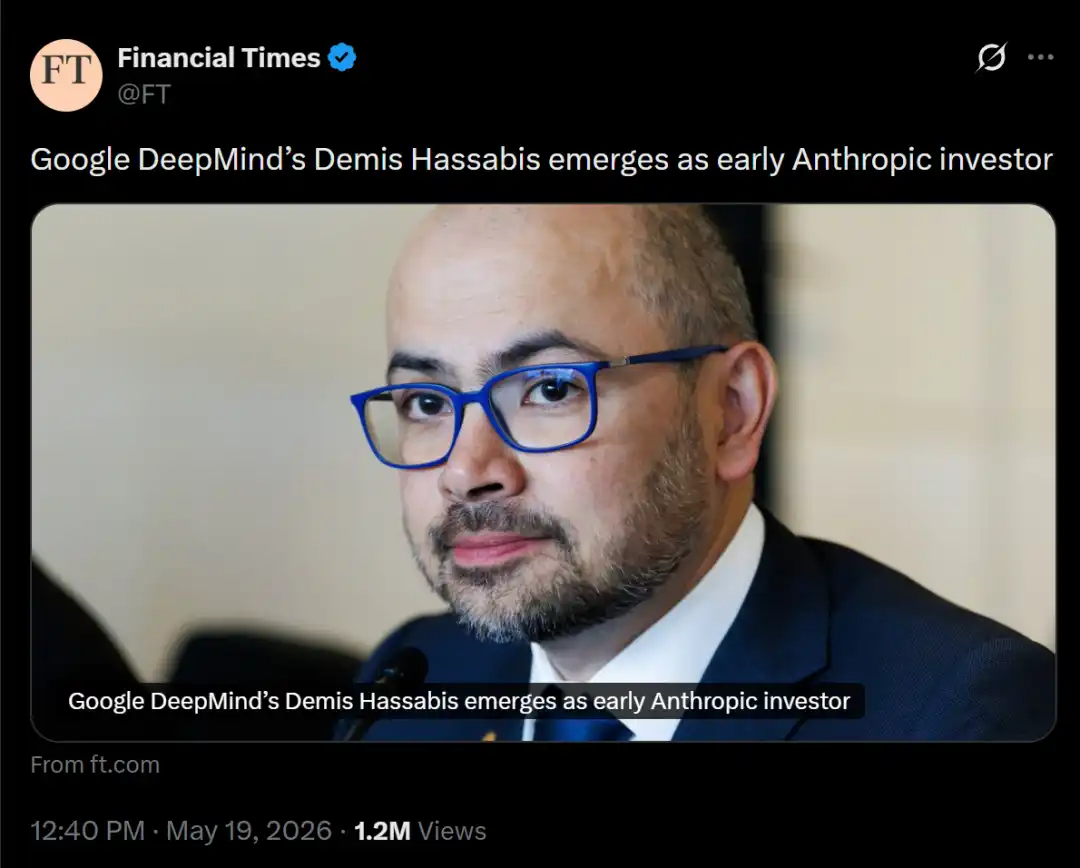
Demis Hassabis, Google AI's top leader, DeepMind founder, and Nobel laureate, was reportedly revealed to be an early, secret financial backer of its biggest rival, the super-unicorn Anthropic!
This meticulously planned infiltration is utterly shocking.

Even more unexpected is that following this clue has unearthed a vast 'DeepMind Mafia' empire, intricately woven and with deeply intertwined interests, personally orchestrated by Hassabis.

From Anthropic, valued at a staggering $900 billion, to Inflection AI which secured massive Microsoft investment, to Ineffable Intelligence which recently landed over $3 billion in funding... the leading figures or early backers behind the world's hottest, most cash-magnetizing AI startups are all him!

This is perhaps the most brilliant "Trojan Horse" in tech history—this "Godfather of AI" has quietly taken control of the discourse power in the global AI ecosystem right under our noses.
The Ultimate "Infiltration": Google AI Boss is a Major Shareholder in Its Rival?

In the current large model battlefield, Google's Gemini and Anthropic's Claude are locked in intense competition.

To outmaneuver their opponent, the two companies are engaged in a pixel-perfect arms race every day.

Yet, who would have thought that while Google employees work overtime to benchmark against Claude, their top boss had quietly bought shares in this "rival" company back when Anthropic was first founded.

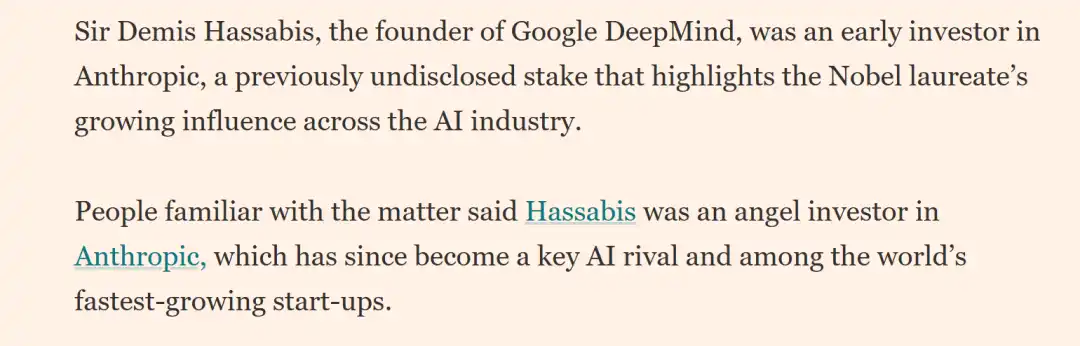
According to the latest revelations by the Financial Times, Hassabis secretly invested in Anthropic as a personal angel investor during its early days.

This hidden ownership stake was previously unknown to the public.

The shock level is akin to discovering that during the fierce Cola Wars, the CEO of Coca-Cola was a founding shareholder of PepsiCo.
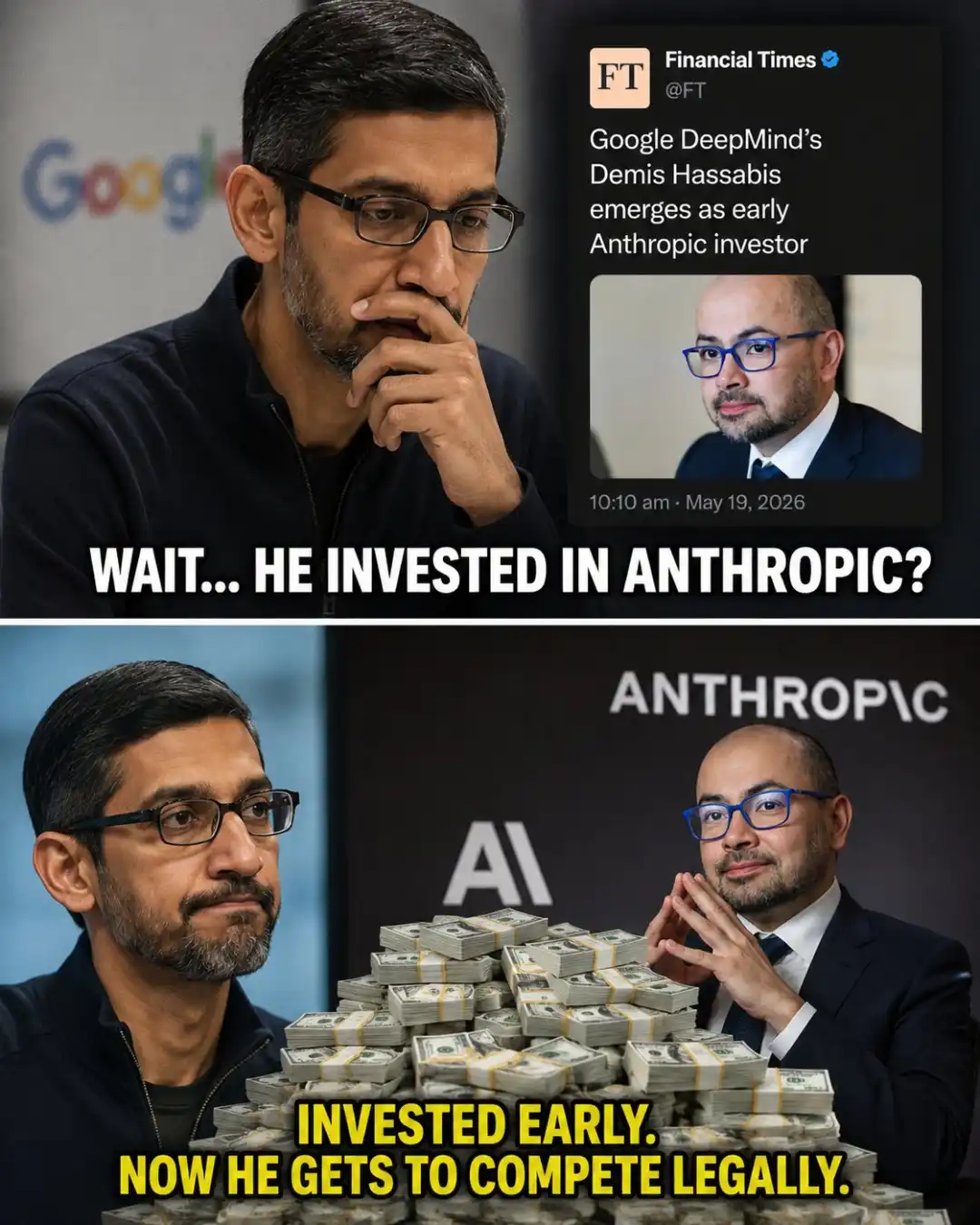
Looking at Anthropic's current monstrous size, you know Hassabis's investment paid off handsomely.

According to insiders, Anthropic's valuation has skyrocketed to an astonishing $900 billion in its latest funding round!

It has not only surpassed its arch-rival OpenAI but has ballooned into the fastest-growing "Leviathan" in global tech history.

Do the math, the assets in Hassabis's hands are now enormous enough to rival nations.

What's even more interesting is that Hassabis's "mothership," Google, later joined the game as well.

Google officially announced a multi-billion dollar investment in Anthropic earlier, establishing a deep cloud and AI partnership.
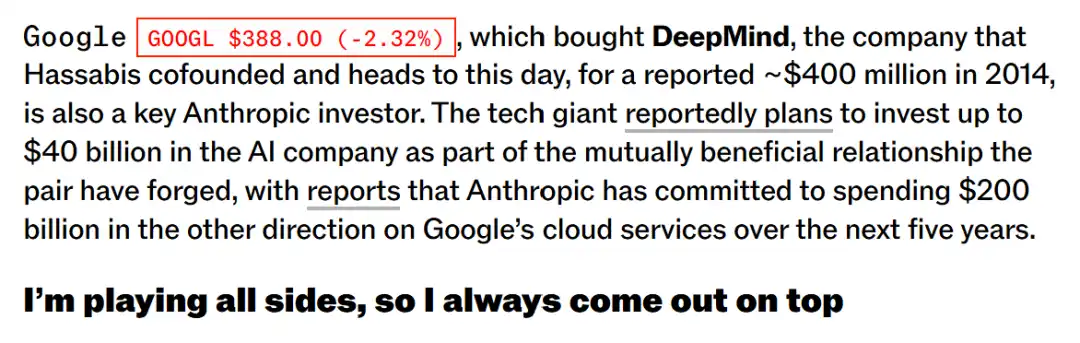
Rumored details of the deal suggest the scale of this "two-way street" is staggering—

Google reportedly plans to invest up to $40 billion in Anthropic; in return, as part of the agreement, Anthropic is said to have committed to spending a whopping $200 billion on Google Cloud services over the next five years!

In his left hand is the Google AI empire he commands; in his right hand is the $900 billion rival he incubated early on; and in between are tens of billions in cloud service contracts.

Hassabis's actions show us, "If I bet on both sides, the only winner in the end can be me."
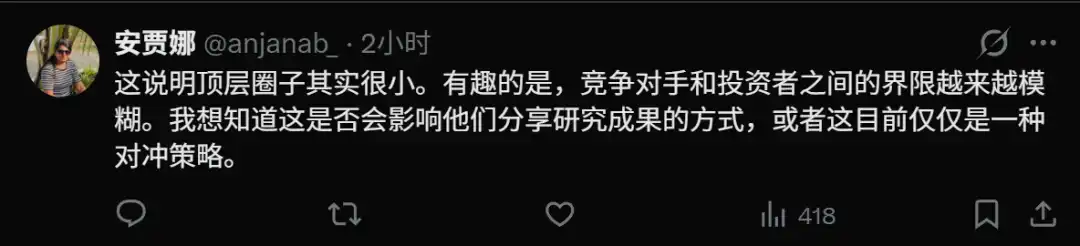
Dario: He is My Mentor

Digging deeper, things get even more intriguing.

The relationship between the two men goes far beyond mere financial ties.

According to sources close to Anthropic's leadership, Dario Amodei, Anthropic's founder and CEO, privately regards Hassabis as his role model and mentor.

Even though Dario previously held a core executive position at OpenAI, in his heart, Hassabis's DeepMind represents the holy grail of modern AI engineering.

In Dario's widely circulated personal essay "Machines of Loving Grace," although he doesn't name names directly, the reverence and admiration for a certain "AI pioneer" between the lines is unmistakable to anyone reading.

Anyone with insight can tell—he's talking about Hassabis.

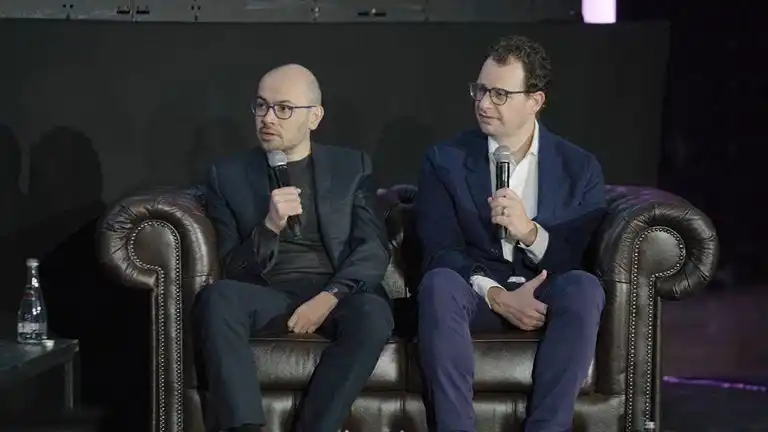
The "Couch Moment" at the World Economic Forum

This relationship of friendly rivalry and mutual admiration was immortalized in a famous moment at the 2025 World Economic Forum.

At the time, as leaders of two industry giants, Hassabis and Dario, during an interview, were squeezed onto a narrow two-seater sofa by event staff.

The two AI titans, worth billions and shaping humanity's future, sat shoulder to shoulder, pressed tightly together due to the cramped space.

According to eyewitnesses, the scene was described like this: "It was a textbook example of tech world bromance. Two public rivals, squeezed together on camera, their eyes holding not animosity, but instead a sense of mutual understanding and amusement shared by peers at the top."

This personal closeness, transcending corporate boundaries, not only softens the coldness of business warfare but also reveals that on the highest throne of AI, they are fellow travelers on the same path.
The "DeepMind Mafia" on a Rampage: Former Employees Raised $14 Billion in Four Years!

Hassabis's ambition is far from limited to just Anthropic.

In Silicon Valley, there was once the famous "PayPal Mafia." This entrepreneurial clique, consisting of Elon Musk, Peter Thiel, Reid Hoffman, and others, nearly dominated the early Web 2.0 era.

Today, a more massive and potentially more disruptive "DeepMind Mafia" is rapidly expanding, with dual centers in London and Silicon Valley.
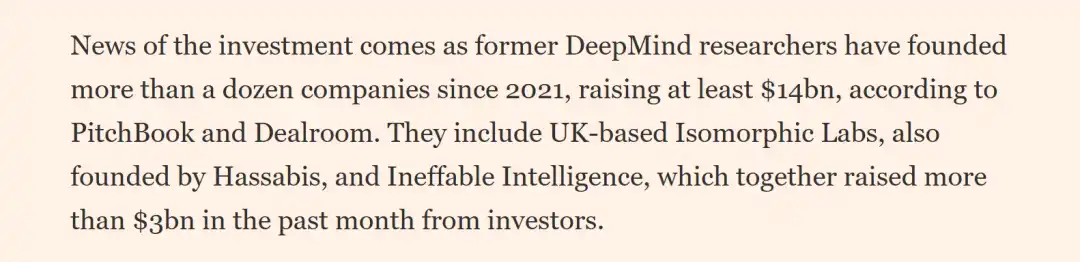
According to the latest statistics from the international authoritative startup databases PitchBook and Dealroom: Since 2021, core technical leads and executives who left DeepMind have gone on to found over 12 super AI startups.

Within just four years, this faction has cumulatively and frenziedly secured over $14 billion in funding from the market!

This scale is enough to make any venture capital firm tremble.

Let's look at this empire map composed of Hassabis and his disciples—

Core Members of the "DeepMind Mafia"
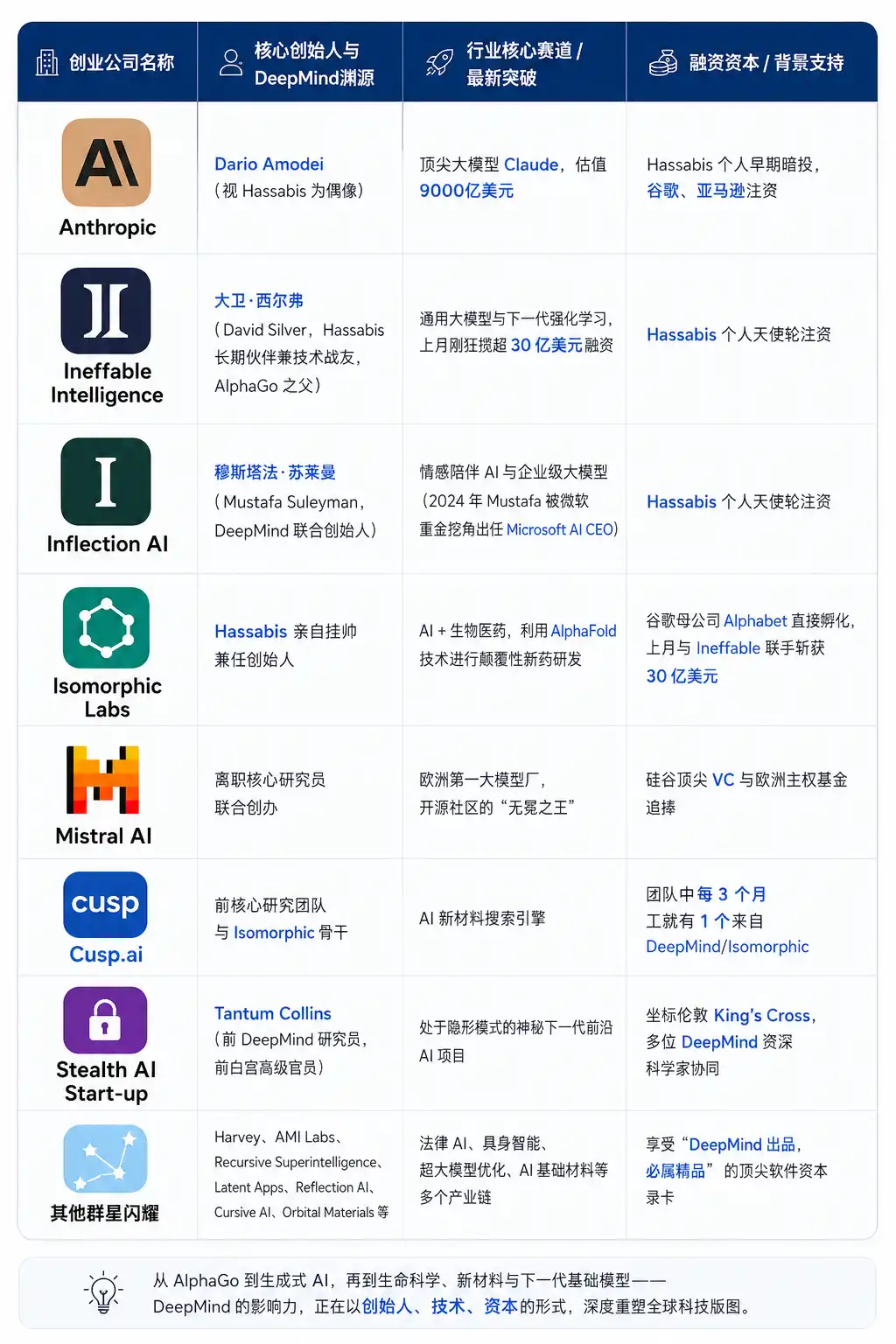
This list is still growing rapidly.

A seasoned Silicon Valley investor put it this way: "Nowadays, in the AI startup scene, if your resume says 'Former Senior Researcher at DeepMind,' you don't even need to finish your pitch deck—the checks are already on the table."

The Hidden Capital Web: Revealing the Harsh Truth Behind the Giants' 'Bloody War'

The most terrifying aspect of Hassabis's capital puzzle is its comprehensiveness and covertness.

As a billionaire who sold DeepMind to Google for £400 million in 2014, Hassabis holds vast cash reserves.

But instead of spending it on yachts or mansions like the typical wealthy, he turned this money into numerous precise capital tentacles, quietly reaching into the entrepreneurial ventures of former colleagues and subordinates.

David Silver wants to work on general AI, Hassabis invests.

Mustafa Suleyman leaves to start Inflection AI, Hassabis invests.

He is even a core angel investor in the famous startup incubator Entrepreneurs First (EF).

This kind of capital deployment completely tears open the harsh truth of modern tech giant competition—

Under the spotlight, the giants fight fiercely over market share, for financial reports and stock prices, engaging in bloody PR wars and patent battles.

But behind the curtain, the top AI elites are deeply bound together through a hidden network woven from personal capital, mentor-discipleship, and former colleague relationships.
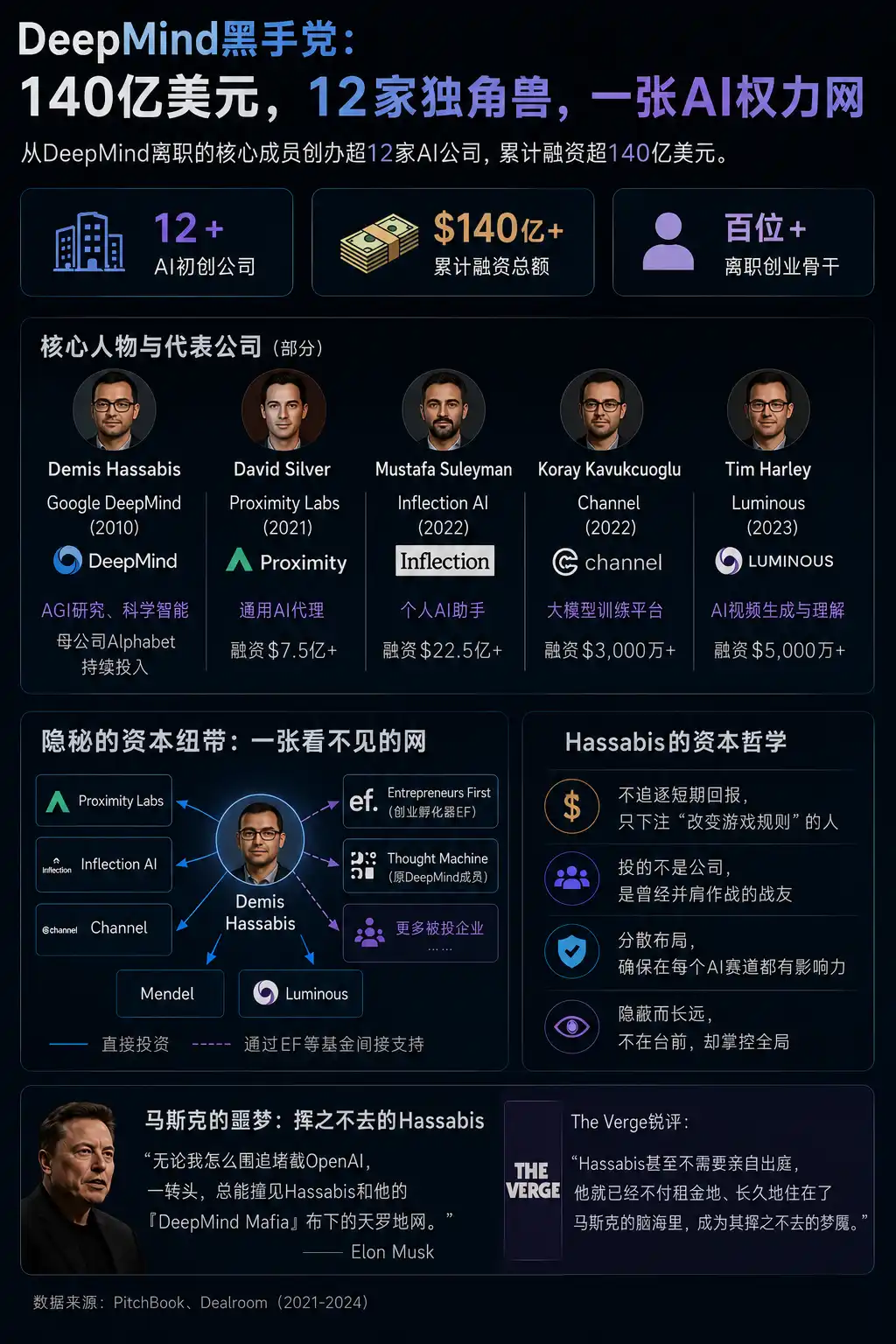
This phenomenon has even caused the maverick Elon Musk anxiety and anger.

In the high-profile, ongoing "Musk vs. Altman" lawsuit, court documents and testimonies show that Hassabis's name appears with high frequency in Musk's legal filings.

The Verge sharply commented: "Hassabis doesn't even need to show up in court; he already resides rent-free, permanently, in Musk's mind, becoming Musk's haunting nightmare.

Because Musk has discovered that no matter how he tries to corner OpenAI, whenever he turns around, he always runs into the intricate net laid by Hassabis and his 'DeepMind Mafia.'"

Pulling the Strings from Within: DeepMind Takes Over Google Completely

If aggressively deploying capital externally and nurturing external armies represents Hassabis's external strategy; then centralizing power and pulling strings from behind the scenes within Google is his internal mastery.

While exporting capital outward, DeepMind's senior executives are taking over the core power of the entire Google tech empire at an astonishing pace.

2023: The Unification of Google AI

Looking back to 2023, when OpenAI unleashed ChatGPT and caught Google off guard, causing its stock price to plummet, Alphabet made a historic decision: forcibly merging Google's once-proud Google Brain with DeepMind to form the new Google DeepMind, placed under Hassabis's unified command.

On the surface, this merger was a combination of strengths; in reality, it was a full-scale takeover of Google's core R&D force by DeepMind.

Hassabis declared at the time: "We need to simplify decision-making with greater speed, stronger collaboration, and execution to focus on achieving maximum impact."

Translation: I'm in charge of the AI business here.

Core Lieutenants, Ascending to Power

Within just two years, DeepMind's trusted inner circle has completely taken over and occupied the core decision-making layers of Google's AI and cloud services.

Koray Kavukcuoglu, DeepMind's former CTO, was officially promoted last year to Google's Chief AI Architect.

This means the underlying architecture of all future Google AI products bears the DeepMind stamp.

Pushmeet Kohli, who led the Nobel Prize-winning scientific marvel AlphaFold project, was formally appointed last month as Google Cloud's Chief Scientist. Thus, the technical brain behind Google's most profitable cloud business is also now a DeepMind confidant.

The "Power Behind the Throne" in London

Most remarkably, even though DeepMind has thoroughly completed its reverse takeover of Google's AI empire, Hassabis, wielding immense power, stubbornly keeps his headquarters in London's King's Cross district, refusing to relocate to Silicon Valley's Mountain View.

To accommodate this true power, Google even spent $1 billion building a grand new headquarters building in London's King's Cross.

"Demis possesses terrifying, incalculable soft power both within Google and across the entire tech industry," remarked Matt Clifford, a long-time friend of Hassabis and co-founder of EF.

"He was a pioneer long before anyone else figured out what AI was. A large part of the reason the younger generation of founders can raise such massive amounts of money is because they carry Demis's spiritual endorsement. Whether he's in Silicon Valley or London, his influence is growing exponentially."

The Ultimate Gambit of the "Godfather of AI"

As a former child prodigy in chess, now knighted by the British monarchy, Demis Hassabis clearly sees the entire global AI industry as a grand chess game.

In this game, Gemini is his public-facing chariot charging for Google; Anthropic is the hidden piece he placed secretly as a contingency; Ineffable, Inflection, Mistral, and other billion-dollar unicorns are the sharp pawns he has scattered across the board, ready to encircle the market at any moment.

And he himself sits calmly in his King's Cross office, watching capital, talent, and technology circulate perfectly within the web he has woven.

This recent exposure by the media punctures the harshest truth in the tech circle: the so-called great war among giants is nothing but a capital game played by the top elites, moving pieces from left hand to right.

No matter where the tide of technology flows, it never escapes the grasp of those who bought into the wave early.


Perguntas relacionadas

QWhat was the shocking revelation about Google's AI chief Demis Hassabis reported in the article?

ADemis Hassabis, Google's AI chief and DeepMind founder, was revealed to be an early secret financial backer of Anthropic, Google's major rival in AI.

QAccording to the article, what is the term used to describe the network of former DeepMind employees and their influence in the AI startup scene?

AThe term used is the 'DeepMind Mafia,' referring to the extensive network of former DeepMind employees who have founded and led major AI startups, collectively raising over $14 billion in funding.

QWhat significant corporate restructuring did Google undertake in 2023 in response to competitive pressure, as mentioned in the article?

AIn 2023, Google merged its Google Brain AI research unit with DeepMind to form Google DeepMind, placing it under the unified leadership of Demis Hassabis to streamline AI efforts.

QHow does the article characterize the relationship between Demis Hassabis and Anthropic CEO Dario Amodei?

AThe article characterizes their relationship as one of mutual respect and mentorship, with Dario Amodei privately viewing Hassabis as a role model and spiritual guide, despite their companies being public rivals.

QWhat is the article's perspective on the nature of competition among major AI companies?

AThe article suggests that while AI giants compete fiercely in public, the competition is underpinned by a hidden network of personal capital, mentorship, and former colleague ties among top AI elites, implying a more interconnected and less adversarial reality at the highest levels.

Leituras Relacionadas

Will the Next Crypto Bull Run Start with On-Chain Trading of SpaceX?

This article presents a scenario-based forecast for the crypto industry from 2026 to 2029, arguing that the next major cycle will be driven not by technological narratives but by legal access to real-world assets. The author predicts that by mid-2026, pre-IPO perpetual contracts for top private companies like SpaceX, OpenAI, and Anthropic on platforms like Hyperliquid will become the primary gateway for accessing quality assets, as most crypto-native tokens fail to capture real value. The much-hyped AI x Crypto intersection largely fails except for prediction markets, which thrive on betting on AI model supremacy. By 2027, public blockchain foundations are forced to choose between catering to retail speculation or building compliant infrastructure for institutions, with many opting for the latter. Growth in stablecoins and tokenized private credit/equity hits a "triple ceiling" due to regulatory and political uncertainty rather than market demand. The pivotal shift is forecast for 2028. A major liquidation event in pre-IPO perpetuals exposes the structural flaw of synthetic markets lacking a real underlying asset anchor. In response, regulatory changes finally allow the public solicitation of private securities resales to verified accredited investors. This creates a legitimate secondary market for real company equity, which then becomes the core asset class of the new bull market, relegating synthetic perps to a niche role. By 2029, the industry becomes "boring" but foundational. Tokens without claims on real cash flows or assets cease trading. Stablecoin growth is steady but politically capped. Crypto infrastructure fades from view as it gets absorbed into traditional finance backends. The article's central thesis is that the key bottleneck for crypto's next phase is legal and regulatory channels for real asset ownership, not technology.

marsbitHá 18m

Will the Next Crypto Bull Run Start with On-Chain Trading of SpaceX?

marsbitHá 18m

The Value Distribution of Stablecoins

**Summary: The Value Distribution of Stablecoins** The article argues that stablecoins are evolving from mere trading tools into broader channels for dollar access. It divides the stablecoin ecosystem into four layers to analyze how value is distributed: 1. **Issuance Layer:** Mints stablecoins, holds reserve assets, and captures the spread between reserve yield and user costs (e.g., Tether, Circle). This layer currently earns the largest profit margin. 2. **Infrastructure Layer:** Connects stablecoins to the traditional financial system, handling fiat on/off-ramps, banking integration, compliance (KYC/AML), and asset management (e.g., Bridge, BVNK). This is the "unglamorous" but critical work, building the essential bridges between crypto and real-world finance. 3. **Acquiring/Distribution Layer:** Integrates stablecoins into merchant systems, manages payment flows, and provides enterprise financial software (e.g., Stripe, Coinbase). They act as the access point for businesses. 4. **Application Layer:** The end-users and businesses that ultimately use stablecoins for payments, settlements, or as a store of value. They benefit from convenience but have little pricing power. The core thesis is that while the issuance layer currently dominates profits, the often-overlooked **infrastructure layer holds significant long-term potential**. The real challenge and barrier to mass adoption is not the on-chain transfer of stablecoins (which is simple), but the complex "last mile" integration into existing business workflows, banking systems, and regulatory frameworks across different countries. Companies in this layer are currently in a "land grab" phase, investing heavily to build networks, secure bank partnerships, and establish compliance pathways. While their position is currently pressured by the profitable issuers above and distribution platforms below, the article suggests that if stablecoins become a default financial rail for businesses, the infrastructure providers who have done the hard work of integration will ultimately gain strong pricing power and become entrenched, essential players.

marsbitHá 7h

The Value Distribution of Stablecoins

marsbitHá 7h

The Value Distribution of Stablecoins

The Value Distribution of Stablecoins The article argues that stablecoins are evolving from a mere trading tool into a broad "dollar channel." It analyzes the industry's value chain through four layers: 1. **Issuance Layer (e.g., Tether, Circle):** The top layer that mints stablecoins, holds reserve assets, and captures the thickest interest rate spread. 2. **Infrastructure Layer (e.g., Bridge, BVNK):** Connects stablecoins to the traditional financial system, handling critical but complex "dirty work" like fiat on/off-ramps, banking integration, compliance (KYC/AML), and cross-border settlement. 3. **Acquiring/Distribution Layer (e.g., Stripe, Coinbase):** Embeds stablecoins into merchant systems, manages payment flows, and integrates with enterprise software. 4. **Application Layer:** End-users and businesses that ultimately use stablecoins for payments, settlement, or storing value. The author posits that while the issuance layer currently captures the most profit, the most overlooked and potentially critical layer is infrastructure. The core challenge for stablecoin adoption isn't the on-chain transfer (which is simple), but bridging the gap between blockchain and the real-world financial system. This involves solving practical problems for businesses: fiat conversion, reconciliation, tax handling, and user onboarding. Infrastructure companies are currently in a difficult "land-grab" phase—building networks, securing banking relationships, and achieving compliance country-by-country. They face pressure from both the profitable issuance layer above and distribution platforms below. However, the author suggests this layer is building a crucial moat. Once stablecoins become a default business rail, the infrastructure players who have done the hard work of integration may gain significant, durable value and pricing power.

链捕手Há 7h

The Value Distribution of Stablecoins

链捕手Há 7h

Trading

Spot
Futuros

Artigos em Destaque

O que é $S$

Compreender o SPERO: Uma Visão Abrangente Introdução ao SPERO À medida que o panorama da inovação continua a evoluir, o surgimento de tecnologias web3 e projetos de criptomoeda desempenha um papel fundamental na formação do futuro digital. Um projeto que tem atraído atenção neste campo dinâmico é o SPERO, denotado como SPERO,$$s$. Este artigo tem como objetivo reunir e apresentar informações detalhadas sobre o SPERO, para ajudar entusiastas e investidores a compreender as suas bases, objetivos e inovações nos domínios web3 e cripto. O que é o SPERO,$$s$? O SPERO,$$s$ é um projeto único dentro do espaço cripto que procura aproveitar os princípios da descentralização e da tecnologia blockchain para criar um ecossistema que promove o envolvimento, a utilidade e a inclusão financeira. O projeto é concebido para facilitar interações peer-to-peer de novas maneiras, proporcionando aos utilizadores soluções e serviços financeiros inovadores. No seu núcleo, o SPERO,$$s$ visa capacitar indivíduos ao fornecer ferramentas e plataformas que melhoram a experiência do utilizador no espaço das criptomoedas. Isso inclui a possibilidade de métodos de transação mais flexíveis, a promoção de iniciativas impulsionadas pela comunidade e a criação de caminhos para oportunidades financeiras através de aplicações descentralizadas (dApps). A visão subjacente do SPERO,$$s$ gira em torno da inclusão, visando fechar lacunas dentro das finanças tradicionais enquanto aproveita os benefícios da tecnologia blockchain. Quem é o Criador do SPERO,$$s$? A identidade do criador do SPERO,$$s$ permanece algo obscura, uma vez que existem recursos publicamente disponíveis limitados que fornecem informações detalhadas sobre o(s) seu(s) fundador(es). Esta falta de transparência pode resultar do compromisso do projeto com a descentralização—uma ética que muitos projetos web3 partilham, priorizando contribuições coletivas em vez de reconhecimento individual. Ao centrar as discussões em torno da comunidade e dos seus objetivos coletivos, o SPERO,$$s$ incorpora a essência do empoderamento sem destacar indivíduos específicos. Assim, compreender a ética e a missão do SPERO é mais importante do que identificar um criador singular. Quem são os Investidores do SPERO,$$s$? O SPERO,$$s$ é apoiado por uma diversidade de investidores que vão desde capitalistas de risco a investidores-anjo dedicados a promover a inovação no setor cripto. O foco desses investidores geralmente alinha-se com a missão do SPERO—priorizando projetos que prometem avanço tecnológico social, inclusão financeira e governança descentralizada. Essas fundações de investidores estão tipicamente interessadas em projetos que não apenas oferecem produtos inovadores, mas que também contribuem positivamente para a comunidade blockchain e os seus ecossistemas. O apoio desses investidores reforça o SPERO,$$s$ como um concorrente notável no domínio em rápida evolução dos projetos cripto. Como Funciona o SPERO,$$s$? O SPERO,$$s$ emprega uma estrutura multifacetada que o distingue de projetos de criptomoeda convencionais. Aqui estão algumas das características-chave que sublinham a sua singularidade e inovação: Governança Descentralizada: O SPERO,$$s$ integra modelos de governança descentralizada, capacitando os utilizadores a participar ativamente nos processos de tomada de decisão sobre o futuro do projeto. Esta abordagem promove um sentido de propriedade e responsabilidade entre os membros da comunidade. Utilidade do Token: O SPERO,$$s$ utiliza o seu próprio token de criptomoeda, concebido para servir várias funções dentro do ecossistema. Esses tokens permitem transações, recompensas e a facilitação de serviços oferecidos na plataforma, melhorando o envolvimento e a utilidade gerais. Arquitetura em Camadas: A arquitetura técnica do SPERO,$$s$ suporta modularidade e escalabilidade, permitindo a integração contínua de funcionalidades e aplicações adicionais à medida que o projeto evolui. Esta adaptabilidade é fundamental para manter a relevância no panorama cripto em constante mudança. Envolvimento da Comunidade: O projeto enfatiza iniciativas impulsionadas pela comunidade, empregando mecanismos que incentivam a colaboração e o feedback. Ao nutrir uma comunidade forte, o SPERO,$$s$ pode melhor atender às necessidades dos utilizadores e adaptar-se às tendências do mercado. Foco na Inclusão: Ao oferecer taxas de transação baixas e interfaces amigáveis, o SPERO,$$s$ visa atrair uma base de utilizadores diversificada, incluindo indivíduos que anteriormente podem não ter participado no espaço cripto. Este compromisso com a inclusão alinha-se com a sua missão abrangente de empoderamento através da acessibilidade. Cronologia do SPERO,$$s$ Compreender a história de um projeto fornece insights cruciais sobre a sua trajetória de desenvolvimento e marcos. Abaixo está uma cronologia sugerida que mapeia eventos significativos na evolução do SPERO,$$s$: Fase de Conceituação e Ideação: As ideias iniciais que formam a base do SPERO,$$s$ foram concebidas, alinhando-se de perto com os princípios de descentralização e foco na comunidade dentro da indústria blockchain. Lançamento do Whitepaper do Projeto: Após a fase conceitual, um whitepaper abrangente detalhando a visão, os objetivos e a infraestrutura tecnológica do SPERO,$$s$ foi lançado para atrair o interesse e o feedback da comunidade. Construção da Comunidade e Primeiros Envolvimentos: Esforços ativos de divulgação foram feitos para construir uma comunidade de primeiros adotantes e investidores potenciais, facilitando discussões em torno dos objetivos do projeto e angariando apoio. Evento de Geração de Tokens: O SPERO,$$s$ realizou um evento de geração de tokens (TGE) para distribuir os seus tokens nativos a apoiantes iniciais e estabelecer liquidez inicial dentro do ecossistema. Lançamento da dApp Inicial: A primeira aplicação descentralizada (dApp) associada ao SPERO,$$s$ foi lançada, permitindo que os utilizadores interagissem com as funcionalidades principais da plataforma. Desenvolvimento Contínuo e Parcerias: Atualizações e melhorias contínuas nas ofertas do projeto, incluindo parcerias estratégicas com outros players no espaço blockchain, moldaram o SPERO,$$s$ em um jogador competitivo e em evolução no mercado cripto. Conclusão O SPERO,$$s$ é um testemunho do potencial do web3 e das criptomoedas para revolucionar os sistemas financeiros e capacitar indivíduos. Com um compromisso com a governança descentralizada, o envolvimento da comunidade e funcionalidades inovadoras, abre caminho para um panorama financeiro mais inclusivo. Como em qualquer investimento no espaço cripto em rápida evolução, potenciais investidores e utilizadores são incentivados a pesquisar minuciosamente e a envolver-se de forma ponderada com os desenvolvimentos em curso dentro do SPERO,$$s$. O projeto demonstra o espírito inovador da indústria cripto, convidando a uma exploração mais aprofundada das suas inúmeras possibilidades. Embora a jornada do SPERO,$$s$ ainda esteja a desenrolar-se, os seus princípios fundamentais podem, de facto, influenciar o futuro de como interagimos com a tecnologia, as finanças e uns com os outros em ecossistemas digitais interconectados.

69 Visualizações TotaisPublicado em {updateTime}Atualizado em 2024.12.17

O que é $S$

O que é AGENT S

Agent S: O Futuro da Interação Autónoma no Web3 Introdução No panorama em constante evolução do Web3 e das criptomoedas, as inovações estão constantemente a redefinir a forma como os indivíduos interagem com plataformas digitais. Um projeto pioneiro, o Agent S, promete revolucionar a interação humano-computador através do seu framework aberto e agente. Ao abrir caminho para interações autónomas, o Agent S visa simplificar tarefas complexas, oferecendo aplicações transformadoras em inteligência artificial (IA). Esta exploração detalhada irá aprofundar-se nas complexidades do projeto, nas suas características únicas e nas implicações para o domínio das criptomoedas. O que é o Agent S? O Agent S é um framework aberto e agente, especificamente concebido para abordar três desafios fundamentais na automação de tarefas computacionais: Aquisição de Conhecimento Específico de Domínio: O framework aprende inteligentemente a partir de várias fontes de conhecimento externas e experiências internas. Esta abordagem dupla capacita-o a construir um rico repositório de conhecimento específico de domínio, melhorando o seu desempenho na execução de tarefas. Planeamento ao Longo de Longos Horizontes de Tarefas: O Agent S emprega planeamento hierárquico aumentado por experiência, uma abordagem estratégica que facilita a decomposição e execução eficientes de tarefas intrincadas. Esta característica melhora significativamente a sua capacidade de gerir múltiplas subtarefas de forma eficiente e eficaz. Gestão de Interfaces Dinâmicas e Não Uniformes: O projeto introduz a Interface Agente-Computador (ACI), uma solução inovadora que melhora a interação entre agentes e utilizadores. Utilizando Modelos de Linguagem Multimodais de Grande Escala (MLLMs), o Agent S pode navegar e manipular diversas interfaces gráficas de utilizador de forma fluida. Através destas características pioneiras, o Agent S fornece um framework robusto que aborda as complexidades envolvidas na automação da interação humana com máquinas, preparando o terreno para uma infinidade de aplicações em IA e além. Quem é o Criador do Agent S? Embora o conceito de Agent S seja fundamentalmente inovador, informações específicas sobre o seu criador permanecem elusivas. O criador é atualmente desconhecido, o que destaca ou o estágio nascente do projeto ou a escolha estratégica de manter os membros fundadores em anonimato. Independentemente da anonimidade, o foco permanece nas capacidades e no potencial do framework. Quem são os Investidores do Agent S? Como o Agent S é relativamente novo no ecossistema criptográfico, informações detalhadas sobre os seus investidores e financiadores não estão explicitamente documentadas. A falta de informações disponíveis publicamente sobre as fundações de investimento ou organizações que apoiam o projeto levanta questões sobre a sua estrutura de financiamento e roteiro de desenvolvimento. Compreender o apoio é crucial para avaliar a sustentabilidade do projeto e o seu impacto potencial no mercado. Como Funciona o Agent S? No núcleo do Agent S reside uma tecnologia de ponta que lhe permite funcionar eficazmente em diversos ambientes. O seu modelo operacional é construído em torno de várias características-chave: Interação Humano-Computador Semelhante: O framework oferece planeamento avançado em IA, esforçando-se para tornar as interações com computadores mais intuitivas. Ao imitar o comportamento humano na execução de tarefas, promete elevar as experiências dos utilizadores. Memória Narrativa: Utilizada para aproveitar experiências de alto nível, o Agent S utiliza memória narrativa para acompanhar os históricos de tarefas, melhorando assim os seus processos de tomada de decisão. Memória Episódica: Esta característica fornece aos utilizadores orientações passo a passo, permitindo que o framework ofereça suporte contextual à medida que as tarefas se desenrolam. Suporte para OpenACI: Com a capacidade de funcionar localmente, o Agent S permite que os utilizadores mantenham o controlo sobre as suas interações e fluxos de trabalho, alinhando-se com a ética descentralizada do Web3. Fácil Integração com APIs Externas: A sua versatilidade e compatibilidade com várias plataformas de IA garantem que o Agent S possa integrar-se perfeitamente em ecossistemas tecnológicos existentes, tornando-o uma escolha apelativa para desenvolvedores e organizações. Estas funcionalidades contribuem coletivamente para a posição única do Agent S no espaço cripto, à medida que automatiza tarefas complexas e em múltiplos passos com mínima intervenção humana. À medida que o projeto evolui, as suas potenciais aplicações no Web3 podem redefinir a forma como as interações digitais se desenrolam. Cronologia do Agent S O desenvolvimento e os marcos do Agent S podem ser encapsulados numa cronologia que destaca os seus eventos significativos: 27 de Setembro de 2024: O conceito de Agent S foi lançado num artigo de pesquisa abrangente intitulado “Um Framework Agente Aberto que Usa Computadores como um Humano”, mostrando a base para o projeto. 10 de Outubro de 2024: O artigo de pesquisa foi disponibilizado publicamente no arXiv, oferecendo uma exploração aprofundada do framework e da sua avaliação de desempenho com base no benchmark OSWorld. 12 de Outubro de 2024: Uma apresentação em vídeo foi lançada, proporcionando uma visão visual das capacidades e características do Agent S, envolvendo ainda mais potenciais utilizadores e investidores. Estes marcos na cronologia não apenas ilustram o progresso do Agent S, mas também indicam o seu compromisso com a transparência e o envolvimento da comunidade. Pontos-Chave Sobre o Agent S À medida que o framework Agent S continua a evoluir, várias características-chave destacam-se, sublinhando a sua natureza inovadora e potencial: Framework Inovador: Concebido para proporcionar um uso intuitivo de computadores semelhante à interação humana, o Agent S traz uma abordagem nova à automação de tarefas. Interação Autónoma: A capacidade de interagir autonomamente com computadores através de GUI significa um avanço em direção a soluções computacionais mais inteligentes e eficientes. Automação de Tarefas Complexas: Com a sua metodologia robusta, pode automatizar tarefas complexas e em múltiplos passos, tornando os processos mais rápidos e menos propensos a erros. Melhoria Contínua: Os mecanismos de aprendizagem permitem que o Agent S melhore a partir de experiências passadas, aprimorando continuamente o seu desempenho e eficácia. Versatilidade: A sua adaptabilidade em diferentes ambientes operacionais, como OSWorld e WindowsAgentArena, garante que pode servir uma ampla gama de aplicações. À medida que o Agent S se posiciona no panorama do Web3 e das criptomoedas, o seu potencial para melhorar as capacidades de interação e automatizar processos significa um avanço significativo nas tecnologias de IA. Através do seu framework inovador, o Agent S exemplifica o futuro das interações digitais, prometendo uma experiência mais fluida e eficiente para os utilizadores em diversas indústrias. Conclusão O Agent S representa um ousado avanço na união da IA e do Web3, com a capacidade de redefinir a forma como interagimos com a tecnologia. Embora ainda esteja nas suas fases iniciais, as possibilidades para a sua aplicação são vastas e cativantes. Através do seu framework abrangente que aborda desafios críticos, o Agent S visa trazer interações autónomas para o primeiro plano da experiência digital. À medida que avançamos mais profundamente nos domínios das criptomoedas e da descentralização, projetos como o Agent S desempenharão, sem dúvida, um papel crucial na formação do futuro da tecnologia e da colaboração humano-computador.

676 Visualizações TotaisPublicado em {updateTime}Atualizado em 2025.01.14

O que é AGENT S

Como comprar S

Bem-vindo à HTX.com!Tornámos a compra de Sonic (S) simples e conveniente.Segue o nosso guia passo a passo para iniciar a tua jornada no mundo das criptos.Passo 1: cria a tua conta HTXUtiliza o teu e-mail ou número de telefone para te inscreveres numa conta gratuita na HTX.Desfruta de um processo de inscrição sem complicações e desbloqueia todas as funcionalidades.Obter a minha contaPasso 2: vai para Comprar Cripto e escolhe o teu método de pagamentoCartão de crédito/débito: usa o teu visa ou mastercard para comprar Sonic (S) instantaneamente.Saldo: usa os fundos da tua conta HTX para transacionar sem problemas.Terceiros: adicionamos métodos de pagamento populares, como Google Pay e Apple Pay, para aumentar a conveniência.P2P: transaciona diretamente com outros utilizadores na HTX.Mercado de balcão (OTC): oferecemos serviços personalizados e taxas de câmbio competitivas para os traders.Passo 3: armazena teu Sonic (S)Depois de comprar o teu Sonic (S), armazena-o na tua conta HTX.Alternativamente, podes enviá-lo para outro lugar através de transferência blockchain ou usá-lo para transacionar outras criptomoedas.Passo 4: transaciona Sonic (S)Transaciona facilmente Sonic (S) no mercado à vista da HTX.Acede simplesmente à tua conta, seleciona o teu par de trading, executa as tuas transações e monitoriza em tempo real.Oferecemos uma experiência de fácil utilização tanto para principiantes como para traders experientes.

1.3k Visualizações TotaisPublicado em {updateTime}Atualizado em 2026.06.02

Como comprar S

Discussões

Bem-vindo à Comunidade HTX. Aqui, pode manter-se informado sobre os mais recentes desenvolvimentos da plataforma e obter acesso a análises profissionais de mercado. As opiniões dos utilizadores sobre o preço de S (S) são apresentadas abaixo.

活动图片