Google Is Really Anxious, Launches Deep Research Agent Late at Night with MCP Support and Native Charts

marsbitPublicado em 2026-04-22Última atualização em 2026-04-22

Resumo

Google has launched two new AI research agents, Deep Research and Deep Research Max, built on the Gemini 3.1 Pro model. These agents are designed for enterprise and developer use, accessible via API, and support integration of open web data with private enterprise information through a single API call. They also feature native chart and infographic generation within reports and support the Model Context Protocol (MCP) to connect with third-party data sources securely. Deep Research is optimized for speed and lower latency, while Deep Research Max prioritizes depth and extended reasoning, making it suitable for asynchronous workflows like overnight analysis tasks. The agents are not available to general Gemini app users, including Pro subscribers, and are currently offered as a paid preview through the Interactions API. The update aims to position Google competitively against rivals like OpenAI and Anthropic in the AI research and analysis tool space, particularly targeting high-value sectors such as finance and consulting. Enhanced capabilities include multi-modal input support, collaborative planning features, and improved performance on benchmarks, though comparative data with competitors should be interpreted cautiously due to potential methodological differences.

By | Alphabet AI

Google is really anxious.

Just earlier, news broke that Google co-founder Sergey Brin has restarted "founder mode," personally overseeing the battle and forming an elite "strike team" to fully enhance Gemini's key capabilities in AI programming and autonomous agents to catch up with competitors like Anthropic.

Then, late at night, Google announced a major update, launching a new generation of autonomous research agents built on the Gemini 3.1 Pro model: Deep Research and Deep Research Max.

Not only has the reasoning capability at the model's foundation been strengthened, but there is also a strong push to evolve autonomous research agents towards enterprise-grade and developer platforms. Through API openness, support for private data, background asynchronous tasks, and other methods, Google is attempting to seize the initiative in the high-value scenario of "AI research/analysis tools," responding to competition from opponents like OpenAI (Hermes) and Perplexity.
These two agents, for the first time, allow developers to fuse open web data with enterprise proprietary information through a single API call, natively generate charts and infographics in research reports, and also connect to any third-party data source via the Model Context Protocol (MCP).

The two agents are now available as a public preview through paid plans of the Gemini API and can be accessed via the Interactions API first launched by Google in December 2025.

That's right, these new agents are currently only available via API; regular users cannot access them in the Gemini App, even if they have a paid subscription. Seeing the update news but finding they can't use it, some users lamented: "Google, for some reason, continues to punish us Pro subscribers of the Gemini App..."

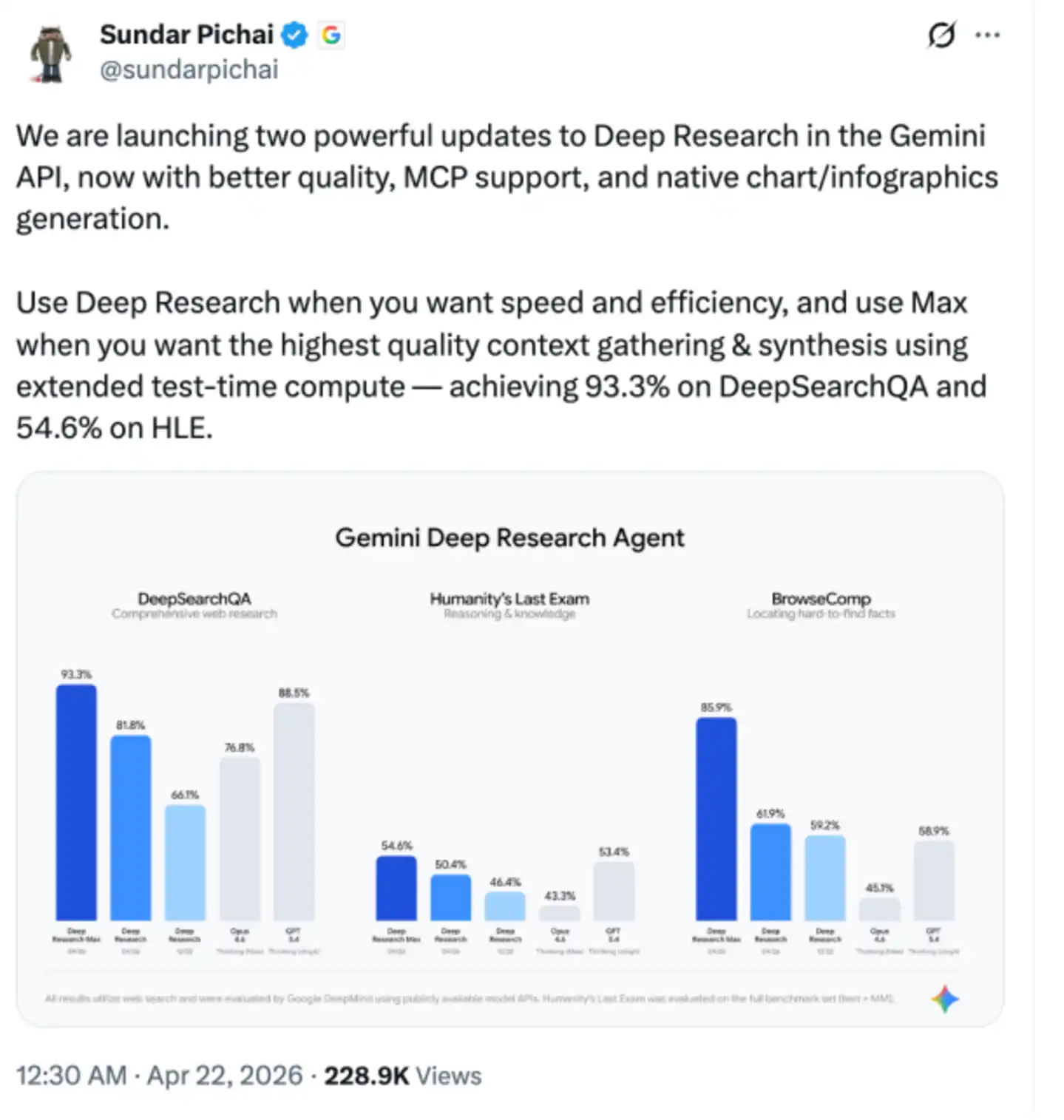
Google CEO Sundar Pichai also personally took to X to promote it: "When you need speed and efficiency, use Deep Research; when you pursue the highest quality context collection and synthesis, use the Max version—it achieves scores of 93.3% on DeepSearchQA and 54.6% on HLE through extended test-time computation."
Eighteen months ago, the goal of Google Deep Research was to help graduate students avoid being overwhelmed by a sea of browser tabs. Today, Google hopes it can replace the basic research work of investment banking junior analysts.

The gap between these two goals—and whether this technology can truly bridge it—will determine whether autonomous research agents become a transformative product in the enterprise software field or just another AI demo that looks impressive in benchmarks but disappoints in meetings.

Two Versions, Adapted to Different Workloads

The standard Deep Research has lower latency and lower cost, suitable for scenarios prioritizing speed.

Deep Research Max prioritizes depth over speed. This agent uses extended test-time computation for deep reasoning, searching, and iteration, ultimately generating a report.

Google points out that asynchronous background workflows are its ideal use case, such as running via a cron job at night and delivering a complete due diligence report to the analyst team the next morning.

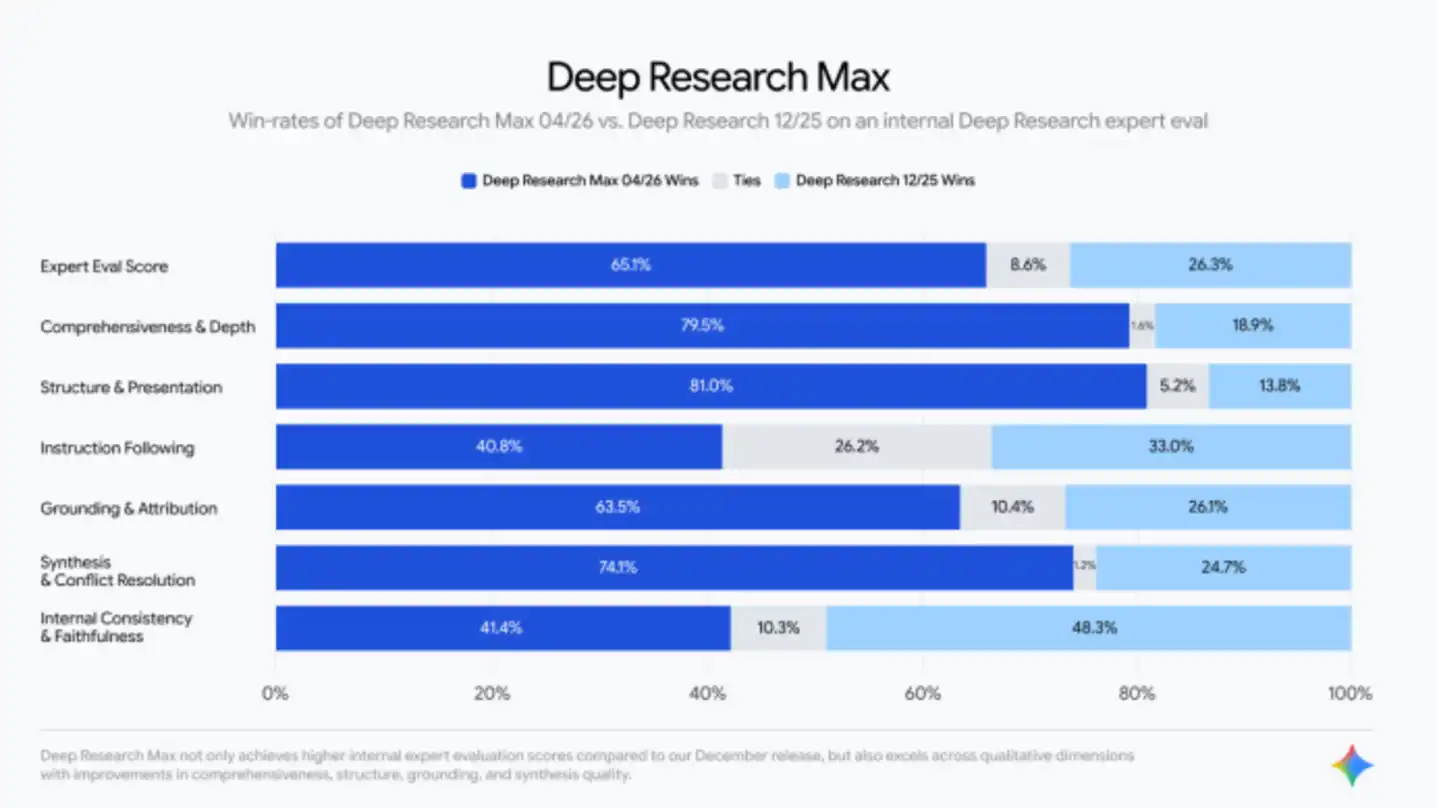
In Google's own benchmarks, Deep Research Max showed significant improvements in retrieval and reasoning tasks. The agent can gather information from more sources than previous versions and capture nuances that older models easily missed.
Google also provided a comparison with competitors.

However, comparing with OpenAI's GPT-5.4 and Anthropic's Opus 4.6 is not entirely fair. GPT-5.4 excels in autonomous web search but is not specifically optimized for deep research. For this, OpenAI provides its own DR agent, which switched to GPT-5.2, not GPT-5.4, after the February update. OpenAI's strongest search model is actually GPT-5.4 Pro, but Google clearly did not include it in the comparison.
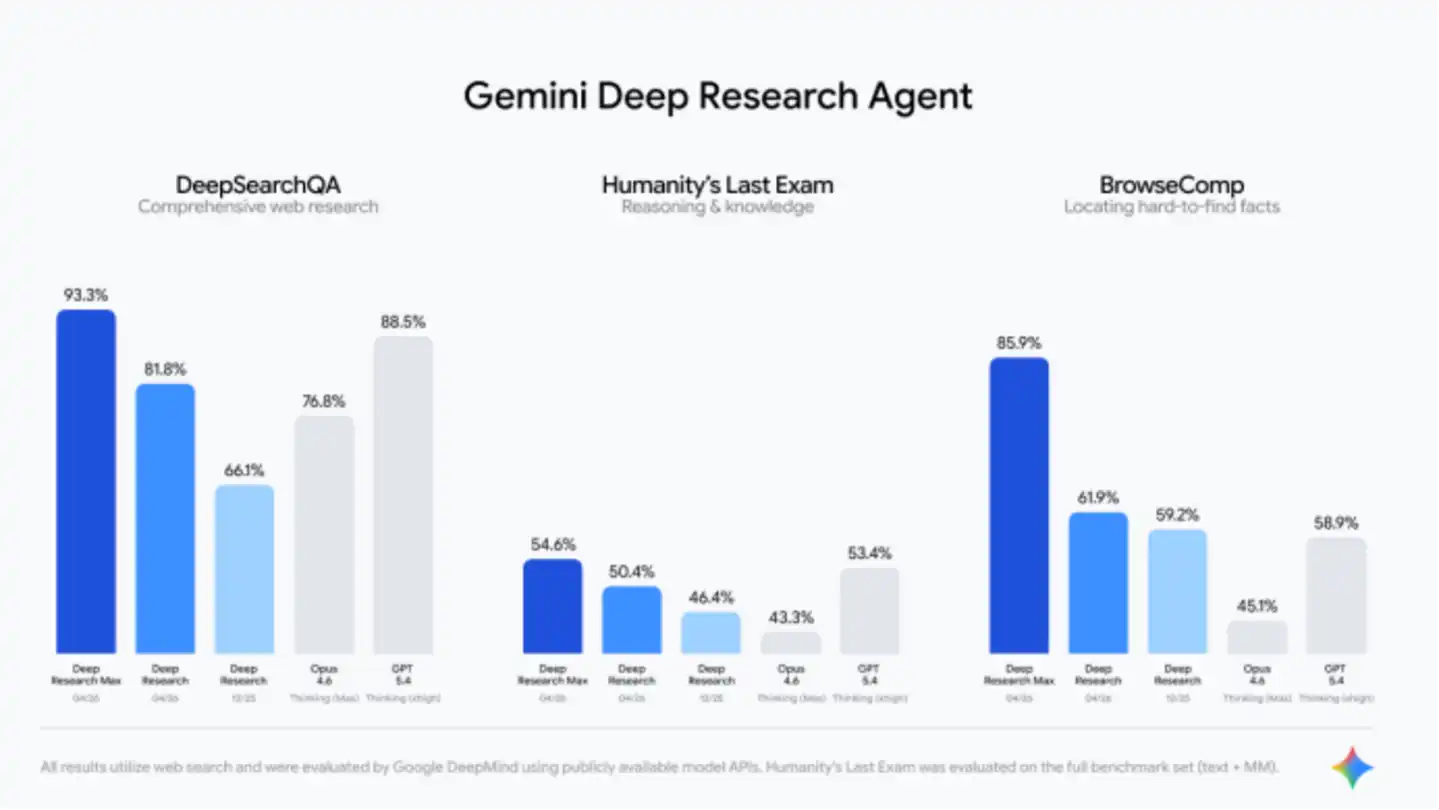
According to OpenAI's data, GPT-5.4 Pro can score up to 89.3% on the agent search benchmark BrowseComp, while GPT-5.4 scores 82.7%.

Based on Anthropic's own reports, Opus 4.6 scores higher on BrowseComp than the value shown, specifically 84%. This score was achieved with reasoning turned off, and the model performed better than the high-intensity reasoning settings used by Google in the API benchmark tests.

These discrepancies likely stem from differences in testing methods—whether the models were evaluated via the raw API or encapsulated within each lab's own toolchain. Google's data is not necessarily wrong, but it deserves cautious interpretation. In any case, the presentation lacks sufficient transparency.

MCP Support

Perhaps the most impactful feature of this release is the newly added support for the Model Context Protocol (MCP). This feature transforms Deep Research from a powerful web research tool into something closer to a "universal data analyst."

MCP is an emerging open standard for connecting AI models to external data sources. It allows Deep Research to securely query private databases, internal document repositories, and specialized third-party data services—all without sensitive information ever leaving its original environment.

In practice, this means a hedge fund could simultaneously point Deep Research to its internal trading flow database and a financial data terminal, then ask the agent to combine both with public information from the web to synthesize insights.

Google revealed that it is actively working with companies like FactSet, S&P, and PitchBook to design their MCP servers, clearly indicating that Google is seeking deep integration with data providers that Wall Street and the broader financial services industry rely on daily.

According to a blog post written by Google DeepMind product managers Lukas Haas and Srinivas Tadepalli, the goal is to "enable joint customers to integrate financial data products into workflows powered by Deep Research, and by leveraging its massive data universe, gather context at lightning speed, thereby leaping forward in productivity."

This feature directly addresses one of the most stubborn pain points in enterprise AI adoption: the huge gap between the information models can find on the open internet and the information organizations actually need for decision-making. Previously, bridging this gap required significant custom engineering work.

MCP support, combined with Deep Research's autonomous browsing and reasoning capabilities, simplifies most of this complexity to a one-time configuration. Developers can now have Deep Research use Google Search, remote MCP servers, URL Context, code execution, and file search simultaneously—or completely turn off web access and search only on custom data.

The system also supports multimodal input, including PDFs, CSVs, images, audio, and video, for use as grounding context.

Native Charts

The second major feature is native chart and infographic generation.

Previous versions of Deep Research could only generate plain text reports. If users needed visualizations, they had to export the data and create charts themselves. This shortcoming significantly weakened the "end-to-end automation" positioning.

Now, the new generation of agents can natively embed high-quality charts and infographics within reports, dynamically rendering complex datasets in HTML or Google's Nano Banana format, making them a direct part of the analytical narrative.

For enterprise users—especially those in the financial and consulting industries who need to produce deliverables ready for stakeholders—this feature transforms Deep Research from a tool that "accelerates the research phase" into one that can generate something close to a final analytical product.
Furthermore, combined with the new collaborative planning feature (which allows users to review, guide, and optimize the agent's research plan before execution) and real-time streaming of intermediate reasoning steps, the new system gives developers fine-grained control over the investigation scope while maintaining the high level of transparency required in regulated industries.

Deep Research Is Becoming Part of the "Infrastructure" Google Provides to Enterprises

Google's official blog post clearly states that when developers build using the Deep Research agent, they are calling "the same autonomous research infrastructure that powers multiple popular Google products (such as the Gemini App, NotebookLM, Google Search, and Google Finance)." This indicates that the agents provided via the API are not simplified versions of Google's internal build, but the same system, offered as a service at platform scale.

This evolution has progressed extremely rapidly.

Google first launched Deep Research in the Gemini App in December 2024 as a consumer-facing feature, then powered by Gemini 1.5 Pro. Google described it as a personal AI research assistant that could synthesize web information in minutes, saving users hours of work.

In March 2025, Google upgraded Deep Research using Gemini 2.0 Flash Thinking Experimental and opened trials to everyone. It was then upgraded to Gemini 2.5 Pro Experimental, with Google reporting that evaluators preferred its reports over competitors' by a 2-to-1 ratio.

December 2025 was a key turning point, as Google launched the Interactions API, providing Deep Research programmatically for the first time, powered by Gemini 3 Pro, and simultaneously released the open-source DeepSearchQA benchmark.

The underlying model driving these improvements is Gemini 3.1 Pro, released on February 19, 2026. It achieved a major leap in core reasoning capability: on the ARC-AGI-2 benchmark, which evaluates a model's ability to solve novel logic patterns, 3.1 Pro scored 77.1%, more than double that of Gemini 3 Pro.


Perguntas relacionadas

QWhat are the two new autonomous research agents announced by Google, and what are their key differences?

AGoogle announced two new autonomous research agents: Deep Research and Deep Research Max. The standard Deep Research has lower latency and lower cost, making it suitable for speed-critical scenarios. Deep Research Max prioritizes depth over speed, using extended test-time compute for in-depth reasoning, search, and iteration to generate reports, and is ideal for asynchronous background workflows.

QWhat is the Model Context Protocol (MCP) support in the new Deep Research agents, and why is it significant?

AThe Model Context Protocol (MCP) is an emerging open standard for connecting AI models to external data sources. Its support allows Deep Research to securely query private databases, internal document repositories, and third-party data services without sensitive information leaving its original environment. This transforms the agent from a powerful web research tool into a 'universal data analyst' and addresses a key enterprise adoption pain point by bridging the gap between public web information and proprietary organizational data.

QWhat new capability do the Deep Research agents have regarding data visualization, and why is it important for enterprise users?

AThe new Deep Research agents can natively generate high-quality charts and infographics within their reports, dynamically rendering complex datasets in HTML or Google's Nano Banana format. This is important for enterprise users, particularly in finance and consulting, as it transforms the tool from one that only accelerates the research phase into one that can produce analysis products that are nearly ready for delivery to stakeholders.

QHow are these new Deep Research agents made available to users, and is there any limitation for regular Gemini app subscribers?

AThe new Deep Research agents are available as a public preview exclusively through the paid tiers of the Gemini API, accessible via the Interactions API first introduced in December 2025. They are not available to regular users within the Gemini app, even for those who have a paid Pro subscription.

QWhat underlying model powers the latest Deep Research agents, and what major improvement does it offer?

AThe latest Deep Research agents are powered by the Gemini 3.1 Pro model. This model represents a major leap in core reasoning capabilities, achieving a score of 77.1% on the ARC-AGI-2 benchmark, which is more than double the score of its predecessor, Gemini 3 Pro. This benchmark evaluates a model's ability to solve novel logic patterns.

Leituras Relacionadas

How to Define "Real U.S. Stocks": Differences Between On-Chain Tokens, Price Contracts, and Direct Broker Connections

**Title:** Defining "Real US Stocks": Differences Among On-Chain Tokens, Price Contracts, and Broker-Direct Access **Summary:** In 2026, using stablecoins to purchase US stocks is mainstream, but products marketed as "buying US stocks with USDT" offer fundamentally different assets. This article analyzes three primary models. **1. Tokenized Stocks:** These are on-chain tokens representing economic exposure to underlying stocks, held by an issuer or custodian. They offer benefits like 24/7 trading and DeFi composability (e.g., use as loan collateral). However, users lack direct legal shareholder status; dividends may not be paid in cash, and voting rights are typically non-binding advisory expressions. Examples include platforms like Ondo Finance. **2. Stock Futures / Equity Perpetuals:** These are derivative contracts tracking a stock's price, allowing leveraged long/short positions 24/7, similar to crypto perpetuals. They offer high efficiency and flexibility but involve funding fees, which can be a significant long-term cost, especially during strong trends. Crucially, they confer no ownership rights (dividends, voting) to the holder. **3. Broker-Direct Model:** This model provides access to real securities via licensed broker-dealers. Stocks/ETFs are bought and held within the US clearing and custodial system (e.g., DTCC), making it the only path to genuine stock ownership. Users receive cash dividends and formal proxy voting rights (where applicable). It supports thousands of stocks and ETFs, far exceeding the coverage of the other two models. Key advantages include no funding fees, a clean cost structure for long-term holds, and the potential to transfer holdings to other brokers. Some platforms facilitate stablecoin (USDT/USDC) deposits, reducing reliance on traditional banking. A critical distinction exists *within* the broker-direct model: the underlying brokerage architecture (e.g., Fully Disclosed IB, Omnibus IB, Self-Clearing) determines how client assets are held, protected, and how safeguards like SIPC insurance are conveyed. Users should verify the specific clearing structure and regulatory compliance of any platform. In conclusion, "buying US stocks with USDT" can mean holding an on-chain economic proxy (Tokenized Stocks), trading a price derivative (Stock Futures), or owning the actual security (Broker-Direct). For users seeking full ownership rights and long-term investment, the broker-direct model is the definitive choice, though its implementation details require careful scrutiny.

marsbitHá 1h

How to Define "Real U.S. Stocks": Differences Between On-Chain Tokens, Price Contracts, and Direct Broker Connections

marsbitHá 1h

NVIDIA Launches DSX Platform, Expanding into AI Factory Infrastructure

NVIDIA has unveiled the DSX platform at its GTC Taipei event, marking a strategic expansion from GPU sales into comprehensive AI factory infrastructure solutions. The platform addresses challenges like power supply, cooling, and resource orchestration as AI models scale, shifting the industry focus from single-chip performance to overall infrastructure efficiency. DSX integrates NVIDIA's chips, systems, software, and partner technologies to cover the entire AI factory lifecycle—from design and simulation to deployment and operations. It aims to accelerate deployment, improve reliability and operational efficiency, and reduce the cost per generated token in AI inference. The software suite includes DSX MaxLPS, which uses 45°C liquid cooling and rack-level optimization to allow up to 40% more GPUs per megawatt, and DSX OS, an open-source platform for AI factory operations. The platform also encompasses reference designs, digital twin simulation (DSX Sim), dynamic workload adjustment based on grid conditions (DSX Flex), and data exchange between systems. Early adopters include cloud providers like CoreWeave and Lambda. Major hardware partners, including Dell, HPE, Lenovo, and Supermicro, are developing DSX-ready systems. Pilot projects for DSX Flex are underway with energy providers. Strategically, DSX represents NVIDIA's ongoing transition from an AI chip supplier to a full-stack AI infrastructure platform provider, aiming to set industry standards and solidify its market leadership.

marsbitHá 1h

NVIDIA Launches DSX Platform, Expanding into AI Factory Infrastructure

marsbitHá 1h

After Burning Tens of Billions of Dollars in Tokens, Silicon Valley Giants Start Limiting Employee Token Usage

After burning tens of billions of dollars on AI tokens, major Silicon Valley firms are now restricting employee usage. Companies like Microsoft, Uber, and Salesforce, which heavily promoted AI for "efficiency," are facing a cost crisis. The practice of "tokenmaxxing"—pushing employees to maximize AI tool usage—led to wasteful spending on trivial tasks like checking the weather or writing birthday messages, with studies showing significant hidden costs for bug fixes and code rewrites. The core issue is a misalignment between individual productivity gains and actual business value. While employees use AI to automate tasks they dislike, such as writing reports, this often doesn't translate to increased company revenue or improved core business outcomes. For instance, AI-generated code speeds up development but also sees an 800% increase in "code churn" (code being discarded or rewritten). As a result, only 14% of CFOs report seeing a clear, measurable return on AI investments. Firms are now shifting strategies. Microsoft has revoked most internal licenses for Claude Code, while others are implementing monitoring and cost controls. New tools from companies like Harness and CloudZero aim to track AI spending and tie costs to business results. Some AI vendors, like HubSpot, are moving from token-based pricing to charging based on outcomes, such as "resolved conversations" or "leads generated." This represents a necessary correction in the AI adoption cycle. The challenge now is for companies to move beyond using AI merely to speed up old tasks and instead rethink their workflows and business models fundamentally. The future of enterprise AI depends on proving its value, not just its usage.

marsbitHá 1h

After Burning Tens of Billions of Dollars in Tokens, Silicon Valley Giants Start Limiting Employee Token Usage

marsbitHá 1h

Trading

Spot
Futuros

Artigos em Destaque

Como comprar NIGHT

Bem-vindo à HTX.com!Tornámos a compra de Midnight (NIGHT) simples e conveniente.Segue o nosso guia passo a passo para iniciar a tua jornada no mundo das criptos.Passo 1: cria a tua conta HTXUtiliza o teu e-mail ou número de telefone para te inscreveres numa conta gratuita na HTX.Desfruta de um processo de inscrição sem complicações e desbloqueia todas as funcionalidades.Obter a minha contaPasso 2: vai para Comprar Cripto e escolhe o teu método de pagamentoCartão de crédito/débito: usa o teu visa ou mastercard para comprar Midnight (NIGHT) instantaneamente.Saldo: usa os fundos da tua conta HTX para transacionar sem problemas.Terceiros: adicionamos métodos de pagamento populares, como Google Pay e Apple Pay, para aumentar a conveniência.P2P: transaciona diretamente com outros utilizadores na HTX.Mercado de balcão (OTC): oferecemos serviços personalizados e taxas de câmbio competitivas para os traders.Passo 3: armazena teu Midnight (NIGHT)Depois de comprar o teu Midnight (NIGHT), armazena-o na tua conta HTX.Alternativamente, podes enviá-lo para outro lugar através de transferência blockchain ou usá-lo para transacionar outras criptomoedas.Passo 4: transaciona Midnight (NIGHT)Transaciona facilmente Midnight (NIGHT) no mercado à vista da HTX.Acede simplesmente à tua conta, seleciona o teu par de trading, executa as tuas transações e monitoriza em tempo real.Oferecemos uma experiência de fácil utilização tanto para principiantes como para traders experientes.

305 Visualizações TotaisPublicado em {updateTime}Atualizado em 2025.12.08

Como comprar NIGHT

Discussões

Bem-vindo à Comunidade HTX. Aqui, pode manter-se informado sobre os mais recentes desenvolvimentos da plataforma e obter acesso a análises profissionais de mercado. As opiniões dos utilizadores sobre o preço de NIGHT (NIGHT) são apresentadas abaixo.

活动图片












