Goldman Sachs Research Report Analysis: Sandisk NBM Locks in 80% Gross Margin, Target Price Sees 26% Upside

marsbitPublicado em 2026-09-10Última atualização em 2026-09-10

Resumo

Goldman Sachs report analysis: Sandisk's NBM contracts are expected to secure an 80% gross margin floor, with a target price implying 26% upside. At the Communacopia conference, Sandisk revealed that its long-term NAND Business Model (NBM) agreements cover 50% of planned FY27 and 67% of FY28 shipments. Crucially, these contracts contain floor-price clauses designed to protect approximately 80% gross margins even in a pessimistic NAND price downturn scenario. Goldman Sachs, in a September 9 report, reiterated its Buy rating with a 12-month price target of $2,200, implying 26.6% upside from the current $1,738. The core thesis is shifting from cyclical play to structural upgrade. The NAND market is transitioning from short-term spot pricing to long-term agreements, driven primarily by data center demand. Supply growth remains constrained while demand expands, fueled by AI inference. Sandisk, via its joint venture with Kioxia and its low capital intensity, is positioned for stronger earnings visibility. Key points from the report and management commentary: - **NBM & Margin Visibility:** The floor-price mechanism in NBMs significantly reduces exposure to spot price volatility, locking in high-margin revenue for a substantial portion of future shipments. - **Tight Supply Dynamics:** Management expects limited NAND supply growth, with AI inference driving demand. Chinese competitors' capacity expansions are viewed as largely absorbed by the domestic market. - **Long-Term Growth v...

Author: Rita

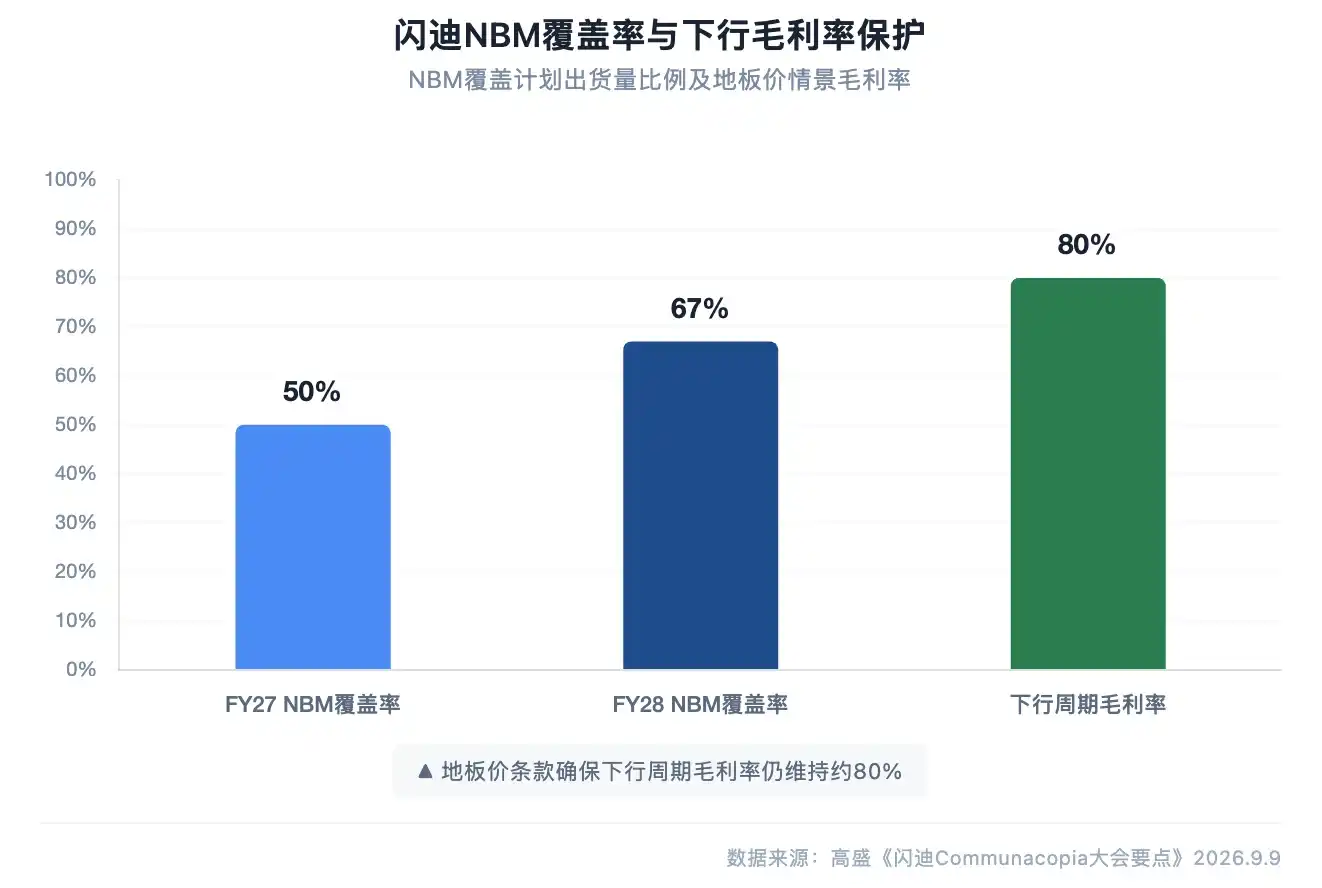
At the Communacopia conference, Sandisk revealed that its long-term agreements (NBM) now cover 50% of FY27 and 67% of FY28 planned shipment volumes. Even in a pessimistic NAND price decline scenario, the floor prices in these agreements can still support a gross margin of around 80%. In its conference summary report dated September 9, Goldman Sachs maintained its 'Buy' rating with a 12-month target price of $2,200, implying a 26.6% upside potential from the current price of $1,738.

Goldman Sachs believes Sandisk's core investment thesis is shifting from cyclical speculation to structural upgrade. The NAND market is transitioning from short-term spot pricing to long-term agreements, with data center demand becoming the primary driver. Growth on the supply side is constrained, while demand continues to expand driven by AI inference. Through its joint venture platform with Kioxia and low capital intensity, Sandisk possesses stronger earnings visibility in this cycle.

NBM Locks in 80% Gross Margin

Sandisk's management detailed the financial components of NBM at the conference. The floor price clause is central, ensuring that under extreme scenarios of significant NAND price declines, the gross margin for the majority of its business can still be maintained at around 80%. This protective mechanism alters Sandisk's profit structure, making it no longer fully exposed to the sharp fluctuations of spot prices.

In terms of coverage ratio, 50% of FY27 planned shipments and 67% of FY28 are covered by NBM. Goldman Sachs views this coverage as a significant improvement in Sandisk's revenue visibility for the next two years. Management's confidence in long-term financial targets is precisely built upon the certainty brought by these agreements.
Supply Constraints, Chinese Capacity Absorbed Domestically

Sandisk's outlook on the NAND supply side is tight. Management believes that supply growth will remain sluggish for the foreseeable future, while the proliferation of AI inference continues to drive demand growth. This supply-demand dynamic provides support for prices.

Regarding capacity expansion by Chinese competitors, Sandisk believes that their new supply is primarily absorbed by the local market, having a limited impact on the global market. Goldman Sachs also mentioned in its report that YMTC's roadmap iteration is a potential risk, but its impact is judged to be manageable at present.

HBF Opens Long-Term Space

Sandisk management expressed optimism about the long-term prospects of HBF and KV Cache. HBF is seen as a potential solution to the AI 'memory wall' problem, with its higher density able to meet the dual demands of AI computing for memory bandwidth and capacity. KV Cache is crucial for AI inference; management had previously described it as a key component of the AI data center memory TAM.

Goldman Sachs cited management's estimate that by 2032, KV Cache will account for approximately 35% of the 1.2 ZB AI data center memory TAM. This data suggests that Sandisk has far greater long-term growth space in the AI storage field than in traditional NAND.

Low Capital Intensity Supports Bit Growth

Sandisk's joint venture agreement with Kioxia has been extended to 2034. Management emphasized that this arrangement, combining IP ownership and R&D investment, gives the JV efficient manufacturing capability, allowing it to gain a disproportionate share of bit growth relative to capital expenditure. Sandisk's capital intensity is about 5%, significantly lower than the industry average.

Management also stated that through the BiCS platform, the company can already see the technology roadmap for several years ahead, supporting further bit growth under the same low capital intensity. Goldman Sachs believes this cost advantage is a key differentiating factor for Sandisk compared to its peers.

Share Buybacks Lead Capital Return

Sandisk reiterated that share repurchases are the primary method for returning excess capital to shareholders. The company has executed approximately $4.5 billion in buybacks. Management remains open to introducing dividends in the future, but buybacks remain the core tool at this stage.

Goldman Sachs's $2,200 target price is based on a 20x P/E multiple applied to a normalized EPS of $110. The current price of $1,738 implies a 26.6% upside potential. Goldman Sachs believes the earnings stability brought by NBM, the industry's constrained supply, and low capital intensity jointly support this valuation.

Downside risks include: the long-term structural shift in NAND pricing failing to materialize; YMTC continuing to iterate its technology roadmap; Sandisk failing to gain eSSD market share.
Disclaimer

This article is Tide Research's compilation and interpretation of a third-party brokerage research report (Goldman Sachs, September 9, 2026), combined with the organization of public market information. The ratings, target prices, earnings forecasts, and related judgments cited in this article are the views of that brokerage's analyst, representing only the stance of their affiliated institution, and do not represent Tide Research's views, nor do they constitute any investment advice.

The market carries risks; decisions must be made independently. This article should not serve as the basis for buying or selling any securities.


Perguntas relacionadas

QWhat is the key financial protection mechanism of SanDisk's NBM (Long-term Agreements) mentioned in the report, and what level of gross margin does it support?

AThe core financial protection mechanism is the floor price clause. This clause ensures that, even in a pessimistic scenario of declining NAND prices, it can support a gross margin of approximately 80% for a majority of SanDisk's business covered by these agreements.

QWhat is the current stock price of SanDisk and Goldman Sachs' 12-month target price, as stated in the article?

AThe current stock price is $1738. Goldman Sachs' 12-month target price is $2200, implying an upside potential of 26.6%.

QAccording to Goldman Sachs, what is the main reason for SanDisk's shift in core investment logic?

AGoldman Sachs believes SanDisk's core logic is shifting from cyclical speculation to structural upgrade. This is due to the NAND market's transition from short-term spot pricing to long-term agreements, with data center demand becoming the primary driver.

QWhat does SanDisk management predict regarding the long-term TAM (Total Addressable Market) contribution of KV Cache for AI data center memory by 2032?

AManagement's calculation, cited by Goldman Sachs, indicates that by 2032, KV Cache will account for approximately 35% of the 1.2 Zettabyte AI data center memory TAM.

QWhat is SanDisk's current primary method for returning excess capital to shareholders, and what is an alternative they remain open to?

ASanDisk's primary method for returning excess capital is through stock repurchases. The company has already executed about $4.5 billion in buybacks. Management is open to introducing a dividend in the future, but share repurchases remain the core tool for now.

Leituras Relacionadas

Tian Yuandong: After Co-authoring My Last Paper with GPT-5, I Realized I Would Be Unemployed Within 5 Years

After co-authoring his final paper at Meta with GPT-5, AI researcher Yuandong Tian realized his research role could be obsolete within five years. Reflecting in a podcast, Tian—a former Meta FAIR scientist and co-founder of Recursive Superintelligence—discussed AI's accelerating research capabilities, citing OpenAI's recent release of 722 AI-generated math manuscripts. He recounted his career evolution: from CMU debates on whether AlexNet was a fluke, to building the early Go AI DarkForest at Meta, and later exploring reinforcement learning and latent-space reasoning (as in the Coconut paper). His work on grokking with GPT-5 boosted his productivity 6-10x, highlighting AI's growing role in experimentation and implementation. However, Tian argues human researchers remain crucial for initiating projects and validating AI-generated ideas. Current AI excels at repetitive tasks but struggles with novel, high-level concepts. He emphasizes that designing the right "action space" is often more critical than the algorithm itself. On AI advancement, Tian is optimistic about open-source models catching up to closed ones and advocates for open research to avoid a future where powerful AI is controlled by a few. He believes the next leap requires new architectures enabling human-like learning efficiency with minimal data, potentially through reinforcement learning and recursive self-improvement. Despite the challenges, Tian sees this as an opportunity to leverage AI for tackling larger, more profound problems.

marsbitHá 3h

Tian Yuandong: After Co-authoring My Last Paper with GPT-5, I Realized I Would Be Unemployed Within 5 Years

marsbitHá 3h

What Is Citrini Buying in a Major Downturn?

Amidst a significant market downturn, Citrini Research, known for its AI-focused "2028 Global Intelligence Crisis" report, has published a new analysis titled "Breaking The Wall." The report discusses the intersection of Agentic AI, cryptocurrency, and traditional finance, and notably reveals a curated basket of 15 crypto tokens, entirely excluding Bitcoin (BTC) and Ethereum (ETH). This portfolio is structured around three primary themes, allocating 92% of its weight. The largest allocation, 39%, is dedicated to the derivatives sector, featuring newer projects like Derive (DRV) and Lighter (LIT) at a full 10% each, surpassing the 7% weight given to the more established Hyperliquid (HYPE). This signals a belief that the perpetual DEX arena remains open for newer entrants to gain ground. A 27% allocation targets the yield and staking narrative, covering the "on-chain interest rate" ecosystem from liquid staking tokens (Ether.fi - ETHFI at 10%) and synthetic dollars (Ethena - ENA at 9%) to fixed-income protocols (Pendle - PENDLE at 3%). A 26% portion is assigned to blue-chip and infrastructure assets like Aave (AAVE), Solana (SOL), and Chainlink (LINK), with Uniswap (UNI) receiving a relatively modest 4%. The remaining allocations include LayerZero (ZRO) for cross-chain and Ondo (ONDO) for Real World Assets (RWA). Separately, Citrini's public market equity basket is exclusively focused on compliant financial infrastructure—such as Securitize (20%), Circle, and Coinbase—with no exposure to bitcoin proxy stocks like MicroStrategy. The key takeaway is not the specific tokens, but the underlying investment thesis: Citrini is prioritizing assets with clear cash flows, user adoption, and auditability. The portfolio construction deliberately avoids meme coins, AI agent tokens, and L2 airdrop tokens, concentrating instead on derivatives, yield-generating protocols, and the regulated gateways for traditional capital entering the crypto space.

marsbitHá 4h

What Is Citrini Buying in a Major Downturn?

marsbitHá 4h

Trading

Spot
活动图片