Goertek Micro's IPO Terminated Again: Two Failed Attempts to Enter the Capital Market, Previously Raised 19.5 Billion

marsbitPublished on 2026-10-13Last updated on 2026-10-13

Abstract

Goertek Microelectronics' IPO has been terminated for the second time. Its parent company, Goertek Inc., announced the decision to halt the planned spin-off and listing of Goertek Microelectronics on the Hong Kong Stock Exchange Main Board. The decision was made after comprehensive consideration of external environmental changes and the companies' own development plans. This marks the second failed attempt by Goertek Microelectronics to go public. It had previously sought a listing on the Shenzhen Stock Exchange's ChiNext board in 2022, aiming to raise 3.19 billion yuan, but was unsuccessful. The company then switched its focus to the Hong Kong market in early 2025. Goertek Microelectronics is a semiconductor company primarily focused on the R&D, production, and sales of MEMS devices and microsystem modules. Financial data shows the company's revenue was 4.536 billion yuan in 2024, with an adjusted net profit of 365 million yuan. For Q1 2025, revenue grew 54% year-over-year to 1.12 billion yuan. The company had previously raised 1.95 billion yuan in a 2021 financing round. Goertek Inc. stated that the termination of the spin-off will not adversely affect the ongoing healthy development of either company, their future strategic plans, or their financial and operational performance. Goertek Microelectronics will continue operating as a subsidiary, focusing on business expansion in areas like sensing, interaction, and semiconductors.

On the 12th, Goertek Inc. announced that its board of directors agreed to terminate the spin-off and listing of its subsidiary, Goertek Micro Electronics Co., Ltd. ("Goertek Micro"), on the Main Board of The Stock Exchange of Hong Kong Limited.

Goertek Inc. stated that since the planning of this spin-off and listing initiative, the company has been advancing related matters, organizing intermediaries to conduct due diligence and other related work, and strictly fulfilling decision-making procedures and information disclosure obligations in accordance with the requirements of relevant laws, regulations, and normative documents.

Based on comprehensive consideration of changes in the external environment, as well as the development plans of both the company and Goertek Micro, and adhering to the principle of safeguarding shareholder interests and being responsible to shareholders, the company decided to terminate the spin-off and listing of Goertek Micro on the Main Board of the Hong Kong Stock Exchange after prudent discussion and evaluation.

Goertek Inc. emphasized that after the termination of this spin-off and listing, Goertek Micro will continue to actively expand its business in fields such as sensing and interaction, and semiconductors as a subsidiary of the company. The termination of this spin-off and listing will not affect the continued healthy development of the company and Goertek Micro, will not impact the implementation of the company's future strategic plans, and will not have any significant adverse effects on the company's production, operational activities, or financial condition.

Consecutive Failures in Attempting ChiNext and Hong Kong Stock Exchange Listings

The listing journey of Goertek Micro has been tumultuous. It initially attempted to list on the Shenzhen Stock Exchange's ChiNext board. In October 2022, it even submitted a draft for the listing committee hearing, planning to raise 3.19 billion yuan, but ultimately did not succeed.
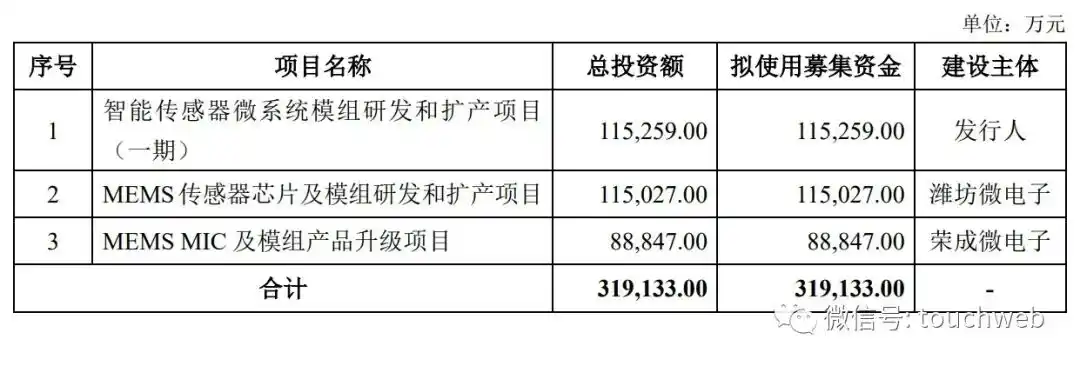
In January 2025, Goertek Micro shifted its focus to the Hong Kong Stock Exchange. After nearly two years, its listing attempt was terminated once again.

It is reported that in 2004, Goertek Micro Electronics started as a department within Goertek Inc., beginning its microelectronics business with the independent development of MEMS chips.
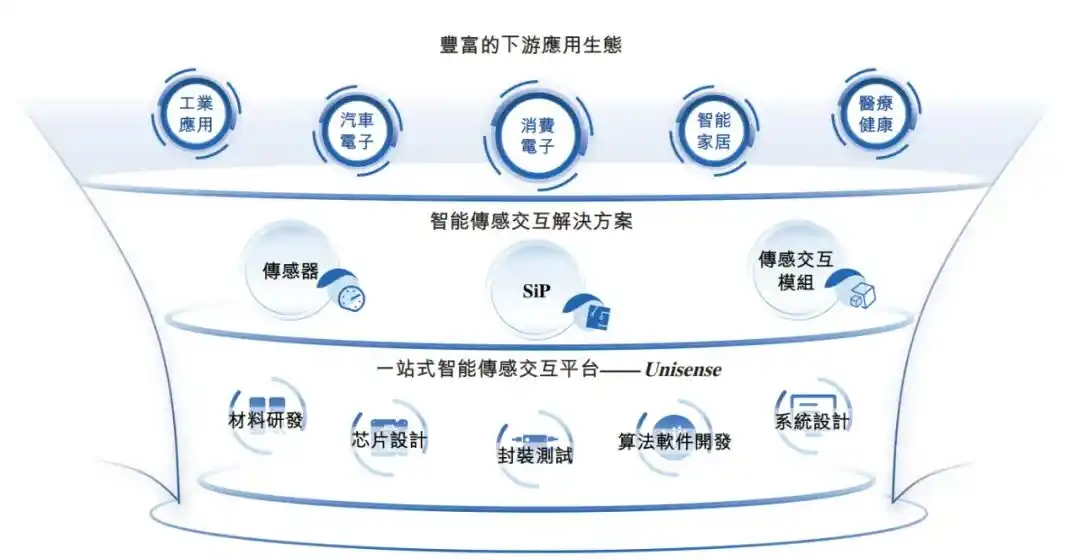
As the sole entity within the Goertek system engaged in microelectronics-related business, it is a semiconductor company primarily focused on the R&D, production, and sales of MEMS devices and microsystem modules. Its business covers key segments of the industry chain such as chip design, product development, packaging and testing, and system applications. Through vertical integration, it provides customers with a one-stop product solution of "chip + device + module".

The prospectus shows that Goertek Micro Electronics' revenue for 2022, 2023, and 2024 was 3.12 billion yuan, 3 billion yuan, and 4.536 billion yuan, respectively; gross profit was 577 million yuan, 517 million yuan, and 861 million yuan, respectively; operating profit was 306 million yuan, 213 million yuan, and 269 million yuan, respectively; profit for the period was 325 million yuan, 289 million yuan, and 309 million yuan, respectively.
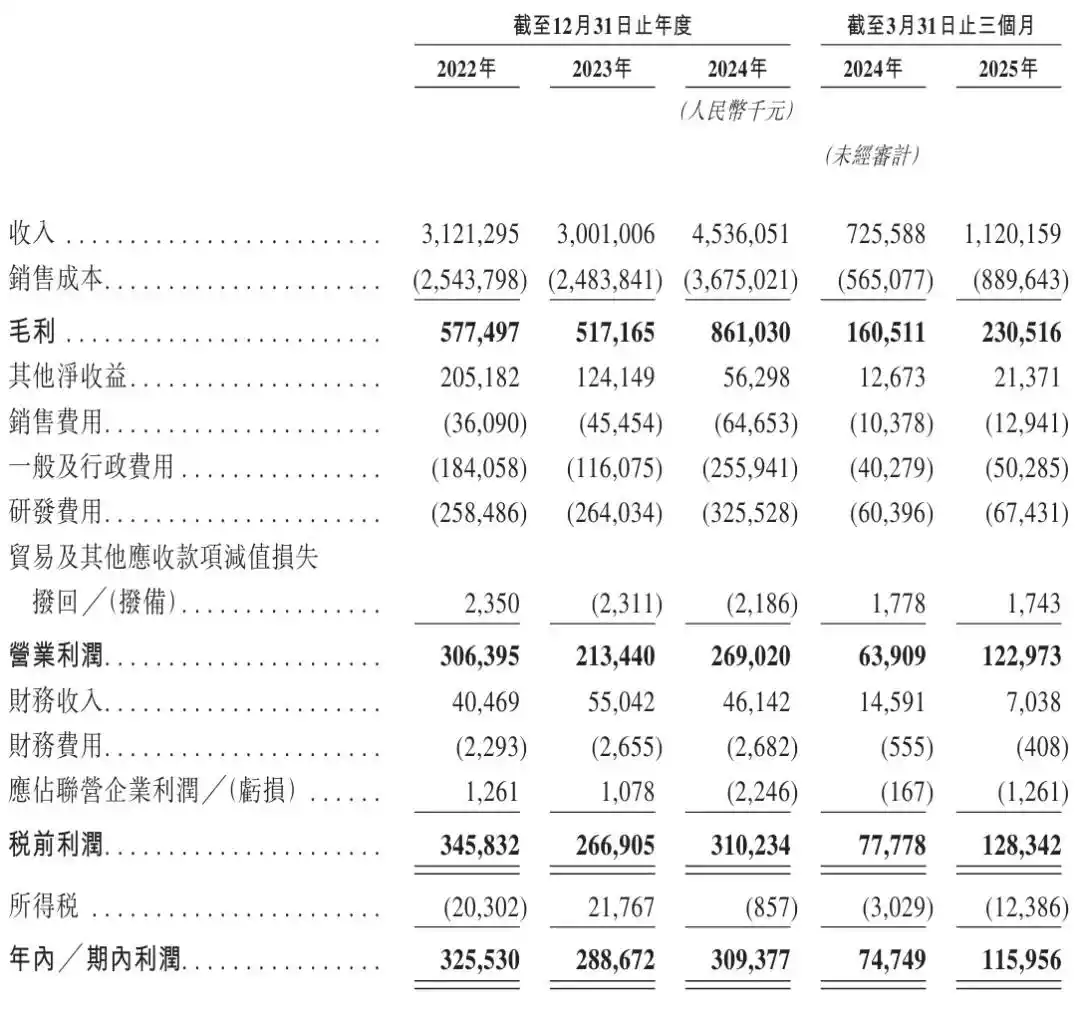
In the first quarter of 2025, Goertek Micro Electronics' revenue was 1.12 billion yuan, a 54% increase compared to 726 million yuan in the same period last year; gross profit was 230 million yuan, compared to 161 million yuan in the same period last year; operating profit was 123 million yuan, compared to 63.91 million yuan in operating profit in the same period last year; non-GAAP net profit was 116 million yuan, compared to 74.75 million yuan in non-GAAP net profit in the same period last year.

Goertek Micro Electronics' adjusted net profit for 2022, 2023, and 2024 was 379 million yuan, 254 million yuan, and 365 million yuan, respectively; the adjusted net profit for the first three months of 2025 was 133 million yuan, compared to 82.53 million yuan in adjusted net profit in the same period last year.
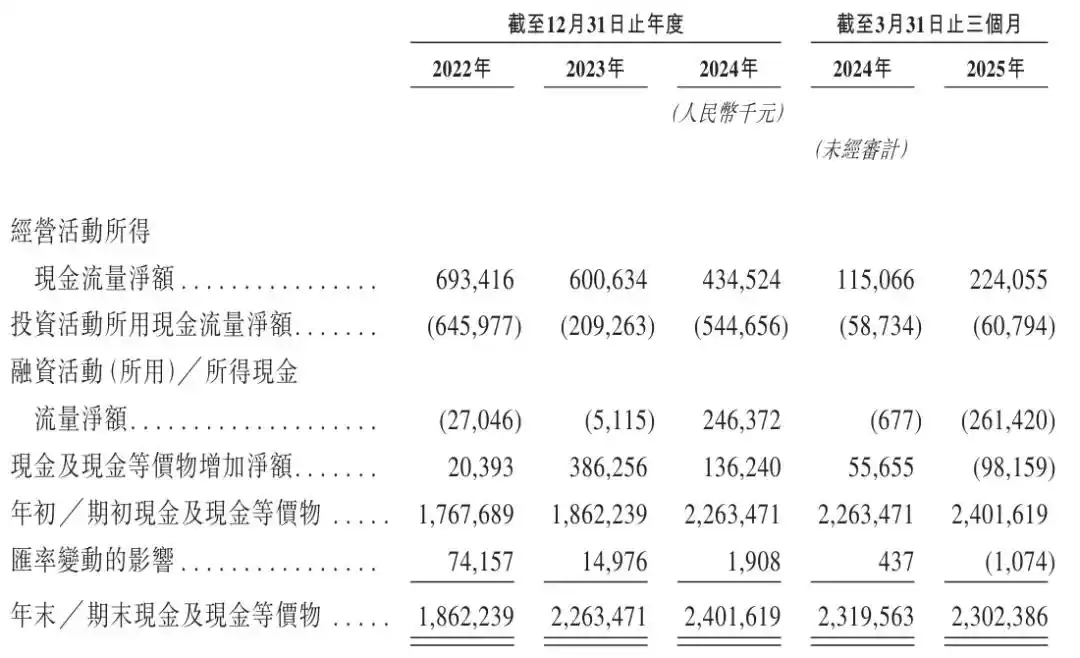
As of March 31, 2025, Goertek Micro Electronics held cash and cash equivalents of 2.3 billion yuan.

Previously Raised 19.5 Billion, Goertek Inc. is the Major Shareholder

The executive directors of Goertek Micro are Dr. Song and Ma Xinjiang; the non-executive directors are Jiang Xun and Li Yongzhi; the independent non-executive directors are Dr. Wang Qian, Dr. Peng Chunrong, and Ms. Chen Yuehua.

Goertek Micro Electronics raised 1.95 billion yuan in financing in March 2021. Among the investors, Gongqingchun Chunlin subscribed for 270 million yuan, Qingdao Henghuitai subscribed for 200 million yuan, Rongcheng Urban Construction, Shenzhen Linghui, and CITIC Securities each subscribed for 100 million yuan, Beijing Chunlin subscribed for 90 million yuan, Eden Media subscribed for 60 million yuan, CCB International Capital subscribed for 50 million yuan, CICC Qichen and China Electronics & CICC each subscribed for 45 million yuan, Guowei Runxin subscribed for 40 million yuan, and CCB Science and Technology Innovation subscribed for 20 million yuan.

The cost per share for these shareholders' subscriptions was 22.86 yuan. The actual controllers of Goertek Micro Electronics are Jiang Bin and Ms. Hu Shuangmei, who are husband and wife.

Financial reports show that Goertek Inc.'s revenue for the first half of 2026 was 40.046 billion yuan, an increase of 6.65% compared to 37.549 billion yuan in the same period last year.
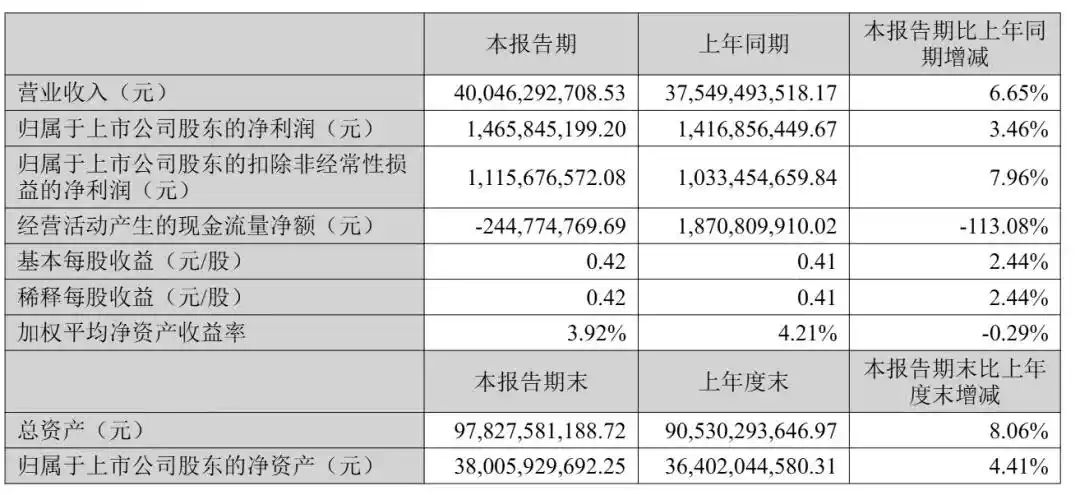
Goertek Inc.'s net profit for the first half of 2026 was 1.466 billion yuan, an increase of 3.46% compared to 1.417 billion yuan in the same period last year; non-GAAP net profit was 1.116 billion yuan, an increase of 8% compared to 1.033 billion yuan in the same period last year.

As of June 30, 2026, Goertek Group Co., Ltd. held 15.63% of the shares, Jiang Bin held 8.09%, Jiang Long held 7.05%, Hong Kong Securities Clearing Company Ltd. held 1.84%, Goertek Inc. - "Home 8" Employee Stock Ownership Plan held 1.06%, Goertek Inc. - "Home 6" Employee Stock Ownership Plan held 0.85%;
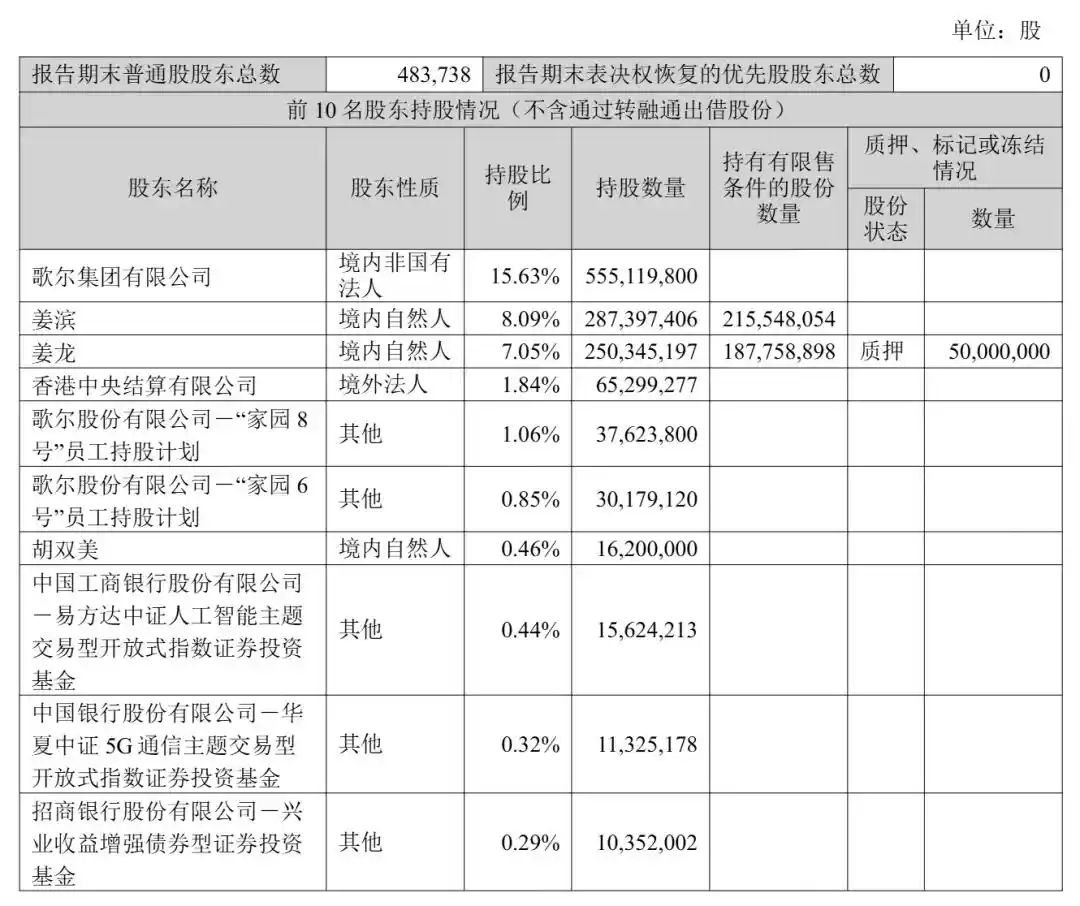
Goertek Shareholding Structure as of June 30, 2026

Hu Shuangmei held 0.46%, Industrial and Commercial Bank of China Limited - Huatai-PineBridge CSI 300 Exchange Traded Fund held 0.44%, Bank of China Limited - ChinaAMC CSI 5G Communication Theme Exchange Traded Fund held 0.32%, China Merchants Bank Co., Ltd. - Industrial Income Enhanced Bond Securities Investment Fund held 0.29%.

As of today's market close, Goertek Inc.'s stock price was 20.85 yuan, with a market capitalization of 74.2 billion yuan.

This article is from the WeChat public account "雷递" (ID: touchweb), author: Lei Jianping

Related Questions

QWhat was the primary reason given by Goertek Inc. for terminating the spinoff and listing of its subsidiary, Goertek Microelectronics, on the Hong Kong Stock Exchange?

AThe primary reason given was based on a comprehensive consideration of changes in the external environment and the development plans of both Goertek Inc. and Goertek Microelectronics, aiming to uphold the interests of shareholders and take responsibility for them.

QWhat are the two capital markets that Goertek Microelectronics has attempted and failed to list on?

AGoertek Microelectronics first attempted to list on the Shenzhen Stock Exchange's ChiNext board, and later on the Hong Kong Stock Exchange's main board, failing on both occasions.

QHow much did Goertek Microelectronics aim to raise during its 2022 attempt to list on the ChiNext board?

ADuring its 2022 attempt to list on the ChiNext board, Goertek Microelectronics aimed to raise 3.19 billion RMB.

QWhat was Goertek Microelectronics' revenue for the year 2024 according to its prospectus?

AAccording to its prospectus, Goertek Microelectronics' revenue for the year 2024 was 4.536 billion RMB.

QWho are the actual controlling persons of Goertek Microelectronics, and what is their relationship?

AThe actual controlling persons of Goertek Microelectronics are Jiang Bin and Hu Shuangmei, and they are husband and wife.

Related Reads

Crypto Stocks Weekly丨Strategy Adds 1,036 BTC but Holdings Fall Below Cost Basis; Bitmine Holds 4.97% of ETH Supply (November 10)

The article begins by noting that Democrats swept both chambers of Congress, ushering in a divided-government phase, after which markets shifted focus to AI regulation and capex payback cycles, with Anthropic's IPO seen as a bellwether for AI stocks. US equities fell sharply (Nasdaq -5.52% and Philadelphia Semiconductor Index -12.24% on Nov 5) before a Monday rebound driven by falling oil prices and oversold buying—characterized as a repair, not a new high. Macro data showed October nonfarm payrolls +165k and unemployment at 4.1%, keeping 10-year Treasury yields near 4.86% and rate-hike expectations alive. Citi cut US equities and global tech to neutral while upgrading Europe ex-UK, citing unstable AI sentiment; Goldman noted AI stocks are ~40% of the S&P 500 versus ~15% of STOXX 600. Crypto diverged from the equity rebound: US spot Bitcoin ETFs saw $1.282B in weekly net outflows (BlackRock's IBIT -$12.09B... actually $1.209B), Ethereum ETFs -$365M for a sixth straight weekly outflow, with continued outflows on Nov 9. NYSE-affiliated tokenized securities platform chose Avalanche for settlement infrastructure. Corporate treasury updates: Strategy bought 1,036 BTC at ~$79,012 (total 850,364 BTC, average cost ~$75,456, now above spot), funded partly by ATM share sales, with most proceeds used to repurchase STRC preferred shares. Strive added 29 BTC (total 43,153). Listed companies now hold over 6% of Bitcoin's supply (1.2664M BTC across 199 firms). Bitmine added 9,587 ETH, holding 6,070,092 ETH (~4.97% of supply, ~99% of its 5% goal). DeFi Development Corp's SOL rose to 2,609,829. Hyperliquid Strategies raised $911M in Q3, bought ~9.1M HYPE (holdings up to 38.5M, ~16% of circulating supply), and repurchased ~2.7M PURR shares.

marsbit11m ago

Crypto Stocks Weekly丨Strategy Adds 1,036 BTC but Holdings Fall Below Cost Basis; Bitmine Holds 4.97% of ETH Supply (November 10)

marsbit11m ago

When Will the Chip Stock 'Capitulation-Style Selling' End? BofA: Perhaps in Early 2027, Stock Price Pullbacks Typically Lead Fundamental Inflection Points by 6-9 Months

The SOX semiconductor index has fallen 38% (from 14,634 to 9,011) since its June 22, 2026 peak, over 136 days—exceeding the average historical peak-to-trough decline of 32% but less than half the average 253-day duration of past downturns (2011, 2015, 2018, 2022). BofA analyst Vivek Arya expects this "indiscriminate selling," driven by AI capex slowdown fears, to end around early 2027. Historically, SOX declines lead actual semiconductor sales declines by 6–9 months, implying real EPS cuts may emerge from Q1 2027, with capex reductions reflected in H2 2027—though stocks may already price in much of the bad news. SOX currently trades at 13.7x forward P/E versus 17.7x for the S&P 500 (a 22% discount, down from a 15% premium at the AI peak), leaving roughly 12% downside to the historical trough valuation of ~12x. US cloud capex runs at ~$300B/quarter (~$1.2T annualized) versus $1.555T consensus for 2027—about 23% below expectations if spending holds steady, equating to ~30 GW of compute deployment versus BofA's 40+ GW base case. A 20% capex cut would pressure AI semiconductor revenue by 20%+ and EPS by 35–40%. BofA outlines three scenarios: base case ( ~10% downside, bottoming Q1 2027, favor segment leaders), bear case (pressure into mid-2027, favor EDA, high-FCF analog, low-AI-exposure names), and bull case (favor memory, optics, quantum, CPUs). Potential stabilizers include policy clarity in Q1 2027, buybacks (Lam $25B, Nvidia, Micron starting Dec 9), and slower capex extending the upcycle.

marsbit31m ago

When Will the Chip Stock 'Capitulation-Style Selling' End? BofA: Perhaps in Early 2027, Stock Price Pullbacks Typically Lead Fundamental Inflection Points by 6-9 Months

marsbit31m ago

TSMC: October Revenue Up 60%, with Month-over-Month Growth Still Accelerating

TSMC reported October consolidated revenue of NT$586.89 billion, up 59.7% year-over-year and 14.7% month-over-month, signaling accelerating momentum. Converted to RMB, that is about RMB 119.4 billion, with cumulative revenue for the first ten months reaching NT$4.49 trillion, up 43.3% year-over-year. The near-60% growth came on top of an already high base, while the sequential acceleration confirms strengthening demand rather than a slowdown. The report arrived at a delicate moment. The Philadelphia Semiconductor Index had plunged 12.25% over two sessions, its worst single-day drop since March 2020, as political changes in the U.S. prompted new governors in Texas and Ohio to pause approvals for new data center projects. Markets pessimistically priced in a halt across the AI data center supply chain. Sentiment rebounded sharply on November 9, with the semiconductor index jumping 6.86%, and Taiwan's weighted index surging 1,960.06 points, its second-largest single-day gain on record, supported by government stabilization funds and short-selling restrictions. TSMC stands apart from other AI assets. As the only foundry capable of mass-producing 3nm and 2nm chips, it holds about 90% of the global AI chip foundry market, with advanced-node capacity booked through 2028. Its diversified revenue mix—68% high-performance computing, 21% smartphones, 4% automotive and 4% IoT—provides a buffer, allowing it to reallocate capacity to flagship phone chips, automotive computing, and edge AI if data center approvals slow. October's results validate management's guidance of roughly 44% full-year dollar revenue growth and capital spending of US$60-64 billion. Expansion continues, with 2nm ramping and Arizona's second fab moved up to Q3 2027; Goldman Sachs raised its 12-month target price to NT$3,300. Google's expanded eighth-generation TPU lineup adds further demand, with TSMC and other Taiwanese suppliers in the ecosystem. TSMC's ADR trades at about 24x trailing earnings, low relative to its growth. Risks include a prolonged U.S. data center approval freeze and geopolitical or oil-price shocks. In A-shares, domestic substitution names such as SMIC and NAURA remain driven by rising localization rather than Texas approvals.

marsbit32m ago

TSMC: October Revenue Up 60%, with Month-over-Month Growth Still Accelerating

marsbit32m ago

Trading

Spot
活动图片