Global Top Streamer MrBeast Becomes a Major Card for Tom Lee

比推Publicado em 2026-01-16Última atualização em 2026-01-16

Resumo

This article details the strategic $200 million investment by BitMine Immersion Technologies (BMNR), led by Wall Street analyst Tom Lee, into Beast Industries, the holding company of global YouTube phenomenon MrBeast. The deal signals a major move to explore integrating DeFi into Beast's upcoming financial services platform. MrBeast, whose main channel has over 460 million subscribers, built an empire on ultra-high-cost, viral video content, often spending millions per video. His business, Beast Industries, now generates an estimated $400 million in annual revenue across content, consumer goods (like his profitable Feastables chocolate brand), and licensing, with a valuation around $5 billion. Despite this, MrBeast operates with minimal personal cash flow, reinvesting nearly all profits back into content to fuel growth and maintain his massive audience reach. The partnership with Tom Lee and BMNR is framed as a necessary evolution. Facing the limits of a high-cost, ad-reliant model, Beast Industries aims to build a more sustainable economic relationship with its audience through decentralized finance (DeFi). Potential applications include a lower-cost payment layer, a programmable account system for creators and fans, and decentralized asset tracking. The article positions this as a high-risk, high-reward experiment in transforming a vast attention economy into a new financial infrastructure, all while being mindful of not eroding the immense trust MrBeast has built with hi...

$200 million is the figure just announced today.

BitMine Immersion Technologies (BMNR), chaired by Wall Street renowned analyst Tom Lee , announced that it will invest in Beast Industries, the holding company behind global top streamer MrBeast. Meanwhile, Beast Industries mentioned in its official statement that the company will explore how to "integrate DeFi into the upcoming financial services platform" in the future.
If you only look at the news, it seems like another familiar crossover: traditional, crypto, internet celebrity, entrepreneurship. On one side is the YouTube霸主 (overlord) with cumulative global subscriptions exceeding 400 million, where a single video can get the algorithm to weight you spontaneously; on the other side is Wall Street's top analyst best at telling crypto narratives, skilled at writing grand blockchain concepts into balance sheets. Everything seems perfectly logical.

MrBeast's Journey

Looking back at MrBeast's early videos, it's hard to connect them to today's Beast Industries, valued at $5 billion.
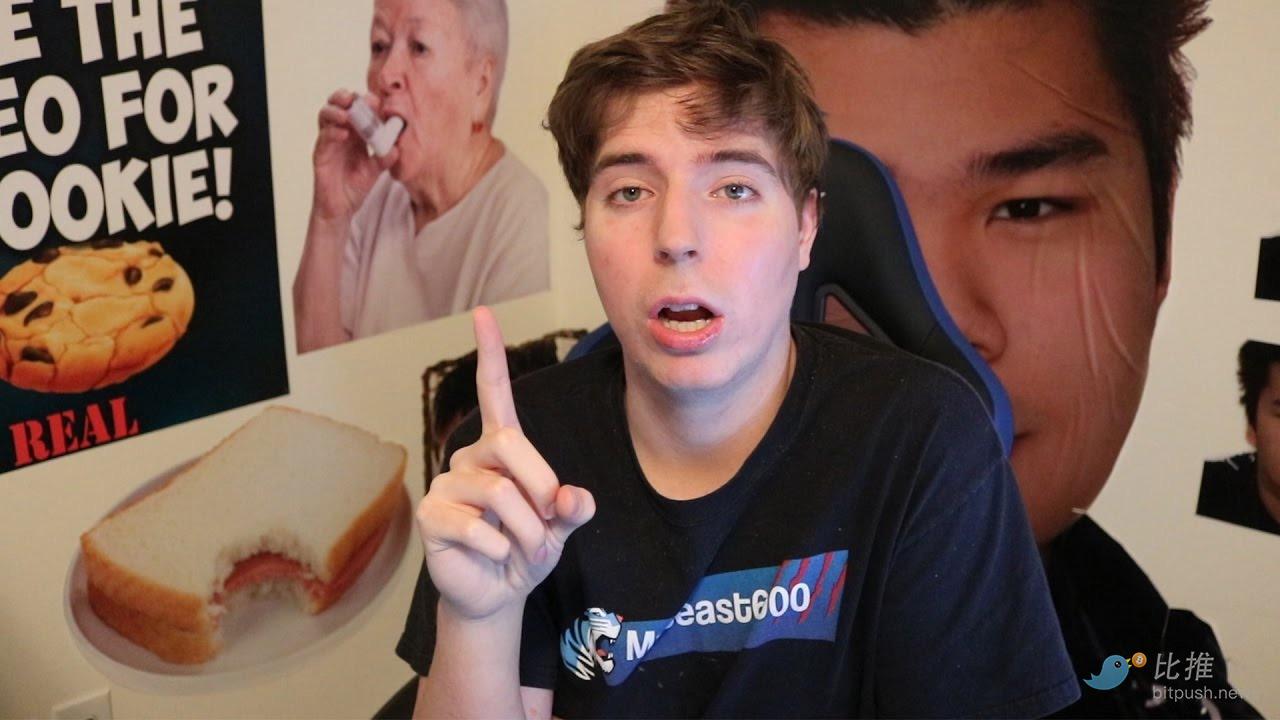
In 2017, Jimmy Donaldson, who had just graduated from high school, uploaded a video of himself counting continuously for 44 hours—"Challenge: Count from 1 to 100,000!" The content was simple, almost childish, with no plot, no editing, just a person repeating numbers to the camera, yet it became a turning point in his content career.

He was not yet 19 at the time, with only about 13,000 channel subscribers. After the video was released, it quickly surpassed a million views, becoming the first globally viral case study.

Later, in an interview recalling that time, he said one thing:

"I wasn't actually trying to get famous back then; I just wanted to know if the result would be different if I was willing to put all my time into something no one else was willing to do."

That video was indeed different. Donaldson successfully built his audience, but more importantly, from that moment on, he formed an almost obsessive belief: attention is not earned by talent, but by investment and endurance.

Treating YouTube as a Company, Not a Creative Platform

Many creators, after gaining fame, choose to "play it safe": reduce risk, increase efficiency, turn content into stable cash flow.

MrBeast chose the opposite path.

He has repeatedly emphasized one thing in multiple interviews:

"Basically, all the money I earn gets spent on the next video."

This is the core of his business model.

By 2024, his main channel had over 460 million subscribers, with cumulative video views exceeding 100 billion. But behind this lies extremely high costs:

  • The production cost for a single top video is consistently between $3 million – $5 million;

  • Some large-scale challenges or philanthropic projects can cost over $10 million;

  • The first season of "Beast Games" on Amazon Prime Video was described by himself as "completely out-of-control production," and he admitted in an interview: losses amounted to tens of millions of dollars.

When he said this, he didn't show regret:

"If I don't do this, the audience will watch someone else.
At this level, you can't save money and expect to win."

This sentence can almost be the key to understanding Beast Industries.

Beast Industries: $400 Million Annual Revenue, But Thin Profits

By 2024, MrBeast consolidated all his businesses under the name Beast Industries.

From public information, this company has far exceeded the scope of "creator side hustles":

  • Annual revenue exceeds $400 million;

  • Business spans content production, fast-moving consumer goods (FMCG) retail, licensed merchandise, tool-based products;

  • After the latest round of funding, the general market expectation for its valuation is around $5 billion.

But it's not easy.

MrBeast's YouTube main channel and Beast Games bring huge exposure but consume almost all the profits.
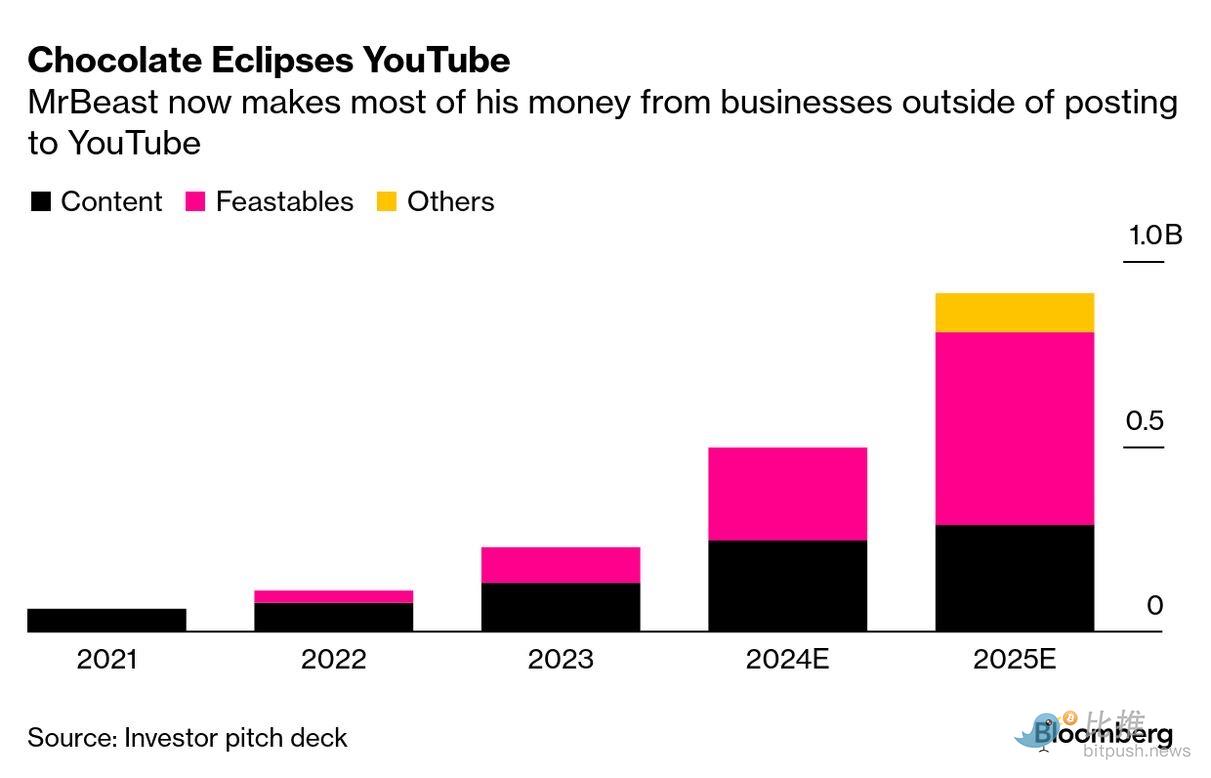
In stark contrast to the content is his chocolate brand, Feastables. Public information shows that in 2024, Feastables' sales were about $250 million, contributing over $20 million in profit. This was the first time Beast Industries had a stable, replicable cash flow business. By the end of 2025, Feastables had entered over 30,000 physical retail stores in North America (including Walmart, Target, 7-Eleven, etc.), covering the US, Canada, and Mexico, significantly enhancing the brand's offline sales capabilities.

MrBeast has stated on multiple occasions that video production costs are getting higher and higher, even "increasingly difficult to break even." But he still insists on investing heavily in content production because, in his view, this is not just paying for videos, but buying traffic for the entire business ecosystem.

The core barrier of the chocolate business is not production, but the ability to reach consumers. While other brands need to spend huge sums on advertising exposure, he only needs to release one video. Whether the video itself is profitable is no longer important; as long as Feastables continues to sell, this business闭环 (closed loop) can continue to operate.

"I'm Actually Broke"

In early 2026, MrBeast revealed in a Wall Street Journal interview that he was broke, sparking discussion:

"I'm basically in a 'negative cash' state right now. They all say I'm a billionaire, but there's not much money in my bank account."

This statement is not "humblebragging," but rather a natural result of his business model.

MrBeast's wealth is highly concentrated in unlisted equity; although he holds just over 50% of Beast Industries, the company continues to expand and almost never pays dividends; he personally even deliberately avoids keeping cash. In June 2025, MrBeast revealed that because he continuously invested almost all his savings into video production and business expansion, he once had to borrow money from his mother to pay for his wedding.

As he later explained more bluntly:

"I don't look at my bank balance—it affects my decision-making."

And the fields he invests in have long gone beyond content and consumer goods.

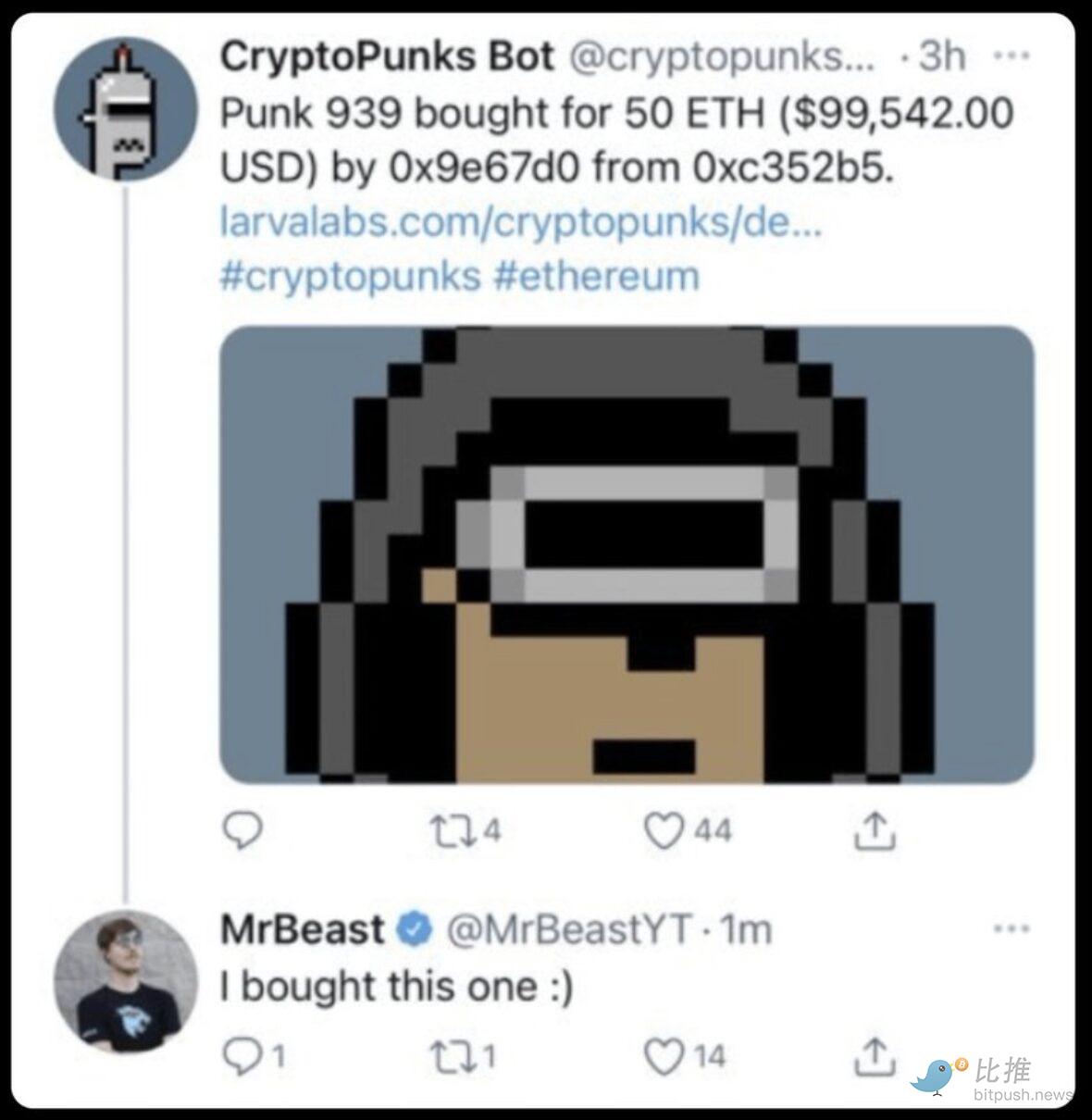
In fact, as early as the 2021 NFT boom, on-chain records show he purchased and traded multiple CryptoPunks, some of which were sold for 120 ETH each (worth hundreds of thousands of dollars at the time).
However, as the market entered a correction period, his attitude became more cautious.

The real turning point, is that MrBeast's own business model has reached a critical edge.

When a person controls a global top-tier traffic入口 (entry point) but is长期 (long-term) in a state of high investment, cash紧张 (tightness), and expansion reliant on financing, finance is no longer just an investment option, but becomes an infrastructure that must be重构 (restructured).

The命题 (proposition) repeatedly discussed within Beast Industries in recent years has gradually become clear: how to make users no longer just "watch content, buy goods," but enter a long-term, stable, sustainable economic relationship?

This is precisely the direction traditional internet platforms have tried for years: payments, accounts, credit systems. And at this juncture, the emergence of Tom Lee and BitMine Immersion (BMNR) has directed this path towards a more structural possibility.

Joining Forces with Tom Lee to Build a DEFI Foundation

On Wall Street, Tom Lee has always played the role of a "narrative architect." From early explanations of Bitcoin's value logic to emphasizing the strategic significance of Ethereum on corporate balance sheets, he is skilled at translating technological trends into financial language. BMNR's investment in Beast Industries is not chasing internet celebrity热度 (heat), but betting on the programmable future of attention入口 (entry points).

So, what exactly does DeFi mean here?

Current public information is extremely restrained: no token issuance, no yield promises, no exclusive financial products for fans. But the phrase "integrating DeFi into the financial services platform" points to several possibilities:

- Lower-cost payment and settlement layer;

- Programmable account systems for creators and fans;

- Asset recording and equity structures based on decentralized mechanisms.

The imagination space is large, but the risks are equally huge. If handled improperly, financial logic could backfire and damage the trust assets accumulated over years. And MrBeast's emphasis on trust is perhaps the most crucial constraint in this experiment. After all, he once said:

"If one day what I do hurts the audience, I would rather do nothing."

This statement will likely be tested repeatedly in every future attempt at financialization.

So, when the world's strongest attention machine seriously starts building financial infrastructure, will it become a new-generation platform, or an "overly brave" crossover?

The answer won't be revealed quickly.

But there is one thing he understands better than any of his peers: the greatest capital is not past glory, but the right to "start over." After all, he is only 27 years old.

Author: Seed.eth


Twitter:https://twitter.com/BitpushNewsCN

Bitpush TG Discussion Group:https://t.me/BitPushCommunity

Bitpush TG Subscription: https://t.me/bitpush

Original link:https://www.bitpush.news/articles/7603279

Perguntas relacionadas

QWhat is the significance of the $200 million investment by BitMine Immersion Technologies in Beast Industries?

AThe $200 million investment by BitMine Immersion Technologies (BMNR), led by Wall Street analyst Tom Lee, into MrBeast's Beast Industries signifies a strategic move to explore integrating DeFi into the company's upcoming financial services platform, potentially building a programmable financial infrastructure for its massive audience.

QHow did MrBeast's early video 'Counting to 100,000' impact his career?

AMrBeast's early video 'Counting to 100,000', where he counted numbers for 44 hours, went viral and became his first phenomenon-level success. It marked a turning point, teaching him that attention could be earned through extreme dedication and endurance, not just talent, and helped grow his channel significantly.

QWhat is the core philosophy behind MrBeast's business model regarding revenue and spending?

AMrBeast's core business philosophy is to reinvest almost all the money he earns back into the next video. He believes that at his scale, you cannot win by being frugal; continuous high investment in content is necessary to maintain audience attention and drive the broader business ecosystem.

QWhich business within Beast Industries provides a stable and replicable cash flow, and how does it benefit from the content?

AFeastables, MrBeast's chocolate brand, is the business within Beast Industries that provides stable and replicable cash flow, generating over $200 million in profit on $2.5 billion in sales. It benefits massively from the free, immense exposure from his YouTube videos, which act as a powerful advertising channel, reducing customer acquisition costs.

QWhy did MrBeast describe himself as 'broke' despite his company's high valuation, and what does this reveal about his financial strategy?

AMrBeast described himself as 'broke' because his wealth is highly illiquid, tied up in the equity of his privately held company, Beast Industries, which reinvests almost all profits and does not pay dividends. This reveals his strategy of prioritizing aggressive reinvestment and growth over personal liquidity, believing that checking his bank balance would negatively impact his decision-making for expansion.

Leituras Relacionadas

After Three Consecutive Quarters of Decline, Can the Crypto Market Find a Window for Stabilization in Q3?

The cryptocurrency market has just concluded its worst-performing quarter since 2022, with total capitalization dropping 12.6% to $2.1 trillion. All core metrics indicate capital is leaving the sector, not just rotating within it. Bitcoin fell 14.2% and Ethereum dropped 25.4% in Q2, breaking their previous correlation with US tech stocks. A key driver is the reversal in US spot Bitcoin ETF flows, which saw a net outflow of approximately $4.67 billion in Q2, including a record monthly outflow near $4.5 billion in June. While recent data suggests long-term holders are accumulating again, sustained ETF outflows mean continued selling pressure. Market focus is now singularly on the Federal Reserve. The upcoming July FOMC meeting is seen as the most critical event for Q3. A dovish signal could support Bitcoin reclaiming a $68,000-$84,000 range, while a hawkish stance might establish a new trading band around $50,000-$56,000. Additionally, regulatory uncertainty persists, with the progress of the crucial *CLARITY Act* stalling in the Senate, reducing its perceived 2026 passage probability to 40-45%. Despite the broad downturn, a few sectors showed growth. Prediction markets saw nominal volume surge 48.7% year-over-year to $113.8 billion, and tokenized collectibles transaction volume rose 143% quarterly to $1.4 billion. The Real-World Asset (RWA) tokenization sector also continued steady growth, now representing ~$28.1 billion in on-chain value. The market's foundation for an extreme crash appears limited, with Bitcoin price hovering near its 200-week moving average. However, the trading paradigm has shifted from narrative-driven speculation to decisions based on price action, policy developments, and interest rate expectations, making a broad sentiment-driven rally unlikely in the near term.

marsbitHá 10h

After Three Consecutive Quarters of Decline, Can the Crypto Market Find a Window for Stabilization in Q3?

marsbitHá 10h

BIT Trading Moment: BTC Still Suppressed by Weekly 200 EMA, Rejection May Restart Decline; Storage and Semiconductors that Surged Last Night Begin Falling in Evening Trading

**Crypto & Stock Market Wrap: Bitcoin Tests Resistance, Stocks Retreat After AI Surge** Bitcoin consolidates around $66,000, facing key resistance near $68,000—an area seen as a major psychological and technical hurdle where previous rallies have failed. Analysts note the cryptocurrency is caught between its 200-week moving average (~$63,333) and 200-week EMA (~$68,328). A clear break above $68k is needed to signal a stronger bullish trend, while a rejection could lead to a retest of $63k support. Market sentiment remains cautious, with low futures open interest pointing to a low-liquidity rebound rather than a full bull market. Bitcoin spot ETFs saw another $203 million inflow. US stock futures pointed lower after a strong Tuesday session led by a massive rebound in semiconductors and memory stocks. The rally was fueled by renewed optimism about AI-driven hardware demand, with Micron, SanDisk, and SK Hynix surging. However, those gains reversed in pre-market trading. Super Micro Computer (SMCI) soared over 20% after hours on strong guidance and a record backlog. Other standouts included Rocket Lab and nuclear energy plays Oklo and X-Energy. Rising oil prices (Brent above $91) and climbing Treasury yields (10-year near 4.64%), however, are reigniting inflation concerns and acting as a headwind for equities. In Asia, markets were mixed. South Korea's KOSPI pared early gains to close slightly higher as semiconductor stocks like SK Hynix gave back initial surges. Japan's Nikkei edged lower as the yen hit a fresh 38-year low against the dollar, raising fears of potential market intervention. Key events to watch include the Samsung Galaxy launch, AMD's AI event, and a slew of major tech earnings from Alphabet, Tesla, and IBM after the close on Wednesday, followed by the ECB meeting and Intel's earnings on Thursday.

marsbitHá 11h

BIT Trading Moment: BTC Still Suppressed by Weekly 200 EMA, Rejection May Restart Decline; Storage and Semiconductors that Surged Last Night Begin Falling in Evening Trading

marsbitHá 11h

Former CFTC Chairman, Circle President Tarbert: Preaching Long-Termism While Cashing Out $30 Million Himself

Former CFTC Chairman and Circle President Heath Tarbert has consistently advocated for a long-term vision in public, urging patience from investors as Circle’s stock price has fallen significantly from its peak. However, it has been revealed that since Circle’s IPO, Tarbert has continuously sold his CRCL shares through pre-arranged trading plans, cashing out approximately $30 million, without making any public market purchases. This contrast between his public messaging and personal actions has drawn criticism. Tarbert joined Circle in July 2023 as Chief Legal Officer, leveraging his regulatory experience to help guide the company through its IPO and expansion. Despite promoting stablecoins as long-term infrastructure, he established a 10b5-1 trading plan just before Circle went public, leading to substantial stock sales over the following year. In March 2026, he initiated another plan to sell more shares. His career trajectory highlights a pattern of moving between high-level regulatory roles and influential positions in the financial sector. After resigning as CFTC Chairman in early 2021, he joined Citadel Securities as Chief Legal Officer just 27 days later, during a period of intense regulatory scrutiny for the firm. He later joined Circle, aiding its efforts to navigate regulatory challenges for its public listing. While Tarbert's expertise in policy and compliance is valuable to companies like Circle, his actions—advocating long-term confidence while personally divesting—raise questions about the alignment between his public statements and his private financial decisions, leaving investors who followed his advice to bear the market risks.

marsbitHá 11h

Former CFTC Chairman, Circle President Tarbert: Preaching Long-Termism While Cashing Out $30 Million Himself

marsbitHá 11h

Gate Research Institute: The 'Wall Street-ization' Wave of Crypto Financial Products – Competition or Integration?

The article titled "Gate Research Institute: Are Crypto Financial Products Sparking a 'Wall Street' Wave—Competition or Convergence?" explores the evolving relationship between the crypto ecosystem and traditional finance (TradFi). The piece begins by reflecting on Bitcoin's original 2009 vision of decentralization, disintermediation, and moving away from banks. It then contrasts this with the 2024 landscape, where key crypto assets like Bitcoin are increasingly held through Wall Street products like ETFs issued by giants like BlackRock. The article questions whether this signifies that TradFi is systematically taking over the rights to issue, price, custody, and distribute crypto financial assets. The core argument is that this is not a zero-sum takeover but rather a bidirectional convergence where each side addresses the other's weaknesses. Crypto offers 24/7 global markets, programmable settlement, and open access but lacks compliant channels, institutional-grade custody, deep fiat liquidity, and mainstream distribution. TradFi possesses these but is constrained by legacy systems, limited operating hours, and slow settlement. Two primary convergence paths are highlighted: * **Path A (CEX to TradFi):** Exemplified by Gate, which has progressed from offering tokenized stocks and CFDs to providing direct, real stock trading (US, Hong Kong, South Korea) within its platform, using USDT. * **Path B (TradFi to Crypto):** Exemplified by Robinhood, which has integrated crypto trading, acquired exchanges like Bitstamp, and is moving traditional assets like stocks onto the blockchain via tokenization and its own Layer 2. Both paths are ultimately competing to become the next-generation, unified financial account—a "super account" where users can seamlessly trade cryptocurrencies, stocks, ETFs, RWA (Real World Assets), and tokenized treasury products in one interface. The growth of RWA and tokenized treasuries (e.g., BlackRock's BUIDL) is presented as the asset-layer fusion, providing stable, yield-bearing assets on-chain and acting as a bridge between the two worlds. In conclusion, the "Wall Street-ization" of crypto is framed as a mutual transformation. Decentralized ideals persist in the protocol layer, while at the application layer, a more efficient, global, and accessible unified capital market is emerging from this convergence. The future competition lies not between crypto exchanges and stockbrokers, but between platforms vying to offer the most comprehensive asset coverage, liquidity, and user experience within a single account.

marsbitHá 11h

Gate Research Institute: The 'Wall Street-ization' Wave of Crypto Financial Products – Competition or Integration?

marsbitHá 11h

Trading

Spot
活动图片





