Global Shift Towards Easing, ETH May Have Taken the 'Best Offensive Position'

比推Publicado em 2025-12-12Última atualização em 2025-12-12

Resumo

Global monetary policy is shifting towards easing, creating a favorable environment for risk assets. Despite a significant market decline in October, the long-term trend of crypto integration with traditional finance continues. A key narrative is emerging: U.S. political and economic elites are building a capital network connecting U.S. Treasury bonds, stablecoins, and Ethereum-based RWA (Real World Assets) protocols. This chain funnels dollar credit into assets ultimately settled on Ethereum and its Layer 2s. Ethereum's recent Fusaka upgrade is a milestone, addressing the issue of L1 value capture diminished by L2 growth. By introducing a dynamic floor price for data blobs (EIP-7918), it ensures L2 activity consistently contributes to ETH burning. Post-upgrade, blob fees have become the primary source of ETH burn, potentially returning ETH to a deflationary state. Technically, ETH appears strong. Leverage in the market is at historically low levels (~4%), and the Long BTC/Short ETH trade has been failing since November. ETH exchange reserves are at a multi-year low, suggesting a potential short squeeze. With anticipated friendly monetary policy from both the U.S. and China, ETH is positioned in a favorable accumulation zone.

Author: Trend Research

Original Title: Under Global Easing Expectations, ETH Has Entered the Value 'Sweet Spot'


Since the market crash on October 11, the entire cryptocurrency market has been sluggish, with market makers and investors suffering heavy losses. The recovery of capital and sentiment will take time.

However, the cryptocurrency market is never short of new fluctuations and opportunities, and we remain optimistic about the future market.

This is because the trend of mainstream crypto assets integrating with traditional finance to form new ecosystems has not changed; instead, it has rapidly built moats during the market downturn.

I. Wall Street Consensus Strengthens

On December 3, U.S. SEC Chairman Paul Atkins stated in an exclusive interview with FOX on the New York Stock Exchange: "In the coming years, the entire U.S. financial market may migrate to the blockchain."

Atkins said:

  1. The core advantage of tokenization is that if assets exist on the blockchain, the ownership structure and asset attributes will be highly transparent. Currently, listed companies often do not know who their shareholders are, where they are located, or where the shares are held.

  2. Tokenization is also expected to achieve "T+0" settlement, replacing the current "T+1" trading settlement cycle. In principle, the delivery versus payment (DVP)/receive versus payment (RVP) mechanism on-chain can reduce market risks and improve transparency. The time gap between clearing, settlement, and fund delivery is currently a source of systemic risk.

  3. Tokenization is seen as an inevitable trend in financial services, with mainstream banks and brokerages already moving toward tokenization. The world may not even take 10 years... perhaps it will become a reality in just a few years. We are actively embracing new technologies to ensure the U.S. remains at the forefront in areas like cryptocurrency.

In reality, Wall Street and Washington have already built a capital network deeply embedded in crypto, forming a new narrative chain: U.S. political and economic elites → U.S. bonds (Treasury bonds) → Stablecoins / Crypto treasury companies → Ethereum + RWA + L2
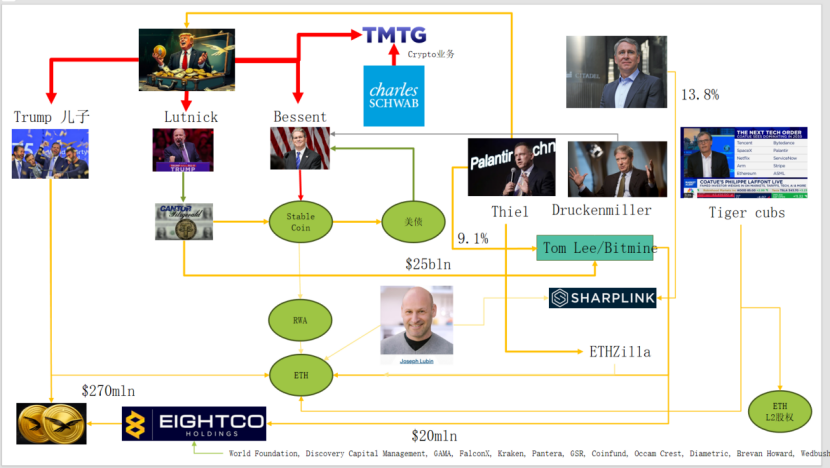
From this chart, we can see the intricate connections between the Trump family, traditional bond market makers, the Treasury, tech companies, and crypto companies, with the green elliptical links forming the backbone:

(1) Stable Coins (USDT, USDC, dollar assets behind WLD, etc.)

The majority of reserve assets are short-term U.S. bonds + bank deposits, held through brokers like Cantor.

(2) U.S. Bonds (U.S. Treasuries)

Issued and managed by the Treasury / Bessent side.

Used by Palantir, Druckenmiller, Tiger Cubs, etc., as low-risk interest rate base holdings.

Also the yield assets pursued by stablecoins / treasury companies.

(3) RWA (Real World Assets)

From U.S. bonds, mortgages, accounts receivable to housing finance.

Tokenized through Ethereum L1 / L2 protocols.

(4) ETH & ETH L2 Equity

Ethereum is the main chain承接 RWA, stablecoins, DeFi, and AI-DeFi.

L2 equity / Token represents a claim on future trading volume and fee cash flows.

This chain expresses:

U.S. dollar credit → U.S. bonds → Stablecoin reserves → Various crypto treasury / RWA protocols → Ultimately沉淀 on ETH / L2.

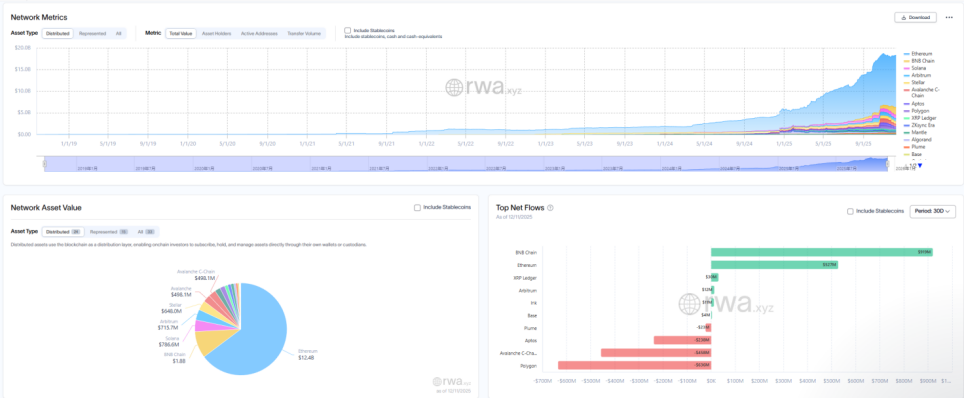
In terms of RWA TVL, compared to other public chains that declined after the October 11 crash, ETH is the only public chain that quickly recovered and rose. Its current TVL is $12.4 billion, accounting for 64.5% of the total crypto market.
II. Ethereum Explores Value Capture

The recent Ethereum Fusaka upgrade did not cause much stir in the market, but from the perspective of network structure and economic model evolution, it is a "milestone event." Fusaka is not just about scaling through EIPs like PeerDAS but also attempts to address the issue of insufficient value capture by the L1 mainnet due to L2 development.
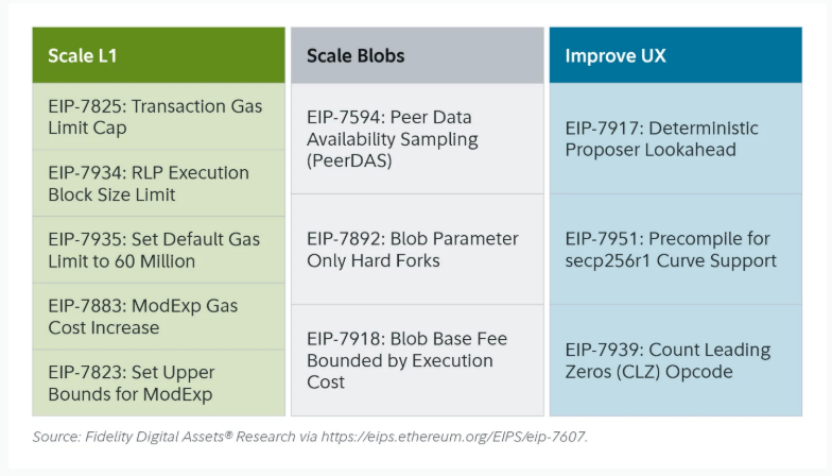
Through EIP-7918, ETH introduces a "dynamic floor price" for blob base fees, binding its lower limit to the L1 execution layer base fee, requiring blobs to pay at least about 1/16 of the L1 base fee unit price for DA fees. This means Rollups can no longer occupy blob bandwidth at near-zero cost for extended periods, and the corresponding fees will be burned and回流 to ETH holders.
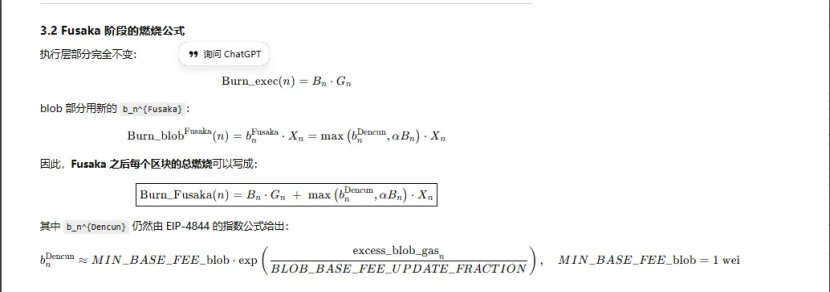
There have been three upgrades related to "burning" in Ethereum:

(1) London (Single-dimension): Only burned the execution layer; ETH began to experience structural burning due to L1 usage.

(2) Dencun (Dual-dimension + independent blob market): Burned execution layer + blob; L2 data写入 blob also burned ETH, but during low demand, the blob portion was almost 0.

(3) Fusaka (Dual-dimension + blob bound to L1): To use L2 (blob), one must pay at least a fixed proportion of the L1 base fee, which is burned. L2 activity is more stably mapped to ETH burning.
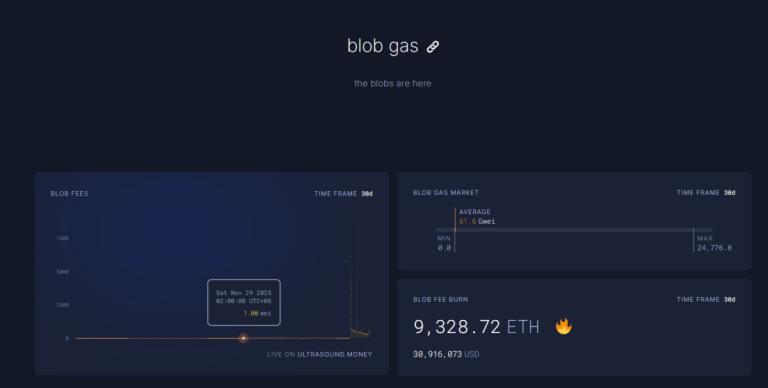
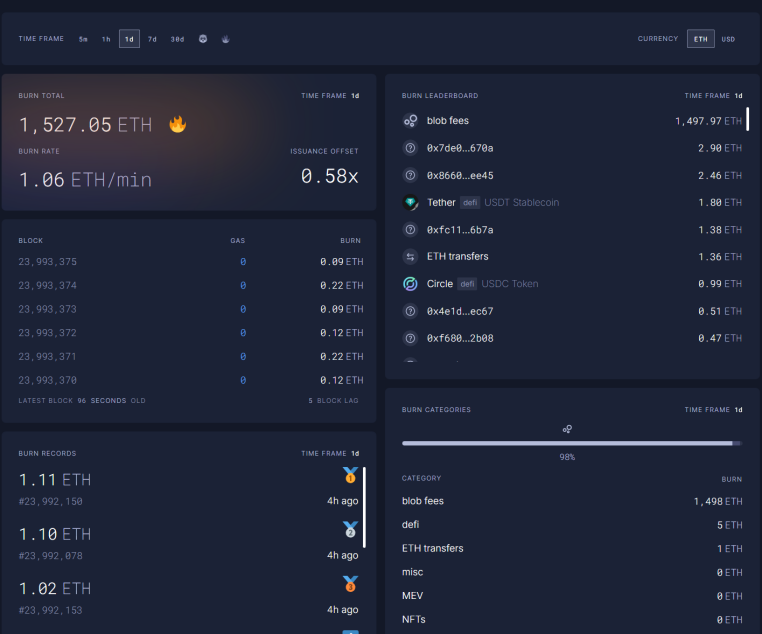
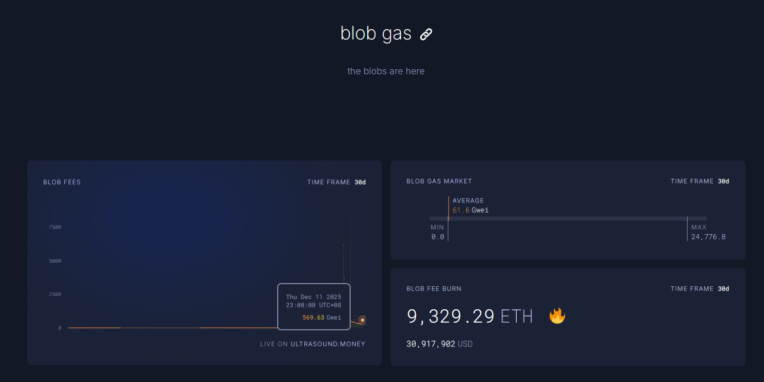
As of December 11, 23:00, the 1-hour blob fees have reached 569.63 billion times the pre-Fusaka upgrade level, burning 1,527 ETH in one day. Blob fees now contribute the highest proportion to burning,高达 98%. As ETH L2 becomes more active, this upgrade is expected to return ETH to deflation.

III. Ethereum Technicals Strengthen

During the October 11 crash, ETH's futures leverage was thoroughly cleared, eventually reaching the spot leverage盘. At the same time, many with insufficient faith in ETH led to many early OG investors reducing their holdings and fleeing. According to Coinbase data, speculative leverage in the crypto圈 has dropped to a historically low region of 4%.
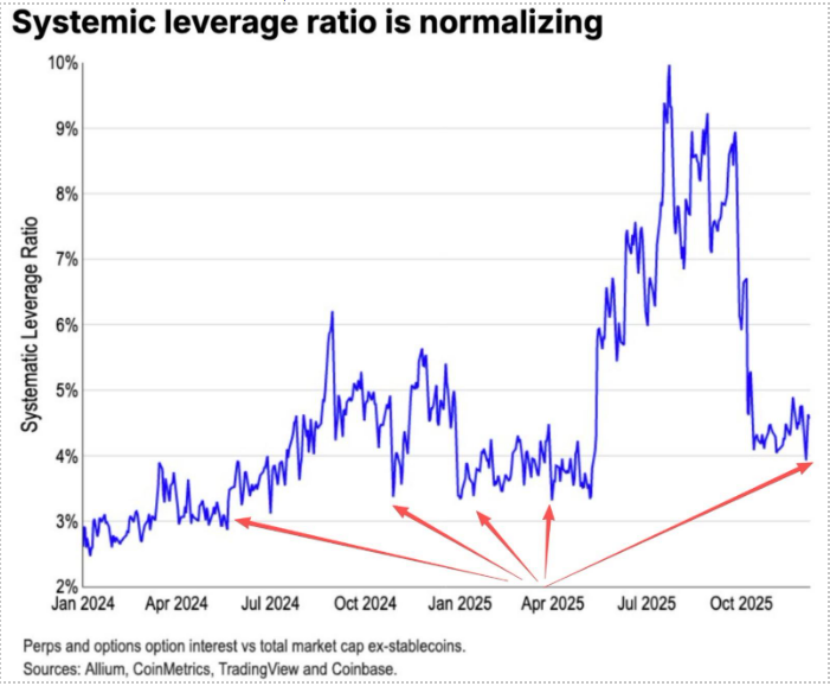
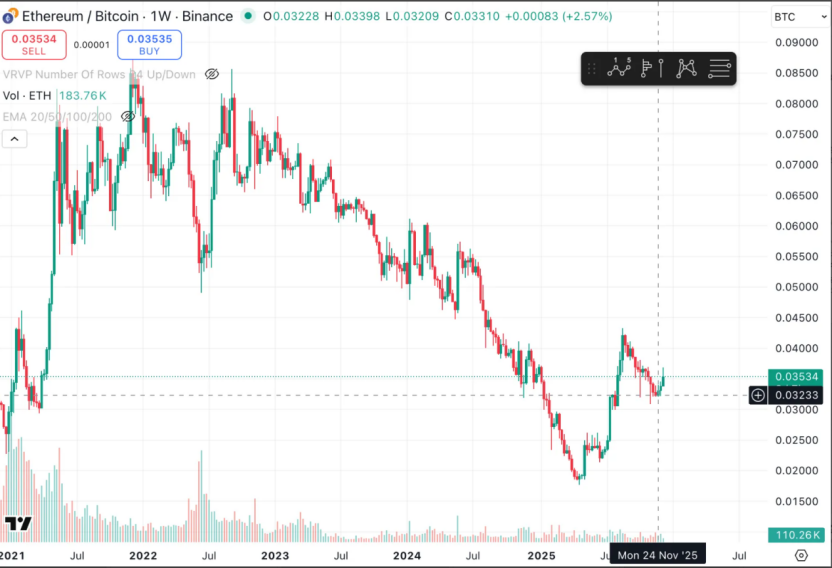
In the past, a significant portion of ETH short positions came from traditional Long BTC/Short ETH paired trades, which generally performed very well during bear markets. However, this time an意外 occurred. The ETH/BTC ratio has maintained a sideways resistance trend since November.
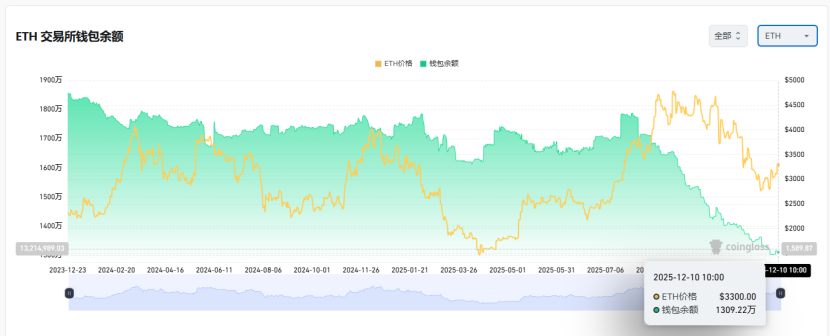
ETH's current存量 on exchanges is 13 million coins, about 10% of the total supply, at a historical low. As the Long BTC/Short ETH pairing has failed since November, during extreme panic, a "short squeeze" opportunity may gradually emerge.
As we approach the interaction between 2025 and 2026, future monetary and fiscal policies from both China and the U.S. have released friendly signals:

The U.S. will actively pursue tax cuts, interest rate reductions, and relaxed crypto regulations. China will implement appropriate easing and financial stability (suppressing volatility).

Under the expectations of relative easing in China and the U.S., and scenarios suppressing downward asset volatility, during extreme panic when capital and sentiment have not fully recovered, ETH is still in a good buying "sweet spot."


Twitter:https://twitter.com/BitpushNewsCN

Bitpush TG Discussion Group:https://t.me/BitPushCommunity

Bitpush TG Subscription: https://t.me/bitpush

Original Link:https://www.bitpush.news/articles/7595197

Perguntas relacionadas

QWhat is the new narrative chain formed by Wall Street and Washington in the crypto space according to the article?

AThe narrative chain is: U.S. political and economic elites → U.S. Treasury bonds (national debt) → Stablecoins / crypto treasury companies → Ethereum + RWA + L2.

QHow does the Fusaka upgrade aim to address the issue of L1 value capture on Ethereum?

AThe Fusaka upgrade introduces EIP-7918, which binds the blob base fee to a 'dynamic floor price' linked to the L1 execution layer base fee. This requires Rollups to pay at least approximately 1/16 of the L1 base fee for data availability, ensuring fees are burned and value flows back to ETH holders.

QWhat advantage does tokenization bring to asset ownership and settlement as highlighted by SEC Chairman Paul Atkins?

ATokenization provides high transparency in ownership structure and asset attributes, and enables 'T+0' settlement, replacing the current 'T+1' cycle, thereby reducing market risk and improving transparency.

QWhy is ETH considered to be in a good 'buying zone' or 'best offensive position' according to the article?

AETH is in a favorable position due to low leverage in the market (4%), reduced exchange supply (10% of total supply), the failure of Long BTC/Short ETH paired trades, and expectations of宽松 monetary policies from both the U.S. and China in 2025-2026.

QWhat role does Ethereum play in the RWA (Real World Assets) ecosystem based on the article?

AEthereum is the main chain hosting RWA protocols, stablecoins, and DeFi, with its L1/L2 used for tokenizing assets like U.S. Treasury bonds, mortgages, and accounts receivable. It holds 64.5% of the total crypto TVL in RWA.

Leituras Relacionadas

Google and Amazon Simultaneously Invest Heavily in a Competitor: The Most Absurd Business Logic of the AI Era Is Becoming Reality

In a span of four days, Amazon announced an additional $25 billion investment, and Google pledged up to $40 billion—both direct competitors pouring over $65 billion into the same AI startup, Anthropic. Rather than a typical venture capital move, this signals the latest escalation in the cloud wars. The core of the deal is not equity but compute pre-orders: Anthropic must spend the majority of these funds on AWS and Google Cloud services and chips, effectively locking in massive future compute consumption. This reflects a shift in cloud market dynamics—enterprises now choose cloud providers based on which hosts the best AI models, not just price or stability. With OpenAI deeply tied to Microsoft, Anthropic’s Claude has become the only viable strategic asset for Google and Amazon to remain competitive. Anthropic’s annualized revenue has surged to $30 billion, and it is expanding into verticals like biotech, positioning itself as a cross-industry AI infrastructure layer. However, this funding comes with constraints: Anthropic’s independence is challenged as it balances two rival investors, its safety-first narrative faces pressure from regulatory scrutiny, and its path to IPO introduces new financial pressures. Globally, this accelerates a "tri-polar" closed-loop structure in AI infrastructure, with Microsoft-OpenAI, Google-Anthropic, and Amazon-Anthropic forming exclusive model-cloud alliances. In contrast, China’s landscape differs—investments like Alibaba and Tencent backing open-source model firm DeepSeek reflect a more decoupled approach, though closed-source models from major cloud providers still dominate. The $65 billion bet is ultimately about securing a seat at the table in an AI-defined future—where missing the model layer means losing the cloud war.

marsbitHá 1h

Google and Amazon Simultaneously Invest Heavily in a Competitor: The Most Absurd Business Logic of the AI Era Is Becoming Reality

marsbitHá 1h

Computing Power Constrained, Why Did DeepSeek-V4 Open Source?

DeepSeek-V4 has been released as a preview open-source model, featuring 1 million tokens of context length as a baseline capability—previously a premium feature locked behind enterprise paywalls by major overseas AI firms. The official announcement, however, openly acknowledges computational constraints, particularly limited service throughput for the high-end DeepSeek-V4-Pro version due to restricted high-end computing power. Rather than competing on pure scale, DeepSeek adopts a pragmatic approach that balances algorithmic innovation with hardware realities in China’s AI ecosystem. The V4-Pro model uses a highly sparse architecture with 1.6T total parameters but only activates 49B during inference. It performs strongly in agentic coding, knowledge-intensive tasks, and STEM reasoning, competing closely with top-tier closed models like Gemini Pro 3.1 and Claude Opus 4.6 in certain scenarios. A key strategic product is the Flash edition, with 284B total parameters but only 13B activated—making it cost-effective and accessible for mid- and low-tier hardware, including domestic AI chips from Huawei (Ascend), Cambricon, and Hygon. This design supports broader adoption across developers and SMEs while stimulating China's domestic semiconductor ecosystem. Despite facing talent outflow and intense competition in user traffic—with rivals like Doubao and Qianwen leading in monthly active users—DeepSeek has maintained technical momentum. The release also comes amid reports of a new funding round targeting a valuation exceeding $10 billion, potentially setting a new record in China’s LLM sector. Ultimately, DeepSeek-V4 represents a shift toward open yet realistic infrastructure development in the constrained compute landscape of Chinese AI, emphasizing engineering efficiency and domestic hardware compatibility over pure model scale.

marsbitHá 1h

Computing Power Constrained, Why Did DeepSeek-V4 Open Source?

marsbitHá 1h

Trading

Spot
Futuros

Artigos em Destaque

Como comprar MAY

Bem-vindo à HTX.com!Tornámos a compra de Mayflower (MAY) simples e conveniente.Segue o nosso guia passo a passo para iniciar a tua jornada no mundo das criptos.Passo 1: cria a tua conta HTXUtiliza o teu e-mail ou número de telefone para te inscreveres numa conta gratuita na HTX.Desfruta de um processo de inscrição sem complicações e desbloqueia todas as funcionalidades.Obter a minha contaPasso 2: vai para Comprar Cripto e escolhe o teu método de pagamentoCartão de crédito/débito: usa o teu visa ou mastercard para comprar Mayflower (MAY) instantaneamente.Saldo: usa os fundos da tua conta HTX para transacionar sem problemas.Terceiros: adicionamos métodos de pagamento populares, como Google Pay e Apple Pay, para aumentar a conveniência.P2P: transaciona diretamente com outros utilizadores na HTX.Mercado de balcão (OTC): oferecemos serviços personalizados e taxas de câmbio competitivas para os traders.Passo 3: armazena teu Mayflower (MAY)Depois de comprar o teu Mayflower (MAY), armazena-o na tua conta HTX.Alternativamente, podes enviá-lo para outro lugar através de transferência blockchain ou usá-lo para transacionar outras criptomoedas.Passo 4: transaciona Mayflower (MAY)Transaciona facilmente Mayflower (MAY) no mercado à vista da HTX.Acede simplesmente à tua conta, seleciona o teu par de trading, executa as tuas transações e monitoriza em tempo real.Oferecemos uma experiência de fácil utilização tanto para principiantes como para traders experientes.

239 Visualizações TotaisPublicado em {updateTime}Atualizado em 2025.07.01

Como comprar MAY

Discussões

Bem-vindo à Comunidade HTX. Aqui, pode manter-se informado sobre os mais recentes desenvolvimentos da plataforma e obter acesso a análises profissionais de mercado. As opiniões dos utilizadores sobre o preço de MAY (MAY) são apresentadas abaixo.

活动图片