Global Long-Term Bonds Break Down: The Fiscal Illusion of the Low-Interest Era is Collapsing

marsbitPublicado em 2026-05-19Última atualização em 2026-05-19

Resumo

Global long-term bonds are experiencing a widespread breakdown, as the fiscal illusion of the low-interest-rate era collapses. Sovereign yields are hitting multi-year highs in the US, UK, Japan, and France, signaling a market repricing driven by a common reality: unsustainable debt and deficits outpacing economic growth, compounded by renewed inflationary pressures from energy shocks. The direct trigger is the blockade of the Strait of Hormuz, which has pushed oil prices higher and reignited inflation fears. This squeezes central bank policy space, with expectations shifting from future rate cuts to potential hikes. The core "fiscal Ponzi scheme" is becoming evident—governments rely on new debt to service existing obligations, but as growth lags and borrowing costs rise, investors demand higher yields. Key developments include the US 30-year yield surpassing 5% for the first time since 2007, with tepid auction demand; Japan's 30-year yield reaching 4%, threatening its long-standing low-rate financial system; and political paralysis in the UK and France making meaningful fiscal consolidation unlikely. The marginal buyer for US debt is also shifting from foreign central banks to more price-sensitive private investors. While debt managers may adjust issuance, fundamental drivers—deteriorating fiscal paths, persistent inflation, and constrained central banks—remain. The market is conclusively repricing the end of the low-interest-rate financing model for highly indebted develo...

Author: Claude, Shenchao TechFlow

Shenchao Insight: Long-term bonds in developed countries are collectively faltering. The market is no longer repricing the fiscal surprise of a single country, but rather the reality of high debt, high deficits, and even higher interest rates coexisting in the long term. As debt growth persistently outpaces economic growth, energy shocks rekindle inflation, and central banks' room for rate cuts is compressed, the "low-interest rollover model" that has supported developed countries' financing for over a decade is developing cracks.

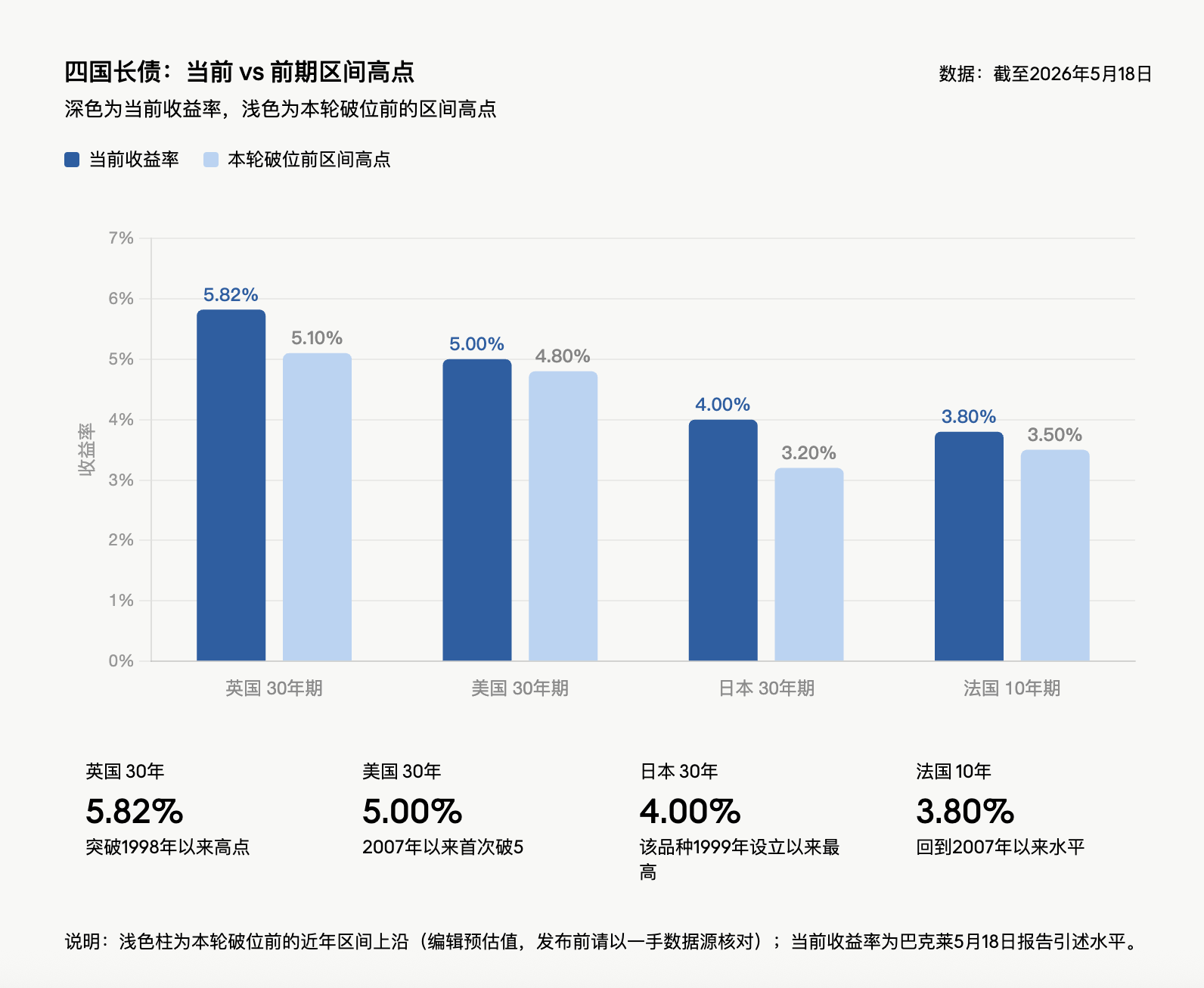
Over the past week, the yield on the UK 30-year government bond rose to 5.82%, the highest since 1998; Japan's 30-year government bond yield hit 4%, a record high since its inception in 1999; the US 30-year Treasury yield surpassed 5% for the first time since 2007; France's 10-year bond yield climbed above 3.8%, also returning to levels last seen in 2007. This sell-off has already weighed on global stock markets, prompting G7 finance ministers to specifically discuss this bond rout at their meeting this week.

According to a report dated May 18 by Ajay Rajadhyaksha, head of Fixed Income, FX, and Commodities Research at Barclays, "Long bonds didn't just sell off last week, they broke out of ranges everywhere." The core judgment is that with debt growing faster than the economy, inflation paths worsening, and no political will for fiscal reform, there is insufficient reason to extend duration even as long bonds have already sold off.

Priya Misra, Portfolio Manager at J.P. Morgan Asset Management, issued a similar warning: "Rates are rising in unison across the long end of the globe, and they tend to reinforce each other, and expectations of Fed rate hikes are now entering the market narrative."

Multi-Country Bond Markets Break Down Simultaneously, Collective "Fiscal Ponzi Scheme" Comes to Light

A decline in a single country's bond market can often be attributed to local inflation, fiscal policies, politics, or central bank communication. However, the near-simultaneous breakdowns in the UK, Japan, the US, and France indicate the market is now trading more than just local risks.

The commonality is clear: major developed economies generally have debt-to-GDP ratios above 100%, and fiscal deficits are not covered by nominal growth. The US deficit is approximately $2 trillion, about 6.5% of GDP, with nominal growth around 4.5% to 5%; France's nominal GDP grew 2.2% year-on-year for the quarter ending March 2026, with a deficit around 5%; the UK's deficit exceeds 4%.

This is the core contradiction pointed to by the "fiscal Ponzi scheme": governments continuously rely on new debt and rollover financing to sustain spending, but the pace of debt expansion exceeds economic growth, while interest costs are becoming more expensive again. As long as this combination persists, long-term bonds require higher yields to attract buyers.

New spending is adding further pressure. NATO agreed in The Hague last year to raise its defense spending target to 5% of GDP by 2035; European defense spending already grew by double-digit percentages last year and may continue for a decade; the US government is requesting a $1.5 trillion defense budget for the next fiscal year. These expenditures lack corresponding offsetting cuts.
Strait of Hormuz Blockade, Oil Price Shock Reignites Inflation

Debt and deficits were already fragile; an energy price shock is further tightening the policy space. The blockade of the Strait of Hormuz is the direct trigger for this bond market turmoil. The disruption of the world's most crucial oil shipping chokepoint has continuously pushed oil prices higher, reigniting inflation expectations.

Barclays' base case assumes Brent crude will average $100 in 2026, a 50% increase from the 2025 average. This would directly worsen the inflation outlook, compress central banks' room for rate cuts, and could even force them to hike rates. Higher rates mean existing debt interest payments will continue to rise, which in turn makes reducing deficits even more difficult. This resembles a fiscal ratchet mechanism—with each forward turn, the government's maneuvering room shrinks, and bond investors demand greater compensation.

J.P. Morgan Managing Director Priya Misra stated bluntly: "Unless the strait reopens, the rate range has shifted higher overall."

Looking at short-term data, the US 2-year yield briefly rose to 4.09%, the highest since February 2025; the 10-year yield stood at 4.58%, near a one-year high; US Treasuries overall have recorded negative returns year-to-date, whereas gains were nearly 2% as of late February.

Inflation Narrative Dominates the Market, Term Premium Being Repriced

The judgment from Karen Manna, Fixed Income Strategist and Portfolio Manager at Federated Hermes, is: "We are seeing a world that is truly dealing with a new inflation wave."

Kevin Flanagan, Head of Investment Strategy at WisdomTree, anticipates the next Consumer Price Index report may show annual inflation reaching 4%, the highest level since 2023. He directly points out the market logic: "The inflation narrative is dominating the market. The bond market is demanding a higher premium to hold newly issued Treasuries."

Last week's Treasury auctions confirmed this pricing: The 30-year auction rate hit 5%, the first since 2007, but demand was tepid; investor demand for the 3-year and 10-year auctions was also lukewarm. Even the rise in long-term bond yields to year-to-date highs is not, in itself, a sufficient reason to add duration.

Fed Path Completely Reverses, Bets Shift from Two Cuts to a March Hike

The inflation storm is reshaping expectations for the Federal Reserve's policy path. The environment facing incoming Fed Chairman Kevin Warsh is far from the "easing channel" envisioned by the market at the start of the year.

Traders now see a March hike next year as highly probable, with the odds of a hike by December around three-quarters; back at the end of February, the market was expecting two rate cuts in 2026. US Treasury yields are now about 50 basis points or more higher than their late-February levels.

Official commentary has further cemented hawkish pricing. Chicago Fed President Austan Goolsbee said last week that broad price pressures might even signal an overheating economy; Fed Governor Michael Barr called inflation the "overwhelming" risk facing the economy. The Fed's April meeting minutes will be released this Wednesday, and the market will closely watch how much support dissenting members garnered among officials.

The latest J.P. Morgan US Treasury Client Survey shows net short positions on Treasuries have risen to their highest level in 13 weeks, indicating a clear increase in market bets for further bond market declines.

Japan's Low-Rate System Being Repriced

Japan's 30-year government bond yield touching 4% may not be extreme in the US or UK, but it holds different significance for the Japanese market. For the past 20 years, Japan's long-term interest rates have hovered near zero, and the balance sheet structures of pension funds, insurance companies, and regional banks were built around this environment.

The Bank of Japan's policy rate is currently 0.75%. At the April policy meeting, three out of nine board members opposed the current stance; market pricing shows a 77% probability of a June rate hike. Even if the BOJ raises rates to 1%, real rates would remain significantly negative.

The rise in Japan's long-term yields can be interpreted as monetary policy normalization: the end of deflation, real wage growth, and the economy returning to a more normal state. However, the issue is that normalization may not be gentle for an economy with debt exceeding twice its GDP. A 4% yield on a 30-year Japanese bond is not just a change in a yield figure; it signifies the repricing of the entire low-interest-rate financial system.

UK, France: Political Structures Make Deficit Reduction Almost Impossible

The UK Labour government has a working majority of over 150 seats in the 650-seat parliament, theoretically possessing the capacity for fiscal adjustment. However, last summer, proposed savings of just £1.4 billion related to winter fuel subsidies sparked a backlash within the Labour parliamentary party.

Political pressure is mounting. Ninety-seven Labour MPs have demanded the Prime Minister resign or provide a departure timeline; main challenger Andy Burnham once argued fiscal policy should not submit to the bond market, later clarifying he would not completely ignore investors. The UK has had four prime ministers and five chancellors of the exchequer in the past four years. Bond market pricing indicates over 60 basis points of further rate hike potential for the Bank of England by year-end, although Governor Bailey may prefer to wait and see.

France's problem is less eye-catching than UK gilts, but its fiscal structure is equally tricky. France has had five prime ministers in less than three years. The current government has survived two no-confidence votes to push through a budget targeting a 5% of GDP deficit. The 2023 reform raising the retirement age to 64 is under attack, even though 64 is still below most Western economies. France's deficit is already significantly higher than its nominal GDP growth, voters will harshly punish austerity attempts, and constitutional arrangements make it easier for parliament to block spending cuts. Everyone knows the deficit must fall, but no one is willing to bear the political cost of reducing it.

US Buyer Structure Has Changed: Foreign Central Banks Turn to Gold, Private Investors Demand Higher Prices

The US 30-year Treasury yield surpassing 5% is the first time since 2007. The direct causes are rising inflation, fiscal expansion, and high deficits, but this is not new. The deeper change lies in the shifting marginal buyers.

The US federal deficit is approximately $2 trillion. The Congressional Budget Office projects that federal debt held by the public will rise from its current level of over 100% of GDP to 120% by 2036. However, this forecast may still be optimistic. A key variable is tariff revenue: The US effective tariff rate has fallen from a peak of 12% to between 7% and 8%, below the CBO's assumption of 15%. Even if it eventually rises to 10%, tariff revenue over the next decade would only be about 60% of the roughly $3 trillion deficit reduction assumed in its projections. Assumptions for defense spending and interest costs may also be too low.

The dollar's reserve currency status remains a structural advantage for the US, allowing it to finance at rates that peer debtors struggle to obtain. However, this does not mean a 6.5% deficit ratio is sustainable. Foreign central banks were once stable buyers of duration assets, but since the West froze Russia's foreign reserves, central bank allocations have shifted towards gold. Last year, gold's share in central bank reserves surpassed that of US Treasuries. Japan, the largest holder of US Treasuries, finds its domestic market rates more attractive. The Fed is still in quantitative tightening mode. Those stepping in to buy long-term bonds are price-sensitive private investors demanding higher term premiums.

The Fed is Not a "Fuse" for Long Bonds

Debt management offices have relatively reduced long-term bond issuance in recent years and may continue adjusting issuance structures, but this can only ease supply pressure, not change the fiscal and inflation direction.

Some in the market discuss whether the Fed might be forced to restart large-scale asset purchases to prevent long-end rates from rising further. However, Warsh's previous statement regarding the Fed's balance sheet was, "A bloated balance sheet could be meaningfully reduced," which is not language suggesting preparation for a US version of Yield Curve Control.

Faced with the ongoing sell-off, some investors choose to stay on the sidelines. WisdomTree analyst Kevin Flanagan said he currently maintains holdings in floating rate notes and keeps interest rate exposure low, "preferring to buy later rather than too early." He views the 4.5% level on the 10-year yield as "more of a psychological barrier," and if Middle East tensions escalate again and push oil prices higher, yields could retest last year's high of 4.62%. Hank Smith, Head of Investment Strategy at Haverford Trust, holds a more cautious view, stating that it remains an unresolved question whether the rise in consumer and producer prices is temporary "or will persist into 2027."

The forces driving the sell-off—fiscal deterioration, increased defense spending, sticky inflation, and constrained central banks—are not disappearing in a week or two. Unless economic data weakens significantly or credible changes emerge in fiscal paths, developed market long bonds are still trading on the same issue: the low-interest financing model of the high-debt era is being repriced by the market.


Criptomoedas em alta

Perguntas relacionadas

QWhat is the core reason for the simultaneous sell-off in long-term bonds across major developed economies like the US, UK, Japan, and France, according to the article?

AThe article argues the core reason is a market reassessment of the 'low-interest-rate rolling model' due to a common reality of high debt, high deficits, and persistent higher interest rates. Key drivers are debt growing faster than economic growth, energy shocks reigniting inflation, and central banks having less room to cut rates, which forces markets to demand higher yields to compensate.

QHow did the blockade of the Strait of Hormuz contribute to the bond market turmoil described in the article?

AThe blockade of the Strait of Hormuz, a critical global oil transit route, pushed oil prices higher, reigniting inflation expectations. This energy price shock further compressed the policy space for central banks, potentially forcing them to raise rates. Higher interest rates increase government debt servicing costs, widening deficits and forcing bond investors to demand even higher yields, creating a vicious cycle.

QWhat significant shift has occurred in the market's expectation for Federal Reserve policy, as mentioned in the text?

AThe market's expectation for the Federal Reserve's policy path has completely reversed. At the end of February, the market anticipated two rate cuts in 2026. Now, traders view a rate hike in March of the coming year as highly likely, with about a 75% probability of a hike by December. This shift is driven by renewed and persistent inflation pressures.

QWhy is Japan's 30-year government bond yield reaching 4% considered particularly significant, despite being lower than similar yields in the US or UK?

AA 4% yield for Japan's 30-year bond is highly significant because Japan's financial system has been built around near-zero interest rates for over two decades. Pensions, insurers, and regional banks structured their balance sheets based on this environment. Therefore, this rise represents a fundamental repricing of Japan's entire low-interest-rate financial architecture, which is challenging for an economy with debt exceeding 200% of GDP.

QAccording to the article, what are the two key changes in the buyer structure for US Treasury bonds that are contributing to higher long-term yields?

ATwo key changes in the US Treasury buyer structure are: 1) Foreign central banks, traditional stable buyers of duration, are shifting reserves towards gold and away from US Treasuries, partly due to geopolitical factors like the freezing of Russian reserves. 2) The marginal buyers are now more price-sensitive private investors who demand higher term premiums (compensation for holding long-term debt), as opposed to less price-sensitive official buyers. The Fed is also reducing its balance sheet (quantitative tightening).

Leituras Relacionadas

After Three Consecutive Quarters of Decline, Can the Crypto Market Find a Window for Stabilization in Q3?

The cryptocurrency market has just concluded its worst-performing quarter since 2022, with total capitalization dropping 12.6% to $2.1 trillion. All core metrics indicate capital is leaving the sector, not just rotating within it. Bitcoin fell 14.2% and Ethereum dropped 25.4% in Q2, breaking their previous correlation with US tech stocks. A key driver is the reversal in US spot Bitcoin ETF flows, which saw a net outflow of approximately $4.67 billion in Q2, including a record monthly outflow near $4.5 billion in June. While recent data suggests long-term holders are accumulating again, sustained ETF outflows mean continued selling pressure. Market focus is now singularly on the Federal Reserve. The upcoming July FOMC meeting is seen as the most critical event for Q3. A dovish signal could support Bitcoin reclaiming a $68,000-$84,000 range, while a hawkish stance might establish a new trading band around $50,000-$56,000. Additionally, regulatory uncertainty persists, with the progress of the crucial *CLARITY Act* stalling in the Senate, reducing its perceived 2026 passage probability to 40-45%. Despite the broad downturn, a few sectors showed growth. Prediction markets saw nominal volume surge 48.7% year-over-year to $113.8 billion, and tokenized collectibles transaction volume rose 143% quarterly to $1.4 billion. The Real-World Asset (RWA) tokenization sector also continued steady growth, now representing ~$28.1 billion in on-chain value. The market's foundation for an extreme crash appears limited, with Bitcoin price hovering near its 200-week moving average. However, the trading paradigm has shifted from narrative-driven speculation to decisions based on price action, policy developments, and interest rate expectations, making a broad sentiment-driven rally unlikely in the near term.

marsbitHá 4h

After Three Consecutive Quarters of Decline, Can the Crypto Market Find a Window for Stabilization in Q3?

marsbitHá 4h

BIT Trading Moment: BTC Still Suppressed by Weekly 200 EMA, Rejection May Restart Decline; Storage and Semiconductors that Surged Last Night Begin Falling in Evening Trading

**Crypto & Stock Market Wrap: Bitcoin Tests Resistance, Stocks Retreat After AI Surge** Bitcoin consolidates around $66,000, facing key resistance near $68,000—an area seen as a major psychological and technical hurdle where previous rallies have failed. Analysts note the cryptocurrency is caught between its 200-week moving average (~$63,333) and 200-week EMA (~$68,328). A clear break above $68k is needed to signal a stronger bullish trend, while a rejection could lead to a retest of $63k support. Market sentiment remains cautious, with low futures open interest pointing to a low-liquidity rebound rather than a full bull market. Bitcoin spot ETFs saw another $203 million inflow. US stock futures pointed lower after a strong Tuesday session led by a massive rebound in semiconductors and memory stocks. The rally was fueled by renewed optimism about AI-driven hardware demand, with Micron, SanDisk, and SK Hynix surging. However, those gains reversed in pre-market trading. Super Micro Computer (SMCI) soared over 20% after hours on strong guidance and a record backlog. Other standouts included Rocket Lab and nuclear energy plays Oklo and X-Energy. Rising oil prices (Brent above $91) and climbing Treasury yields (10-year near 4.64%), however, are reigniting inflation concerns and acting as a headwind for equities. In Asia, markets were mixed. South Korea's KOSPI pared early gains to close slightly higher as semiconductor stocks like SK Hynix gave back initial surges. Japan's Nikkei edged lower as the yen hit a fresh 38-year low against the dollar, raising fears of potential market intervention. Key events to watch include the Samsung Galaxy launch, AMD's AI event, and a slew of major tech earnings from Alphabet, Tesla, and IBM after the close on Wednesday, followed by the ECB meeting and Intel's earnings on Thursday.

marsbitHá 5h

BIT Trading Moment: BTC Still Suppressed by Weekly 200 EMA, Rejection May Restart Decline; Storage and Semiconductors that Surged Last Night Begin Falling in Evening Trading

marsbitHá 5h

Former CFTC Chairman, Circle President Tarbert: Preaching Long-Termism While Cashing Out $30 Million Himself

Former CFTC Chairman and Circle President Heath Tarbert has consistently advocated for a long-term vision in public, urging patience from investors as Circle’s stock price has fallen significantly from its peak. However, it has been revealed that since Circle’s IPO, Tarbert has continuously sold his CRCL shares through pre-arranged trading plans, cashing out approximately $30 million, without making any public market purchases. This contrast between his public messaging and personal actions has drawn criticism. Tarbert joined Circle in July 2023 as Chief Legal Officer, leveraging his regulatory experience to help guide the company through its IPO and expansion. Despite promoting stablecoins as long-term infrastructure, he established a 10b5-1 trading plan just before Circle went public, leading to substantial stock sales over the following year. In March 2026, he initiated another plan to sell more shares. His career trajectory highlights a pattern of moving between high-level regulatory roles and influential positions in the financial sector. After resigning as CFTC Chairman in early 2021, he joined Citadel Securities as Chief Legal Officer just 27 days later, during a period of intense regulatory scrutiny for the firm. He later joined Circle, aiding its efforts to navigate regulatory challenges for its public listing. While Tarbert's expertise in policy and compliance is valuable to companies like Circle, his actions—advocating long-term confidence while personally divesting—raise questions about the alignment between his public statements and his private financial decisions, leaving investors who followed his advice to bear the market risks.

marsbitHá 5h

Former CFTC Chairman, Circle President Tarbert: Preaching Long-Termism While Cashing Out $30 Million Himself

marsbitHá 5h

Gate Research Institute: The 'Wall Street-ization' Wave of Crypto Financial Products – Competition or Integration?

The article titled "Gate Research Institute: Are Crypto Financial Products Sparking a 'Wall Street' Wave—Competition or Convergence?" explores the evolving relationship between the crypto ecosystem and traditional finance (TradFi). The piece begins by reflecting on Bitcoin's original 2009 vision of decentralization, disintermediation, and moving away from banks. It then contrasts this with the 2024 landscape, where key crypto assets like Bitcoin are increasingly held through Wall Street products like ETFs issued by giants like BlackRock. The article questions whether this signifies that TradFi is systematically taking over the rights to issue, price, custody, and distribute crypto financial assets. The core argument is that this is not a zero-sum takeover but rather a bidirectional convergence where each side addresses the other's weaknesses. Crypto offers 24/7 global markets, programmable settlement, and open access but lacks compliant channels, institutional-grade custody, deep fiat liquidity, and mainstream distribution. TradFi possesses these but is constrained by legacy systems, limited operating hours, and slow settlement. Two primary convergence paths are highlighted: * **Path A (CEX to TradFi):** Exemplified by Gate, which has progressed from offering tokenized stocks and CFDs to providing direct, real stock trading (US, Hong Kong, South Korea) within its platform, using USDT. * **Path B (TradFi to Crypto):** Exemplified by Robinhood, which has integrated crypto trading, acquired exchanges like Bitstamp, and is moving traditional assets like stocks onto the blockchain via tokenization and its own Layer 2. Both paths are ultimately competing to become the next-generation, unified financial account—a "super account" where users can seamlessly trade cryptocurrencies, stocks, ETFs, RWA (Real World Assets), and tokenized treasury products in one interface. The growth of RWA and tokenized treasuries (e.g., BlackRock's BUIDL) is presented as the asset-layer fusion, providing stable, yield-bearing assets on-chain and acting as a bridge between the two worlds. In conclusion, the "Wall Street-ization" of crypto is framed as a mutual transformation. Decentralized ideals persist in the protocol layer, while at the application layer, a more efficient, global, and accessible unified capital market is emerging from this convergence. The future competition lies not between crypto exchanges and stockbrokers, but between platforms vying to offer the most comprehensive asset coverage, liquidity, and user experience within a single account.

marsbitHá 5h

Gate Research Institute: The 'Wall Street-ization' Wave of Crypto Financial Products – Competition or Integration?

marsbitHá 5h

Trading

Spot

Artigos em Destaque

Como comprar ERA

Bem-vindo à HTX.com!Tornámos a compra de Caldera (ERA) simples e conveniente.Segue o nosso guia passo a passo para iniciar a tua jornada no mundo das criptos.Passo 1: cria a tua conta HTXUtiliza o teu e-mail ou número de telefone para te inscreveres numa conta gratuita na HTX.Desfruta de um processo de inscrição sem complicações e desbloqueia todas as funcionalidades.Obter a minha contaPasso 2: vai para Comprar Cripto e escolhe o teu método de pagamentoCartão de crédito/débito: usa o teu visa ou mastercard para comprar Caldera (ERA) instantaneamente.Saldo: usa os fundos da tua conta HTX para transacionar sem problemas.Terceiros: adicionamos métodos de pagamento populares, como Google Pay e Apple Pay, para aumentar a conveniência.P2P: transaciona diretamente com outros utilizadores na HTX.Mercado de balcão (OTC): oferecemos serviços personalizados e taxas de câmbio competitivas para os traders.Passo 3: armazena teu Caldera (ERA)Depois de comprar o teu Caldera (ERA), armazena-o na tua conta HTX.Alternativamente, podes enviá-lo para outro lugar através de transferência blockchain ou usá-lo para transacionar outras criptomoedas.Passo 4: transaciona Caldera (ERA)Transaciona facilmente Caldera (ERA) no mercado à vista da HTX.Acede simplesmente à tua conta, seleciona o teu par de trading, executa as tuas transações e monitoriza em tempo real.Oferecemos uma experiência de fácil utilização tanto para principiantes como para traders experientes.

515 Visualizações TotaisPublicado em {updateTime}Atualizado em 2026.06.02

Como comprar ERA

Discussões

Bem-vindo à Comunidade HTX. Aqui, pode manter-se informado sobre os mais recentes desenvolvimentos da plataforma e obter acesso a análises profissionais de mercado. As opiniões dos utilizadores sobre o preço de ERA (ERA) são apresentadas abaixo.

活动图片












