Global debt markets show dollar dominance moves in cycles, US Fed says

cointelegraphPublicado em 2025-12-18Última atualização em 2025-12-18

Resumo

A new Federal Reserve discussion paper reveals that the U.S. dollar’s dominance in global debt markets has moved in cycles over the past 60 years, with no clear long-term trend toward either dollarization or de-dollarization. The study identifies three distinct "dollarization waves" since the 1960s, showing currency usage shifts are cyclical rather than structural. As of 2024, emerging markets still rely heavily on dollar-denominated debt, which makes up about 80% of their international bonds. Meanwhile, the rise of dollar-pegged stablecoins like USDT and USDC—which together represent 85% of the $309.6 billion stablecoin market—has reinforced dollar dominance. These stablecoins are backed significantly by U.S. Treasury holdings, making their issuers major holders of U.S. government debt. The report concludes that despite vulnerabilities, the dollar’s global role remains unchallenged due to a lack of alternatives. Efforts to internationalize other currencies, including the Chinese renminbi, have seen limited success. European policymakers have expressed concern over the growing influence of dollar-backed stablecoins.

A new Federal Reserve discussion paper finds that the US dollar’s role in global bond markets has risen and fallen in cycles over the past six decades, with no clear long-term trend toward either greater dollar dominance or de-dollarization.

Using the Bank for International Settlements’ (BIS) international debt securities database, the authors identify three distinct “dollarization waves” since the 1960s, showing that shifts in currency use have followed cyclical patterns rather than a steady structural change in global financing.

“We find no monotonic dollarization or de-dollarization trend; instead, the dollar’s share exhibits a wavelike pattern,” the paper says.

The most recent wave emerged after the 2008 global financial crisis, when the dollar regained market share in international bond issuance, climbing back toward levels seen before the surge in euro-denominated bond issuance in the early 2000s, according to the report.
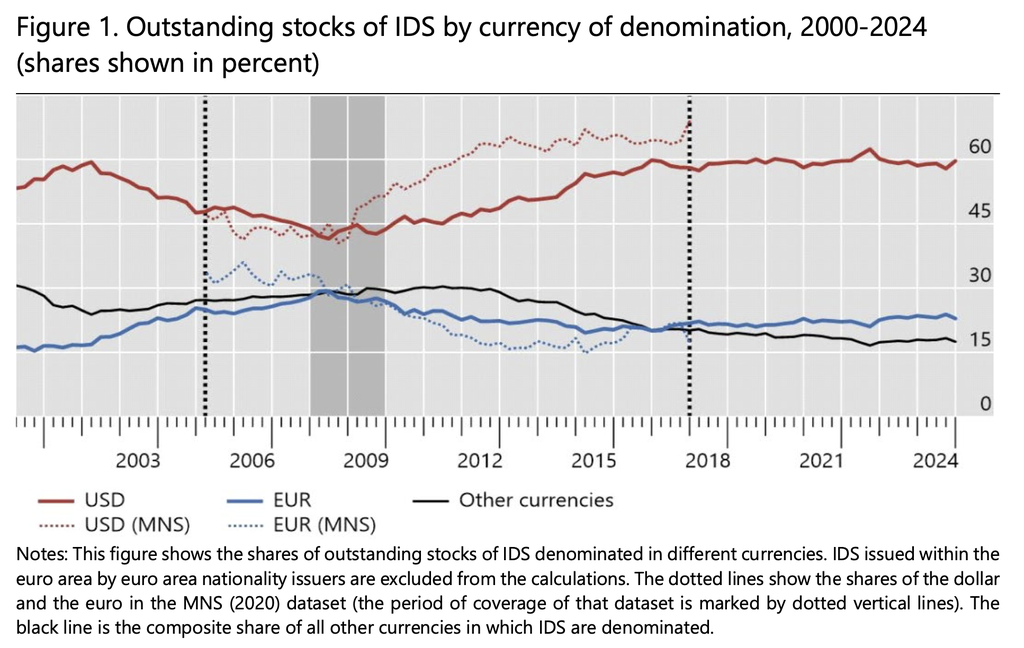
Share of international debt issued by currency, 2000–2024. Source: Federalreserve.gov

The study also found that, as of 2024, emerging market issuers still rely predominantly on dollar-denominated debt, which accounts for about 80% of their outstanding international bonds, while efforts by China begun in 2010 to internationalize its currency, the renminbi, have produced only modest gains.

“While the dollar’s eminence rests on vulnerable foundations, the absence of viable alternatives has left the dollar’s primacy unchallenged,” the report said.

Related: Intuit to use Circle’s stablecoin for financial platforms

Stablecoins back US Treasurys

The global stablecoin market has expanded sharply over the past year, growing to roughly $309.6 billion from $205.5 billion in December 2024, according to DefiLlama data.

Most of that growth has been concentrated in US dollar-pegged tokens, with Tether’s USDt (USDT) and Circle’s USDC (USDC) together accounting for about 85% of total stablecoin supply, or roughly $264 billion of the market at the time of writing.
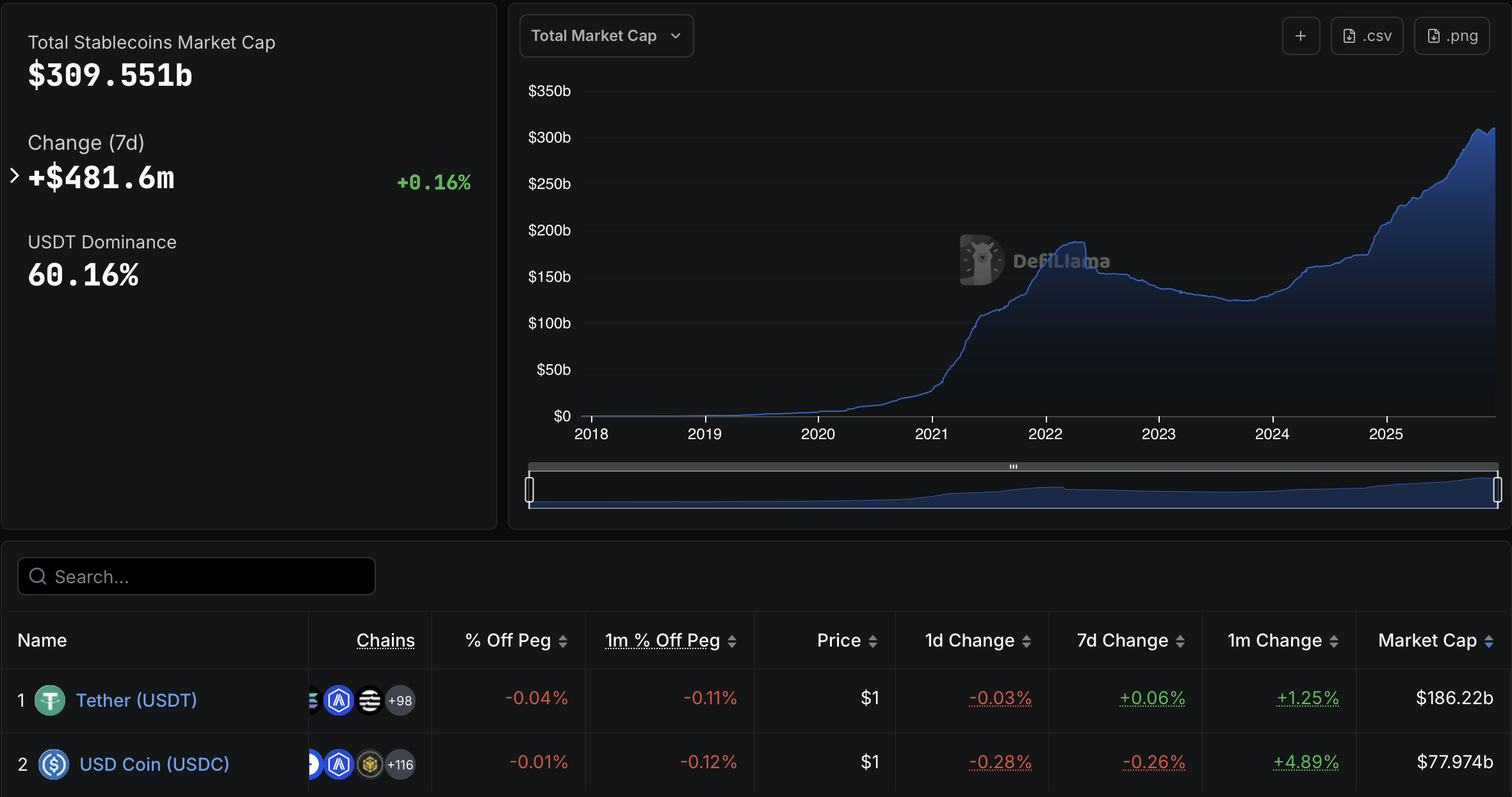
Stablecoin market cap. Source: DefiLlama

As dollar-pegged stablecoins have expanded, issuers have become significant holders of short-term US government debt.

In its second-quarter 2025 reserve report, Tether said its exposure to US Treasurys exceeded $127 billion, including $105.5 billion held directly and $21.3 billion held indirectly. According to the company, that level of Treasury holdings places Tether among the largest holders of US government debt.

Circle’s latest transparency report, dated Dec. 15, shows USDC is also backed largely by US government debt instruments, including $49.7 billion in overnight reverse Treasury repos and $18.5 billion in short-term Treasurys.
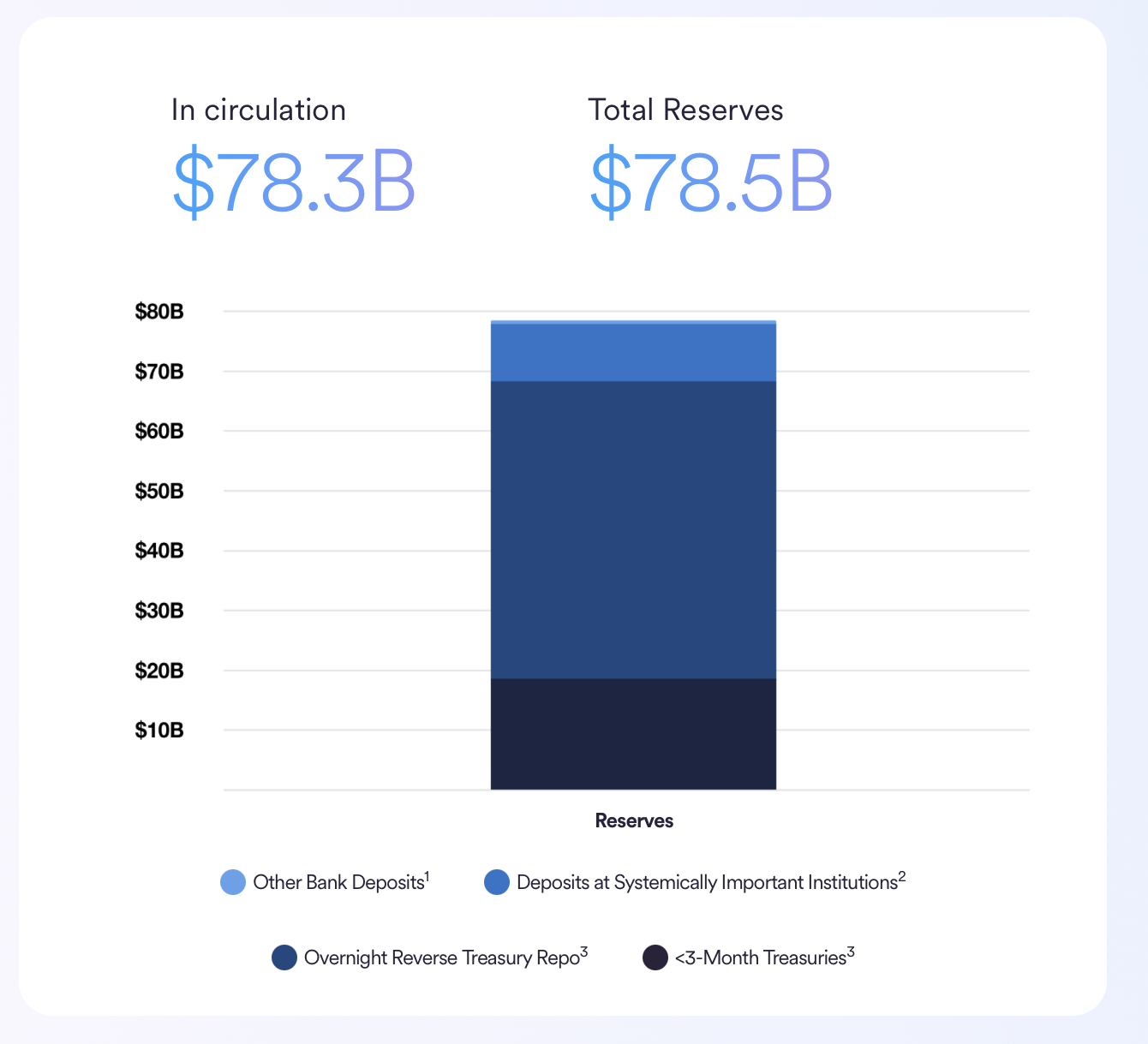
Circle’s reserves composition. Dec. 15, 2025. Source: Circle

A July report from digital asset bank Sygnum said the US government sees dollar-pegged stablecoins as a means to reinforce the dollar’s role as a global reserve currency and is backing their growth through legislation.

Other countries have taken notice. In April, Italy’s Economy and Finance Minister Giancarlo Giorgetti warned that US policies supporting dollar-backed stablecoins pose a greater long-term risk to Europe’s financial system than trade tariffs, citing their potential to erode the euro’s role in cross-border payments.

In December, a group of 10 European banks said they plan to launch a euro-pegged stablecoin in the second half of 2026.

Magazine: Meet the onchain crypto detectives fighting crime better than the cops

Criptomoedas em alta

Perguntas relacionadas

QWhat is the main finding of the Federal Reserve discussion paper regarding the US dollar's role in global debt markets?

AThe paper finds that the US dollar's role in global bond markets has risen and fallen in cyclical waves over the past six decades, with no clear long-term trend toward either greater dollar dominance or de-dollarization.

QAccording to the report, what percentage of emerging market issuers' outstanding international bonds are denominated in US dollars as of 2024?

AAs of 2024, dollar-denominated debt accounts for about 80% of emerging market issuers' outstanding international bonds.

QWhich two stablecoins dominate the stablecoin market, and what is their combined market share?

ATether's USDt (USDT) and Circle's USDC (USDC) together account for about 85% of the total stablecoin supply.

QHow significant is Tether's holding of US Treasurys, according to its Q2 2025 reserve report?

ATether's exposure to US Treasurys exceeded $127 billion, a level that places it among the largest holders of US government debt.

QWhat concern did Italy's Economy and Finance Minister raise regarding US policies on dollar-backed stablecoins?

AHe warned that US policies supporting dollar-backed stablecoins pose a greater long-term risk to Europe's financial system than trade tariffs, citing their potential to erode the euro's role in cross-border payments.

Leituras Relacionadas

Qualcomm: AI Hype Subsides, When Will Smartphones Emerge from the Gloom?

Qualcomm reported its Q3 FY2026 results (ending June 2026), with revenue of $9.95B, down 4% YoY but above expectations. Gross margin declined to 53.1%, pressured by rising costs across manufacturing and memory. Key business segments showed mixed performance: Handset revenue fell 19.6% YoY to $5.09B, dragged by an 11% decline in non-Apple Android shipments and weaker high-end mix. Conversely, Automotive revenue surged 61% to $1.59B, and IoT grew 9% to $1.83B. Core operating profit dropped 41% YoY due to margin compression and higher expenses. Management's Q4 FY2026 guidance projects revenue of $9.7B-$10.5B, in line with consensus, but Non-GAAP EPS guidance of $2.05-$2.25 fell short of expectations. Amidst persistent weakness in its core handset market, Qualcomm is pursuing growth in AI, focusing on Edge AI (smartphones, PCs, automotive) and Data Center AI. Its data center strategy includes four pillars: AI accelerators (e.g., AI200), commercial CPUs (Dragonfly C1000), custom silicon, and connectivity solutions. While these initiatives initially boosted its stock, concerns over AI capital expenditure sustainability have since erased those gains. The company targets $5B in data center revenue for FY2027 and $15B for FY2029. The report concludes that with the traditional handset business still under pressure, the data center opportunity is currently viewed as a longer-term option, and a more conservative valuation based on core operations may be warranted until AI contributions materialize.

marsbitHá 3m

Qualcomm: AI Hype Subsides, When Will Smartphones Emerge from the Gloom?

marsbitHá 3m

From TPU to Self-Evolving Agents: How Jeff Dean Predicts the Next Step in AI

At the 2026 YC Startup School, Jeff Dean outlined his vision for AI's next phase, shifting focus from simply scaling models to building intelligent, autonomous systems. He believes AI's progress is no longer just about creating smarter models, but about integrating them into systems capable of long-term, iterative work, automated experimentation, and continuous learning. This evolution moves the competition from "who has the bigger model" to "who can best organize intelligence." Dean suggests AI capabilities are now comparable to a junior engineer, enabling the automation of complex workflows. However, the true challenge and opportunity lie in managing these AI "workers" at scale. He emphasizes the importance of **context engineering**—structuring tools, memory, and feedback loops—over raw model power. For startups, this means building deep expertise in niche domains where general models currently fail (near 0-1% success rates), leveraging proprietary data, specialized tools, and domain-specific evaluators. A recurring theme is re-examining fundamental constraints. Dean's past work, like moving Google's search index to memory or creating the TPU, stemmed from questioning outdated assumptions about hardware and cost. He sees similar inflection points today, particularly in **specialized inference hardware** to drastically reduce latency and energy consumption for real-time Agent operation. Notably, he points out that in modern AI systems, the dominant cost is often not computation but **data movement**. Reliable, long-running Agents require robust system design, borrowing concepts from distributed computing like checkpointing, state management, and parallel exploration to handle failures and maintain progress over days or weeks. As AI automates execution, the scarcest human skills will shift to **defining clear specifications**, **judging what problems are worth solving** (taste), and designing effective feedback loops. Ultimately, Dean's framework prioritizes understanding the problem deeply, identifying the true bottlenecks, and systematically building closed-loop systems where AI can not only perform tasks but also improve AI itself.

marsbitHá 3m

From TPU to Self-Evolving Agents: How Jeff Dean Predicts the Next Step in AI

marsbitHá 3m

Trading

Spot

Artigos em Destaque

Como comprar US

Bem-vindo à HTX.com!Tornámos a compra de Talus Network (US) simples e conveniente.Segue o nosso guia passo a passo para iniciar a tua jornada no mundo das criptos.Passo 1: cria a tua conta HTXUtiliza o teu e-mail ou número de telefone para te inscreveres numa conta gratuita na HTX.Desfruta de um processo de inscrição sem complicações e desbloqueia todas as funcionalidades.Obter a minha contaPasso 2: vai para Comprar Cripto e escolhe o teu método de pagamentoCartão de crédito/débito: usa o teu visa ou mastercard para comprar Talus Network (US) instantaneamente.Saldo: usa os fundos da tua conta HTX para transacionar sem problemas.Terceiros: adicionamos métodos de pagamento populares, como Google Pay e Apple Pay, para aumentar a conveniência.P2P: transaciona diretamente com outros utilizadores na HTX.Mercado de balcão (OTC): oferecemos serviços personalizados e taxas de câmbio competitivas para os traders.Passo 3: armazena teu Talus Network (US)Depois de comprar o teu Talus Network (US), armazena-o na tua conta HTX.Alternativamente, podes enviá-lo para outro lugar através de transferência blockchain ou usá-lo para transacionar outras criptomoedas.Passo 4: transaciona Talus Network (US)Transaciona facilmente Talus Network (US) no mercado à vista da HTX.Acede simplesmente à tua conta, seleciona o teu par de trading, executa as tuas transações e monitoriza em tempo real.Oferecemos uma experiência de fácil utilização tanto para principiantes como para traders experientes.

454 Visualizações TotaisPublicado em {updateTime}Atualizado em 2026.06.02

Como comprar US

Discussões

Bem-vindo à Comunidade HTX. Aqui, pode manter-se informado sobre os mais recentes desenvolvimentos da plataforma e obter acesso a análises profissionais de mercado. As opiniões dos utilizadores sobre o preço de US (US) são apresentadas abaixo.

活动图片













