Global Crypto Reporting Expands As 48 Countries Prep For CARF 2027

bitcoinistPublicado em 2026-01-02Última atualização em 2026-01-02

Resumo

A coordinated effort among 48 jurisdictions to implement the Crypto-Asset Reporting Framework (CARF) has begun, with standardized crypto transaction and user data collection starting January 1, 2026. The first automatic cross-border exchanges between tax authorities are expected in 2027. Service providers, including exchanges, brokers, and crypto ATMs, must collect account details, transaction histories, and users’ tax residency information. This framework aims to enhance tax transparency and enforcement of existing rules, not create new taxes. While larger platforms are adapting systems, smaller ones face operational burdens, and privacy concerns have been raised regarding data storage and access. An additional 27 jurisdictions plan to begin collection in 2027, with exchanges following in 2028. For users, this means more detailed onboarding processes and clearer record-keeping requirements from providers.

A coordinated effort to gather crypto tax records has begun in a group of jurisdictions preparing to take part in the Crypto-Asset Reporting Framework (CARF).

According to official monitoring from the Organization for Economic Co-operation and Development (OECD), 48 jurisdictions committed to start collecting standardized crypto transaction and user data from January 1, 2026, with the first automatic cross-border exchanges expected to take place in 2027.

Countries Begin Collecting Data

Based on reports, service providers such as major exchanges, some broker platforms, crypto ATMs and certain custody services will be obliged to record account details, transaction histories and users’ tax residency information for reporting to domestic tax authorities.

That information will be formatted so it can be shared automatically with partner tax offices once the exchange phase starts. The OECD monitoring update lays out the kinds of fields that must be gathered and stored for future reporting.
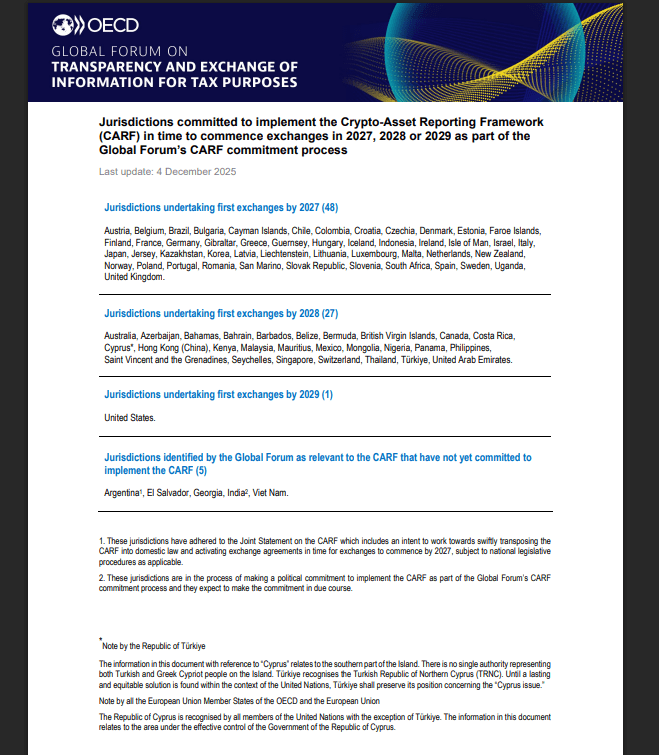
Source: OECD

What Exchanges Must Report

According to news outlets tracking the rollout, exchanges are already adjusting onboarding forms and internal compliance systems to verify customers’ tax residency and capture wallet-level activity.

Some jurisdictions, led by the United Kingdom, have moved faster to require platforms to keep detailed purchase and sale records for users in scope. Tax authorities will then receive yearly reports covering balances, transfers and gains for listed accounts.

Operational Strain And Privacy Questions

The new rules create practical burdens. Smaller platforms will need to upgrade systems or hire compliance staff to track the new data points.

Based on reports, privacy advocates and parts of the crypto industry are warning that the depth of data collection could raise concerns about how long sensitive transaction records are held and who can access them.

Some legal teams are already studying how domestic data-privacy laws interact with automatic information exchange.

Total crypto market cap currently at $2.99 trillion. Chart: TradingView

Middle Nations Join The Second Wave

A further group of jurisdictions has said it will begin domestic collection later. Reports note that an additional 27 jurisdictions have timelines that target January 1, 2027 for starting to collect, with exchanges of information to follow in 2028 for that batch.

At least one analysis of national updates also indicates that a handful of countries are planning to stagger implementation because of local legislative calendars.

How This Will Play Out For Users

For ordinary crypto users, the immediate change will be more questions during account setup and clearer record-keeping demands from providers.

Based on official guidance, CARF itself does not create new taxes; rather, it gives tax offices the data they need to enforce existing rules. For some investors, that means past reporting gaps will be easier for authorities to spot.

Reports have disclosed that implementation will vary by country. Some tax administrations are ready to receive standardized files in 2027, while others are still finishing domestic law changes.

Observers say the rollout marks a major step toward treating crypto transactions like other financial accounts when it comes to cross-border tax transparency.

Featured image from Unsplash, chart from TradingView

Perguntas relacionadas

QWhat is the Crypto-Asset Reporting Framework (CARF) and when will the first automatic cross-border exchanges begin?

AThe Crypto-Asset Reporting Framework (CARF) is a coordinated effort to gather standardized crypto tax records. According to the OECD, the first automatic cross-border exchanges of this data are expected to take place in 2027.

QHow many jurisdictions have committed to start collecting standardized crypto transaction data from January 1, 2026?

A48 jurisdictions have committed to start collecting standardized crypto transaction and user data from January 1, 2026.

QWhat specific information will crypto service providers be obliged to record and report under CARF?

AService providers such as exchanges, broker platforms, crypto ATMs, and custody services will be obliged to record account details, transaction histories, and users' tax residency information for reporting to domestic tax authorities.

QWhat are two major concerns or challenges raised by the implementation of CARF?

ATwo major concerns are the practical burden and operational strain on smaller platforms, which will need to upgrade systems or hire compliance staff, and the privacy concerns regarding how long sensitive transaction records are held and who can access them.

QHow will the CARF implementation affect ordinary crypto users according to the article?

AFor ordinary crypto users, the immediate change will be more questions during account setup and clearer record-keeping demands from their service providers. CARF does not create new taxes but gives tax offices the data to enforce existing rules, making it easier for authorities to spot past reporting gaps.

Leituras Relacionadas

Can a Hair Dryer Earn $34,000? Deciphering the Reflexivity Paradox in Prediction Markets

An individual manipulated a weather sensor at Paris Charles de Gaulle Airport with a portable heat source, causing a Polymarket weather market to settle at 22°C and earning $34,000. This incident highlights a fundamental issue in prediction markets: when a market aims to reflect reality, it also incentivizes participants to influence that reality. Prediction markets operate on two layers: platform rules (what outcome counts as a win) and data sources (what actually happened). While most focus on rules, the real vulnerability lies in the data source. If reality is recorded through a specific source, influencing that source directly affects market settlement. The article categorizes markets by their vulnerability: 1. **Single-point physical data sources** (e.g., weather stations): Easily manipulated through physical interference. 2. **Insider information markets** (e.g., MrBeast video details): Insiders like team members use non-public information to trade. Kalshi fined a剪辑师 $20,000 for insider trading. 3. **Actor-manipulated markets** (e.g., Andrew Tate’s tweet counts): The subject of the market can control the outcome. Evidence suggests Tate’sociated accounts coordinated to profit. 4. **Individual-action markets** (e.g., WNBA disruptions): A single person can execute an event to profit from their pre-placed bets. Kalshi and Polymarket handle these issues differently. Kalshi enforces strict KYC, publicly penalizes insider trading, and reports to regulators. Polymarket, with its anonymous wallet-based system, has historically been more permissive, arguing that insider information improves market accuracy. However, it cooperated with authorities in the "Van Dyke case," where a user traded on classified government information. The core paradox is reflexivity: prediction markets are designed to discover truth, but their financial incentives can distort reality. The more valuable a prediction becomes, the more likely participants are to influence the event itself. The market ceases to be a mirror of reality and instead shapes it.

marsbitHá 42m

Can a Hair Dryer Earn $34,000? Deciphering the Reflexivity Paradox in Prediction Markets

marsbitHá 42m

First Day Review of "Musk's WeChat" XChat: Even Worse Than Expected

Elon Musk's much-anticipated "WeChat-like" app, XChat, has officially launched after multiple delays. The initial review reveals a product that falls short of expectations, offering an experience largely similar to X Platform's (formerly Twitter) direct messages, despite being marketed as an encrypted communication tool. Key observations from the first-day test include: 1. The app's promoted "end-to-end encryption" and its claimed relation to Bitcoin's architecture were criticized by experts as a superficial attempt to capitalize on crypto buzz, with no real technical connection. 2. Musk's vision of an ad-free "secure communication system" is technically met, but only because the app is currently extremely basic, featuring only a single chat interface. 3. A promised anti-screenshot feature appears inconsistent; it works in X Platform group chats but fails within the XChat app itself, where screenshots still capture avatars. 4. The app supports 45 languages and has a 16+ age rating, indicating a broader tolerance for content compared to WeChat's 13+ rating. 5. A puzzling login process requires users to verify the email associated with their X account. 6. The touted encryption" feels minimal in practice, with its presence only indicated by a simple "Encrypted - Yes" label on messages. 7. Disappearing message timers for groups can be set from 5 minutes to 4 weeks, with the timer starting upon being read by a user. 8. Group invite links are shared with X Platform groups. 9. Group size limits are planned to be increased, aiming for 1000 members, a move that has drawn user criticism. 10. The app offers 8 different colored icons, and its chat bubbles are notably similar to WeChat's. Message deletion options mimic Telegram's. Crucially, many pre-announced features like importing X contacts, integrating Grok AI, X Money payments, and Cashtags are not yet available. The initial release is seen as a bare-bones and underwhelming first step.

Odaily星球日报Há 1h

First Day Review of "Musk's WeChat" XChat: Even Worse Than Expected

Odaily星球日报Há 1h

Trading

Spot
Futuros
活动图片