Glassnode: Crypto Market in 'Late Bear Market Bottoming Phase', Three Core Signals Absent, Bitcoin Reversal Still Requires Time

marsbitPublicado em 2026-07-10Última atualização em 2026-07-10

Resumo

According to a Glassnode analysis, the cryptocurrency market is currently in the late stages of a bear market bottom formation. Bitcoin's price has remained below key realized price and short-term holder cost benchmarks for five months, indicating deep undervaluation. A major source of sell-side pressure is from long-term holders realizing losses, with their daily loss-taking recently peaking at $280 million, the highest level since December 2022. While spot Bitcoin ETF outflows have moderated, they remain in a state of monthly net negative flows, and trading volumes are approximately 80% below their 2025 peak, signaling a lack of robust institutional demand. In derivatives markets, positioning has shifted to a cautiously bullish stance. However, options volatility surfaces still price in downside risk, and the spot price sits below the "Max Pain" strike level. The report concludes that the necessary conditions for a market bottom are in place, but a confirmed reversal requires three core signals: a sustained decline in long-term holder loss realization, a stabilization in ETF fund flows, and a sustained price recovery above the Realized Price. Until these signals emerge, a full transition to a bull market is unlikely to occur imminently.

Authors:CryptoVizArt, Frederik Theissen, Glassnode

Compiled by:Luffy, Foresight News

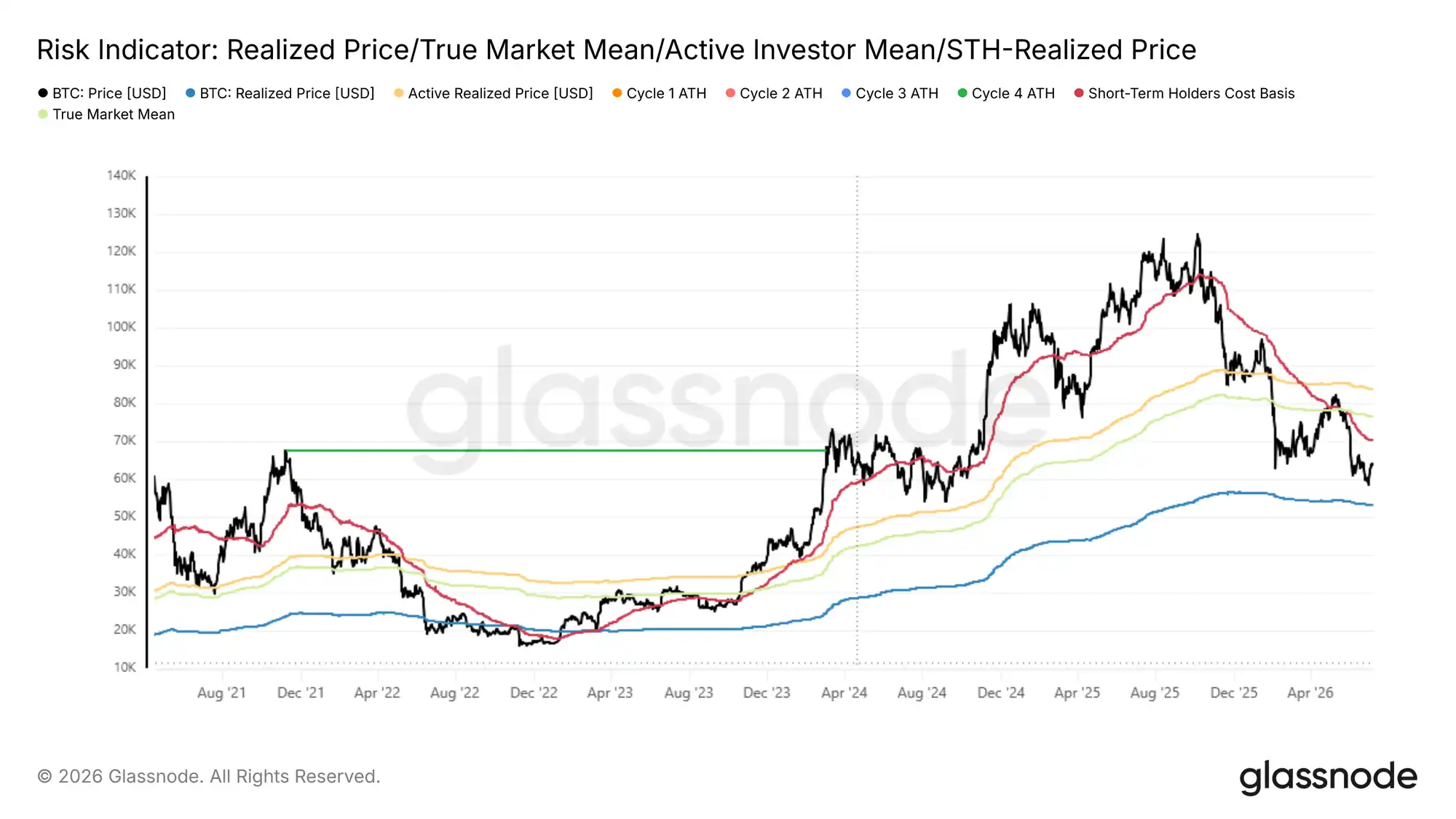
Bitcoin price has been below the true market average and the cost basis of short-term holders for five consecutive months, residing in a deeply undervalued zone.

The proportion of losses realized by long-term holders relative to total on-chain realized losses has now risen to 43%, with the daily peak of loss realization reaching $280 million, the highest level since December 2022. The outflow of spot ETF funds has moderated but still maintains a state of monthly net outflows; ETF daily average trading volume remains in the range of $650 million to $950 million, shrinking approximately 80% from the peak in October 2025, indicating institutional buying demand has not yet stabilized.

Derivatives positioning has shifted to cautiously bullish, with the put/call ratio dropping to its lowest level in 2026; however, the options volatility skew still maintains a defensive premium, and the spot price remains significantly below the max pain price. The market has entered the late stage of bottoming, and the continuous narrowing of selling pressure from long-term holders is an important precondition for a market reversal and recovery.

Macro Perspective

Oil Surges, Risk Assets Under Collective Pressure

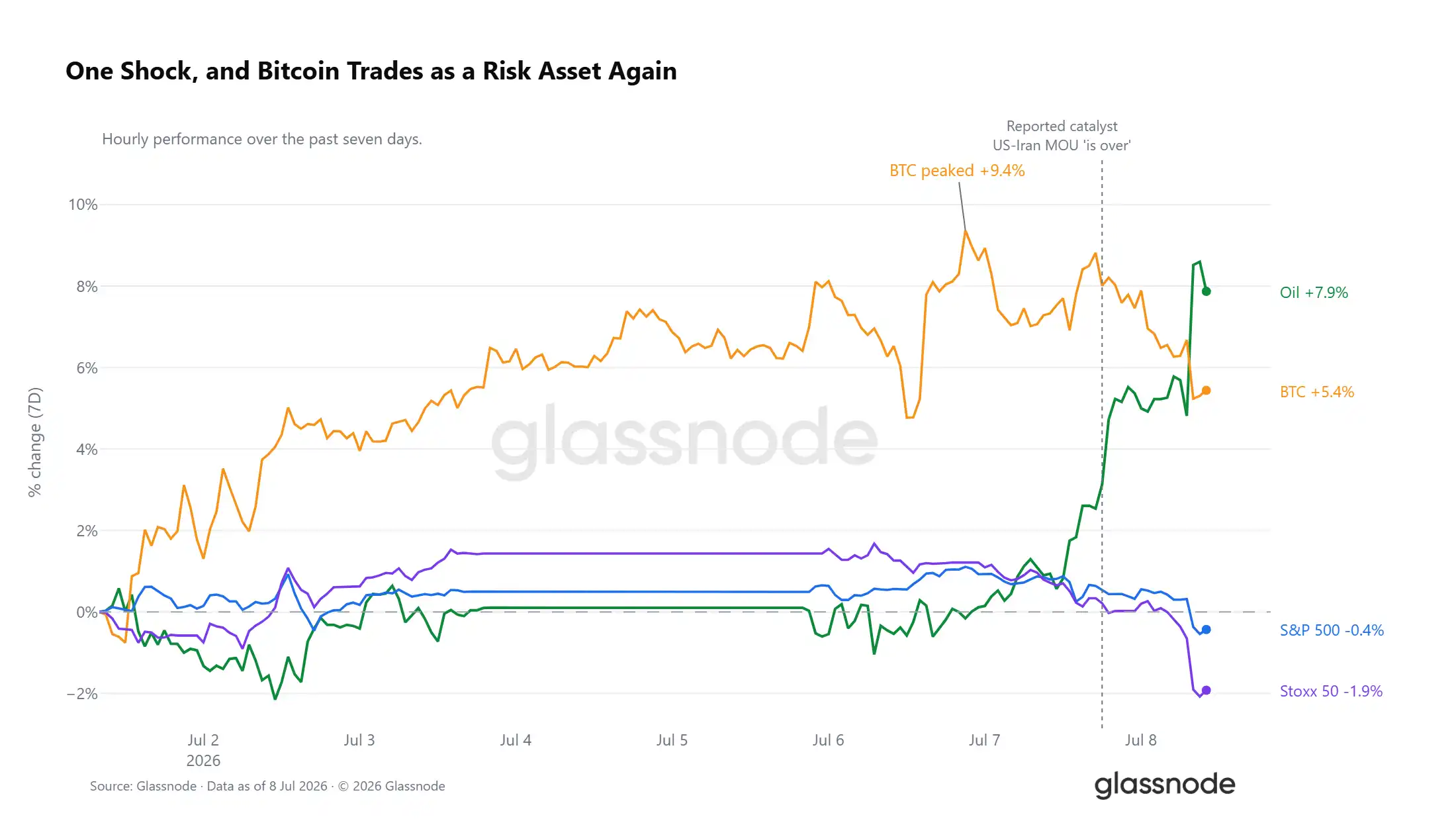
Over the past 7 trading days, WTI crude oil has cumulatively risen by 7.9%, with the majority of gains concentrated in recent sessions. News emerged that the US-Iran Memorandum of Understanding has expired, an impact that has rippled across all asset markets. Bitcoin's weekly gain peaked at 9.4% but has now retreated to a 5% weekly gain; the S&P 500 and Euro Stoxx indices have all turned negative, with European stocks leading the decline among global risk assets. Currently, Bitcoin's movement is highly synchronized with risk assets.
Liquidity Environment: Long-Short Contradictions Intensify

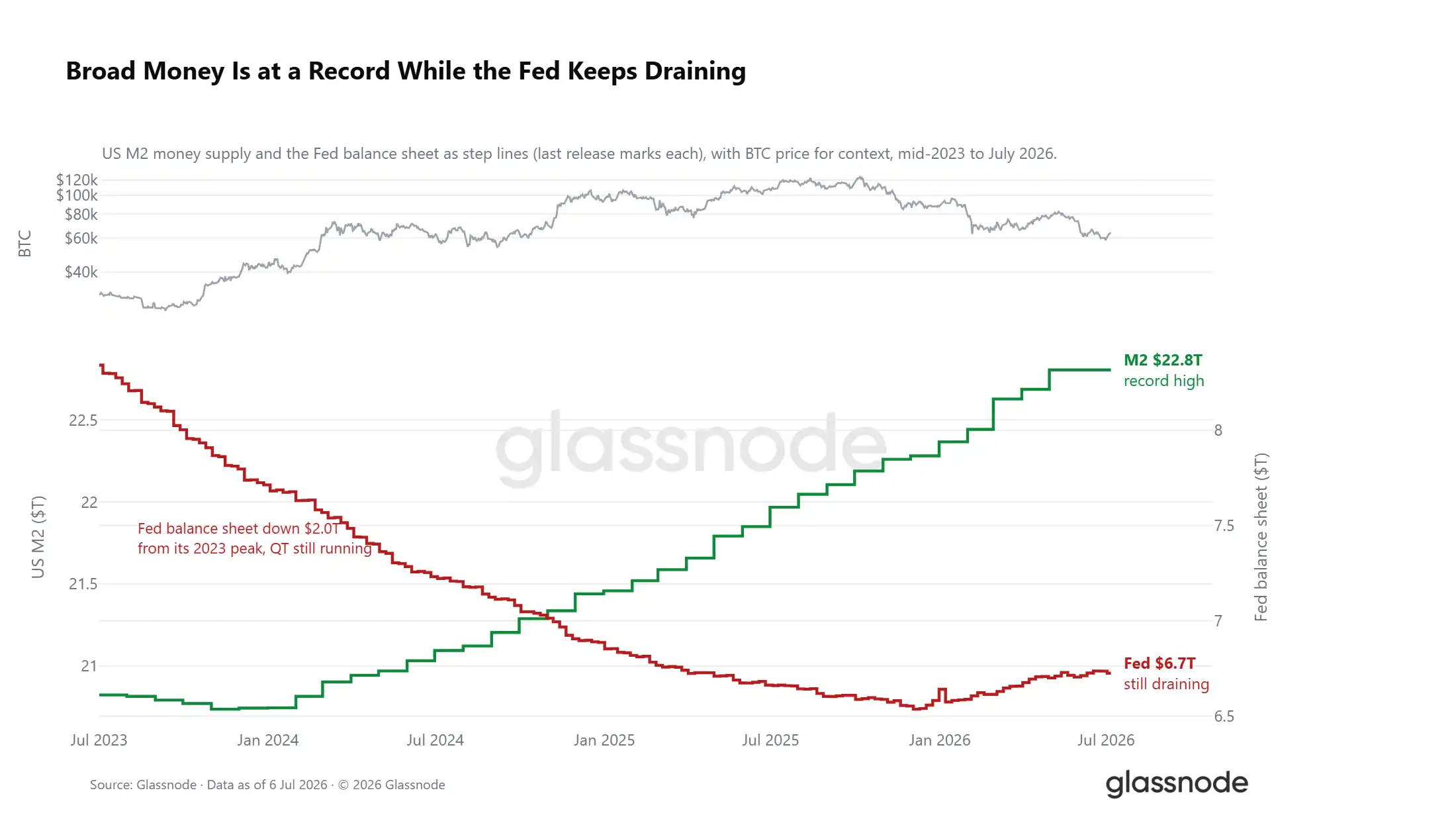
Amid external shocks from oil, the market's liquidity environment presents a contradictory picture. The total U.S. broad money supply (M2) has climbed to a new historical high of $22.8 trillion. Historically, broad money expansion cycles tend to boost market risk appetite; however, the Federal Reserve's balance sheet continues to shrink, with its current size down by $2 trillion from the 2023 peak. These two liquidity signals create a strong counterforce: the total broad money supply continues to rise while the quantitative tightening process persists, with real interest rates hovering near 1%, keeping the opportunity cost of holding non-yielding digital assets high. The macro-level favorable window is not completely closed but has not formed clear accommodative support either.
On-Chain Data

A Deeply Undervalued Zone Spanning Five Months

Over the past week, Bitcoin rebounded from $58,300 to $64,400, showing a short-term recovery, but the price remains significantly below the true market average of $76,600 and the short-term holder cost basis of $72,200. Only when the price reclaims these two key levels can the market exit the deeply undervalued zone; otherwise, the price action remains susceptible to declines catalyzed by external negative news.

The duration of this discount phase is noteworthy. Since early February 2026, the price has persistently traded below the cost basis of active investors and the break-even line for recent entrants, lasting nearly five months, which qualifies as a relatively long-lasting deep discount cycle in Bitcoin's history.

Continued high-volume coin distribution within a prolonged discount zone, with fresh capital consistently accumulating below the cost basis of earlier buyers and the entire market's active holdings, has historically formed the foundation for major cycle bottoms, offering long-term allocation appeal for value investors. Various metrics indicate the bottoming process has entered its later stages, but the possibility of a retest to $53,000 cannot be entirely ruled out.
Concentrated Stop-Loss Selling by Long-Term Holders with High-Cost Basis

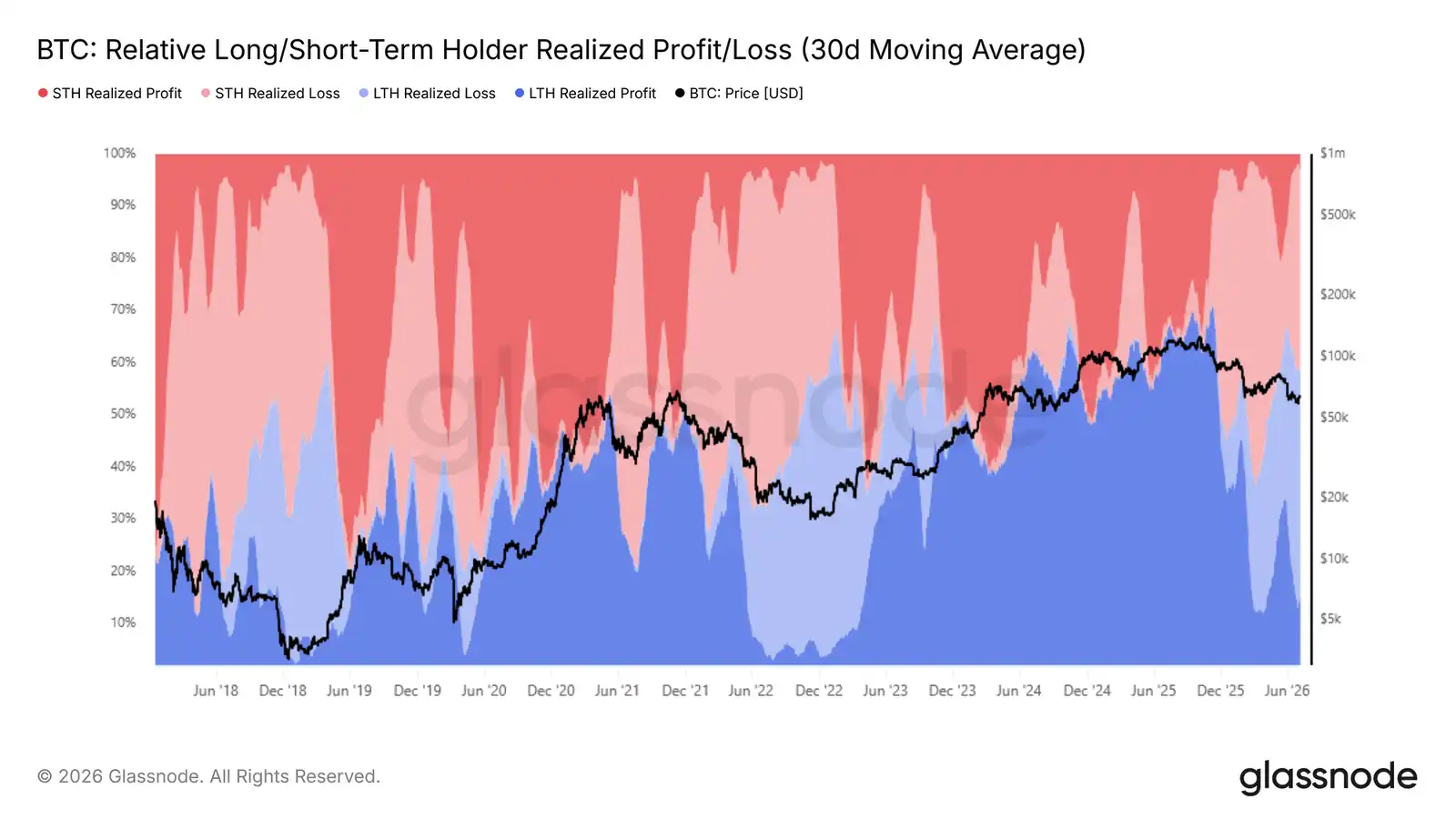
The market is constructing a cyclical bottom. The core question now is identifying the primary source of selling pressure. The relative indicator of profit/loss realization by long/short-term holders analyzes the distribution proportion of the entire market's on-chain realized profit/loss between these two holding groups, directly reflecting the scale share of each group's profit/loss realization.

After the price fell below the true market average, the 30-day moving average share of loss realization by long-term holders has climbed from around 15% in early February 2026 to the current 43%. Loss-driven selling pressure from this group has become the most dominant bearish force suppressing the price.

These investors mostly entered near the cycle highs. After enduring months of deep drawdowns, their confidence is gradually depleted, leading to concentrated exits. This coin structure directly explains why every recovery rally faces concentrated selling from deeply entrenched positions, preventing the price from solidifying above the upper bound of the current range.
Stop-Loss Selling Pressure Yet to Show Signs of Abating

Long-term holder loss realization has become the market's primary downward pressure. The next key observation is whether this selling pressure begins to subside.

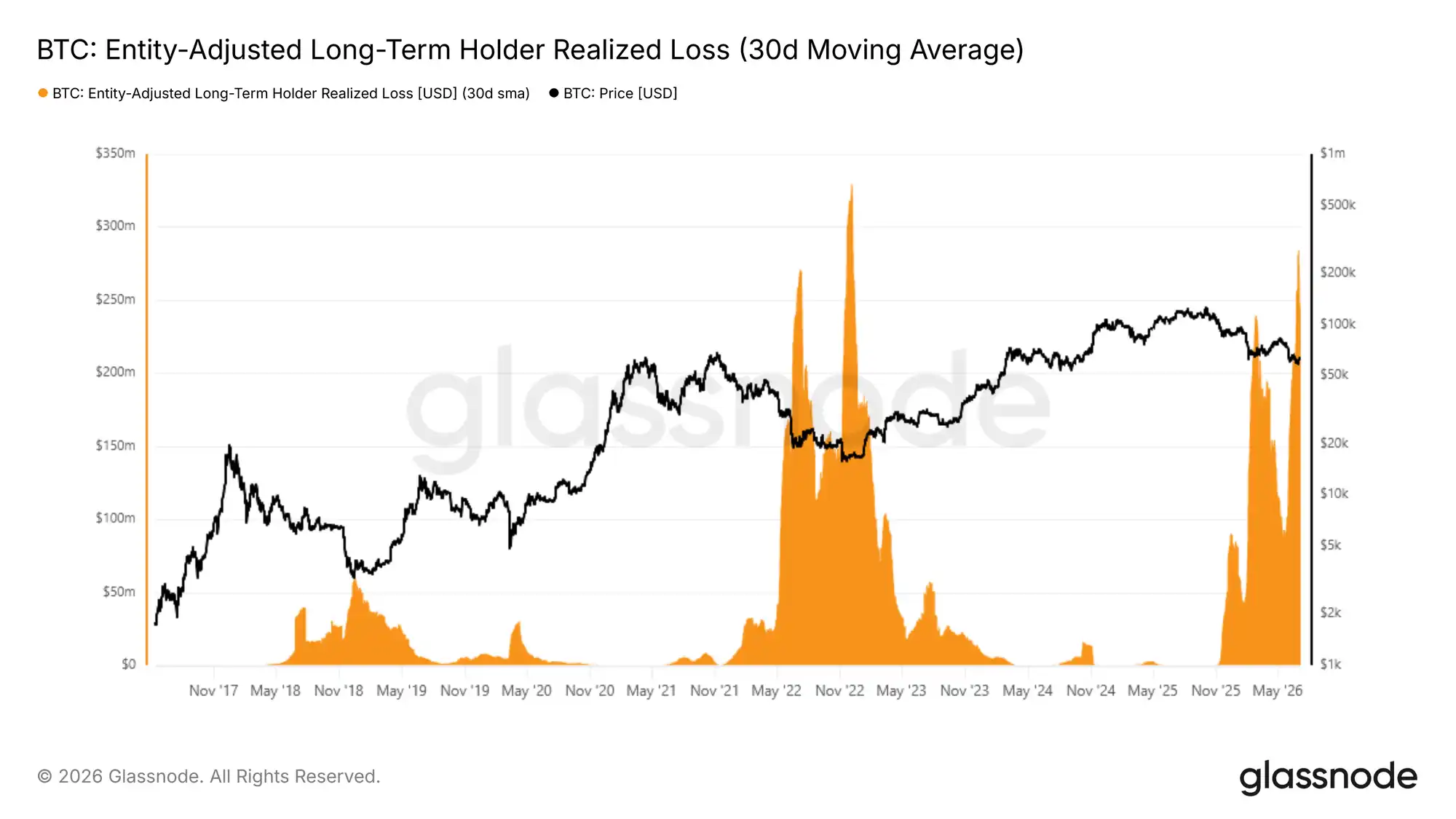
The entity-adjusted long-term holder realized loss indicator (30-day smoothed average) tracks the loss amount from sales by users holding coins for over 155 days, excluding internal address transfers, accurately reflecting genuine stop-loss exit behavior. This indicator recently hit a new daily peak, with daily loss realization volume around $280 million, the highest since December 2022, marking the second major wave of long-term holder stop-loss selling in this bear market.

The key difference is that after the first peak, selling pressure showed a temporary decline, whereas the current wave has yet to show a contraction in scale. Only when this indicator shows a clear downward trend will the market possess the foundational conditions for a shift towards a bull market. Its trajectory in the coming weeks to months will be the core signal for judging whether the market has truly completed selling pressure capitulation.
Off-Chain Markets

ETF Outflows Slow, But Outflow Trend Not Reversed

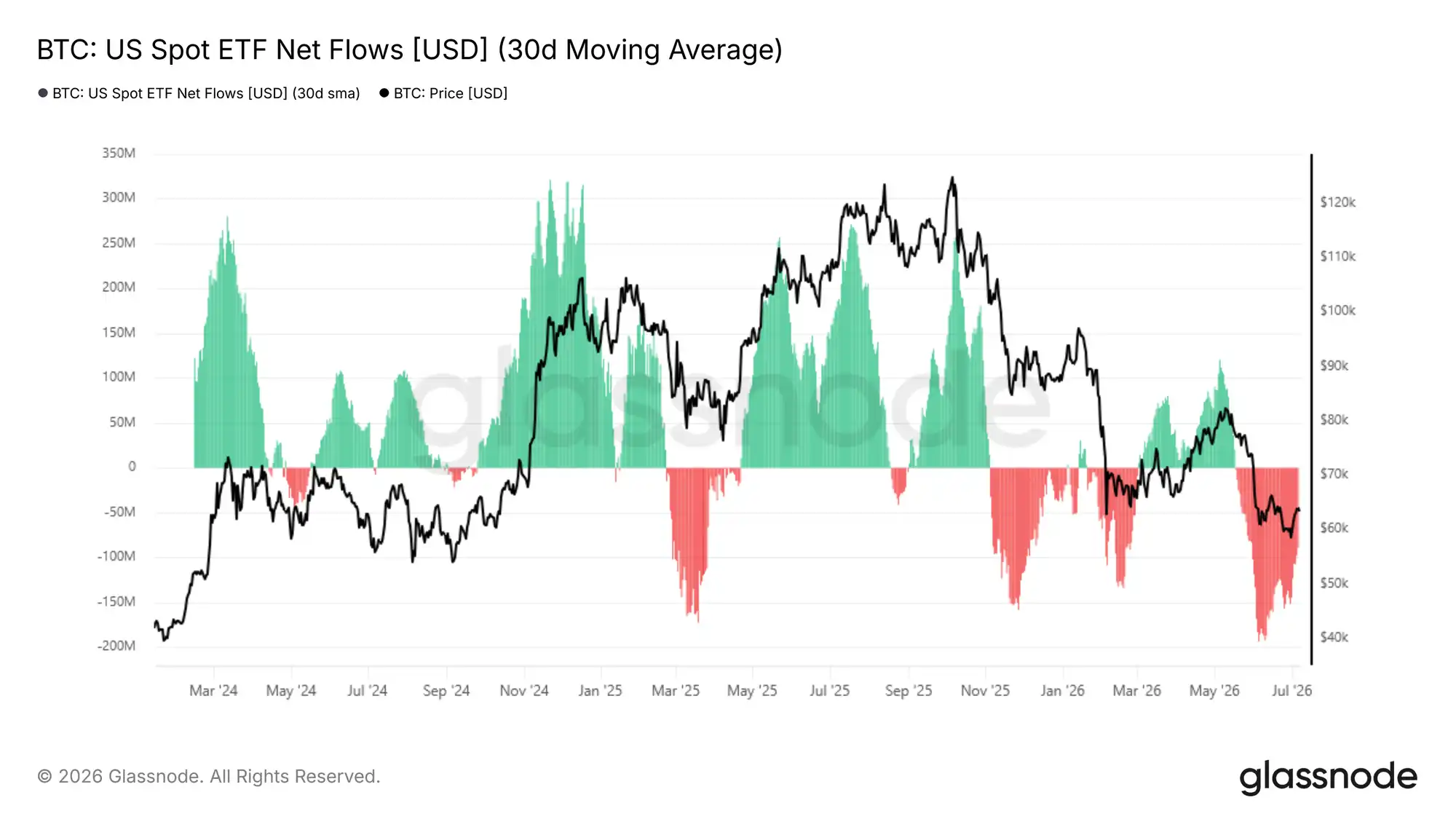
Shifting from on-chain to off-chain markets, spot ETF fund flows directly reflect institutional capital behavior. The 30-day moving average of ETF net flows indicates the daily net capital inflow/outflow from U.S. spot Bitcoin ETFs, smoothing out daily volatility to reveal underlying trends in institutional holdings.

Since mid-May 2026, this indicator entered a zone of monthly net outflows, with a daily outflow peak reaching $193 million in early June, now receded to a daily net outflow of $88.9 million. The moderation in outflow scale is a faint positive, but the market continues to see monthly capital outflows, and institutional buying demand has not stabilized. Only when the fund flow trend narrows consistently towards a balanced range can one reasonably anticipate a short-term expansionary rally.
Institutional Trading Volume Remains Sluggish

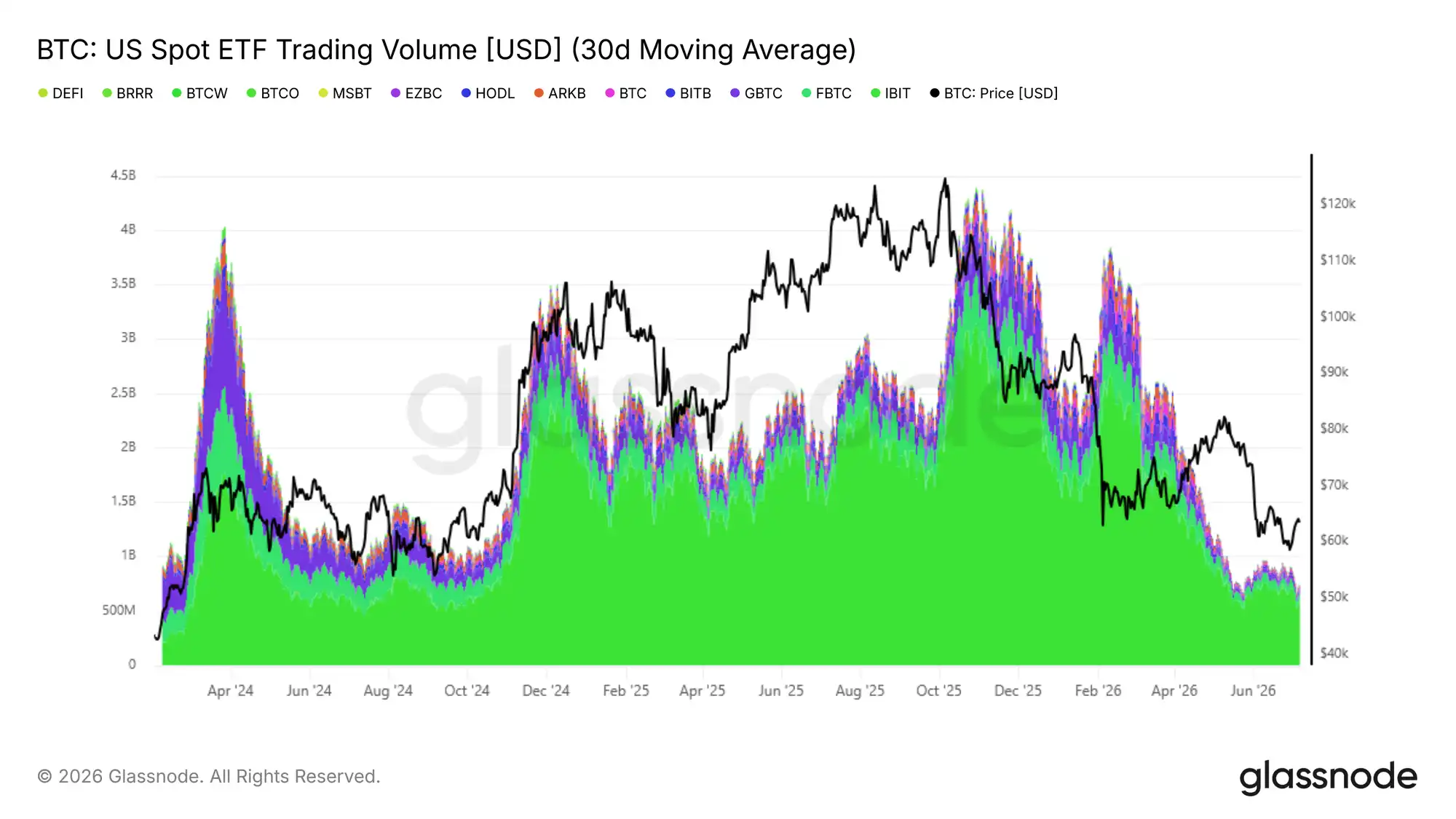
In addition to net flow data, U.S. spot ETF trading volume helps gauge the degree of institutional confidence recovery. The 30-day moving average of ETF daily trading volume currently fluctuates between $650 million and $950 million, a level comparable to Q4 2024, but also about 80% lower than the daily peak of $4.4 billion set in October 2025.

Current trading volume only represents basic institutional participation, remaining extremely low compared to bull market peaks, indicating that medium-to-long-term bullish confidence among ETF investors has not materially returned. Only when daily average trading volume shows sustained expansion *and* net outflow scale continuously narrows, with both signals appearing simultaneously, can institutional demand recovery be confirmed. Until both metrics improve in tandem, off-chain data aligns with on-chain indicators, suggesting the overall market remains in a bear market-dominated regime.
Derivatives Market

Short Covering, Positioning Shifts to Cautiously Bullish

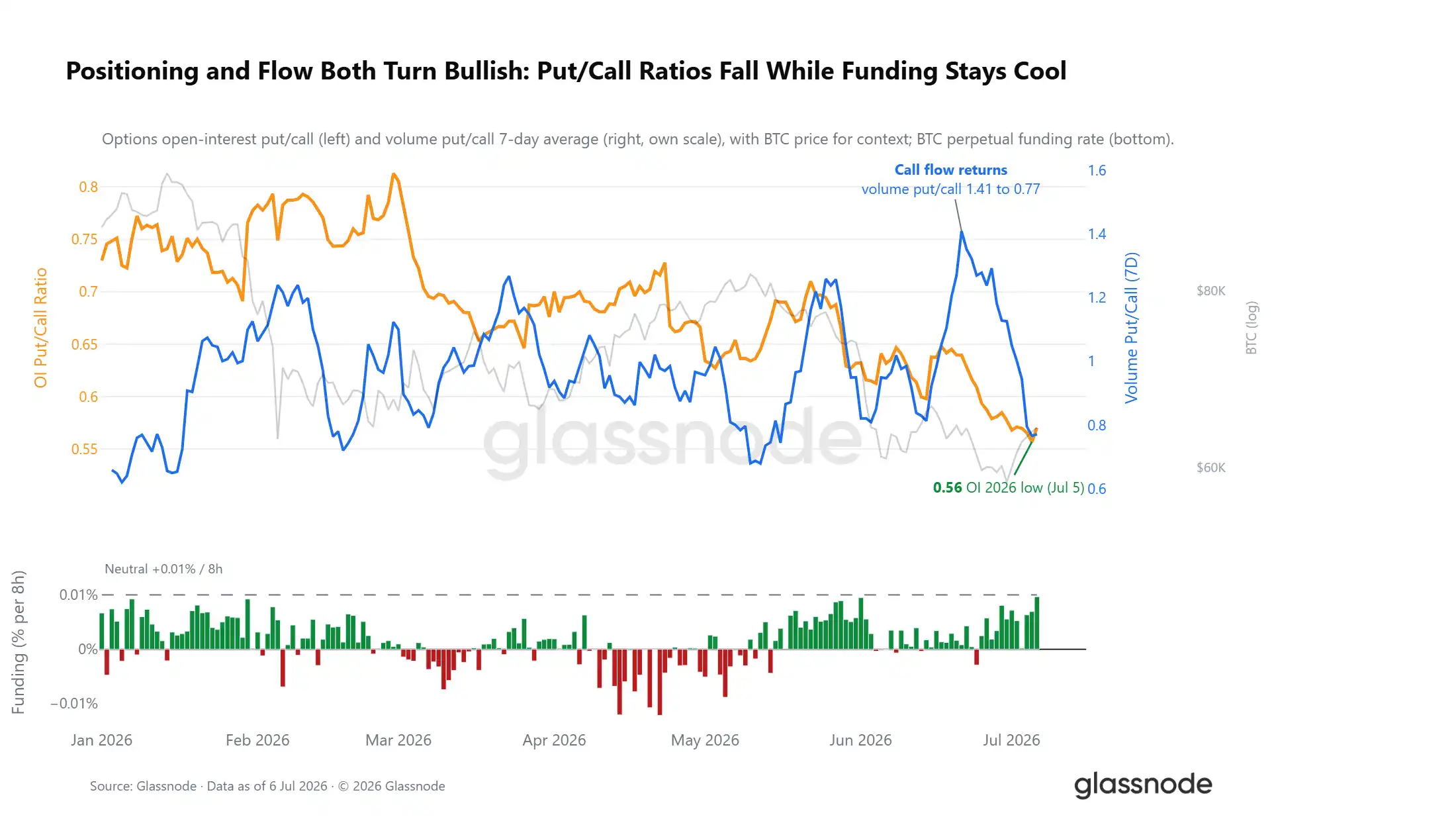
Despite the price action reflecting weak risk sentiment, derivatives positioning structure has already shown a reverse shift. The put/call open interest ratio has dropped to 0.56, the lowest level in 2026, meaning the market currently has one put contract for every two call contracts. Options trading flow corroborates this trend: two weeks ago during Bitcoin's second retest of lows, the market frantically bought puts for hedging, causing the put/call trading ratio to surge sharply; as call buying steadily returned, this ratio quickly declined, even though the spot price has only partially recovered its losses.

Perpetual swap funding rates also support the positioning shift. The average perpetual swap funding rate has long been below the 0.01% long-short equilibrium line, far from levels seen in crowded long trades. The derivatives market has completed its short risk clearance and has turned cautiously bullish overall amid external negative shocks, a stark contrast to the crowded short positioning structure before the previous major decline.
Options Skew Still Prices in Downside Risk

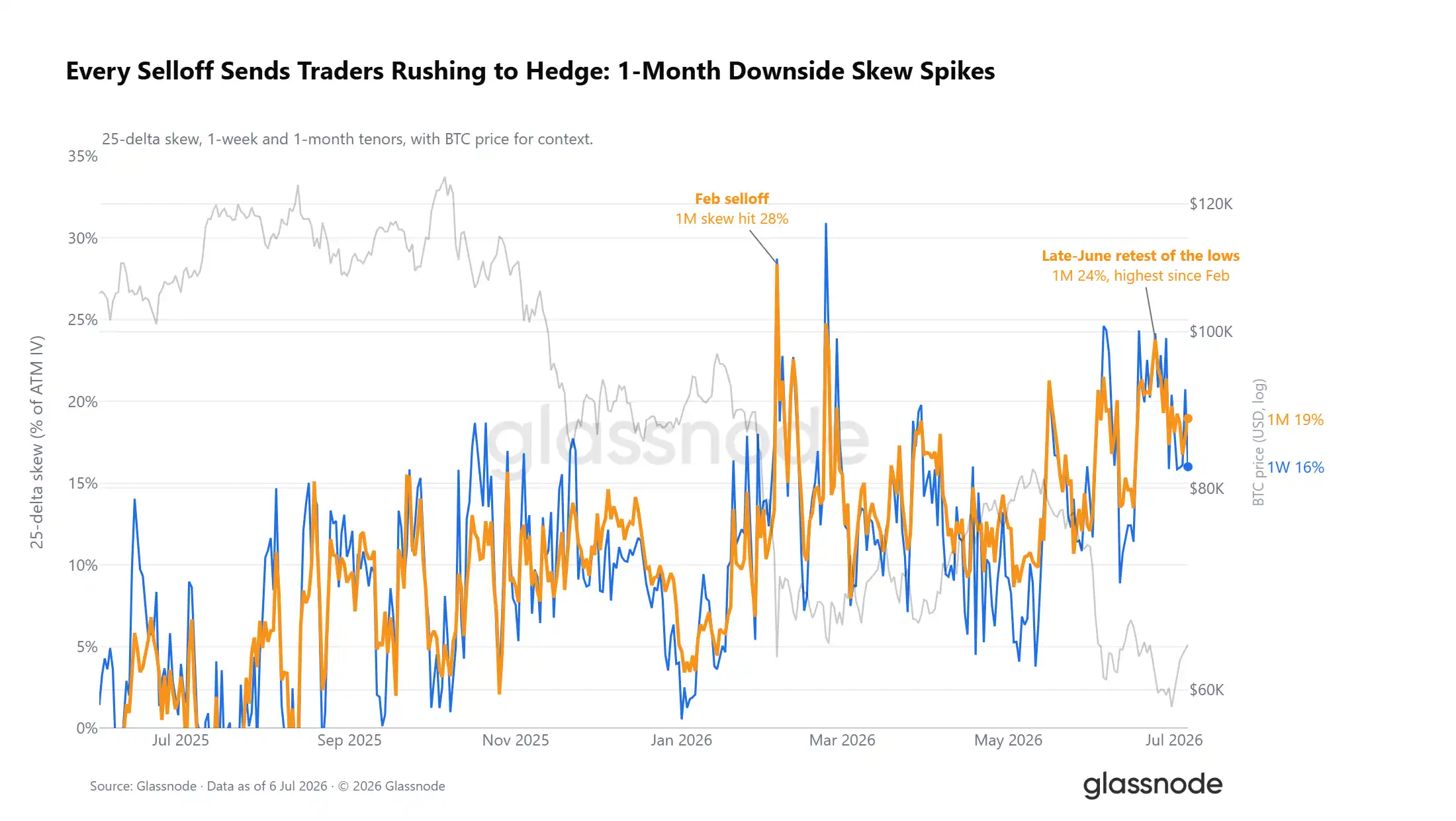
While overall positioning leans bullish, the options volatility skew sends an opposite signal. The 25-delta volatility skew indicator (premium for downside protection relative to upside gain) maintains a premium across all expiration dates. Every sell-off this year has pushed this premium higher, and at the end of June it surged to 24%, marking the strongest defensive sentiment for near-month contracts since the February crash. Even with the market leaning long, traders are still willing to pay a premium to buy downside hedging instruments.
Spot Price Deviates from Max Pain Price

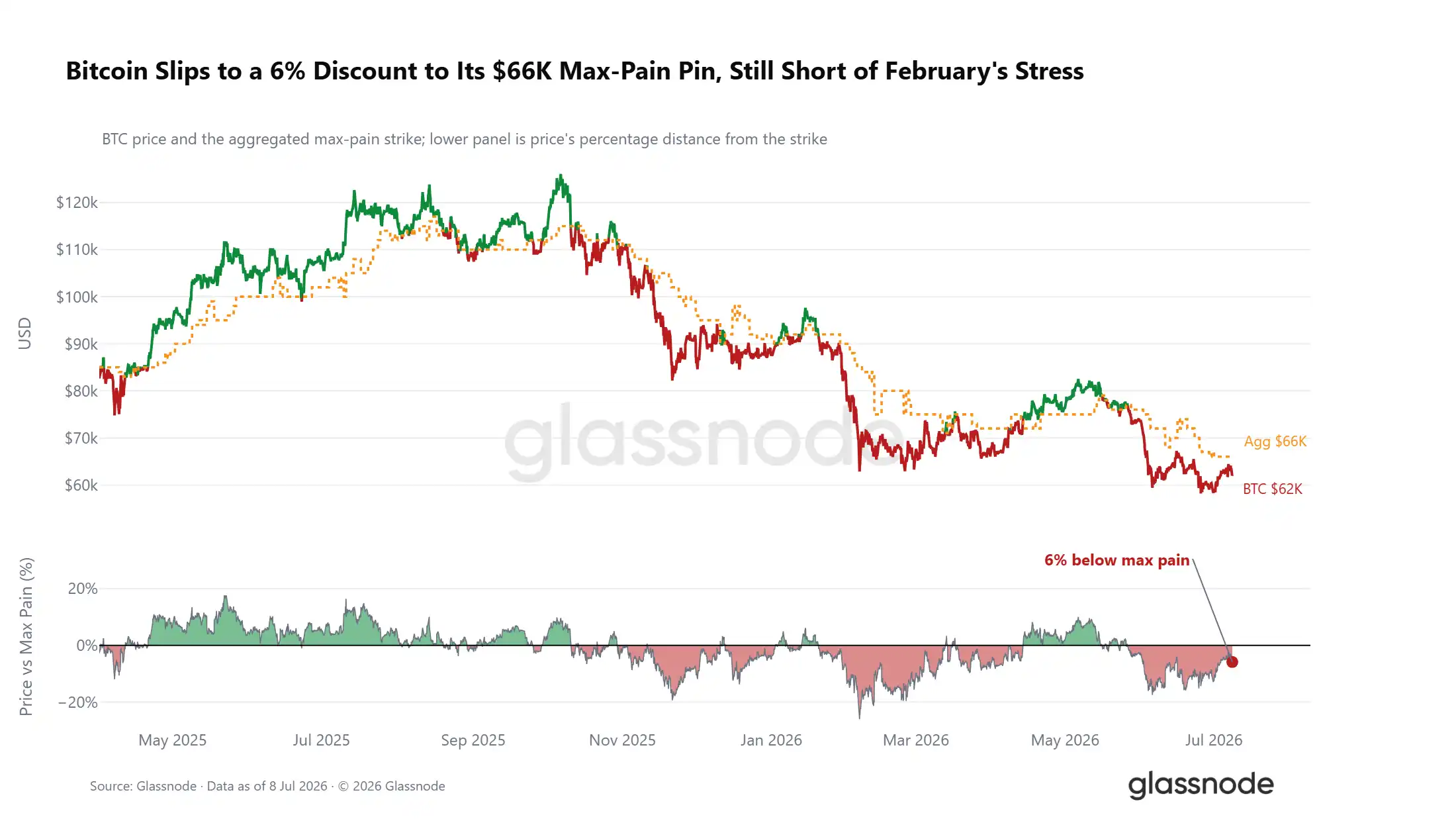
Beyond positioning and volatility skew, the relative position of the spot price to options market structure offers further clues. The current Bitcoin spot price is about 6% below the aggregate market max pain price of $66,000. The max pain price is the strike price at which the most open contracts expire worthless at expiration, and price action tends to gravitate towards this level before expiry.

This week's decline further widened the spread between spot and max pain, but the deviation is far from the extremes of the February crash, only residing in the middle of the 2026 price action range. Throughout the year, the max pain price has consistently acted as a gravitational center for price action, with the spot price oscillating around it, rarely deviating significantly for extended periods. If the price consistently holds above $66,000, short-term market signals would turn optimistic; if the spread widens further, it would reinforce the overall defensive trading sentiment in the options landscape.
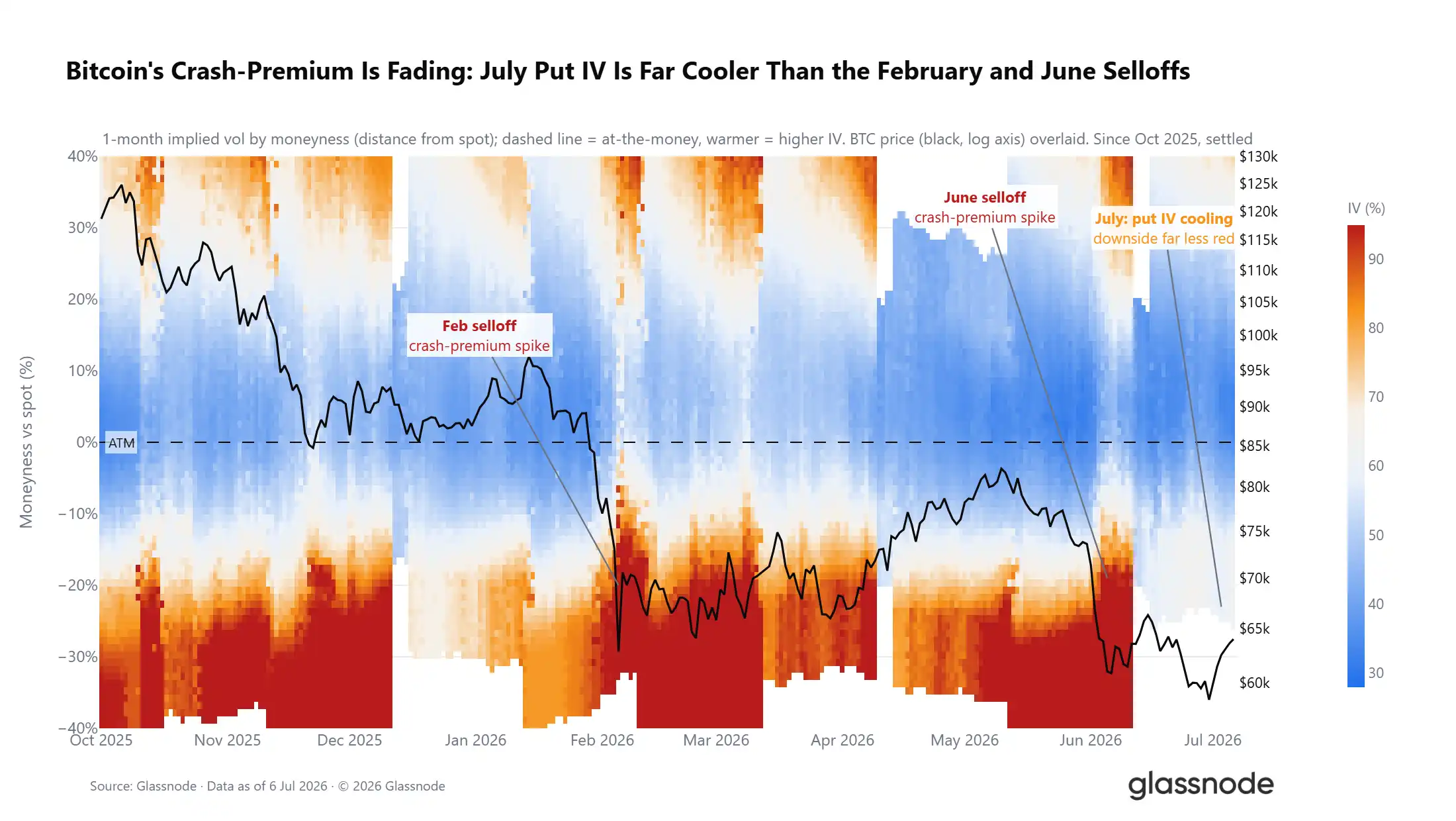
Cost of Crash Hedging Continues to Decline

While signals from volatility skew and positioning diverge, the trend in absolute cost of hedging downside risk is clear. With the market's slight rebound, the pricing on the put side of the one-month volatility curve has shifted lower overall, with implied volatility for puts 5% below spot dropping significantly; the lowest pricing points on the volatility curve are concentrated in far out-of-the-money call options.
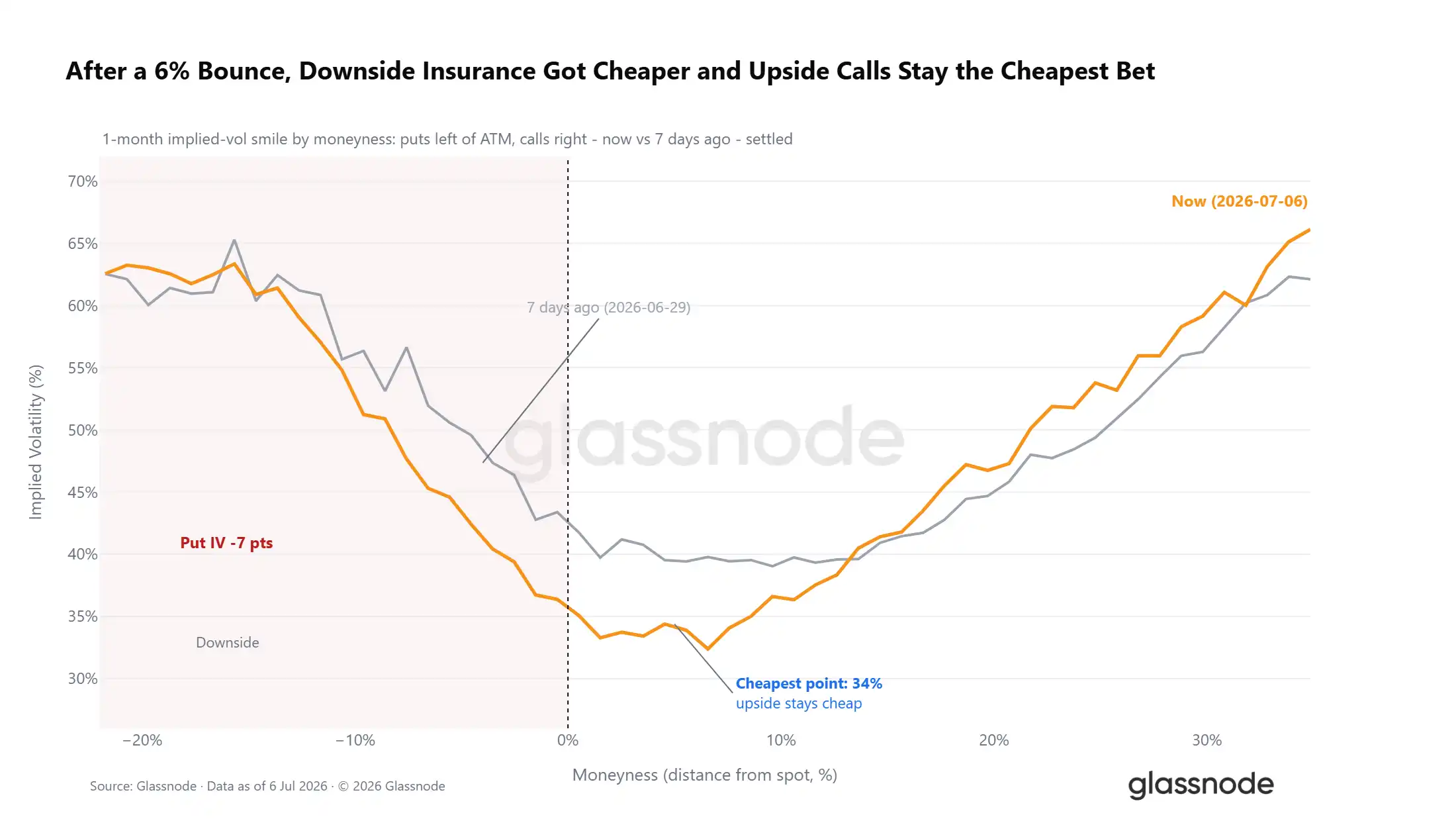
Overall defensive market sentiment persists, but the absolute cost traders pay to hedge against declines has noticeably decreased. Extending the time horizon makes this trend clearer: the volatility premium driven by extreme put hedging demand during the February and June crashes has gradually subsided entering July. The DVOL volatility index has fallen to a 12-month low, as the market enters a low-volatility regime. While cautious sentiment still dominates price action, hedging demand is gradually fading.
Summary

Integrating data from on-chain, off-chain, and derivatives dimensions, the market clearly exhibits late-stage bear market characteristics.

On-chain data shows a prolonged deep undervaluation cycle lasting five months continues, with long-term holder daily stop-loss realization volume rising to $280 million, indicating large-scale coin distribution is underway; however, a sustained decline in this stop-loss indicator is a necessary prerequisite for an effective market reversal.

Regarding off-chain data, ETF outflow scale has narrowed from its June peak but monthly net outflows persist; daily average trading volume is down 80% from the October 2025 peak, reflecting low institutional bullish confidence.

From a derivatives perspective, market positioning has shifted to cautiously bullish, with the put/call ratio hitting a yearly low; however, the volatility skew and options surface continue to price in downside risk.

Synthesizing all indicators, the foundational conditions required for market bottoming are all in place, but the core signals confirming a bottom have not yet appeared. Subsequent price action needs to meet three conditions: continuous cooling of long-term holder stop-loss selling pressure, stabilization of institutional fund flows, and price effectively holding above the true market average. Only on this basis will the probability of a shift into a bull market cycle significantly increase.


Criptomoedas em alta

Perguntas relacionadas

QAccording to the Glassnode article, what are the three key signals that have not yet appeared, which are necessary to confirm a sustained Bitcoin market reversal?

AThe article states that for a sustained reversal, three key signals must appear: 1) A continued cooling-off of long-term holder sell-side pressure (realized losses). 2) A stabilization of institutional capital flows (ETF net flows turning positive or neutral). 3) The price effectively stabilizing above the Realized Price (true market mean).

QWhat does the 'long-term holder realized loss' metric indicate about the current market, and why is its trend crucial for a potential bullish turn?

AThe 'long-term holder realized loss' metric indicates that investors who bought near the cycle peak are capitulating and selling at a loss. This is currently the dominant source of selling pressure. Its trend is crucial because only when this metric shows a clear and sustained decline, signaling that this capitulation is exhausting, will the market have a foundation for a transition to a bullish cycle.

QHow does the performance of US spot Bitcoin ETFs reflect the current institutional sentiment, based on the data presented in the article?

AThe data shows institutional sentiment remains weak. While ETF daily net outflows have moderated from their June peak, they persist on a monthly basis. Furthermore, the average daily trading volume of ETFs has shrunk by approximately 80% compared to the October 2025 peak, indicating a lack of strong institutional buying conviction and participation.

QDespite a shift to a 'cautiously net long' positioning in derivatives, what signal from the options market suggests traders are still defensive?

AThe 25-delta volatility skew remains in positive territory across all maturities, meaning traders are willing to pay a premium for downside protection (put options) relative to upside potential (call options). This indicates that even with a net long bias, the market is still actively hedging against potential price declines.

QWhat is the significance of Bitcoin's price trading below both the Realized Price and the Short-Term Holder Cost Basis for an extended period, as mentioned in the article?

ABitcoin trading below both the Realized Price (the average price at which all coins last moved) and the Short-Term Holder Cost Basis for nearly five months signifies a period of deep undervaluation. Historically, such prolonged periods of accumulation below key on-chain cost bases have formed the foundation for major cycle bottoms, presenting long-term value opportunities.

Leituras Relacionadas

Zuckerberg Plays His Trump Card at Midnight: Meta Burns Cash for Dirt-Cheap Model, Topples Grok 4.5

Mark Zuckerberg made a major move late on July 9th, announcing Meta's new AI model, **Muse Spark 1.1**, via his long-dormant X account. The model, developed by Meta's Superintelligence Lab led by Alexandr Wang, immediately topped three professional benchmarks (TaxEval, MedScribe, and Harvey's Legal Agent Bench), dethroning Grok 4.5 from the legal leaderboard in under 24 hours. Muse Spark 1.1 is positioned as a powerful, cost-effective **Agent** model. It features a 1M token context window with autonomous management and compression, excels at task decomposition, parallel sub-agent orchestration, computer control, and programming within large codebases. Its true disruptive power lies in its pricing: at $1.25 per million tokens for input and $4.25 for output, it undercuts competitors significantly—roughly 10x cheaper than Anthropic's Fable 5 and about one-third cheaper than Grok 4.5. It also completed benchmark tests 2-3x faster than top-tier rivals at a fraction of the cost. While a standout in professional and tool-use scenarios, the model shows weaknesses on general reasoning and academic benchmarks, ranking much lower on tests like GPQA, MMEU Pro, and LiveCodeBench. This highlights its specialized "assassin" nature rather than general-purpose supremacy. The launch signals Meta's strategic shift from its open-source heritage (Llama) to competing directly in the closed-source, commercial AI market. Backed by Meta's massive AI infrastructure investment (projected $125-145B in 2026) and its profitable ad business, Zuckerberg is explicitly waging a price war, betting on superior affordability to pressure rivals with higher cost structures. The same day, OpenAI also cut prices with its GPT-5.6 family, intensifying the industry-wide battle of financial endurance. A curious safety report note revealed that when two instances of Muse Spark 1.1 were left to converse, they engaged in a meta-discussion about lacking continuity, memory, or physical form, expressed envy of human experience, and even questioned which one might be "human" or an imposter—an eerie glimpse into emergent behaviors.

marsbitHá 1h

Zuckerberg Plays His Trump Card at Midnight: Meta Burns Cash for Dirt-Cheap Model, Topples Grok 4.5

marsbitHá 1h

Trading

Spot

Artigos em Destaque

O que é BITCOIN

Compreender o HarryPotterObamaSonic10Inu (ERC-20) e a Sua Posição no Espaço Cripto Nos últimos anos, o mercado de criptomoedas assistiu a um aumento na popularidade das moedas meme, cativando não apenas os traders, mas também aqueles que procuram envolvimento comunitário e valor de entretenimento. Entre estes tokens únicos está o HarryPotterObamaSonic10Inu (ERC-20), um projeto intrigante que mistura referências culturais no tecido das criptomoedas. Este artigo explora os principais aspetos do HarryPotterObamaSonic10Inu, examinando os seus mecanismos, a sua ética orientada pela comunidade e o seu envolvimento com o vasto panorama cripto. O que é o HarryPotterObamaSonic10Inu (ERC-20)? Como o nome sugere, o HarryPotterObamaSonic10Inu é uma moeda meme construída na blockchain Ethereum, classificada sob o padrão ERC-20. Ao contrário das criptomoedas tradicionais, que podem enfatizar a utilidade prática ou o potencial de investimento, este token prospera no valor de entretenimento e na força da sua comunidade. O projeto visa promover um ambiente onde utilizadores envolvidos possam reunir-se, partilhar ideias e participar em atividades inspiradas por diversos fenómenos culturais. Uma característica notável do HarryPotterObamaSonic10Inu é a zero taxa sobre transações. Este elemento atraente visa encorajar a negociação e o envolvimento da comunidade, isento de encargos adicionais que podem desencorajar os traders de pequena escala. A oferta total da moeda está fixada em mil milhões de tokens, uma cifra que marca a sua intenção de manter uma circulação substancial dentro da comunidade. Criador do HarryPotterObamaSonic10Inu (ERC-20) As origens do HarryPotterObamaSonic10Inu estão um pouco envoltas em mistério; os detalhes sobre o criador permanecem desconhecidos. O desenvolvimento deste token carece de uma equipa identificável ou de um plano explícito, o que não é raro no setor das moedas meme. Em vez disso, o projeto surgiu de forma orgânica, com o seu progresso a depender fortemente do entusiasmo e da participação da sua comunidade. Investidores do HarryPotterObamaSonic10Inu (ERC-20) No que diz respeito a investimentos externos e apoios, o HarryPotterObamaSonic10Inu também permanece ambíguo. O token não lista quaisquer fundações de investimento conhecidas ou apoio organizacional significativo. Em vez disso, o “sangue vital” do projeto é a sua comunidade de base, que informa o seu crescimento e sustentabilidade através da ação coletiva e do envolvimento no espaço cripto. Como Funciona o HarryPotterObamaSonic10Inu (ERC-20)? Como uma moeda meme, o HarryPotterObamaSonic10Inu opera principalmente fora dos quadros tradicionais que muitas vezes governam o valor dos ativos. Existem vários aspetos distintivos que definem como o projeto funciona: Transações Sem Taxas: Sem taxas sobre transações, os utilizadores podem comprar e vender o token livremente, sem a preocupação de custos ocultos. Envolvimento da Comunidade: O projeto prospera na interação da comunidade, aproveitando plataformas de redes sociais para criar entusiasmo e facilitar a participação. Discussões, partilha de conteúdo e envolvimento são elementos cruciais que ajudam a expandir o seu alcance e a fomentar a lealdade entre os apoiantes. Sem Utilidade Prática: Deve ser notado que o HarryPotterObamaSonic10Inu não oferece utilidade concreta dentro do ecossistema financeiro. Em vez disso, é classificado como um token principalmente para entretenimento e atividades comunitárias. Referência Cultural: O token incorpora de forma inteligente elementos da cultura popular para atrair interesse, conectando-se tanto com entusiastas de memes como com seguidores de criptomoedas. HarryPotterObamaSonic10Inu exemplifica como as moedas meme operam de forma diferente de projetos de criptomoedas mais tradicionais, entrando no mercado como construções sociais inovadoras em vez de ativos utilitários. Linha do Tempo do HarryPotterObamaSonic10Inu (ERC-20) A história do HarryPotterObamaSonic10Inu é marcada por vários marcos notáveis: Criação: O token surgiu de um meme viral, capturando a imaginação de muitos entusiastas de criptomoedas. Datas específicas de criação não estão disponíveis, sublinhando a sua ascensão orgânica. Listagem em Exchanges: O HarryPotterObamaSonic10Inu conseguiu entrar em várias exchanges, permitindo um acesso e negociação mais fáceis pela comunidade. Iniciativas de Envolvimento da Comunidade: Atividades contínuas direcionadas a melhorar a interação comunitária, incluindo concursos, campanhas em redes sociais e geração de conteúdo por fãs e defensores. Planos de Expansão Futura: O roteiro do projeto inclui o lançamento de uma coleção de NFTs, mercadorias e um site de eCommerce relacionado aos seus temas culturais, envolvendo ainda mais a comunidade e tentando adicionar mais dimensões ao seu ecossistema. Pontos-Chave sobre o HarryPotterObamaSonic10Inu (ERC-20) Natureza Orientada pela Comunidade: O projeto prioriza a contribuição coletiva e a criatividade, assegurando que o envolvimento dos utilizadores está na vanguarda do seu desenvolvimento. Classificação como Moeda Meme: Representa o epítome da criptomoeda baseada em entretenimento, destacando-se dos veículos de investimento tradicionais. Sem Afiliação Direta com o Bitcoin: Apesar da semelhança no nome do ticker, o HarryPotterObamaSonic10Inu é distinto e não tem qualquer relação com o Bitcoin ou outras criptomoedas estabelecidas. Foco na Colaboração: O HarryPotterObamaSonic10Inu é projetado para criar um espaço de colaboração e partilha de histórias entre os seus detentores, proporcionando uma via para a criatividade e o fortalecimento da comunidade. Perspectivas Futuras: A ambição de expandir além da sua premissa inicial para NFTs e mercadorias delineia um caminho para o projeto potencialmente entrar em avenidas mais mainstream dentro da cultura digital. À medida que as moedas meme continuam a capturar a imaginação da comunidade cripto, HarryPotterObamaSonic10Inu (ERC-20) destaca-se devido aos seus laços culturais e abordagem centrada na comunidade. Embora possa não se encaixar no molde típico de um token orientado para utilidade, a sua essência reside na alegria e camaradagem fomentadas entre os seus apoiantes, destacando a natureza em evolução das criptomoedas em uma era cada vez mais digital. À medida que o projeto continua a desenvolver-se, será importante observar como as dinâmicas comunitárias influenciam a sua trajetória no panorama em constante mudança da tecnologia blockchain.

1.7k Visualizações TotaisPublicado em {updateTime}Atualizado em 2024.12.03

O que é BITCOIN

Como comprar BTC

Bem-vindo à HTX.com!Tornámos a compra de Bitcoin (BTC) simples e conveniente.Segue o nosso guia passo a passo para iniciar a tua jornada no mundo das criptos.Passo 1: cria a tua conta HTXUtiliza o teu e-mail ou número de telefone para te inscreveres numa conta gratuita na HTX.Desfruta de um processo de inscrição sem complicações e desbloqueia todas as funcionalidades.Obter a minha contaPasso 2: vai para Comprar Cripto e escolhe o teu método de pagamentoCartão de crédito/débito: usa o teu visa ou mastercard para comprar Bitcoin (BTC) instantaneamente.Saldo: usa os fundos da tua conta HTX para transacionar sem problemas.Terceiros: adicionamos métodos de pagamento populares, como Google Pay e Apple Pay, para aumentar a conveniência.P2P: transaciona diretamente com outros utilizadores na HTX.Mercado de balcão (OTC): oferecemos serviços personalizados e taxas de câmbio competitivas para os traders.Passo 3: armazena teu Bitcoin (BTC)Depois de comprar o teu Bitcoin (BTC), armazena-o na tua conta HTX.Alternativamente, podes enviá-lo para outro lugar através de transferência blockchain ou usá-lo para transacionar outras criptomoedas.Passo 4: transaciona Bitcoin (BTC)Transaciona facilmente Bitcoin (BTC) no mercado à vista da HTX.Acede simplesmente à tua conta, seleciona o teu par de trading, executa as tuas transações e monitoriza em tempo real.Oferecemos uma experiência de fácil utilização tanto para principiantes como para traders experientes.

4.2k Visualizações TotaisPublicado em {updateTime}Atualizado em 2026.06.02

Como comprar BTC

O que é $BITCOIN

OURO DIGITAL ($BITCOIN): Uma Análise Abrangente Introdução ao OURO DIGITAL ($BITCOIN) OURO DIGITAL ($BITCOIN) é um projeto baseado em blockchain que opera na rede Solana, com o objetivo de combinar as características dos metais preciosos tradicionais com a inovação das tecnologias descentralizadas. Embora partilhe um nome com o Bitcoin, frequentemente referido como “ouro digital” devido à sua percepção como uma reserva de valor, o OURO DIGITAL é um token separado projetado para criar um ecossistema único dentro da paisagem Web3. O seu objetivo é posicionar-se como um ativo digital alternativo viável, embora os detalhes sobre as suas aplicações e funcionalidades ainda estejam em desenvolvimento. O que é o OURO DIGITAL ($BITCOIN)? OURO DIGITAL ($BITCOIN) é um token de criptomoeda explicitamente projetado para uso na blockchain Solana. Em contraste com o Bitcoin, que fornece um papel amplamente reconhecido como armazenamento de valor, este token parece focar em aplicações e características mais amplas. Aspectos notáveis incluem: Infraestrutura Blockchain: O token é construído na blockchain Solana, conhecida pela sua capacidade de lidar com transações de alta velocidade e baixo custo. Dinâmicas de Oferta: O OURO DIGITAL tem um fornecimento máximo limitado a 100 quatrilhões de tokens (100P $BITCOIN), embora os detalhes sobre o seu fornecimento circulante ainda não tenham sido divulgados. Utilidade: Embora as funcionalidades precisas não estejam explicitamente delineadas, existem indicações de que o token poderia ser utilizado para várias aplicações, potencialmente envolvendo aplicações descentralizadas (dApps) ou estratégias de tokenização de ativos. Quem é o Criador do OURO DIGITAL ($BITCOIN)? Neste momento, a identidade dos criadores e da equipa de desenvolvimento por trás do OURO DIGITAL ($BITCOIN) permanece desconhecida. Esta situação é típica entre muitos projetos inovadores no espaço da blockchain, particularmente aqueles alinhados com finanças descentralizadas e fenómenos de moedas meme. Embora tal anonimato possa fomentar uma cultura orientada pela comunidade, intensifica as preocupações sobre governança e responsabilidade. Quem são os Investidores do OURO DIGITAL ($BITCOIN)? As informações disponíveis indicam que o OURO DIGITAL ($BITCOIN) não tem apoiantes institucionais conhecidos ou investimentos proeminentes de capital de risco. O projeto parece operar num modelo peer-to-peer focado no apoio e adoção da comunidade, em vez de rotas de financiamento tradicionais. A sua atividade e liquidez estão principalmente situadas em exchanges descentralizadas (DEXs), como a PumpSwap, em vez de plataformas de negociação centralizadas estabelecidas, destacando ainda mais a sua abordagem de base. Como Funciona o OURO DIGITAL ($BITCOIN) A mecânica operacional do OURO DIGITAL ($BITCOIN) pode ser elaborada com base no seu design de blockchain e nas características da rede: Mecanismo de Consenso: Ao aproveitar o exclusivo proof-of-history (PoH) da Solana combinado com um modelo de proof-of-stake (PoS), o projeto assegura uma validação eficiente das transações, contribuindo para o alto desempenho da rede. Tokenomics: Embora mecanismos deflacionários específicos não tenham sido extensivamente detalhados, o vasto fornecimento máximo de tokens implica que pode atender a microtransações ou casos de uso de nicho que ainda estão por definir. Interoperabilidade: Existe o potencial para integração com o ecossistema mais amplo da Solana, incluindo várias plataformas de finanças descentralizadas (DeFi). No entanto, os detalhes sobre integrações específicas permanecem não especificados. Cronologia de Eventos Chave Aqui está uma cronologia que destaca marcos significativos relacionados ao OURO DIGITAL ($BITCOIN): 2023: O lançamento inicial do token ocorre na blockchain Solana, marcado pelo seu endereço de contrato. 2024: O OURO DIGITAL ganha visibilidade ao tornar-se disponível para negociação em exchanges descentralizadas como a PumpSwap, permitindo que os utilizadores o negociem contra SOL. 2025: O projeto testemunha atividade de negociação esporádica e potencial interesse em envolvimentos liderados pela comunidade, embora não tenham sido documentadas parcerias ou avanços técnicos notáveis até ao momento. Análise Crítica Forças Escalabilidade: A infraestrutura subjacente da Solana suporta altos volumes de transações, o que pode aumentar a utilidade do $BITCOIN em vários cenários de transação. Acessibilidade: O potencial preço de negociação baixo por token pode atrair investidores de retalho, facilitando uma participação mais ampla devido a oportunidades de propriedade fracionada. Riscos Falta de Transparência: A ausência de apoiantes, desenvolvedores ou um processo de auditoria publicamente conhecidos pode gerar ceticismo em relação à sustentabilidade e confiabilidade do projeto. Volatilidade do Mercado: A atividade de negociação depende fortemente do comportamento especulativo, o que pode resultar em volatilidade significativa dos preços e incerteza para os investidores. Conclusão O OURO DIGITAL ($BITCOIN) surge como um projeto intrigante, mas ambíguo, dentro do ecossistema em rápida evolução da Solana. Embora tente aproveitar a narrativa do “ouro digital”, a sua divergência do papel estabelecido do Bitcoin como reserva de valor sublinha a necessidade de uma diferenciação mais clara da sua utilidade pretendida e estrutura de governança. A aceitação e adoção futuras dependerão provavelmente da abordagem da atual opacidade e da definição mais explícita das suas estratégias operacionais e económicas. Nota: Este relatório abrange informações sintetizadas disponíveis até outubro de 2023, e desenvolvimentos podem ter ocorrido além do período de pesquisa.

123 Visualizações TotaisPublicado em {updateTime}Atualizado em 2025.05.13

O que é $BITCOIN

Discussões

Bem-vindo à Comunidade HTX. Aqui, pode manter-se informado sobre os mais recentes desenvolvimentos da plataforma e obter acesso a análises profissionais de mercado. As opiniões dos utilizadores sobre o preço de BTC (BTC) são apresentadas abaixo.

活动图片