Glassnode: BTC Rally a 'False Breakout', Fragile Bottom Still Awaiting Formation

marsbitPublicado em 2026-01-22Última atualização em 2026-01-22

Resumo

Glassnode's analysis indicates that the recent Bitcoin price rebound is a "false breakout," with the market remaining structurally fragile and lacking a confirmed bottom. Despite some signs of seller exhaustion in early January 2026, the rally faced strong resistance near the $98K level—the cost basis for short-term holders—where profit-taking and break-even selling intensified. On-chain data reveals persistent overhead supply from both short-term and long-term holders, creating sustained selling pressure and limiting upward momentum. While spot flows have turned slightly positive with reduced exchange outflows, demand remains selective and not yet broad-based. Corporate treasury inflows are sporadic and event-driven, failing to provide consistent buying support. Derivatives markets show low participation, with muted futures volume and cautious leverage usage. Options markets saw only short-term volatility spikes in response to events, while longer-term implied volatility remained stable. Dealer gamma positioning turned net short below $90K, increasing downside vulnerability. In summary, the market is in a low-engagement consolidation phase, driven more by a lack of selling rather than strong buying interest. A durable bottom has yet to form, and any sustained recovery will require a robust catalyst to absorb overhead supply and boost investor conviction.

Entering early January 2026, the market showed signs of seller exhaustion, creating an opportunity for a price rebound towards the upper boundary of the current trading range. However, this rally comes with elevated risk as prices approach the ~$98k zone, where recent investors have formed active 'breakeven' selling pressure around their cost basis.

Core Insights

· On-chain structure remains fragile: Price hovers near key cost basis levels, lacking sustained confirmation of conviction from long-term holders.

· Supply overhang persists: Recent buyers face overhead resistance, limiting the sustainability of any advance and making rallies prone to sell-offs.

· Spot flows turn positive: Selling pressure on major exchanges has eased, but buying remains selective, not broad-based.

· Treasury inflows are patchy: Treasury activity is sporadic and event-driven, not yet forming a coordinated buying trend, with limited impact on overall demand.

· Derivatives participation is low: Futures volume is contracting, leverage use is cautious, and the market is in a low-engagement state.

· Options market sees only short-term pressure: Short-term implied volatility reacted to risk events, while medium-to-long-term volatility remains stable.

· Hedging demand spikes then normalizes: The surge in the Put/Call Volume Ratio has subsided, indicating risk aversion was tactical.

· Dealer gamma positioning is net short: This weakens mechanical support for price stability and increases market sensitivity to liquidity shocks.

On-Chain Deep Dive

Over the past two weeks, the anticipated technical rebound has largely played out, with price stalling below the Short-Term Holder cost basis after touching resistance, once again confirming substantial overhead selling pressure. This report will focus on the structure and behavior of this 'overhead' supply to reveal emerging seller dynamics.

Technical Rebound Meets Resistance

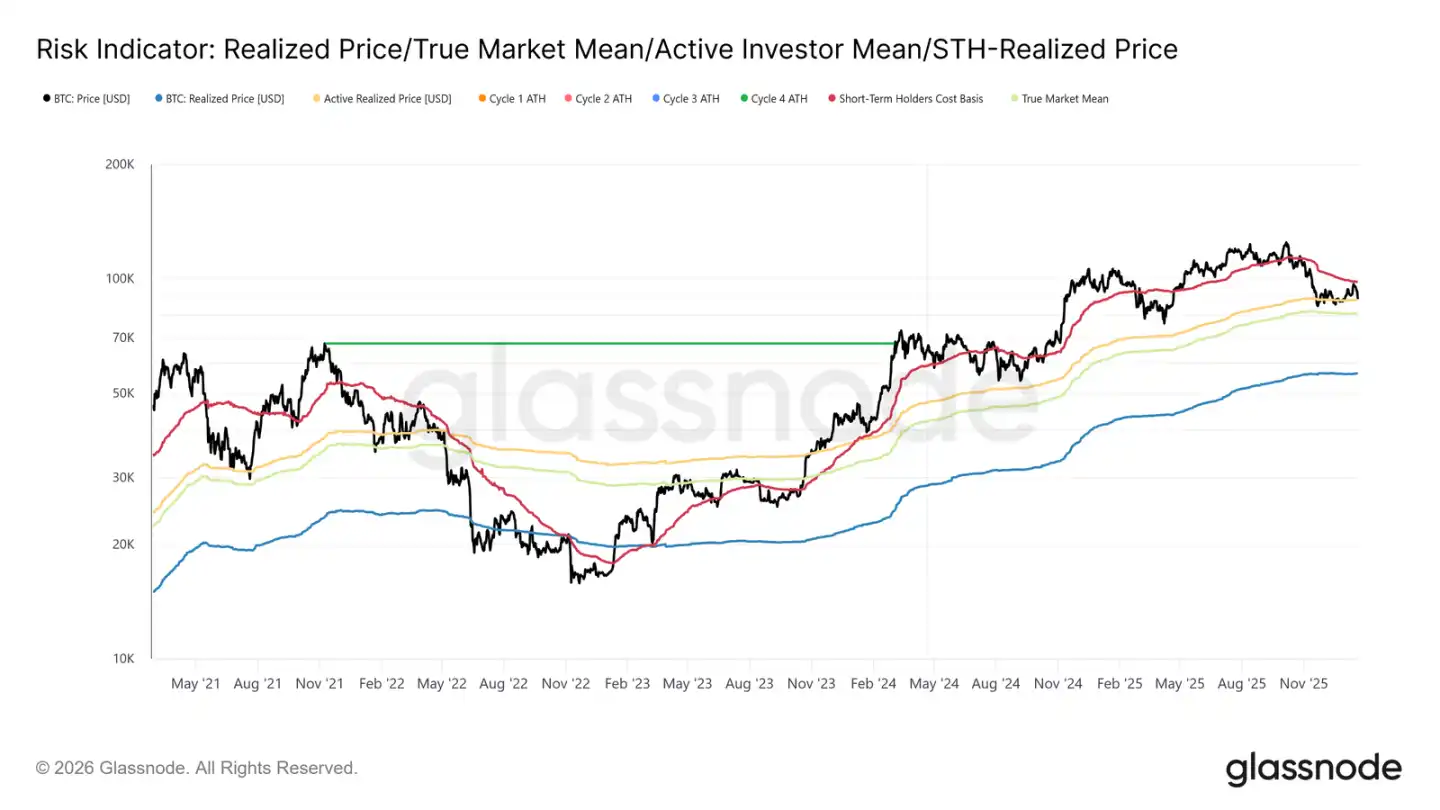
A clear narrative has emerged: the market has been in a mild bearish phase. Its lower bound is supported by the ~$81.1k Realized Mean, while the upper bound is capped by the average cost basis of Short-Term Holders. This range creates a fragile equilibrium where downside pressure is absorbed, but upside attempts are repeatedly sold into by investors who bought between Q1 and Q3 2025.

Entering early January 2026, the exhaustion of seller momentum opened a window for price to rebound towards the range high. However, this rally is at high risk as prices near the ~$98k zone, where recent investors show increased willingness to sell around their breakeven point.

The recent rejection around ~$98.4k (the STH cost basis) mirrors the market structure seen in Q1 2022. Back then, the market repeatedly failed to decisively break above the cost basis of recent buyers, leading to a prolonged consolidation period. This similarity underscores the fragile nature of the current recovery attempt.
Overhead Supply Pressure Remains

Building on the observation of price rejection at key cost levels, a closer look at the on-chain supply distribution provides clearer insight into why upward momentum has repeatedly faltered.

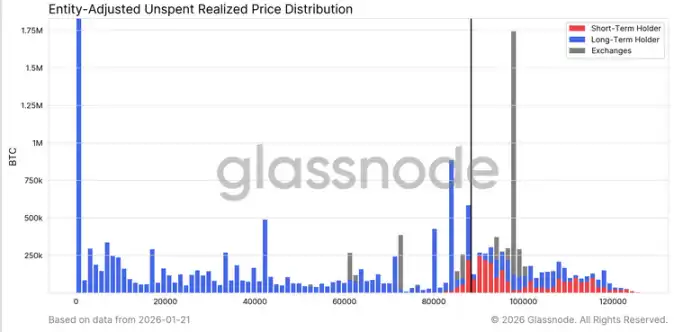
The URPD (Unrealized Profit/Loss Distribution) chart clearly illustrates why the excess supply above $98k remains the primary force capping near-to-mid-term rallies. The recent rebound partially filled the 'vacuum zone' between ~$93k and $98k, primarily through early buyers distributing to new entrants, forming a new cluster of Short-Term Holder supply.

However, the supply distribution above $100k reveals a broad and dense supply zone, with these coins gradually aging into Long-Term Holder status. This undigested 'overhead' supply is a persistent source of selling pressure, likely keeping price suppressed below the $98.4k (STH cost basis) and $100k psychological levels. Thus, a significant and sustained acceleration in demand momentum is required for a decisive breakout.
Long-Term Holders Also Present Resistance

Expanding the view from Short-Term Holders to longer-term holdings, we find the same structural constraints persist.

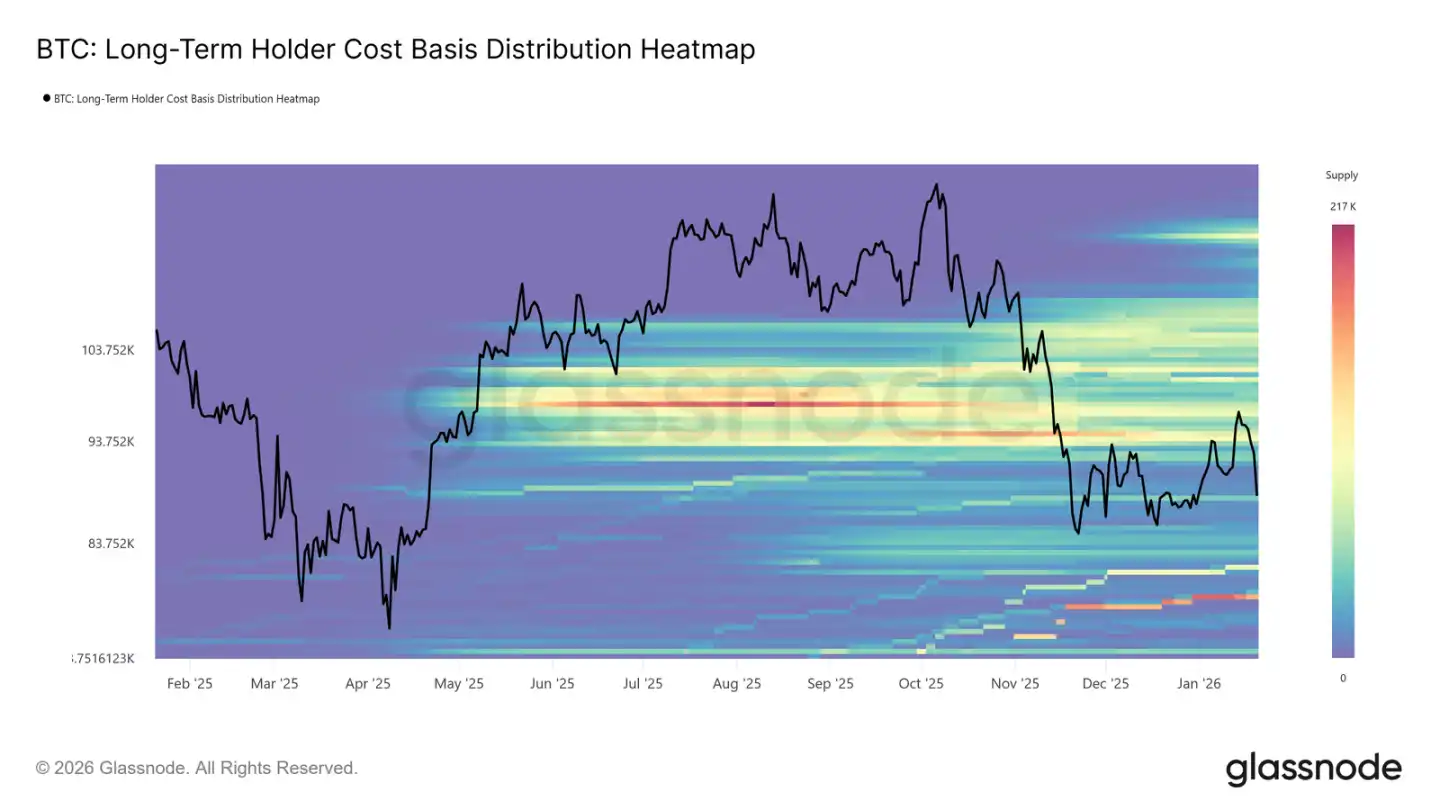
The Long-Term Holder cost basis distribution heatmap shows a dense cluster of long-term coin acquisition costs above the current spot price. This zone represents a significant source of potential seller liquidity when price rallies towards these historical entry levels.

Long-Term Holders will remain a potential source of resistance until new, sufficiently strong demand emerges to absorb this overhead supply. Therefore, upside potential is likely to remain capped, and any rally vulnerable to renewed selling, until this 'overhead' supply is thoroughly digested.
Rally Meets Profit-Taking and Stop-Loss Selling

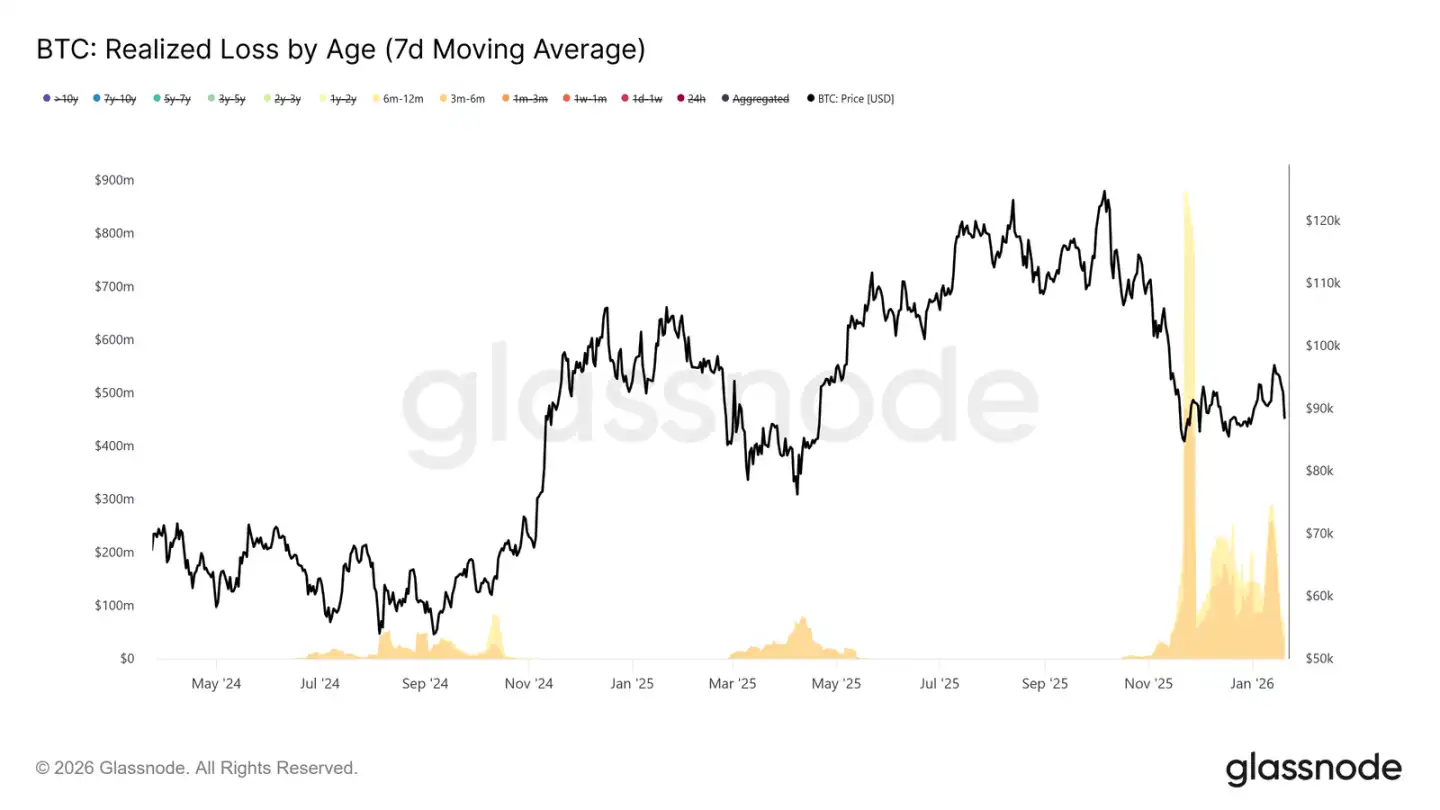
Going further, we can identify which investor cohorts were actively distributing (for profit or stop-losses) during the recent push towards ~$98k, thus capping the price.

Realized Losses broken down by coin age show that loss-taking was dominated by the 3-6 month cohort, followed by the 6-12 month holders. This pattern is characteristic of 'pain capitulation,' particularly from those who bought above $110k and are now exiting as price approaches their cost basis. This behavior reinforces seller pressure around key recovery levels.
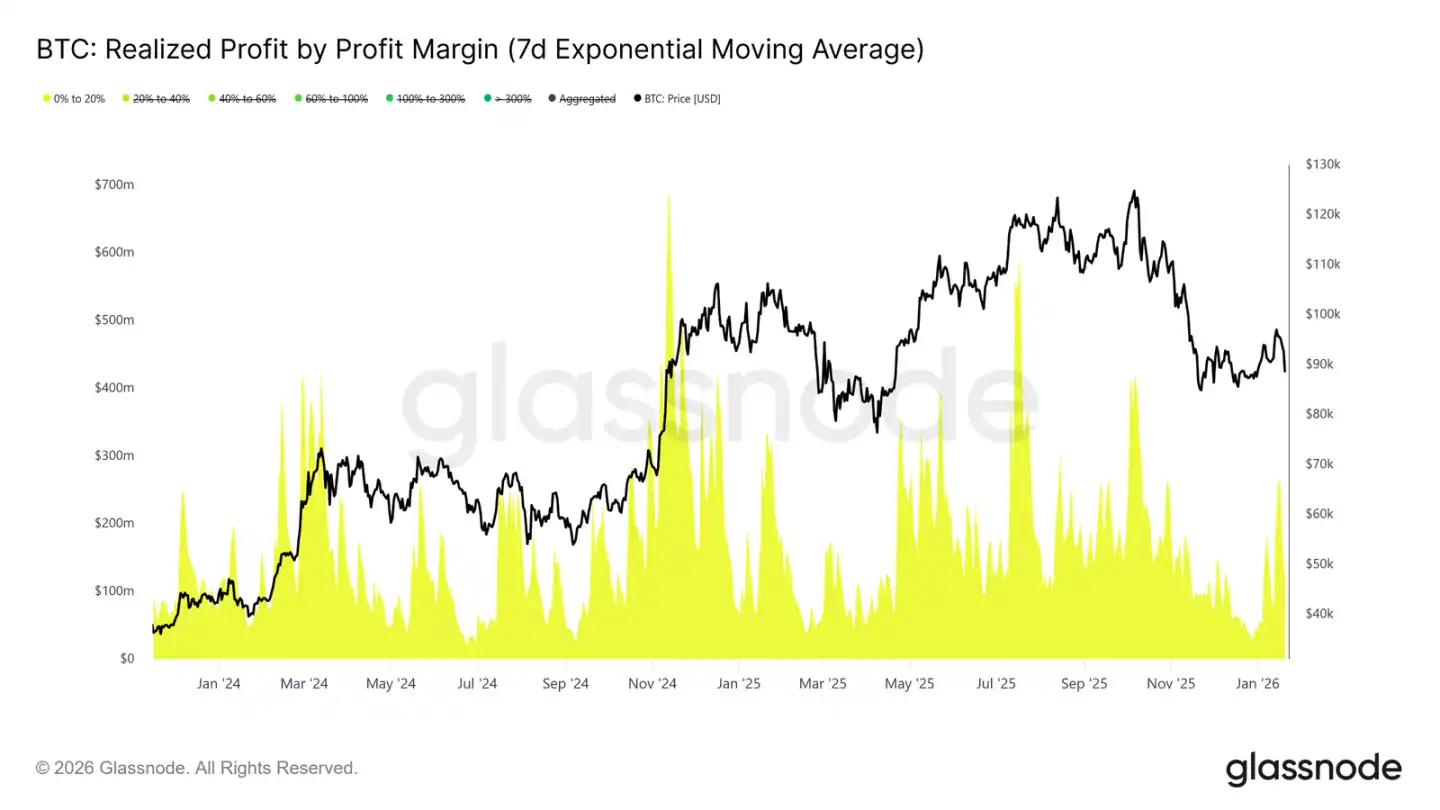
Concurrently, Realized Profits segmented by profit margin show a notable increase in the proportion of profit-taking within the 0% to 20% margin bracket. This highlights the influence of 'breakeven sellers' and short-term swing traders who tend to exit upon modest gains rather than waiting for trend continuation.

This behavior is common during market transitions where investor conviction is fragile, prioritizing capital preservation and tactical profits. This increase in low-margin selling continuously undermines upward momentum as supply is released around cost basis.
Off-Chain Market Watch

Spot Flows Turn Positive

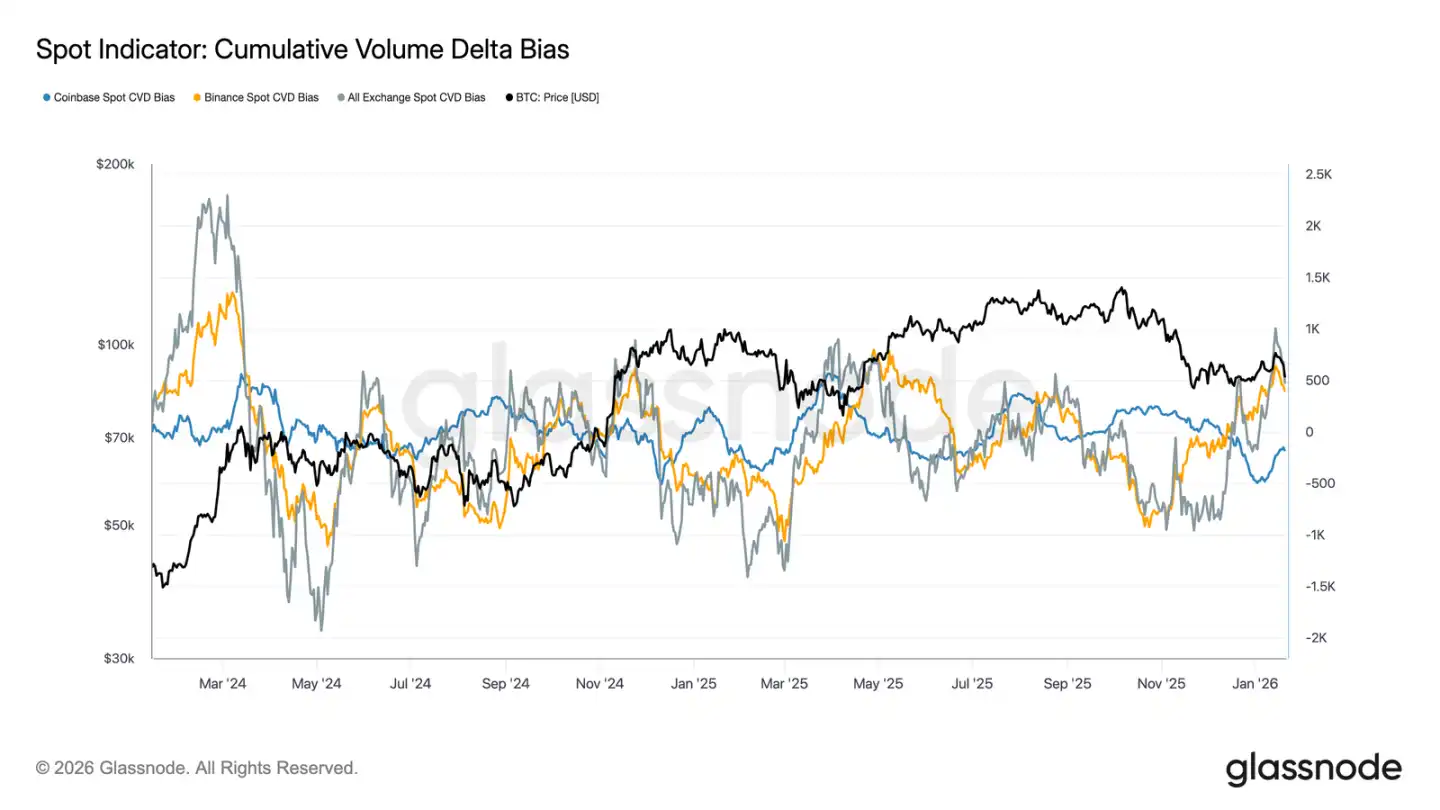
Spot market behavior has improved following the recent decline. The Binance and Exchange Composite CVD (Cumulative Volume Delta) metrics have flipped back to net buying, indicating spot participants are starting to re-accumulate rather than sell into strength, contrasting with the persistent selling pressure seen in earlier consolidation phases.

Coinbase, which had been a primary source of sell pressure during the range-bound trading, has also seen a significant slowdown in its net selling pace. The abatement of selling from Coinbase helps reduce overhead supply, stabilizing price action and supporting the recent bounce.

Although spot participation hasn't yet shown the sustained, aggressive buying typical of a trending expansion phase, the shift back to net buying on major platforms marks a positive improvement in the underlying spot market structure.
Digital Asset Treasury Inflows Remain Patchy

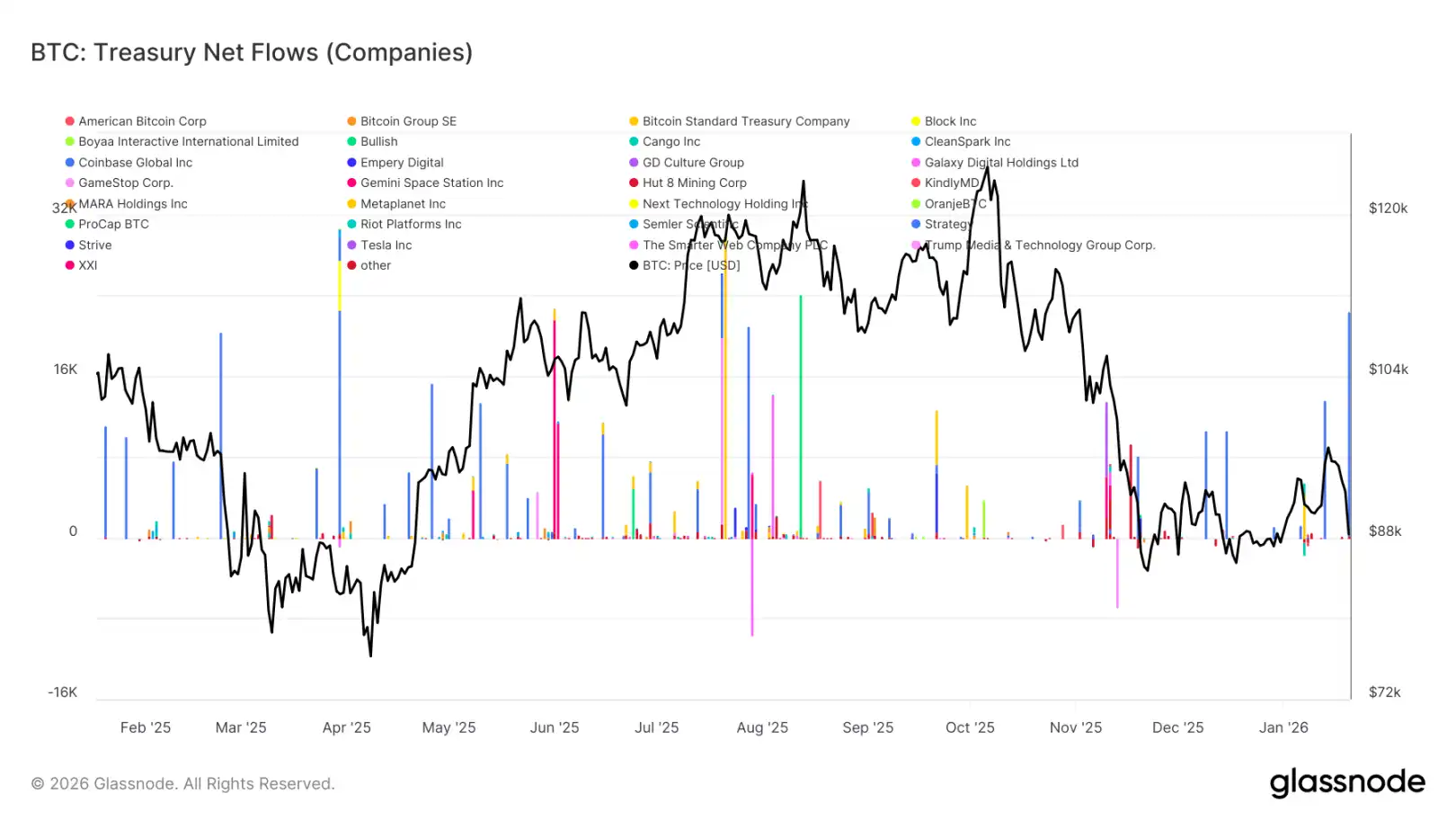
Recent net flows for digital asset treasuries remain patchy and uneven, characterized by isolated event-driven activity rather than broad trend buying. While there have been notable buying spikes from individual companies over the past few weeks, overall corporate demand has not yet entered a sustained accumulation mode.

Overall, digital asset treasury flows are oscillating narrowly around the zero line, indicating most corporate treasuries are currently in a wait-and-see or opportunistic mode, not systematically accumulating. This contrasts with earlier phases where multiple corporations bought in concert, driving trend acceleration.

Overall, the latest data shows corporate treasuries are only a marginal, selective source of demand, with an intermittent impact that is not yet decisive for overall price dynamics.
Derivatives Markets Are Quiet

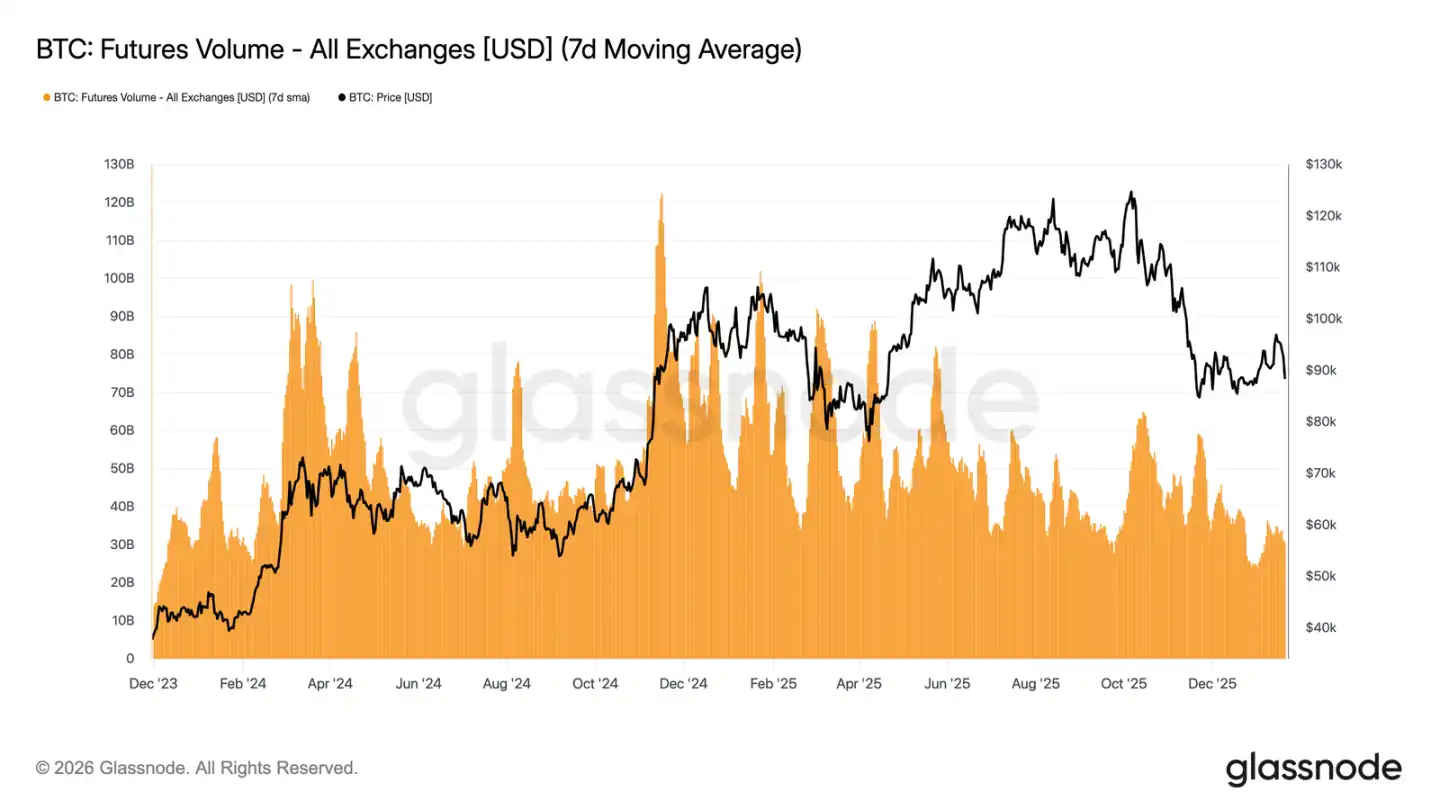
Bitcoin futures' 7-day moving average volume continues to contract, remaining well below levels typically associated with trending markets. The recent price volatility has not been accompanied by a meaningful expansion in volume, highlighting the low participation and lack of confidence in the derivatives market.

The current market structure suggests recent price action is more driven by sparse liquidity than aggressive positioning. Adjustments in Open Interest also lack concurrent volume growth, reflecting more the adjustment and rebalancing of existing risk rather than the deployment of new leverage.

In summary, the derivatives market is currently in a low-engagement 'quiet' state with sparse speculative interest. This 'ghost market' characteristic means the market could be very sensitive to any recovery in trade volume, but its influence on price discovery is currently limited.
Implied Volatility Spikes Only Short-Term

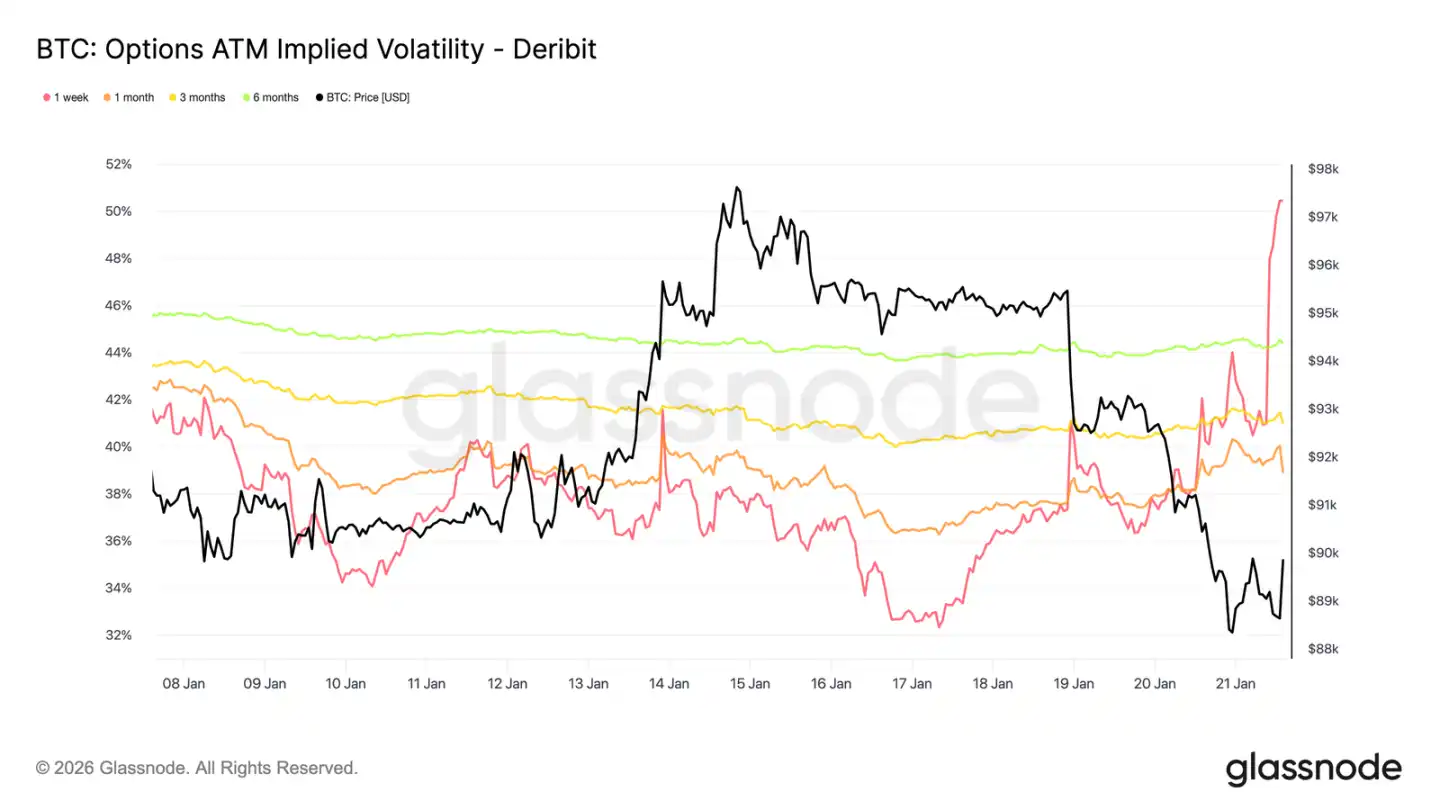
The spot sell-off triggered by macro and geopolitical news only stimulated a rise in short-term volatility. Since Sunday's drop, 1-week implied volatility rose by over 13 volatility points, while 3-month implied volatility rose only ~2 points, and 6-month implied volatility barely moved.

This acute steepening at the very front of the volatility curve indicates traders are engaging tactically, not reassessing the medium-term risk structure. Only short-term vol adjusted, reflecting event-driven uncertainty, not a shift across the volatility complex.

The market is pricing transient risk, not lasting turmoil.
Short-Dated Skew Experiences Wild Swings

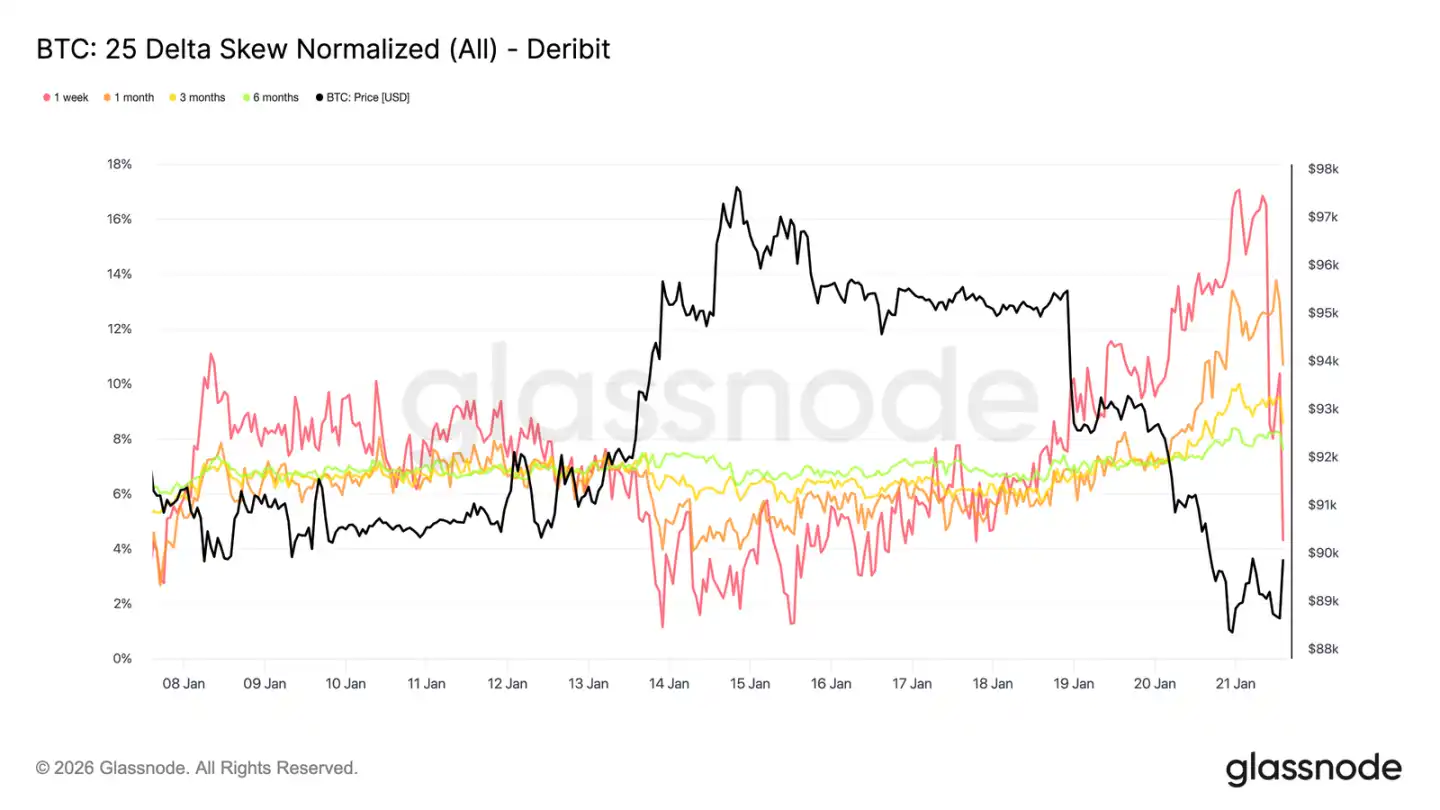
Similar to at-the-money volatility, short-dated skew also dominated this adjustment. The 1-week 25 Delta skew, which was near equilibrium a week ago, has sharply pivoted to a 'puts richer' state.

Since last week, this skew measure has moved ~16 volatility points towards puts, reaching a put premium of nearly 17%. The 1-month skew also reacted, while longer-dated skews, already in put territory, only deepened slightly.

Such a violent skew inversion often accompanies local extremes where the market is over-positioned and the prevailing trend is difficult to sustain. As the market digested the impact of Davos-related commentary, the downside premium was partially taken profit on, and skew began retracing rapidly.
Volatility Risk Premium Holds High

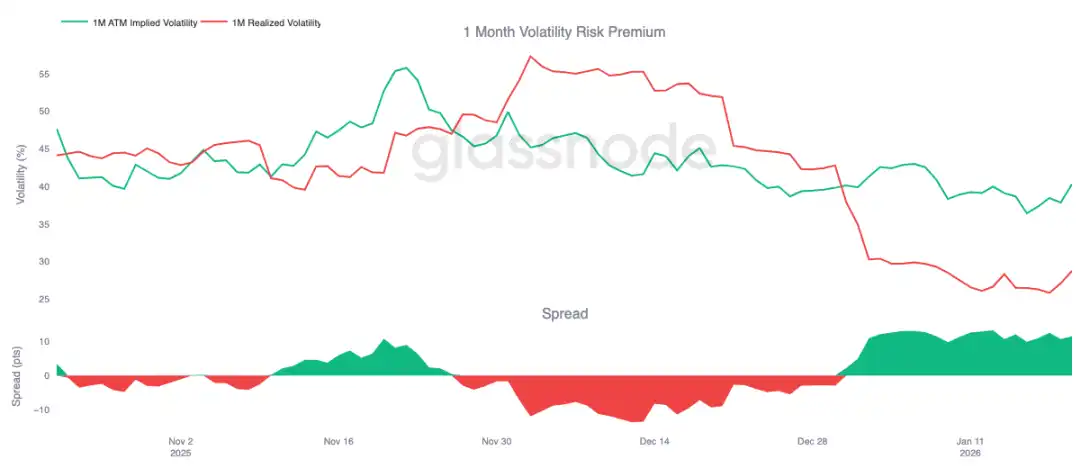
The 1-month Volatility Risk Premium has held in positive territory since the start of the year. Despite implied volatility being at historically absolute lows, its pricing remains consistently higher than actual realized volatility. In other words, options remain 'expensive' relative to the price volatility actually occurring.

The Volatility Risk Premium captures the difference between implied and realized volatility. A positive premium means option sellers are compensated for assuming volatility risk. This creates a favorable environment for 'short vol' strategies – holding short gamma positions can generate returns as long as realized vol remains contained.

This dynamic is self-reinforcing, suppressing volatility. As long as selling volatility is profitable, more participants will join, keeping implied vol suppressed. As of Jan 20, the 1-month vol spread sits at ~11.5 volatility points in favor of sellers, which speaks volumes about the continued friendliness of the environment for selling volatility.
Dealer Positioning Flips Net Short

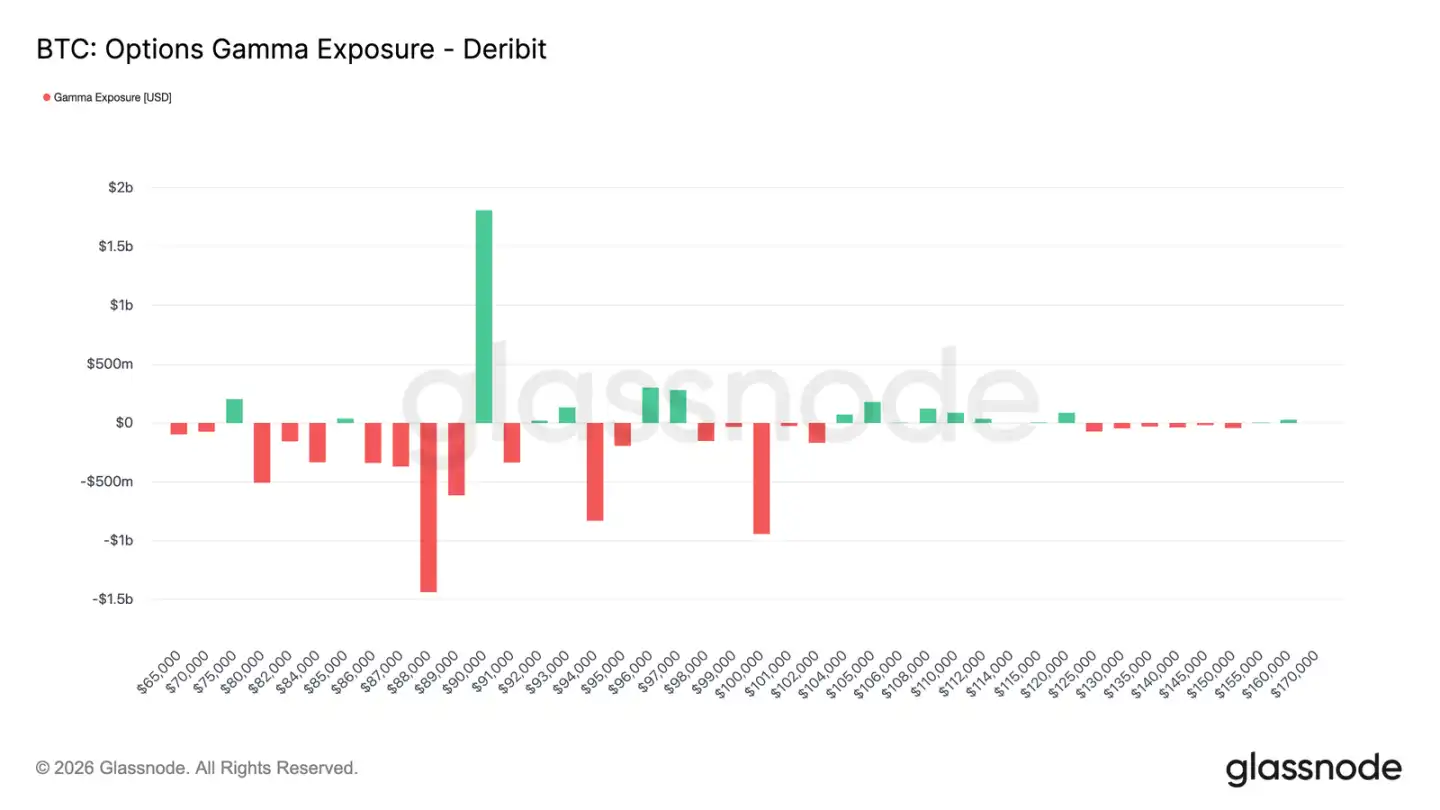
Dealer gamma positioning is a key structural force influencing short-term price action. Recent flow data shows investors actively bought downside protection, leaving dealers net short gamma below $90k. Concurrently, some investors financed this by selling upside calls, leaving dealers net long gamma above $90k.

This creates an asymmetric setup: Below $90k, dealers are net short gamma, meaning price declines could be self-accelerating due to their hedging activity (selling futures or spot). Above $90k, dealers' net long gamma acts as a stabilizer, as rallies trigger their hedging buys, dampening the move.

Thus, price action below $90k is likely to remain fragile, while the $90k level itself becomes a key friction point. A decisive and sustained break above this level would require sufficient market momentum and confidence to digest the dealer hedging flows and push their gamma exposure to higher strikes.
Conclusion

The Bitcoin market remains in a state of low participation, with current price action stemming more from 'reduced selling pressure' than 'aggressive buying.' On-chain data continues to reveal issues of supply overhang and fragile structural support. Spot flows, while improved, have not yet translated into a sustained buying trend.

Institutional demand remains cautious, with treasury flows stabilizing around the zero line and activity dominated by sporadic trades. Derivatives markets are quiet, with futures volume contraction and constrained leverage use, collectively creating a low-liquidity environment where price is hypersensitive to slight positioning changes.

The options market also reflects this restraint. Volatility repricing was confined to the short term, hedging demand has normalized, and elevated volatility risk premiums continue to anchor overall vol levels.

Overall, the market appears to be quietly building a base. The current consolidation stems not from overheated participation but from a temporary pause in investor conviction, as they await the next catalyst capable of inspiring broad engagement.


Perguntas relacionadas

QAccording to Glassnode, why is the recent BTC rebound considered a 'false breakout'?

AThe rebound is considered a 'false breakout' because the price has stalled below the cost basis of short-term holders (around $98k), confirming substantial overhead selling pressure. The market lacks sustained confirmation from long-term holders and faces persistent supply overhang from investors who bought at higher prices, making any rally vulnerable to renewed sell-offs.

QWhat key resistance level is currently capping Bitcoin's price upside as per the on-chain analysis?

AThe key resistance level capping Bitcoin's price upside is the Short-Term Holder (STH) cost basis at approximately $98,400, along with the psychological $100,000 level. Above this, there is a dense supply zone from coins acquired at higher prices that act as a persistent source of selling pressure.

QHow does the article describe the current state of demand from corporate treasuries?

ADemand from corporate treasuries is described as sporadic, event-driven, and uneven. Activity is characterized by isolated buying spikes from individual companies rather than a broad, coordinated trend of accumulation. Overall, corporate treasury flows are oscillating near the zero line, indicating a观望or opportunistic stance rather than systematic buying.

QWhat is the significance of the '9k gamma level' mentioned in the derivatives market analysis?

AThe '9k gamma level' is a key friction point identified from dealer positioning. Below $90,000, dealers hold negative gamma, meaning price declines could be self-accelerating due to their hedging activities (selling futures or spot). Above $90,000, dealers hold positive gamma, which acts as a stabilizer as price rises trigger their hedging buys. This creates an asymmetric market structure where moves below $90k are more fragile.

QWhat does the low participation in the derivatives market, described as a 'ghost market', imply for price action?

AThe low participation in the derivatives market, or 'ghost market' state, implies that recent price action is more driven by thin liquidity rather than aggressive new positioning. It means the market is in a low-conviction environment with subdued speculative interest, making prices highly sensitive to any influx of volume, though such influence is currently limited.

Leituras Relacionadas

Cook's Curtain Call and Ternus Takes the Helm: The Disruption and Reboot of Apple's 4 Trillion Dollar Empire

Tim Cook has officially announced he will step down as CEO of Apple in September, transitioning to executive chairman after a 15-year tenure during which he grew the company’s market value from around $350 billion to nearly $4 trillion. He will be succeeded by John Ternus, a 50-year-old hardware engineering veteran who has been groomed for the role through increasing public visibility and internal responsibility. Ternus’s appointment signals a strategic shift toward hardware and engineering leadership, with Johny Srouji—head of Apple Silicon—taking on an expanded role as Chief Hardware Officer. This consolidation aims to strengthen Apple’s core technological capabilities. However, Cook’s departure highlights a significant unresolved issue: Apple’s delayed and fragmented approach to artificial intelligence. Despite early efforts, such as hiring John Giannandrea from Google in 2018, Apple’s AI initiatives—particularly around Siri—have struggled with internal restructuring and reliance on external partnerships, including with Google. The transition comes at a critical moment as Apple faces paradigm shifts with the rise of artificial general intelligence (ASI). The company’s closed ecosystem of hardware, software, and services—once a major advantage—now presents challenges in adapting to an AI-centric world where intelligence may matter more than the device itself. Ternus must quickly articulate a clear AI strategy, possibly starting at WWDC, to reassure markets and redefine Apple’s role in a new technological era. His task is not only to maintain Apple’s operational excellence but also to reinvigorate its capacity to innovate and lead in the age of AI.

marsbitHá 2h

Cook's Curtain Call and Ternus Takes the Helm: The Disruption and Reboot of Apple's 4 Trillion Dollar Empire

marsbitHá 2h

Trading

Spot
Futuros

Artigos em Destaque

O que é BITCOIN

Compreender o HarryPotterObamaSonic10Inu (ERC-20) e a Sua Posição no Espaço Cripto Nos últimos anos, o mercado de criptomoedas assistiu a um aumento na popularidade das moedas meme, cativando não apenas os traders, mas também aqueles que procuram envolvimento comunitário e valor de entretenimento. Entre estes tokens únicos está o HarryPotterObamaSonic10Inu (ERC-20), um projeto intrigante que mistura referências culturais no tecido das criptomoedas. Este artigo explora os principais aspetos do HarryPotterObamaSonic10Inu, examinando os seus mecanismos, a sua ética orientada pela comunidade e o seu envolvimento com o vasto panorama cripto. O que é o HarryPotterObamaSonic10Inu (ERC-20)? Como o nome sugere, o HarryPotterObamaSonic10Inu é uma moeda meme construída na blockchain Ethereum, classificada sob o padrão ERC-20. Ao contrário das criptomoedas tradicionais, que podem enfatizar a utilidade prática ou o potencial de investimento, este token prospera no valor de entretenimento e na força da sua comunidade. O projeto visa promover um ambiente onde utilizadores envolvidos possam reunir-se, partilhar ideias e participar em atividades inspiradas por diversos fenómenos culturais. Uma característica notável do HarryPotterObamaSonic10Inu é a zero taxa sobre transações. Este elemento atraente visa encorajar a negociação e o envolvimento da comunidade, isento de encargos adicionais que podem desencorajar os traders de pequena escala. A oferta total da moeda está fixada em mil milhões de tokens, uma cifra que marca a sua intenção de manter uma circulação substancial dentro da comunidade. Criador do HarryPotterObamaSonic10Inu (ERC-20) As origens do HarryPotterObamaSonic10Inu estão um pouco envoltas em mistério; os detalhes sobre o criador permanecem desconhecidos. O desenvolvimento deste token carece de uma equipa identificável ou de um plano explícito, o que não é raro no setor das moedas meme. Em vez disso, o projeto surgiu de forma orgânica, com o seu progresso a depender fortemente do entusiasmo e da participação da sua comunidade. Investidores do HarryPotterObamaSonic10Inu (ERC-20) No que diz respeito a investimentos externos e apoios, o HarryPotterObamaSonic10Inu também permanece ambíguo. O token não lista quaisquer fundações de investimento conhecidas ou apoio organizacional significativo. Em vez disso, o “sangue vital” do projeto é a sua comunidade de base, que informa o seu crescimento e sustentabilidade através da ação coletiva e do envolvimento no espaço cripto. Como Funciona o HarryPotterObamaSonic10Inu (ERC-20)? Como uma moeda meme, o HarryPotterObamaSonic10Inu opera principalmente fora dos quadros tradicionais que muitas vezes governam o valor dos ativos. Existem vários aspetos distintivos que definem como o projeto funciona: Transações Sem Taxas: Sem taxas sobre transações, os utilizadores podem comprar e vender o token livremente, sem a preocupação de custos ocultos. Envolvimento da Comunidade: O projeto prospera na interação da comunidade, aproveitando plataformas de redes sociais para criar entusiasmo e facilitar a participação. Discussões, partilha de conteúdo e envolvimento são elementos cruciais que ajudam a expandir o seu alcance e a fomentar a lealdade entre os apoiantes. Sem Utilidade Prática: Deve ser notado que o HarryPotterObamaSonic10Inu não oferece utilidade concreta dentro do ecossistema financeiro. Em vez disso, é classificado como um token principalmente para entretenimento e atividades comunitárias. Referência Cultural: O token incorpora de forma inteligente elementos da cultura popular para atrair interesse, conectando-se tanto com entusiastas de memes como com seguidores de criptomoedas. HarryPotterObamaSonic10Inu exemplifica como as moedas meme operam de forma diferente de projetos de criptomoedas mais tradicionais, entrando no mercado como construções sociais inovadoras em vez de ativos utilitários. Linha do Tempo do HarryPotterObamaSonic10Inu (ERC-20) A história do HarryPotterObamaSonic10Inu é marcada por vários marcos notáveis: Criação: O token surgiu de um meme viral, capturando a imaginação de muitos entusiastas de criptomoedas. Datas específicas de criação não estão disponíveis, sublinhando a sua ascensão orgânica. Listagem em Exchanges: O HarryPotterObamaSonic10Inu conseguiu entrar em várias exchanges, permitindo um acesso e negociação mais fáceis pela comunidade. Iniciativas de Envolvimento da Comunidade: Atividades contínuas direcionadas a melhorar a interação comunitária, incluindo concursos, campanhas em redes sociais e geração de conteúdo por fãs e defensores. Planos de Expansão Futura: O roteiro do projeto inclui o lançamento de uma coleção de NFTs, mercadorias e um site de eCommerce relacionado aos seus temas culturais, envolvendo ainda mais a comunidade e tentando adicionar mais dimensões ao seu ecossistema. Pontos-Chave sobre o HarryPotterObamaSonic10Inu (ERC-20) Natureza Orientada pela Comunidade: O projeto prioriza a contribuição coletiva e a criatividade, assegurando que o envolvimento dos utilizadores está na vanguarda do seu desenvolvimento. Classificação como Moeda Meme: Representa o epítome da criptomoeda baseada em entretenimento, destacando-se dos veículos de investimento tradicionais. Sem Afiliação Direta com o Bitcoin: Apesar da semelhança no nome do ticker, o HarryPotterObamaSonic10Inu é distinto e não tem qualquer relação com o Bitcoin ou outras criptomoedas estabelecidas. Foco na Colaboração: O HarryPotterObamaSonic10Inu é projetado para criar um espaço de colaboração e partilha de histórias entre os seus detentores, proporcionando uma via para a criatividade e o fortalecimento da comunidade. Perspectivas Futuras: A ambição de expandir além da sua premissa inicial para NFTs e mercadorias delineia um caminho para o projeto potencialmente entrar em avenidas mais mainstream dentro da cultura digital. À medida que as moedas meme continuam a capturar a imaginação da comunidade cripto, HarryPotterObamaSonic10Inu (ERC-20) destaca-se devido aos seus laços culturais e abordagem centrada na comunidade. Embora possa não se encaixar no molde típico de um token orientado para utilidade, a sua essência reside na alegria e camaradagem fomentadas entre os seus apoiantes, destacando a natureza em evolução das criptomoedas em uma era cada vez mais digital. À medida que o projeto continua a desenvolver-se, será importante observar como as dinâmicas comunitárias influenciam a sua trajetória no panorama em constante mudança da tecnologia blockchain.

1.2k Visualizações TotaisPublicado em {updateTime}Atualizado em 2024.12.03

O que é BITCOIN

Como comprar BTC

Bem-vindo à HTX.com!Tornámos a compra de Bitcoin (BTC) simples e conveniente.Segue o nosso guia passo a passo para iniciar a tua jornada no mundo das criptos.Passo 1: cria a tua conta HTXUtiliza o teu e-mail ou número de telefone para te inscreveres numa conta gratuita na HTX.Desfruta de um processo de inscrição sem complicações e desbloqueia todas as funcionalidades.Obter a minha contaPasso 2: vai para Comprar Cripto e escolhe o teu método de pagamentoCartão de crédito/débito: usa o teu visa ou mastercard para comprar Bitcoin (BTC) instantaneamente.Saldo: usa os fundos da tua conta HTX para transacionar sem problemas.Terceiros: adicionamos métodos de pagamento populares, como Google Pay e Apple Pay, para aumentar a conveniência.P2P: transaciona diretamente com outros utilizadores na HTX.Mercado de balcão (OTC): oferecemos serviços personalizados e taxas de câmbio competitivas para os traders.Passo 3: armazena teu Bitcoin (BTC)Depois de comprar o teu Bitcoin (BTC), armazena-o na tua conta HTX.Alternativamente, podes enviá-lo para outro lugar através de transferência blockchain ou usá-lo para transacionar outras criptomoedas.Passo 4: transaciona Bitcoin (BTC)Transaciona facilmente Bitcoin (BTC) no mercado à vista da HTX.Acede simplesmente à tua conta, seleciona o teu par de trading, executa as tuas transações e monitoriza em tempo real.Oferecemos uma experiência de fácil utilização tanto para principiantes como para traders experientes.

3.8k Visualizações TotaisPublicado em {updateTime}Atualizado em 2025.03.21

Como comprar BTC

O que é $BITCOIN

OURO DIGITAL ($BITCOIN): Uma Análise Abrangente Introdução ao OURO DIGITAL ($BITCOIN) OURO DIGITAL ($BITCOIN) é um projeto baseado em blockchain que opera na rede Solana, com o objetivo de combinar as características dos metais preciosos tradicionais com a inovação das tecnologias descentralizadas. Embora partilhe um nome com o Bitcoin, frequentemente referido como “ouro digital” devido à sua percepção como uma reserva de valor, o OURO DIGITAL é um token separado projetado para criar um ecossistema único dentro da paisagem Web3. O seu objetivo é posicionar-se como um ativo digital alternativo viável, embora os detalhes sobre as suas aplicações e funcionalidades ainda estejam em desenvolvimento. O que é o OURO DIGITAL ($BITCOIN)? OURO DIGITAL ($BITCOIN) é um token de criptomoeda explicitamente projetado para uso na blockchain Solana. Em contraste com o Bitcoin, que fornece um papel amplamente reconhecido como armazenamento de valor, este token parece focar em aplicações e características mais amplas. Aspectos notáveis incluem: Infraestrutura Blockchain: O token é construído na blockchain Solana, conhecida pela sua capacidade de lidar com transações de alta velocidade e baixo custo. Dinâmicas de Oferta: O OURO DIGITAL tem um fornecimento máximo limitado a 100 quatrilhões de tokens (100P $BITCOIN), embora os detalhes sobre o seu fornecimento circulante ainda não tenham sido divulgados. Utilidade: Embora as funcionalidades precisas não estejam explicitamente delineadas, existem indicações de que o token poderia ser utilizado para várias aplicações, potencialmente envolvendo aplicações descentralizadas (dApps) ou estratégias de tokenização de ativos. Quem é o Criador do OURO DIGITAL ($BITCOIN)? Neste momento, a identidade dos criadores e da equipa de desenvolvimento por trás do OURO DIGITAL ($BITCOIN) permanece desconhecida. Esta situação é típica entre muitos projetos inovadores no espaço da blockchain, particularmente aqueles alinhados com finanças descentralizadas e fenómenos de moedas meme. Embora tal anonimato possa fomentar uma cultura orientada pela comunidade, intensifica as preocupações sobre governança e responsabilidade. Quem são os Investidores do OURO DIGITAL ($BITCOIN)? As informações disponíveis indicam que o OURO DIGITAL ($BITCOIN) não tem apoiantes institucionais conhecidos ou investimentos proeminentes de capital de risco. O projeto parece operar num modelo peer-to-peer focado no apoio e adoção da comunidade, em vez de rotas de financiamento tradicionais. A sua atividade e liquidez estão principalmente situadas em exchanges descentralizadas (DEXs), como a PumpSwap, em vez de plataformas de negociação centralizadas estabelecidas, destacando ainda mais a sua abordagem de base. Como Funciona o OURO DIGITAL ($BITCOIN) A mecânica operacional do OURO DIGITAL ($BITCOIN) pode ser elaborada com base no seu design de blockchain e nas características da rede: Mecanismo de Consenso: Ao aproveitar o exclusivo proof-of-history (PoH) da Solana combinado com um modelo de proof-of-stake (PoS), o projeto assegura uma validação eficiente das transações, contribuindo para o alto desempenho da rede. Tokenomics: Embora mecanismos deflacionários específicos não tenham sido extensivamente detalhados, o vasto fornecimento máximo de tokens implica que pode atender a microtransações ou casos de uso de nicho que ainda estão por definir. Interoperabilidade: Existe o potencial para integração com o ecossistema mais amplo da Solana, incluindo várias plataformas de finanças descentralizadas (DeFi). No entanto, os detalhes sobre integrações específicas permanecem não especificados. Cronologia de Eventos Chave Aqui está uma cronologia que destaca marcos significativos relacionados ao OURO DIGITAL ($BITCOIN): 2023: O lançamento inicial do token ocorre na blockchain Solana, marcado pelo seu endereço de contrato. 2024: O OURO DIGITAL ganha visibilidade ao tornar-se disponível para negociação em exchanges descentralizadas como a PumpSwap, permitindo que os utilizadores o negociem contra SOL. 2025: O projeto testemunha atividade de negociação esporádica e potencial interesse em envolvimentos liderados pela comunidade, embora não tenham sido documentadas parcerias ou avanços técnicos notáveis até ao momento. Análise Crítica Forças Escalabilidade: A infraestrutura subjacente da Solana suporta altos volumes de transações, o que pode aumentar a utilidade do $BITCOIN em vários cenários de transação. Acessibilidade: O potencial preço de negociação baixo por token pode atrair investidores de retalho, facilitando uma participação mais ampla devido a oportunidades de propriedade fracionada. Riscos Falta de Transparência: A ausência de apoiantes, desenvolvedores ou um processo de auditoria publicamente conhecidos pode gerar ceticismo em relação à sustentabilidade e confiabilidade do projeto. Volatilidade do Mercado: A atividade de negociação depende fortemente do comportamento especulativo, o que pode resultar em volatilidade significativa dos preços e incerteza para os investidores. Conclusão O OURO DIGITAL ($BITCOIN) surge como um projeto intrigante, mas ambíguo, dentro do ecossistema em rápida evolução da Solana. Embora tente aproveitar a narrativa do “ouro digital”, a sua divergência do papel estabelecido do Bitcoin como reserva de valor sublinha a necessidade de uma diferenciação mais clara da sua utilidade pretendida e estrutura de governança. A aceitação e adoção futuras dependerão provavelmente da abordagem da atual opacidade e da definição mais explícita das suas estratégias operacionais e económicas. Nota: Este relatório abrange informações sintetizadas disponíveis até outubro de 2023, e desenvolvimentos podem ter ocorrido além do período de pesquisa.

92 Visualizações TotaisPublicado em {updateTime}Atualizado em 2025.05.13

O que é $BITCOIN

Discussões

Bem-vindo à Comunidade HTX. Aqui, pode manter-se informado sobre os mais recentes desenvolvimentos da plataforma e obter acesso a análises profissionais de mercado. As opiniões dos utilizadores sobre o preço de BTC (BTC) são apresentadas abaixo.

活动图片













