Geopolitical Tensions Push Bitcoin Lower, Driving Market Sentiment Into Extreme Fear

bitcoinistPublicado em 2026-02-19Última atualização em 2026-02-19

Resumo

Escalating geopolitical tensions and a broader risk-off sentiment in traditional markets are driving Bitcoin's price decline, with BTC falling below $70,000. The cryptocurrency is mirroring the weakness in equity futures, with Nasdaq 100 and S&P 500 contracts also dropping. This has led to a fourth consecutive week of outflows from US-listed Bitcoin ETFs, totaling over $360 million last week, pushing the market sentiment into "extreme fear" with a reading of 10 on the CryptoQuant index. Analysts warn that if the current bearish trend continues, Bitcoin could test key support at $60,000, with further macro shocks potentially pushing it toward $50,000. On-chain analysis reveals that short-term holders are currently under significant stress and capitulating, while long-term holders have not yet undergone a true capitulation phase, a typical precursor to a new market uptrend.

The waning cryptocurrency market momentum, coupled with ongoing geopolitical tensions, continues to hamper Bitcoin’s price trajectory, pushing it downward. With BTC’s price and sentiment dropping significantly, the market appears to have entered a phase of heightened uncertainty and caution as investors look for alternative assets to hedge against geopolitical risks.

Bitcoin Weakness Reflects Broader Risk-Off Move

Bitcoin remains on a downward trajectory as its price trades below the $70,000 mark, bolstered by the geopolitical tensions around the world. Following the unfavorable conditions of Bitcoin and the sector, the market is now positioned at a critical moment, where the bearish action could either flip or continue.

Walter Bloomberg shared that Bitcoin is sliding as geopolitical risks spur risk-off trade after examining the cryptocurrency’s price against Nasdaq Futures. Such synchronous decrease indicates that market behavior across asset classes is once again being driven by macro variables like changing interest-rate expectations and a generalized feeling of risk aversion.

The report shows that Bitcoin fell by 1.7% to about $67,000 ahead of the United States Open, tracking weaker equity futures. Meanwhile, Nasdaq 100 Futures experienced a drop of 0.9% and S&P 500 contracts fell by 0.6%.
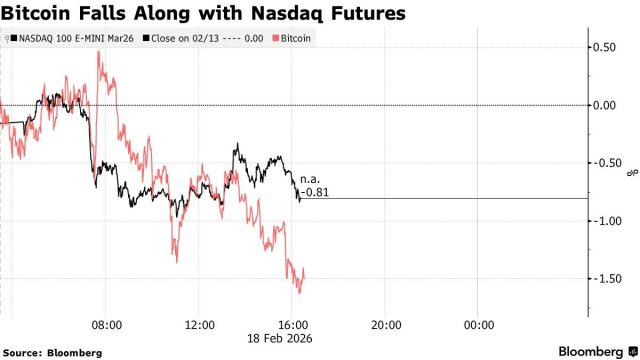
BTC and Nasdaq in the same downward trajectory | Source: Chart from Walter Bloomberg on X

This development has impacted investors’ sentiment and focus. Currently, investors are becoming more cautious due to growing tensions over Iran, renewed discussions about AI’s broader economic effects, and uncertainty about a potential Fed rate cut following recent inflation data.

In the midst of the geopolitical tension, flows, especially from Exchange-Traded Funds (ETFs), have stayed negative. US-listed Bitcoin ETFs recorded a fourth consecutive week of outflows, with over $360 million withdrawn just last week. These outflows point to weakening sentiment as indicated by CryptoQuant’s Fear and Greed Index, which is positioned at 10, classified as extreme fear.

While the market has shifted into extreme fear levels, analysts believe that BTC might extend its ongoing consolidation phase, with $60,000 considered as the main support. However, further macro shocks are expected to push BTC’s price back toward the $50,000 threshold.

Which BTC Investors Are Under Stress

During increased bearish phases, investors’ action and activity are crucial to gauging the current market state and its next possible direction. In a recent analysis, Anil, an on-chain researcher and investor, has outlined a key divergence between Bitcoin short-term holders and long-term holders.

With the market’s current state, BTC short-term holders are going through a stress period driven by capitulation. Meanwhile, long-term Bitcoin holders have yet to undergo a true stress or capitulation process.

It is worth noting that long-term holders eventually go through a phase of capitulation in every cycle, and then a fresh uptrend starts after a period of accumulation. However, it is hard to determine whether the group will capitulate again this time. Should this occur, Anil noted that the area below 1 on the LTH Unrealized Profit/Loss Ratio chart would be the decisive point for the market.

BTC trading at $68,134 on the 1D chart | Source: BTCUSDT on Tradingview.com

Perguntas relacionadas

QWhat is the main reason for Bitcoin's recent price decline according to the article?

AThe main reason for Bitcoin's recent price decline is ongoing geopolitical tensions, which are spurring a risk-off trade among investors.

QWhat is the current reading of CryptoQuant's Fear and Greed Index, and what does it signify?

AThe current reading of CryptoQuant's Fear and Greed Index is 10, which is classified as 'extreme fear,' signifying very weak market sentiment.

QHow did US-listed Bitcoin ETFs perform last week in terms of investor flows?

AUS-listed Bitcoin ETFs recorded a fourth consecutive week of outflows, with over $360 million withdrawn just last week.

QAccording to the on-chain analysis, which group of Bitcoin investors is currently under stress and experiencing capitulation?

AAccording to the on-chain analysis, short-term Bitcoin holders are currently under stress and experiencing capitulation.

QWhat are the two key support levels mentioned for Bitcoin's price if the bearish trend continues?

AThe two key support levels mentioned are $60,000 as the main support and the $50,000 threshold if further macro shocks occur.

Leituras Relacionadas

The Cost of an 11.5% Annualized Return: Will MicroStrategy's STRC Face a Moment of Reckoning?

This article analyzes the potential risks associated with MicroStrategy's (MSTR) use of structured financial products like STRC to leverage its BTC exposure. While these tools have enabled impressive returns (e.g., 11.5% annualized) and fueled significant capital inflows ($13.5B outstanding), they also create substantial annual dividend obligations (~$400M). The author argues that this structure, while effective in a bull market, could become a liability if BTC price stagnates or declines. The core risk is a potential negative feedback loop: the growing dividend burden from continued STRC issuance may eventually outweigh the benefits of increased BTC holdings. To meet these obligations, MicroStrategy might need to use new issuance proceeds for dividends instead of buying more BTC, which could disappoint equity investors. If the market capitalization (mNAV) falls below the value of its BTC holdings, the company could be forced to sell BTC instead of issuing new shares, potentially triggering a panic. The author estimates a potential inflection point in 6 months, where annual dividend costs reach $3-4B. At that stage, CEO Michael Saylor might face a difficult choice: sell BTC to meet obligations or sacrifice the credibility of the preferred shares by halting dividends. The article concludes that this financial engineering, while powerful, could ultimately "backfire" on MicroStrategy if market conditions turn.

marsbitHá 54m

The Cost of an 11.5% Annualized Return: Will MicroStrategy's STRC Face a Moment of Reckoning?

marsbitHá 54m

Trading

Spot
Futuros
活动图片





