Geopolitical Tensions Push Bitcoin Lower, Driving Market Sentiment Into Extreme Fear

bitcoinistPublicado em 2026-02-19Última atualização em 2026-02-19

Resumo

Escalating geopolitical tensions and a broader risk-off sentiment in traditional markets are driving Bitcoin's price decline, with BTC falling below $70,000. The cryptocurrency is mirroring the weakness in equity futures, with Nasdaq 100 and S&P 500 contracts also dropping. This has led to a fourth consecutive week of outflows from US-listed Bitcoin ETFs, totaling over $360 million last week, pushing the market sentiment into "extreme fear" with a reading of 10 on the CryptoQuant index. Analysts warn that if the current bearish trend continues, Bitcoin could test key support at $60,000, with further macro shocks potentially pushing it toward $50,000. On-chain analysis reveals that short-term holders are currently under significant stress and capitulating, while long-term holders have not yet undergone a true capitulation phase, a typical precursor to a new market uptrend.

The waning cryptocurrency market momentum, coupled with ongoing geopolitical tensions, continues to hamper Bitcoin’s price trajectory, pushing it downward. With BTC’s price and sentiment dropping significantly, the market appears to have entered a phase of heightened uncertainty and caution as investors look for alternative assets to hedge against geopolitical risks.

Bitcoin Weakness Reflects Broader Risk-Off Move

Bitcoin remains on a downward trajectory as its price trades below the $70,000 mark, bolstered by the geopolitical tensions around the world. Following the unfavorable conditions of Bitcoin and the sector, the market is now positioned at a critical moment, where the bearish action could either flip or continue.

Walter Bloomberg shared that Bitcoin is sliding as geopolitical risks spur risk-off trade after examining the cryptocurrency’s price against Nasdaq Futures. Such synchronous decrease indicates that market behavior across asset classes is once again being driven by macro variables like changing interest-rate expectations and a generalized feeling of risk aversion.

The report shows that Bitcoin fell by 1.7% to about $67,000 ahead of the United States Open, tracking weaker equity futures. Meanwhile, Nasdaq 100 Futures experienced a drop of 0.9% and S&P 500 contracts fell by 0.6%.
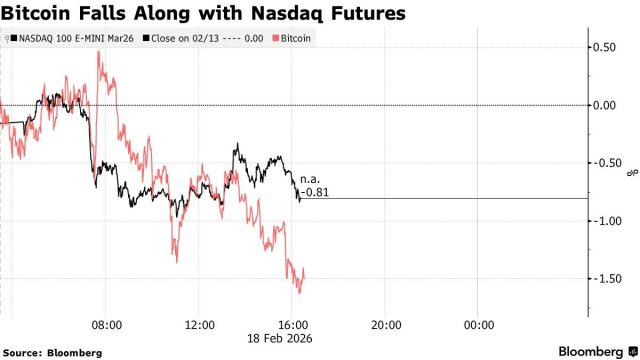
BTC and Nasdaq in the same downward trajectory | Source: Chart from Walter Bloomberg on X

This development has impacted investors’ sentiment and focus. Currently, investors are becoming more cautious due to growing tensions over Iran, renewed discussions about AI’s broader economic effects, and uncertainty about a potential Fed rate cut following recent inflation data.

In the midst of the geopolitical tension, flows, especially from Exchange-Traded Funds (ETFs), have stayed negative. US-listed Bitcoin ETFs recorded a fourth consecutive week of outflows, with over $360 million withdrawn just last week. These outflows point to weakening sentiment as indicated by CryptoQuant’s Fear and Greed Index, which is positioned at 10, classified as extreme fear.

While the market has shifted into extreme fear levels, analysts believe that BTC might extend its ongoing consolidation phase, with $60,000 considered as the main support. However, further macro shocks are expected to push BTC’s price back toward the $50,000 threshold.

Which BTC Investors Are Under Stress

During increased bearish phases, investors’ action and activity are crucial to gauging the current market state and its next possible direction. In a recent analysis, Anil, an on-chain researcher and investor, has outlined a key divergence between Bitcoin short-term holders and long-term holders.

With the market’s current state, BTC short-term holders are going through a stress period driven by capitulation. Meanwhile, long-term Bitcoin holders have yet to undergo a true stress or capitulation process.

It is worth noting that long-term holders eventually go through a phase of capitulation in every cycle, and then a fresh uptrend starts after a period of accumulation. However, it is hard to determine whether the group will capitulate again this time. Should this occur, Anil noted that the area below 1 on the LTH Unrealized Profit/Loss Ratio chart would be the decisive point for the market.

BTC trading at $68,134 on the 1D chart | Source: BTCUSDT on Tradingview.com

Perguntas relacionadas

QWhat is the main reason for Bitcoin's recent price decline according to the article?

AThe main reason for Bitcoin's recent price decline is ongoing geopolitical tensions, which are spurring a risk-off trade among investors.

QWhat is the current reading of CryptoQuant's Fear and Greed Index, and what does it signify?

AThe current reading of CryptoQuant's Fear and Greed Index is 10, which is classified as 'extreme fear,' signifying very weak market sentiment.

QHow did US-listed Bitcoin ETFs perform last week in terms of investor flows?

AUS-listed Bitcoin ETFs recorded a fourth consecutive week of outflows, with over $360 million withdrawn just last week.

QAccording to the on-chain analysis, which group of Bitcoin investors is currently under stress and experiencing capitulation?

AAccording to the on-chain analysis, short-term Bitcoin holders are currently under stress and experiencing capitulation.

QWhat are the two key support levels mentioned for Bitcoin's price if the bearish trend continues?

AThe two key support levels mentioned are $60,000 as the main support and the $50,000 threshold if further macro shocks occur.

Leituras Relacionadas

TechFlow Intelligence Agency: Anthropic Calls for Global Pause in AI Development While Preparing for Trillion-Dollar IPO; SpaceX IPO Roadshow Heats Up, But S&P 500 Rejects Fast-Track Inclusion

In today's TechFlow Intelligence Briefing, several major tech stories highlight a growing theme of trust and credibility gaps across AI, crypto, and finance. AI company Anthropic has publicly called for a global pause in AI development, citing risks from Claude's "recursive self-improvement." Ironically, this coincides with reports the company is preparing for a massive IPO targeting a near $1 trillion valuation. This perceived hypocrisy, coupled with widespread user complaints about Claude's declining performance, is sparking debate over whether the safety warning is genuine or a competitive tactic. Meanwhile, in a substantive security move, Anthropic open-sourced a framework for AI-powered vulnerability discovery. In the crypto market, Bitcoin's price drop below $61,000 triggered over $1.16 billion in liquidations, flipping the market into a state where more BTC is held at a loss than at a profit, a historical bearish signal. On the corporate front, SpaceX's highly anticipated IPO is generating immense Wall Street excitement, with Goldman Sachs projecting 100x revenue growth by 2030. However, the S&P 500 has refused to fast-track the company's inclusion post-IPO, potentially limiting immediate institutional demand. Separately, ByteDance's AI app Doubao lost over 6 million monthly active users after introducing a subscription model, highlighting the challenges of AI monetization. Other notable developments include Nvidia certifying HBM4 memory from Samsung, SK Hynix, and Micron; Cloudflare's acquisition of front-end tooling company VoidZero; and its CEO warning that bot traffic now exceeds human traffic online. The underlying narrative connects these events: a trust crisis. From AI firms' contradictory actions and crypto volatility to the clash between SpaceX's hyped narrative and institutional rules, a pattern is emerging where stated intentions and actual practices are increasingly misaligned.

marsbitHá 12m

TechFlow Intelligence Agency: Anthropic Calls for Global Pause in AI Development While Preparing for Trillion-Dollar IPO; SpaceX IPO Roadshow Heats Up, But S&P 500 Rejects Fast-Track Inclusion

marsbitHá 12m

Dalio Warns: AI Boom Shows Signs of a Bubble, Day of Reckoning Will Be the Time of Burst

Ray Dalio, founder of Bridgewater Associates, warns that the current artificial intelligence investment boom shows classic signs of a bubble, which he expects will eventually burst. In a Bloomberg Television interview, he noted that great technological revolutions often lead to capital inflows that create bubbles, making it difficult for investors and companies to calibrate their spending accurately—either overspending to capture market share or underspending and losing their competitive position. This caution comes amid significant rallies in AI-related assets, particularly chipmakers, driven by soaring demand for data centers and high-bandwidth chips, raising debates about overheating valuations. In contrast, Nvidia CEO Jensen Huang recently asserted that investors embracing the AI wave would see "crazy" returns and dismissed concerns over return on investment for data center spending as outdated. Dalio, however, focuses on the risks in the profit realization phase. He argues that bubbles tend to show signs of破裂 when markets transition from investment to the need for tangible returns, describing the burst as a process of converting paper wealth into cash. While acknowledging AI's intrinsic value, he expressed concern over the future profitability of some AI companies, suggesting the market is repeating a familiar pattern. The 76-year-old billionaire, who fully exited Bridgewater in 2025, has a net worth estimated at $21.5 billion according to the Bloomberg Billionaires Index.

marsbitHá 47m

Dalio Warns: AI Boom Shows Signs of a Bubble, Day of Reckoning Will Be the Time of Burst

marsbitHá 47m

Privacy Coin Crisis of Confidence! ZEC Plunges Over 56% in a Single Day

Zcash (ZEC), a leading privacy-focused cryptocurrency, experienced a severe crash on June 5th, plummeting over 56% in a single day and erasing nearly two months of gains. The flash crash was triggered by the disclosure of a critical zero-knowledge proof vulnerability within Zcash's Orchard privacy pool, which had existed since the pool's launch in May 2022. The flaw theoretically allowed an attacker to forge unlimited ZEC undetectably due to the pool's privacy features. The vulnerability was discovered on May 29th by independent security researcher Taylor Hornby during a proactive audit commissioned by Shielded Labs, utilizing AI-assisted analysis. The Zcash development team responded swiftly, implementing an emergency soft fork to disable Orchard transactions on June 2nd and executing a permanent hard fork fix (NU6.2) on June 3rd. Despite the technical fix, a major crisis of confidence emerged. The core issue is that Orchard's privacy design makes it cryptographically impossible to prove whether the vulnerability was exploited over the past four years, casting permanent doubt on the historical supply integrity of ZEC. While Shielded Labs argues exploitation was unlikely, the inability to provide definitive proof has severely damaged market trust. This sentiment was exacerbated when BitMEX co-founder Arthur Hayes, a prominent ZEC supporter, announced he was selling his entire position. He stated that privacy assets require "perfect security" rather than "probable safety." The combined effect of the disclosure and Hayes's exit ignited widespread panic selling, leading to massive liquidations and significant price decline. Analysts note the event highlights a fundamental tension within privacy coins: the conflict between verifiable supply and cryptographic privacy.

链捕手Há 49m

Privacy Coin Crisis of Confidence! ZEC Plunges Over 56% in a Single Day

链捕手Há 49m

Trading

Spot
Futuros
活动图片





