Gemini, Winklevoss Twins Hit With Class-Action Lawsuit Over Post-IPO Strategy Pivot, Stock Decline

bitcoinistPublicado em 2026-03-21Última atualização em 2026-03-21

Resumo

Shareholders have filed a class action lawsuit in New York against crypto exchange Gemini, its co-founders the Winklevoss twins, and other executives. The suit alleges the company misled investors during its September 2025 IPO by presenting a growth strategy focused on expanding its user base and international presence. The complaint claims that just months after the IPO, Gemini abruptly pivoted its business model to prioritize prediction markets, announced a 25% workforce reduction, and exited key international markets in the UK, EU, and Australia. This "Gemini 2.0" strategy, announced in February 2026, allegedly caused the company's stock price to drop over 8%. The stock fell a further 12.9% following the departure of three senior executives and has declined more than 80% from its all-time high. The plaintiffs seek damages for significant losses suffered due to these alleged misleading statements and omissions.

Shareholders filed a class action lawsuit in New York against crypto exchange Gemini, co-founders Tyler and Cameron Winklevoss, and multiple executives, alleging that the exchange misled investors during its 2025 initial public offering (IPO).

Gemini Accused Of Misleading Investors

This week, crypto exchange Gemini and several executives were hit with a class action lawsuit for allegedly misleading investors before and after the exchange’s September 2025 IPO due to its strategy pivot.

Filed on Wednesday in the US District Court for the Southern District of New York, the complaint claims that the IPO documents were “negligently prepared and, as a result, contained untrue statements of material fact or omitted to state other facts necessary to make the statements made not misleading and were not prepared in accordance with the rules and regulations governing their preparation.”
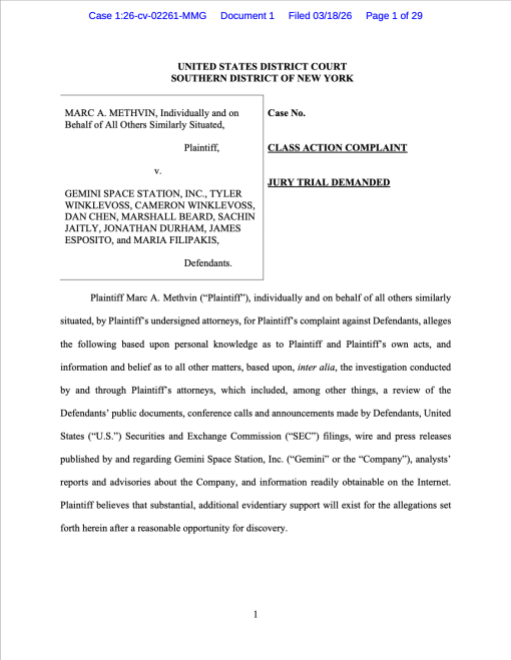
Shareholder files class action lawsuit agaisnt Gemini. Source: courtlistener

Gemini has primarily generated revenues through transactions, deposits, and fees charged to users of its crypto platform, the Plaintiff highlighted, noting that the IPO documents reportedly described the company’s revenue growth strategy as “predominantly focused on expanding [its] exchange platform via increased MTUs [monthly transacting users] (...) increased average daily trading volume, and increasing the number of assets available on [its] platform.”

The documents stated that Gemini would increase monthly transacting users through acquiring new retail and institutional users and expanding internationally.

Additionally, the lawsuit argues that throughout the Class Period, from September 12, 2025, to February 17, 2026, Gemini and its executives made statements that were “materially false” and misleading regarding the company’s business operations and prospects.

The ‘Gemini 2.0’ Strategy Pivot

The complaint emphasized the exchange “gave no indication that the Company was poised for an abrupt corporate pivot to a prediction-market-centric business model” or that it would abandon its international growth strategy just months after the IPO.

According to the lawsuit, “the truth began to emerge” in February 2026, when the crypto exchange co-founders, Tyler and Cameron Winklevoss, announced a corporate pivot to “Gemini 2.0.”

In a blog post, they described three crucial changes to the exchange’s operations: prediction market would be “more front and center in our experience”; its workforce would be reduced by 25%; and it would exit the UK, European Union (EU), and Australian markets.

The Winklevoss twins acknowledged the challenges Gemini has faced in the international market, arguing that the crypto exchange needed to simplify its structure to stay competitive.

However, the lawsuit alleges that, on this news, Gemini’s Class A common stock price fell 8.72%, to close at $6.70 per share on February 5, 2026. Similarly, it noted that the stock price fell 12.9% on February 17, 2026, on the news of the departure of three senior leaders.

Last month, the firm disclosed in a regulatory filing that Chief Operating Officer (COO) Marshall Beard, Chief Financial Officer (CFO) Dan Chen, and Chief Legal Officer (CLO) Tyler Meade were departing the company effective immediately.

In addition, the firm reported operating expenses of $520 million to $530 million, a 40% increase from the previous fiscal year, the lawsuit added. It’s worth noting that Gemini’s stock price briefly dropped to an all-time low of $5.51 on March 20, before bouncing to the $5.75 area. This represents a more than 80% drop from its September all-time high of $40.

“As a result of Defendants’ wrongful acts and omissions, and the precipitous decline in the market value of the Company’s securities, Plaintiff and other Class members have suffered significant losses and damages,” the lawsuit stated, seeking a jury trial and damages for investors who bought shares during the IPO and the Class Period.
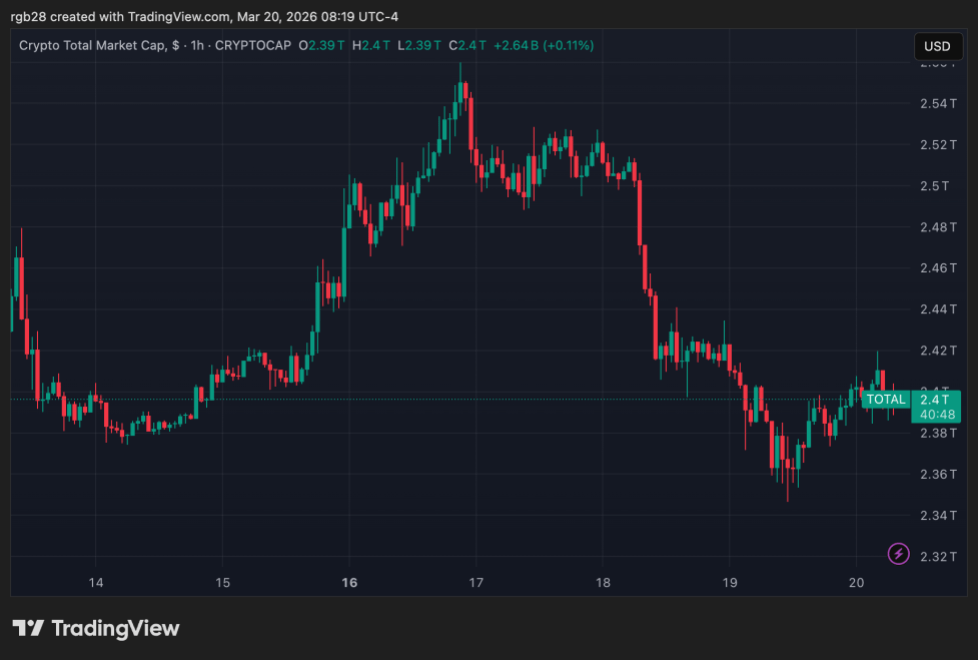
The total crypto market capitalization is at $2.4 trillion in the one-week chart. Source: TOTAL on TradingView


Perguntas relacionadas

QWhat is the main allegation in the class-action lawsuit filed against Gemini and the Winklevoss twins?

AThe lawsuit alleges that Gemini and its executives misled investors during its 2025 IPO by providing IPO documents that were 'negligently prepared' and contained untrue statements of material fact or omitted necessary facts, particularly concerning the company's business strategy and prospects.

QWhat was the 'Gemini 2.0' strategy pivot that triggered the lawsuit?

AThe 'Gemini 2.0' strategy pivot involved three major changes: making prediction markets more central to its platform, reducing its workforce by 25%, and exiting the UK, EU, and Australian markets, which represented an abrupt shift from the international growth strategy outlined in its IPO.

QHow did Gemini's stock price react to the announcement of the corporate pivot and the departure of senior leaders?

AGemini's Class A common stock price fell 8.72% to $6.70 per share on February 5, 2026, following the pivot announcement. It fell another 12.9% on February 17, 2026, on the news of the departure of three senior leaders, and later hit an all-time low of $5.51, representing an over 80% drop from its all-time high.

QWhich key executives were reported to have departed from Gemini, as mentioned in the lawsuit?

AThe departing executives were Chief Operating Officer (COO) Marshall Beard, Chief Financial Officer (CFO) Dan Chen, and Chief Legal Officer (CLO) Tyler Meade.

QWhat was the original revenue growth strategy for Gemini as described in its IPO documents?

AThe IPO documents described the company's revenue growth strategy as predominantly focused on expanding its exchange platform by increasing monthly transacting users (MTUs), increasing average daily trading volume, and increasing the number of assets available on its platform, primarily by acquiring new retail and institutional users and expanding internationally.

Leituras Relacionadas

Sygnum's B2B Bank Model Fuels Cryptocurrency Boom in Switzerland

Swiss digital asset bank Sygnum's B2B model is enabling a cryptocurrency boom in Switzerland by providing integrated infrastructure to traditional banks. Its partnership with Bancastato, a regional bank, allows clients to seamlessly trade cryptocurrencies like Bitcoin, Ethereum, Litecoin, and Solana directly within their existing bank apps. This eliminates the friction of using separate platforms. Under this model, Sygnum handles the backend trading infrastructure, custody, compliance, and regulatory licenses, while partner banks maintain their customer relationships and branding. This "infrastructure-as-a-service" approach allows banks to offer crypto services faster and more safely than building them in-house. Over 25 Swiss financial institutions, including Zuger Kantonalbank and PostFinance, now use Sygnum's B2B platform, making regulated digital asset services accessible to over a third of Switzerland's population. The trend reflects a shift where Swiss banks view crypto as another mainstream asset class rather than a niche product. Sygnum, a licensed bank itself with operations in Zurich, Singapore, and Abu Dhabi, leverages Switzerland's mature regulatory framework, which has integrated crypto into existing banking supervision. This environment, along with the concentration of blockchain firms in "Crypto Valley," is helping mainstream cryptocurrency adoption in the country, with an estimated 18-23% of Swiss residents already owning crypto assets.

cryptonews.ruHá 6m

Sygnum's B2B Bank Model Fuels Cryptocurrency Boom in Switzerland

cryptonews.ruHá 6m

US Department of Justice Files Lawsuit to Recover $47,000 in Cryptocurrency in ATM Fraud Case

The U.S. Department of Justice has filed a civil forfeiture complaint seeking $47,461.73111 in USDT (Tether). Prosecutors allege the cryptocurrency was obtained through a fraud scheme where scammers tricked victims, including a Massachusetts woman, into withdrawing cash from their bank accounts and depositing it into crypto ATMs. In this case, the victim followed instructions after seeing a fake tech support pop-up, depositing funds into a Bitcoin Depot ATM. Authorities later traced a portion of the funds to a specific wallet, seized the assets, and linked the address to other victims. This action is part of a broader crackdown on crypto ATM fraud. In response to such scams, which the FBI reports cost Americans over $333 million in 2025, a bipartisan "Stop Crypto ATM Scams Act" has been introduced in Congress. The proposed bill would impose daily and initial deposit limits, mandate fraud warnings, and strengthen anti-money laundering requirements for operators. Regulatory bodies like FinCEN have also increased scrutiny of crypto kiosks. The Massachusetts case follows other recent forfeiture actions, including one targeting approximately $3.4 million in crypto linked to an investment scam and another for about $327,829 connected to a romance fraud scheme. Civil forfeiture allows the government to seize assets and, if successful, potentially return them to identified victims.

cryptonews.ruHá 9m

US Department of Justice Files Lawsuit to Recover $47,000 in Cryptocurrency in ATM Fraud Case

cryptonews.ruHá 9m

Trading

Spot
活动图片