Gemini nabs US license to offer prediction markets

cointelegraphPublicado em 2025-12-11Última atualização em 2025-12-11

Resumo

Crypto exchange Gemini, founded by the Winklevoss twins, has received a designated contract market license from the CFTC, allowing it to offer prediction markets in the US. Through its affiliate Gemini Titan, the company plans to let users trade event contracts and expand into crypto derivatives like futures and options. The announcement caused Gemini's stock to surge 13.7% in after-hours trading. The license marks the end of a five-year application process and could significantly boost the company, which has seen its stock decline since its public debut. President Cameron Winklevoss stated that prediction markets could potentially rival or exceed traditional capital markets in size.

Crypto exchange Gemini, founded by billionaire twins Tyler and Cameron Winklevoss, has scored a license from the Commodity Futures Trading Commission to offer prediction markets in the US.

Gemini said on Wednesday that its affiliate, Gemini Titan, received a designated contract market license from the CFTC and “plans to enter into the prediction markets space.”

The company said that “starting shortly,” its US users would be able to trade event contracts on its web platform and could expand its US derivatives offerings to include crypto futures, options, and perpetual contracts.

Gemini joins a number of crypto companies that have begun to offer prediction markets, allowing users to bet on the outcomes of a range of events, including sports and geopolitics.

Shares in Gemini (GEMI) shot up 13.7% in after-hours trading on Wednesday to $12.92 after ending the day’s trading session down 0.7%.
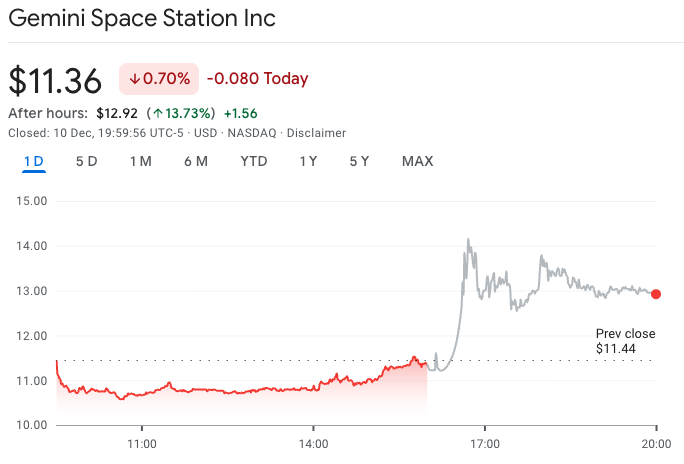
Shares in Gemini jumped on the company’s announcement that it will offer prediction markets. Source: Google Finance

The license could be a major boost for Gemini, whose stock is down 64.5% since its public debut on Sept. 12 as the crypto market has struggled to sustain a rally.

Related: ‘Elite’ traders hunt dopamine-seeking retail on prediction markets: 10x Research

“Prediction markets have the potential to be as big or bigger than traditional capital markets,” said Gemini’s president, Cameron Winklevoss.

Gemini CEO Tyler Winklevoss said it first applied for the license in March 2020, and the approval “marks the culmination of a 5-year licensing process and the beginning of a new chapter for Gemini.”

Magazine: Can Robinhood or Kraken’s tokenized stocks ever be truly decentralized?

Perguntas relacionadas

QWhat license did Gemini receive and from which US regulatory body?

AGemini received a designated contract market license from the Commodity Futures Trading Commission (CFTC).

QWhich Gemini affiliate was specifically granted the license to operate prediction markets?

AGemini Titan, an affiliate of the crypto exchange Gemini, was granted the license.

QHow did the announcement of the license affect Gemini's stock price in after-hours trading?

AGemini's stock (GEMI) shot up 13.7% in after-hours trading to $12.92.

QAccording to Cameron Winklevoss, how big does he believe prediction markets can become?

ACameron Winklevoss stated that prediction markets 'have the potential to be as big or bigger than traditional capital markets.'

QWhen did Gemini first apply for this license, according to CEO Tyler Winklevoss?

ACEO Tyler Winklevoss said the company first applied for the license in March 2020.

Leituras Relacionadas

Not Speculation but a Necessity: The 4 Unique Values of Prediction Markets

Polymarket's recent $4 billion funding round and soaring valuation of $15 billion highlight the explosive growth of prediction markets, with trading volume reaching $25.7 billion in March 2026—a 10.6% monthly increase. This analysis argues that prediction markets serve critical non-speculative functions, positioning them as essential tools rather than mere gambling platforms. Prediction markets offer four unique values: entertainment consumption, insurance-like protection, risk hedging, and truth discovery. Firstly, they stimulate economic activity by engaging users in event-based betting, similar to the broader sports industry. Secondly, they act as a form of decentralized insurance, allowing users to hedge against specific, well-defined risks (e.g., weather events) transparently and without traditional overhead costs. Thirdly, institutions and individuals use these markets to hedge against geopolitical and commodity price risks, as demonstrated during the U.S.-Iran conflict and the launch of 24/7 commodity markets on platforms like Kalshi. Finally, prediction markets counter media bias by aggregating crowd-sourced information, often achieving 30% higher accuracy than surveys due to users' vested interests. Experts like Bitwise’s Jeff Park and SIG’s Jeff Yass emphasize the markets' role in risk transfer and financial innovation. As these platforms evolve, they are poised to become trillion-dollar markets, offering more reliable, decentralized mechanisms for information pricing and risk management.

marsbitHá 2h

Not Speculation but a Necessity: The 4 Unique Values of Prediction Markets

marsbitHá 2h

Trading

Spot
Futuros
活动图片