Galaxy predicts stablecoins will overtake ACH transaction volume in 2026

cointelegraphPublicado em 2025-12-19Última atualização em 2025-12-19

Resumo

Galaxy Research forecasts that stablecoins will surpass the U.S. Automated Clearing House (ACH) system in transaction volume by 2026, driven by regulatory clarity and increasing adoption. Stablecoins already exceed major credit card networks like Visa and currently process about half of ACH volumes. The stablecoin market, valued at around $309 billion, is dominated by USDT and USDC, but new entrants like Western Union, Sony Bank, and SoFi are launching their own dollar-pegged stablecoins. Galaxy also predicts Bitcoin could reach $250,000 by late 2027, with potential new all-time highs in 2026. The report highlights the GENIUS Act’s expected implementation in early 2026 as a key growth catalyst.

Stablecoins could process more transaction volume than the US Automated Clearing House system in 2026, as regulatory clarity and rising adoption expand their usage, according to a new forecast.

Galaxy Research, the research arm of digital asset company Galaxy Digital, pointed to existing transaction data and regulatory developments to support its prediction, noting that “stablecoin transactions already eclipse major credit card networks such as Visa and now process roughly half the transaction volume of the automated clearing house (ACH) system.”

Thad Pinakiewicz, vice president of research, said stablecoin supply has continued to grow at a 30%–40% compound annual growth rate, with transaction volumes rising alongside issuance. Galaxy also cited the expected implementation of definitions under the GENIUS Act in early 2026 as a factor supporting further growth in stablecoin usage.
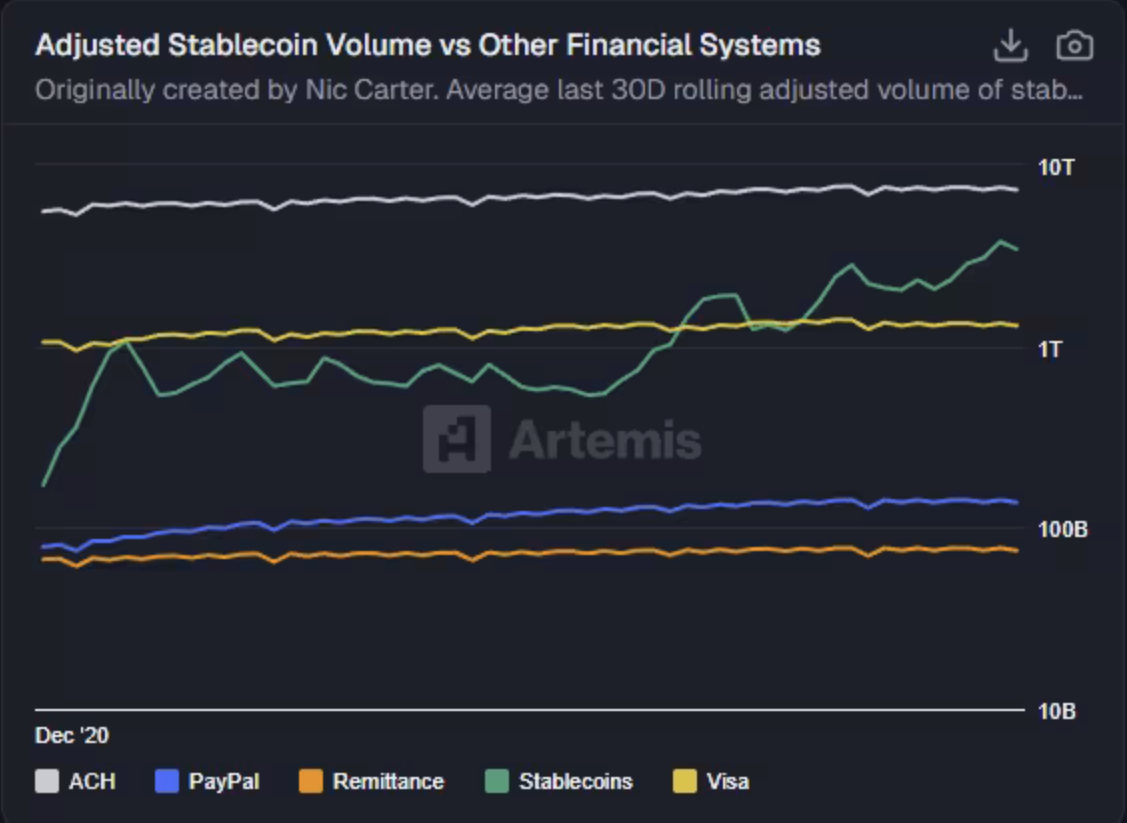
Stablecoin volume vs. other financial systems. Source: Galaxy Digital

The paper also brings predictions for the price of Bitcoin (BTC), writing that it could reach $250,000 by the end of 2027. According to Galaxy Research head of firmwide research Alex Thorn, 2026 is “too chaotic to predict, though Bitcoin making new all-time highs in 2026 is still possible.”

Related: Coinbase ‘cautiously optimistic’ on 2026 as crypto nears institutional inflection point

Dollar-pegged stablecoin market expands

According to data from DefiLlama, the stablecoin market cap currently stands at about $309 billion. While Tether’s USDt (USDT) and Circle’s USDC (USDC) continue to dominate, a growing number of financial institutions and payments companies have entered the stablecoins race in recent months.
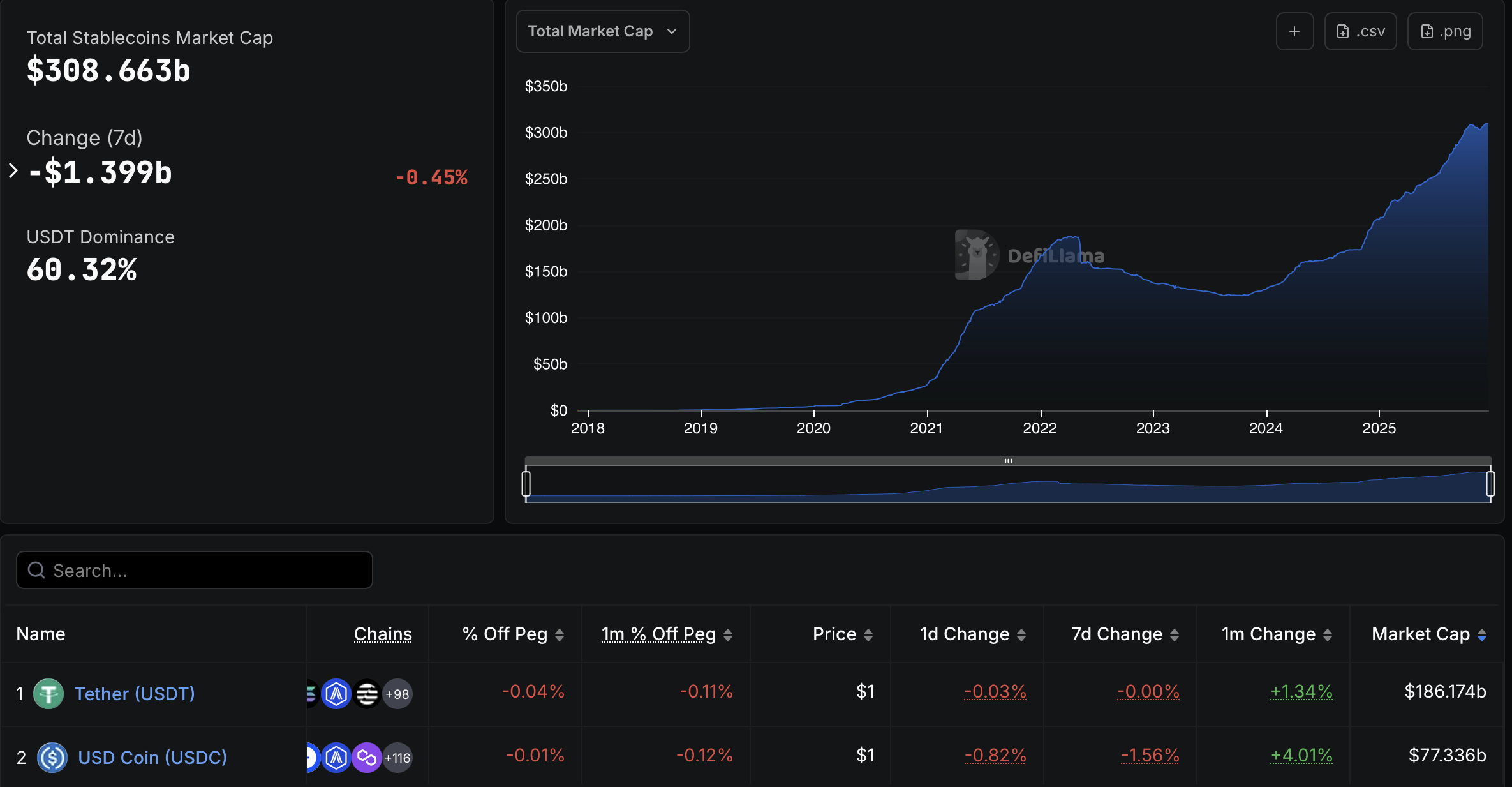
Stablecoin market cap. Source: DefiLlama

In October, Western Union announced plans to launch its own US dollar-pegged stablecoin, the US Dollar Payment Token, which will be built on the Solana blockchain and issued by Anchorage Digital Bank as part of a broader digital asset settlement network.

Sony Bank was reported to be preparing a US dollar-pegged stablecoin for use across Sony’s US ecosystem, including PlayStation games, subscriptions and anime content. The stablecoin is expected to launch in 2026.

On Thursday, SoFi Technologies launched SoFiUSD, a fully reserved US dollar stablecoin issued by its banking subsidiary, SoFi Bank. The company said the token will debut on Ethereum and is designed to support low-cost settlement for banks, fintechs and enterprise platforms.

Galaxy Research associate Jianing Wu said she expects TradFi-partnered stablecoins will consolidate in 2026, as users and merchants are unlikely to adopt a long list of digital dollars and will instead favor one or two with the “broadest acceptance.”

Magazine: Quantum attacking Bitcoin would be a waste of time: Kevin O’Leary

Criptomoedas em alta

Perguntas relacionadas

QAccording to Galaxy Research, when are stablecoins predicted to surpass ACH transaction volume?

AStablecoins are predicted to surpass the US Automated Clearing House (ACH) transaction volume in 2026.

QWhat is the current stablecoin market capitalization, and which two stablecoins dominate the market?

AThe stablecoin market cap currently stands at about $309 billion, and it is dominated by Tether's USDt (USDT) and Circle's USDC (USDC).

QWhat key regulatory development does Galaxy cite as a factor supporting stablecoin growth in 2026?

AGalaxy cites the expected implementation of definitions under the GENIUS Act in early 2026 as a key factor supporting further growth in stablecoin usage.

QWhich major financial services company announced plans to launch a stablecoin on the Solana blockchain in October?

AWestern Union announced plans to launch its own US dollar-pegged stablecoin, the US Dollar Payment Token, on the Solana blockchain in October.

QWhat Bitcoin price prediction does the Galaxy Research paper make for the end of 2027?

AThe Galaxy Research paper predicts that Bitcoin (BTC) could reach $250,000 by the end of 2027.

Leituras Relacionadas

Can Generative Models Finally Be Trained End-to-End? The Core Is a For Loop

This article introduces a novel training paradigm for generative models called Explorative Modeling (XM), which enables true end-to-end training. Traditionally, powerful generative models like autoregressive and diffusion models are not trained end-to-end. They are trained to predict a single small step but require iterative multi-step sampling for inference. This "exposure bias" leads to error accumulation and limits performance. The core challenge XM addresses is "mode blurring." In generative tasks, a single input (e.g., "generate a dog") corresponds to many valid outputs (multiple modes). Standard training objectives like reconstruction loss force the model to average these modes, producing unrealistic, blurry outputs. To avoid this, existing models break generation into many small, almost deterministic steps, sacrificing end-to-end training. XM tackles this by restructuring the training loop itself. Its key insight is to amplify "generative expressivity." For each training input, instead of generating one sample, the model generates K candidate outputs. Only the candidate closest to the real data is used for computing the loss and updating the model via backpropagation. This simple "best-of-K" mechanism is implemented as a short for-loop. By exploring multiple possibilities, the model learns to distribute its guesses across different modes rather than collapsing to their uninformative average. The paper demonstrates that "exploration" acts as a new, powerful scaling axis. Gains from XM increase with model size, data scale, and compute. Experiments show improvements in FID scores for image generation and significant efficiency gains, sometimes outperforming larger models without exploration. When pushed to the limit, XM enables fully single-step, end-to-end generative models. In robotics tasks, an "Explorative Policy" matched the performance of a 100-step Diffusion Policy with a single forward pass, drastically improving inference speed. While the best-of-K concept is not entirely new, the authors' contribution lies in formally understanding it as a direct method to boost generative expressivity without fragmenting the generation process. This work suggests that as models scale, enhancing exploration during training may become crucial for overcoming fundamental performance bottlenecks.

marsbitHá 15m

Can Generative Models Finally Be Trained End-to-End? The Core Is a For Loop

marsbitHá 15m

Annual Salary of Millions Competing for Electricians, Meta Rushes to Open Its Own Technical School

The AI boom is facing an unexpected bottleneck: a severe shortage of skilled construction workers and electricians. As tech giants like Meta, OpenAI, and Alphabet race to build massive data centers—such as OpenAI's $16 billion "Stargate" project—they are hitting a critical labor wall. The U.S. needs an estimated 130,000 more electricians, 240,000 construction workers, and 150,000 supervisors by 2030 for AI infrastructure alone, but tens of thousands of electrician jobs go unfilled each year. While AI companies offer high premiums, with electricians earning up to $280,000 annually, worker scarcity still causes massive losses—delays on a single project can cost $14.2 million per month. The complexity of building AI data centers, which require immense power (equivalent to powering hundreds of thousands of homes), sophisticated electrical systems, and advanced liquid cooling solutions, demands highly skilled technicians who are in short supply. To combat this, companies are investing heavily in training. Meta has committed $115 million to a free training school offering tuition, housing, and stipends, targeting 5,000 new workers. OpenAI is partnering with unions to secure skilled labor. These efforts are paying off, with a significant rise in Gen Z interest in trade schools over college. However, the power demands are staggering. AI data centers are driving a rapid surge in electricity consumption, projected to account for up to 12% of U.S. power use by 2028 and raising costs for consumers. Furthermore, the construction boom is project-based, leading to a potential future glut of trained workers once building peaks, which could depress wages industry-wide. The race for AI supremacy now depends as much on skilled hands as on advanced chips.

marsbitHá 2h

Annual Salary of Millions Competing for Electricians, Meta Rushes to Open Its Own Technical School

marsbitHá 2h

Trading

Spot

Artigos em Destaque

Como comprar ACH

Bem-vindo à HTX.com!Tornámos a compra de Alchemy Pay (ACH) simples e conveniente.Segue o nosso guia passo a passo para iniciar a tua jornada no mundo das criptos.Passo 1: cria a tua conta HTXUtiliza o teu e-mail ou número de telefone para te inscreveres numa conta gratuita na HTX.Desfruta de um processo de inscrição sem complicações e desbloqueia todas as funcionalidades.Obter a minha contaPasso 2: vai para Comprar Cripto e escolhe o teu método de pagamentoCartão de crédito/débito: usa o teu visa ou mastercard para comprar Alchemy Pay (ACH) instantaneamente.Saldo: usa os fundos da tua conta HTX para transacionar sem problemas.Terceiros: adicionamos métodos de pagamento populares, como Google Pay e Apple Pay, para aumentar a conveniência.P2P: transaciona diretamente com outros utilizadores na HTX.Mercado de balcão (OTC): oferecemos serviços personalizados e taxas de câmbio competitivas para os traders.Passo 3: armazena teu Alchemy Pay (ACH)Depois de comprar o teu Alchemy Pay (ACH), armazena-o na tua conta HTX.Alternativamente, podes enviá-lo para outro lugar através de transferência blockchain ou usá-lo para transacionar outras criptomoedas.Passo 4: transaciona Alchemy Pay (ACH)Transaciona facilmente Alchemy Pay (ACH) no mercado à vista da HTX.Acede simplesmente à tua conta, seleciona o teu par de trading, executa as tuas transações e monitoriza em tempo real.Oferecemos uma experiência de fácil utilização tanto para principiantes como para traders experientes.

223 Visualizações TotaisPublicado em {updateTime}Atualizado em 2026.06.02

Como comprar ACH

Discussões

Bem-vindo à Comunidade HTX. Aqui, pode manter-se informado sobre os mais recentes desenvolvimentos da plataforma e obter acesso a análises profissionais de mercado. As opiniões dos utilizadores sobre o preço de ACH (ACH) são apresentadas abaixo.

活动图片