Full Text of the Fed Decision: 25 Basis Point Rate Cut, $40 Billion Treasury Bill Purchases Within 30 Days

比推Publicado em 2025-12-10Última atualização em 2025-12-10

Resumo

The Federal Reserve lowered the target range for the federal funds rate by 25 basis points to 3.50%-3.75% on December 10, 2025, marking the third consecutive rate cut. The decision was approved by a 9-3 vote. The policy statement removed the description of unemployment as "low," and the latest dot plot maintained the projection of an additional 25 basis point rate cut in 2026. Additionally, the Fed will purchase $40 billion in Treasury bills over 30 days starting December 12 to maintain ample reserve levels. The policy stance reflects concerns over moderating economic activity, a rise in unemployment, and inflation that remains elevated. The committee emphasized its commitment to achieving maximum employment and a 2% inflation target, noting increased downside risks to employment. Voting against the decision were Stephen Miran, who preferred a 50 basis point cut, and Austan Goolsbee and Jeffrey Schmid, who favored no change. The Board also unanimously approved a reduction in the primary credit rate to 3.75%.

On December 10, 2025, local time, the Federal Reserve lowered the benchmark interest rate by 25 basis points to 3.50%-3.75% in a 9-3 vote, marking the third consecutive meeting with a rate cut. The policy statement removed the description of the unemployment rate as "low." The latest dot plot maintains the forecast of a 25 basis point rate cut in 2026.

Additionally, the Federal Reserve will purchase $40 billion in Treasury bills within 30 days starting December 12 to maintain ample reserve supply.

Full Text of the Interest Rate Decision

Available data indicate that economic activity is expanding at a moderate pace. Job growth has slowed this year, and the unemployment rate has risen as of September. More recent indicators are consistent with this situation. Inflation has increased compared to the beginning of the year and remains elevated.

The Committee's long-term goals are to achieve maximum employment and 2% inflation. Uncertainty about the economic outlook remains high. The Committee is closely monitoring risks on both sides of its dual mandate and believes that downside risks in employment have increased in recent months.

To support these goals and considering changes in the risk balance, the Committee decided to lower the target range for the federal funds rate by 25 basis points to 3.50% to 3.75%. In assessing the appropriate timing and magnitude of any further adjustments to the target range for the federal funds rate, the Committee will carefully evaluate incoming data, the evolving economic outlook, and the balance of risks. The Committee is strongly committed to supporting maximum employment and returning inflation to its 2% target.

In evaluating the appropriate monetary policy stance, the Committee will continue to monitor the implications of incoming information for the economic outlook. The Committee would be prepared to adjust the stance of monetary policy as appropriate if risks emerge that could impede the attainment of the Committee's goals. The Committee's assessments will take into account a wide range of information, including labor market conditions, inflationary pressures and inflation expectations, and financial and international developments.

The Committee believes that reserve balances have declined to ample levels and will initiate purchases of short-term U.S. Treasury securities as needed to maintain ample reserve supply on an ongoing basis.

Voting in favor of this monetary policy action were: Chair Jerome H. Powell, Vice Chair John C. Williams, Michael S. Barr, Michelle W. Bowman, Susan M. Collins, Lisa D. Cook, Philip N. Jefferson, Alberto G. Musalem, and Christopher J. Waller. Voting against were Stephen I. Miran, who preferred to lower the target range for the federal funds rate by 1/2 percentage point at this meeting; and Austan D. Goolsbee and Jeffrey R. Schmid, who preferred to maintain the target range for the federal funds rate unchanged at this meeting.
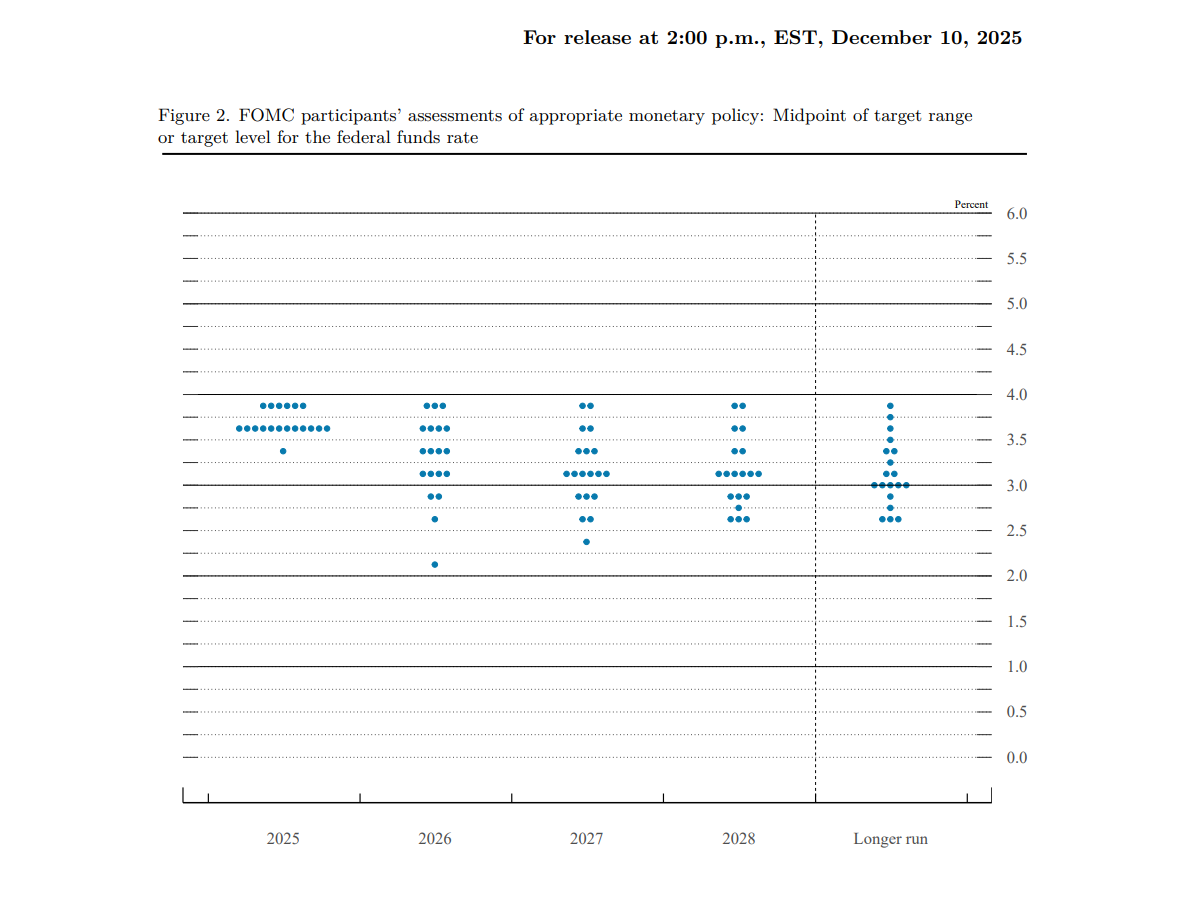
Median Fed Dot Plot: Cumulative 25 Basis Point Rate Cut in 2026

Decisions Regarding Monetary Policy Operations

To implement the monetary policy stance announced in the Federal Open Market Committee's statement on December 10, 2025, the Federal Reserve makes the following decisions:

The Board of Governors of the Federal Reserve System unanimously voted to lower the interest rate on reserve balances to 3.65%, effective December 11, 2025.

As part of the policy decision, the Federal Open Market Committee voted to direct the Open Market Trading Desk at the Federal Reserve Bank of New York, until further notice, to execute transactions in the System Open Market Account in accordance with the following domestic policy directive:

"Effective December 11, 2025, the Federal Open Market Committee directs the Desk:

To conduct open market operations as necessary to maintain the federal funds rate in a target range of 3.50% to 3.75%.

To conduct standing overnight repurchase agreement operations at an offering rate of 3.75%.

To conduct standing overnight reverse repurchase agreement operations at an offering rate of 3.50%, with a per-counterparty limit of $160 billion per day.

To increase the System Open Market Account's holdings of securities by purchasing Treasury bills and, if necessary, other U.S. Treasury securities with remaining maturities of three years or less, to maintain ample levels of reserves.

To reinvest all principal payments from the Federal Reserve's holdings of U.S. Treasury securities at auction. To roll over all principal payments from the Federal Reserve's holdings of agency securities into Treasury bills."

In related actions, the Board of Governors of the Federal Reserve System unanimously voted to approve a 25 basis point reduction in the primary credit rate to 3.75%, effective December 11, 2025. In taking this action, the Board approved requests submitted by the Boards of Directors of the Federal Reserve Banks of New York, Philadelphia, St. Louis, and San Francisco to set this rate.


Twitter:https://twitter.com/BitpushNewsCN

Bitpush TG Discussion Group:https://t.me/BitPushCommunity

Bitpush TG Subscription: https://t.me/bitpush

Original link:https://www.bitpush.news/articles/7594706

Perguntas relacionadas

QWhat was the new target range for the Federal Funds Rate after the December 10, 2025, Fed decision?

AThe new target range for the Federal Funds Rate is 3.50% to 3.75%.

QHow many members of the Federal Open Market Committee (FOMC) voted against the policy action, and what were their preferred actions?

AThree members voted against the policy action. Stephen I. Miran preferred to lower the target range by 1/2 percentage point, while Austan D. Goolsbee and Jeffrey R. Schmid preferred to maintain the target range unchanged.

QWhat specific action did the Fed announce regarding its balance sheet and Treasury securities?

AThe Fed announced it will purchase $40 billion in Treasury bills over 30 days starting December 12 to maintain ample reserve supplies. It will also reinvest principal payments from its holdings of U.S. Treasury securities and agency securities into Treasury bills.

QAccording to the latest dot plot, what is the median projection for interest rate changes in 2026?

AThe median projection from the latest dot plot is for a cumulative 25 basis point rate cut in 2026.

QWhat changes were made to the policy statement regarding the description of the labor market?

AThe policy statement removed the description of the unemployment rate as 'low'.

Leituras Relacionadas

Strategy Takes a Hardline Stance Against MSCI: What's in the 12-Page Open Letter of Defense?

In October 2024, MSCI proposed excluding companies with over 50% of their assets in digital assets from its global investable market indices, directly threatening Digital Asset Treasury (DAT) companies like MicroStrategy. Analysts warned this could trigger up to $8.8 billion in outflows, with MicroStrategy alone facing $2.8 billion in passive selling pressure. In response, MicroStrategy submitted a 12-page public letter to MSCI, strongly opposing the proposal as "misleading and destructive." The company argued that digital assets represent a revolutionary financial technology, comparable to historic infrastructure investments like oil or telecommunications. It emphasized that DATs are operational businesses with active revenue models, not passive funds, and criticized the 50% threshold as arbitrary, discriminatory, and impractical due to Bitcoin's volatility. MicroStrategy also accused MSCI of violating index neutrality and contradicting the U.S. government's pro-digital asset strategy. The company demanded MSCI withdraw the proposal or extend the consultation period. It is not alone—over 300 entities, including Strive and Bitcoin for Corporations, have joined opposition efforts, suggesting alternative indices instead of exclusion. The outcome, expected by January 2026, will significantly impact the integration of digital asset companies into traditional financial markets.

marsbitHá 17m

Strategy Takes a Hardline Stance Against MSCI: What's in the 12-Page Open Letter of Defense?

marsbitHá 17m

Dogecoin Price Forecast for 2026: The Path to $1 Amid Meme Rally

Dogecoin (DOGE) is back in the spotlight as retail traders return to the meme segment. Analysts express cautious optimism, suggesting that under favorable conditions, including a continued bull market and increased risk appetite, DOGE could potentially reach the $1 mark in 2026. The price is currently consolidating after volatile swings, with significant trading volumes indicating ongoing speculative interest. Key drivers remain its meme narrative, support from high-profile figures, and its correlation with Bitcoin's cycles. The path to $1 is not linear. DOGE must hold key support levels, sustain derivatives interest without overheating, and receive fresh meme-driven momentum. Technical analysis highlights the importance of watching RSI levels and volume for signs of sustainable growth versus short-term pumps. Alongside DOGE, newer, more aggressive meme tokens like Maxi Doge (MAXI) are gaining attention. Having raised approximately $4.3 million in its presale, MAXI offers high-risk, high-reward speculation with features like staking rewards and trading tournaments. While it could amplify portfolio returns during a rally, it carries significant risks associated with early-stage projects, unlike the more established DOGE. The overall strategy for many investors is to combine a core position in DOGE with a smaller, speculative bet on tokens like MAXI to capitalize on the potential meme rally.

bitcoinistHá 28m

Dogecoin Price Forecast for 2026: The Path to $1 Amid Meme Rally

bitcoinistHá 28m

Trading

Spot
Futuros
活动图片