From Utopian Narratives to Financial Infrastructure: The 'Disenchantment' and Pivot of Crypto VC

marsbitPublicado em 2026-03-30Última atualização em 2026-03-30

Resumo

From Utopian Narratives to Financial Infrastructure: The Disenchantment and Pivot of Crypto VC The crypto industry, once championing "blockchain, not Bitcoin" and a broad Web3 vision, is now seeing venture capital flow overwhelmingly into pragmatic financial applications, particularly stablecoin payments. Following the decline of the Web3 and NFT boom in the early 2020s, investment has cooled for many sectors but surged for payment infrastructure. Key signals include Stripe's $1.1 billion acquisition of Bridge and Mastercard's $1.8 billion purchase of BVNK. Data from Architect Partners shows funding for crypto payment companies skyrocketed to $2.6 billion in 2025, exceeding the total of the previous three years combined. In contrast, funding for decentralized applications (DApps) and blockchain gaming has collapsed. The total private crypto funding reached $20.4 billion in 2025, still below the 2022 peak of $27.6 billion. Stablecoins, like USDT and USDC, are now seen as a breakthrough application, with their annual transaction volume soaring 72% to $33 trillion in 2025. Their core appeal is enabling efficient, real-time global value transfer, solving long-standing issues of cost and speed in cross-border payments. However, the industry faces significant challenges from established "gatekeepers" like Visa and Mastercard, which control terminal access. The piece also notes the declining market share of Binance and the emergence of new products like Franklin Templeton's toke...

Written by: Suvashree Ghosh, Matt Haldane

Compiled by: Saoirse, Foresight News

Not long ago, the crypto industry was chanting the slogan "blockchain, not Bitcoin," claiming that distributed ledger technology would go beyond financial applications and completely reshape the internet. However, recent financing trends indicate that in the real world, cash is still king.

Since the Web3 and NFT craze subsided in the early 2020s, investment enthusiasm in the crypto industry has noticeably cooled. But one niche has bucked the trend, attracting increasing venture capital—stablecoin payments.

Stripe's acquisition of Bridge for $1.1 billion last year was an early signal of traditional financial institutions beginning to lay out stablecoin payments. Since then, a batch of startups including ARQ, KAST, and RedotPay have successively secured new funding to build cross-border payment channels and stablecoin-based financial services. Mastercard's acquisition of BVNK for $1.8 billion last week further confirms the market's strong interest in this sector.

"Startups related to stablecoins are almost the hottest area for venture capital financing right now," said Rob Hadick, General Partner at Dragonfly Capital. "Stablecoins have broken away from the entire crypto industry to become one of the few truly breakthrough applications with widespread real-world adoption."

According to data from Architect Partners, which specializes in annual crypto financing reports, the total financing for crypto payment companies soared to $2.6 billion in 2025, exceeding the sum of the previous three years. Driven by Mastercard's acquisition of BVNK, this number is expected to continue climbing this year.
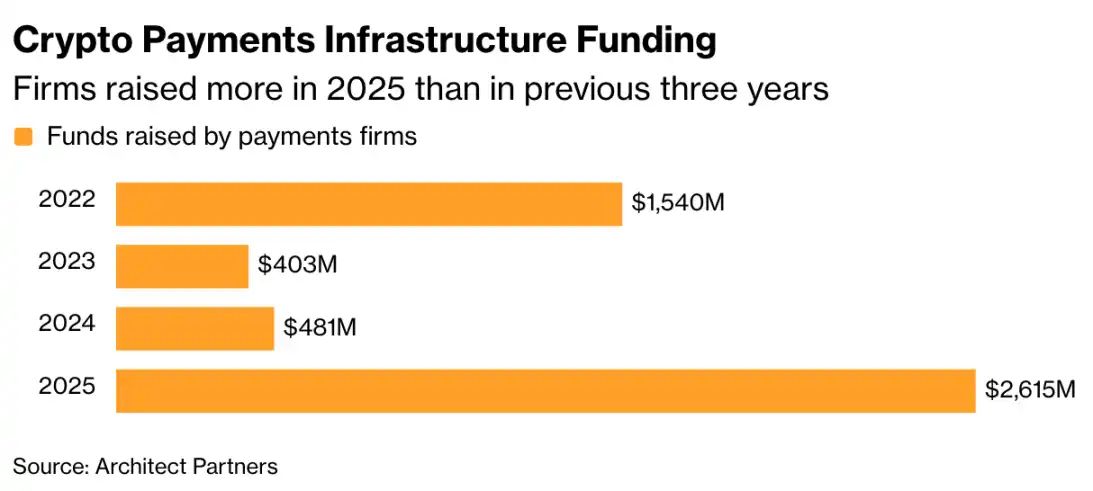
Crypto Payment Infrastructure Financing: 2025 company financing exceeded the sum of the previous three years

Meanwhile, overall private financing in the crypto industry increased from nearly $13 billion in 2024 to $20.4 billion in 2025, but still fell short of the 2022 peak of $27.6 billion.
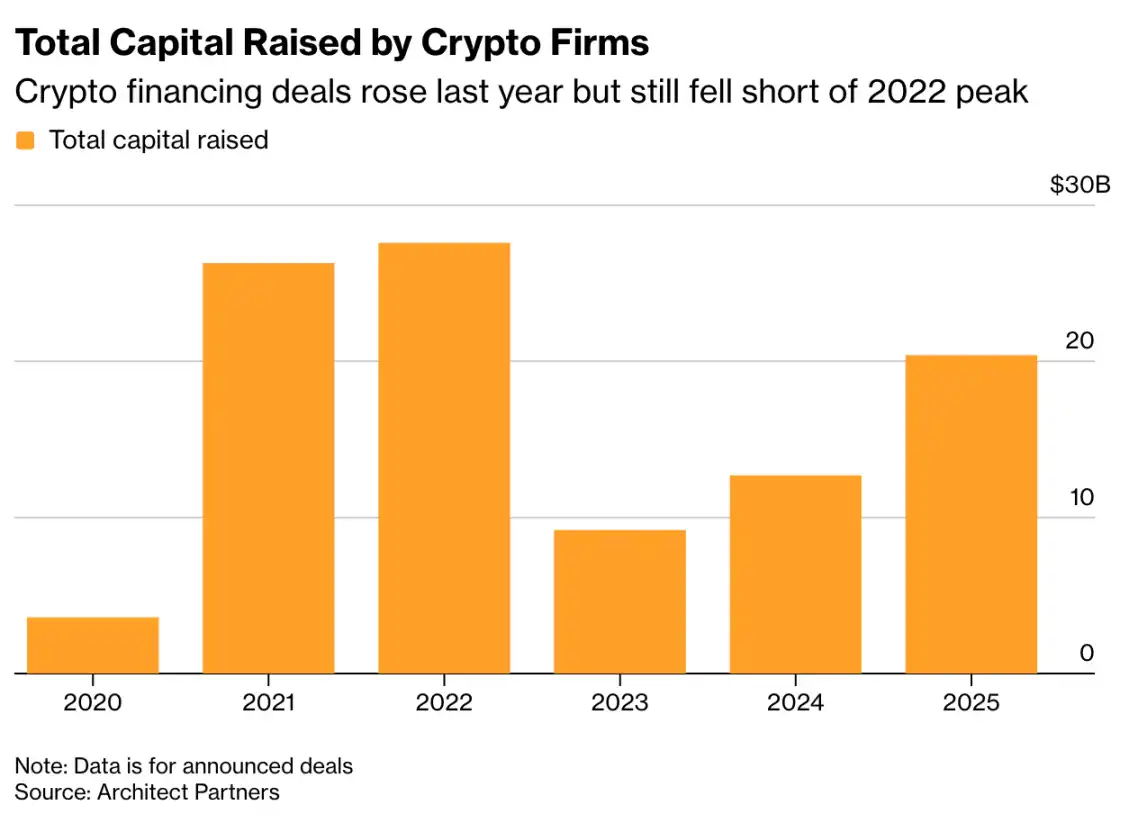
Total Financing for Cryptocurrency Companies: The number of crypto financing deals rose last year but still hasn't reached the 2022 peak

Currently, the two areas with the most concentrated private funding are "Investment & Trading Infrastructure" and "Brokers & Exchanges," both financial application businesses. Payment infrastructure firmly holds third place. In stark contrast, the blockchain gaming sector, which was once at the core of the Web3 and NFT frenzy, saw its financing drop from $3.76 billion in 2022 (about 14% of total financing) to the point where it was no longer listed as a separate category in 2025.

In fact, various types of decentralized applications (Web3 functional layer) collectively raised $5.2 billion in 2022; in the 2025 report, only the consumer DApp category remained, with financing of just $864 million.
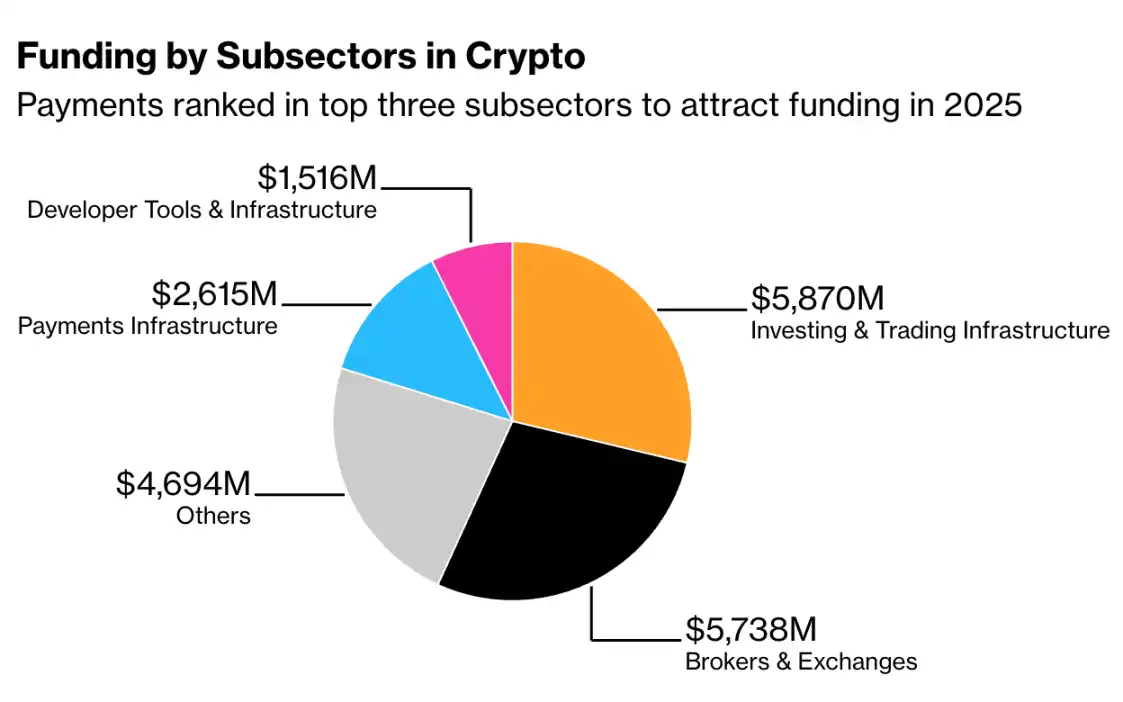
Financing by Cryptocurrency Subsector: Payments跻身 among the top three sub-sectors attracting financing in 2025

Stablecoins are building more robust financial infrastructure for blockchain. These tokens are typically pegged 1:1 to the US dollar, with their value tied to underlying assets. Driven by the Trump administration's pro-crypto policies, market enthusiasm for stablecoins reached unprecedented heights last year.

According to Artemis Analytics data, the total transaction volume of stablecoins surged 72% in 2025, reaching $33 trillion. The two largest stablecoins by size are currently Tether's USDT and Circle's USDC.

Circle's stock price recorded its largest-ever drop on Tuesday as investors assessed potential adjustments to U.S. stablecoin regulations and the impact of intensifying industry competition. But the core appeal of stablecoins remains clear: transferring funds as efficiently as possible.

Cross-border payments remain slow, costly, and capital-intensive. Despite years of fintech development, cross-border transfers still heavily rely on prefunded accounts in different jurisdictions.

"Stablecoins have completely changed this landscape," said Prajit Nanu, co-founder and CEO of cross-border payments company Nium. "They enable value to move globally in real-time without the same level of capital efficiency drain, which is why investors see them as the core infrastructure for the next generation of payments."

This industry still has powerful "gatekeepers." Large payment networks like Visa and Mastercard control access to payment terminals. Eric F. Risley, founder and managing partner of Architect Partners, wrote in the report that the channel distribution issue "is a major concern for every stablecoin and related payment company."
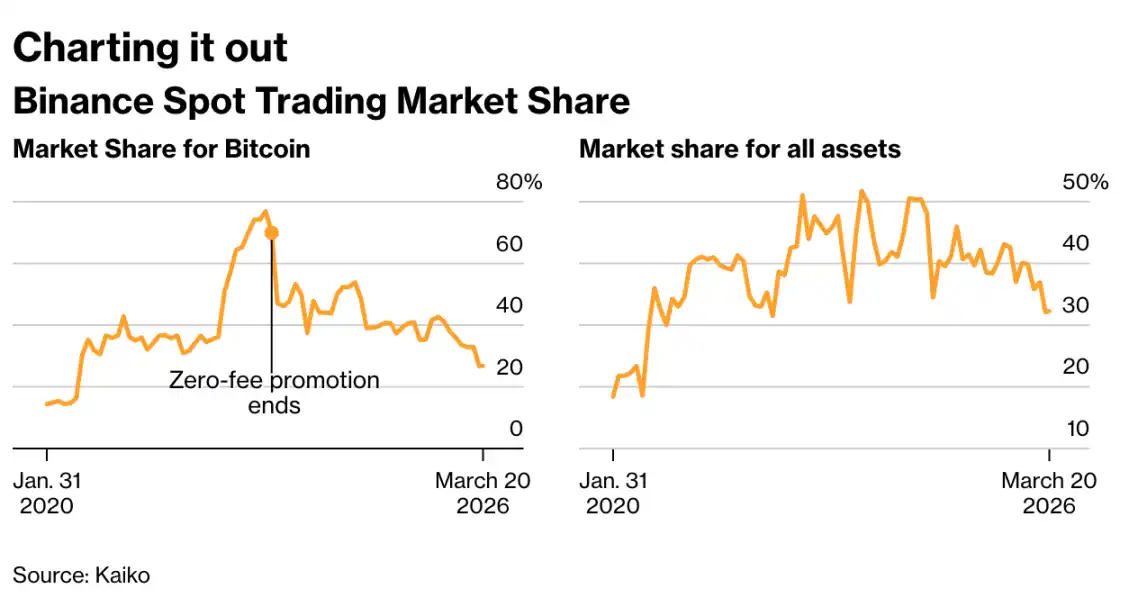
Binance Spot Trading Market Share Trend Chart

As of February this year, Binance's share of Bitcoin spot trading had fallen to 27% (this data varies slightly depending on the statistical method), and its share of all cryptocurrency trading fell from 52% to 32%. Its most profitable derivatives business also saw a significant decline, dropping to 34%.

Franklin Templeton partnered with Ondo Finance to launch an ETF tokenization product, tradable via crypto wallets 24/7, bypassing the broker accounts and limited trading hours that fund investments have relied on for decades.

Industry Voices

"The irony of holding this event in Las Vegas right now is just palpable," said Ben Johnson, Head of Client Solutions at Morningstar, stating bluntly that this industry has "completely crossed the line between investing and gambling, with no room for turning back."

ETFs, originally created to simplify investing, have now become a vehicle for the newest form of financial gambling in the U.S. Bloomberg Intelligence data shows that 36% of the 1,000 new funds launched last year were leveraged products or crypto-related funds.


Perguntas relacionadas

QWhat is the main shift in focus for crypto venture capital investments according to the article?

AThe main shift is from utopian narratives like Web3 and NFTs towards financial infrastructure, particularly stablecoin payments and related services.

QWhich specific area within crypto has seen as a 'breakthrough application' with real-world adoption?

AStablecoins are identified as a breakthrough application that has gained significant real-world adoption, especially in payment infrastructure.

QHow much did funding for crypto payment companies reach in 2025, and how does it compare to previous years?

AFunding for crypto payment companies reached $2.6 billion in 2025, which exceeded the total of the previous three years combined.

QWhat major acquisition is mentioned as a signal of traditional financial institutions' interest in stablecoin payments?

AMastercard's acquisition of BVNK for $1.8 billion is highlighted as a key signal of traditional financial institutions' growing interest in stablecoin payments.

QWhat problem do stablecoins primarily solve in the global financial system, as per the article?

AStablecoins solve the problem of slow, costly, and capital-intensive cross-border payments by enabling real-time global value transfer with greater efficiency.

Leituras Relacionadas

Must-Watch Events Next Week|CLARITY Act Could Face Senate Vote; SpaceX, Circle to Report Earnings (8.3-8.9)

**Summary: Key Events and Developments to Watch (August 3-9)** The upcoming week is marked by significant financial disclosures, key legislative deadlines, and notable product updates. **Major Financial Events:** Several companies are scheduled to release their Q2 2026 earnings. American Bitcoin (ABTC) will report on August 3, followed by SpaceX and Hut 8 Mining Corp. on August 4, and Circle on August 5. Notably, a significant portion of SpaceX shares (up to 12% of total shares) will be unlocked on August 6 following their earnings release. **Key Legislative Deadline:** The U.S. Senate faces an August 7 deadline to secure 60 votes for the CLARITY Act, a bipartisan bill aiming to establish a federal regulatory framework for cryptocurrencies. The Senate may hold a full vote on the bill during the week. **Economic Data:** The U.S. July Non-Farm Payrolls report will be released on August 7, providing crucial labor market data. **Technology & Product Updates:** * **Shutdowns:** DeFi portfolio tracker Zapper and wallet app Ctrl Wallet will cease operations on August 3. * **Upgrades:** LayerZero will deprecate its v1 relayers on August 3. XRP Ledger's new version 3.3.0, featuring five new functions, is expected next week. * **AI:** Elon Musk announced that the advanced Grok 4.6 AI model is set for release around August 7. * **Bitcoin:** The BIP-110 forced signaling for a potential Bitcoin network change is scheduled to begin around August 8. **Other Notable Events:** Chinese robotics firm Unitree Tech has set its preliminary price inquiry for its IPO for August 5. South Korean exchange Upbit will delist AQT and AERGO tokens on August 3.

marsbitHá 1h

Must-Watch Events Next Week|CLARITY Act Could Face Senate Vote; SpaceX, Circle to Report Earnings (8.3-8.9)

marsbitHá 1h

Stocks Are Plummeting More Sharply Than Cryptocurrencies. Where Has the Money Gone?

Stock Markets Plunge Deeper Than Cryptocurrencies: Where Did the Money Go? In late July, Seoul's Kospi index triggered circuit breakers for two consecutive days, plummeting over 40% from its June high. The collapse was led by heavyweight stocks like SK Hynix, whose record profits still disappointed investors, and devastating leveraged ETFs, with one major product losing over 83% of its value. This signaled a global, forced deleveraging targeting the most crowded trades. Interestingly, while stocks exhibited extreme volatility akin to crypto markets, Bitcoin rose nearly 15% in July after a prior steep drop. Analysis shows the money fleeing equities did not flow into Bitcoin. Instead, Bitcoin had already absorbed its sell-off in May-June, when U.S. spot Bitcoin ETFs saw historic outflows. The true safe-haven beneficiary was gold, whose price rose over 20% year-on-year, highlighting a decoupling between Bitcoin and gold as "digital gold." The sell-off was a targeted unwinding of leveraged positions in tech and semiconductors, accelerated by broker-dealer risk management and shifts in the AI narrative, including new competition from Chinese memory chipmakers. The retreat path was clear: from high-valuation tech stocks to cash and U.S. Treasuries, then to gold. For Bitcoin to attract sustained institutional inflows, conditions like eased global liquidity pressure, a "soft-landing" Fed rate cut, and U.S. regulatory clarity via legislation like the stalled CLARITY Act are needed. Currently, Bitcoin is not a safe haven but an already-cleared asset. Its low correlation with tech stocks, however, makes it a potential diversification play for institutional portfolios once the storm passes. The money isn't here yet, but the positioning is underway.

marsbitHá 1h

Stocks Are Plummeting More Sharply Than Cryptocurrencies. Where Has the Money Gone?

marsbitHá 1h

In Conversation with Ray Dalio: We Are Currently in an AI Bubble, with 1% of My Portfolio in Bitcoin

Ray Dalio, founder of Bridgewater Associates, warns in an interview that the current AI boom shows classic bubble characteristics, which could lead to significant economic downturns as seen in past cycles like 1929 or 2000. He explains that speculative enthusiasm, fueled by debt and overvaluation, often precedes a crash when rising rates or taxation force asset sales, causing widespread losses and recession. Dalio also outlines his "Big Cycle" theory, describing an approximate 80-year pattern where widening wealth gaps, massive government deficits, and shifting geopolitical power (like China's rise) create internal conflict and global instability. He emphasizes that we are in a late-cycle, transitional phase where traditional powers like the US and UK face decline. For personal wealth protection, Dalio advises diversification beyond cash into assets like stocks, bonds, real estate, and particularly gold, which he prefers over Bitcoin. While he holds about 1% of his portfolio in Bitcoin as a non-printable hard asset, he views gold as more secure from technological or governmental threats. Regarding AI's impact, Dalio believes it will disproportionately benefit capital owners, worsening inequality by replacing both physical and cognitive labor. He suggests that human intuition and emotional intelligence, combined with AI, will be key for future workers. On taxation, Dalio argues that wealth taxes are impractical and risk triggering asset sell-offs, reducing productive investment. He points to the UK as a cautionary example of debt, low productivity, and political strife. Geopolitically, Dalio foresees a more regionalized world, with the US showing weakness in prolonged conflicts like with Iran, akin to past imperial declines. The ideal outcome, he suggests, is coexisting powerful blocs (e.g., Americas, China-Asia Pacific) without major war.

marsbitHá 5h

In Conversation with Ray Dalio: We Are Currently in an AI Bubble, with 1% of My Portfolio in Bitcoin

marsbitHá 5h

Trading

Spot
活动图片




