From Utopian Narratives to Financial Infrastructure: The 'Disenchantment' and Pivot of Crypto VC

marsbitPublicado em 2026-03-30Última atualização em 2026-03-30

Resumo

From Utopian Narratives to Financial Infrastructure: The Disenchantment and Pivot of Crypto VC The crypto industry, once championing "blockchain, not Bitcoin" and a broad Web3 vision, is now seeing venture capital flow overwhelmingly into pragmatic financial applications, particularly stablecoin payments. Following the decline of the Web3 and NFT boom in the early 2020s, investment has cooled for many sectors but surged for payment infrastructure. Key signals include Stripe's $1.1 billion acquisition of Bridge and Mastercard's $1.8 billion purchase of BVNK. Data from Architect Partners shows funding for crypto payment companies skyrocketed to $2.6 billion in 2025, exceeding the total of the previous three years combined. In contrast, funding for decentralized applications (DApps) and blockchain gaming has collapsed. The total private crypto funding reached $20.4 billion in 2025, still below the 2022 peak of $27.6 billion. Stablecoins, like USDT and USDC, are now seen as a breakthrough application, with their annual transaction volume soaring 72% to $33 trillion in 2025. Their core appeal is enabling efficient, real-time global value transfer, solving long-standing issues of cost and speed in cross-border payments. However, the industry faces significant challenges from established "gatekeepers" like Visa and Mastercard, which control terminal access. The piece also notes the declining market share of Binance and the emergence of new products like Franklin Templeton's toke...

Written by: Suvashree Ghosh, Matt Haldane

Compiled by: Saoirse, Foresight News

Not long ago, the crypto industry was chanting the slogan "blockchain, not Bitcoin," claiming that distributed ledger technology would go beyond financial applications and completely reshape the internet. However, recent financing trends indicate that in the real world, cash is still king.

Since the Web3 and NFT craze subsided in the early 2020s, investment enthusiasm in the crypto industry has noticeably cooled. But one niche has bucked the trend, attracting increasing venture capital—stablecoin payments.

Stripe's acquisition of Bridge for $1.1 billion last year was an early signal of traditional financial institutions beginning to lay out stablecoin payments. Since then, a batch of startups including ARQ, KAST, and RedotPay have successively secured new funding to build cross-border payment channels and stablecoin-based financial services. Mastercard's acquisition of BVNK for $1.8 billion last week further confirms the market's strong interest in this sector.

"Startups related to stablecoins are almost the hottest area for venture capital financing right now," said Rob Hadick, General Partner at Dragonfly Capital. "Stablecoins have broken away from the entire crypto industry to become one of the few truly breakthrough applications with widespread real-world adoption."

According to data from Architect Partners, which specializes in annual crypto financing reports, the total financing for crypto payment companies soared to $2.6 billion in 2025, exceeding the sum of the previous three years. Driven by Mastercard's acquisition of BVNK, this number is expected to continue climbing this year.
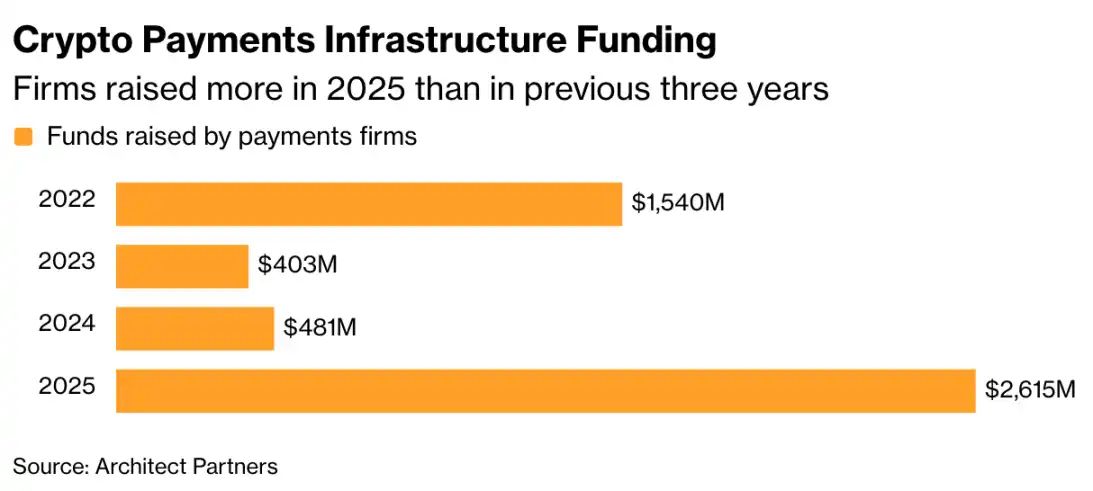
Crypto Payment Infrastructure Financing: 2025 company financing exceeded the sum of the previous three years

Meanwhile, overall private financing in the crypto industry increased from nearly $13 billion in 2024 to $20.4 billion in 2025, but still fell short of the 2022 peak of $27.6 billion.
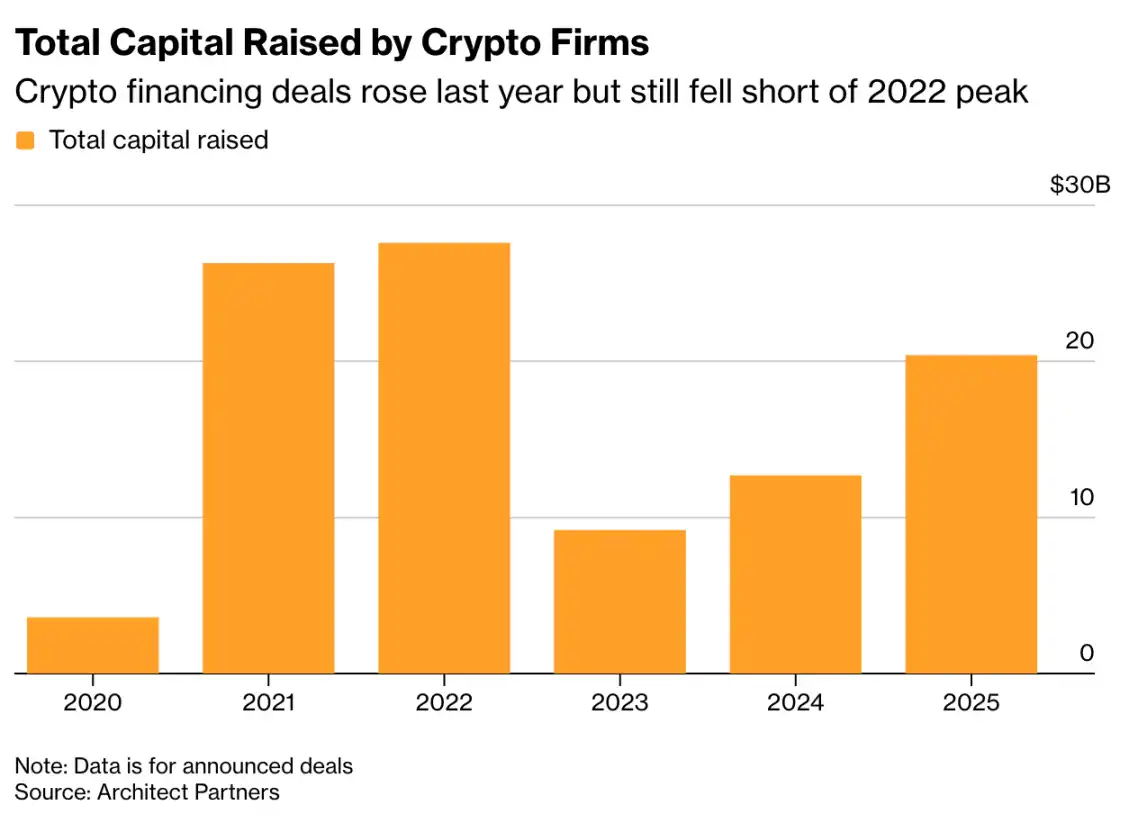
Total Financing for Cryptocurrency Companies: The number of crypto financing deals rose last year but still hasn't reached the 2022 peak

Currently, the two areas with the most concentrated private funding are "Investment & Trading Infrastructure" and "Brokers & Exchanges," both financial application businesses. Payment infrastructure firmly holds third place. In stark contrast, the blockchain gaming sector, which was once at the core of the Web3 and NFT frenzy, saw its financing drop from $3.76 billion in 2022 (about 14% of total financing) to the point where it was no longer listed as a separate category in 2025.

In fact, various types of decentralized applications (Web3 functional layer) collectively raised $5.2 billion in 2022; in the 2025 report, only the consumer DApp category remained, with financing of just $864 million.
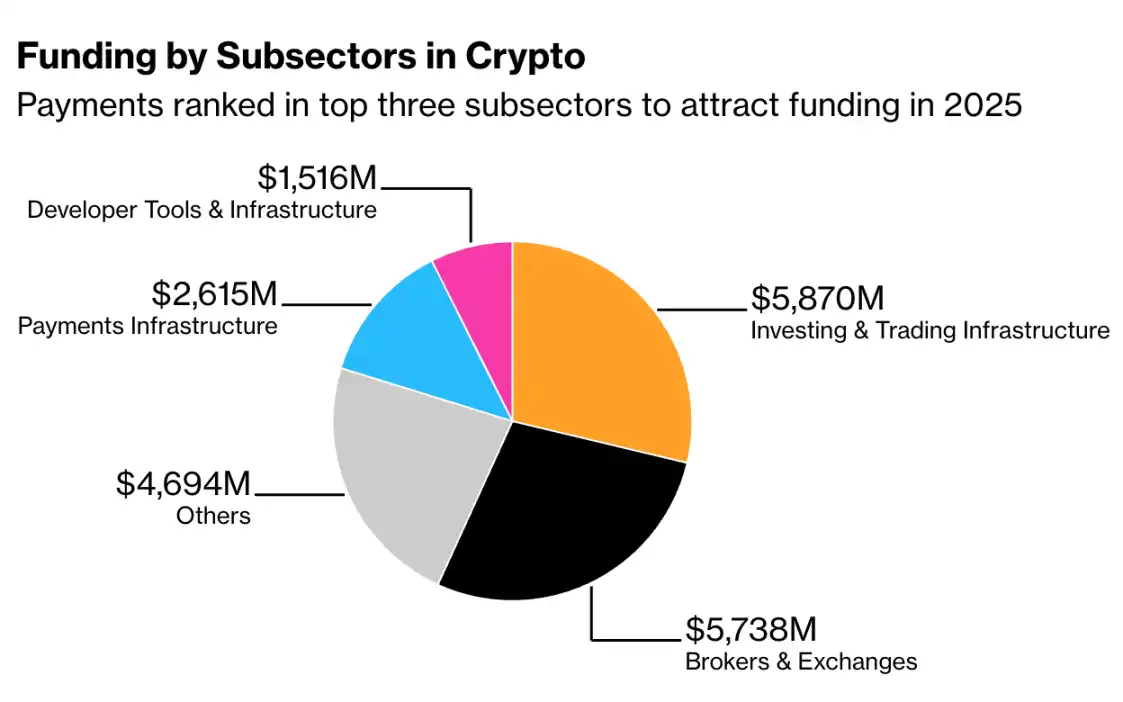
Financing by Cryptocurrency Subsector: Payments跻身 among the top three sub-sectors attracting financing in 2025

Stablecoins are building more robust financial infrastructure for blockchain. These tokens are typically pegged 1:1 to the US dollar, with their value tied to underlying assets. Driven by the Trump administration's pro-crypto policies, market enthusiasm for stablecoins reached unprecedented heights last year.

According to Artemis Analytics data, the total transaction volume of stablecoins surged 72% in 2025, reaching $33 trillion. The two largest stablecoins by size are currently Tether's USDT and Circle's USDC.

Circle's stock price recorded its largest-ever drop on Tuesday as investors assessed potential adjustments to U.S. stablecoin regulations and the impact of intensifying industry competition. But the core appeal of stablecoins remains clear: transferring funds as efficiently as possible.

Cross-border payments remain slow, costly, and capital-intensive. Despite years of fintech development, cross-border transfers still heavily rely on prefunded accounts in different jurisdictions.

"Stablecoins have completely changed this landscape," said Prajit Nanu, co-founder and CEO of cross-border payments company Nium. "They enable value to move globally in real-time without the same level of capital efficiency drain, which is why investors see them as the core infrastructure for the next generation of payments."

This industry still has powerful "gatekeepers." Large payment networks like Visa and Mastercard control access to payment terminals. Eric F. Risley, founder and managing partner of Architect Partners, wrote in the report that the channel distribution issue "is a major concern for every stablecoin and related payment company."
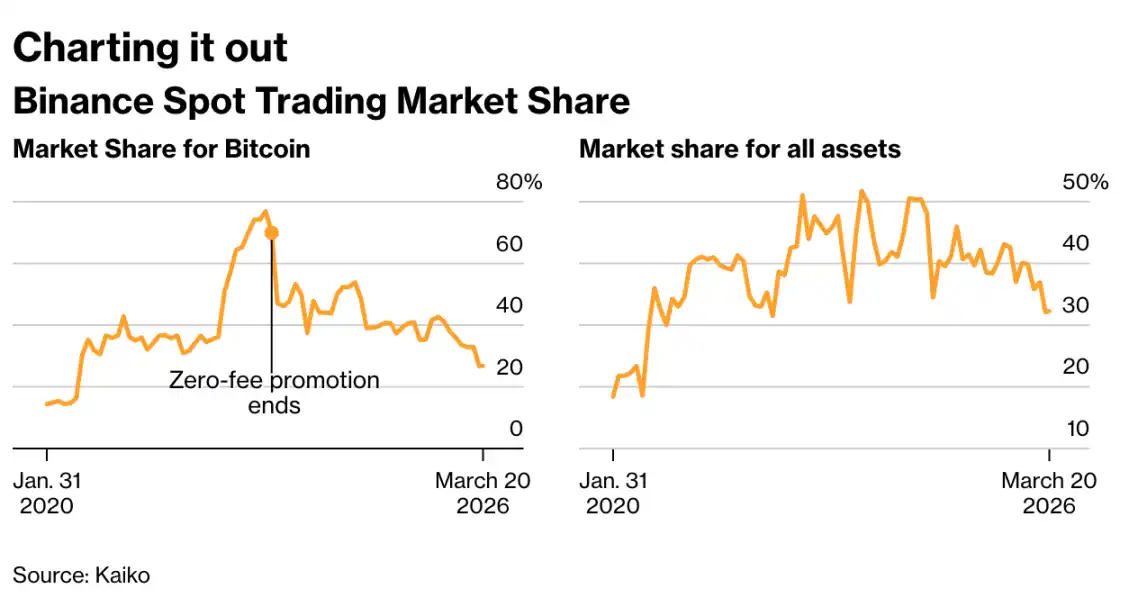
Binance Spot Trading Market Share Trend Chart

As of February this year, Binance's share of Bitcoin spot trading had fallen to 27% (this data varies slightly depending on the statistical method), and its share of all cryptocurrency trading fell from 52% to 32%. Its most profitable derivatives business also saw a significant decline, dropping to 34%.

Franklin Templeton partnered with Ondo Finance to launch an ETF tokenization product, tradable via crypto wallets 24/7, bypassing the broker accounts and limited trading hours that fund investments have relied on for decades.

Industry Voices

"The irony of holding this event in Las Vegas right now is just palpable," said Ben Johnson, Head of Client Solutions at Morningstar, stating bluntly that this industry has "completely crossed the line between investing and gambling, with no room for turning back."

ETFs, originally created to simplify investing, have now become a vehicle for the newest form of financial gambling in the U.S. Bloomberg Intelligence data shows that 36% of the 1,000 new funds launched last year were leveraged products or crypto-related funds.


Perguntas relacionadas

QWhat is the main shift in focus for crypto venture capital investments according to the article?

AThe main shift is from utopian narratives like Web3 and NFTs towards financial infrastructure, particularly stablecoin payments and related services.

QWhich specific area within crypto has seen as a 'breakthrough application' with real-world adoption?

AStablecoins are identified as a breakthrough application that has gained significant real-world adoption, especially in payment infrastructure.

QHow much did funding for crypto payment companies reach in 2025, and how does it compare to previous years?

AFunding for crypto payment companies reached $2.6 billion in 2025, which exceeded the total of the previous three years combined.

QWhat major acquisition is mentioned as a signal of traditional financial institutions' interest in stablecoin payments?

AMastercard's acquisition of BVNK for $1.8 billion is highlighted as a key signal of traditional financial institutions' growing interest in stablecoin payments.

QWhat problem do stablecoins primarily solve in the global financial system, as per the article?

AStablecoins solve the problem of slow, costly, and capital-intensive cross-border payments by enabling real-time global value transfer with greater efficiency.

Leituras Relacionadas

AAOI Defies Trend with Over 10% Surge, 'New Stock God' Serenity Predicts Potential to Double Again

On June 4th, despite a significant sell-off in the broader AI and semiconductor sector triggered by Broadcom's disappointing guidance, Applied Optoelectronics (AAOI) surged over 11%, showcasing a sharp divergence in market sentiment. Broadcom's warning about potential supply chain diversification by key customer Google and a weaker-than-expected outlook punctured the high-flying AI valuation narrative. This led to heavy selling in names like Broadcom (-12.6%) and Micron (-7%), with funds rotating into traditional industrial stocks. AAOI defied this trend. The stock has experienced high volatility recently, driven by bullish analyst coverage, notably from Rosenblatt which raised its price target to $220. Key catalysts include initial 800G optical module revenue from Amazon, potential certification from Oracle, and strong demand across its product portfolio. The company has reported cumulative orders for 800G/1.6T modules exceeding $324 million and is aggressively expanding manufacturing capacity in Texas, targeting an annualized run-rate of $1.4 billion for its module business by Q3 2027. However, AAOI's fundamentals present a mixed picture. Its Q1 2026 results missed expectations, showing a GAAP net loss, and Q2 guidance points to merely breakeven adjusted EPS. Risks include a delayed 800G production ramp to the second half of the year and high dependence on a few key cloud customers. Recent stock sales by company executives near price highs also noted. The article suggests AAOI's rally reflects a market beginning to differentiate within the AI ecosystem. While Broadcom's issues prompted a reassessment of custom ASIC and customer concentration risks, funds flowing into AAOI indicate a belief that the "physical bottleneck" narrative for optical connectivity—where supply remains tight—remains intact and is somewhat decoupled from the current sector weakness. The sustainability of AAOI's premium valuation now hinges on the successful execution of its production plans and upcoming quarterly results.

marsbitHá 7m

AAOI Defies Trend with Over 10% Surge, 'New Stock God' Serenity Predicts Potential to Double Again

marsbitHá 7m

Worried about AI's Self-Evolution, Anthropic Intends to Stop Training?

In early 2026, Anthropic signaled a significant shift in its public narrative regarding AI development timelines and safety. In June, its Anthropic Institute published a detailed article, "When AI builds itself," presenting internal data suggesting accelerating AI self-improvement. Key figures included over 80% of merged code being written by Claude and a 52x speedup in certain optimization tasks. The article outlined three future scenarios, with the most speculative being full recursive self-improvement (RSI), where AI autonomously builds better successors. Anthropic stated RSI is "possible" and may arrive faster than most institutions are prepared for. This narrative pivot followed a series of strategic moves. In January, CEO Dario Amodei wrote about a powerful self-improvement feedback loop. In February, Anthropic revised its Responsible Scaling Policy, removing a core commitment to pause training if capabilities outstripped safety controls, citing the risk of falling behind competitors. This change coincided with reported pressure from the US Department of Defense. By May, Anthropic's valuation had soared to $965 billion. Anthropic's stance was mirrored by other industry leaders. DeepMind CEO Demis Hassabis adjusted his AGI timeline to "by 2029" and admitted to using provocative language like "foothills of the singularity" to create urgency. OpenAI also released a model claiming a key role in its own creation process. The article's carefully calibrated tone—presenting dramatic data alongside qualifying footnotes—exemplifies a balancing act between signaling technological acceleration and managing commercial, regulatory, and safety imperatives. External experts offered contrasting interpretations of the same data, from warnings of catastrophic risk akin to Chernobyl to skepticism that current automation merely handles "grunt work," not genius. The coordinated narrative shift among top labs highlights the complex interplay between perceived technical inflection points and strategic communication aimed at investors, regulators, and the public.

marsbitHá 9m

Worried about AI's Self-Evolution, Anthropic Intends to Stop Training?

marsbitHá 9m

The Macroeconomic Underpinnings of Africa's Payment Market Landscape

The African payments market, characterized by the world's highest mobile money penetration and fastest-growing cryptocurrency adoption, is not a coincidence but a macroeconomic necessity driven by deep structural factors. Two key drivers create this landscape: (1) Africa's heavy reliance on commodity exports, trade, and remittances, generating massive cross-border settlement and remittance demand; and (2) chronically underdeveloped financial infrastructure, exacerbated by international bank de-risking, foreign exchange mismanagement, and persistent inflation. This vacuum has allowed mobile money and crypto to thrive. Mobile money platforms replace banks for domestic payments, while cryptocurrencies serve as a store of value against local currency depreciation and a low-cost medium for cross-border exchange. A crucial division lies along the Sahara Desert. North Africa is integrated into the oil-anchored MENA framework, while Sub-Saharan Africa (SSA), plagued by dollar shortages and fragmented currencies, has become a natural, massive market for mobile money and crypto. Nigeria, Kenya, and South Africa are global leaders in adoption. The SSA economy is deeply dollarized due to currency instability, yet suffers from a severe "dollar shortage" caused by trade deficits and limited export capacity. This creates parallel forex markets and high remittance costs. Cryptocurrencies, particularly stablecoins, fill this gap by providing access to dollar liquidity, cheaper cross-border transfers, and an inflation-resistant store of value, primarily driven by retail users for small-value transactions. While regional initiatives like PAPSS aim to reduce dollar dependence, the fundamental constraints of commodity reliance, trade imbalances, and shallow financial markets persist. Therefore, mobile money and cryptocurrencies are not niche trends but essential financial infrastructure filling a structural void, and they are likely to remain central to Africa's economic landscape for the foreseeable future.

链捕手Há 19m

The Macroeconomic Underpinnings of Africa's Payment Market Landscape

链捕手Há 19m

Trading

Spot
Futuros
活动图片




