From Speculation to Risk Management: Predictive Markets Are Filling the Gap in Commercial Insurance

marsbitPublicado em 2026-08-17Última atualização em 2026-08-17

Resumo

From Speculation to Risk Management: Predictive Markets Filling the Commercial Insurance Gap The emergence of AI risk management tools like Blanket is exploring the potential of predictive markets as a genuine insurance tool for businesses. These markets, with their simple contract structure—paying $1 if an event occurs, $0 if not—allow the real-time market price to reflect collective probability assessments. Businesses can use them to hedge against operational risks (e.g., abnormal weather, energy price fluctuations) that are often not covered by traditional business interruption insurance, which typically requires physical damage. A key question is whether these markets are genuinely used for hedging or remain primarily speculative. Analysis of Kalshi markets from August 2025 to August 2026 compared weather contracts (a potential hedge instrument) against sports contracts (largely speculative) and traditional CME grain futures. Three behavioral metrics were examined: 1. **Daily Turnover Rate:** Weather contracts showed the lowest rate (0.210), lower than corn futures (0.266) and significantly lower than sports contracts (0.315), suggesting longer holding periods. 2. **Hold-to-Expiry Ratio:** Weather contracts had a much higher ratio (over 0.5) compared to near-zero ratios for sports contracts, indicating a stronger tendency to hold positions until settlement, consistent with hedging behavior. 3. **Position Buildup Timing:** Weather market positions reached 50% of their...

Written by: G_Gyeomm

Compiled by: AIdidiaoJP, Foresight News

I. A New Type of Insurance Directly Priced by the Market

The recently launched AI risk management tool Blanket is attempting to turn predictive markets into a genuine insurance tool usable by businesses. The logic is straightforward: a business inputs its operational information, the system automatically diagnoses its main risk exposures, and then recommends corresponding Kalshi event contracts to help the business hedge against these risks.

The hedging mechanism itself is not complex. The contract structure of a predictive market is extremely clear — it pays $1 if an event occurs and $0 if it doesn't. The contract's real-time price represents the market's collective judgment on the probability of that event occurring.

It is precisely this simple structure that gives predictive markets the potential to become real hedging tools. Businesses can preemptively purchase contracts for events that could impact their operations, such as abnormal weather, energy price volatility, or tariff policy changes. If these risks materialize, the contract payouts can partially or fully offset the operational losses.

A specific example: an ice cream shop that would lose about $20,000 in revenue if the summer is unusually cool.

The hedging operation is as follows: buy 20,000 temperature contracts at $0.30 each. If the average summer temperature falls below a preset threshold, each contract pays out $1. The total cost is $6,000.

There are only two possible outcomes:

  • Cool Summer: The temperature is below the threshold, revenue is down $20,000, but the contracts pay out $20,000 in total. The net loss is locked at $6,000 — exactly the initial cost of buying the contracts.
  • Hot Summer: The temperature is above the threshold, revenue is unaffected, but the contracts expire worthless, and the $6,000 cost is completely lost.

Regardless of the outcome, the final loss is firmly locked at $6,000. This $6,000 is essentially the insurance premium. And the rate for this premium is not set by an insurance company's actuary or any traditional underwriting institution, but by the market itself — the price quoted in real-time by countless buyers and sellers with real money.

II. Is the Hedging Market Really Functioning?

Predictive markets have already accumulated enough speculative demand. They first gained fame through election predictions, then smoothly expanded into the sports arena, largely solving the volume problem. The industry generally believes the next growth space lies in expanding more practical use cases, with hedging needs repeatedly mentioned as one of the most promising directions.

In principle, its value is indeed significant. The gaps not covered by existing hedging tools are quite broad. Traditional business interruption insurance in commercial insurance typically requires physical damage as a precondition. A ski shop losing revenue because there was hardly any snow all winter — this kind of pure "operational risk" — is almost impossible to find suitable insurance products to cover on the market.

There are mature hedging tools in the futures market, but the barriers are high: requiring an ISDA agreement, opening a specialized futures account, posting margin, and minimum contract size limits. These are not issues for large institutions, but are almost unattainable for ordinary small and medium-sized enterprises. Goldman Sachs can maintain a professional derivatives trading team, but the cafe on the corner obviously cannot.

The problem is, there has always been a clear chasm between theoretical rationality and actual use. Predictive markets have long carried the label of "gambling," and whether they can truly operate as an independent hedging market — rather than just a speculative tool — has never been systematically verified.

The real question that needs answering is: Are predictive markets actually being used for hedging? Does real hedging demand exist? Trading behavior itself can provide clues. We selected three sets of data for comparison.

The first set is CME grain futures — a typical traditional hedging market, primarily used to mitigate losses from price fluctuations in agricultural and livestock products.

The second set is the Kalshi sports market — where hedging demand is extremely limited, and trading is almost entirely driven by speculation.

The third set is the Kalshi weather market — it handles weather risk in a manner similar to CME weather futures, while sharing the exact same event contract structure and trading environment with the Kalshi sports market. This makes it an excellent test sample — to see which side its trading behavior is closer to.

Hedging and speculation typically exhibit different trading characteristics. Hedgers tend to establish positions well before the actual risk window arrives and hold them until expiration; speculators move in and out more frequently, chasing prices, with noticeably higher turnover rates.

If the Kalshi weather market's turnover rate and holding behavior are closer to traditional hedging markets than to the sports market, then hedging demand is real.

Conversely, if it's not much different from the sports market, then actual usage is closer to pure speculation. In that case, tools like Blanket might be responding to a nice industry hypothesis, not a real demand confirmed by data.

The dataset for this analysis covers 1,265 Kalshi markets settled between August 2025 and August 2026. The screening criteria were: cumulative trading volume of at least 500 contracts, and trading lasting at least three days.

III. Data Point 1: Average Daily Turnover Rate

First, look at how frequently positions are traded in each market. Turnover rate is defined as daily trading volume divided by open interest (OI) for that day. We calculated the daily turnover rate for each contract in each market and then took the median for the entire trading cycle.

The results are clear: Kalshi weather contracts have the lowest turnover rate, only 0.210. The traditional hedging product corn futures is 0.266, and Kalshi sports contracts are the highest at 0.315.
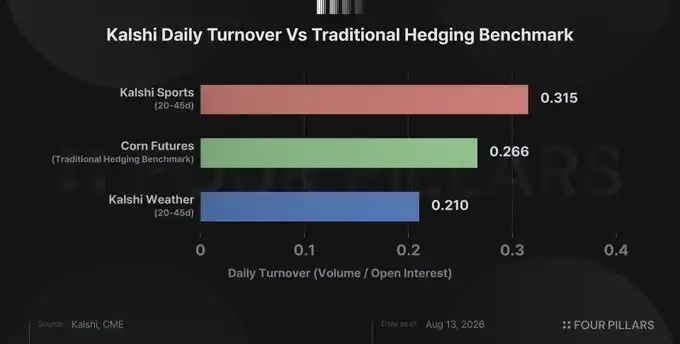
Sports contracts turn over about 1.5 times faster than weather contracts. This indicates a relatively longer holding tendency for weather contracts, initially suggesting the possible existence of real hedging demand.

However, a caveat: Corn futures' turnover rate sits in the middle, and the differences among the three data sets are not particularly stark. Based on turnover rate alone, we cannot fully confirm the existence of hedging demand in the weather market. What this data can definitively tell us so far is only that weather contract turnover is significantly lower than sports contract turnover.

IV. Data Point 2: Hold-to-Expiration Ratio

The second key metric is the hold-to-expiration ratio — measuring how many positions remain untouched in the market at settlement. It is calculated as the final open interest for each contract divided by the cumulative trading volume. A higher value indicates more positions were firmly held until the expiration date.
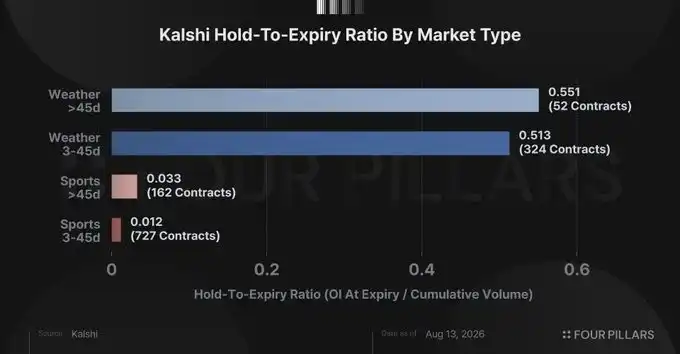
The difference in results is very striking: regardless of trading duration, the hold-to-expiration ratio for weather contracts exceeds 0.5. In contrast, sports contracts are only 0.012 and 0.033 respectively. In the 3 to 45-day trading interval, weather is 42.8 times that of sports; in the over 45-day interval, the gap is still 16.7 times.

This clearly shows: Weather contracts are far more inclined to "buy and hold" than sports contracts. Hedgers hold contracts to receive payouts if the risk materializes, not to chase price differences. Therefore, a high hold-to-expiration ratio strongly supports the judgment that there is real hedging demand in the weather market.

Of course, this cannot be directly interpreted as the entire weather market being used for hedging. This data does not track the identities of individual position buyers and sellers, so it cannot be simply equated with the proportion of original buyers holding to expiration. What can be confirmed at present is that the holding behavior of weather contracts is distinctly different from that of sports contracts.

V. Data Point 3: When Were Positions Established?

The final question is: When were these positions established? We divided the daily open interest for each contract by that contract's peak open interest, converted the time from launch to expiration into a progress bar from 0% to 100%, and then plotted the median curve.

The criterion for judgment is the point at which half of the peak open interest is reached. If half is reached when there is still more time until expiration, it means positions were built earlier — which is more in line with the behavior pattern of hedgers.
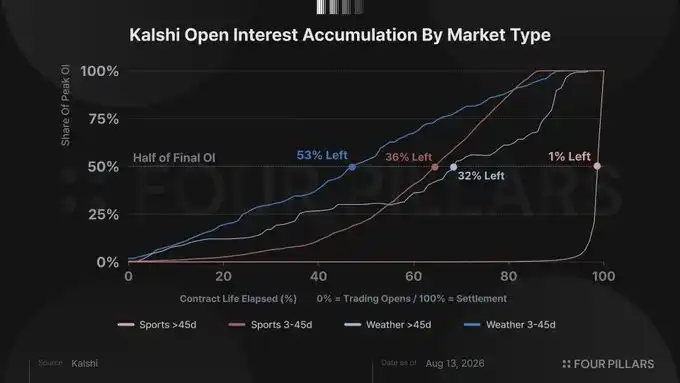
For weather contracts trading for 3 to 45 days, they had already reached half their peak open interest when their lifecycle was at 47%, leaving 53% of the time until expiration. Sports contracts in the same interval didn't reach half until 65%, with only 36% of the time remaining.

For contracts over 45 days, the difference is even more astonishing. Weather contracts reached half when there was still 32% until expiration, while sports contracts had only 1.3% left. Regardless of the interval, weather positions were established much earlier than sports positions.
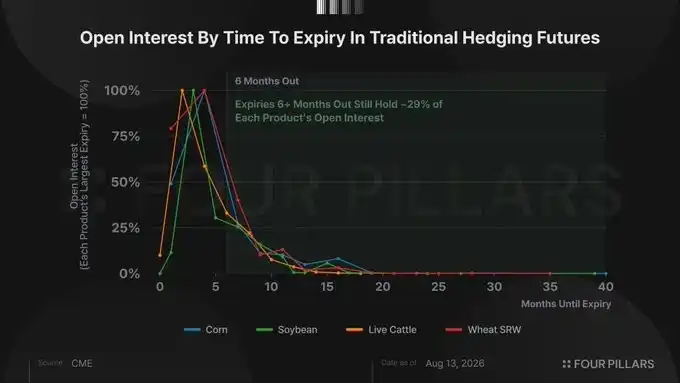
This behavior of "early positioning" is precisely a typical characteristic of traditional hedging markets. As of August 11, 2026, CME grain and livestock futures contracts expiring in six months had already accumulated massive open interest. Corn futures even held 65,127 positions on contracts expiring 16 months later.

This reflects the tendency to act well before the risk actually materializes. And the behavioral pattern of Kalshi weather contracts is clearly closer to traditional hedging markets than to sports markets.

VI. Hedging Relies on Liquidity Built by Speculation

Conclusion first: The Kalshi weather market is neither a purely hedging market nor a purely speculative one like sports. Speculative demand still contributes a significant portion of the liquidity, but on top of that, hedging demand has also emerged relatively clearly.

The three indicators point in the same direction: weather contracts trade less frequently, retain more positions at settlement, and positions are established earlier. No single indicator can confirm trading intent with 100% certainty, but the high consistency of these behaviors collectively supports a judgment — there indeed exists a holding demand in the Kalshi weather market distinct from sports, and a considerable part of it is likely real hedging demand.

More importantly, speculative demand is not so much a weakness of predictive markets as it is a prerequisite for the hedging function to exist. A market with only hedgers and no speculators would struggle to find sufficient counterparties and continuous liquidity.

In predictive markets, speculators are responsible for pricing and providing liquidity, while hedgers transfer the risks they do not wish to bear on this foundation. The risk is no longer directly underwritten by an insurance company but is naturally dispersed among market participants through trading.

Therefore, the next phase of growth for predictive markets is not about "squeezing out" speculation and shifting entirely to hedging. What truly matters is: How much real corporate hedging demand can be layered on top of the liquidity base already built by speculation? This is the core variable that determines whether it can upgrade from an "interesting speculative tool" to a "usable risk management infrastructure."


Criptomoedas em alta

Perguntas relacionadas

QWhat is the main difference between using a prediction market and traditional insurance for business risk management?

AThe main difference is that in prediction markets, the insurance premium (price of the contract) is determined collectively by market participants based on their assessment of the event's probability, whereas in traditional insurance, the premium is calculated by the insurer's actuaries.

QWhat are the three data points used to analyze whether the Kalshi weather market is used for hedging?

AThe three data points are: 1) Average daily turnover rate, 2) Hold-to-expiration ratio, and 3) The timing of when positions are established (measured by the time it takes to reach 50% of peak open interest).

QAccording to the analysis, how does the trading behavior of Kalshi weather contracts compare to its sports contracts?

AThe analysis shows that Kalshi weather contracts have a lower turnover rate, a significantly higher hold-to-expiration ratio, and positions are established much earlier compared to Kalshi sports contracts. This suggests behavior more consistent with hedging.

QWhat is the primary role of speculators in a prediction market that aims to serve hedging purposes?

ASpeculators provide the necessary liquidity and price discovery in the prediction market, which creates a functional trading environment that allows hedgers to enter and exit positions to transfer their risks.

QWhat example is given to illustrate how a business could use a prediction market contract to hedge against operational risk?

AThe example given is an ice cream shop that could hedge against a cool summer. It could buy 20,000 temperature contracts at $0.30 each (total cost $6,000). If the summer is cool and average temperature falls below a threshold, each contract pays $1, offsetting the estimated $20,000 revenue loss, thereby locking the net loss at the initial $6,000 cost. If the summer is hot, the contracts expire worthless, and the shop loses the $6,000 premium but enjoys full revenue.

Leituras Relacionadas

'The Idea of Catching the Absolute Bottom Is Wrong': Experts on a New Phase of Bitcoin Capitulation

Analysts from CryptoQuant advise investors against trying to pinpoint the exact bottom of Bitcoin's price. Their data shows the percentage of the Bitcoin supply in profit has fallen to 51.4%, a level historically associated with capitulation phases followed by accumulation. This means approximately 48.6% of circulating coins are held at an unrealized loss. The metric, based on UTXO analysis comparing a coin's last moved price to its current market value, last neared this level in early 2023 when Bitcoin traded between $16,000 and $20,000. CryptoQuant states that the idea of catching the "absolute bottom" is flawed. The decline in the average cost basis during a bear market reflects coins transferring from weak hands to stronger, long-term holders. While some investors realize losses, others may use the decline for gradual accumulation. The accumulation window may last longer than many expect, even as fear drives some participants away. Historically, a supply in profit below 55% has been linked to re-accumulation periods. Separately, Swan Bitcoin CEO Cory Klippsten offered a forecast, suggesting Bitcoin could form a bottom in October 2026, followed by a recovery towards approximately $130,000 ahead of the 2028 halving. This aligns with the historical pattern of local lows forming about 12 months after bull market peaks; Bitcoin hit its all-time high above $126,000 in early October 2025. However, Klippsten cautioned against over-relying on past cycles due to limited historical data.

cryptonews.ruHá 3m

'The Idea of Catching the Absolute Bottom Is Wrong': Experts on a New Phase of Bitcoin Capitulation

cryptonews.ruHá 3m

How Does FalconX Bring Institutional Lending On-Chain? Deep Dive into the FALX Operational Mechanism

FALX is a structured credit facility that brings institutional prime brokerage loans on-chain as fixed-income assets. It works by having FalconX originate overcollateralized loans to institutional clients (e.g., quant funds, market makers). These loan exposures enter a bankruptcy-remote SPV. The Pareto protocol provides the on-chain credit vault infrastructure, while M11 Credit acts as the credit curator, administrative agent, and collateral agent. Platforms like Plume, Ethereum, and Solana serve as distribution channels for investors. Investors deposit USDC into the vault, receiving an estimated ~7.4% net yield (after a 10% performance fee). This yield represents a premium over low-risk on-chain alternatives (like tokenized Treasuries at ~4%) to compensate for risks including FalconX operational risk, collateral liquidation risk, SPV legal risk, M11's execution risk, a 31-day redemption notice period, and potential contagion from DeFi re-collateralization. The structure incorporates multiple risk mitigations: overcollateralized underlying loans, a first-loss capital contribution from FalconX, and independent oversight by M11. However, challenges remain, such as scaling investor demand (current AUM is ~$148M against a ~$1B potential capacity), managing redemption liquidity, and addressing new risks from the vault token's use as collateral in DeFi lending protocols like Morpho. FALX demonstrates a pragmatic path for on-chain credit by leveraging existing institutional loan origination and combining it with legal structures, external curation, and blockchain-based distribution.

marsbitHá 4m

How Does FalconX Bring Institutional Lending On-Chain? Deep Dive into the FALX Operational Mechanism

marsbitHá 4m

AI Isn't Smarter Than Humans, It Can Just Afford to Fail; Fields Medalist Highlights 10 OpenAI Breakthroughs

"AI isn't smarter than humans, it just loses more." This is the core idea from Fields Medalist Timothy Gowers, analyzing OpenAI's ten new mathematical breakthroughs. These results, including disproving the 80-year-old Erdős unit distance conjecture and finding the first non-sofic group, caused a "Deep Blue moment" among mathematicians, prompting some to question their future role. Gowers argues the distinction between finding counterexamples and proving theorems is artificial. The real difference lies in the search strategy. AI excels in problems with well-defined, data-rich search paths where it can afford countless failed attempts—it "can lose." Its strengths are breadth of knowledge, speed, and resilience in brute-force exploration. However, AI currently struggles with problems requiring deep "pruning" of a vast decision tree—the intuitive judgment of which paths are fruitless. This is because training data consists of polished final proofs, lacking the crucial "natural friction" of human reasoning that highlights difficult steps. As Terence Tao noted, AI often misallocates emphasis, smoothing over this informative friction. True AI breakthrough, per Gowers, will arrive not when it solves isolated hard problems, but when it produces a method so novel and generative that it immediately redirects the research of an entire human mathematical community—like the cap-set problem solution did in 2016. For now, AI's advantage is stamina, not genius.

marsbitHá 10m

AI Isn't Smarter Than Humans, It Can Just Afford to Fail; Fields Medalist Highlights 10 OpenAI Breakthroughs

marsbitHá 10m

Looking Back at Information Hiding in the GenAI Era from Claude's Invisible Watermark: How Can Embedded Watermarks Ensure Losslessness?

On August 11, 2026, Anthropic announced that its new Claude models will embed invisible, machine-readable watermarks into generated text, allowing AI-generated content to be traced even after copying and redistribution, without affecting semantic quality or readability. This move follows global initiatives to watermark AI outputs, highlighted by the World Economic Forum and futurist Kevin Kelly. A core challenge is ensuring watermarking does not degrade model performance, leading to the key research goal of "provably lossless" generation. The theoretical foundation lies in provably secure steganography, which requires that watermarked data be indistinguishable from normal data in distribution. Early theoretical work was limited by the inability to precisely sample natural data distributions. The rise of generative AI models around 2018 provided a breakthrough, as these models learn and sample from explicit distributions. Pioneering work by a University of Science and Technology of China (USTC) team proposed frameworks for provably secure steganography using generative models, mapping encrypted messages to drive content generation. Subsequent research expanded the practicality of these techniques. Advancements include public-key steganography for asymmetric extraction, "box-less" extraction where the receiver doesn't need the original model, and "grey-box" scenarios for resource-constrained devices. A key innovation, SyncPool, resolved tokenization ambiguities in LLMs to ensure reliable message recovery. The principles of provably secure steganography directly enable "provably lossless" watermarks. If a watermark can be embedded without altering the model's sampling distribution, generation quality remains mathematically guaranteed. USTC's system, applied in platforms like Spark AI, offers plug-and-play watermarking for robust detection and model attribution. Internationally, research on "unbiased" or "distortion-free" watermarks for LLMs has accelerated, with work from Stanford, University of Maryland, and others. In the image domain, techniques like Gaussian Shading (CVPR 2024) embed watermarks by randomizing them into the latent space of diffusion models, proving no performance loss. Follow-up works enhanced robustness and addressed issues like parameter variation. The concept of "losslessness" has also been extended to model watermarking itself, using cryptographic constructs to ensure the watermark doesn't interfere with normal model use. The field has thus evolved from "empirical security" to "provable security," offering a theoretical guarantee against quality degradation from watermarking. The watermarking ecosystem involves an ongoing arms race between embedding and removal attempts, where the constraint of preserving content quality is a shared pursuit for both defenders and attackers, making the cost of removal a central part of the security博弈.

marsbitHá 10m

Looking Back at Information Hiding in the GenAI Era from Claude's Invisible Watermark: How Can Embedded Watermarks Ensure Losslessness?

marsbitHá 10m

Trading

Spot

Artigos em Destaque

O que é G$

Compreender o GoodDollar ($G$): Um Plano para um Rendimento Básico Universal Descentralizado Introdução No panorama em constante evolução das criptomoedas e da tecnologia blockchain, iniciativas que procuram abordar questões sociais prementes têm ganhado uma atenção crescente. Um desses projetos é o GoodDollar ($G$), uma solução de rendimento básico universal (UBI) baseada na Web3. O GoodDollar esforça-se para enfrentar a desigualdade e reduzir a disparidade de riqueza, criando e distribuindo recursos econômicos acessíveis aos que mais precisam. Através da sua utilização inovadora das finanças descentralizadas (DeFi), o GoodDollar apresenta um modelo único que poderia potencialmente reconfigurar a forma como a assistência financeira é percebida e entregue globalmente. O que é o GoodDollar ($G$)? O GoodDollar é um protocolo de criptomoeda que facilita a emissão e distribuição de tokens digitais, referidos como $G$, aos seus utilizadores registados diariamente. Esses tokens funcionam como uma forma de rendimento básico universal, promovendo o empoderamento financeiro de indivíduos de diversas origens, especialmente aqueles tradicionalmente excluídos do sistema financeiro. Operando na blockchain, o GoodDollar utiliza múltiplas cadeias, incluindo Ethereum, Celo e Fuse, assegurando acesso amplo e usabilidade. O objetivo fundamental do GoodDollar é tornar as criptomoedas acessíveis e benéficas para todos, independentemente do seu ponto de partida econômico. O Criador do GoodDollar ($G$) Os detalhes sobre o criador do GoodDollar permanecem um pouco obscuros. No entanto, é notavelmente destacado que o projeto tem um forte apoio da eToro, uma plataforma de investimento amplamente reconhecida que forneceu o financiamento inicial e o suporte fundamental para o desenvolvimento do GoodDollar. A visão por trás do projeto não é apenas orientada para o lucro, mas inclina-se fortemente para o empreendedorismo social, visando uma mudança sistémica na acessibilidade econômica. Investidores do GoodDollar ($G$) O GoodDollar goza do apoio financeiro e operacional da eToro. Esta parceria desempenhou um papel significativo no lançamento do protocolo e nos seus desenvolvimentos subsequentes. Enquanto a eToro foi instrumental na estabelecer a fundação do projeto, o GoodDollar visiona uma transição para um modelo financiado pela sua comunidade a longo prazo. Esta mudança para o financiamento comunitário está em linha com o compromisso do GoodDollar com a descentralização, permitindo que os seus utilizadores tenham uma participação direta no futuro do projeto. Como Funciona o GoodDollar ($G$)? O framework operacional do GoodDollar baseia-se fortemente nos princípios de DeFi para gerar juros a partir de criptomoedas em stake. Este mecanismo permite ao projeto cunhar e distribuir tokens $G$ como um rendimento básico digital para utilizadores em todo o mundo. Várias características-chave contribuem para a singularidade e inovação do GoodDollar: Rendimento Básico Universal (UBI): Todos os dias, os utilizadores registados recebem tokens gratuitos, estabelecendo um fluxo de rendimento automático destinado a aliviar as pressões financeiras. Modelo Económico Sustentável: A tokenómica do projeto visa equilibrar a oferta e a procura de tokens $G$, garantindo que o valor permaneça estável ao longo do tempo. Tokens Garantidos por Reservas: Cada token $G$ é garantido por uma reserva de criptomoedas, conferindo-lhe um valor inerente e fiabilidade, um aspecto crucial para manter a confiança dos utilizadores. Governança Descentralizada: O GoodDollar incorpora uma abordagem democrática à tomada de decisões através de governança descentralizada com poder de tokens. Isso permite que os membros da comunidade participem ativamente na definição da trajetória do projeto, tornando-o verdadeiramente orientado pela comunidade. Acessibilidade Global: O GoodDollar estabeleceu uma considerável pegada comunitária, com mais de 640.000 membros espalhados por 181 países. Tal alcance generalizado é instrumental na facilitação do UBI em escala global. Cronologia do GoodDollar ($G$) A evolução do GoodDollar é marcada por vários marcos significativos ao longo da sua história: 2019: O lançamento da carteira GoodDollar marcou o primeiro passo para operacionalizar a sua visão de entregar UBI através de criptomoeda. 2020: Após o bem-sucedido lançamento da carteira, o protocolo GoodDollar fez a sua estreia oficial. Isso marcou uma fase crucial na sua missão de fornecer rendimento diário distribuído. 2021: O projeto avançou ainda mais com a introdução da sua Organização Autónoma Descentralizada (DAO), promovendo um maior nível de envolvimento e governança comunitária. 2022: O GoodDollar revelou a sua versão 2 (V2) amiga das DeFi, esforçando-se por um maior envolvimento dos utilizadores e eficiência operacional. O mesmo ano também viu a transição para uma estrutura de governança descentralizada através do GoodDAO. 2022: Um novo roteiro foi conceptualizado, focando em iniciativas como um programa de subsídios destinado a promover empreendimentos relacionados com $G$ e um Mercado GoodDollar atualizado. Características Principais do GoodDollar ($G$) O projeto GoodDollar introduz inúmeras características críticas destinadas a redefinir o cenário do rendimento básico: Rendimento Básico Universal: A entrega diária de tokens gratuitos aos seus utilizadores sublinha fundamentalmente a sua missão de eliminar a precariedade económica. Operação Multi-Cadeia: A utilização de múltiplas redes de blockchain melhora a acessibilidade e escalabilidade, assegurando uma participação mais ampla. Envolvimento com Finanças Descentralizadas: O uso de DeFi permite o financiamento sustentável do modelo UBI, reforçando a sua viabilidade como uma solução económica. Envolvimento e Governança Comunitária: O GoodDollar imagina um modelo onde a comunidade influencia as operações através da participação democrática, promovendo transparência e responsabilidade. Comunidade Global: Com uma comunidade global diversificada, o projeto pode implementar soluções de UBI adaptadas a vários contextos culturais e económicos. Conclusão O GoodDollar representa um salto transformador para a incorporação dos princípios de rendimento básico universal através da lente inovadora da tecnologia blockchain. Ao aproveitar as finanças descentralizadas, o projeto não apenas fornece uma solução para a desigualdade financeira, mas também envolve ativamente os utilizadores na sua governança e operações. Com uma comunidade em crescimento e um roteiro em evolução, o GoodDollar destaca-se como um jogador significativo na interseção entre criptomoeda e bem social, abrindo caminho para um futuro financeiro mais equitativo. À medida que continua a evoluir, a jornada do GoodDollar poderá, em última análise, inspirar outras iniciativas a considerar modelos semelhantes, promovendo ainda mais a causa do empoderamento económico para todos.

159 Visualizações TotaisPublicado em {updateTime}Atualizado em 2024.12.03

O que é G$

Como comprar G

Bem-vindo à HTX.com!Tornámos a compra de Gravity (G) simples e conveniente.Segue o nosso guia passo a passo para iniciar a tua jornada no mundo das criptos.Passo 1: cria a tua conta HTXUtiliza o teu e-mail ou número de telefone para te inscreveres numa conta gratuita na HTX.Desfruta de um processo de inscrição sem complicações e desbloqueia todas as funcionalidades.Obter a minha contaPasso 2: vai para Comprar Cripto e escolhe o teu método de pagamentoCartão de crédito/débito: usa o teu visa ou mastercard para comprar Gravity (G) instantaneamente.Saldo: usa os fundos da tua conta HTX para transacionar sem problemas.Terceiros: adicionamos métodos de pagamento populares, como Google Pay e Apple Pay, para aumentar a conveniência.P2P: transaciona diretamente com outros utilizadores na HTX.Mercado de balcão (OTC): oferecemos serviços personalizados e taxas de câmbio competitivas para os traders.Passo 3: armazena teu Gravity (G)Depois de comprar o teu Gravity (G), armazena-o na tua conta HTX.Alternativamente, podes enviá-lo para outro lugar através de transferência blockchain ou usá-lo para transacionar outras criptomoedas.Passo 4: transaciona Gravity (G)Transaciona facilmente Gravity (G) no mercado à vista da HTX.Acede simplesmente à tua conta, seleciona o teu par de trading, executa as tuas transações e monitoriza em tempo real.Oferecemos uma experiência de fácil utilização tanto para principiantes como para traders experientes.

631 Visualizações TotaisPublicado em {updateTime}Atualizado em 2026.06.02

Como comprar G

O que é @G

Graphite Network, $@G: A Conexão entre TradFi e Web3 Introdução ao Graphite Network, $@G No vibrante mundo das criptomoedas e projetos web3, o Graphite Network emerge como um farol de inovação. Com o seu token nativo, $@G, esta blockchain de Camada 1, Proof-of-Authority (PoA) é projetada para preencher a lacuna entre as finanças tradicionais (TradFi) e o ecossistema Web3 em rápida evolução. À medida que as moedas digitais ganham tração, o Graphite Network esforça-se por oferecer uma plataforma blockchain que prioriza a segurança, conformidade e velocidade, apresentando-se como um facilitador de confiança e responsabilidade. O que é o Graphite Network, $@G? O Graphite Network não é apenas mais um projeto de blockchain; visa redefinir como a descentralização, segurança e responsabilidade do utilizador são percebidas no domínio das finanças digitais. O projeto possui uma série de características distintas: Blockchain Baseada em Reputação: No seu núcleo, o Graphite Network implementa uma política de um utilizador, uma conta, reforçada com mecanismos integrados de Know Your Customer (KYC) e de pontuação. Este design assegura um equilíbrio entre a privacidade do utilizador e a transparência—um aspecto crítico das operações financeiras no mundo digital de hoje. Rendimento de Nós de Ponto de Entrada: A rede incentiva os utilizadores a configurar nós de ponto de entrada, permitindo que os operadores ganhem recompensas a partir das transações da rede. Este modelo de geração de rendimento não só aumenta o envolvimento dos utilizadores, mas também reforça a saúde e descentralização da rede. Compatibilidade com EVM: Com uma máquina virtual (VM) compatível com Ethereum, o Graphite Network permite a integração sem costura de aplicações descentralizadas (dApps) e contratos inteligentes existentes em Solidity, convidando assim os desenvolvedores a aproveitar as suas capacidades sem modificações extensivas. Integração de KYC: Numa era em que a conformidade é primordial, o quadro KYC integrado com múltiplos níveis de verificação melhora o controlo sobre as operações financeiras sem participação obrigatória, estabelecendo um precedente para a autonomia do utilizador. Quem é o Criador do Graphite Network, $@G? O Graphite Network nasce dos esforços da Graphite Foundation, uma organização sem fins lucrativos dedicada ao desenvolvimento, manutenção e evolução do Graphite Network. O compromisso da fundação sublinha a visão do projeto de criar um ambiente blockchain seguro e sustentável, focado no envolvimento genuíno dos utilizadores e na conformidade. Quem são os Investidores do Graphite Network, $@G? Atualmente, há informações limitadas disponíveis sobre os investidores específicos que apoiam a iniciativa Graphite Network. A organização fundadora, a Graphite Foundation, funciona de forma independente na promoção do crescimento do projeto, enquanto procura parcerias que ressoem com a sua visão de uma plataforma blockchain acessível e em conformidade. Como Funciona o Graphite Network, $@G? A operação do Graphite Network está fundamentada no seu mecanismo de consenso único Proof-of-Authority, que encontra um impressionante equilíbrio entre alta capacidade de processamento e descentralização. Vamos explorar os vários componentes que definem a sua operação: Nós de Transporte: Servindo como nós de ponto de entrada, estes são críticos para o ecossistema. Os operadores podem ganhar receita a partir das transações que atravessam a rede, o que não só empodera os utilizadores individuais, mas também reforça a descentralização da rede. Nós Autorizados: No coração do Graphite Network estão os validadores principais que passam por rigorosos testes de conformidade, abrangendo uma verificação KYC robusta juntamente com avaliações técnicas. Este nível de confiança é essencial para garantir que as transações dentro da rede mantenham um alto nível de integridade. Sistema de Tickers: O Graphite Network utiliza um sistema de ticker distinto para os seus tokens embrulhados, denotados como @G. Esta característica melhora a clareza na integração de ativos, tornando as transações dos utilizadores compreensíveis e diretas. A abordagem inovadora do Graphite Network reflete um passo significativo na resolução das questões cruciais das finanças digitais, posicionando-se favoravelmente para o futuro à medida que mais utilizadores transitam de formas tradicionais de finanças para o mundo das aplicações descentralizadas. Cronologia do Graphite Network, $@G Para entender a progressão e os marcos do Graphite Network, é benéfico rever eventos-chave na sua cronologia: 2021: A incepção do Graphite Network pela Graphite Foundation marca o início de um novo capítulo no desenvolvimento de blockchain, focando na conformidade e no empoderamento do utilizador. Desenvolvimentos Chave: Após o seu lançamento, a introdução do rendimento de nós de ponto de entrada, o estabelecimento de um modelo baseado em reputação, a verificação KYC integrada e a provisão de compatibilidade EVM representam avanços significativos no projeto. Atividades Recentes: O contínuo desenvolvimento e esforços de nutrição da Graphite Foundation têm-se concentrado em aumentar as características da rede enquanto fomentam o crescimento do ecossistema, demonstrando um compromisso a longo prazo com a sustentabilidade e inovação. Pontos Adicionais Além dos seus componentes fundamentais, o Graphite Network abrange várias ferramentas e características que reforçam a sua usabilidade: Graphite Wallet: Uma extensão do Chrome fácil de usar que facilita o acesso a várias características e aplicações da rede em cadeias compatíveis com Ethereum, melhorando a conveniência do utilizador. Graphite Bridge: Esta utilidade permite transferências sem costura de ativos Graphite entre diferentes redes, promovendo um ecossistema integrado e interoperável. Graphite Explorer: Servindo como uma ferramenta essencial dentro do ecossistema, esta característica permite aos utilizadores visualizar e verificar o código-fonte dos contratos inteligentes, rastrear transações e explorar outras informações vitais em tempo real. Graphite Testnet: O projeto fornece um ambiente de teste robusto para desenvolvedores, permitindo-lhes garantir estabilidade e escalabilidade antes da implementação na mainnet. Esta iniciativa não só empodera os desenvolvedores, mas também melhora a fiabilidade de toda a rede. Conclusão O Graphite Network, com o seu token nativo $@G, representa um avanço significativo na conexão entre as finanças tradicionais e a tecnologia blockchain de ponta. Ao focar na segurança, conformidade e descentralização, esta plataforma inovadora está pronta para liderar a transição para a era Web3. À medida que o envolvimento dos utilizadores cresce e mais projetos aproveitam as suas capacidades, o Graphite Network está posicionado para fazer contribuições duradouras para o panorama digital em rápida evolução. Em conclusão, o Graphite Network é um testemunho do que pode ser alcançado quando o pensamento inovador encontra as crescentes demandas das finanças e tecnologia modernas. À medida que o mundo explora o potencial das finanças descentralizadas, o Graphite Network sem dúvida continuará a ser um jogador notável nesta arena.

106 Visualizações TotaisPublicado em {updateTime}Atualizado em 2025.01.06

O que é @G

Discussões

Bem-vindo à Comunidade HTX. Aqui, pode manter-se informado sobre os mais recentes desenvolvimentos da plataforma e obter acesso a análises profissionais de mercado. As opiniões dos utilizadores sobre o preço de G (G) são apresentadas abaixo.

活动图片