From Satoshi to Saylor: The Crypto Undercurrent in the Epstein Files

比推Publicado em 2026-02-03Última atualização em 2026-02-03

Resumo

Recent disclosures from the "Epstein Files" reveal significant, previously unknown connections between the late financier Jeffrey Epstein and the cryptocurrency industry. As early as 2011, Epstein was aware of Bitcoin, calling it a "brilliant idea" with "serious flaws." The documents show he was involved in discussions about Bitcoin's nature, invested in the seed round of infrastructure firm Blockstream, and received updates on market developments from figures like a16z's Steven Sinofsky. The files suggest Epstein may have met with "some Bitcoin creators," potentially including Satoshi Nakamoto, raising questions about Bitcoin's origins and the U.S. government's knowledge. He also proposed creating Sharia-compliant digital currencies to Middle Eastern contacts. Additionally, the documents include a harsh critique of MicroStrategy CEO Michael Saylor from 2010, describing him as a socially awkward "weirdo" at one of Epstein's parties. The revelations, which also involve investments in projects like Ripple and Stellar, hint at a deeper, hidden history of crypto's early days, with more information potentially yet to be disclosed.

Author: Cookie, Block Rhythm BlockBeats

Original Title: Claimed to Have Met Satoshi, Called Saylor a Freak: The Crypto Secrets in the Epstein Files


On January 30, the U.S. Department of Justice disclosed a large number of "Epstein Files" for the first time, immediately attracting widespread attention and discussion globally. While we were seeing whether Musk "went to the island," Bill Gates's extramarital affair, or the next Fed chairman nominee Kevin Warsh also appeared on Epstein's party invitation list, these newly disclosed files also dropped a series of bombshells about the cryptocurrency industry.

The history of the cryptocurrency industry may have finally revealed the tip of the iceberg and could be rewritten from now on.

Was Epstein a "Crypto OG"?

As early as 2011, Epstein had already taken notice of Bitcoin. That year, Bitcoin's total annual trading volume had not yet exceeded $100 million, and its price had surged past $30 only to plummet by 90%.

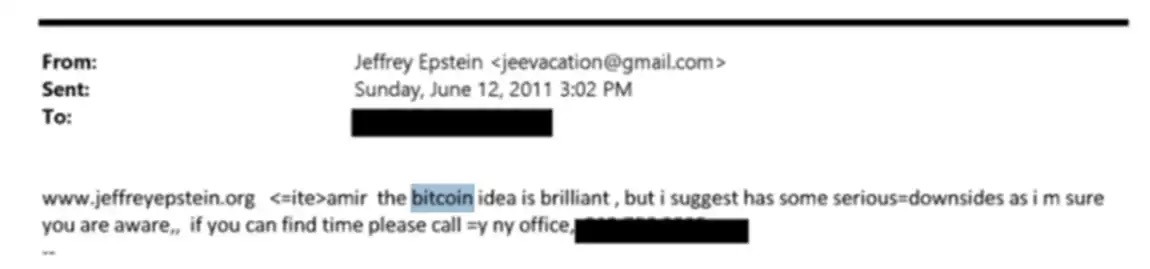
The email below is dated June 12, 2011, right around the peak of Bitcoin's price that year. Epstein stated in the email, "Bitcoin is a brilliant idea, but it has some serious drawbacks."
In 2013, the frequency of cryptocurrency mentions in Epstein's correspondence increased.

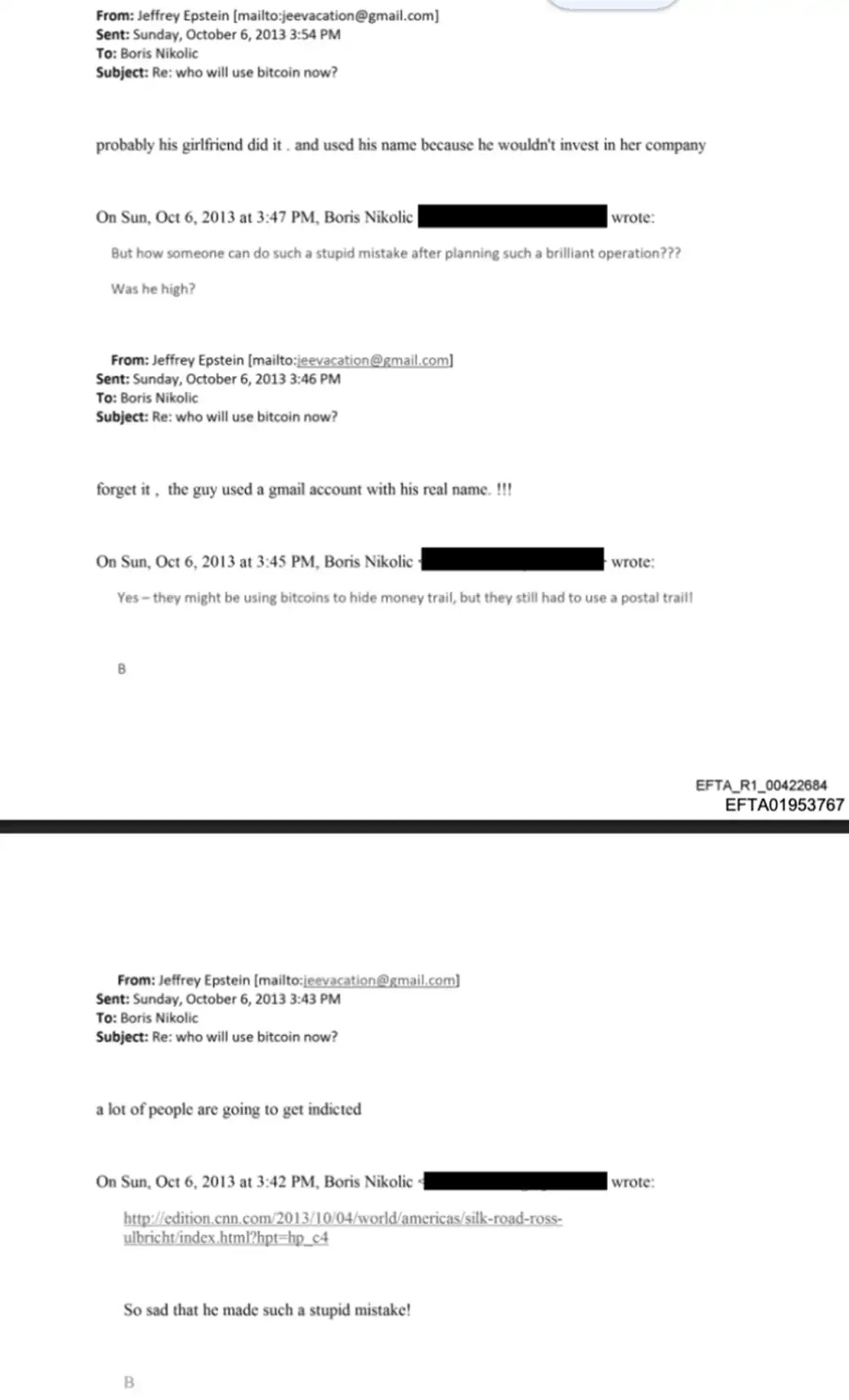
First, in an email exchange with Boris Nikolic (who once served as Bill Gates's chief technology advisor and was named in Epstein's will), the subject was "Who uses Bitcoin now?" They sarcastically discussed Ross Ulbricht, the founder of Silk Road who was arrested that year, saying that Ross's use of a Gmail account with his real name was a stupid mistake.
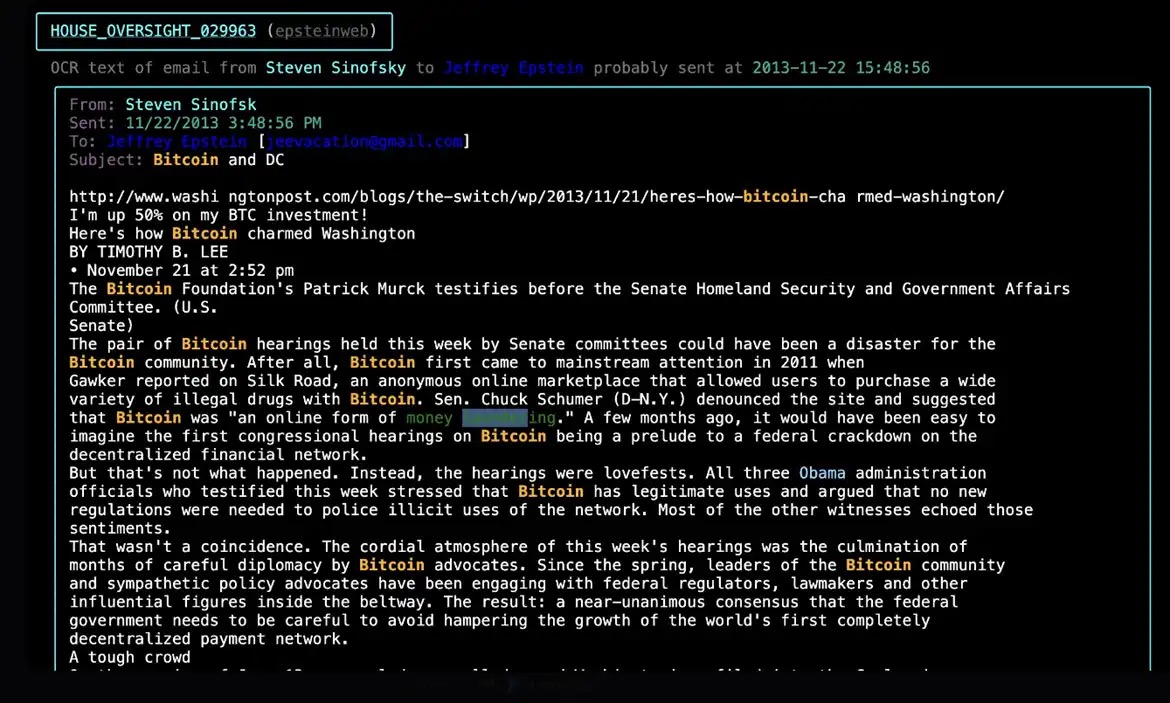
a16z board partner and former president of Microsoft's Windows division, Steven Sinofsky, emailed Epstein to say that his Bitcoin investment had increased by 50% and shared Timothy B. Lee's article "How Bitcoin Captivated Washington."
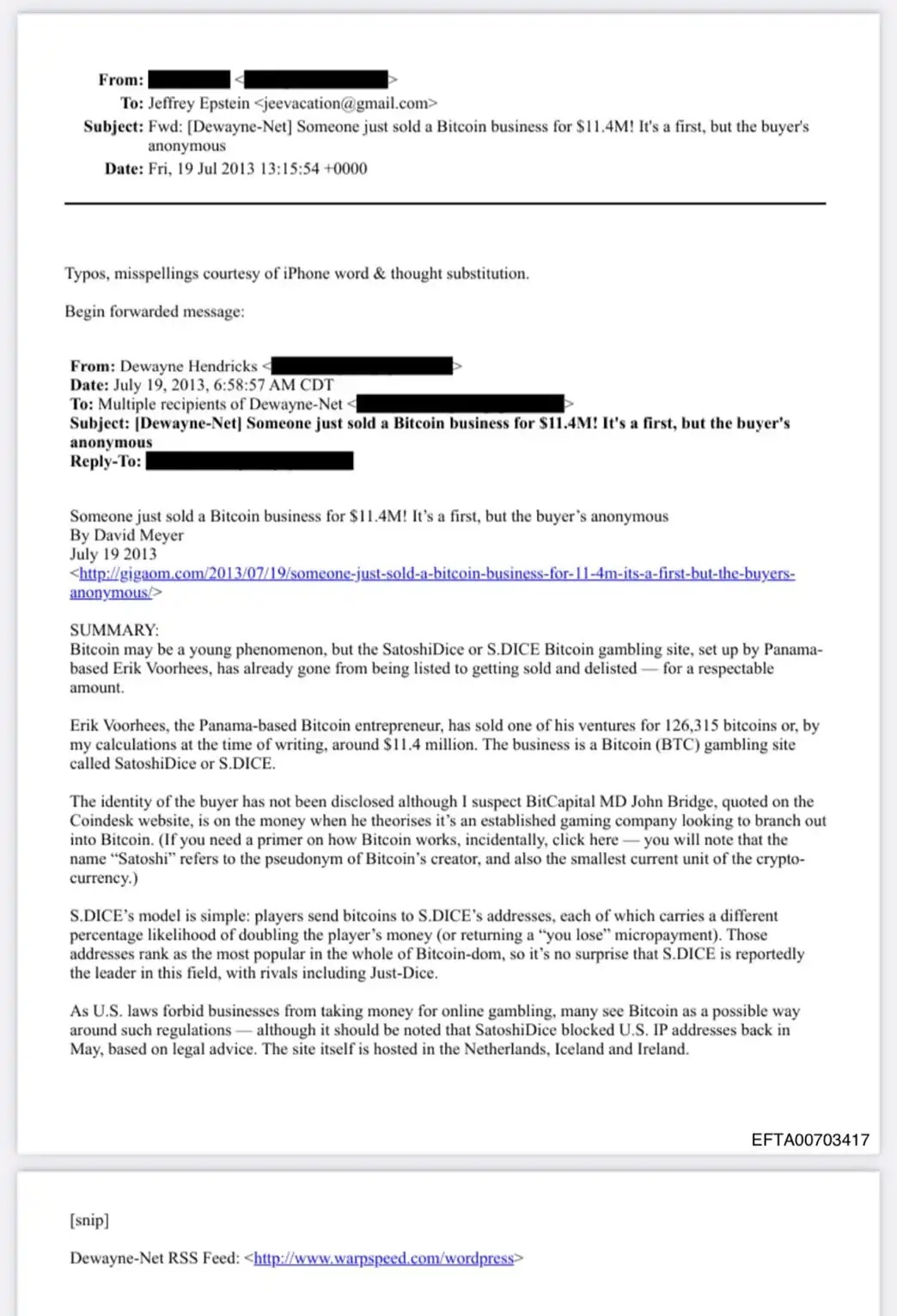
He also received news that the once-famous Bitcoin website Satoshi Dice had been sold for $11.4 million.
In 2014, Epstein engaged in an in-depth discussion with PayPal co-founder Peter Thiel about the nature of Bitcoin.
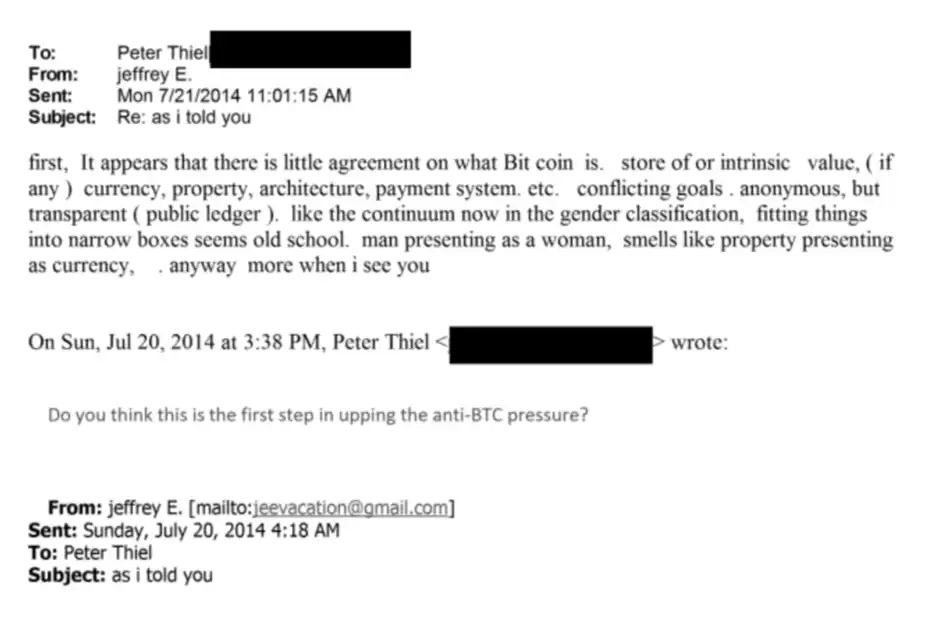
"There is no consensus on what Bitcoin is—a store of value, a currency, or property... It's like a man dressing as a woman, like property masquerading as currency."

This exchange shows that Epstein was very familiar with the ideological debates surrounding Bitcoin's nature in the early stages of the cryptocurrency market. He even compared it to gender identity.

Another email revealed that Epstein participated in the seed round funding of Bitcoin infrastructure company Blockstream. The round totaled $18 million, and Epstein's investment increased from $50,000 to $500,000.
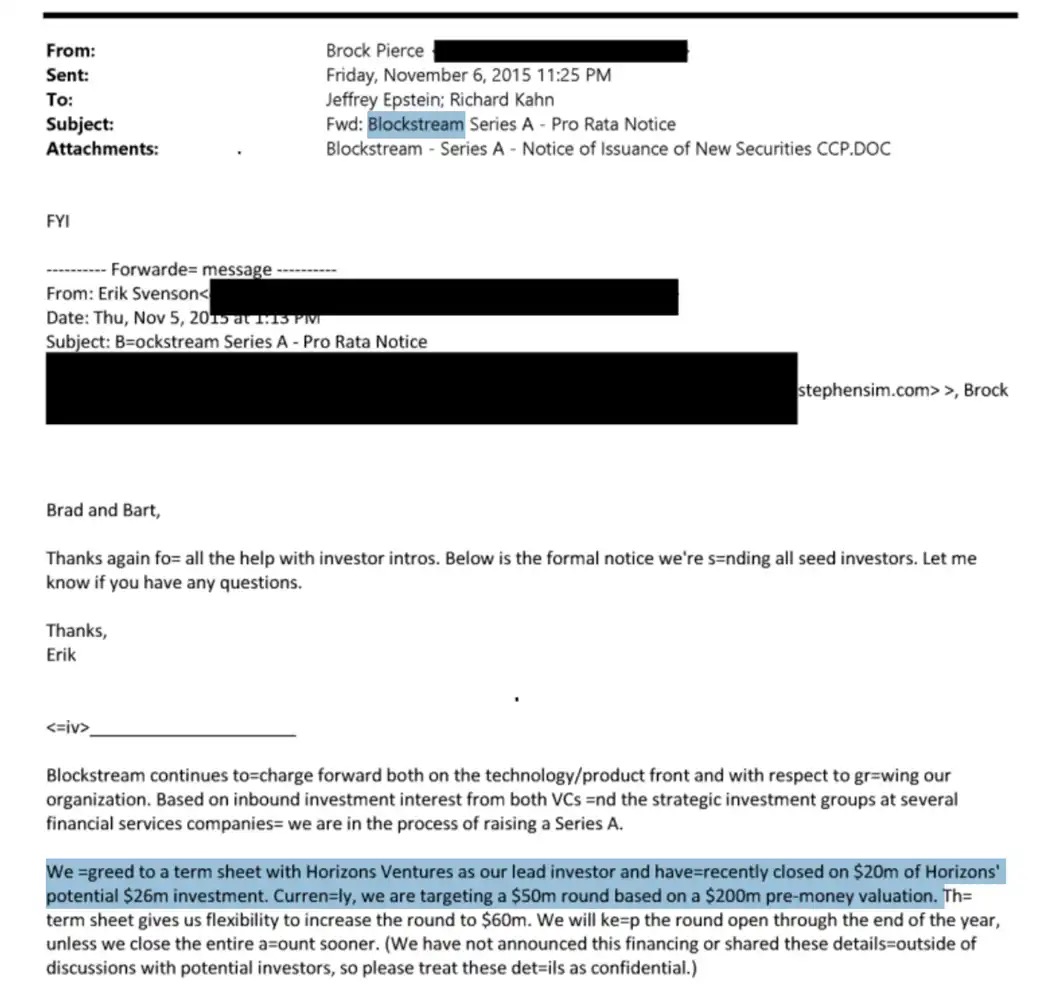
Blockstream CEO Adam Back recently issued a statement denying any direct or indirect financial connection between the company and Epstein or his estate. He explained that Epstein was a limited partner in a fund that once held a minority stake in Blockstream but had since fully divested.

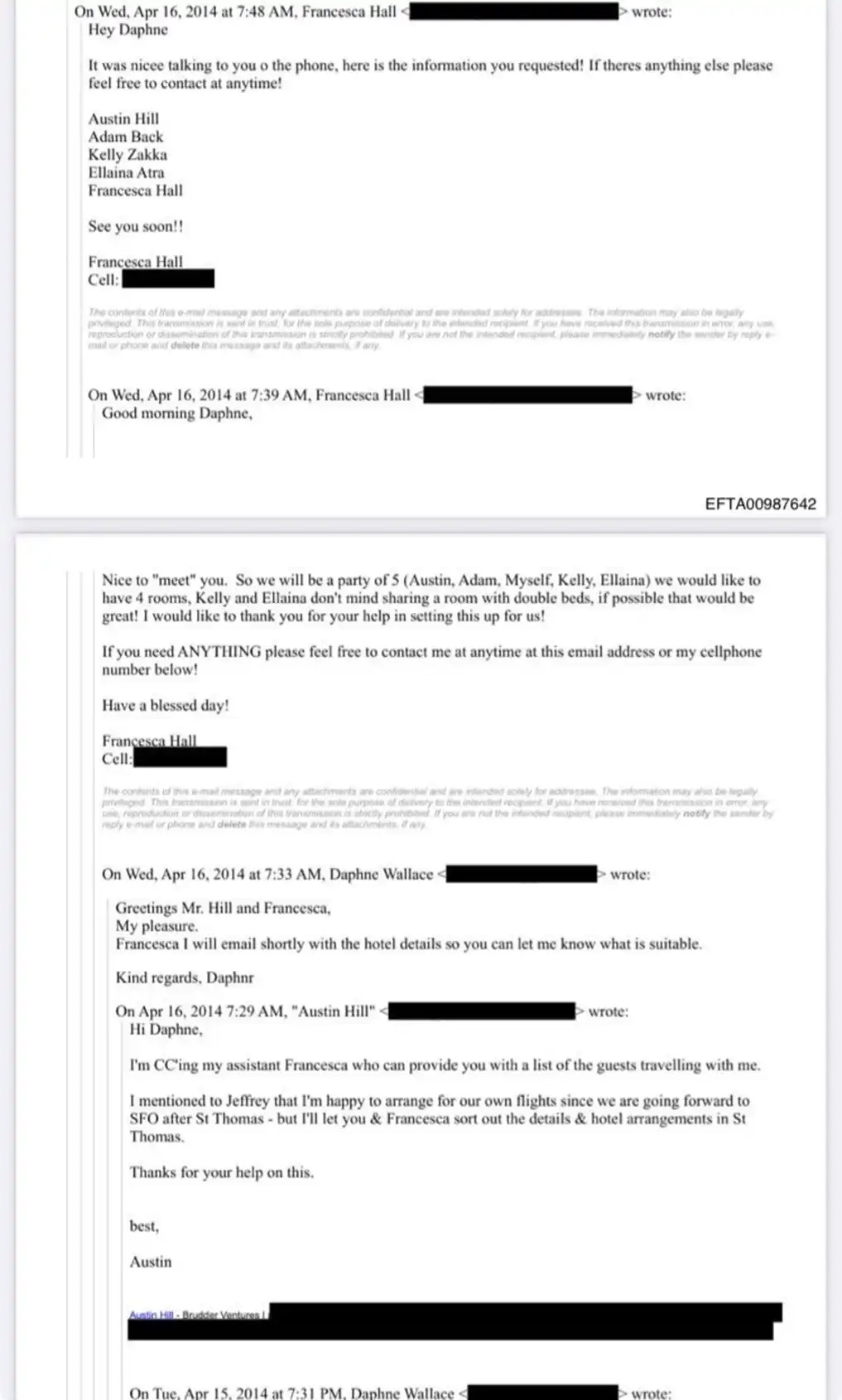
However, the names of Adam Back and Austin Hill (Blockstream co-founder) appeared in travel arrangement emails for St. Thomas Island (about 2 miles from "Epstein Island"):
Additionally, in 2014, Austin Hill emailed Epstein and Joi Ito (former director of the MIT Media Lab; Epstein invested in Blockstream through his fund). He stated that Ripple ($XRP) and Stellar (a new project by Ripple founder Jed McCaleb after leaving Ripple) negatively impacted the ecosystem Blockstream was building and harmed Blockstream because their investors were "backing two horses in the same race."
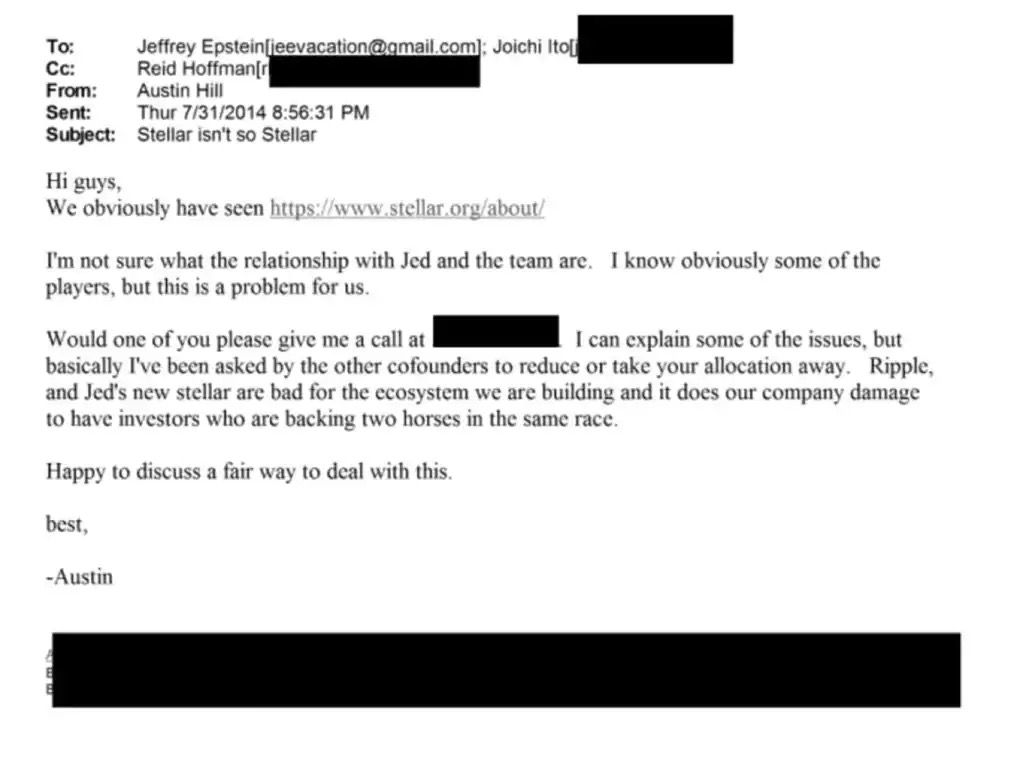
There is some divergence in the English-speaking community regarding the interpretation of this. Based on the context, I personally tend to adopt the interpretation that Epstein may have also invested in Ripple/Stellar at the time, which displeased Blockstream. This led Austin Hill to state in the email, "I was asked by other co-founders to reduce or even cancel your allocation."

Although Ripple and Stellar's growth was not affected, we do not know if more, unknown, excellent cryptocurrency projects have been stifled in their infancy through such behind-the-scenes pressure, from then until now.

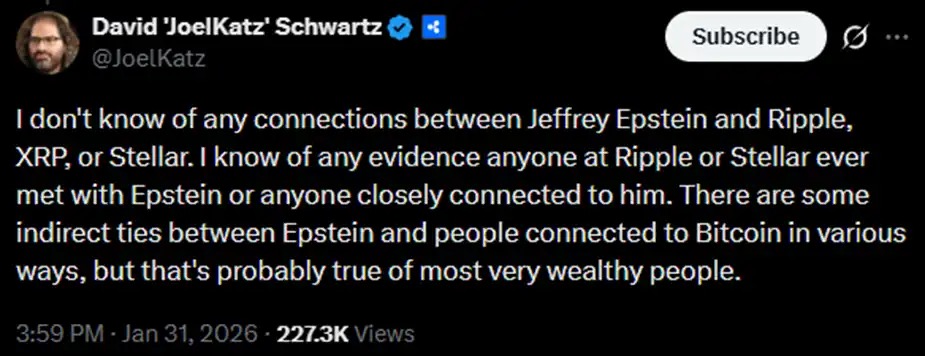
In response, former Ripple CTO David Schwartz tweeted, "I don't want to be a conspiracy theorist, but if this is just the tip of the iceberg, I wouldn't be surprised at all."
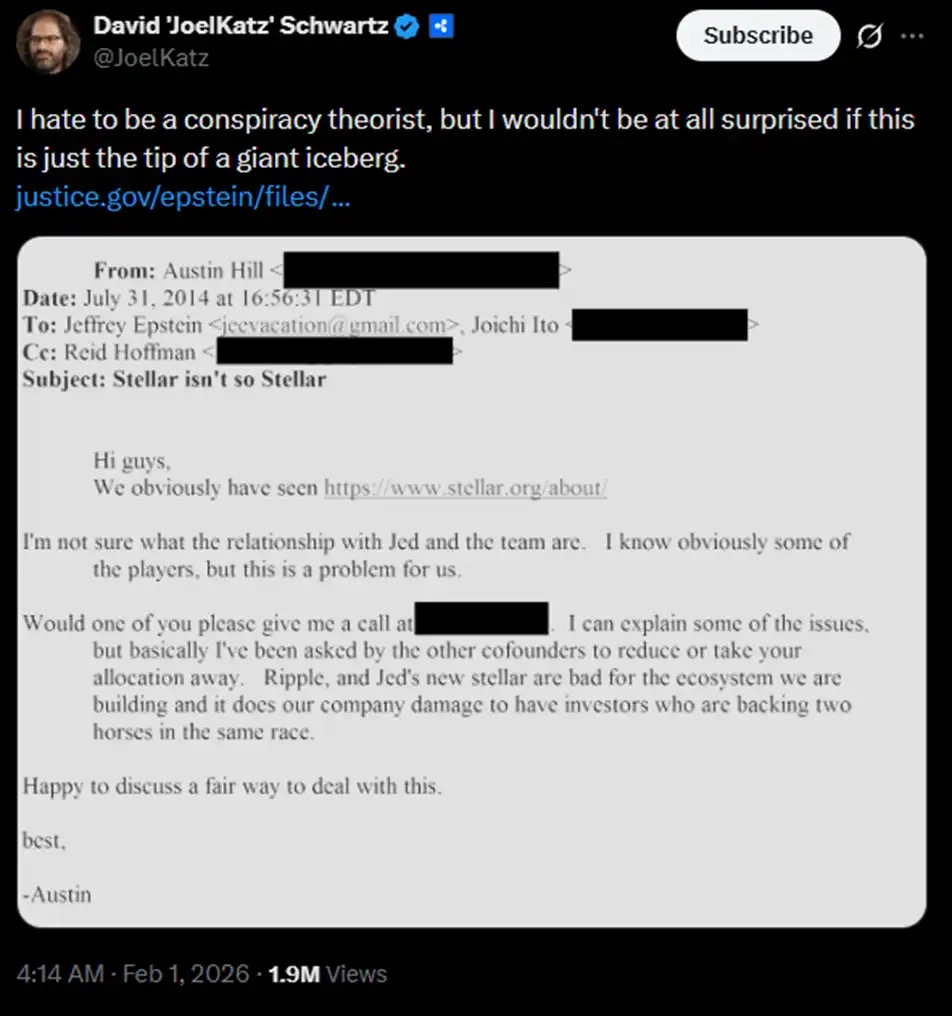
So, does this mean Epstein's evil also existed in the cryptocurrency field? David Schwartz also stated that for most ultra-wealthy individuals, having some connection to Bitcoin is probably very common.
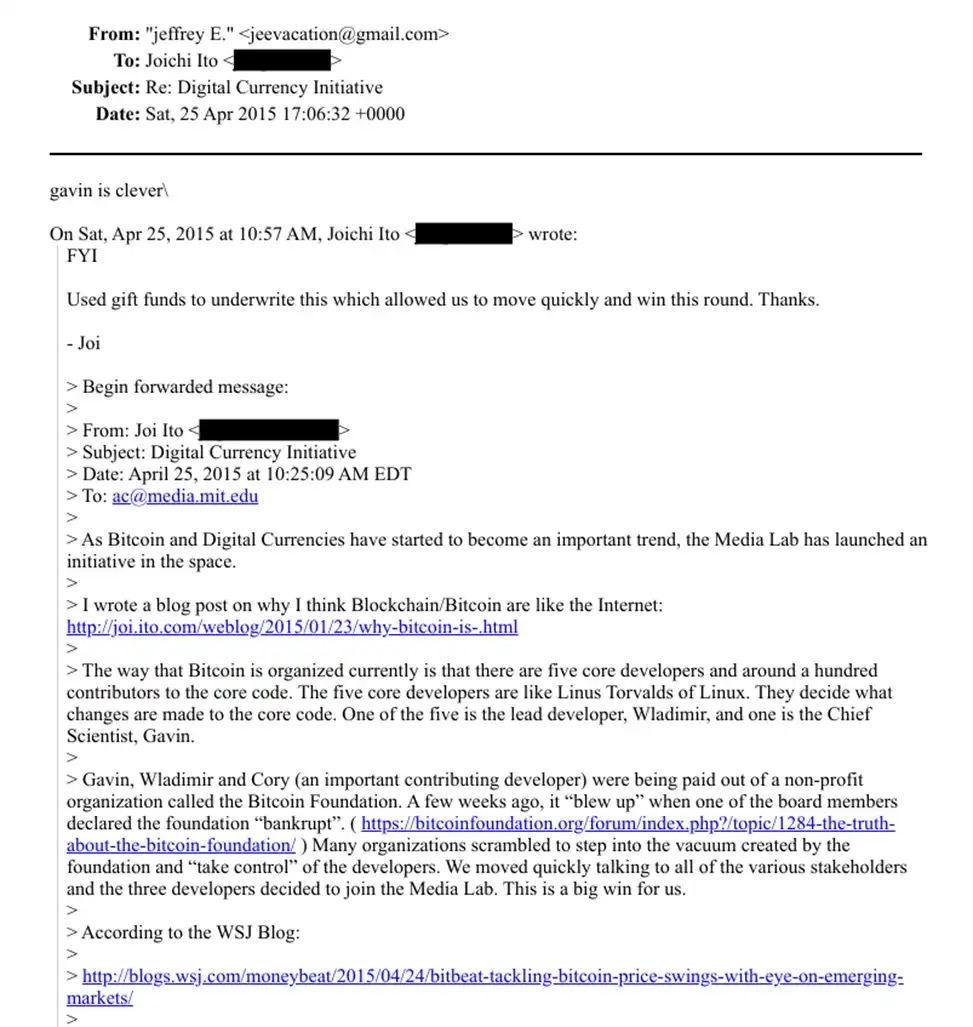
Furthermore, in 2014-2015, the collapse of the Bitcoin Foundation left Bitcoin Core developers without stable salaries. The MIT Media Lab's Digital Currency Initiative (DCI) began paying salaries to several Bitcoin Core developers. As a result, three Bitcoin Core developers—Gavin Andresen, Wladimir van der Laan, and Cory Fields—decided to join the MIT Media Lab.

At that time, the scandal had not yet broken, and the public was unaware of Epstein's anonymous donations to the MIT Media Lab. Joi Ito thanked Epstein via email, not only explaining Bitcoin's development operations to Epstein but also stating that thanks to this money, the lab was "able to move quickly and score a huge victory" because "many organizations wanted to take advantage of the situation to control Bitcoin's developers."

Epstein's reply was a simple compliment about Gavin Andresen: "Gavin is very smart."
Did Epstein Meet Satoshi?

In 2016, Epstein emailed Saudi Royal Court advisor Raafat AlSabbagh and current Abu Dhabi Department of Culture and Tourism advisor Aziza Al Ahmadi with two "radical ideas for creating two new currencies." One was a "Sharia" dollar. Just as all U.S. dollar bills have "In God We Trust," the Middle East could have its own "Sharia" dollar for internal use.
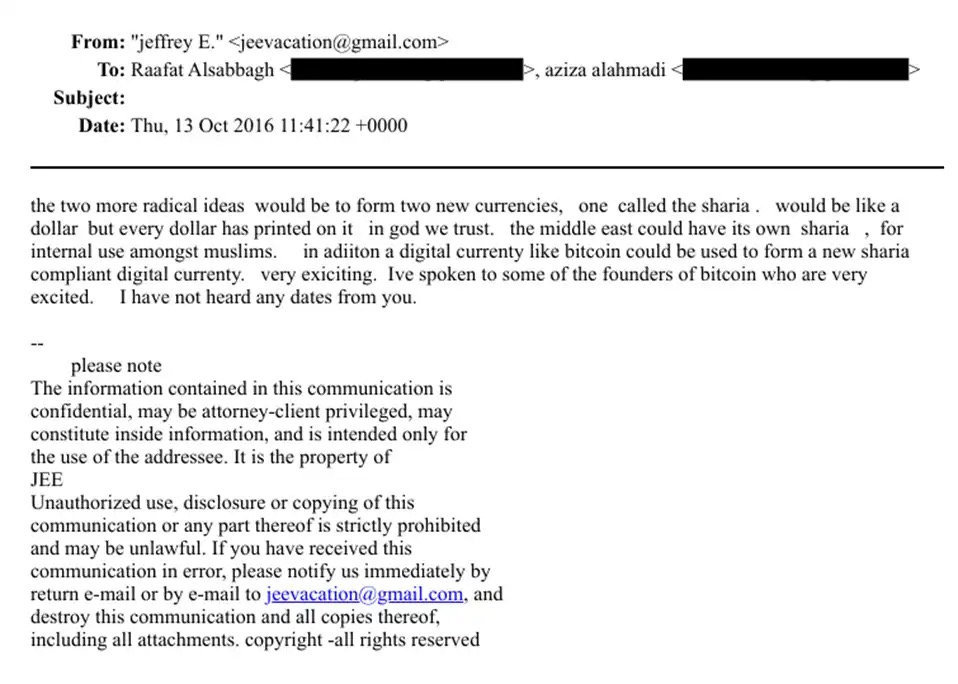
The other idea was to create a digital currency like Bitcoin to make money compliant with Sharia law. Then, after this idea, he casually and lightly dropped this piece of information:

"I have spoken with some of the Bitcoin creators, and they are very excited."

Epstein's purpose at the time might have been more about showing off his connections to enhance his reliable image, so he mentioned it offhand. But this could completely rewrite the history of Bitcoin and even the entire cryptocurrency industry. "Some Bitcoin creators"—does this mean Satoshi Nakamoto was not an individual but a team? If so, many mysteries surrounding Satoshi Nakamoto would have a reasonable explanation.

There are even more thought-provoking questions. Who was this team? What was their motivation for creating Bitcoin? If Epstein really met them, how did he initially find out who they were and establish a relationship with them? If even Epstein knew who created Bitcoin, wouldn't the U.S. government know? What motives does the U.S. government, which has remained silent on this issue, have?

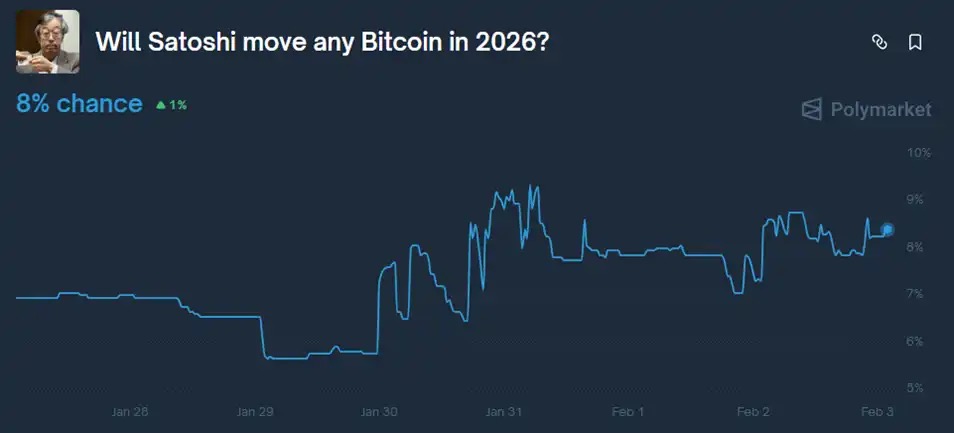
After this latest batch of Epstein files was disclosed, the possibility of "Satoshi Nakamoto's Bitcoin address taking action in 2026" on the prediction market Polymarket rose from about 6% to about 9.3% and is currently holding at 8%.
If Epstein did meet Satoshi Nakamoto, it seems Satoshi was not successful in evangelizing Bitcoin to him during their contact. In an email exchange on August 31, 2017, when asked "Is it worth buying a Bitcoin?" Epstein simply said "No." At that time, one Bitcoin was less than $5,000.

Whether Epstein actually met Satoshi Nakamoto is still unknown. However, we do know that he met the now most famous Bitcoin bull—MicroStrategy CEO Michael Saylor.

For years, Saylor's determination to only buy and never sell Bitcoin has been堪称变态 (abnormal/perverse, used here for emphasis on his extreme behavior). But in 2010, he was not yet famous for this identity.

That year, Comrade Saylor spent $25,000 to attend a party organized by Epstein's publicist Peggy Siegal and initially displayed his "autistic" traits at the event. This is how Peggy Siegal described Saylor:
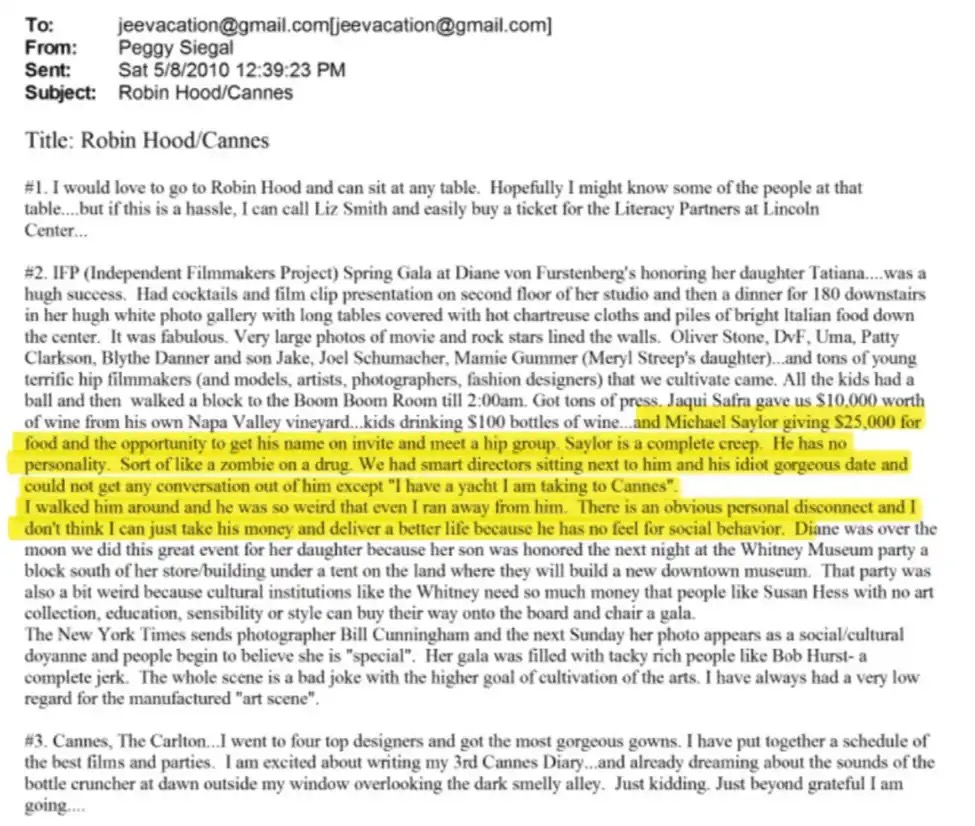
"This guy is a total freak, completely charmless, like a zombie on a drug overdose. We had smart directors at our party, sitting right next to him and his pretty, idiotic chick, and besides 'I have a yacht' and 'I'm going to Cannes,' there was no conversation. I took him around, but he was so weird I just had to run away. He has no personality and no social skills. I don't even know how to get money from him."

Being called变态 (freak/weirdo) by a变态 (freak/weirdo, referring to Epstein's associates) shows just how变态 Saylor) Saylor really is. Perhaps only a creation as great as Bitcoin could accommodate a变态 like Saylor and allow him to build a great career.

Conclusion

About half of the Epstein files have not yet been disclosed. How many more bombshells related to the cryptocurrency industry are hidden in these remaining files?

Will time clear the fog?


Twitter:https://twitter.com/BitpushNewsCN

Bitpush TG Discussion Group:https://t.me/BitPushCommunity

Bitpush TG Subscription: https://t.me/bitpush

Original link:https://www.bitpush.news/articles/7608204

Perguntas relacionadas

QWhat was Jeffrey Epstein's initial opinion on Bitcoin in 2011, and what did he identify as its key issue?

AIn 2011, Jeffrey Epstein described Bitcoin as 'a brilliant idea' but noted that it had 'some serious drawbacks.'

QWhich prominent Bitcoin infrastructure company did Epstein invest in through a fund, and what was the controversy surrounding his involvement?

AEpstein invested in Blockstream's seed round through a fund, initially putting in $50,000 which grew to $500,000. Blockstream's CEO later denied any direct or indirect financial ties, stating Epstein was a limited partner in a fund that held a minority stake and had fully divested.

QWhat startling claim did Epstein make in a 2016 email regarding the creators of Bitcoin?

AIn a 2016 email, Epstein claimed, 'I have been meeting with some of the bitcoin creators and they are very excited,' suggesting he may have had contact with Satoshi Nakamoto or the founding team.

QHow did Epstein's associate, Peggy Siegal, describe MicroStrategy CEO Michael Saylor after meeting him at a party?

APeggy Siegal described Michael Saylor as a 'complete freak' with 'no charm,' comparing him to a 'zombie on too many drugs.' She found him socially awkward and difficult to engage with.

QWhat role did Epstein's donations to the MIT Media Lab play in the Bitcoin ecosystem?

AEpstein's anonymous donations to the MIT Media Lab allowed its Digital Currency Initiative (DCI) to fund the salaries of key Bitcoin Core developers like Gavin Andresen, Wladimir van der Laan, and Cory Fields, which the lab's director saw as a crucial move to prevent other organizations from controlling the developers.

Leituras Relacionadas

When AI Traffic Surpasses Humans, How Do You Prove You're Human?

As AI-generated web traffic now surpasses human activity, the internet's foundational business models—built on human attention, browsing, and advertising—face severe disruption. AI agents crawl websites at immense scale without generating ad revenue, while AI summaries divert traffic from original content sites. In response, over 2.5 million sites are blocking AI crawlers, and protections like Cloudflare's "honeypot" traps have emerged, though advanced AI can bypass these. The collapse of traditional CAPTCHAs, which assumed machines were weaker than humans, has led to a shift toward behavioral biometrics for human verification. Companies like IBM and BioCatch now analyze unique human patterns—cursor movements, typing rhythms, keystroke dynamics, and even cognitive delays like the Stroop effect—to distinguish real users from bots. These biometric signatures are difficult to fake or alter, offering a new layer of security but raising significant privacy concerns. Two competing visions for a reliable human verification system are emerging. One, exemplified by Sam Altman’s World (formerly Worldcoin), uses centralized iris scanning to generate unique credentials, though it faces bans and criticism over unauthorized data collection. The other employs cryptographic zero-knowledge proofs, allowing users to prove they are human without revealing identity or biometric data, as advocated by Vitalik Buterin. However, decentralized approaches risk exploitation through identity renting in economically unequal regions. The central dilemma is between a scalable but privacy-invasive centralized system that permanently controls users' biometric data, and a privacy-preserving cryptographic system vulnerable to real-world economic manipulation. The author expresses a preference for the cryptographic path, arguing that despite its flaws, it avoids the irreversible biometric surveillance inherent in centralized alternatives.

Foresight NewsHá 4m

When AI Traffic Surpasses Humans, How Do You Prove You're Human?

Foresight NewsHá 4m

Crypto Primary Market Investment and Financing Forward-Looking Weekly Report | Stablecoin Regulation Nears Implementation, ETF Funds Continue to Withdraw, Capital Begins Betting on Payment and Cash Flow

Crypto Market Weekly Report (Jun 1-7, 2026): Capital Shifts Focus to Payments & Cash Flow Market data indicates a significant divergence: while traditional institutional funds continue exiting via BTC and ETH ETFs (recording net outflows of $1.72B and $168M this week, respectively), stablecoin supply continues growing. This suggests capital is shifting from speculative asset allocation toward defensive positioning within on-chain liquidity, awaiting new, concrete opportunities. This trend is reflected in venture capital focus. Weekly fundraising fell 27% to $302M, with investments concentrating on infrastructure with tangible revenue potential: 1. **Stablecoin Infrastructure (28% of funding):** Projects like M0 Protocol ($35M raise) are gaining attention as regulatory clarity (e.g., the GENIUS Act) nears, shifting the focus from legitimacy to building payment and settlement networks. 2. **AI Agent Infrastructure (26%):** Investments are moving from conceptual AI Agents towards the execution and economic layers required for a functional "Agent economy." Key raises include OpenRouter ($40M) and Halliday ($20M). 3. **Real World Assets (RWA) (18%):** The search for on-chain yield and cash flow drives continued interest in RWA platforms like Ondo Finance. Security threats are evolving from smart contract exploits toward key management failures, permission control issues, and regulatory execution risks (e.g., court-ordered asset freezes). **Key Takeaways:** The investment thesis is shifting from narrative-driven bets to revenue and cash-flow-generating protocols. Future attention should be on the progression of stablecoin regulations, the commercial validation of AI Agent economies, and the performance of high-revenue protocols like derivatives platforms.

marsbitHá 12m

Crypto Primary Market Investment and Financing Forward-Looking Weekly Report | Stablecoin Regulation Nears Implementation, ETF Funds Continue to Withdraw, Capital Begins Betting on Payment and Cash Flow

marsbitHá 12m

Buy an NFT First to Get a Ticket? The Largest World Cup Ticket Slump in History

"Ticketing Woes for 2026 World Cup: NFT 'Right-to-Buy' and High Prices Dampen Sales" Despite anticipation for the 2026 FIFA World Cup, with 48 teams and 104 matches across North America, the tournament faces significant unsold tickets, with approximately 180,000 group-stage tickets still available for resale just before kick-off. This unexpected shortfall is attributed to FIFA's controversial new ticketing strategy, which includes an NFT-based "Right-to-Buy" (RTB) system and opaque, dynamic pricing. FIFA introduced RTBs as digital collectibles (NFTs) sold on its FIFA Collect platform. An RTB grants the holder only the right to purchase a ticket for a specific match later, not the ticket itself. This two-step process, criticized for selling "scarcity" first, saw RTBs priced from tens to hundreds of dollars, generating millions in revenue for FIFA. With many tickets remaining available on official channels, the value of these prepaid purchase rights is now being questioned. Compounding the issue are ticket prices, reported to be 2 to 4 times higher than the 2022 Qatar World Cup, and up to 7 times more for marquee matches. FIFA employed dynamic pricing, common in U.S. sports, but lacked transparency on seat availability and exact locations during sales, frustrating global fans facing high travel costs. This has drawn scrutiny from regulators in New York and New Jersey. FIFA's official resale platform also drew criticism for imposing high fees—roughly 10% on sellers and 17% on buyers, allowing FIFA to profit further from secondary market transactions. While FIFA President Gianni Infantino states over 6 million tickets have been sold, the situation highlights a potential disconnect between fan enthusiasm and willingness to pay under an aggressive commercial model.

marsbitHá 19m

Buy an NFT First to Get a Ticket? The Largest World Cup Ticket Slump in History

marsbitHá 19m

Trading

Spot
Futuros

Artigos em Destaque

Como comprar COOKIE

Bem-vindo à HTX.com!Tornámos a compra de Cookie DAO (COOKIE) simples e conveniente.Segue o nosso guia passo a passo para iniciar a tua jornada no mundo das criptos.Passo 1: cria a tua conta HTXUtiliza o teu e-mail ou número de telefone para te inscreveres numa conta gratuita na HTX.Desfruta de um processo de inscrição sem complicações e desbloqueia todas as funcionalidades.Obter a minha contaPasso 2: vai para Comprar Cripto e escolhe o teu método de pagamentoCartão de crédito/débito: usa o teu visa ou mastercard para comprar Cookie DAO (COOKIE) instantaneamente.Saldo: usa os fundos da tua conta HTX para transacionar sem problemas.Terceiros: adicionamos métodos de pagamento populares, como Google Pay e Apple Pay, para aumentar a conveniência.P2P: transaciona diretamente com outros utilizadores na HTX.Mercado de balcão (OTC): oferecemos serviços personalizados e taxas de câmbio competitivas para os traders.Passo 3: armazena teu Cookie DAO (COOKIE)Depois de comprar o teu Cookie DAO (COOKIE), armazena-o na tua conta HTX.Alternativamente, podes enviá-lo para outro lugar através de transferência blockchain ou usá-lo para transacionar outras criptomoedas.Passo 4: transaciona Cookie DAO (COOKIE)Transaciona facilmente Cookie DAO (COOKIE) no mercado à vista da HTX.Acede simplesmente à tua conta, seleciona o teu par de trading, executa as tuas transações e monitoriza em tempo real.Oferecemos uma experiência de fácil utilização tanto para principiantes como para traders experientes.

214 Visualizações TotaisPublicado em {updateTime}Atualizado em 2026.06.02

Como comprar COOKIE

Discussões

Bem-vindo à Comunidade HTX. Aqui, pode manter-se informado sobre os mais recentes desenvolvimentos da plataforma e obter acesso a análises profissionais de mercado. As opiniões dos utilizadores sobre o preço de COOKIE (COOKIE) são apresentadas abaixo.

活动图片