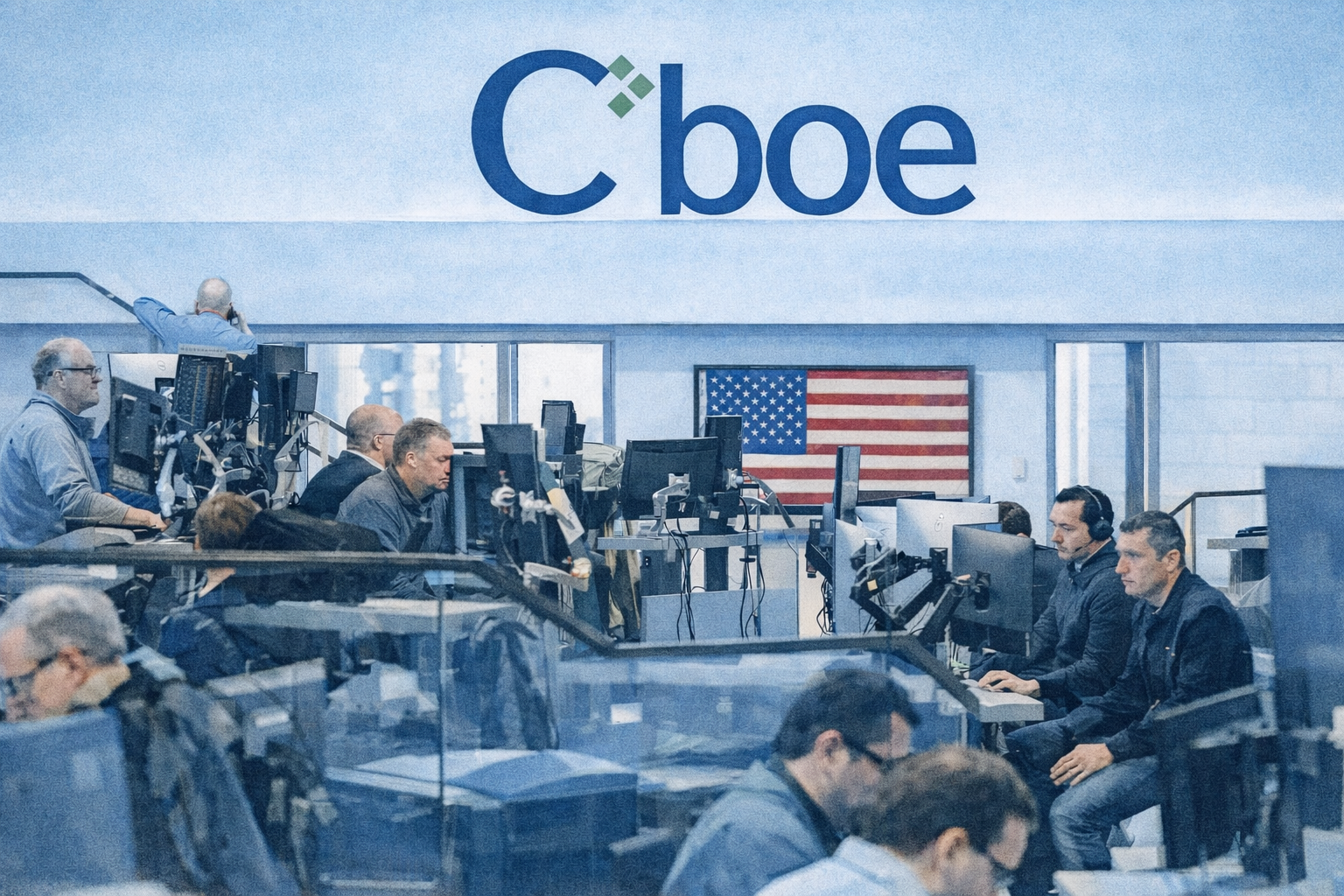
From Quiet Exit to Relaunch: Traditional Options Exchange Cboe Competes with Prediction Markets for Entry

marsbitPublicado em 2026-02-05Última atualização em 2026-02-05

Resumo

Cboe Global Markets is considering reintroducing "all-or-nothing" binary options to attract retail investors, as prediction markets like Kalshi and Polymarket surge in popularity. These contracts offer fixed payouts if specific conditions are met, such as an index reaching a certain level, otherwise expiring worthless. Cboe had previously launched similar products tied to the S&P 500 and VIX in 2008 but failed due to low liquidity and limited retail participation at the time. The current move is driven by the explosive growth in event-based trading and retail derivative activity, fueled by mobile apps and social media. Unlike the earlier institutional-focused offering, the new binary options are explicitly targeted at散户, with simpler, event-driven contracts designed to compete directly with prediction markets. Cboe emphasizes strict regulatory oversight by the SEC or CFTC and clearing via the OCC to distinguish its products from unregulated platforms. This relaunch represents a strategic effort by traditional exchanges to reclaim retail interest in outcome-based trading, leveraging today’s mature distribution channels and heightened investor appetite for straightforward, short-term derivatives. Success hinges on delivering an intuitive, low-friction experience that can effectively rival prediction markets while operating within a clear regulatory framework.

Author: Zen, PANews

As prediction markets continue to divert retail investors' attention, traditional financial institutions and exchanges are clearly unwilling to stand by idly.

Chicago Board Options Exchange (Cboe Global Markets) is taking the initiative, exploring the relaunch of "all-or-nothing" binary options contracts to attract retail investors. These contracts have a simple structure, paying a fixed return (e.g., $100) at expiration if predetermined conditions are met, otherwise expiring worthless.

According to a WSJ report, the new product will undergo rigorous legal and compliance reviews before official listing. Regulatory oversight may fall under the U.S. Securities and Exchange Commission (SEC) or the Commodity Futures Trading Commission (CFTC), with clearing support provided by the Options Clearing Corporation (OCC).

Cboe previously launched binary options linked to the S&P 500 Index (SPX) and the Volatility Index (VIX) in 2008, but they were delisted due to insufficient liquidity. Their comeback now is particularly noteworthy.

The First Attempt 18 Years Ago and the Quiet Exit

"All-or-nothing" options contracts are not a novel concept or product; Cboe itself introduced them over a decade ago. But ultimately, it was a case of starting early yet arriving late.

In July 2008, Cboe announced the launch of binary options linked to the S&P 500 (SPX) and the Cboe Volatility Index (VIX). According to an approval document released by the SEC in May of the same year, Cboe applied to add a framework for "cash-settled, European-style exercise" binary index options to its exchange rules. The document also clarified that the OCC (Options Clearing Corporation) would be responsible for issuance, clearing, and settlement, and amended its relevant bylaws and rules accordingly.

Compared to the later proliferation of "black platform binary options" on the internet, Cboe's binary options were a standardized, centrally cleared derivative innovation. They compressed the complex payoff curve of options into a fixed payout, allowing traders to use a more direct way to express their view on whether an index would reach a certain level. At launch, Cboe expected to attract diverse participants, including individual investors and hedge funds, to bet on the direction of these indices.

However, this product did not generate the anticipated market enthusiasm, nor did it achieve significant scale or sustained trading, ultimately leading to its quiet delisting. Behind this were both structural market issues and deep-seated problems stemming from its product positioning.

At that time, the market was dominated by institutional investors, with very low retail participation, leading to insufficient liquidity and lackluster subscription interest. Binary options require a "two-way street" between brokers and retail investors. But in the early stages of mobile internet development, the financial dissemination power of social media was far from formed, and retail investors typically lacked trading motivation and habits.

When demand didn't materialize, the supply side became even harder to sustain. Thin trading weakened market maker incentives, wider spreads further suppressed demand, creating a reflexive "liquidity death spiral." This was the main reason a compliant, centrally cleared binary option failed commercially.

In terms of positioning, the 2008 binary options were also more like tools for professional traders, a new product addition for existing options participants. Their product language, settlement rules, and underlying selection were more "institutionalized" rather than products for the masses. They were linked to SPX and VIX, with strike prices and settlement rules that were not intuitive for the average investor. Even though their payoff was binary in form, the barrier to understanding remained high.

In contrast, today's popular prediction markets have spread largely because they replaced the underlying assets with more intuitive events, including but not limited to political elections, sports events, etc. Retail investors can participate directly in trading without needing overly complex analytical logic. Cboe did not have such an ecosystem back then.

Relaunch Plan as Timing Matures

Cboe's current proposal for a relaunch is closely related to the current market environment. Since the 2024 U.S. presidential election, prediction market activity has experienced "explosive growth." In January 2026, combined trading volume on Kalshi and Polymarket exceeded $17 billion, hitting a record high.

As the prediction market boom brings a surge in retail derivative trading, the industry has begun to see it as an emerging growth area and an opportunity for exchanges and financial institutions to develop new businesses, thus joining the battle for users. In December 2025, CME Group partnered with sports betting giant FanDuel to launch an official prediction market platform in some U.S. states.

Equally noteworthy alongside prediction markets is the explosive enthusiasm of retail investors for derivative trading. Following the 2020 pandemic shock, U.S. options trading volume repeatedly hit record highs, with retail investors playing a significant role. Data from the Options Clearing Corporation shows that the average daily trading volume in the U.S. options market in 2025 was approximately 61 million contracts, a historical record.

At the same time, the rise of internet brokers and social media has fundamentally changed trading methods. Retail investors can quickly access trading strategies and contract information through mobile apps and online communities. In this environment, simple and clear derivative contracts have a natural appeal to retail users.

If the core reason for the failure of binary options in 2008 was the "absence of retail investors," today's market is the opposite, with distribution channels and product strategies now mature. Cboe realizes it's time to relaunch binary options contracts.

Not Nostalgia, but an "Entry Point Battle"

Binary options carry unavoidable historical baggage.

In the U.S. regulatory context, the term was once highly associated with internet fraud and manipulation. The CFTC and SEC jointly issued investor alerts, pointing out that regulators had received numerous complaints about fraud involving online binary options platforms, including refusal to return funds, identity theft, manipulation of trading software causing client losses, etc.

It is precisely for this reason that Cboe's current move particularly emphasizes strict compliance review before listing and oversight by the SEC or CFTC. The subtext is platform controllability, safety, and transparency. This also explains why traditional exchanges feel urgency amidst the prediction market frenzy. They do not want to completely cede the retail demand for outcome betting to a sector with more complex regulation and blurrier boundaries.

There are several key differences between the binary options being relaunched now and the 2008 version. First, the target audience is different. The previous product was mainly aimed at institutions and experienced investors, attracting almost no retail traders. This time, it explicitly targets the retail group, hoping to provide a simple and easy-to-understand derivative entry point for mass investors.

Second, there is a difference in product positioning. The 2008 contracts were essentially special options linked to indices (SPX, VIX), used to precisely express bullish or bearish views on market indices. Now, Cboe emphasizes introducing simpler, event-based contract forms, aiming to cater to ordinary investors' interest in betting on event outcomes.

Another key factor is the change in the external environment mentioned above. At the market level, Cboe's new product has different technological and channel support for marketing and participation. At the regulatory level, event contract products in the U.S. today are more often under CFTC oversight, whereas the previous binary options required SEC approval. This also reflects the regulatory boundary tensions brought by prediction markets.

Stringing these clues together, Cboe's move can be understood as: a recapture of the retail trading gateway for event outcomes. In 2008, Cboe early on brought binary options into the exchange system, but encountered an era where retail was absent, the understanding barrier was relatively high, and distribution channels were insufficient, ultimately leading to failure.

Today, prediction markets have cultivated a user mindset for intuitive betting and created a huge market imagination space. At the same time, retail options trading volume has long proven that散户 are willing to pay for derivatives that are "simple, short-cycle, and have clear outcomes."

The most critical factor going forward might be whether Cboe can, within compliance constraints, provide a trading experience sufficiently close to the "intuitive, smooth, low-friction" feel of prediction markets. If it fails, its fate might repeat itself. If it succeeds, it could become a landmark event in the "redrawing of boundaries" between traditional exchanges and prediction markets.


Criptomoedas em alta

Perguntas relacionadas

QWhy is Cboe Global Markets considering reintroducing binary options contracts?

ACboe is reintroducing binary options to attract retail investors, as prediction markets are diverting significant attention and trading activity from散户, and the current market environment with high retail participation in derivatives makes it an opportune time to offer simpler, event-based contracts.

QWhat were the main reasons for the failure of Cboe's initial binary options launch in 2008?

AThe initial launch failed due to low liquidity and lack of retail investor participation, as the market was dominated by institutional investors, and the product was too complex and not intuitive enough for普通 investors, leading to a 'liquidity death spiral'.

QHow does the current retail trading environment differ from that in 2008, making a relaunch more viable?

AToday's environment features high retail engagement in derivatives, facilitated by internet brokers and social media, making简单, short-term contracts attractive. Retail option trading volumes have hit record highs, and distribution channels are成熟, unlike in 2008 when散户 were largely absent.

QWhat regulatory challenges are associated with binary options, and how is Cboe addressing them?

ABinary options have been linked to fraud and manipulation in the past. Cboe is addressing this by conducting strict legal reviews before launch, ensuring oversight by either the SEC or CFTC, and using the Options Clearing Corporation (OCC) for清算 to emphasize safety and transparency.

QHow does Cboe's new binary options product differ from its 2008 version in terms of target audience and design?

AThe 2008 version targeted institutional investors with complex index-based contracts, while the new product is designed for retail investors with simpler, event-based contracts that are more intuitive and easier to understand, aligning with the appeal of prediction markets.

Leituras Relacionadas

Playnance’s $GCOIN Lists on KoinBX Amid Rapid Growth in India

Playnance's native token, $GCOIN, has been listed on the cryptocurrency exchange KoinBX as of June 18. This move aims to enhance accessibility for its rapidly growing community, particularly in India, where the blockchain-powered Web3 iGaming ecosystem has gained significant traction. Over 130 partners in Playnance's "Be the Boss" program have built communities engaging thousands of active players in the region. The "Be the Boss" model allows participants to create and manage their own gaming communities, earning rewards tied to community activity. CEO Pini Peter noted India's high engagement, with community leaders successfully building player networks. One partner, Dr. Nicolas, reported earning over $57,000 through the program in recent months, highlighting both the financial rewards and the opportunity to grow an engaged community. $GCOIN serves as the ecosystem's core utility token, incentivizing participation and aligning the interests of players and community leaders ("Bosses"). The listing on KoinBX is part of Playnance's strategy to expand globally, increasing the token's utility and accessibility by combining community ownership, gamified engagement, and blockchain-based incentives. Founded in 2020, Playnance is a Web3 iGaming infrastructure company focused on creating live, non-custodial, on-chain products to onboard mainstream users. It currently processes approximately one million transactions daily, aiming to simplify the user experience while maintaining full on-chain transparency.

TheNewsCryptoHá 36m

Playnance’s $GCOIN Lists on KoinBX Amid Rapid Growth in India

TheNewsCryptoHá 36m

STRC Hits Historic Low, Saylor's Perpetual Motion Machine Grinds to a Halt

STRC, the perpetual preferred stock issued by MicroStrategy to fund its Bitcoin purchases, hit a historic low of $85.32, a 17% discount to its $100 par value. Designed as a "digital credit engine" to trade stably near par and enable continuous share issuance for buying Bitcoin, its plunge signals a breakdown in this model. Three key factors drove the decline: 1. Bitcoin's price fell over 50% from its peak, trading around $63,000 amid hawkish Fed signals. 2. MicroStrategy's cash reserves were depleted after a $1.5 billion convertible note repayment, slashing the dividend coverage for STRC's 11.5% yield to ~7 months. The company then sold 32 BTC to cover dividends—Michael Saylor's first Bitcoin sale since 2022—damaging the "never sell" narrative. 3. A competing Bitcoin-backed preferred stock, Strive's SATA, offers a higher yield (~13%) and daily dividends, drawing investors away from STRC. The drop triggers a negative cycle: STRC below par halts ATM share issuances, cutting off a key funding source for Bitcoin buys and potentially forcing more BTC sales for dividends, further eroding confidence. While Saylor argues the model is mathematically sound—needing only 2.3% annual Bitcoin growth to sustain itself—the market is testing the resilience of the leveraged Bitcoin treasury strategy in a bear market. The STRC price now reflects rising skepticism about this financial machinery's durability during downturns.

marsbitHá 57m

STRC Hits Historic Low, Saylor's Perpetual Motion Machine Grinds to a Halt

marsbitHá 57m

A Guide to Grayscale’s ‘Bottom Fishing’: Using Cash Flow to Assess Cryptocurrency Value

**Title:** Grayscale's Guide to Bottom-Fishing: Valuing Cryptoassets Using Cash Flows **Summary:** This report by Grayscale Research presents a fundamental valuation framework for cryptocurrency assets, moving beyond pure speculation to analyze those with underlying cash flows. It distinguishes between "commodity-like" assets (e.g., Bitcoin) and "cash-flow" assets, primarily within DeFi. Using the leading decentralized lending protocol Aave as a case study, the analysis applies traditional financial methodologies like Discounted Cash Flow (DCF) and Price-to-Earnings (P/E) multiples. Key findings indicate that AAVE tokens are currently undervalued. Despite recent challenges, the protocol's strong revenue growth, ~50% net profit margin, and diversified treasury support a fundamental valuation range of $80-$100 per token (compared to a ~$75 market price at the time of writing). In a base-case scenario driven by stablecoin adoption and regulatory clarity, the fair value could rise to around $175 within a year. The report emphasizes that protocol success does not automatically translate to token value. It critically examines the "value capture" mechanisms—such as buybacks, burns, and staking rewards—that channel protocol profits to token holders. Furthermore, it addresses the legal and governance complexities of Decentralized Autonomous Organizations (DAOs), noting their difference from traditional corporate equity but highlighting how robust, transparent governance can align protocol economics with holder interests. The conclusion is that the crypto market is maturing, with capital increasingly flowing towards projects with demonstrable fundamentals, real adoption, and disciplined capital allocation, creating opportunities for value-based investors.

marsbitHá 2h

A Guide to Grayscale’s ‘Bottom Fishing’: Using Cash Flow to Assess Cryptocurrency Value

marsbitHá 2h

After semiconductors lead the gains, are funds buying into AI orders or a macroeconomic rebound?

After US-Iran talks led to a temporary ceasefire and framework for reopening the strategic Strait of Hormuz, U.S. stocks rose on June 18, with the Nasdaq gaining 1.9%. The semiconductor and AI hardware sectors outperformed. This rally stemmed primarily from reduced geopolitical risk, which lowered oil prices and inflation expectations, easing discount rate pressure on high-valuation growth stocks like tech. The key question is not whether tech rebounded, but the nature of the rebound. The market appears to be selectively repricing AI infrastructure plays rather than broadly chasing AI narratives. Gains were concentrated in chips, optical interconnects, memory, and domestic manufacturing—segments tied to tangible data center build-outs and capital expenditure. Intel's ~10% surge, fueled by a Trump statement about potential Apple collaboration, exemplifies this mixed dynamic. It reflects policy catalysts and domestic manufacturing sentiment more than confirmed fundamentals. Meanwhile, strong earnings from companies like Astera Labs (revenue up 93% YoY) provided concrete evidence of AI-driven demand in hardware. In essence, the rally represents a risk-premium recalibration. Lower Middle East tensions opened a valuation repair window, and capital flowed first into AI infrastructure segments with visible near-term revenue streams. The sustainability of this move hinges on upcoming Q2 earnings, specifically continued strength in cloud provider capex, AI server orders, and hardware company guidance. Policy hopes alone are insufficient; the cycle needs validation from orders and financials.

marsbitHá 2h

After semiconductors lead the gains, are funds buying into AI orders or a macroeconomic rebound?

marsbitHá 2h

Trading

Spot
Futuros

Artigos em Destaque

Como comprar ZEN

Bem-vindo à HTX.com!Tornámos a compra de Horizen (ZEN) simples e conveniente.Segue o nosso guia passo a passo para iniciar a tua jornada no mundo das criptos.Passo 1: cria a tua conta HTXUtiliza o teu e-mail ou número de telefone para te inscreveres numa conta gratuita na HTX.Desfruta de um processo de inscrição sem complicações e desbloqueia todas as funcionalidades.Obter a minha contaPasso 2: vai para Comprar Cripto e escolhe o teu método de pagamentoCartão de crédito/débito: usa o teu visa ou mastercard para comprar Horizen (ZEN) instantaneamente.Saldo: usa os fundos da tua conta HTX para transacionar sem problemas.Terceiros: adicionamos métodos de pagamento populares, como Google Pay e Apple Pay, para aumentar a conveniência.P2P: transaciona diretamente com outros utilizadores na HTX.Mercado de balcão (OTC): oferecemos serviços personalizados e taxas de câmbio competitivas para os traders.Passo 3: armazena teu Horizen (ZEN)Depois de comprar o teu Horizen (ZEN), armazena-o na tua conta HTX.Alternativamente, podes enviá-lo para outro lugar através de transferência blockchain ou usá-lo para transacionar outras criptomoedas.Passo 4: transaciona Horizen (ZEN)Transaciona facilmente Horizen (ZEN) no mercado à vista da HTX.Acede simplesmente à tua conta, seleciona o teu par de trading, executa as tuas transações e monitoriza em tempo real.Oferecemos uma experiência de fácil utilização tanto para principiantes como para traders experientes.

229 Visualizações TotaisPublicado em {updateTime}Atualizado em 2026.06.02

Como comprar ZEN

Discussões

Bem-vindo à Comunidade HTX. Aqui, pode manter-se informado sobre os mais recentes desenvolvimentos da plataforma e obter acesso a análises profissionais de mercado. As opiniões dos utilizadores sobre o preço de ZEN (ZEN) são apresentadas abaixo.

活动图片