From Pizza to Unit of Account: A Prehistory of Bitcoin Price Discovery

marsbitPublicado em 2026-05-19Última atualização em 2026-05-19

Resumo

From Pizza to Unit of Account: The Prehistory of Bitcoin Price Discovery This article traces Bitcoin's earliest price discovery mechanisms, focusing on its functional evolution as a unit of account rather than its price trajectory. The analysis centers on a nine-month period from October 2009 to July 2010, identifying three distinct, sequential layers of price formation. The narrative begins with the cost-of-production anchor established by NewLibertyStandard in October 2009, which calculated a unilateral USD/BTC exchange rate based on the electricity cost of mining. This constituted a posted rate, not a market-discovered price. The second layer emerged with peer-to-peer (P2P) discovery mechanisms starting in March 2010. This included Dustin Dollar's Bitcoin Market platform, which introduced a basic public order book, and forum-based实物 trades. The pivotal event in this phase was Laszlo Hanyecz's purchase of two pizzas for 10,000 BTC on May 22, 2010. Critically, the offer was made exclusively in BTC ("10,000 bitcoins for a couple of pizzas"), marking the first documented instance where Bitcoin functionally acted as a unit of account to price another good in a real transaction, 21 days before Hanyecz later provided a USD anchor (~$25). The third layer commenced in July 2010 with Jed McCaleb's launch of the Mt.Gox exchange. Its continuous order book, with last price, highs, lows, and volume, provided the first standardized, externally referenceable format for BTC/USD prices....

Prologue

On May 22, 2010, Laszlo Hanyecz exchanged 10,000 BTC for two pizzas. This day was later dubbed Bitcoin Pizza Day, commemorated annually by the crypto community in a specific way—multiplying the value of 10,000 BTC from that day by the current fiat price to produce a starkly contrasting figure, captioned "the most expensive pizza in history."

This article does not calculate that compound interest.

This article discusses something else: on May 22, 2010, Bitcoin (BTC) was, for the first time, used as a unit to price another commodity in a real transaction. This is the verifiable moment when BTC first functionally played the "unit of account" role among the three functions of money (medium of exchange / unit of account / store of value). This moment sits at the midpoint of a longer timeline of mechanisms—from cost-of-production anchoring (NewLibertyStandard), to P2P matching and discovery (Bitcoin Market), to centralized matching with continuous quotes (Mt.Gox). What Bitbase Research aims to reconstruct is this nine-month prehistory and its comparable forms with the evolutionary paths of price discovery mechanisms for various asset classes throughout history.

Chapter One · What is a "Price"—The Birth of a Unit of Account

1.1 The Three Functions of Money and the Conceptual Boundary of "Price"

The functions of money are standardly defined in financial economics textbooks. Frederic Mishkin, in Chapter 3 of the 13th edition of "The Economics of Money, Banking, and Financial Markets," divides monetary functions into three items [1]: medium of exchange, unit of account, store of value. John Hicks's judgment in the opening of "Critical Essays in Monetary Theory" (Oxford, 1967) is more concise—"money is what money does"; money is defined by its functions, not its physical form [2].

This distinction has specific methodological significance for this article. Something "having an exchange rate" is not the same as "having a price." An exchange rate can be unilaterally published—a third-party observer calculates the conversion ratio between two assets and then announces it; it does not require market participants to conclude transactions based on it, nor does it require others to reference this ratio to price their goods. Price is different. Price is the product of market matching; it requires at least two parties to agree on a conversion ratio for a specific transaction at a specific moment, and this ratio can be recognized, referenced, and reused by third parties.

By this distinction, before May 22, 2010, BTC was in a specific semantic state: it had an exchange rate, but it did not have a market price in the market sense.

1.2 The Functional Performance of "Unit of Account"

Among the three functions of money, medium of exchange and unit of account are often intuitively conflated, but they are not equivalent. The former describes "using this thing as an intermediary in a transaction"—as long as both parties are willing, anything can perform this function. The latter describes "using this thing as the unit for pricing other things." A commodity being used as a payment instrument in a transaction does not necessarily mean it simultaneously functions to price that commodity.

On May 18, 2010, Laszlo Hanyecz wrote in the initiating post of Bitcointalk topic=137: "I'll pay 10,000 bitcoins for a couple of pizzas," and explicitly allowed the other party to order Papa John's pizzas on his behalf [3]. No US Dollar (USD) amount appears in the entire initiating post—he did not say "pizzas worth how many dollars"; he said "10,000 bitcoins for two pizzas." When the completion of this transaction was reported at 19:17:26 UTC on May 22 [4], something happened at the functional level: two pizzas were priced in units of "10,000 BTC."

This is the verifiable moment when BTC was first functionally performed as a unit of account. "Functionally performing this role" and "fully satisfying this function in monetary definition" are two different things. The latter requires this unit to be consistently used as a pricing identifier across groups of traders, a condition only partially met after Mt.Gox's continuous quoting. May 22 is the first time this function appeared in an actual transaction.

Notably, the figure "about $25" does not appear in the initiating post of May 18. Hanyecz gave this fiat anchor for the first time in a subsequent reply in the same thread on June 12, 2010, at 20:14:44 UTC [5]. BTC first assumed the function of pricing pizzas in a transaction; the semantic act of "reverse identification between BTC and USD" occurred 21 days later. This temporal sequence has methodological significance: BTC's functional performance as a unit of account occurred before the bidirectional identification between BTC and USD was completed.

Chapter Two · Mechanism Timeline

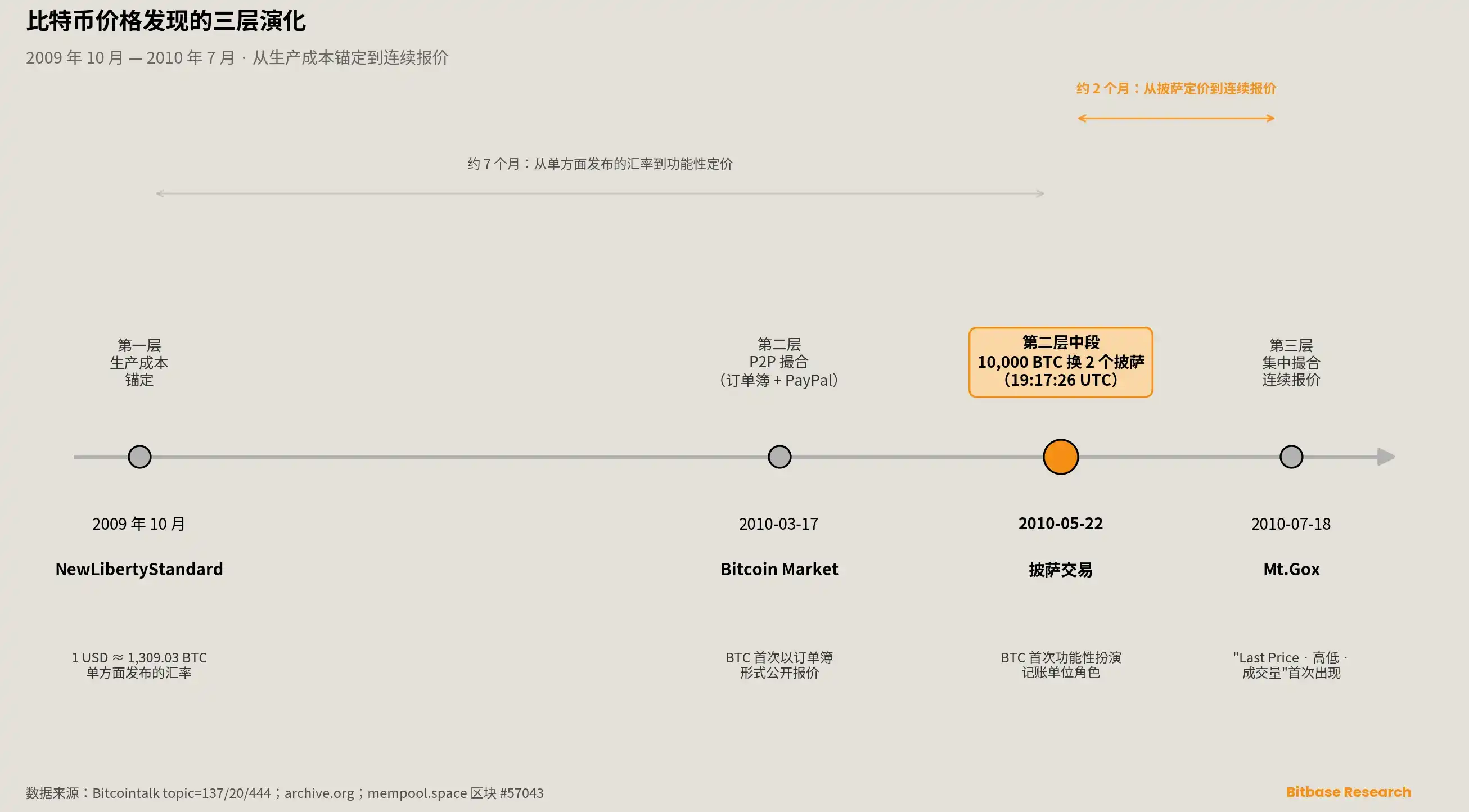
This chapter reconstructs the three-tier mechanism evolution from October 2009 to July 2010 in chronological order. Each section provides firsthand timestamps, firsthand post IDs, and a description of the mechanism itself.
2.1 Tier One · Cost-of-Production Anchoring (From October 2009)

NewLibertyStandard (hereafter NLS) published a BTC-to-USD exchange rate formula on its webpage newlibertystandard.wetpaint.com in October 2009. The website is now offline. As of May 14, 2026, the earliest recorded archive.org snapshot is from December 29, 2009, 13:26:10 UTC [6]. The formula on the snapshot reads:

During 2009 my exchange rate was calculated by dividing $1.00 by the average amount of electricity required to run a computer with high CPU for a year, 1,331.5 kWh, multiplied by the average residential cost of electricity in the United States for the previous year, $0.1136, divided by 12 months divided by the number of bitcoins generated by my computer over the past 30 days.

The methodology of this formula is to anchor BTC's value to the "marginal production cost of running a miner"—electricity cost divided by BTC output per unit time. It is essentially an extension of the classical labor-energy theory of value to digital assets: BTC had no market; it was priced by the electric meter. This is a "unilaterally published exchange rate," not a market-matched price.

The first exchange rate figure publicized by NLS, 1 USD ≈ 1,309.03 BTC, has been widely reused in secondary narratives, but there is no original post by NLS himself on the Bitcointalk forum citing this number [7]. This study adopts the archived snapshot data and honestly notes: as of May 14, 2026, this specific number is only available from the first-hand source of the archive snapshot.

Separate from NLS, the earliest recorded BTC-to-USD transaction was conducted by Martti Malmi, an early Bitcoin core contributor—on October 12, 2009, Malmi transferred 5,050 BTC to NLS, received $5.02 via PayPal, and confirmed it in a tweet on January 15, 2014 [8].

2.2 Tier Two · P2P Matching and Discovery (From March 2010)

The second tier mechanism was initiated by dwdollar (real identity Dustin Dollar). On January 15, 2010, at 09:42:18 UTC, dwdollar initiated a motion in Bitcointalk topic=20 msg=100 [9]: "I'm in the process of building an exchange. ... It will be a real market where people will be able to buy and sell Bitcoins with each other."

The platform Bitcoin Market began service on March 17, 2010. dwdollar's update post that day read: "Looks like we had our first real trade around noon!"—this was the first BTC-to-USD transaction matched via a quasi-public order book.

The matching mechanism of Bitcoin Market needs to be stated factually: it was not the complete form of order book matching. dwdollar self-described in msg=265 on February 6, 2010, at 22:37:44 UTC: "ONLY the limit orders work. Market orders will come later." [10]—the platform only supported limit orders, market orders were not implemented; settlement relied on PayPal intermediation, not pure on-chain settlement. Nevertheless, Bitcoin Market was the first platform to publicly display BTC quotes in an order book form; this form itself has mechanistic significance.

Parallel to Bitcoin Market during the same period was P2P physical matching on Bitcointalk. Hanyecz's pizza event is a representative case of this form. The two paths coexisted in parallel from March to July 2010—the dwdollar path proved BTC could be matched with USD to produce quotes, the Hanyecz path proved BTC could be matched with physical goods to produce quotes.

2.3 Midpoint · The Pizza Transaction (May 22, 2010)

Hanyecz's pizza transaction sits at the midpoint of the second tier in the mechanism timeline. Reconstructed in UTC chronological order:

  • 2010-05-18 00:35:20 UTC: Hanyecz issued the invitation in Bitcointalk topic=137 msg=1141 [3]. Hanyecz was located in Jacksonville, Florida, USA (EDT, UTC−4), corresponding to the local time of 2010-05-17 20:35. This timezone conversion explains why some secondary narratives date the initiation to May 17.

  • 2010-05-22 18:16:31 UTC: txid a1075db55d416d3ca199f55b6084e2115b9345e16c5cf302fc80e9d5fbf5d48d was included in block #57043 [11].

  • 2010-05-22 19:17:26 UTC: Hanyecz reported completion in msg=1195—"I just want to report that I successfully traded 10,000 bitcoins for pizza. Thanks jercos!" [4]

The 61-minute difference between the on-chain block time and the Bitcointalk confirmation post time is consistent with the narrative of "posting confirmation after pizza delivery." This time difference also independently confirms that the Bitcointalk forum displays timestamps in UTC, not Eastern Time.

The real identity and location of the counterparty jercos are often misstated in secondary narratives. jercos is Jeremy Sturdivant, who stated in a written interview with Bitcoin Who's Who on January 30, 2016: "I have yet to travel outside of the US, and am living on the west coast, near Santa Cruz, California." [12] According to Sturdivant's own account, he is an American, living near Santa Cruz, California, was 19 years old on May 22, 2010, and had never left the United States. The widely circulated description of a "19-year-old British person" is inconsistent with firsthand records.

Hanyecz withdrew the open invitation on June 4, 2010, at 17:51:05 UTC [13], stating "I can't afford that many more." Eight days later, on June 12, he reopened the invitation in msg=1526 and gave the USD anchor for the first time: two pizzas costing about $25, maybe $30 with a tip [5].

2.4 Tier Three · Centralized Matching with Continuous Quotes (From July 2010)

On July 18, 2010, at 01:57:19 UTC, username mtgox posted an announcement in Bitcointalk topic=444 msg=3866: "Hi Everyone, I just put up a new bitcoin exchange." [14] The operator behind this account was Jed McCaleb—founder of eDonkey, the original holder of the mtgox.com domain (an acronym for Magic: The Gathering Online eXchange). The Wayback Machine's earliest recorded capture of mtgox.com is August 17, 2007 [15], about 17 months before the BTC genesis block; this domain was repurposed as a BTC exchange in July 2010.

McCaleb described the platform's quoting architecture in msg=3873 (2010-07-18 02:15:09 UTC) of the same thread [14]: "Last Price ... High ... Low ... Volume ... Current Lowest Buy Price; Current Highest Sell Price ... All trades are between users."—"Last Price," "24-hour high/low," "volume," "best bid/ask"; this set of terms appeared for the first time in the Bitcoin context, marking that BTC now had a standard format for continuous quoting. The mechanistic difference was structural: matching between users rather than intermediary settlement, automatic continuous operation of the order book, 24/7 availability.

From this moment, BTC gained external referentiality in the unit of account dimension—others could say "my thing is worth X BTC," and X BTC had an uninterrupted USD identifier. Mt.Gox was announced to be transferred by McCaleb to MagicalTux (later Mark Karpelès) on March 6, 2011 [16]; its subsequent fate is another independent timeline not expanded here.

Chapter Three · Structural Similarity—The Same Curve Across Three Hundred Years

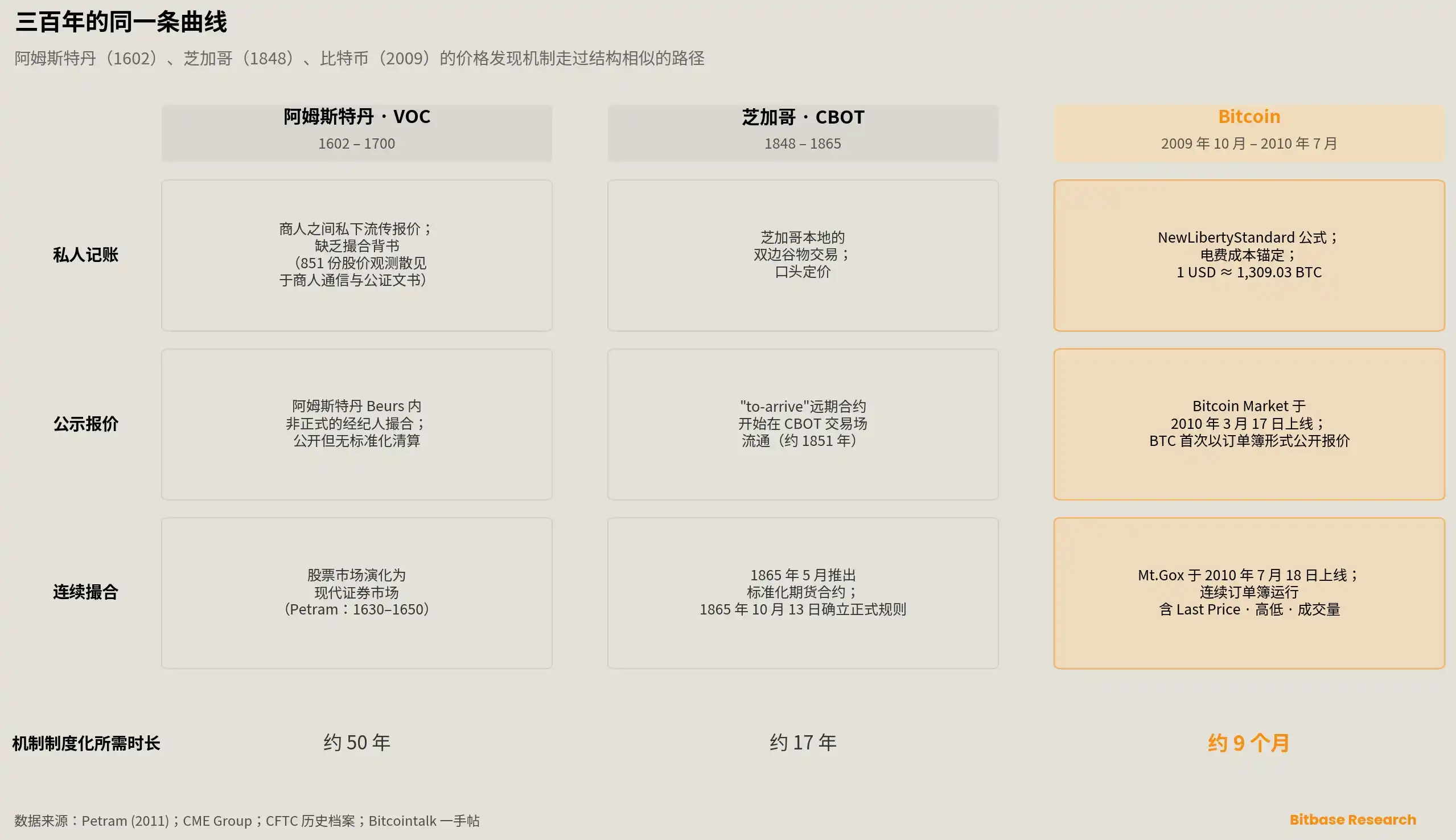
The proposition of this chapter is: The three-tier mechanism evolution completed by BTC between October 2009 and July 2010—cost-of-production anchoring → P2P matching and discovery → centralized matching with continuous quotes—has comparable structural forms with the evolutionary paths of various asset classes throughout history. This chapter presents two cases for structural comparison and does not construct a quantifiable cross-asset comparison model.

3.1 Amsterdam · The 17th-Century VOC Secondary Market

The Dutch East India Company (VOC) was established in 1602, issuing shares to 1,143 subscribers; share transfers required in-person registration by the company bookkeeper at the East India House [17]. This is generally regarded as the earliest identifiable scenario of an equity secondary market [17].

The maturation of its price discovery mechanism occurred about half a century later. Lodewijk Petram, in his 2011 PhD dissertation "The world's first stock exchange" at the University of Amsterdam, states: the stock market "evolved into a modern securities market" between 1630 and 1650, and "a continuous price discovery process took shape in that period" [17]. Petram's judgment is based on 851 sets of 17th-century stock price observation data. These data were not from official exchange records—neither the VOC nor the exchange systematically recorded prices; data were scattered in merchant correspondence, notarial deeds, and occasional newspapers. The very "dataset" of 17th-century VOC share prices grew from private bookkeeping and oral exchange rates.

The structural similarity with BTC's early path is specific. The NLS formula is to BTC what privately circulated VOC quotes among 17th-century merchants were: unilaterally published, private bookkeeping, lacking matching endorsement. Bitcoin Market is to BTC what informal broker matching within the Amsterdam Beurs was: public but lacking standardized clearing. Mt.Gox is to BTC the starting point of continuous quoting institutionalization—not the end point.

3.2 Chicago · 19th-Century CBOT Standardized Futures Contracts

The second comparison comes from 19th-century American grain trading. The Chicago Board of Trade (CBOT) was founded in 1848, initially as a spot market for commodities [18]. Around 1851, "to-arrive" forward contracts began circulating at CBOT—traders promised to deliver grain at a future date at a specified price [18].

The key institutionalization date for the price discovery mechanism is 1865. CME Group historical archives and the official history of the U.S. Commodity Futures Trading Commission (CFTC) both record [18][19]: CBOT introduced standardized futures contracts in May 1865 and established formal trading rules on October 13, 1865. There is academic controversy over this—one view holds that mature futures trading did not appear until around 1874 [18]. This study adopts 1865 as the starting point and acknowledges this periodization dispute.

The structural similarity between the CBOT path and the BTC path lies in this: the evolution from dispersed bilateral forward contracts to standardized, tradable futures contracts with margin and delivery rules follows the same curve of price discovery mechanism institutionalization. Chicago took 17 years, Bitcoin took 9 months. The difference in time scale does not dissolve the structural similarity. Price discovery in all markets does not start from an exchange; it grows from specific bilateral transactions, oral exchange rates, and private bookkeeping.
3.3 The Explanatory Power and Boundaries of Structural Similarity

Placing BTC's early path within the three-hundred-year sequence of Amsterdam–Chicago–Bitcoin yields a judgment at the mechanism level, not a quantitative model. Three assets, three institutional environments, three technological conditions, yet the price discovery mechanisms all follow the same coarse-grained path: private bookkeeping → publicized quotes → continuous matching. In other words, crypto derivatives infrastructure was not invented out of thin air; it lies on a financial institution evolution line spanning centuries.

This structural similarity argument is not a causal argument. It does not claim "BTC inevitably followed the same path as VOC and grain futures," nor does it claim "all future digital assets will follow the same curve." It claims that: when an observer faces a new asset class, the "prehistory of price discovery mechanisms" is a more enduring subject of study than "asset price trends."

Chapter Four · Acknowledging Limitations and Leaving Gaps

This piece does not expand on contemporary price discovery mechanism comparisons. ETF fund flows, CME open interest, Perpetual Futures funding rates, on-chain market-making—these are the current forms of this 16-year path, but the space and methodology required to expand on them are left for subsequent research.

There are three reverse signals for this article's core argument. First, if academic or on-chain archaeology research reveals an earlier effective entity publishing exchange rates before NewLibertyStandard, the positioning of the "first externally publicized exchange rate" needs revision. Second, if the timestamps of the three core Bitcointalk threads—topic=20, topic=137, topic=444—are proven false at the archival layer, the event anchors need resetting. Third, if the "semantic transition of unit of account" framework is replaced by a more precise monetary function evolution theory, the core argument requires revision.

This article acknowledges the following boundaries. First, "BTC's first functional performance as a unit of account" is an interpretive proposition, not the full establishment of the function in monetary definition. Second, labeling Bitcoin Market as "P2P matching and discovery" is a simplification. Third, the structural similarity argument with Amsterdam and Chicago serves only as a mechanism-level comparison and does not construct a quantifiable cross-asset comparison model. This article does not predict BTC price movements and makes no statements regarding BTC's investment attributes as a single asset.


Perguntas relacionadas

QWhat was the key significance of the Bitcoin Pizza Day transaction on May 22, 2010, according to the article?

AThe transaction marked the first documented instance where Bitcoin (BTC) functionally acted as a unit of account, pricing the two pizzas at 10,000 BTC, distinct from its use merely as a medium of exchange.

QDescribe the three-layer evolution of Bitcoin's price discovery mechanism in its first nine months as outlined in the article.

AThe evolution comprised: 1) Cost-of-production anchoring (NewLibertyStandard, October 2009), 2) P2P matching discovery (Bitcoin Market platform and Bitcointalk bartering, starting March 2010), and 3) Centralized continuous matching and quoting (Mt.Gox, starting July 2010).

QHow does the article distinguish between 'having an exchange rate' and 'having a price' in the context of early Bitcoin?

A'Having an exchange rate' refers to a unilaterally published conversion ratio that doesn't require market consensus or real transactions. 'Having a price' refers to a ratio resulting from market matching where at least two parties agree on a specific transaction, making the ratio identifiable and reusable by third parties.

QWhat structural similarity does the article draw between Bitcoin's early price discovery and the 17th-century Amsterdam VOC stock market?

ABoth followed a similar path: starting with private valuations or unilaterally published rates (NLS formula/merchant quotes), moving to informal public matching (Bitcoin Market/Beurs brokerages), and eventually evolving towards a formalized system of continuous, standardized quoting (Mt.Gox/VOC's mature price discovery process in the 1630s-1650s).

QAccording to the article, what are the potential signals that would require a revision of its core arguments?

AThe core arguments would need revision if: 1) An entity earlier than NewLibertyStandard publishing a valid exchange rate is discovered. 2) The timestamps in the core Bitcointalk threads (topics 20, 137, 444) are proven false. 3. A more precise theoretical framework for the evolution of monetary functions replaces the 'semantic leap as a unit of account' framework.

Leituras Relacionadas

Anthropic Major Release: "The Founder's Playbook" - All 4 Stages of Entrepreneurship, Completely Reimagined with AI

**Anthropic Releases "The Founder's Playbook," Reimagining the Four Stages of Startups with AI** The logic of entrepreneurship is being fundamentally reshaped by AI. Anthropic's new handbook, "The Founder's Playbook: Building an AI-Native Startup," defines the AI-native startup as a new species: not a traditional company with AI tools, but a venture driven by AI from day one. The founder's role is transforming from a hands-on builder to a conductor or architect, orchestrating AI agents for execution while focusing on high-level judgment and strategy. Anthropic outlines a product matrix of Claude tools for different tasks: Claude Chat for interactive research, Claude Code for generating production-ready code, and Claude Cowork for automating knowledge-intensive workflows. The handbook structures the startup lifecycle into four stages, detailing core goals, pitfalls, and AI applications for each: 1. **Idea Stage**: Focuses on validating a real problem. The core challenge is avoiding confirmation bias. AI practices include using Claude as a "structured devil's advocate" to challenge assumptions and for automated market/competitor research. 2. **MVP Stage**: Aims to gather early signals of Product-Market Fit (PMF). Key risks are technical debt and scope creep due to rapid AI-assisted development. Recommended AI uses include maintaining project memory documents (e.g., CLAUDE.md), using Claude Code for structured coding, and automating user feedback analysis. 3. **Launch Stage**: Centers on establishing scalable growth, operations, and compliance. Challenges include accelerating technical debt and founders becoming bottlenecks. AI should be used to build an "operating system" for launch—automating routine tasks (scheduling, reporting, content) and code audits—freeing founders for critical decisions. 4. **Scale Stage**: Focuses on achieving sustainable business operations. The main challenge is delegating operational control. AI should be leveraged for differentiated marketing, operational optimization, and building competitive moats through data network effects. The handbook concludes that in the AI era, "Can we build it?" is no longer the primary constraint. The advantage shifts back to foundational strengths: **insight, judgment, and a deep understanding of a specific problem and audience.**

marsbitHá 7h

Anthropic Major Release: "The Founder's Playbook" - All 4 Stages of Entrepreneurship, Completely Reimagined with AI

marsbitHá 7h

Trading

Spot
Futuros

Artigos em Destaque

O que é BITCOIN

Compreender o HarryPotterObamaSonic10Inu (ERC-20) e a Sua Posição no Espaço Cripto Nos últimos anos, o mercado de criptomoedas assistiu a um aumento na popularidade das moedas meme, cativando não apenas os traders, mas também aqueles que procuram envolvimento comunitário e valor de entretenimento. Entre estes tokens únicos está o HarryPotterObamaSonic10Inu (ERC-20), um projeto intrigante que mistura referências culturais no tecido das criptomoedas. Este artigo explora os principais aspetos do HarryPotterObamaSonic10Inu, examinando os seus mecanismos, a sua ética orientada pela comunidade e o seu envolvimento com o vasto panorama cripto. O que é o HarryPotterObamaSonic10Inu (ERC-20)? Como o nome sugere, o HarryPotterObamaSonic10Inu é uma moeda meme construída na blockchain Ethereum, classificada sob o padrão ERC-20. Ao contrário das criptomoedas tradicionais, que podem enfatizar a utilidade prática ou o potencial de investimento, este token prospera no valor de entretenimento e na força da sua comunidade. O projeto visa promover um ambiente onde utilizadores envolvidos possam reunir-se, partilhar ideias e participar em atividades inspiradas por diversos fenómenos culturais. Uma característica notável do HarryPotterObamaSonic10Inu é a zero taxa sobre transações. Este elemento atraente visa encorajar a negociação e o envolvimento da comunidade, isento de encargos adicionais que podem desencorajar os traders de pequena escala. A oferta total da moeda está fixada em mil milhões de tokens, uma cifra que marca a sua intenção de manter uma circulação substancial dentro da comunidade. Criador do HarryPotterObamaSonic10Inu (ERC-20) As origens do HarryPotterObamaSonic10Inu estão um pouco envoltas em mistério; os detalhes sobre o criador permanecem desconhecidos. O desenvolvimento deste token carece de uma equipa identificável ou de um plano explícito, o que não é raro no setor das moedas meme. Em vez disso, o projeto surgiu de forma orgânica, com o seu progresso a depender fortemente do entusiasmo e da participação da sua comunidade. Investidores do HarryPotterObamaSonic10Inu (ERC-20) No que diz respeito a investimentos externos e apoios, o HarryPotterObamaSonic10Inu também permanece ambíguo. O token não lista quaisquer fundações de investimento conhecidas ou apoio organizacional significativo. Em vez disso, o “sangue vital” do projeto é a sua comunidade de base, que informa o seu crescimento e sustentabilidade através da ação coletiva e do envolvimento no espaço cripto. Como Funciona o HarryPotterObamaSonic10Inu (ERC-20)? Como uma moeda meme, o HarryPotterObamaSonic10Inu opera principalmente fora dos quadros tradicionais que muitas vezes governam o valor dos ativos. Existem vários aspetos distintivos que definem como o projeto funciona: Transações Sem Taxas: Sem taxas sobre transações, os utilizadores podem comprar e vender o token livremente, sem a preocupação de custos ocultos. Envolvimento da Comunidade: O projeto prospera na interação da comunidade, aproveitando plataformas de redes sociais para criar entusiasmo e facilitar a participação. Discussões, partilha de conteúdo e envolvimento são elementos cruciais que ajudam a expandir o seu alcance e a fomentar a lealdade entre os apoiantes. Sem Utilidade Prática: Deve ser notado que o HarryPotterObamaSonic10Inu não oferece utilidade concreta dentro do ecossistema financeiro. Em vez disso, é classificado como um token principalmente para entretenimento e atividades comunitárias. Referência Cultural: O token incorpora de forma inteligente elementos da cultura popular para atrair interesse, conectando-se tanto com entusiastas de memes como com seguidores de criptomoedas. HarryPotterObamaSonic10Inu exemplifica como as moedas meme operam de forma diferente de projetos de criptomoedas mais tradicionais, entrando no mercado como construções sociais inovadoras em vez de ativos utilitários. Linha do Tempo do HarryPotterObamaSonic10Inu (ERC-20) A história do HarryPotterObamaSonic10Inu é marcada por vários marcos notáveis: Criação: O token surgiu de um meme viral, capturando a imaginação de muitos entusiastas de criptomoedas. Datas específicas de criação não estão disponíveis, sublinhando a sua ascensão orgânica. Listagem em Exchanges: O HarryPotterObamaSonic10Inu conseguiu entrar em várias exchanges, permitindo um acesso e negociação mais fáceis pela comunidade. Iniciativas de Envolvimento da Comunidade: Atividades contínuas direcionadas a melhorar a interação comunitária, incluindo concursos, campanhas em redes sociais e geração de conteúdo por fãs e defensores. Planos de Expansão Futura: O roteiro do projeto inclui o lançamento de uma coleção de NFTs, mercadorias e um site de eCommerce relacionado aos seus temas culturais, envolvendo ainda mais a comunidade e tentando adicionar mais dimensões ao seu ecossistema. Pontos-Chave sobre o HarryPotterObamaSonic10Inu (ERC-20) Natureza Orientada pela Comunidade: O projeto prioriza a contribuição coletiva e a criatividade, assegurando que o envolvimento dos utilizadores está na vanguarda do seu desenvolvimento. Classificação como Moeda Meme: Representa o epítome da criptomoeda baseada em entretenimento, destacando-se dos veículos de investimento tradicionais. Sem Afiliação Direta com o Bitcoin: Apesar da semelhança no nome do ticker, o HarryPotterObamaSonic10Inu é distinto e não tem qualquer relação com o Bitcoin ou outras criptomoedas estabelecidas. Foco na Colaboração: O HarryPotterObamaSonic10Inu é projetado para criar um espaço de colaboração e partilha de histórias entre os seus detentores, proporcionando uma via para a criatividade e o fortalecimento da comunidade. Perspectivas Futuras: A ambição de expandir além da sua premissa inicial para NFTs e mercadorias delineia um caminho para o projeto potencialmente entrar em avenidas mais mainstream dentro da cultura digital. À medida que as moedas meme continuam a capturar a imaginação da comunidade cripto, HarryPotterObamaSonic10Inu (ERC-20) destaca-se devido aos seus laços culturais e abordagem centrada na comunidade. Embora possa não se encaixar no molde típico de um token orientado para utilidade, a sua essência reside na alegria e camaradagem fomentadas entre os seus apoiantes, destacando a natureza em evolução das criptomoedas em uma era cada vez mais digital. À medida que o projeto continua a desenvolver-se, será importante observar como as dinâmicas comunitárias influenciam a sua trajetória no panorama em constante mudança da tecnologia blockchain.

1.5k Visualizações TotaisPublicado em {updateTime}Atualizado em 2024.12.03

O que é BITCOIN

Como comprar BTC

Bem-vindo à HTX.com!Tornámos a compra de Bitcoin (BTC) simples e conveniente.Segue o nosso guia passo a passo para iniciar a tua jornada no mundo das criptos.Passo 1: cria a tua conta HTXUtiliza o teu e-mail ou número de telefone para te inscreveres numa conta gratuita na HTX.Desfruta de um processo de inscrição sem complicações e desbloqueia todas as funcionalidades.Obter a minha contaPasso 2: vai para Comprar Cripto e escolhe o teu método de pagamentoCartão de crédito/débito: usa o teu visa ou mastercard para comprar Bitcoin (BTC) instantaneamente.Saldo: usa os fundos da tua conta HTX para transacionar sem problemas.Terceiros: adicionamos métodos de pagamento populares, como Google Pay e Apple Pay, para aumentar a conveniência.P2P: transaciona diretamente com outros utilizadores na HTX.Mercado de balcão (OTC): oferecemos serviços personalizados e taxas de câmbio competitivas para os traders.Passo 3: armazena teu Bitcoin (BTC)Depois de comprar o teu Bitcoin (BTC), armazena-o na tua conta HTX.Alternativamente, podes enviá-lo para outro lugar através de transferência blockchain ou usá-lo para transacionar outras criptomoedas.Passo 4: transaciona Bitcoin (BTC)Transaciona facilmente Bitcoin (BTC) no mercado à vista da HTX.Acede simplesmente à tua conta, seleciona o teu par de trading, executa as tuas transações e monitoriza em tempo real.Oferecemos uma experiência de fácil utilização tanto para principiantes como para traders experientes.

4.0k Visualizações TotaisPublicado em {updateTime}Atualizado em 2025.03.21

Como comprar BTC

O que é $BITCOIN

OURO DIGITAL ($BITCOIN): Uma Análise Abrangente Introdução ao OURO DIGITAL ($BITCOIN) OURO DIGITAL ($BITCOIN) é um projeto baseado em blockchain que opera na rede Solana, com o objetivo de combinar as características dos metais preciosos tradicionais com a inovação das tecnologias descentralizadas. Embora partilhe um nome com o Bitcoin, frequentemente referido como “ouro digital” devido à sua percepção como uma reserva de valor, o OURO DIGITAL é um token separado projetado para criar um ecossistema único dentro da paisagem Web3. O seu objetivo é posicionar-se como um ativo digital alternativo viável, embora os detalhes sobre as suas aplicações e funcionalidades ainda estejam em desenvolvimento. O que é o OURO DIGITAL ($BITCOIN)? OURO DIGITAL ($BITCOIN) é um token de criptomoeda explicitamente projetado para uso na blockchain Solana. Em contraste com o Bitcoin, que fornece um papel amplamente reconhecido como armazenamento de valor, este token parece focar em aplicações e características mais amplas. Aspectos notáveis incluem: Infraestrutura Blockchain: O token é construído na blockchain Solana, conhecida pela sua capacidade de lidar com transações de alta velocidade e baixo custo. Dinâmicas de Oferta: O OURO DIGITAL tem um fornecimento máximo limitado a 100 quatrilhões de tokens (100P $BITCOIN), embora os detalhes sobre o seu fornecimento circulante ainda não tenham sido divulgados. Utilidade: Embora as funcionalidades precisas não estejam explicitamente delineadas, existem indicações de que o token poderia ser utilizado para várias aplicações, potencialmente envolvendo aplicações descentralizadas (dApps) ou estratégias de tokenização de ativos. Quem é o Criador do OURO DIGITAL ($BITCOIN)? Neste momento, a identidade dos criadores e da equipa de desenvolvimento por trás do OURO DIGITAL ($BITCOIN) permanece desconhecida. Esta situação é típica entre muitos projetos inovadores no espaço da blockchain, particularmente aqueles alinhados com finanças descentralizadas e fenómenos de moedas meme. Embora tal anonimato possa fomentar uma cultura orientada pela comunidade, intensifica as preocupações sobre governança e responsabilidade. Quem são os Investidores do OURO DIGITAL ($BITCOIN)? As informações disponíveis indicam que o OURO DIGITAL ($BITCOIN) não tem apoiantes institucionais conhecidos ou investimentos proeminentes de capital de risco. O projeto parece operar num modelo peer-to-peer focado no apoio e adoção da comunidade, em vez de rotas de financiamento tradicionais. A sua atividade e liquidez estão principalmente situadas em exchanges descentralizadas (DEXs), como a PumpSwap, em vez de plataformas de negociação centralizadas estabelecidas, destacando ainda mais a sua abordagem de base. Como Funciona o OURO DIGITAL ($BITCOIN) A mecânica operacional do OURO DIGITAL ($BITCOIN) pode ser elaborada com base no seu design de blockchain e nas características da rede: Mecanismo de Consenso: Ao aproveitar o exclusivo proof-of-history (PoH) da Solana combinado com um modelo de proof-of-stake (PoS), o projeto assegura uma validação eficiente das transações, contribuindo para o alto desempenho da rede. Tokenomics: Embora mecanismos deflacionários específicos não tenham sido extensivamente detalhados, o vasto fornecimento máximo de tokens implica que pode atender a microtransações ou casos de uso de nicho que ainda estão por definir. Interoperabilidade: Existe o potencial para integração com o ecossistema mais amplo da Solana, incluindo várias plataformas de finanças descentralizadas (DeFi). No entanto, os detalhes sobre integrações específicas permanecem não especificados. Cronologia de Eventos Chave Aqui está uma cronologia que destaca marcos significativos relacionados ao OURO DIGITAL ($BITCOIN): 2023: O lançamento inicial do token ocorre na blockchain Solana, marcado pelo seu endereço de contrato. 2024: O OURO DIGITAL ganha visibilidade ao tornar-se disponível para negociação em exchanges descentralizadas como a PumpSwap, permitindo que os utilizadores o negociem contra SOL. 2025: O projeto testemunha atividade de negociação esporádica e potencial interesse em envolvimentos liderados pela comunidade, embora não tenham sido documentadas parcerias ou avanços técnicos notáveis até ao momento. Análise Crítica Forças Escalabilidade: A infraestrutura subjacente da Solana suporta altos volumes de transações, o que pode aumentar a utilidade do $BITCOIN em vários cenários de transação. Acessibilidade: O potencial preço de negociação baixo por token pode atrair investidores de retalho, facilitando uma participação mais ampla devido a oportunidades de propriedade fracionada. Riscos Falta de Transparência: A ausência de apoiantes, desenvolvedores ou um processo de auditoria publicamente conhecidos pode gerar ceticismo em relação à sustentabilidade e confiabilidade do projeto. Volatilidade do Mercado: A atividade de negociação depende fortemente do comportamento especulativo, o que pode resultar em volatilidade significativa dos preços e incerteza para os investidores. Conclusão O OURO DIGITAL ($BITCOIN) surge como um projeto intrigante, mas ambíguo, dentro do ecossistema em rápida evolução da Solana. Embora tente aproveitar a narrativa do “ouro digital”, a sua divergência do papel estabelecido do Bitcoin como reserva de valor sublinha a necessidade de uma diferenciação mais clara da sua utilidade pretendida e estrutura de governança. A aceitação e adoção futuras dependerão provavelmente da abordagem da atual opacidade e da definição mais explícita das suas estratégias operacionais e económicas. Nota: Este relatório abrange informações sintetizadas disponíveis até outubro de 2023, e desenvolvimentos podem ter ocorrido além do período de pesquisa.

92 Visualizações TotaisPublicado em {updateTime}Atualizado em 2025.05.13

O que é $BITCOIN

Discussões

Bem-vindo à Comunidade HTX. Aqui, pode manter-se informado sobre os mais recentes desenvolvimentos da plataforma e obter acesso a análises profissionais de mercado. As opiniões dos utilizadores sobre o preço de BTC (BTC) são apresentadas abaixo.

活动图片