From "Manual Rules" to "AI Mind Reading": X's New Algorithm Reshapes the Information Flow, More Accurate and More Dangerous

比推Publicado em 2026-01-20Última atualização em 2026-01-20

Resumo

Elon Musk's X (formerly Twitter) has transitioned from a recommendation system based on "manually stacked rules and heuristic algorithms" to one that relies entirely on a large AI model to predict user preferences. The new algorithm, For You," mixes content from accounts a user follows with posts from across the platform that the AI believes the user will like. The process begins by building a user profile based on historical interactions (likes, retweets, dwell time) and user features (following list, preferences). The system then gathers candidate posts from two sources: the user's direct network ("Thunder") and a broader network of potentially interesting content from strangers ("Phoenix"). After data hydration and an initial filtering step to remove duplicates, old posts, or content from blacklisted authors, the core scoring process begins. A Transformer model (Phoenix Grok) predicts the probability of a user taking various positive actions (like, retweet, reply, click) or negative ones (block, mute, report) on each post. A final score is calculated by weighting these probabilities. An Author Diversity Scorer is then applied to reduce the visibility of multiple posts from the same author in a single batch. The highest-scoring posts undergo a final filter to remove policy-violating content and remove duplicates from the same thread before being sorted into the user's feed. The shift represents a move from "telling the machine what to do" to "letting the machine learn ...

Written by: KarenZ, Foresight News

Original title: Plain Language Breakdown of X's New Recommendation Algorithm: From "Data Fishing" to "Scoring"


Has Musk changed Twitter's recommendation system from "manually stacking rules and mostly heuristic algorithms" to "purely relying on AI large models to guess what you like"?

On January 20, Twitter (X) officially disclosed the new recommendation algorithm, which is the logic behind the "For You" timeline on the Twitter homepage.

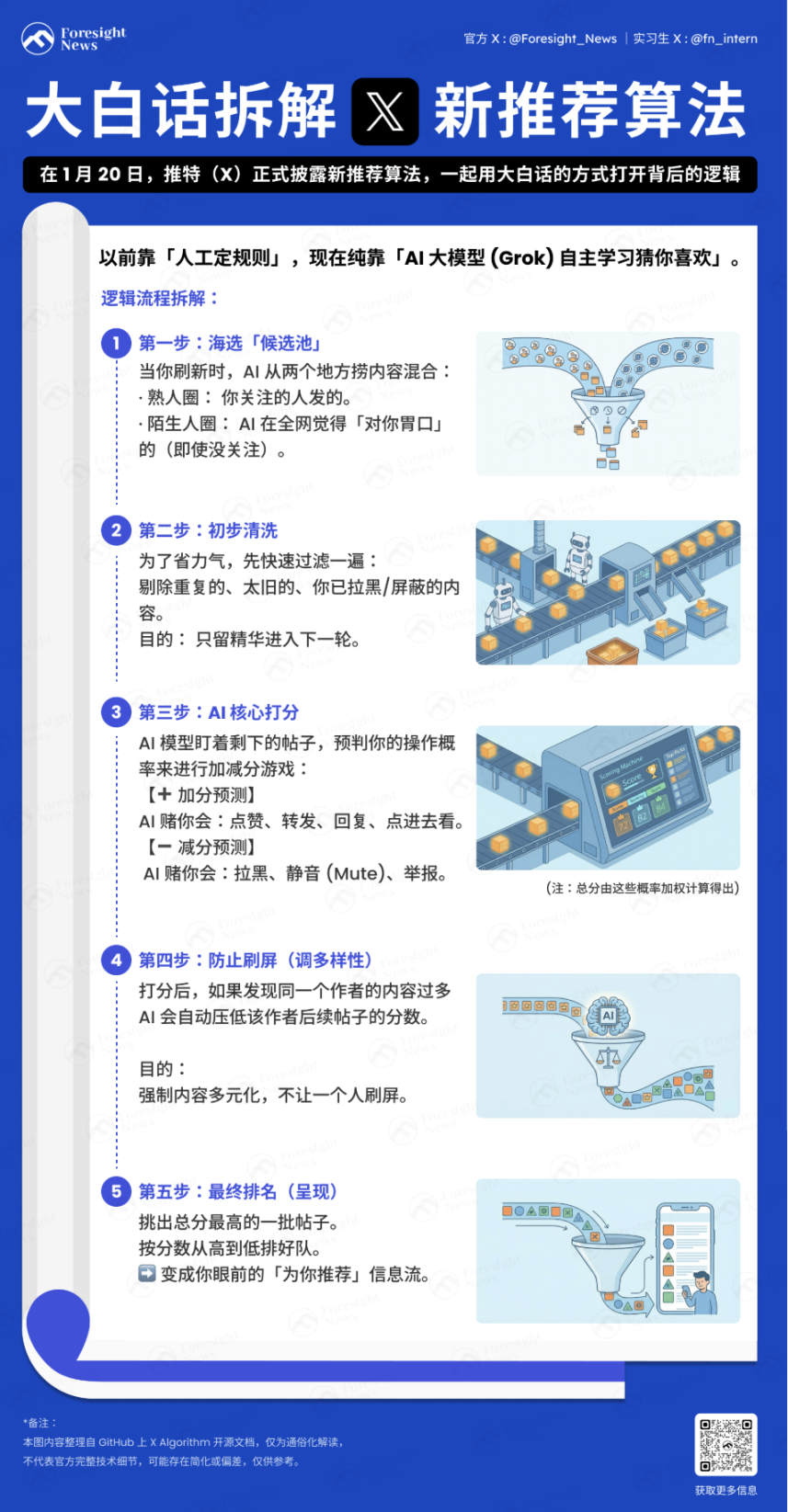
Simply put, the current algorithm is: mixing "content posted by people you follow" and "content from the entire network that might suit your taste," then sorting it based on a series of your previous actions on X, such as likes, comments, etc., according to its appeal to you. After two rounds of filtering, it eventually becomes the recommended information flow you see.

Below is the core logic translated into plain language:
Building a Profile

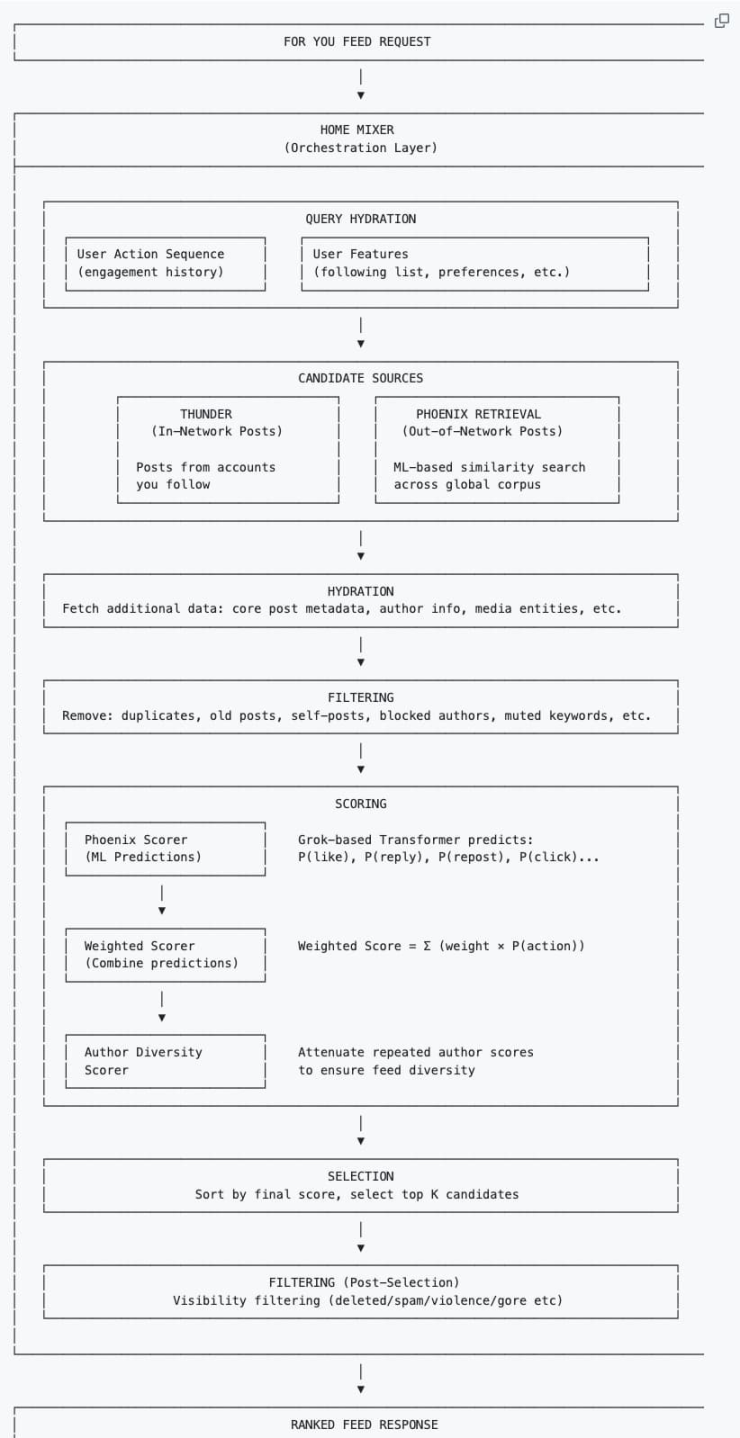
The system first collects the user's contextual information to build a "profile" for subsequent recommendations:

  • User behavior sequence: Historical interaction records (likes, retweets, dwell time, etc.).

  • User features: Follow list, personal preference settings, etc.

Where does the content come from?

Every time you refresh the "For You" timeline, the algorithm fetches content from the following two sources:

  • Inner Circle (Thunder): Tweets from people you follow.

  • Outer Circle (Phoenix): Posts from people you don't follow, but which the AI, based on your taste, fishes out from the vast sea of people as posts you might be interested in (even if you don't follow the author).

These two piles of content are mixed together to form the candidate tweets.

Data Completion and Preliminary Filtering

After fishing up thousands of posts, the system pulls the complete metadata of the posts (author information, media files, core text). This process is called Hydration. Then it performs a quick cleaning round, eliminating duplicate content, old posts, posts the user themselves posted, content from blocked authors, or content containing muted keywords.

This step is to save computing resources and prevent invalid content from entering the core scoring phase.

How is scoring done?

This is the most crucial part. The Transformer model based on Phoenix Grok scrutinizes each remaining candidate post after filtering and calculates the probability of you performing various actions on it. It's a game of adding and subtracting points:

Plus points (Positive feedback): The AI thinks you are likely to like, retweet, reply, click on the image, or click to view the profile.

Minus points (Negative feedback): The AI thinks you are likely to block the author, mute, or flag the post.
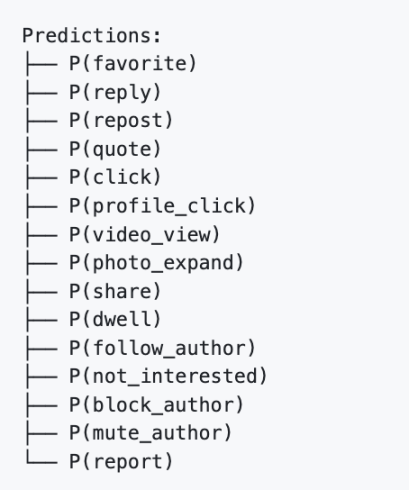
Final Score = (Like probability × weight) + (Reply probability × weight) – (Block probability × weight)...

It is worth noting that in the new recommendation algorithm, the Author Diversity Scorer usually intervenes after the AI calculates the final score. When it detects multiple pieces of content from the same author in a batch of candidate posts, this tool automatically "downgrades" the score of that author's subsequent posts, making the authors you see more diverse.

Finally, sort by score and pick the batch of posts with the highest scores.

Secondary Filtering

The system re-checks the top-scoring posts, filters out violations (such as spam, violent content), deduplicates multiple branches of the same thread, and finally arranges them in order from highest to lowest score, becoming the information flow you see.
Summary

X has removed all manually designed features and most heuristic algorithms from the recommendation system. The core advancement of the new algorithm lies in "letting the AI autonomously learn user preferences," achieving a leap from "telling the machine what to do" to "letting the machine learn how to do it itself."

First, recommendations are more accurate, and "multi-dimensional prediction" fits real needs better. The new algorithm relies on the Grok large model to predict various user behaviors—not only calculating "whether you will like/retweet" but also calculating "whether you will click the link to view," "how long you will stay," "whether you will follow the author," and even predicting "whether you will report/block." This refined judgment allows the recommended content to fit users' subconscious needs with unprecedented precision.

Second, the algorithm mechanism is relatively fairer and can, to some extent, break the curse of "big account monopoly," giving new and small accounts more opportunities: The old "heuristic algorithm" had a fatal problem: big accounts, relying on historically high interaction volumes, could get high exposure no matter what content they posted, while new accounts, even with high-quality content, were buried due to "lack of data accumulation." The candidate isolation mechanism allows each post to be scored independently, unrelated to "whether other content in the same batch is a hit." At the same time, the Author Diversity Scorer also reduces the spamming behavior of subsequent posts by the same author in the same batch.

For X the company: This is a cost-reducing and efficiency-increasing measure, using computing power to replace manpower, and using AI to improve retention. For users, we are dealing with a "super brain" that constantly tries to read our minds. The more it understands us, the more we rely on it. But precisely because it understands us too well, we will sink deeper into the "information cocoon" woven by the algorithm and become more easily targeted by emotionally charged content.


Twitter:https://twitter.com/BitpushNewsCN

Bitpush TG Discussion Group:https://t.me/BitPushCommunity

Bitpush TG Subscription: https://t.me/bitpush

Original link:https://www.bitpush.news/articles/7604412

Perguntas relacionadas

QWhat is the core change in X's new recommendation algorithm compared to the old system?

AThe core change is shifting from 'manually designed rules and mostly heuristic algorithms' to a system that 'relies purely on AI large models to guess user preferences', allowing the AI to autonomously learn user preferences.

QFrom which two sources does the new algorithm gather candidate content for a user's 'For You' timeline?

AIt gathers content from the 'Thunder' circle (posts from people the user follows) and the 'Phoenix' circle (posts from accounts the user doesn't follow but that the AI predicts they might be interested in).

QWhat is the purpose of the 'Author Diversity Scorer' in the new algorithm?

AThe Author Diversity Scorer detects when multiple posts from the same author are in a batch of candidate content and automatically lowers the score of that author's subsequent posts to ensure the user sees a more diverse range of authors.

QHow does the AI model determine the final score for a piece of content?

AA Transformer model calculates the probability of the user performing various actions on the content. It adds points for predicted positive feedback (like, retweet, reply) and subtracts points for predicted negative feedback (block, mute, report), with each action weighted. The final score is the sum of these weighted probabilities.

QWhat are two main potential consequences for users mentioned in the article regarding the new algorithm?

AThe consequences are: 1) More accurate and personalized content that better fits the user's subconscious needs. 2) A deeper entrapment in an 'information cocoon' and a higher likelihood of being precisely targeted by emotional content because the algorithm understands them so well.

Leituras Relacionadas

Must-Watch Events Next Week|CLARITY Act Could Face Senate Vote; SpaceX, Circle to Report Earnings (8.3-8.9)

**Summary: Key Events and Developments to Watch (August 3-9)** The upcoming week is marked by significant financial disclosures, key legislative deadlines, and notable product updates. **Major Financial Events:** Several companies are scheduled to release their Q2 2026 earnings. American Bitcoin (ABTC) will report on August 3, followed by SpaceX and Hut 8 Mining Corp. on August 4, and Circle on August 5. Notably, a significant portion of SpaceX shares (up to 12% of total shares) will be unlocked on August 6 following their earnings release. **Key Legislative Deadline:** The U.S. Senate faces an August 7 deadline to secure 60 votes for the CLARITY Act, a bipartisan bill aiming to establish a federal regulatory framework for cryptocurrencies. The Senate may hold a full vote on the bill during the week. **Economic Data:** The U.S. July Non-Farm Payrolls report will be released on August 7, providing crucial labor market data. **Technology & Product Updates:** * **Shutdowns:** DeFi portfolio tracker Zapper and wallet app Ctrl Wallet will cease operations on August 3. * **Upgrades:** LayerZero will deprecate its v1 relayers on August 3. XRP Ledger's new version 3.3.0, featuring five new functions, is expected next week. * **AI:** Elon Musk announced that the advanced Grok 4.6 AI model is set for release around August 7. * **Bitcoin:** The BIP-110 forced signaling for a potential Bitcoin network change is scheduled to begin around August 8. **Other Notable Events:** Chinese robotics firm Unitree Tech has set its preliminary price inquiry for its IPO for August 5. South Korean exchange Upbit will delist AQT and AERGO tokens on August 3.

marsbitHá 1h

Must-Watch Events Next Week|CLARITY Act Could Face Senate Vote; SpaceX, Circle to Report Earnings (8.3-8.9)

marsbitHá 1h

Stocks Are Plummeting More Sharply Than Cryptocurrencies. Where Has the Money Gone?

Stock Markets Plunge Deeper Than Cryptocurrencies: Where Did the Money Go? In late July, Seoul's Kospi index triggered circuit breakers for two consecutive days, plummeting over 40% from its June high. The collapse was led by heavyweight stocks like SK Hynix, whose record profits still disappointed investors, and devastating leveraged ETFs, with one major product losing over 83% of its value. This signaled a global, forced deleveraging targeting the most crowded trades. Interestingly, while stocks exhibited extreme volatility akin to crypto markets, Bitcoin rose nearly 15% in July after a prior steep drop. Analysis shows the money fleeing equities did not flow into Bitcoin. Instead, Bitcoin had already absorbed its sell-off in May-June, when U.S. spot Bitcoin ETFs saw historic outflows. The true safe-haven beneficiary was gold, whose price rose over 20% year-on-year, highlighting a decoupling between Bitcoin and gold as "digital gold." The sell-off was a targeted unwinding of leveraged positions in tech and semiconductors, accelerated by broker-dealer risk management and shifts in the AI narrative, including new competition from Chinese memory chipmakers. The retreat path was clear: from high-valuation tech stocks to cash and U.S. Treasuries, then to gold. For Bitcoin to attract sustained institutional inflows, conditions like eased global liquidity pressure, a "soft-landing" Fed rate cut, and U.S. regulatory clarity via legislation like the stalled CLARITY Act are needed. Currently, Bitcoin is not a safe haven but an already-cleared asset. Its low correlation with tech stocks, however, makes it a potential diversification play for institutional portfolios once the storm passes. The money isn't here yet, but the positioning is underway.

marsbitHá 1h

Stocks Are Plummeting More Sharply Than Cryptocurrencies. Where Has the Money Gone?

marsbitHá 1h

In Conversation with Ray Dalio: We Are Currently in an AI Bubble, with 1% of My Portfolio in Bitcoin

Ray Dalio, founder of Bridgewater Associates, warns in an interview that the current AI boom shows classic bubble characteristics, which could lead to significant economic downturns as seen in past cycles like 1929 or 2000. He explains that speculative enthusiasm, fueled by debt and overvaluation, often precedes a crash when rising rates or taxation force asset sales, causing widespread losses and recession. Dalio also outlines his "Big Cycle" theory, describing an approximate 80-year pattern where widening wealth gaps, massive government deficits, and shifting geopolitical power (like China's rise) create internal conflict and global instability. He emphasizes that we are in a late-cycle, transitional phase where traditional powers like the US and UK face decline. For personal wealth protection, Dalio advises diversification beyond cash into assets like stocks, bonds, real estate, and particularly gold, which he prefers over Bitcoin. While he holds about 1% of his portfolio in Bitcoin as a non-printable hard asset, he views gold as more secure from technological or governmental threats. Regarding AI's impact, Dalio believes it will disproportionately benefit capital owners, worsening inequality by replacing both physical and cognitive labor. He suggests that human intuition and emotional intelligence, combined with AI, will be key for future workers. On taxation, Dalio argues that wealth taxes are impractical and risk triggering asset sell-offs, reducing productive investment. He points to the UK as a cautionary example of debt, low productivity, and political strife. Geopolitically, Dalio foresees a more regionalized world, with the US showing weakness in prolonged conflicts like with Iran, akin to past imperial declines. The ideal outcome, he suggests, is coexisting powerful blocs (e.g., Americas, China-Asia Pacific) without major war.

marsbitHá 5h

In Conversation with Ray Dalio: We Are Currently in an AI Bubble, with 1% of My Portfolio in Bitcoin

marsbitHá 5h

Trading

Spot
活动图片





