From Macro to Allocation: Key Variables for TradFi × Crypto in 2026

比推Publicado em 2026-01-22Última atualização em 2026-01-22

Resumo

CoinFound's "TradFi x Crypto 2026 Outlook" report identifies key trends shaping the convergence of traditional finance and crypto. It highlights 2025 as an inflection point of integration, with 2026 accelerating into a phase of "programmable finance." The report outlines eight major macro forces, including a crisis of trust in fiat systems driving demand for hard assets like Bitcoin and gold, geopolitical shifts fostering parallel blockchain-based settlement systems, and AI automation creating demand for machine-to-machine payments using stablecoins. Additionally, energy scarcity is turning mining firms into critical infrastructure, while Real-World Assets (RWA) are evolving from issuance to utility, enhancing liquidity and serving as programmable collateral. Seven key investment trends for 2026 are projected: the RWA market will structurally expand, led by stablecoins and new growth in equities and commodities; stablecoins will compete as global payment infrastructure; tokenized stock liquidity will grow; and private credit RWA will become more transparent and asset-driven due to default risks. Furthermore, gold and commodity RWAs will enable new collateralized finance, RWA liquidity will centralize on major exchanges, and crypto equities (DATs) will see both differentiation and consolidation. The report concludes that 2026 will be defined by secondary market expansion and credit growth, with risks centered on the complexity of managing off-chain defaults triggering on-ch...

Author: CoinFound, TradFi × Crypto Data Technology Company

Original Title: 2026 TradFi x Crypto Outlook: 8 Macro Forces and 7 Investment Trends Driving 2026


On January 21, CoinFound officially released the "CoinFound Annual Report: TradFi x Crypto 2026 Outlook," which focuses on the deep integration trends between TradFi and Crypto. The following is a summary of the report:

2025 is the "tipping point for integration," and 2026 will enter an accelerated period of "programmable finance."

The report distills 8 Mega Forces and 7 trend outlooks: from Stablecoin 2.0 competing for global payment infrastructure, to RWA evolving from "issuance" to "utility," and key variables such as stock tokenization, DAT differentiation, and concentration.

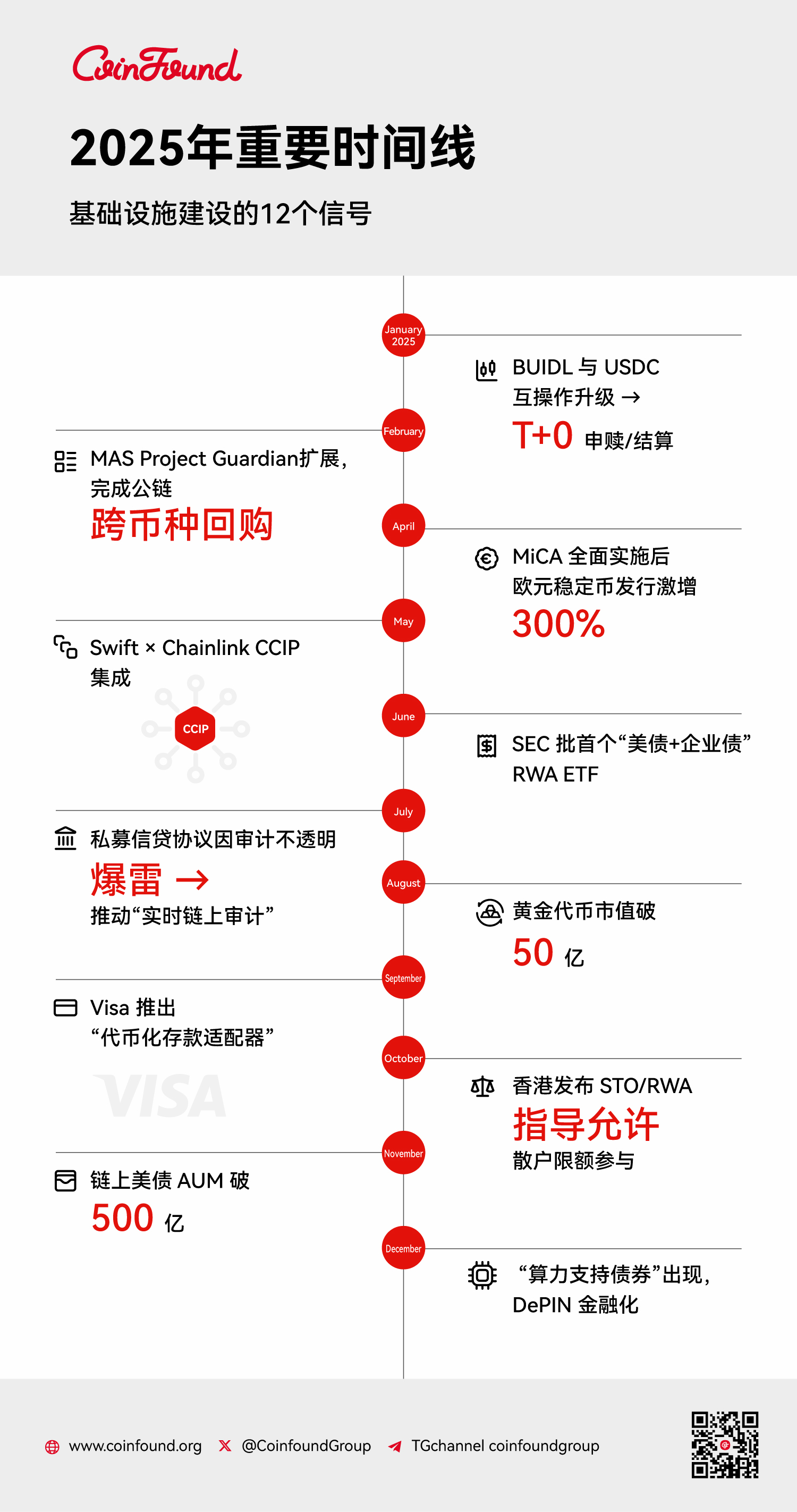
2025 Timeline of Key Events in Traditional Finance x Crypto
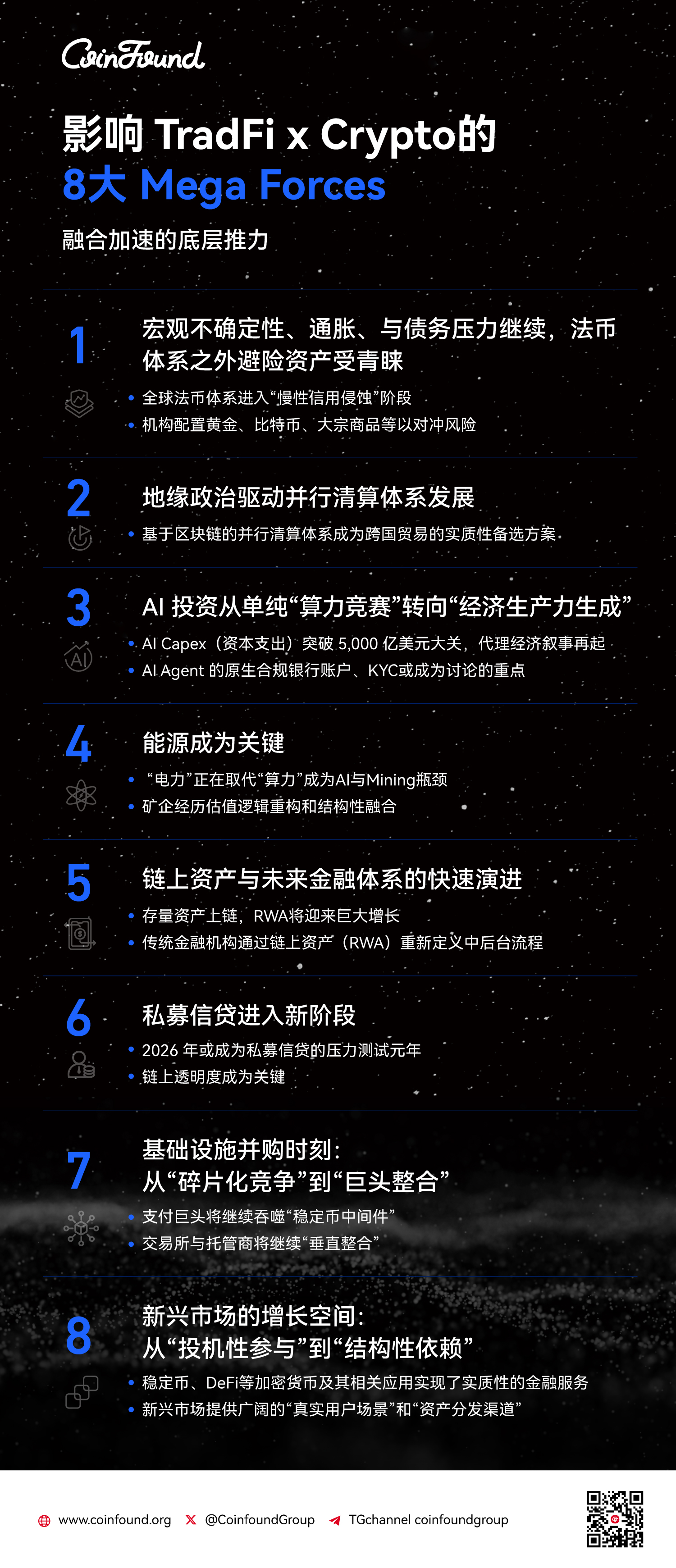
In 2026, the following macro trends will impact the TradeFi x Crypto field:

  • Fiat System Trust Crisis and Hard Asset Resurgence: Facing the global debt spiral and "fiscal dominance" risks, institutions are accelerating allocations to "hard assets" such as gold, Bitcoin, and commodities to hedge against fiat currency credit erosion.

  • Geopolitics Driving Parallel Settlement Systems: The need for "de-weaponization" of financial infrastructure is pushing blockchain as an alternative settlement solution independent of SWIFT, with atomic settlement mechanisms effectively reducing trust and counterparty risks in cross-border transactions.

  • AI Productivity Monetization and Machine Payment Emergence: The focus of AI investment is shifting from computing hardware to economic productivity generation, creating a rigid demand for compliant stablecoins and on-chain automated settlements by AI Agents to achieve value attribution between machines.

  • Energy as a Core Asset and Miner Infrastructure Transformation: Power shortages are driving mining companies to transform into "hybrid computing centers," with their scarce power access rights (Time-to-Power) triggering acquisitions by tech giants and driving a revaluation of mining companies towards data center infrastructure.

  • On-Chain Assets (RWA) Moving from Issuance to Utility: Asset tokenization is entering the "programmable finance" stage, where RWA is no longer just a digital certificate but serves as 24/7 core collateral, significantly enhancing the capital efficiency of repo markets and overall liquidity.

  • Private Credit Stress Testing and Transparency Transformation: The 2026 debt maturity wave may trigger default risks, forcing the industry to shift from "black boxes" to real-time on-chain transparent audits based on zero-knowledge proofs (ZK) to avoid DeFi chain liquidation crises.

  • Infrastructure Moving from Fragmented Competition to Giant Integration: The market is entering a consolidation phase similar to the telecommunications industry, with payment and financial giants acquiring stablecoin middleware and custodians to secure their positions, eliminate redundancy, and build compliance moats. Emerging markets are shifting from speculation to structural dependence: Crypto assets have deepened into underlying tools for payments and remittances in emerging markets, with vast real user scenarios making them a core hub connecting traditional financial assets with global retail liquidity.

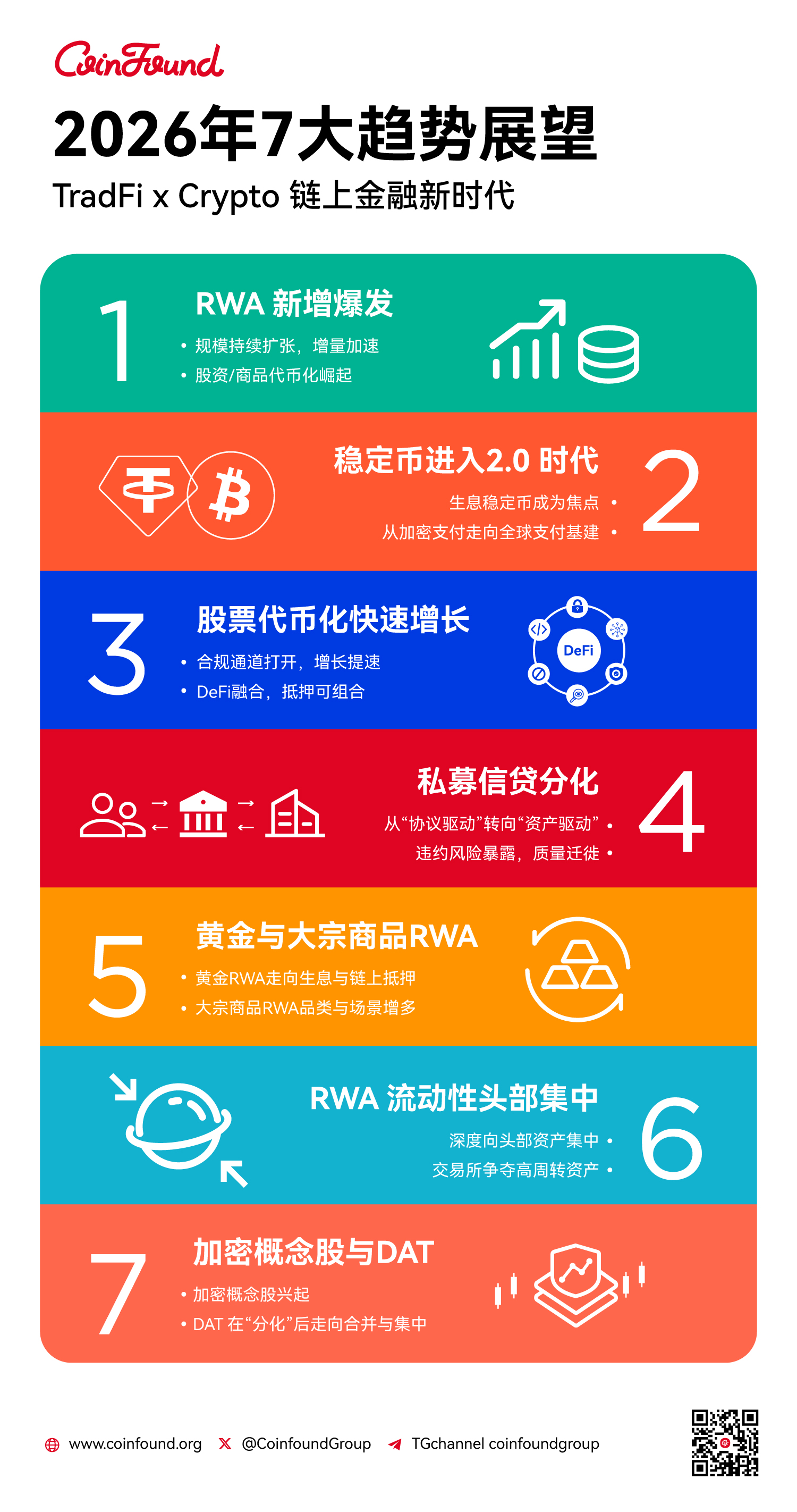
The trend outlook for 2026 is as follows:

1. Structural explosion in the RWA market, stablecoins laying the foundation for a $320 billion market, with equities and commodities becoming new growth points

2. Stablecoins enter the 2.0 era, moving from crypto payments to competing for global payment infrastructure

3. Stock tokenization liquidity may grow rapidly, with DeFi integration becoming key

4. Private credit RWA shifts to "asset-driven," potentially accelerating differentiation under "default" risk pressure

5. Gold and commodity RWA usher in a new era of "full-asset collateral"

6. RWA liquidity will further concentrate, with three types of RWA assets gaining favor among exchanges

7. The "rise" of crypto concept stocks, and the "differentiation" and "concentration" of DAT
Summary

2025 Summary: 2025 was a year of "demystification and integration" for TradeFi and Crypto. Blockchain technology is being reduced from its "revolutionary"光环 to an efficient bookkeeping and settlement technology. The success of Treasury RWA has demonstrated the feasibility of traditional assets on-chain, while the full entry of giants like BlackRock has provided irreversible credit endorsement for the industry.

2026 Prediction: 2026 will be a year of "secondary market explosion and credit expansion." We judge:

  • Liquidity Explosion: With the improvement of infrastructure, RWA will shift from "holding for yield" to "high-frequency trading."

  • Credit Downward Drift: Asset classes will drift downward from high-credit government bonds to corporate bonds, stocks, and emerging market credit, with risk premium becoming a new source of return.

  • Risk Warning: As the scale of RWA expands, the complexity of off-chain default transmission to on-chain liquidation will be the biggest systemic risk.

In 2026, both TradeFi and Crypto will be unified under the banner of "On-chain Finance."


Twitter:https://twitter.com/BitpushNewsCN

Bitpush TG Discussion Group:https://t.me/BitPushCommunity

Bitpush TG Subscription: https://t.me/bitpush

Original link:https://www.bitpush.news/articles/7605062

Perguntas relacionadas

QWhat are the 8 Mega Forces that will influence the TradFi x Crypto landscape in 2026 according to the CoinFound report?

AThe 8 Mega Forces are: 1. Fiat system trust crisis and the return to hard assets, 2. Geopolitically driven parallel clearing systems, 3. AI productivity monetization and the rise of machine payments, 4. Energy as a core asset and the infrastructuralization of mining companies, 5. On-chain assets (RWA) moving from issuance to utility, 6. Stress testing and transparency transformation in private credit, 7. Infrastructure consolidation from fragmented competition to giant integration, and 8. Emerging markets shifting from speculation to structural dependence.

QWhat is the projected market size for stablecoins in 2026, and what is driving this growth?

AThe stablecoin market is projected to have a base of 3200 billion USD. This growth is driven by stablecoins evolving from crypto payments to competing for global payment infrastructure, entering what the report calls the 'Stablecoin 2.0' phase.

QHow does the report characterize the year 2025 versus the year 2026 for TradFi and Crypto?

AThe report characterizes 2025 as the 'inflection point for integration,' where blockchain technology was demystified and seen as efficient settlement tech. In contrast, 2026 is predicted to be a year of 'secondary market explosion and credit expansion,' marking an acceleration period for 'programmable finance'.

QWhat major shift is expected in the RWA (Real World Assets) market in 2026?

AThe major shift is that RWA will move from 'issuance' to 'utility.' It will no longer be just digital certificates but will function as 24/7 core collateral, significantly enhancing the capital efficiency of repo markets and overall liquidity. The asset class will also expand from high-credit government bonds to include corporate bonds, stocks, and emerging market credit.

QWhat does the report identify as the biggest systemic risk for the expanding RWA market?

AThe biggest systemic risk identified is the complexity of off-chain asset defaults being transmitted to on-chain liquidations as the scale of RWA expands.

Leituras Relacionadas

Agent Race Ends, Super Workbench Takes Over

The era of fragmented AI agents is ending. Over the past month, China's tech giants—Tencent, Alibaba, and ByteDance—have simultaneously shifted strategy: instead of launching new, standalone AI agents, they are consolidating their various agent projects into unified "super workbenches." Tencent integrated its QClaw teams into WorkBuddy, a strategic product hailed as a potential third flagship after QQ and WeChat. Alibaba is merging its QoderWork, Wukong, and MuleRun agents into a new "Qianwen Office" platform under DingTalk's leadership. ByteDance rebranded its TRAE SOLO coding agent to TRAE Work, signaling a broader focus on workflow collaboration. This convergence marks a pivotal industry consensus. The initial exploration phase, where companies rapidly built numerous overlapping agents for different scenarios, proved costly and inefficient. With open-source tools eroding technical barriers, competition has shifted from agent creation to resource consolidation and cost control. Historically, platform wars are won not by creating more products, but by simplifying them—as seen with browsers unifying web access and super-apps consolidating services. Now, the "super workbench" aims to become the unified AI entry point for work. This reflects a deeper market realization: the primary audience for AI is no longer just programmers (a market in the tens of millions) but all knowledge workers (a market of billions). The real opportunity lies in augmenting everyday tasks—managing emails, documents, data, and meetings—across the entire workday. The core battleground is becoming control over the primary AI entry point that employees use daily. Tencent's WorkBuddy leverages WeChat and Tencent Docs; Alibaba's Qianwen Office taps into DingTalk's organizational data; ByteDance's TRAE Work integrates with Feishu's workflows. Whoever owns this "super workbench" gains strategic control over orchestrating enterprise data and APIs. This shift is redefining enterprise software. Traditional SaaS applications, valued for their user interfaces, will recede into the background. Their core functionalities will be exposed as standardized "Skills" or APIs for the super workbench's agents to invoke. Software value will shift from selling user seats to charging based on API calls and outcomes delivered. The evolution of agents is moving through clear stages: first as novel standalone products, then as consolidated primary work entry points, and finally as pervasive, invisible capabilities embedded into the digital fabric. The recent moves by major tech firms signal the transition from the first stage into the second, accelerating toward the third. In the end, the most successful agent technology may become invisible—like electricity or the HTTP protocol—a fundamental, unnamed infrastructure powering work itself.

marsbitHá 7m

Agent Race Ends, Super Workbench Takes Over

marsbitHá 7m

Michael Saylor: 110 Reasons to Oppose BIP-110

Michael Saylor presents 110 arguments against Bitcoin Improvement Proposal (BIP) 110, a soft fork aimed at restricting certain non-monetary data storage uses (like inscriptions) on the Bitcoin blockchain. He acknowledges the proponents' valid concerns—such as node costs, fee pressure, and preserving Bitcoin's monetary focus—but fundamentally disagrees with the proposed solution. Saylor argues that BIP 110 represents a dangerous precedent of using consensus rules to enforce value judgments on transaction validity, moving away from Bitcoin's core principles of neutrality and permissionless innovation. His key objections are organized into eleven categories: 1) It violates neutrality and hard consensus by banning currently valid transactions. 2) It fails to meet the high burden of proof required for a consensus change, lacking concrete data on the alleged crisis. 3) Its seven bundled technical restrictions are overly broad, targeting generic script functionalities and blocking future upgrade paths. 4) It sacrifices compatibility and future optionality by closing off designed upgrade hooks. 5) Its temporary rules add significant complexity (grandfathering, expiry states) without sufficient justification. 6) The economic and security impacts, particularly on miner revenue and fee markets, are uncertain and unmodeled. 7) Superior, market-based tools (fee markets, relay/mining policies) already exist to manage blockchain load. 8) It stifles innovation by creating a chilling effect for developers. 9) Its modified activation mechanism (55% threshold, forced signaling) is aggressive and risks network splits. 10) The precedent it sets—using consensus to suppress disliked but legal uses—is more dangerous than the problem it aims to solve. 11) A better path exists: improving measurements, refining resource-based policies, and allowing market forces to work. Saylor concludes that Bitcoin's strength lies in its neutral rules, open markets, and hard consensus. Changing these foundational elements to target specific use cases is an unnecessary and risky "iatrogenic" intervention. He advocates for guarding Bitcoin's neutrality rather than acting as its redeemer.

marsbitHá 23m

Michael Saylor: 110 Reasons to Oppose BIP-110

marsbitHá 23m

Trading

Spot
活动图片