From "Life K-line" to "Laozi": A Look at the Top 5 Hottest BSC "Chinese Memes" Right Now

Odaily星球日报Publicado em 2026-01-11Última atualização em 2026-01-11

Resumo

In the 2026 crypto market resurgence, Chinese-themed meme coins on Binance Smart Chain (BSC) have gained significant traction. This article highlights five popular Chinese meme tokens: 1. "我踏马来了" (I’m Coming): The new leading Chinese meme, with a market cap of ~$36M after reaching ~$52M. It was listed on Binance Alpha, boosting its visibility. 2. "人生K线" (Life K-line): An AI-themed metaphysical token that surged to ~$42M (now ~$20M) after features on CCTV and support from key Binance figures. 3. "老子" (Laozi): A Sichuan dialect-based meme referencing both the local slang for "I" and the ancient philosopher. Market cap is ~$15M, bolstered by a $50K purchase from the BSC Foundation. 4. "川普" (Chuanpu): Plays on Sichuan accent and shares a name with Donald Trump. Market cap is ~$2M, though it lacks the historical significance of political memes like TRUMP. 5. "超级周期" (Super Cycle): Inspired by a CZ tweet about a potential "super cycle" in crypto. Market cap peaked at ~$4M and now sits at ~$1.7M. The momentum of these memes relies heavily on continued attention from influencers like CZ, He Yi, and Binance's listing strategies. Note: Meme coins are highly volatile; this is not investment advice.

Original|Odaily Planet Daily(@OdailyChina)

Author|Wenser(@wenser 2010)

The recovery of the 2026 crypto market started with Meme coins. Overnight, "the whole world is speaking Chinese."

As established Meme coins led the initial surge, the BSC ecosystem quickly took over—a wave of Chinese Memes, leveraging simple yet highly viral concepts like "I'm fucking coming," emerged and spread like wildfire within days. In the current liquidity-scarce environment, each price increase is not accidental but the result of a battle for attention.

Odaily Planet Daily will provide a brief overview of the currently popular Chinese Meme projects on the BSC ecosystem for readers' reference (Odaily Note: Meme coin prices are highly volatile; the following is for informational purposes only and not investment advice).

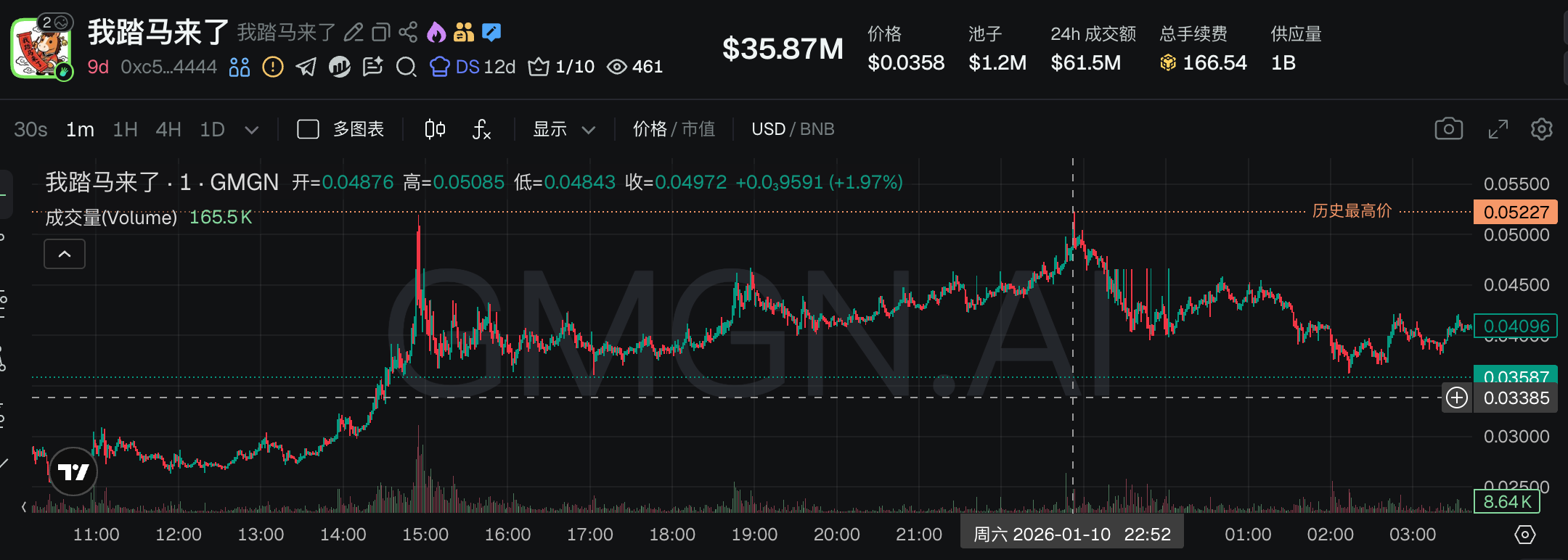
New Chinese Meme Leader: "I'm Fucking Coming", Market Cap Temporarily Reported at $36 Million

As the "new Chinese Meme leader" of the past week, "I'm Fucking Coming" rapidly launched on Binance Alpha, injecting a shot of adrenaline into the Chinese Meme concept board. For related discussions on this Meme coin, we recommend reading "How to Evaluate the Listing of 'I'm Fucking Coming' on Binance?".

Previously, this Meme coin surged to around $52 million and has since pulled back to approximately $36 million. Whether it can reach a new all-time high (ATH) again still depends on achieving milestone accomplishments like Binance futures and spot listings.

GMGN Link: https://gmgn.ai/bsc/token/0xc51a9250795c0186a6fb4a7d20a90330651e4444
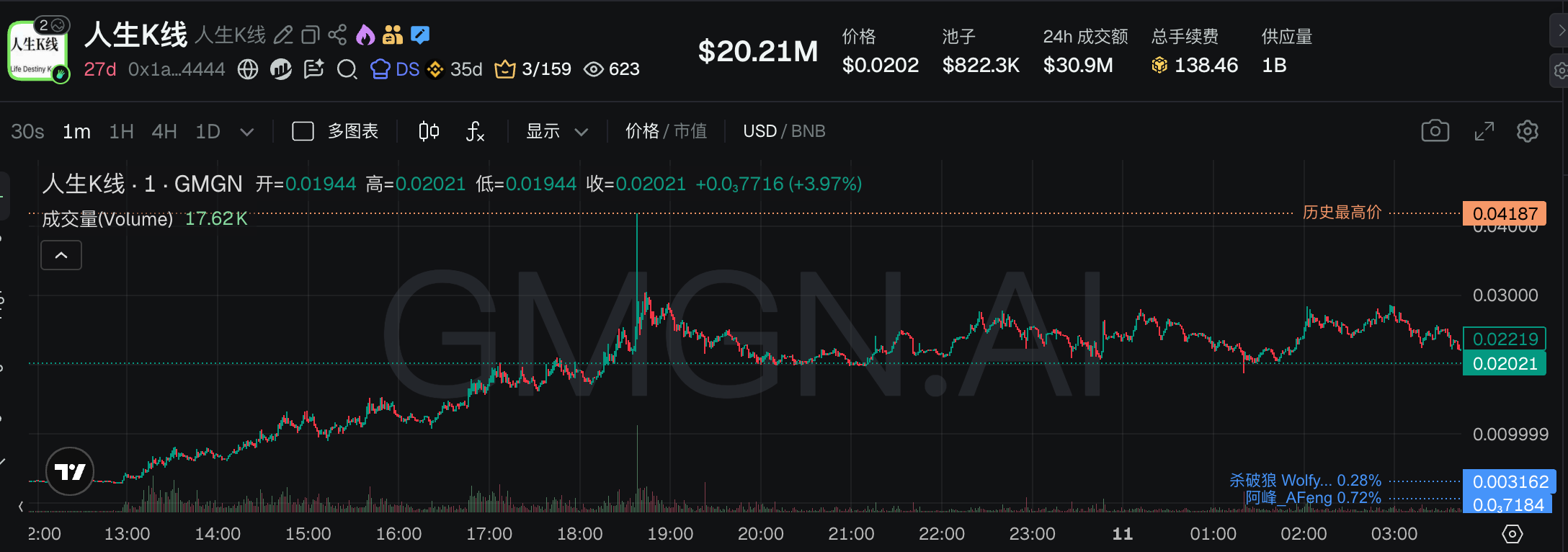
AI Mysticism Concept Coin: Life K-line, Market Cap Temporarily Reported at $20 Million

As early as last month's "Odaily Editorial Tea Party (December 17)", we mentioned the AI mysticism product "Life K-line," while its同名 Meme coin had been relatively quiet.

Recently, the暴涨 of Life K-line was primarily driven by two major events: 1) the product was featured in a report by CCTV (article link here); 2) support from BSC ecosystem and Binance key figure Nina Rong for Life K-line developer 0xSakura, coupled with the latter's update introducing the "Cyber Merit Box"—a product with a "donation" concept—jointly propelled Life K-line's market cap to soar from a low of $2 million to nearly $42 million at its peak.

As of writing, Life K-line's market cap has retreated to around $20 million.

GMGN Link: https://gmgn.ai/bsc/token/0x1a1e69f1e6182e2f8b9e8987e83c016ac9444444
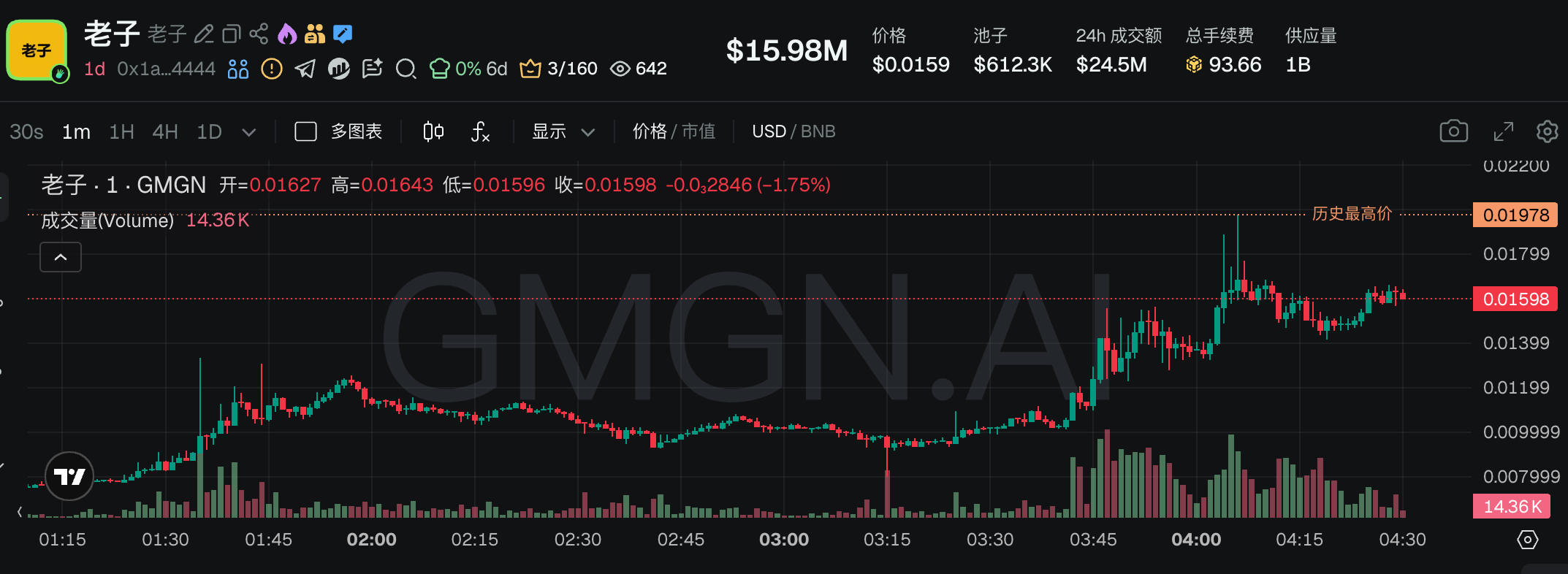
Sichuan Dialect Meme: Laozi, Market Cap Temporarily Reported at $15 Million

Since He Yi's hometown is Sichuan, Sichuan dialect-related Memes have also secured a place in this "BSC ecosystem Chinese Meme热潮." The Sichuan dialect colloquialism for "I"—"Laozi" (老子)—combined with the cultural attribute of sharing its name with the ancient philosopher Laozi, led to a rapid increase in its market cap, which previously approached $20 million.

Latest news shows that the BSC Foundation spent $50,000 to purchase the Chinese Meme coins Hakimi and Laozi, also providing消息面上的支撑 (news-driven support) for the rise of this Meme coin.

GMGN Link: https://gmgn.ai/bsc/token/0x1a5f9d77ca46646cd4937fd8d093f460b66f4444
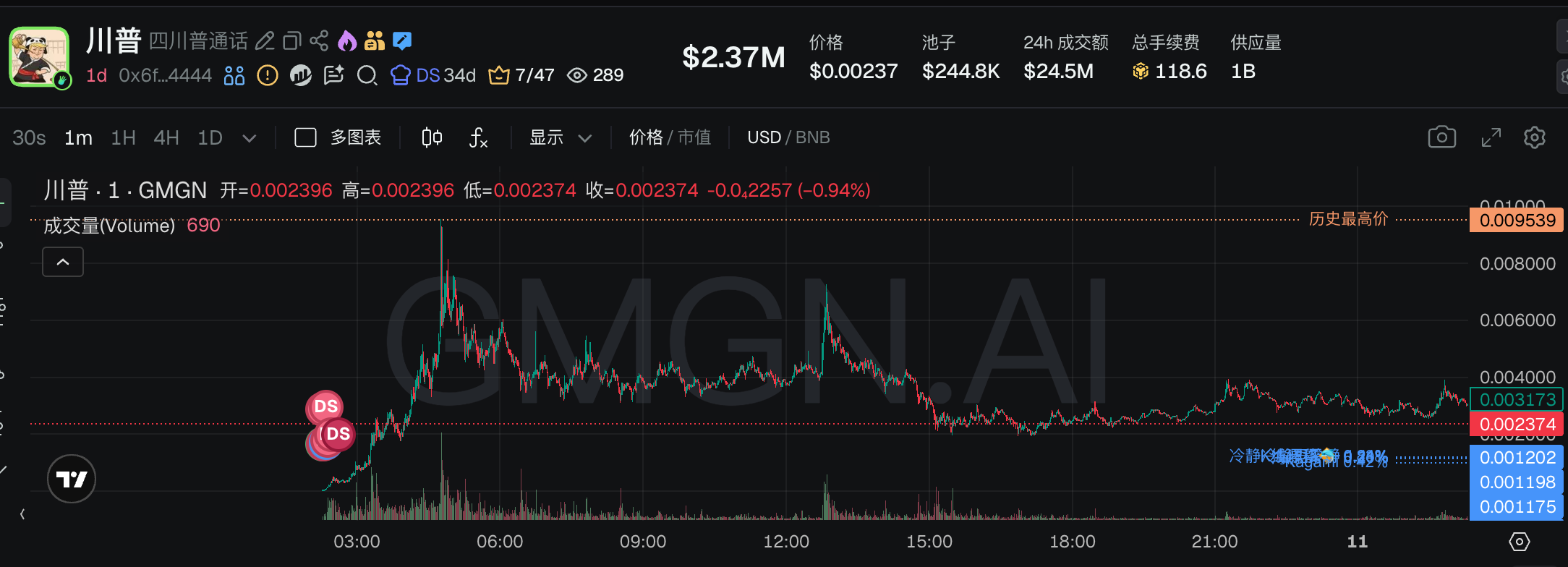
Sichuan Mandarin Concept Meme: Chuanpu, Market Cap Temporarily Reported Around $2 Million

Similar to "Laozi," Chuanpu is an abbreviation for Sichuan Mandarin. It previously gained Meme属性 (Meme attributes) online due to its humorous expressions. Moreover, this Meme has been interpreted by the market with a "celebrity color" because the name of US President Trump is also directly translated as "Chuanpu" in Chinese.

Previously,知名交易员冷静 (well-known trader Lengjing) even posted support, saying: "Another January, another Saturday, another Chuanpu, another 10 o'clock," hinting that the "Chuanpu" Meme coin might even ride the coattails of the热度 (heat) from the legitimate Trump Meme coin TRUMP last January. Of course, this is just one buying angle traders found. Based on current market performance, this is just one among the fast-rising and fast-fading Meme coin market, not a politically significant Meme coin like TRUMP.

GMGN Link: https://gmgn.ai/bsc/token/0x6fafec4730e0102d8ac82b00de460b9f31f44444
CZ Statement Concept Meme: Super Cycle, Market Cap Temporarily Reported at $1.7 Million

Unlike the mostly He Yi-related Meme coins above, Super Cycle is a Meme coin related to Binance founder CZ.

Last night, regarding the "U.S. Securities and Exchange Commission removing cryptocurrency from its 2026 priority risk list," CZ posted: "The super cycle is coming, but I could be wrong." Affected by this news, the Super Cycle Meme coin surged accordingly, with its market cap once exceeding $4 million. It has now retreated to around $1.7 million.

GMGN Link: https://gmgn.ai/bsc/token/0x2433092b3554eefc154f5ee3a275ebf2a85f4444
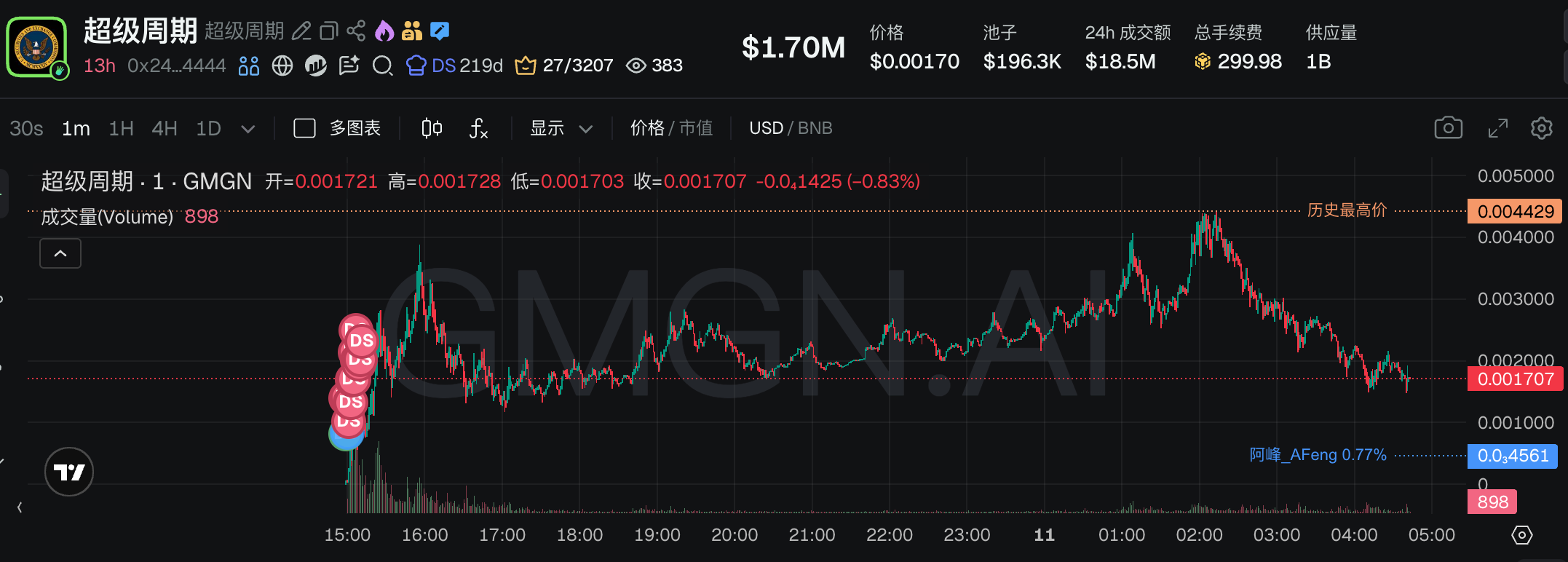
Of course, as we mentioned in "How to Evaluate the Listing of 'I'm Fucking Coming' on Binance?", whether this "BSC Meme热" (BSC Meme heat) can continue still highly depends on how CZ, He Yi, and the Binance listing team "cooperate" afterwards.


Perguntas relacionadas

QWhat is the new leading Chinese Meme token on BSC according to the article, and what is its approximate market capitalization?

AThe new leading Chinese Meme token is '我踏马来了' (I'm coming, damn it), with an approximate market capitalization of $36 million.

QWhich Chinese Meme token is associated with an AI divination product and received coverage from CCTV?

AThe Meme token is '人生K线' (Life K-Line), which is associated with an AI divination product that was reported on by CCTV.

QWhat is the name of the Sichuan dialect-inspired Meme token that BSC Foundation purchased, and what was the purchase amount mentioned?

AThe Sichuan dialect-inspired Meme token is called '老子' (Laozi). The BSC Foundation purchased $50,000 worth of it and another token called '哈基米' (Hachimi).

QWhat event triggered the price surge of the 'Super Cycle' Meme token, and who made the statement that influenced it?

AThe price surge was triggered by a statement from Binance founder CZ, who said 'Super cycle is coming, but I could be wrong' in response to the U.S. SEC removing crypto from its 2026 priority risk list.

QWhat does the article suggest is the key factor for the continuation of the current 'BSC Meme heat'?

AThe article suggests the continuation highly depends on the 'cooperation' of CZ, He Yi, and the Binance listing team.

Leituras Relacionadas

From South Korea to the United States: Blue-Collar Jobs Are Becoming Increasingly Popular, Thanks to AI

AI is reshaping the labor market's value proposition. The traditional four-year college degree is losing its appeal as a guaranteed career path, while skilled blue-collar trades like electricians, welders, and plumbers are experiencing historic demand and wage premiums. This shift is driven by dual pressures: AI's displacement of certain white-collar roles and a booming need for physical infrastructure and data center construction. Data confirms the trend. In the U.S., vocational school revenue surged, and a significant portion of recent layoffs are AI-related. Surveys show a majority of Gen Z adults plan to pursue blue-collar work, citing better job security against AI automation. Vocational education interest has exploded recently. Experts cite a psychological shift as younger generations seek tangible, AI-resistant careers and avoid high student debt. In many cases, salaries for skilled trades now match or exceed those requiring a bachelor's degree. In South Korea, semiconductor vocational high schools boast near-total employment, with graduates securing high-paying roles at companies like Samsung. The shortage is structural, exacerbated by a retiring baby boomer workforce and massive infrastructure projects. Companies like JPMorgan Chase, Meta, and Lowe's are investing heavily in training programs. However, overcoming historical stigma and a "perception gap" around trade careers remains a key challenge to closing the talent gap.

marsbitHá 1h

From South Korea to the United States: Blue-Collar Jobs Are Becoming Increasingly Popular, Thanks to AI

marsbitHá 1h

Qualcomm: AI Hype Subsides, When Will Smartphones Emerge from the Gloom?

Qualcomm reported its Q3 FY2026 results (ending June 2026), with revenue of $9.95B, down 4% YoY but above expectations. Gross margin declined to 53.1%, pressured by rising costs across manufacturing and memory. Key business segments showed mixed performance: Handset revenue fell 19.6% YoY to $5.09B, dragged by an 11% decline in non-Apple Android shipments and weaker high-end mix. Conversely, Automotive revenue surged 61% to $1.59B, and IoT grew 9% to $1.83B. Core operating profit dropped 41% YoY due to margin compression and higher expenses. Management's Q4 FY2026 guidance projects revenue of $9.7B-$10.5B, in line with consensus, but Non-GAAP EPS guidance of $2.05-$2.25 fell short of expectations. Amidst persistent weakness in its core handset market, Qualcomm is pursuing growth in AI, focusing on Edge AI (smartphones, PCs, automotive) and Data Center AI. Its data center strategy includes four pillars: AI accelerators (e.g., AI200), commercial CPUs (Dragonfly C1000), custom silicon, and connectivity solutions. While these initiatives initially boosted its stock, concerns over AI capital expenditure sustainability have since erased those gains. The company targets $5B in data center revenue for FY2027 and $15B for FY2029. The report concludes that with the traditional handset business still under pressure, the data center opportunity is currently viewed as a longer-term option, and a more conservative valuation based on core operations may be warranted until AI contributions materialize.

marsbitHá 1h

Qualcomm: AI Hype Subsides, When Will Smartphones Emerge from the Gloom?

marsbitHá 1h

From TPU to Self-Evolving Agents: How Jeff Dean Predicts the Next Step in AI

At the 2026 YC Startup School, Jeff Dean outlined his vision for AI's next phase, shifting focus from simply scaling models to building intelligent, autonomous systems. He believes AI's progress is no longer just about creating smarter models, but about integrating them into systems capable of long-term, iterative work, automated experimentation, and continuous learning. This evolution moves the competition from "who has the bigger model" to "who can best organize intelligence." Dean suggests AI capabilities are now comparable to a junior engineer, enabling the automation of complex workflows. However, the true challenge and opportunity lie in managing these AI "workers" at scale. He emphasizes the importance of **context engineering**—structuring tools, memory, and feedback loops—over raw model power. For startups, this means building deep expertise in niche domains where general models currently fail (near 0-1% success rates), leveraging proprietary data, specialized tools, and domain-specific evaluators. A recurring theme is re-examining fundamental constraints. Dean's past work, like moving Google's search index to memory or creating the TPU, stemmed from questioning outdated assumptions about hardware and cost. He sees similar inflection points today, particularly in **specialized inference hardware** to drastically reduce latency and energy consumption for real-time Agent operation. Notably, he points out that in modern AI systems, the dominant cost is often not computation but **data movement**. Reliable, long-running Agents require robust system design, borrowing concepts from distributed computing like checkpointing, state management, and parallel exploration to handle failures and maintain progress over days or weeks. As AI automates execution, the scarcest human skills will shift to **defining clear specifications**, **judging what problems are worth solving** (taste), and designing effective feedback loops. Ultimately, Dean's framework prioritizes understanding the problem deeply, identifying the true bottlenecks, and systematically building closed-loop systems where AI can not only perform tasks but also improve AI itself.

marsbitHá 1h

From TPU to Self-Evolving Agents: How Jeff Dean Predicts the Next Step in AI

marsbitHá 1h

Trading

Spot
活动图片




