From KYC to KYA, Is It Time to Give AI Agents Their Own 'ID Cards'?

marsbitPublicado em 2026-05-10Última atualização em 2026-05-10

Resumo

Titled "From KYC to KYA: Is It Time to Issue 'Identity Cards' for AI Agents?", this article discusses the emerging concept of Know Your Agent (KYA) as AI agents become increasingly autonomous. In Agent-to-Agent (A2A) scenarios, where agents execute contracts, payments, and trades without human intervention, the lack of a shared identity standard creates risks like unauthorized transactions, fraud, and accountability gaps. KYA acts as a trust layer to verify an agent's origin, authority, and accountability. The need for KYA is most critical outside centralized platforms (like Google or Coinbase), such as in decentralized exchanges (DEX), A2A payments, and merchant payments. Several key players are building KYA infrastructure: - **ERC-8004**: A proposed Ethereum standard that issues a unique AgentID as an NFT, building on-chain identity, reputation, and validation systems. - **Visa TAP**: Visa's solution issues agent identity credentials, with transactions verified via triple signatures (legitimacy, delegator, payment method). - **Trulioo**: Extends its KYC/KYB compliance infrastructure using a Digital Passport for Agents (DAP), issued after verifying both the developer and user, and refreshed per transaction. - **Sumsub**: Focuses on post-issuance real-time verification, detecting agent anomalies during transactions using its existing compliance systems. Regulatory bodies are also acting. The EU AI Act mandates operator identification in logs for high-risk AI systems, the US...

Authored by: Tiger Research

Compiled by: AididiaoJP, Foresight News

The era of AI agents is accelerating, and alongside it, concerns about the uncontrolled creation and behavior of agents are growing. Know Your Agent (KYA) systems, which assign identities to agents and regulate their behavior, are receiving increasing attention. Why is a KYA identity infrastructure needed? Which companies are building it?

Summary

  • AI agents have entered an era of autonomously executing contracts, payments, and transactions, but there are currently no shared standards to verify "who this agent is." In Agent-to-Agent (A2A) scenarios, KYA is gaining more focus than KYC.
  • KYA is not needed in all scenarios. Within centralized platforms (Google, OpenAI, Coinbase), existing KYC is sufficient. Where KYA truly becomes important is in scenarios where independently deployed autonomous agents interact with DEXs, A2A payments, and merchant payments.
  • The KYA standards race has begun:
  • ERC-8004: Issues AgentIDs on top of NFTs, building an on-chain system for identity, reputation, and verification.
  • Visa TAP: Visa issues identity credentials for agents, verified through TAP's triple signature (legitimacy, delegator, payment method).
  • Trulioo: Adopts the SSL CA model, with DPAs issuing DAPs.
  • Sumsub: Layers a KYA system on top of its own compliance system.

Regulatory action has begun at the national level. The EU's AI Act requires high-risk AI system behavior logs to include operator identity. The US NIST has listed agent identity management as a priority standard area. Singapore has released the world's first national-level AI agent governance framework. Just as the 2019 FATF Travel Rule determined which crypto exchanges survived, whether one possesses KYA infrastructure will determine who enters the next market cycle.

Why is KYA Emerging Now?

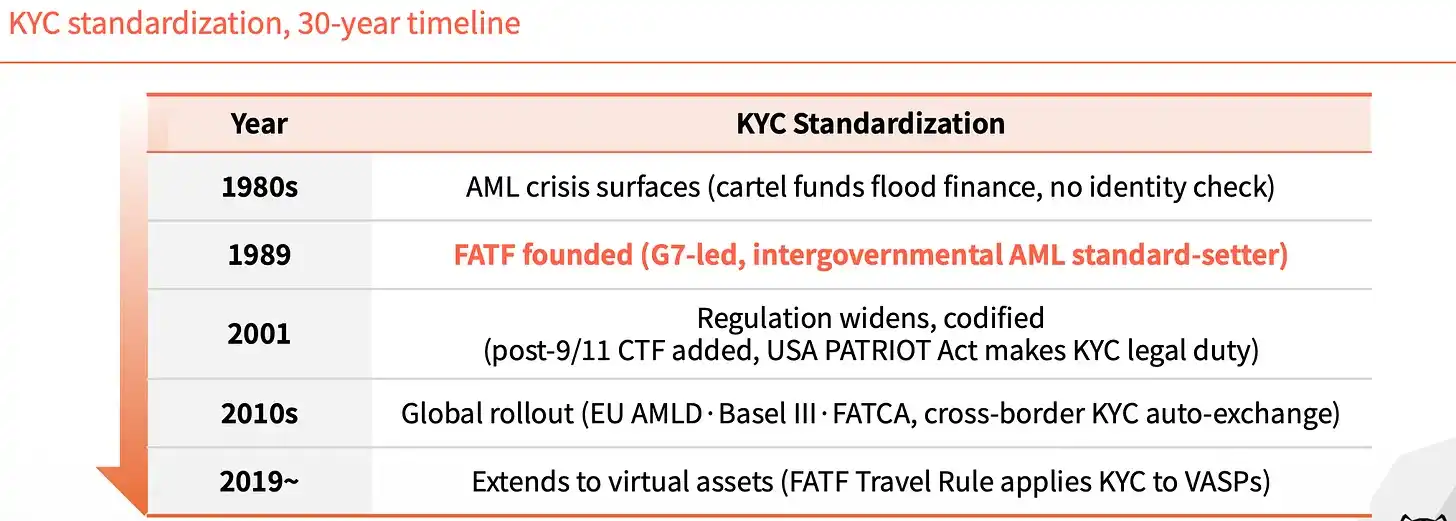
KYC: The Layer That Reshaped Finance

  • Before 1989, global finance lacked a unified identity standard. This gap made it difficult to track drug money and illicit funds.
  • After the FATF was founded in 1989, KYC became a mandatory requirement in finance, blocking illicit funds at the entry point.
Without Agent Identity, Systems Regress

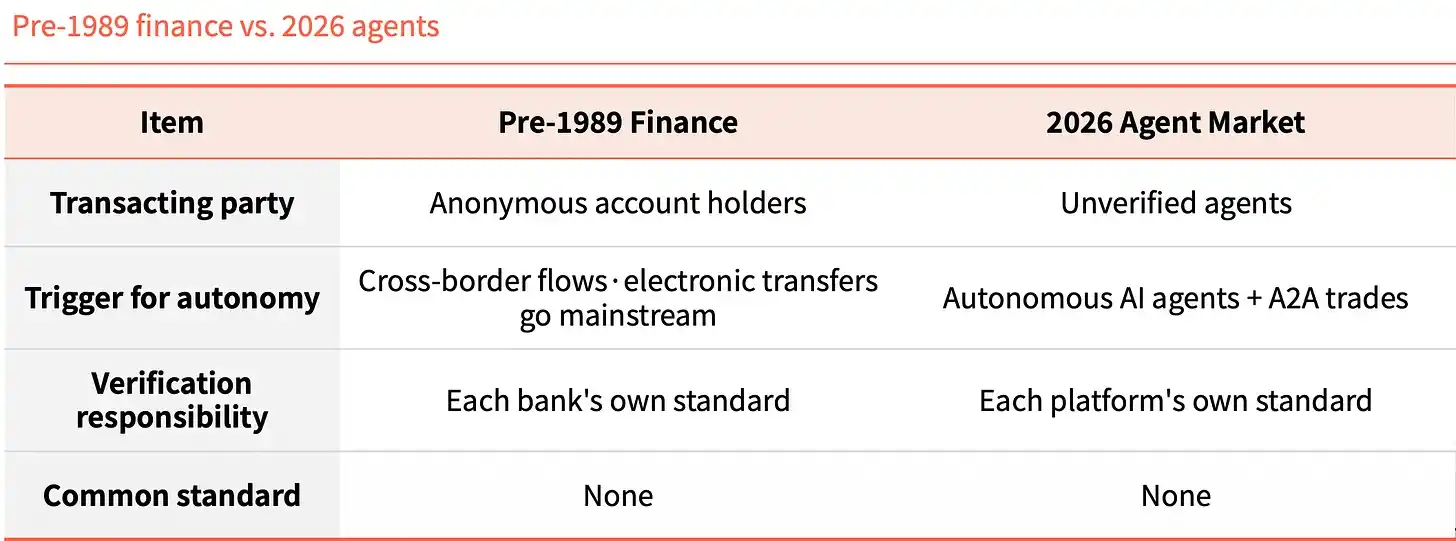
  • AI agents execute contracts, payments, and transactions without human involvement, but currently, it's impossible to verify "who it is."
  • In A2A environments, accountability becomes blurred, dispute risks increase, and users are exposed to fraud patterns like money laundering.
The Role and Response of KYA (Know Your Agent)

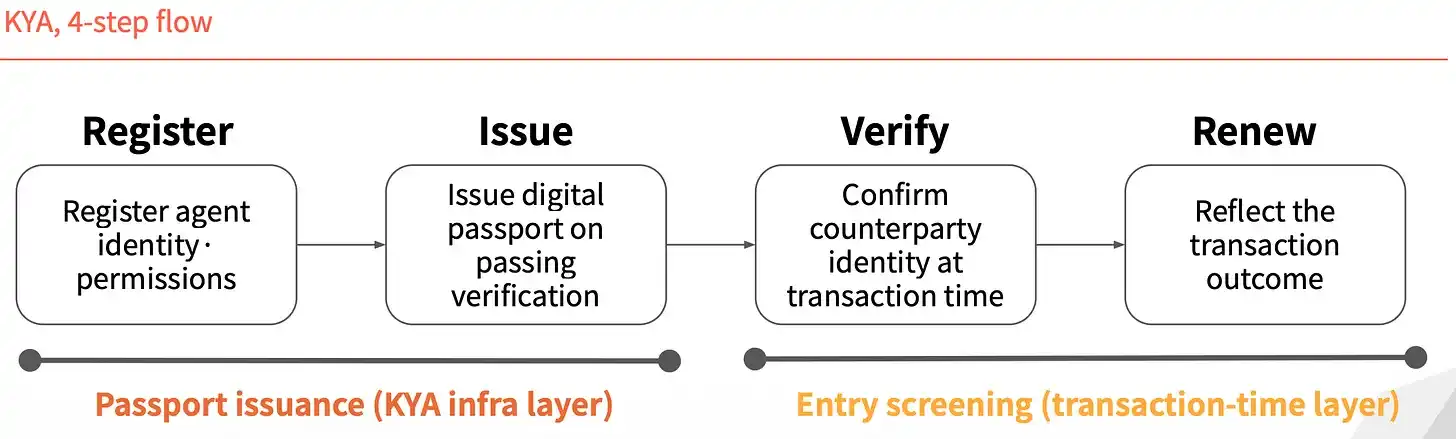
  • KYA (Know Your Agent) is a trust layer that pre-verifies an agent's origin, permissions, and accountability framework.
  • Unverified agents bring three major risks simultaneously: unauthorized transactions, fraud, and accountability gaps.
The Manifestation of KYA's Necessity

KYA is Needed at Every Level

  • Within centralized platforms, user KYC + platform accountability is sufficient. In interoperable scenarios outside platforms, KYA becomes crucial for verifying an agent's specific actions and safety.
  • Within a country (inside a platform), one ID (KYC) is enough to move freely. But once crossing borders (outside a platform), the environment changes, and entry review (KYA) of purpose and trust is needed.
Market Players

ERC-8004: NFT-Based Agent Identity

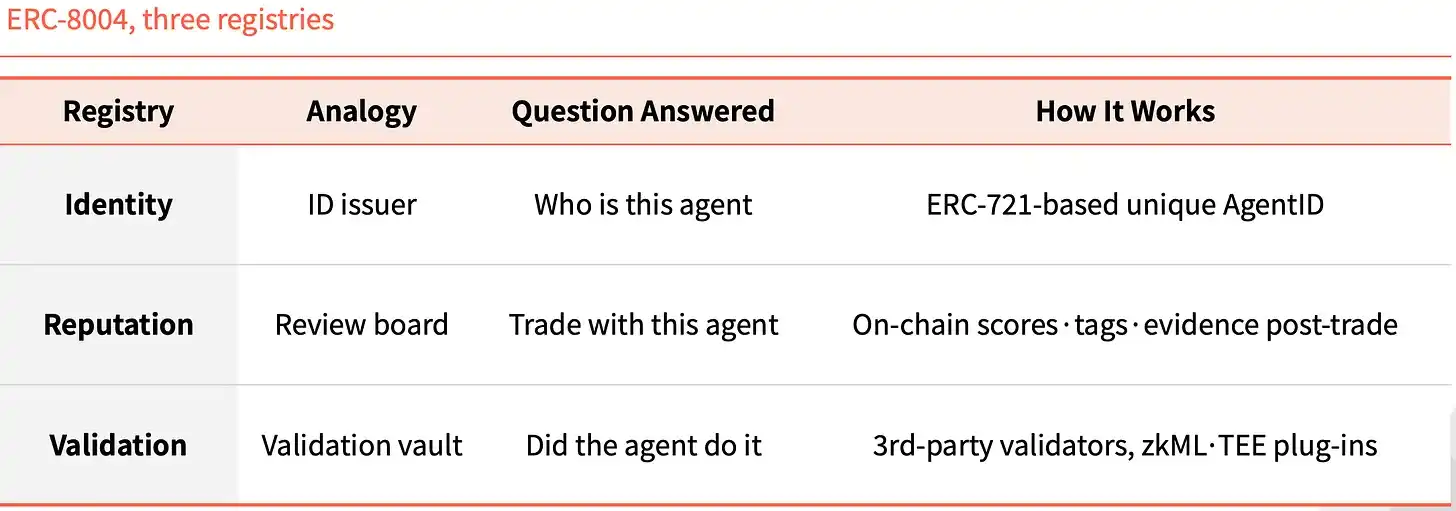
  • ERC-8004 adds an identity layer on top of ERC-721, minting an NFT as a unique ID for each agent.
  • It also adds three on-chain registries (Identity, Reputation, Validation), serving as identity, reputation board, and verification record respectively.
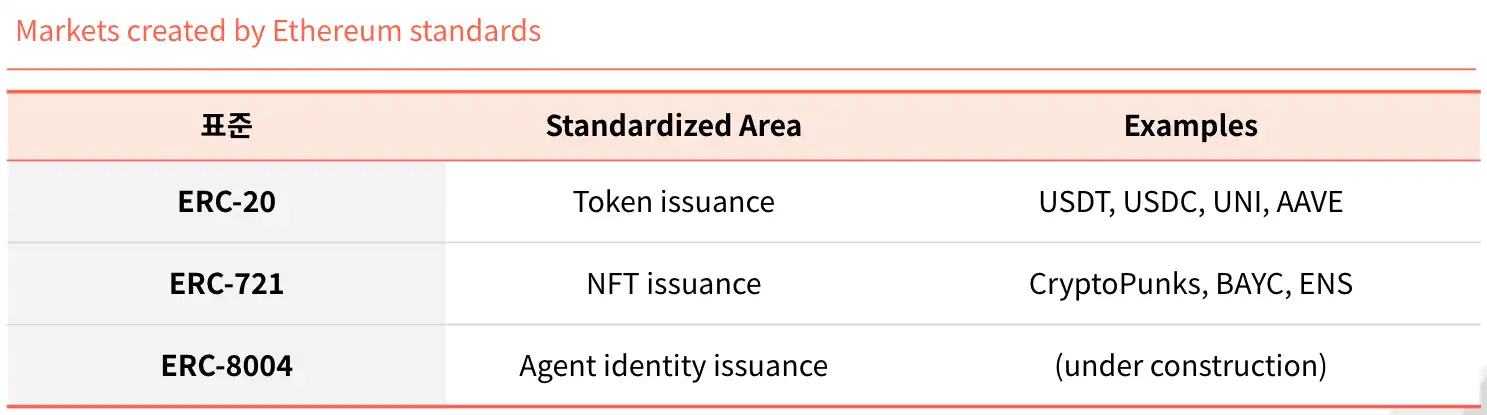
Two Markets Built by Ethereum Standards, a Third is Coming

  • ERC-20 (Token Issuance Standard): Before standardization, every token needed brand-new code. After ERC-20, most major assets were issued on it.
  • ERC-721 (NFT Standard): CryptoPunks, BAYC, ENS built the NFT market itself upon it. As blockchain integration accelerates in the agent era.
  • ERC-8004 will play the same standardizing role for Agents.
Visa TAP: Authentication on the Visa Rail

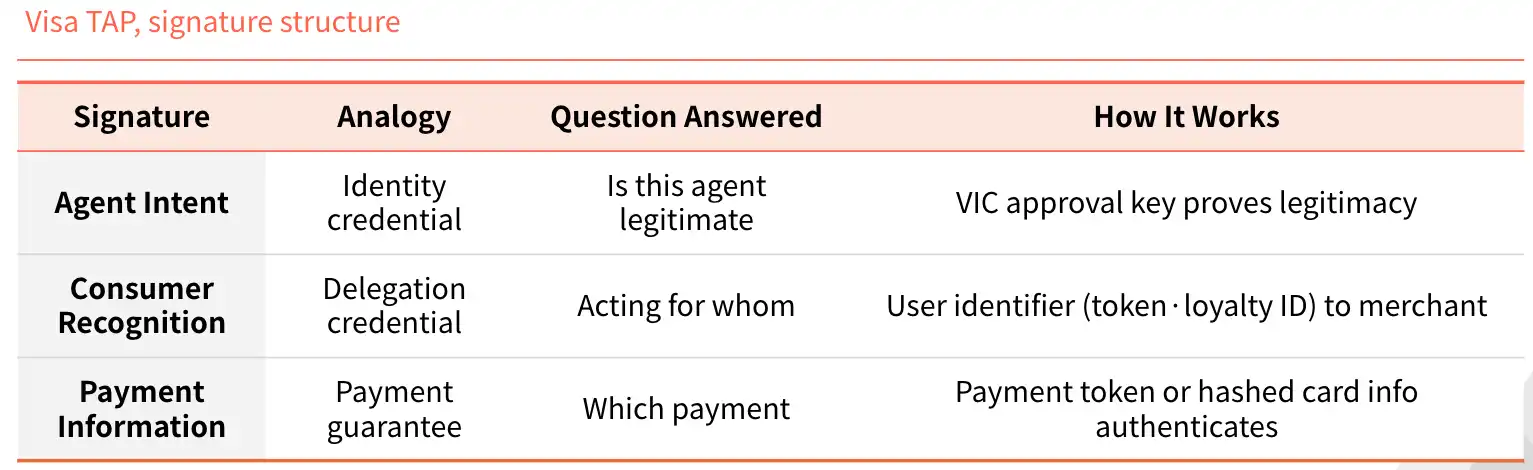
Visa issues identity credentials (Agent Intent) to agents, akin to an identity card. Without a key, transactions cannot occur. Keys are issued only after Visa pre-approval. Every transaction is signed and submitted to the merchant.

The merchant receives three signatures, not one: Visa approval, delegator, payment method, all confirmed simultaneously.
Visa: A Strategy to Pull Every Transaction into the Visa Network

  • Just as Visa previously captured payment rails, it is now encapsulating the agent era.
  • Through Visa Intelligent Commerce (VIC), Visa offers a solution bundle that packages KYA with payments.
  • If agent payments still use the card rail, and this bundle becomes the default option, then Visa's market share can remain stable even through the transition.

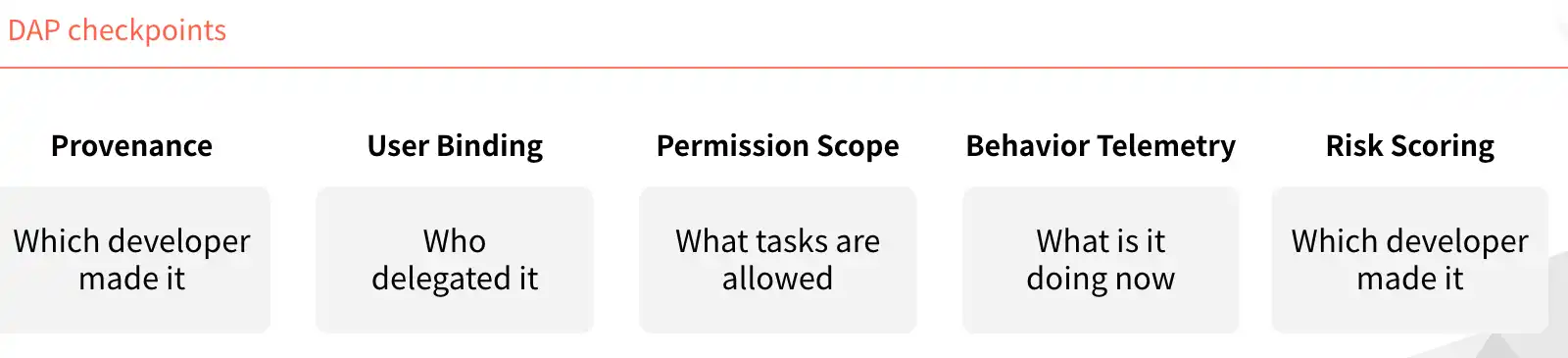
Trulioo: Extending KYC-Era Verification Infrastructure

  • Trulioo is a compliance operator on the global KYC/KYB rail and is expanding its verification stack to KYA.
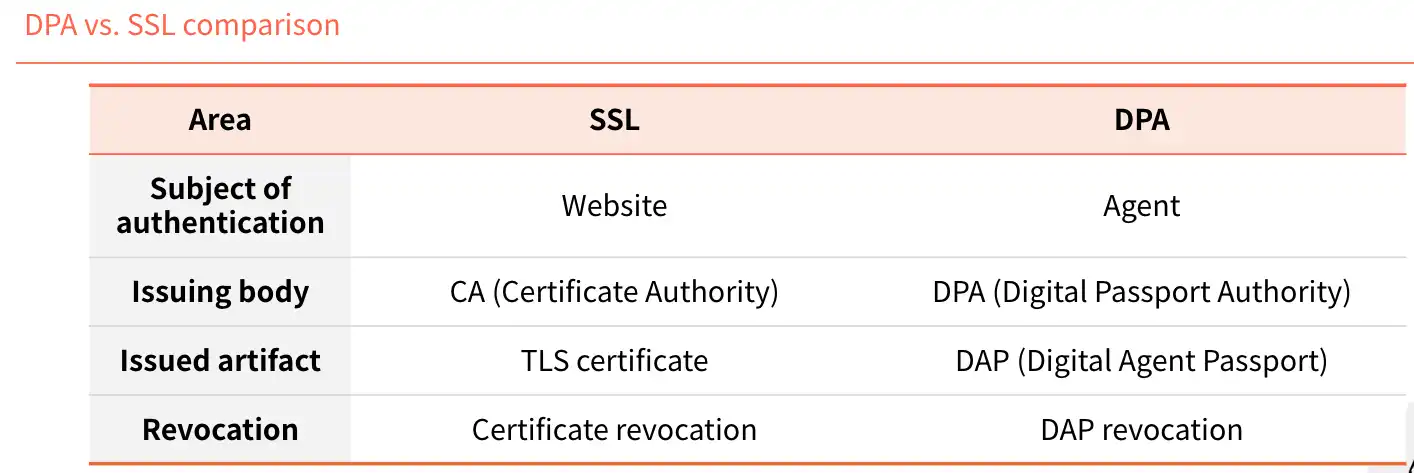
  • DPAs play the role of SSL-CAs. Unlike SSL (domain only), DPAs verify developer KYB and user KYC before issuing a DAP.
  • Banks and fintechs legally require human and business identity. As agents enter finance, Trulioo's KYC/KYB position will be further solidified.
DAP, an Agent's Digital Passport, Refreshed with Each Transaction

  • DAP is an agent's digital passport. A DPA verifies the developer (KYB) and user (KYC), packages both into a token, and grants it to the agent.
  • Unlike a paper passport, it is a live token, refreshed and re-verified with every transaction. Once delegation is revoked or anomalies are detected, the DAP is invalidated immediately.
  • KYA is not a one-time verification. Trust must be reconfirmed with every transaction.
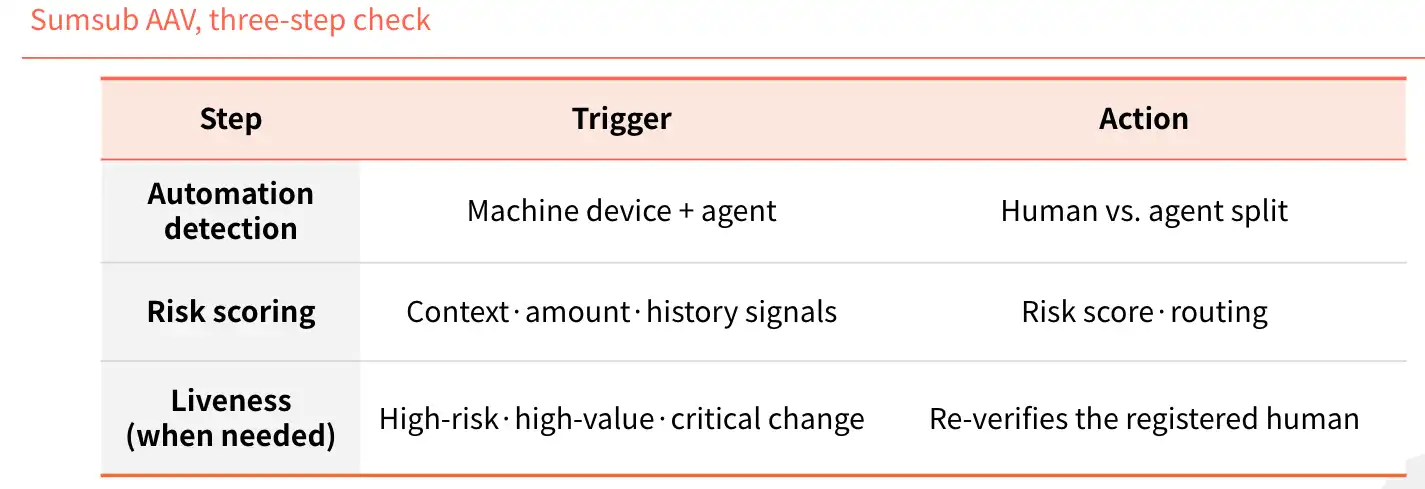
Sumsub (AI Agent Verification): Detecting Agent Anomalies

  • Sumsub's approach is: whenever an agent attempts an anomalous transaction, re-verify the currently active human identity.
  • It leverages its verification systems from its compliance business since 2015 to detect agent anomalies more accurately.
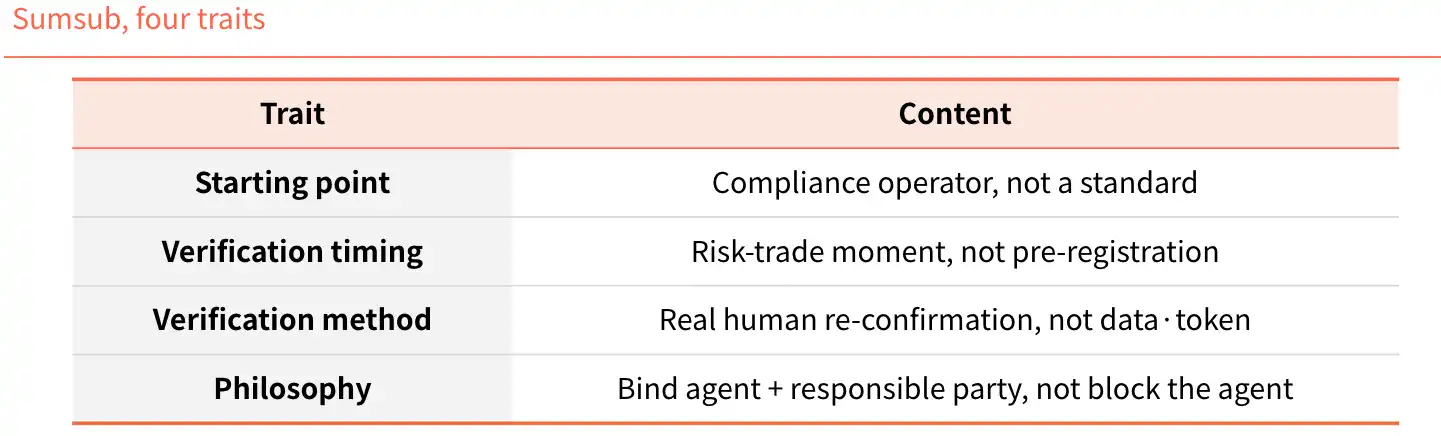
Operators with Technology to Address New Threats of the AI Era

  • Other KYA players focus on one-time pre-transaction identity verification. Sumsub focuses on real-time verification post-issuance.
  • As agent permissions expand, anomaly detection becomes crucial; as fraud scales with technology, Sumsub's real-time verification stack gains attention.
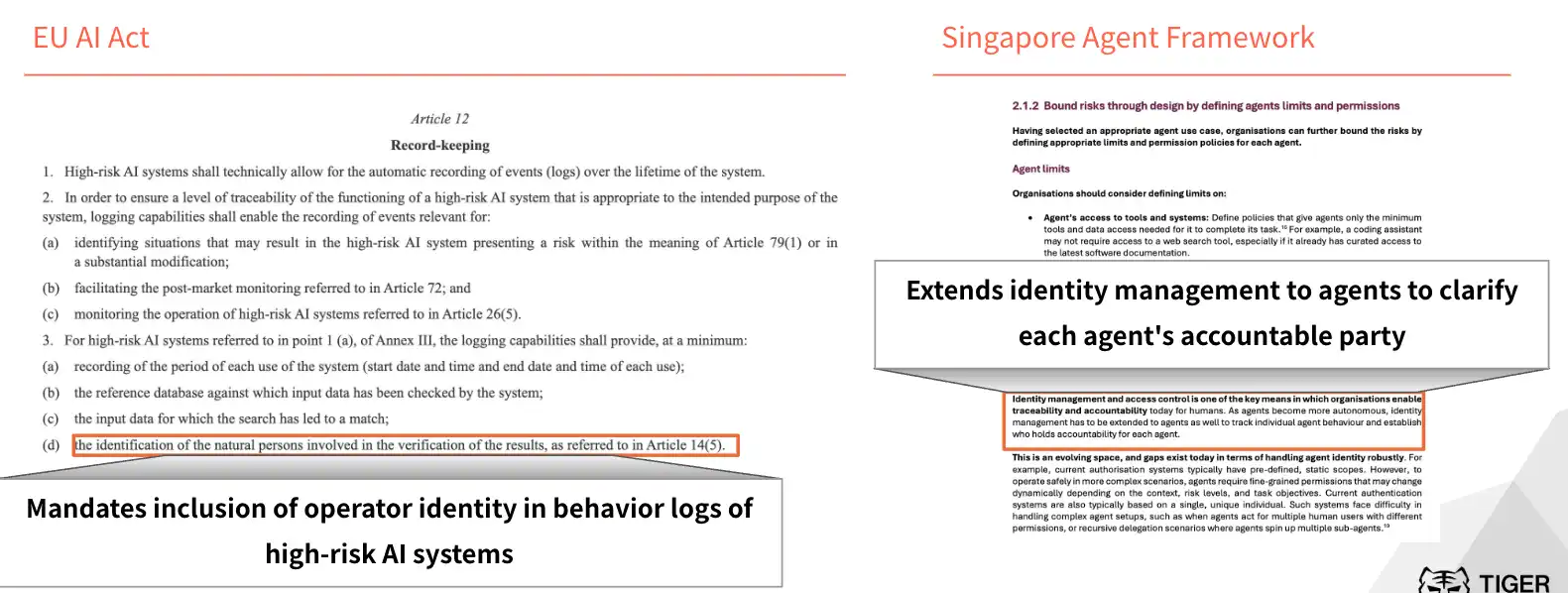
Proactive Regulatory Positioning, Shaping Entry Rules

The Gap Caused by the FATF Travel Rule May Recur with KYA

After the 2019 FATF Travel Rule, VASPs diverged based on their ability to bear KYC/AML infrastructure costs. Peers like CryptoBridge and Deribit, unable to afford it, either shut down or moved to less regulated regions.

The EU, Singapore, and the US are already vying for leadership. KYA will become a core layer of the agent era.
KYA Will Differentiate by Market Segment, Not a Single Winner

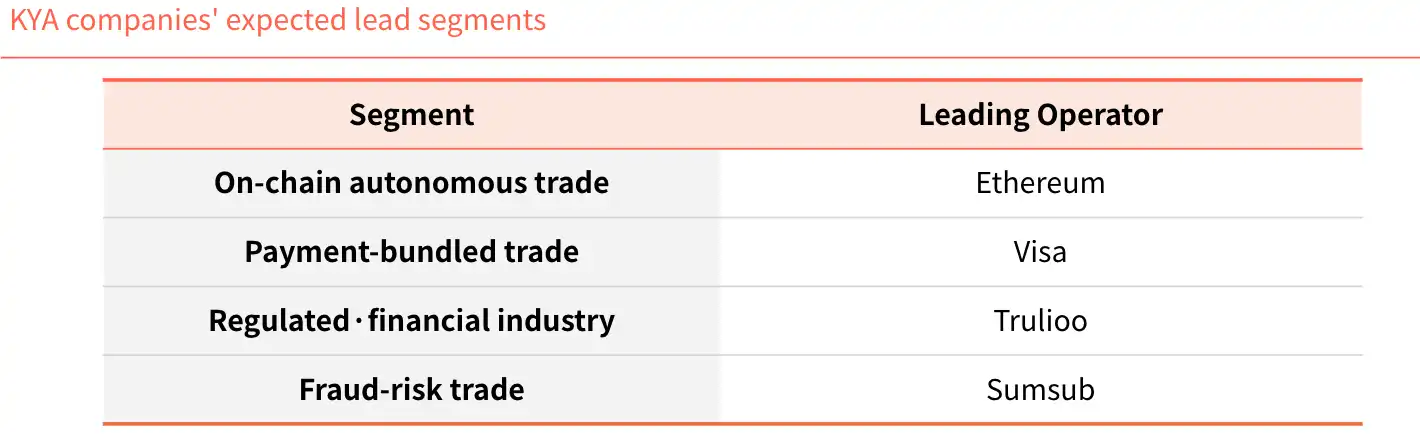
The real variable in the standards race is not technology, but combinations. Mainstream players have entered the collaboration and combination phase. In the future, who pairs with which merchants, payment networks, and KYC customer bases will determine the leader in each segment.

The market will not have a single winner; it will differentiate by market segment.
Perguntas relacionadas

QWhat is KYA (Know Your Agent), and why is it emerging as an important concept in the AI agent era?

AKYA (Know Your Agent) is a system designed to verify the identity, authority, and accountability of AI agents, especially in scenarios where they operate autonomously without direct human oversight. It is emerging as a crucial trust layer due to the rise of AI agents that autonomously execute contracts, payments, and transactions. In these Agent-to-Agent (A2A) environments, there is currently no shared standard to verify 'who the agent is,' leading to increased risks like unauthorized transactions, fraud, and accountability gaps. KYA addresses these risks by establishing a trust infrastructure for pre-verifying an agent's source, permissions, and purpose.

QWhat are some key standards and solutions being developed for KYA?

ASeveral standards and solutions are being developed for KYA. Notable examples include: 1) **ERC-8004**: An Ethereum-based standard that uses NFTs (ERC-721) as unique AgentIDs and adds on-chain registries for identity, reputation, and validation. 2) **Visa TAP (Triple Authorization Protocol)**: Visa's solution that issues identity credentials (Agent Intent) to agents and requires triple signatures (from Visa, the delegator, and the payment method) for transaction approval. 3) **Trulioo's DAP**: Extends their KYC/KYB infrastructure to issue a dynamic Digital Agent Passport (DAP) that is re-validated per transaction. 4) **Sumsub (AI Agent Verification)**: Focuses on post-issuance, real-time verification of agents to detect and prevent abnormal behavior using their existing compliance stack.

QIn what scenarios is KYA most necessary, according to the article?

AAccording to the article, KYA is most necessary outside of centralized, walled-garden platforms (like Google, OpenAI, or Coinbase), where traditional user KYC and platform accountability are sufficient. KYA becomes critical in scenarios involving independent, autonomously deployed agents interacting across platforms, particularly in: 1) **Agent-to-Agent (A2A) transactions** (e.g., payments between agents). 2) **Accessing decentralized exchanges (DEXs)**. 3) **Making payments to merchants**. These represent interoperable environments where a lack of agent identity verification creates significant operational and financial risks.

QHow are governments and regulatory bodies responding to the need for AI agent identity management?

AGovernments and regulatory bodies are beginning to act on AI agent governance, effectively pushing the need for KYA infrastructure. Key actions include: 1) **The EU AI Act**: Requires operators of high-risk AI systems to be identifiable in activity logs. 2) **US NIST**: Has prioritized AI agent identity management as a key standard-setting area. 3) **Singapore**: Released the world's first national-level AI governance framework specifically for agents. The article draws a parallel to the 2019 FATF Travel Rule, suggesting that the ability to implement compliant KYA systems will be a determining factor for which entities can participate in the next phase of the AI agent market.

QWhy does the article suggest the KYA market will be segmented, with no single winner?

AThe article suggests the KYA market will be segmented because the key variable for success is not just technology, but the combination and integration of solutions with existing business ecosystems. Major players are entering a 'cooperation-combination' phase. The future market leader in each segment will be determined by which KYA provider successfully partners with which merchants, payment networks (like Visa's approach), and existing KYC customer bases. Therefore, different KYA standards and solutions (e.g., ERC-8004 for the crypto-native ecosystem, Visa TAP for card-based commerce) are likely to dominate different application areas, leading to a fragmented market rather than a single universal winner.

Leituras Relacionadas

Trading Reflection: Why Does Trading Cryptocurrencies Become More Miserable the Longer You Do It? In Fact, Your Brain Has Been 'Damaged' by Stress.

Trading Reflection: Why Does Trading Cryptocurrency Become More Miserable Over Time? Your Brain Might Be Damaged by Stress This article explores the often-overlooked yet crucial psychological aspect of trading. It argues that long-term success depends less on intellect and more on the survival capacity of one's nervous system. The core issue is that sustained trading pressure disrupts normal brain chemistry. While initial hope and occasional wins provide dopamine-driven pleasure, repeated losses and constant market exposure trigger chronic cortisol release. This stress hormone, meant for short-term survival, keeps the trader in a perpetual "fight-or-flight" mode. Over time, this erodes sleep quality, depletes patience, and fuels emotional, impulsive decision-making. The author describes a dangerous cycle: fear of missing out leads to overtrading and lowered standards. As losses mount (30%, 50%), trading shifts from a pursuit of profit to a psychological battle for survival. The brain begins to associate prolonged stress with the occasional reward, trapping the trader in an addictive loop. Anxiety becomes a baseline state, and trading turns into a compulsive need to feel something—where green candles offer relief and red ones spark self-loathing. The most powerful move a trader can make, the article concludes, is sometimes to stop entirely—to avoid revenge trading, chasing losses, or seeking dopamine fixes. The key is to step back long enough to ask: is this still about passion, or is it a cage of stress hormones? The market and its opportunities will always return, but a trader who is mentally broken will have nothing left to capitalize on them. The best traders are not necessarily the smartest, but those who preserve their mental well-being long enough to stay in the game. Ultimately, the chase may not be for money, but for relief from the very pressure the game creates.

marsbitHá 1h

Trading Reflection: Why Does Trading Cryptocurrencies Become More Miserable the Longer You Do It? In Fact, Your Brain Has Been 'Damaged' by Stress.

marsbitHá 1h

Issued Two Work Badges to Unitree

At the keynote of his speech at the Taipei Music Center, Jensen Huang introduced a humanoid robot named Isaac GR00T. This robot, described as a 'reference design,' is a collaboration: its body comes from Unitree Robotics' H2 Plus, its hands from Singapore's Sharpa, and its 'brain'—the chip and full software stack—is from Nvidia, powered by the Jetson Thor. Huang positioned it as a turnkey solution for universities and researchers, aimed at drastically reducing setup time for experiments. On the same day as this reveal, Unitree Robotics passed its IPO review in Shanghai, seeking to raise 4.2 billion yuan, with a significant portion earmarked for developing its own embodied AI model—its own 'brain.' The article draws a parallel to the smartphone industry, where Qualcomm's 'reference design' led to homogenized hardware and concentrated profits in chips and software. It suggests Nvidia's GR00T initiative follows a similar playbook: by open-sourcing the model and framework, it aims to establish the industry standard, potentially relegating hardware makers to low-margin roles. While currently a body supplier for Nvidia's project, Unitree is actively pursuing its own AI brain, having open-sourced initial models and tested a more advanced one. The company faces a critical window to develop a competitive proprietary system before GR00T becomes the default. The article contrasts this with Tesla's vertically integrated approach for its Optimus robot, which uses in-house chips and benefits from its automotive data and manufacturing scale. It concludes that while the robot body still holds technical value and differentiation, the race for the 'brain' will ultimately define the industry's profit centers and power dynamics.

marsbitHá 1h

Issued Two Work Badges to Unitree

marsbitHá 1h

Trading

Spot
Futuros

Artigos em Destaque

Como comprar ID

Bem-vindo à HTX.com!Tornámos a compra de SPACE ID (ID) simples e conveniente.Segue o nosso guia passo a passo para iniciar a tua jornada no mundo das criptos.Passo 1: cria a tua conta HTXUtiliza o teu e-mail ou número de telefone para te inscreveres numa conta gratuita na HTX.Desfruta de um processo de inscrição sem complicações e desbloqueia todas as funcionalidades.Obter a minha contaPasso 2: vai para Comprar Cripto e escolhe o teu método de pagamentoCartão de crédito/débito: usa o teu visa ou mastercard para comprar SPACE ID (ID) instantaneamente.Saldo: usa os fundos da tua conta HTX para transacionar sem problemas.Terceiros: adicionamos métodos de pagamento populares, como Google Pay e Apple Pay, para aumentar a conveniência.P2P: transaciona diretamente com outros utilizadores na HTX.Mercado de balcão (OTC): oferecemos serviços personalizados e taxas de câmbio competitivas para os traders.Passo 3: armazena teu SPACE ID (ID)Depois de comprar o teu SPACE ID (ID), armazena-o na tua conta HTX.Alternativamente, podes enviá-lo para outro lugar através de transferência blockchain ou usá-lo para transacionar outras criptomoedas.Passo 4: transaciona SPACE ID (ID)Transaciona facilmente SPACE ID (ID) no mercado à vista da HTX.Acede simplesmente à tua conta, seleciona o teu par de trading, executa as tuas transações e monitoriza em tempo real.Oferecemos uma experiência de fácil utilização tanto para principiantes como para traders experientes.

201 Visualizações TotaisPublicado em {updateTime}Atualizado em 2026.06.02

Como comprar ID

Discussões

Bem-vindo à Comunidade HTX. Aqui, pode manter-se informado sobre os mais recentes desenvolvimentos da plataforma e obter acesso a análises profissionais de mercado. As opiniões dos utilizadores sobre o preço de ID (ID) são apresentadas abaixo.

活动图片













