From Hedge Funds to Family Offices, Who is Quietly Increasing Their HYPE Exposure Through PURR?

Odaily星球日报Publicado em 2026-08-18Última atualização em 2026-08-18

Resumo

The article, originally published by Odaily Planet Daily, discusses how major traditional financial institutions are increasing their exposure to HYPE, the native token of the Hyperliquid ecosystem, through investments in its treasury company, Hyperliquid Strategies Inc. (NASDAQ: PURR). This trend follows PURR's inclusion in major indices like the Russell 3000 and S&P Global BMI in mid-2026. Analysis of recently filed 13F reports reveals several prominent hedge funds and family offices actively buying or increasing their stakes in PURR. Key investors include Stanley Druckenmiller's Duquesne Family Office ($23M initial stake), quantitative giant Renaissance Technologies ($18.7M), and "Tiger Cub" funds like Slate Path Capital ($21M) and Discovery Capital Management ($10.3M). Other notable buyers are Balyasny Asset Management and Brazil-based Wealth High Governance Capital. Additionally, passive investment giants like Vanguard and Nuveen have increased holdings due to index inclusions, with Q2 institutional inflows into PURR totaling approximately $142 million. The author frames this institutional accumulation as a significant milestone, indicating growing Wall Street interest in the Hyperliquid ecosystem as potential "next-generation financial infrastructure." While acknowledging the challenges ahead for HYPE's price and ecosystem development, the piece highlights upcoming bullish catalysts. These include the August 26th launch of the "AQAv2 revenue-sharing mechanism," expect...

Original|Odaily Planet Daily(@OdailyChina)

Author|Wenser(@wenser 2010 )

On June 30th, Hyperliquid Strategies (PURR), HYPE's treasury company, was officially included in the Russell 3000 and Russell 2000 indexes. Earlier, PURR had already been added to the S&P Global BMI Index. Following the listing of HYPE-related ETFs, this milestone achievement is also seen as further evidence of Wall Street investment institutions laying out positions in HYPE tokens and the Hyperliquid ecosystem.

Recently, with the disclosure of the latest 13F filings, more information about investment institutions either buying or increasing their stakes in PURR for the first time has emerged. Odaily Planet Daily uses this as a clue to explore the representative institutions in the industry that are indirectly increasing their HYPE exposure. (Note: The total value of stock holdings below is calculated based on PURR's stock price as of June 30th.)

Those Wall Street Institutions and Family Offices Actively Buying: Druckenmiller Family Office, Renaissance Fund Prominently Listed

Let's start with the hedge funds and family offices that actively bought or increased their stakes in PURR.

Druckenmiller Family Office Duquesne: Holds $23 Million Worth of PURR Stock

The Q2 2026 13F filing submitted to the SEC by the Druckenmiller Family Office, Duquesne, shows that as of June 30th, Duquesne disclosed for the first time holding $23 million worth of shares in HYPE's treasury company, Hyperliquid Strategies Inc. (Nasdaq code: PURR). The institution currently manages approximately $5.2 billion in assets.

The founder of this institution is Stanley Druckenmiller, one of Wall Street's most renowned macro investors, who created a record of 30 consecutive years without losses. He came from George Soros's Quantum Fund, where he served as chief trader, shining brightly during the classic "Soros broke the Bank of England" trade in 1992.

Furthermore, the current Federal Reserve Chair, Wallis, previously worked at the Duquesne Family Office. Before his appointment, his main assets exceeded $100 million, including two investments related to the Duquesne Family Office exceeding $50 million each, possibly related to his consulting work for the family office.

Renaissance Technologies: Holds $18.7 Million Worth of PURR Stock

This institution was founded by the late mathematician Jim Simons and is now led by Peter Brown, managing over $96 billion in assets. Its flagship Medallion fund is one of the most successful hedge funds in history. According to the latest 13F filing, the institution increased its stake in PURR by approximately 2.4 million shares, worth about $18.7 million.

As one of the world's most renowned quantitative hedge funds, Renaissance Technologies' quantitative algorithms and investment models have long been admired by countless market investors. Building a position in PURR indicates that the stock meets the screening standards of its algorithmic factor models and pricing efficiency.

Slate Path Capital: Holds $21 Million Worth of PURR Stock

This institution was founded by David Greenspan, a former partner and managing director at the well-known "Tiger Cub" hedge fund Blue Ridge Capital. It is a typical fundamentally-driven "Tiger Cub" fund, focusing on global stocks and macro structural opportunities. It currently manages approximately $12 billion in assets.

According to the latest 13F filing, the institution holds approximately 2.7 million shares of PURR, worth about $21.4 million.

Discovery Capital Management: Holds $10.3 Million Worth of PURR Stock

This institution was founded by Robert Citrone, also a Tiger Fund alumnus, who officially established Discovery in 1999. It currently manages approximately $3.5 billion in assets. It is known for its focus on emerging markets, foreign exchange, fixed income, and global macro hedge trading.

Its investment style is "sharp and aggressive," adept at finding excess returns in high-volatility assets. Currently, the institution holds approximately 1.3 million shares of PURR, worth about $10.3 million.

Balyasny Asset Management: Holds $3 Million Worth of PURR Stock

This asset management firm was co-founded by Dmitry Balyasny, Scott Schroeder, and Taylor O'Malley. It has approximately 2,700 employees and 24 offices globally, making it one of the world's top multi-strategy hedge funds. As of August 2026, the firm manages approximately $38 billion in assets.

Latest data shows the firm holds approximately 386,000 shares of PURR, worth about $3 million.

Wealth High Governance Capital: Holds Approximately $17.1 Million Worth of PURR Stock

This institution is an independent wealth management and asset management firm based in São Paulo, Brazil. It is not a traditional large bank-affiliated asset manager but rather a boutique asset management platform built by a group of former senior executives from the Brazilian private bank Credit Suisse around 2020. The main member driving global asset investment is the founding partner and CIO Andrew Reider, who previously worked at the Moreira Salles family office and Verde Asset Management. Currently, the institution's total investment scale is approximately $940 million; its US 13F-disclosed stock portfolio is valued at approximately $640 million.

Latest data shows that approximately 1.82% of its total portfolio consists of PURR stock, valued at approximately $17.1 million.
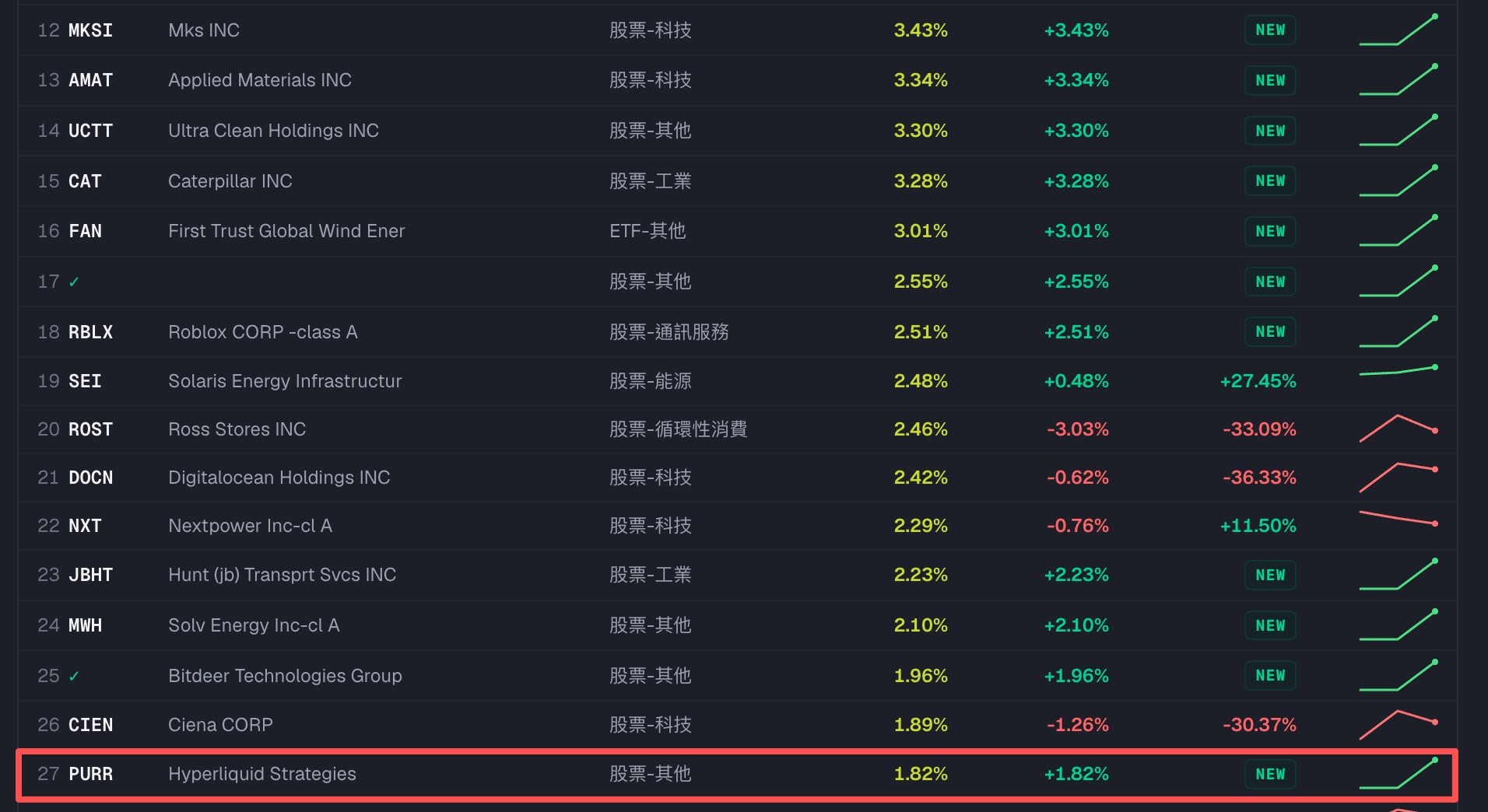
Apart from the above institutions, others that actively bought PURR stock include Tudor Investment Corporation, Point72, D.E. Shaw, etc. However, due to their relatively small holdings, they will not be detailed one by one here.

Passively Holding Giant Funds: Vanguard Group and Nuveen

As mentioned earlier, besides actively buying hedge funds and other institutions, benefiting from PURR's inclusion in the Russell indexes, Vanguard Group and TIAA's asset management platform Nuveen passively increased their holdings of PURR stock.

Among them, the global asset management giant Vanguard Group, with over $10 trillion in assets under management, increased its PURR holdings by approximately 843,000 shares in Q2, worth about $6.6 million; TIAA's asset management platform Nuveen, which currently manages approximately $1.4 trillion in assets and traces its origins back to 1898, increased its PURR holdings by approximately 1.07 million shares in Q2, worth about $8.4 million.

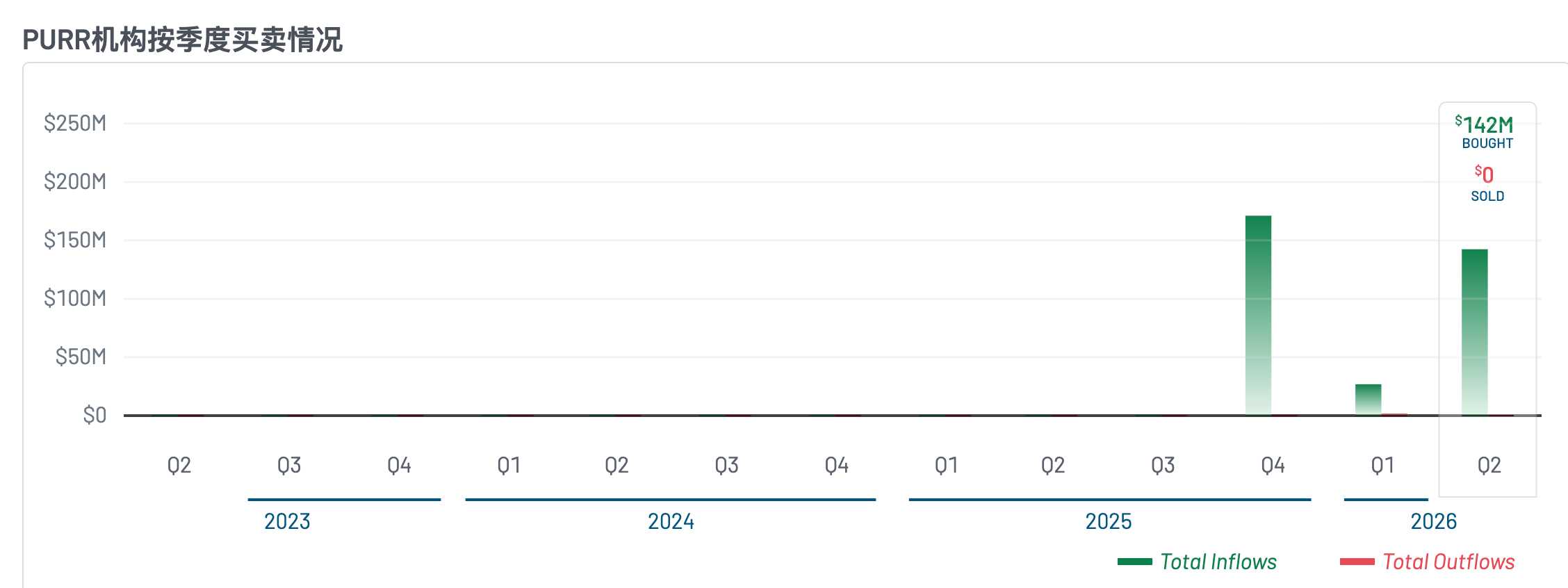
According to Marketbeat data, total institutional buying of PURR in Q2 2026 was approximately $142 million.
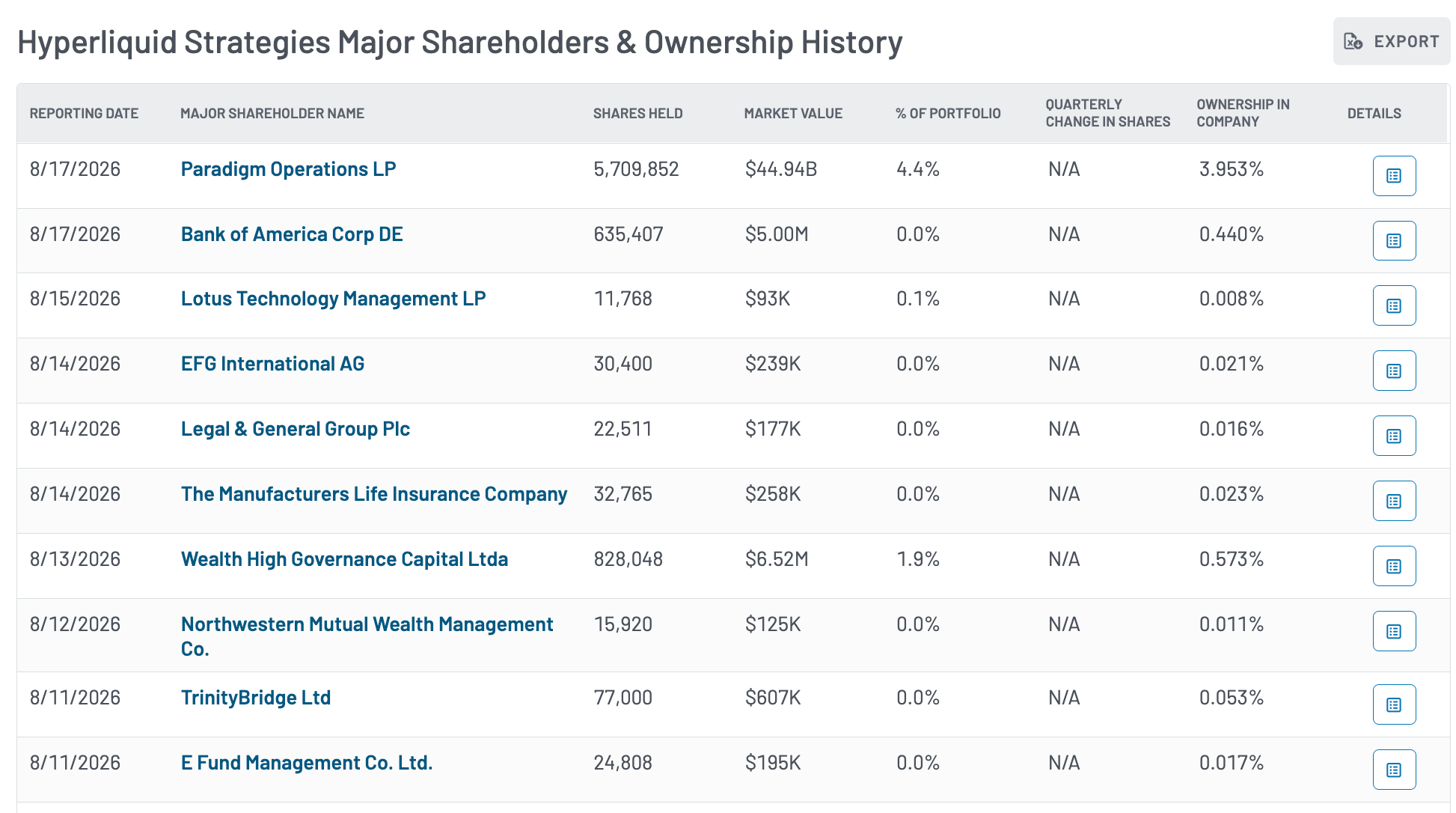
Other notable institutions recently disclosed to hold PURR stock include Paradigm, Bank of America, etc., with holding values typically ranging from a few hundred thousand to a few million dollars.
Of course, the disclosure date for 13F filings is June 30th, and the PURR holdings of major investment institutions may have changed to varying degrees by now. However, looking at the overall trend, PURR's institutional investors have gradually transitioned from early crypto arbitrage firms to quantitative funds, hedge funds, and traditional Wall Street financial institutions. Institutions like BlackRock, Jane Street, Geode, and Invesco have also bought in passively through index funds. In other words, HYPE token investment exposure and the Hyperliquid ecosystem have attracted increasing attention, trial investments, and even position allocations from the traditional finance industry. Even the state of Ohio in the US has indirectly achieved this by holding PURR stock. On the path to finding the "next generation of global financial infrastructure," traditional financial institutions will never sit idly by.

However, while the prospects are bright, the road is winding. Before the future arrives where Hyperliquid welcomes more global capital liquidity, the price performance of the HYPE token and the continuous development of the Hyperliquid ecosystem still have a long way to go.

Recently, Hyperliquid's "AQAv2 Revenue Sharing Mechanism," scheduled to launch on August 26th, is expected to contribute $200 million annually for HYPE buybacks. This mechanism has also received support from Circle and Coinbase. Stimulated by this positive development and the ongoing construction of the Hyperliquid HIP-3 and HIP-4 markets, the HYPE token price is expected to usher in a new round of rebound.

ETH was once viewed as the "global financial asset taken over by Wall Street institutions," and now, this expectation falls on HYPE. As for whether it can shoulder this expectation, perhaps we will find out in Q4 this year.


Criptomoedas em alta

Perguntas relacionadas

QWhich hedge fund founded by the late mathematician Jim Simons increased its holdings in PURR, and what was the reported value of its position?

AThe hedge fund Renaissance Technologies, founded by the late mathematician Jim Simons, increased its holdings in PURR. The reported value of its position was approximately $18.7 million.

QWhat was the milestone achievement for Hyperliquid Strategies (PURR) on June 30th, and what other major index had already included it earlier?

AOn June 30th, Hyperliquid Strategies (PURR) was officially added to the Russell 3000 Index and the Russell 2000 Index. Earlier, it had already been included in the S&P Global BMI Index.

QWhich family office, founded by Stanley Druckenmiller, was a new holder of PURR according to Q2 13F filings, and what is its AUM?

AAccording to Q2 13F filings, the Duquesne Family Office, founded by Stanley Druckenmiller, was a new holder of PURR. Its Assets Under Management (AUM) are approximately $5.2 billion.

QName two major asset managers that passively increased their holdings in PURR due to its inclusion in the Russell indexes, and state their AUM.

ATwo major asset managers that passively increased their holdings in PURR were The Vanguard Group, with over $10 trillion in AUM, and Nuveen (under TIAA), with approximately $1.4 trillion in AUM.

QWhat upcoming mechanism on Hyperliquid is expected to contribute $200 million annually to HYPE buybacks, and which two major companies are supporting it?

AThe upcoming mechanism is the 'AQAv2 Revenue Sharing Mechanism' on Hyperliquid, expected to contribute $200 million annually to HYPE buybacks. It is supported by Circle and Coinbase.

Leituras Relacionadas

After Changxin, Yushu Takes the Lead: The Value and Weight of the First Humanoid Robot Stock

On August 19, 2026, Unitree Robotics (688836.SH), known as China's "first humanoid robotics stock," officially listed on the Shanghai Stock Exchange's STAR Market. The stock opened at 1,100 yuan, a surge of 629.44% from its 150.80 yuan IPO price, with its market capitalization briefly reaching 445 billion yuan. This highlights intense market enthusiasm for the humanoid robot sector. The IPO was characterized by high demand and low circulation, with only 7.44% of shares initially tradable. This scarcity, coupled with strong investor interest (record-high participation and a low 0.0181% lottery win rate), contributed to the dramatic price surge. Founder Wang Xingxing, holding over 31% of shares, saw his wealth exceed 110 billion yuan, making him China's wealthiest "post-90s" entrepreneur. Major institutional backers like Meituan, DeepSeek, Tencent, and Sequoia China also reaped substantial gains. Key to the valuation is Unitree's status as a profitable company in a field where many competitors are not. In 2025, it achieved 600 million yuan in adjusted net profit and delivered over 5,500 humanoid robots, ranking first globally in shipments. However, over 70% of its humanoid revenue still comes from R&D and education, with industrial applications accounting for only about 9%, indicating early-stage commercialization. The company faces competition from global players like Figure AI (est. $39-40B valuation), Boston Dynamics, and Tesla's Optimus, as well as domestic rivals like Zhiyuan and Ubtech. To become the "global humanoid robotics leader," its market cap would need to exceed 500 billion yuan. Market opinions on its future are divided: optimists cite its profitability, leading shipments, and strategic tie-up with DeepSeek; the cautious point to high valuations and unproven mass-market adoption; a neutral view expects a post-surge consolidation into an "earnings verification phase." Risks include high valuation digestion pressure, slower-than-expected commercialization in industrial/household settings, potential US FCC regulatory impacts on new models, intense competition, rapid technological iteration, and short-term stock volatility. The IPO marks a significant milestone, but Unitree's path to becoming a global leader remains challenging.

Odaily星球日报Há 18m

After Changxin, Yushu Takes the Lead: The Value and Weight of the First Humanoid Robot Stock

Odaily星球日报Há 18m

Token Economy Surges, Have Ordinary People Got a Slice of the Pie?

Token Frenzy: Is the Average Person Getting a Piece of the Pie? As AI adoption soars in China, daily Token consumption—the basic unit for AI text processing—has skyrocketed, exceeding 140 trillion. This "Token economy" is often measured like GDP, touted as a sign of progress. However, this metric primarily reflects supply-side activities: corporate investment, infrastructure scaling, and platform revenues. The crucial question of whether this growth translates into tangible benefits for ordinary citizens—higher wages, better jobs, improved public services, or increased leisure—remains largely unanswered. The article argues there's a fundamental mismatch. Policy, exemplified by subsidies in Beijing's Yizhuang district, often stimulates "demand" by incentivizing companies to consume more Tokens (an intermediate business cost), rather than by boosting household income or final consumer spending. This creates a closed loop where growth in Token usage justifies further production capacity expansion, without necessarily extending value to the broader population. Several disconnects are highlighted. High Token usage doesn't equal completed tasks, increased profits, or macroeconomic productivity gains. Even when corporate efficiency improves, the benefits may not trickle down due to existing economic structures favoring investment over household consumption. The risk is that AI, a genuinely productive technology, becomes another tool for supply-side expansion within a system adept at measuring output (like server capacity and call volumes) but less focused on distributing the gains widely. Drawing a parallel to Henry Ford's assembly line, the piece notes that Ford's revolution combined ruthless production efficiency with a social compact (higher wages, stability) that enabled mass consumption. Today's "Token economy" narrative enthusiastically champions the first part—process re-engineering and cost reduction—but lacks a credible mechanism for the second: ensuring that productivity gains lead to broader societal welfare. The ultimate challenge is not whether Tokens have value, but whether their economic benefits can escape a system that excels at building supply but struggles to cultivate its own demand.

marsbitHá 1h

Token Economy Surges, Have Ordinary People Got a Slice of the Pie?

marsbitHá 1h

Overnight Global Shock: Why Did AI Stocks Plunge Across the Board?

Overnight, U.S. AI-related stocks fell sharply, with the Nasdaq down 1.33% and the Philadelphia Semiconductor Index plunging nearly 5%. Panic spread globally, dragging down Asia-Pacific markets. Key negative drivers included: 1. **Geopolitical Tension & Macro Pressure:** Escalating U.S.-Iran tensions pushed oil prices higher, fueling inflation fears and expectations of prolonged high interest rates. Rising bond yields pressured high-valuation, capital-intensive AI stocks, especially as soaring AI infrastructure financing costs became evident. 2. **AI Commercialization Concerns:** OpenAI's Q2 results showed slowing revenue growth and widening losses, dampening market optimism about near-term AI application profitability. This shifted investor focus from pure capital expenditure narratives to actual commercial returns. 3. **Supply Chain Uncertainty:** U.S.-South Korea semiconductor investment disputes intensified. Market fears that Korean memory giants (Samsung, SK Hynix) face a dilemma—either divert capital to costly U.S. production or risk trade barriers—disrupted the critical HBM memory sector, amplifying sell-offs via leveraged ETFs. While long-term AI demand remains, the market is now scrutinizing real profitability, financing costs, and supply chain stability rather than paying premiums for unchecked growth stories. For markets like China's A-shares, the impact is primarily sentiment-driven, requiring distinction between short-term panic and fundamental deterioration.

marsbitHá 1h

Overnight Global Shock: Why Did AI Stocks Plunge Across the Board?

marsbitHá 1h

Trading

Spot

Artigos em Destaque

Como comprar HYPE

Bem-vindo à HTX.com!Tornámos a compra de Hyperliquid (HYPE) simples e conveniente.Segue o nosso guia passo a passo para iniciar a tua jornada no mundo das criptos.Passo 1: cria a tua conta HTXUtiliza o teu e-mail ou número de telefone para te inscreveres numa conta gratuita na HTX.Desfruta de um processo de inscrição sem complicações e desbloqueia todas as funcionalidades.Obter a minha contaPasso 2: vai para Comprar Cripto e escolhe o teu método de pagamentoCartão de crédito/débito: usa o teu visa ou mastercard para comprar Hyperliquid (HYPE) instantaneamente.Saldo: usa os fundos da tua conta HTX para transacionar sem problemas.Terceiros: adicionamos métodos de pagamento populares, como Google Pay e Apple Pay, para aumentar a conveniência.P2P: transaciona diretamente com outros utilizadores na HTX.Mercado de balcão (OTC): oferecemos serviços personalizados e taxas de câmbio competitivas para os traders.Passo 3: armazena teu Hyperliquid (HYPE)Depois de comprar o teu Hyperliquid (HYPE), armazena-o na tua conta HTX.Alternativamente, podes enviá-lo para outro lugar através de transferência blockchain ou usá-lo para transacionar outras criptomoedas.Passo 4: transaciona Hyperliquid (HYPE)Transaciona facilmente Hyperliquid (HYPE) no mercado à vista da HTX.Acede simplesmente à tua conta, seleciona o teu par de trading, executa as tuas transações e monitoriza em tempo real.Oferecemos uma experiência de fácil utilização tanto para principiantes como para traders experientes.

544 Visualizações TotaisPublicado em {updateTime}Atualizado em 2026.06.02

Como comprar HYPE

Discussões

Bem-vindo à Comunidade HTX. Aqui, pode manter-se informado sobre os mais recentes desenvolvimentos da plataforma e obter acesso a análises profissionais de mercado. As opiniões dos utilizadores sobre o preço de HYPE (HYPE) são apresentadas abaixo.

活动图片