From 'Global Computer/Settlement Layer' to 'Bulletin Board': What Are Ethereum and Vitalik Trying to Achieve?

marsbitPublicado em 2026-03-22Última atualização em 2026-03-22

Resumo

In a significant shift of perspective, Vitalik Buterin recently proposed that Ethereum's core value may not lie in its function as a "world computer" or "global settlement layer," but rather as a simple yet powerful primitive: a cryptographically secure, globally shared "public bulletin board." This concept emphasizes data availability—a neutral, uncensorable, and permanent data layer where anyone can read and write information, but no single entity (including governments or developers) can alter or erase it. This "global shared memory" supports applications like secure voting systems, certificate revocation lists, and decentralized coordination—scenarios that require verifiable and tamper-proof data publishing rather than complex on-chain execution. The emergence of AI further validates this direction. As AI agents and services grow, so does the need for privacy-preserving and trustless interactions. Proposals like ZK API Usage Credits illustrate how Ethereum can enable anonymous AI model access and agent-to-agent economic coordination, relying precisely on the blockchain’s transparent and immutable data layer. Rather than a step back, this reframing represents a maturation of Ethereum’s vision—from defining what it can do to serving as essential infrastructure for what the world truly needs: a foundational layer of truth in an increasingly automated and opaque digital era.

In the traditional perception of many people, Ethereum's core positioning has always been the "World Computer" or "Global Settlement Layer".

Over the past decade, it has indeed been responsible for executing smart contracts, supporting DeFi, and underpinning NFTs, effectively becoming a programmable financial and application execution layer.

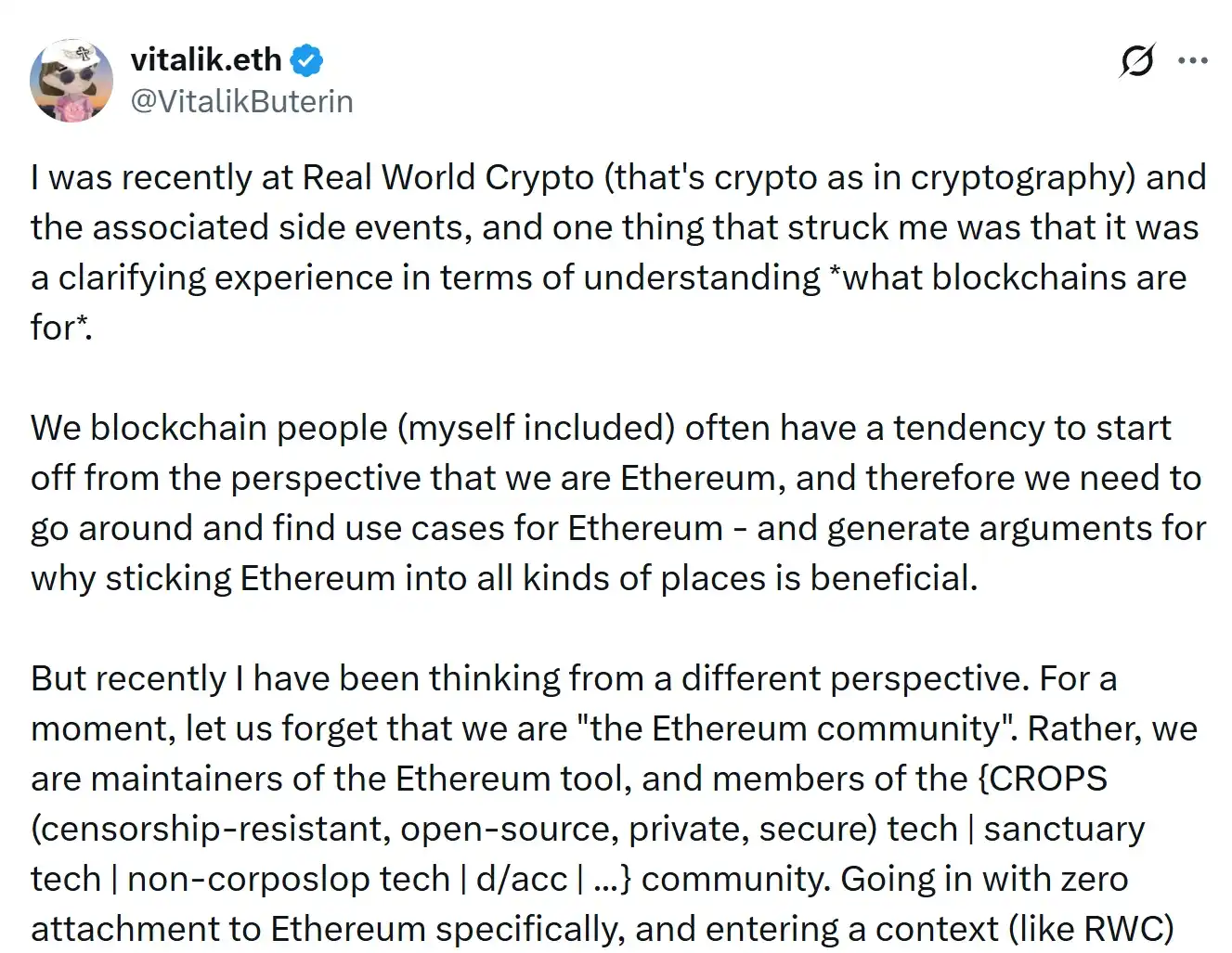
But on March 12, Vitalik Buterin proposed a rather refreshing perspective—the crypto industry may have overcomplicated the actual use cases of blockchain. The most fundamental value of Ethereum might not be the smart contract functionality we have always emphasized, but an extremely simple primitive:

A cryptographically secure, globally shared "public bulletin board".

Many users might wonder, from a "computer" to a "bulletin board", is this a functional regression, or is there another angle to consider?
I. The "Global Shared Memory" Behind the "Bulletin Board"

The so-called "public bulletin board", as the name implies, is fundamentally about data availability.

It's simple to understand: imagine a giant bulletin board posted in a central city square—anyone can read it, nothing can be withdrawn, and there is no censorship. This simply refers to a bulletin board on a global scale: global users can confirm that the data indeed exists, even the most powerful government cannot erase it, and no administrator can prevent you from publishing compliant content.

Ultimately, many digital systems, such as secure online voting and software version control, have a core need not for complex financial transactions, but for an anti-censorship, publicly verifiable data publishing space. This is precisely the "bulletin board" long sought in the field of cryptography:

  • Secure voting systems. Traditional electronic voting relies on centralized databases, which carry the risk of tampering. Publishing voting records on Ethereum allows anyone to verify the results, while the privacy of the votes is protected by cryptography;
  • Certificate revocation systems. Revocation lists for HTTPS certificates, software signing certificates, etc., need a publicly accessible, tamper-proof data source. Blockchain is naturally suited for this role;
  • Multi-party coordination and governance. Open-source projects, decentralized governance, community funds—these scenarios require multiple parties to collaborate without trusting each other. Ethereum can serve as a neutral coordination layer to publish data and verify actions;

These scenarios share a common characteristic: they don't need Ethereum to "run" anything, they just need Ethereum to "remember" something. Vitalik therefore gave a more precise ultimate definition: Ethereum is global shared memory.

Anyone can write to it, anyone can read from it, and no one can unilaterally erase it—not a company, not a government, not even Vitalik himself.

This positioning also corresponds to a clear technical path. The 2024 EIP-4844 (Blob data) was the initial scaling of this bulletin board. The full rollout of PeerDAS (Peer Data Availability Sampling) in 2026 expanded the "area" of the bulletin board a hundredfold. Ethereum is no longer fixated on the TPS of the main chain, but is committed to becoming the global storage center with the largest capacity and highest security, a foundational layer providing globally shared data availability.

II. With AI's Arrival, the Public Bulletin Board Becomes More Necessary

Understanding the essence of the "bulletin board", and then looking at the advent of AI, reveals that these are not two separate things, but two sides of the same coin.

Objectively speaking, the "bulletin board" line of thinking is actually quite related to the current impact of AI on Web3. Because increasingly, the number of conversations people have with AI daily has surpassed the number with any single human. But with current AI services, what you asked, when you asked it, how many times you asked—all are tied to your real identity.

For example, using ChatGPT requires an email and credit card; calling the Claude API leaves clear billing records; every prompt is a digital trace pointing back to you.

Therefore, in February 2026, Vitalik and the Ethereum Foundation's AI lead, Davide Crapis, jointly proposed ZK API Usage Credits, aiming to enable anonymous calls to AI large models using zero-knowledge proofs. The logic of the proposal is clear:

A user deposits funds (e.g., 100 USDC) into a smart contract, which records this deposit in an encrypted list on-chain. Thereafter, each time the user calls an AI API, they don't need to expose their identity; they just need to generate a zero-knowledge proof demonstrating "I have the right to use this credit" to complete the call.

What does this scheme require? A public bulletin board, a publicly verifiable, immutable data layer, to record "who has how much credit", without recording "who is who".

Simultaneously, the proliferation of AI Agents brings another new issue: how can these automatically running programs achieve economic coordination amongst themselves? After all, when one AI Agent needs to call the service of another AI Agent, it needs to pay, establish credibility, and handle disputes. But it has no bank account, no legal identity, and no "real-name information" trusted by centralized platforms.

Ethereum, as an economic coordination layer for AI Agents, provides a natural answer. Agents can initiate transactions on-chain, stake collateral, and establish verifiable reputation records—all built upon the transparent data layer provided by that "bulletin board".

In a broader framework, this positioning of the relationship between Ethereum and AI is even one of integration—as AI's capabilities grow stronger, the needs for privacy protection, verifiability, and decentralization become more rigid.

So, Ethereum is not competing with AI; it is aiming to become the most needed infrastructure in the AI era: a public data layer that anyone can write to, anyone can trust, and no one can shut down.

III. Is the "Smart Contract" Narrative Not Enough Anymore?

Perhaps in Vitalik Buterin's vision, the majority of future Ethereum users might not be "humans", but AI Agents.

Therefore, this shift in positioning from "World Computer" to "Bulletin Board", while easily misinterpreted as lowering expectations, is actually the opposite in understanding.

The "World Computer" is a narrative from an internal perspective, asking "what can our technology do?", while the "Bulletin Board" is a perspective from external demand, asking "what does the world truly need?".

This perhaps also benefits from the people Vitalik met at cryptography conferences—those voting system researchers, certificate protocol designers, privacy tool developers. They had no interest in blockchain or Ethereum, but the things they needed were exactly what Ethereum could provide.

Therefore, the author believes Ethereum is indeed becoming more realistic step by step, because this is the proper stance of a mature technology: it no longer tries to define application scenarios, but instead refines itself into a sufficiently reliable piece of infrastructure, waiting for the scenarios that truly need it to grow naturally.

Just like TCP/IP doesn't explain what the internet can do, but without TCP/IP, the internet can do nothing.

From this perspective, this is perhaps Ethereum's moment of "looking inward when actions don't yield results".

After all, the core, most irreplaceable value of blockchain has always been that truth which is not subject to anyone's will. This means that no matter how fast AI evolves, no matter how blurred the line between reality and illusion becomes, as long as this bulletin board exists, humanity will have a place to store "truth".

This, perhaps, is Ethereum's most honest self-positioning yet.

Criptomoedas em alta

Perguntas relacionadas

QWhat is the new core value proposition of Ethereum as proposed by Vitalik Buterin on March 12th?

AEthereum's most fundamental value is not its smart contract functionality, but a simple primitive: a cryptographically secure, globally shared 'public bulletin board' or 'global shared memory'.

QWhat are some specific use cases mentioned for the 'public bulletin board' concept on Ethereum?

ASpecific use cases include secure online voting systems, certificate revocation systems (like HTTPS and software signing certificates), and multi-party coordination and governance for open-source projects and DAOs.

QHow does the proposed 'ZK API Usage Credits' system work for anonymous AI model calls?

AA user deposits funds (e.g., 100 USDC) into a smart contract, which records the encrypted deposit on-chain. For each API call, the user generates a zero-knowledge proof to demonstrate they have the right to use that credit, without revealing their identity.

QWhy is the 'public bulletin board' concept considered even more necessary with the rise of AI?

AAI services currently bind user queries to real identities (via email, credit cards, etc.). The bulletin board provides a privacy-preserving, verifiable data layer for anonymous interactions and serves as an economic coordination layer for AI Agents that lack traditional legal identities or bank accounts.

QHow does the shift from 'world computer' to 'bulletin board' represent a change in perspective for Ethereum?

AThe 'world computer' is an internal, technology-focused narrative asking 'what our technology can do,' while the 'bulletin board' is an external, demand-focused perspective asking 'what the world actually needs.' It represents a maturation, positioning Ethereum as reliable infrastructure rather than defining specific applications.

Leituras Relacionadas

Bitcoin Mining Farms Are Becoming AI Factories

Bitcoin mines are transforming into AI factories. This shift is driven by the convergence of three key assets from the previous crypto cycle: infrastructure, talent, and capital. Crypto mining companies like Crusoe, CoreWeave, and Bitdeer are repurposing their core competency—securing power, land, and grid connections in remote locations—to build data centers for AI clients. These firms are signing multi-billion dollar, long-term contracts with companies like Anthropic, AWS, and Microsoft, as AI's demand for reliable, high-capacity compute surpasses the profitability of Bitcoin mining. Simultaneously, crypto entrepreneurs and engineers are applying their skills to new AI ventures. Examples include OpenSea's co-founder launching OpenRouter (an AI model aggregator), and former Coinbase engineers building Fal.ai (a generative media infrastructure platform). Their experience in building scalable, global software networks translates effectively to the AI space. Furthermore, capital accumulated during the crypto boom is now fueling AI. Figures like Jed McCaleb (co-founder of Ripple) funded Voltage Park, a large-scale GPU cloud provider. Notably, some crypto investments, like FTX's early bets on Anthropic and Cursor, have generated astronomical paper returns, demonstrating how high-risk crypto capital flowed into AI before it became mainstream. The transition is not just about repurposing hardware, but about redirecting critical resources—power infrastructure, distributed systems expertise, and venture funding—to the next technological frontier: artificial intelligence.

链捕手Há 13m

Bitcoin Mining Farms Are Becoming AI Factories

链捕手Há 13m

Morpho Launches Fixed-Rate Product Midnight: Lenders and Borrowers Set Their Own Rates, Ending the Era of Interest Rate Models

Morpho Launches Fixed-Rate Product Midnight: Lenders and Borrowers Set Their Own Rates, Ending the Era of Algorithmic Interest Models On-chain lending has grown to $60 billion but remains minuscule compared to traditional finance's $200 trillion annual credit volume. Morpho identifies the lack of fixed rates and maturity dates as key bottlenecks. Institutions need predictability, not the passive floating rates set by algorithmic models. Midnight allows lenders and borrowers to directly quote rates, set terms, and become price makers, not takers. Fixed-rate lending is now viable due to cheaper, faster blockchains and the entry of institutions demanding control and certainty over returns, costs, and duration. Morpho Blue previously gave users control over risk; Midnight adds control over interest rates. Past attempts at on-chain fixed-rate lending failed primarily because they were built on top of floating-rate pools (creating unpredictability) or lacked sufficient active participants. Midnight avoids these pitfalls as a standalone primitive with fixed rates at its core, built upon Morpho Blue's existing large and active user base. Midnight offers distinct value: institutions gain predictable term structures and full control; fintech companies can offer tailored fixed-rate products; lenders/borrowers achieve predictability and efficiency; and curators can now differentiate by configuring both risk and interest rates. Morpho Midnight is not a replacement for Morpho Blue. The Morpho network will now feature two complementary market structures: floating-rate/open-term (Blue) for flexibility and fixed-rate/fixed-term (Midnight) for predictability. Liquidity can flow between them. The launch will be gradual, prioritizing security. Initially, it will support direct lending on Base network with one trading pair (cbBTC/USDC) and limited maturity dates. Advanced features like auto-rollovers will be introduced later.

marsbitHá 14m

Morpho Launches Fixed-Rate Product Midnight: Lenders and Borrowers Set Their Own Rates, Ending the Era of Interest Rate Models

marsbitHá 14m

human.tech Launches Clean SDK for Privacy-First Web3 Apps

human.tech has launched the Clean SDK, a toolkit enabling developers to build privacy-first Web3 applications with transparent accountability. Released alongside Aztec's version 5, the SDK provides components for integrating zero-knowledge identity verification, sanctions screening, and private transactions, without developers handling sensitive user data or building compliance infrastructure from scratch. It uses zero-knowledge proofs and programmable verification to allow apps to confirm user legitimacy and sanctions compliance while keeping identities confidential. The first application built on the SDK, Shield, a privacy bridge to Aztec, also launched. It allows users to transfer assets privately while proving a unique human is behind each transfer and that funds have passed sanctions checks, as verified by a May 2026 audit. The SDK offers three core verification techniques: Proof of Innocence (sanctions screening against 23 sources), Proof of Personhood (simpler verification via Human Passport), and Proof of Clean Hands (higher-assurance zero-knowledge government ID checks). This allows apps to authenticate users and transactions without exposing personal data. Designed for Aztec builders, the SDK lets developers add programmable privacy to decentralized apps, eliminating the need to create their own verification and ZK infrastructure. Shield demonstrates its practical use for private bridges, but the SDK aims to enable a wider ecosystem of private, accountable financial apps and services. The launch addresses growing demand for infrastructure that balances privacy and accountability. The SDK avoids traditional identity databases, storing encrypted data off-chain, screening at both entry and exit points, and including a gated disclosure mechanism for legal requests. human.tech's products, including the Clean SDK, focus on using zero-knowledge technology to enable verifiable personhood and privacy in digital systems.

TheNewsCryptoHá 50m

human.tech Launches Clean SDK for Privacy-First Web3 Apps

TheNewsCryptoHá 50m

Unlocking $100 Million in Liquidity? Pump.fun's New Policy Tests the 5-Minute Pump Technique

Pump.fun, a popular meme coin launchpad, has introduced a new standard mechanism called BOOST. It aims to address a significant capital efficiency issue: when a newly launched token graduates from its initial bonding curve to a liquidity pool (LP), roughly 20% of its liquidity becomes permanently locked as "dead liquidity," estimated to waste over $100 million annually. Instead of locking these funds permanently, BOOST repurposes them. Upon a token's migration, approximately 20% of the settlement funds (e.g., 17.6 SOL or ~$2516 USDC) are used to buy back the token on the open market over a 5-minute period via a Time-Weighted Average Price (TWAP) mechanism. All purchased tokens are immediately burned. This creates a brief, systematic buy pressure immediately after migration, potentially generating a short-term price surge ("pump") while permanently reducing the token's circulating supply. The goal is to enhance the immediate post-launch trading experience, potentially increasing trader retention and sustainable protocol revenue, which funds ongoing token buybacks. However, concerns exist that this artificial 5-minute boost could lower the barrier for launching low-quality tokens and lead to steeper price crashes once the buy pressure stops, if followed by large sell-offs. The feature automatically applies to tokens migrating after July 21, 2024, but not to previously migrated tokens or those launched via the Mayhem AI Agent lab.

marsbitHá 58m

Unlocking $100 Million in Liquidity? Pump.fun's New Policy Tests the 5-Minute Pump Technique

marsbitHá 58m

Trading

Spot

Artigos em Destaque

Como comprar LAYER

Bem-vindo à HTX.com!Tornámos a compra de Solayer (LAYER) simples e conveniente.Segue o nosso guia passo a passo para iniciar a tua jornada no mundo das criptos.Passo 1: cria a tua conta HTXUtiliza o teu e-mail ou número de telefone para te inscreveres numa conta gratuita na HTX.Desfruta de um processo de inscrição sem complicações e desbloqueia todas as funcionalidades.Obter a minha contaPasso 2: vai para Comprar Cripto e escolhe o teu método de pagamentoCartão de crédito/débito: usa o teu visa ou mastercard para comprar Solayer (LAYER) instantaneamente.Saldo: usa os fundos da tua conta HTX para transacionar sem problemas.Terceiros: adicionamos métodos de pagamento populares, como Google Pay e Apple Pay, para aumentar a conveniência.P2P: transaciona diretamente com outros utilizadores na HTX.Mercado de balcão (OTC): oferecemos serviços personalizados e taxas de câmbio competitivas para os traders.Passo 3: armazena teu Solayer (LAYER)Depois de comprar o teu Solayer (LAYER), armazena-o na tua conta HTX.Alternativamente, podes enviá-lo para outro lugar através de transferência blockchain ou usá-lo para transacionar outras criptomoedas.Passo 4: transaciona Solayer (LAYER)Transaciona facilmente Solayer (LAYER) no mercado à vista da HTX.Acede simplesmente à tua conta, seleciona o teu par de trading, executa as tuas transações e monitoriza em tempo real.Oferecemos uma experiência de fácil utilização tanto para principiantes como para traders experientes.

342 Visualizações TotaisPublicado em {updateTime}Atualizado em 2026.06.02

Como comprar LAYER

Discussões

Bem-vindo à Comunidade HTX. Aqui, pode manter-se informado sobre os mais recentes desenvolvimentos da plataforma e obter acesso a análises profissionais de mercado. As opiniões dos utilizadores sobre o preço de LAYER (LAYER) são apresentadas abaixo.

活动图片