From Fragmented Components to the Super Layer

marsbitPublicado em 2026-01-27Última atualização em 2026-01-27

Resumo

In recent developments within the decentralized social space, Farcaster and Lens have both undergone significant strategic transitions, highlighting a broader shift toward platformization and operational specialization. Farcaster’s co-founder announced that Neynar, a major infrastructure provider and client, will acquire the protocol. This move reflects a growing consensus that long-term sustainability depends less on protocol-level iteration and more on professionalized infrastructure and execution. Neynar has abstracted away the complexity of running hubs and provides APIs that allow developers to focus on product development rather than protocol mechanics. Similarly, Lens announced that Mask Network will take over as the protocol’s next “steward,” shifting focus from infrastructure to consumer-facing products. Both Lens and Aave emphasized that the transition involves no change in ownership or governance—only a reallocation of responsibility toward productization and user experience. These cases illustrate that as protocols mature into platforms, the key challenge is no longer adding features, but clearly defining roles and optimizing the full operational stack—infrastructure, tooling, and distribution. The trend points toward the emergence of “super layers,” where tightly integrated technical and operational capabilities become essential to compete at scale. The movement signals that Web3 is entering an era of mature ecosystem competition, where independent teams and ...

Author: JayLovesPotato

Compiled by: Block unicorn

Over the past few days, a series of protocol announcements—along with Vitalik's comments—have reignited discussions in the decentralized social space. While these events may seem isolated, together they clearly indicate that the platformization of protocols is now advancing in a "strategic" manner.

1. The News and the Strategic Context Behind Them
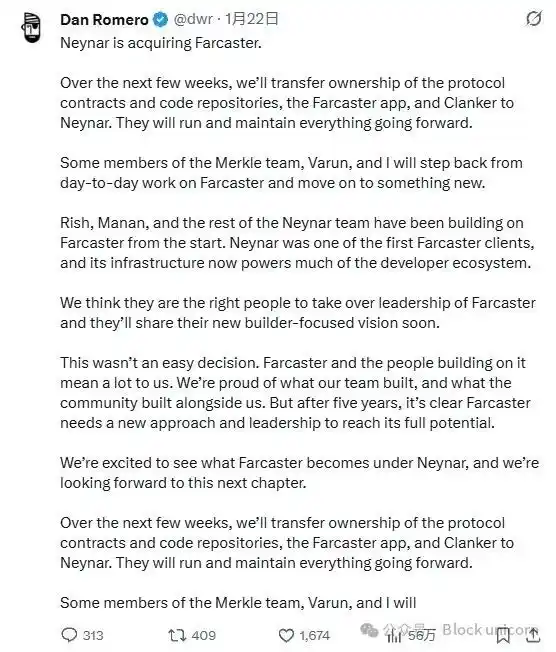
Last Wednesday, Dan Romero, co-founder of the decentralized social platform Farcaster, announced that Neynar, one of Farcaster's earliest and most influential clients, would acquire Farcaster. As part of this transition, ownership of the protocol contracts, core codebase, official applications, and (even) Clanker would be transferred in phases. Meanwhile, Romero noted that the founding team would step back from daily operations to focus on new projects.

Behind Farcaster's decision seems to be a growing internal consensus: the long-term sustainability of social protocols relies less on continuous iteration at the protocol design level and more on increasingly specialized infrastructure and operational execution capabilities at the current stage.

In practice, this means control naturally shifts to infrastructure providers who have successfully aggregated developer resources and traffic—Neynar has been emphasizing the cost and complexity of running Farcaster's hub servers since 2024, abstracting these challenges into APIs and infrastructure layers so developers can focus on product development rather than grappling with protocol internals.
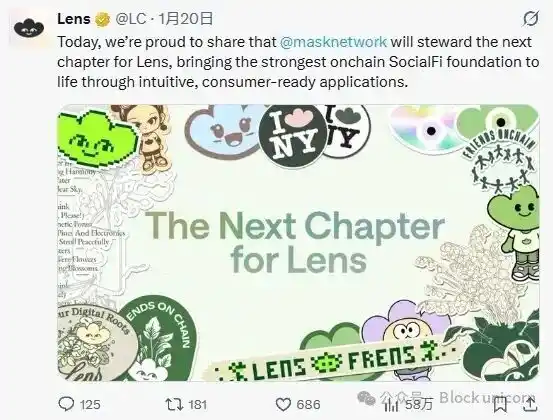
In contrast, Lens has adopted a more advanced—though conceptually aligned with Farcaster—approach. With a relatively richer set of tools, resources, and a mature user base, Lens has chosen to push further in the operational direction.

On January 20, 2026, Lens Labs officially announced that Mask Network would take on the role of "steward" for the next phase of Lens, shifting the project's focus from infrastructure building to consumer-facing products. Mask, for its part, stated that the move aims to translate the protocol's proven achievements into experiences accessible to the mass market.

Notably, both Lens and Aave specifically emphasized that this transition does not involve changes to ownership, financial structure, or governance. The focus is not on the acquisition itself but on a clear reallocation of responsibilities—specifically, who is responsible for turning the protocol into a product people use daily.

2. The Key to Platformization Lies in Clear Role Division

From a broader perspective, both cases point to the same conclusion: as protocols evolve into platforms, the key requirement is no longer adding more features but clearly dividing roles and responsibilities—i.e., how to efficiently optimize the complete operational stack required by a platform, including infrastructure resources, developer onboarding tools, distribution capabilities, and more.

Neynar's core value in the Farcaster ecosystem lies in standardizing social data and user behavior through APIs. Neynar enables developers to immediately start experimenting with products without dealing with the complexities of hub operations or the protocol level. Thus, this acquisition marks Neynar's entry into the next stage—enhancing Farcaster's development and operational layer by integrating the protocol itself.

Lens, though it followed a different path, ultimately landed in a similar framework. With Lens Chain and V3 already establishing the foundational architecture, the next challenge is no longer building more protocols but delivering consumer experiences that users truly engage with daily. The partnership with Mask Network is precisely aimed at bridging this gap.

3. The Battle of the Super Layers

In fact, the integration and consolidation of protocols are not new. Similar patterns have emerged in the Web2 and Web2.5 spaces since around 2025. Wallet providers, crypto payment companies, exchanges, and infrastructure providers are increasingly seeking to integrate adjacent services or make acquisitions to achieve vertical expansion and build so-called "super layers."

However, the most important aspect is not the range of functions these players are trying to bundle. Instead, the decisive shift lies in how they carefully design the integration—selecting the technology stack and operational platforms to integrate based on clearly defined target audiences.

The Neynar–Farcaster and Mask–Lens cases show that the Web3 ecosystem is also moving beyond the stage of loosely connected experimental protocols into an era of large-scale network ecosystems, where organization, operations, and technology are tightly interwoven. Even in the realm of building an open internet, Web3 product teams, long constrained by founder-centric, semi-closed structures, now face the reality of competition: independent team structures, clear division of responsibilities, and the ability to operate products long-term are no longer optional but essential.

Looking ahead, the market dynamics around building super layers (spanning both Web2 and Web3) are likely to become more strategic and more intense.


Criptomoedas em alta

Perguntas relacionadas

QWhat is the strategic shift behind Farcaster's acquisition by Neynar?

AThe strategic shift is that the long-term sustainability of social protocols relies more on specialized infrastructure and operational execution rather than continuous iteration at the protocol design level. Control naturally transfers to infrastructure providers like Neynar, which abstracts away the complexity and cost of running hubs, allowing developers to focus on product development.

QHow does the Lens and Mask Network partnership differ from a traditional acquisition?

AThe partnership does not involve changes in ownership, financial structure, or governance. The focus is on a clear reallocation of responsibility—specifically, who is responsible for turning the protocol into a product that people use daily, rather than a merger or acquisition itself.

QWhat is the core value that Neynar provides to the Farcaster ecosystem?

ANeynar's core value lies in standardizing social data and user behavior through APIs, enabling developers to immediately start product experiments without dealing with the complexities of hub operations or the protocol layer.

QWhat broader trend do the Farcaster and Lens cases indicate about Web3 ecosystem evolution?

AThey indicate that the Web3 ecosystem is moving beyond loosely connected experimental protocols into an era of large-scale network ecosystems where organization, operations, and technology are tightly interwoven, with clear role divisions and long-term operational capabilities becoming essential.

QWhat is meant by the 'super layer' in the context of Web2 and Web3?

AThe 'super layer' refers to the trend where providers (like wallets, exchanges, infrastructure companies) integrate adjacent services or make acquisitions to achieve vertical expansion, building comprehensive platforms that bundle functionalities based on carefully selected tech and operational stacks for specific target audiences.

Leituras Relacionadas

Soaring 20% Then Dropping 5%: When Will the Bottom of the Korean Stock Market Be?

"South Korean stocks face a turbulent period as the KOSPI index, after a 20% surge, fell 5% to 6257 points. The market is grappling with severe issues: over 500,000 leveraged retail accounts have been liquidated, and more than 24 trillion won has flowed from stocks into bank deposits for safety. This reflects a significant loss of market liquidity and shaken investor confidence. In response, Korean financial regulators are taking action. They have tripled the minimum保证金 (margin) requirement for single-stock leveraged ETF trades to 30 million won and are considering granting themselves "emergency intervention" powers. These could include capping leverage ratios and setting investment limits on these ETFs, seen by many as amplifying market volatility. Initial results show a 75% drop in these products' trading volume post-regulation. The market downturn has political repercussions, pushing President Yoon Suk-yeol's approval rating to a new low. Meanwhile, foreign investors made a record net purchase of 7.18 trillion won during a recent rebound, while domestic retail investors sold off massively. Morgan Stanley has upgraded South Korean stocks to "overweight," citing the ongoing "leverage unwinding" and potential for a 36% upside, with giants like Samsung Electronics and SK Hynix providing valuation support. However, analysts caution that the market's structure remains vulnerable to foreign capital flows, and the current low may not be the bottom."

marsbitHá 4m

Soaring 20% Then Dropping 5%: When Will the Bottom of the Korean Stock Market Be?

marsbitHá 4m

Goldman Sachs Stakes a Clear Position: This Is the Largest Capital Demand Cycle in Human History, and the Fed Is Just an Observer

Goldman Sachs argues that the world is entering the most capital-intensive investment cycle in history, driven by concurrent massive demands from AI infrastructure, reindustrialization, defense reinvestment, power grid rebuilding, supply chain realignment, and sovereign debt financing. This structural competition for capital is pushing its cost higher, fundamentally altering investment paradigms. Goldman's Mark Wilson states that the Federal Reserve is merely a "passenger, not the driver" in this shift, with rising yields rooted in these real economy demands rather than just monetary policy. While major indices appeared calm in July, underlying market movements were historic, featuring extreme stock dispersion and a severe momentum factor crash, leading to significant de-risking by fund managers. Wilson cautions against expecting a quick reversal in August, citing ongoing digestion of higher rates, disrupted risk models, and typically muted market performance ahead of US midterm elections. Corporate fundamentals remain robust with strong earnings, though growth rates are peaking in the US while accelerating in Europe. Notably, hyperscale cloud companies like Amazon and Microsoft are announcing staggering capital expenditure projections for 2027-2028, justified by explosive AI-related revenue growth and high returns. Amazon revealed its AI revenue run-rate exceeds $25 billion, growing triple-digits annually, and expressed confidence that AWS could become a trillion-dollar revenue business. The report concludes that a transitional period is underway, marked by a growing tension between aggressively investing private tech giants and increasingly capital-constrained sovereign governments. The AI super-cycle continues, with August likely being a consolidation phase.

marsbitHá 9m

Goldman Sachs Stakes a Clear Position: This Is the Largest Capital Demand Cycle in Human History, and the Fed Is Just an Observer

marsbitHá 9m

Outflow of Stablecoins from South Korea Continues for 18 Consecutive Months, Exceeding $360 Million in June

In June 2026, South Korea experienced a net outflow of stablecoins to overseas crypto exchanges, amounting to 560.3 billion won ($367 million). This represents approximately 78% of the net value of foreign stocks purchased by Korean investors in the same period. According to the Financial Supervisory Service (FSS), this marks the 18th consecutive month of net outflows, a trend ongoing since January 2025. The FSS reported that 2.76 trillion won ($1.8+ billion) in stablecoins were withdrawn from the country's five major exchanges to foreign platforms in June, while 2.2 trillion won ($1.4 billion) flowed back in. The second quarter of 2026 saw a significant net outflow of 1.69 trillion won (~$1.1 billion), surpassing net sales of foreign stocks in the same period. Analysts cite access to unavailable domestic financial instruments as a primary driver. Foreign platforms offer crypto derivatives, spot and futures products tied to major Korean stocks like Samsung and Hyundai, along with RWA tokenization, DeFi, staking, and leveraged products. Lawmaker Lee Jong-wook warned that the stablecoin outflows constitute capital flight, exposing investors to risks on unregulated foreign platforms. He called for accelerated regulatory reform and enhanced investor protection measures. The government is reportedly working on a digital assets law to foster the blockchain sector.

cryptonews.ruHá 14m

Outflow of Stablecoins from South Korea Continues for 18 Consecutive Months, Exceeding $360 Million in June

cryptonews.ruHá 14m

Trading

Spot

Artigos em Destaque

Como comprar LAYER

Bem-vindo à HTX.com!Tornámos a compra de Solayer (LAYER) simples e conveniente.Segue o nosso guia passo a passo para iniciar a tua jornada no mundo das criptos.Passo 1: cria a tua conta HTXUtiliza o teu e-mail ou número de telefone para te inscreveres numa conta gratuita na HTX.Desfruta de um processo de inscrição sem complicações e desbloqueia todas as funcionalidades.Obter a minha contaPasso 2: vai para Comprar Cripto e escolhe o teu método de pagamentoCartão de crédito/débito: usa o teu visa ou mastercard para comprar Solayer (LAYER) instantaneamente.Saldo: usa os fundos da tua conta HTX para transacionar sem problemas.Terceiros: adicionamos métodos de pagamento populares, como Google Pay e Apple Pay, para aumentar a conveniência.P2P: transaciona diretamente com outros utilizadores na HTX.Mercado de balcão (OTC): oferecemos serviços personalizados e taxas de câmbio competitivas para os traders.Passo 3: armazena teu Solayer (LAYER)Depois de comprar o teu Solayer (LAYER), armazena-o na tua conta HTX.Alternativamente, podes enviá-lo para outro lugar através de transferência blockchain ou usá-lo para transacionar outras criptomoedas.Passo 4: transaciona Solayer (LAYER)Transaciona facilmente Solayer (LAYER) no mercado à vista da HTX.Acede simplesmente à tua conta, seleciona o teu par de trading, executa as tuas transações e monitoriza em tempo real.Oferecemos uma experiência de fácil utilização tanto para principiantes como para traders experientes.

375 Visualizações TotaisPublicado em {updateTime}Atualizado em 2026.06.02

Como comprar LAYER

Discussões

Bem-vindo à Comunidade HTX. Aqui, pode manter-se informado sobre os mais recentes desenvolvimentos da plataforma e obter acesso a análises profissionais de mercado. As opiniões dos utilizadores sobre o preço de LAYER (LAYER) são apresentadas abaixo.

活动图片