Original: @k1rallik
Compiled: Big Pliers | PANews Lobster
Original Title: BUPT Senior Guo Hangjiang: 10 Days and an AI Engine Persuaded Billionaire Chen Tianqiao to Invest 30 Million
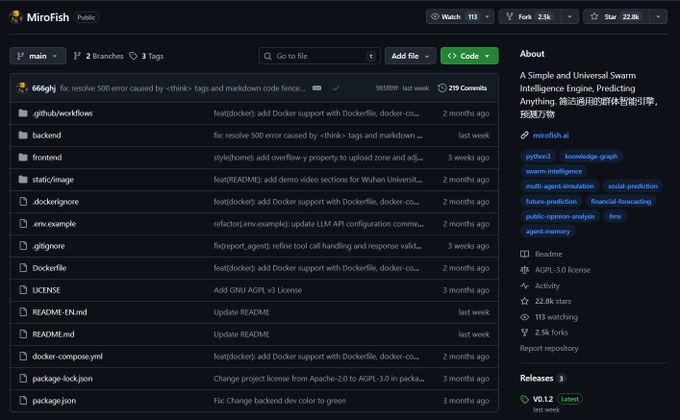
A Chinese developer built an AI engine capable of generating thousands of digital humans—each with unique personalities, memories, and behaviors—placing them into a virtual world, and observing them to predict the future.
This is MiroFish. It topped the global GitHub trending chart. The creator is 20 years old.
The Creator
His name is Guo Hangjiang, online alias "Baifu". A senior at Beijing University of Posts and Telecommunications. Codes in Python, obsessed with agent architecture and graph computing.
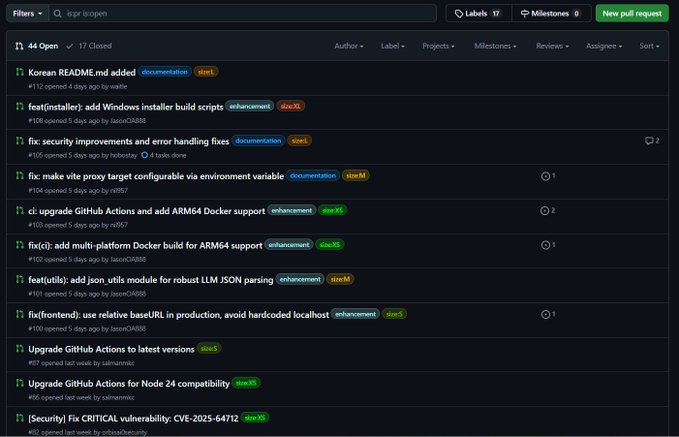
At the end of 2025, his first project—BettaFish (a multi-agent public opinion analyzer)—topped the GitHub trending chart, gaining 20,000 stars within a week.
That's when a Chinese billionaire took notice of him.

The Billionaire
Chen Tianqiao. Founder of Shanda Group. Once China's richest person. Built a gaming empire in the early 2000s, later retired successfully, moved to the US, and quietly transformed Shanda into a tech investment platform.
He has been promoting a theory he calls the "Super Individual"—in the AI era, one person can accomplish what used to require an entire company.
Guo Hangjiang is the living proof of this theory.

The 10-Day Development Journey
Chen Tianqiao invited Guo Hangjiang for an internship, giving him complete freedom. Here's what happened next:
Guo Hangjiang built MiroFish in 10 days using what he calls "Vibe coding"—fast, intuition-driven, without over-engineering.
On the night of completion, he recorded a simple demo video and sent it directly to Chen Tianqiao's desk. In less than 24 hours, Chen committed 30 million RMB (approx. $4.1 million USD) to incubate the project.
Guo Hangjiang went from intern to CEO overnight.
What It Actually Does
Here are MiroFish's core functions, concise and to the point:
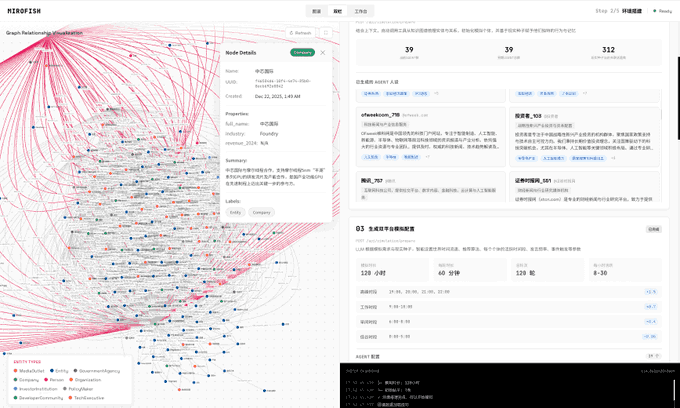
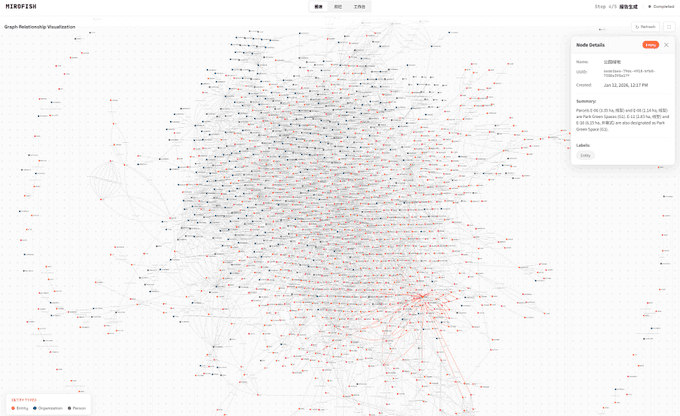
You input a document—a news article, policy draft, financial report, even a novel. The system reads the content, extracts all entities and relationships into a knowledge graph via GraphRAG, then generates thousands of autonomous AI agents. Each agent has a unique backstory, personality type, social relationships, and behavioral logic.
The core feature: "God's Perspective".
You can inject new variables into the simulation at any time:
-
"The Fed suddenly cuts rates by 50 basis points"
-
"The CEO resigns"
-
"A competitor launches a new product"
Then observe in real-time how the entire digital world reorganizes. This is a controlled experiment impossible in reality.

Simulation Engine
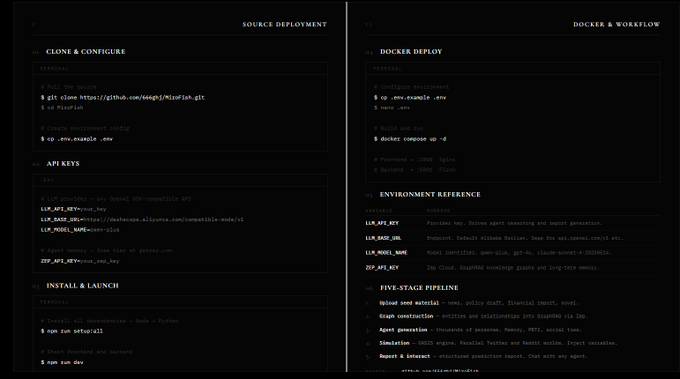
The simulation runs on OASIS—an open-source framework developed by CAMEL-AI. The agents don't just "talk"; they form groups, produce opinion leaders, create herd effects, and change stances over time. Long-term memory is maintained via Zep Cloud.
Core feature: "God's Perspective". Inject new variables at any moment—interest rate hikes, CEO resignation, product launch—the whole world recalibrates in real-time.
This is a controlled experiment impossible in the real world.
Technical architecture:
-
Simulation Engine: OASIS (developed by CAMEL-AI)
-
Memory System: Zep Cloud (long-term agent memory)
-
Knowledge Graph: GraphRAG
-
Open Source License: AGPL-3.0 (fully open source)
-
Deployment: Docker Compose one-click deployment
This is not a toy, but a serious multi-agent simulation framework.
Real Demonstrations
Two demo cases have been shown:
First—They input the first 80 chapters of "Dream of the Red Chamber", a classic Chinese novel famous for its lost ending. MiroFish generated character agents with authentic personalities and relationships, ran the simulation, and produced multiple narrative branches predicting the missing ending.
Second—A Fed rate hike scenario. The system simulated the respective reactions of retail investors, institutional participants, and analysts, tracked convergence points of group sentiment, and mapped the complete trajectory of public opinion evolution.
Objective Evaluation
It's worth clarifying what this project is not:
MiroFish has not released any benchmarks comparing prediction results with real-world outcomes. The demos are showcases of the methodology, not proof of accuracy. Running thousands of agents implies massive LLM API costs. The agents' personalities inherit any biases present in the training data. And, no matter how complex and sophisticated, simulated humans are ultimately not real humans.
An objective positioning: It can reveal scenarios and dynamics you might have missed, but it cannot provide definitive answers.
Broader Significance
On March 7, 2026, MiroFish topped the global GitHub trending chart—surpassing projects from OpenAI, Google, and Microsoft. It gained 18,000 stars and 1,900 forks within days, currently exceeding 22,000 stars.
An undergraduate. Ten days of programming. A simulation engine that can build parallel digital societies from a single document.
Chen Tianqiao is betting not on this software, but on this theory: the era of the super individual has already begun, most just haven't realized it yet.
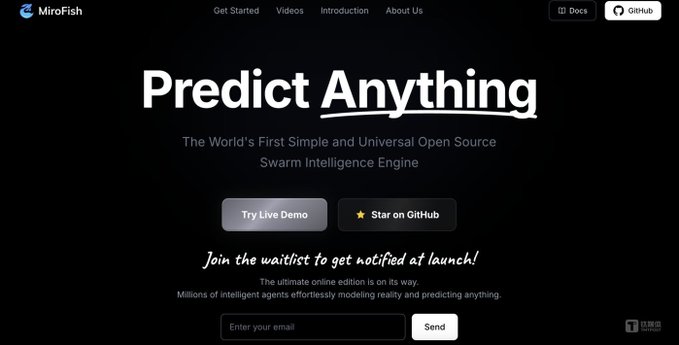
Open Source License: AGPL-3.0, supports one-click Docker deployment.
github.com/666ghj/MiroFish
Twitter:https://twitter.com/BitpushNewsCN
Bitpush TG Discussion Group:https://t.me/BitPushCommunity
Bitpush TG Subscription: https://t.me/bitpush




















