From $1.6 Billion to a 30-Story Fall: The Final Fate of an Algorithmic Stablecoin Operator

marsbitPublicado em 2026-08-10Última atualização em 2026-08-10

Resumo

From $1.6 Billion to a 30-Story Fall: The Final Outcome of a Stablecoin "Whale" On August 7, 2026, Chinese-Canadian crypto investor Harry Yeh (founder of Quantum Fintech Group) was found dead outside a luxury apartment in Asunción, Paraguay, having reportedly fallen from the 30th floor. The scene, where he was found naked and covered in a black plastic bag with his apartment in disarray, prompted an investigation exploring accident, suicide, and homicide. Yeh was a notable early investor in the crypto space, entering in 2013. His major moment came in late 2021 when he took over the troubled algorithmic stablecoin project Tomb Finance on Fantom. Through leveraged tactics and promotion, he drove its Total Value Locked (TVL) to a peak of $1.6 billion in January 2022, though the project's tokens later collapsed. He subsequently promoted LIF3, positioning it as an improved successor. Publicly, Yeh maintained a high-profile image, showcasing a lavish lifestyle on social media. His death adds to a series of non-normal deaths among high-net-worth crypto participants in recent years, including the founders of failed exchange Thodex and other investors. The incident underscores the extreme volatility and potential personal risks within the cryptocurrency industry, highlighting the need for greater emphasis on off-chain security and mental health. The investigation into his death remains ongoing.

Written by: Ma He, Foresight News

On August 7, 2026, local Paraguayan media La Tribuna reported that the body of a Chinese man was discovered outside the luxury apartment building Jade Park in the Trinidad district of Asunción. The preliminary identity was confirmed as Harry Chun Tak Yeh (social media account @ harryyeh), founder and managing partner of Quantum Fintech Group.
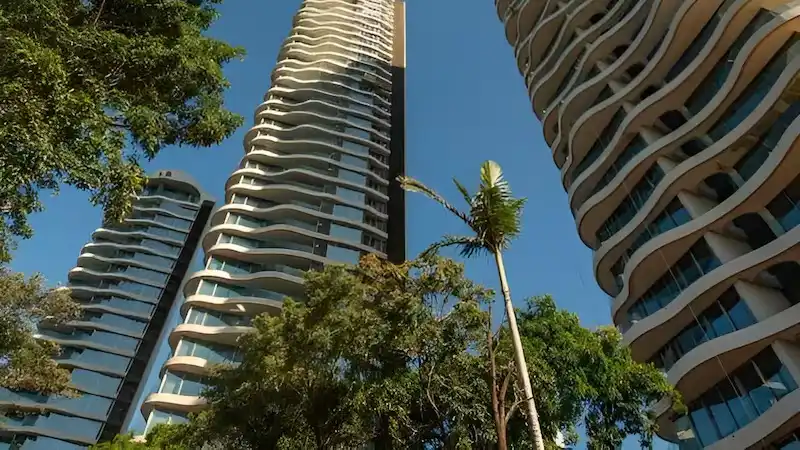
According to the local police bulletin, his fall was initially estimated to have occurred in the early hours of last Tuesday local time, from the 30th floor of the building, one of the tallest in the neighborhood. His body was completely naked and covered by a black plastic bag. Investigators later examined his associated 30th-floor apartment, finding the door open and the interior in severe disarray. Another apartment on the 27th floor of the same building, also linked to him, was secured for forensic evidence. Harry Yeh's 29-year-old Brazilian girlfriend, who lived on a lower floor, told authorities she knew nothing about the incident.

Paraguay's homicide unit and forensic department have collected evidence and transferred it to the prosecutor's office. The prosecutor's office is currently investigating multiple possibilities including accident, suspected suicide, and homicide. The body has been sent to the judicial morgue for an autopsy. As of now, there is no official final conclusion.

Investor in Multiple Projects

His official website harryyeh . com introduced Harry Yeh as Managing Director of Quantum Fintech Group, a company focused on investment management in the cryptocurrency, blockchain, and digital asset space, seeking excess returns for clients and partners. The website explicitly states that during his tenure running the company, he founded and became the seed investor of LIF3 and L3 Reserve. LIF3 is a full-chain DeFi ecosystem, while L3 Reserve is the issuer of L3 USD, positioned as a variably collateralized stable asset.
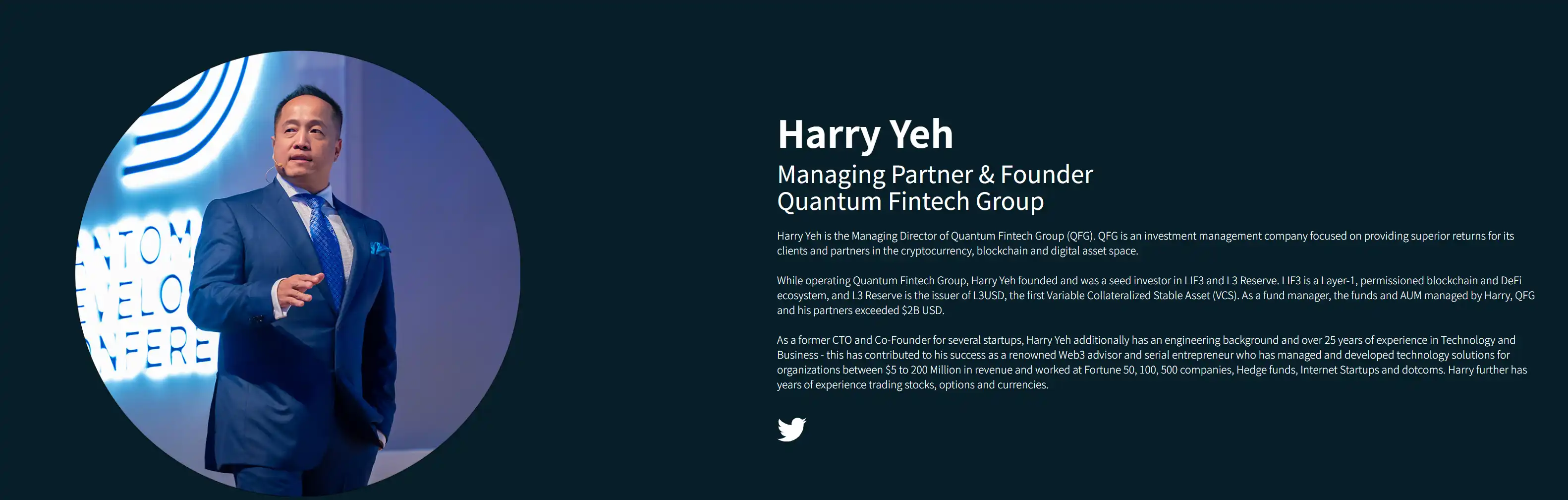
The website shows that Harry Yeh had over 25 years of experience in technology and business, having served as CTO and co-founder of several startups, and had years of experience trading stocks, options, and foreign exchange. Public records indicate he was born in Hong Kong and moved to Canada as a child.

In 2013, when the Bitcoin price was around $60, he entered the market and launched his first fund with approximately $250,000. He initially conducted OTC trading, market-making, and related fund management through Binary Fintech Group.

2021 was a key turning point. In September of that year, Tomb Finance (an algorithmic stablecoin-like project deployed on Fantom, involving tokens like TOMB, TSHARE, TBOND) suffered a liquidation panic due to social engineering exploiting the 'Gatekeeper Tax'—a selling tax established to prevent whale withdrawals. Harry Yeh announced that he and his team would take over, and detailed a plan on September 11. Subsequently, through leverage and aggressive PR, he pushed Tomb Finance's TVL to a historical peak of $1.6 billion in January 2022. However, the project's tokens have since approached zero, and its last X post was in February 2025.
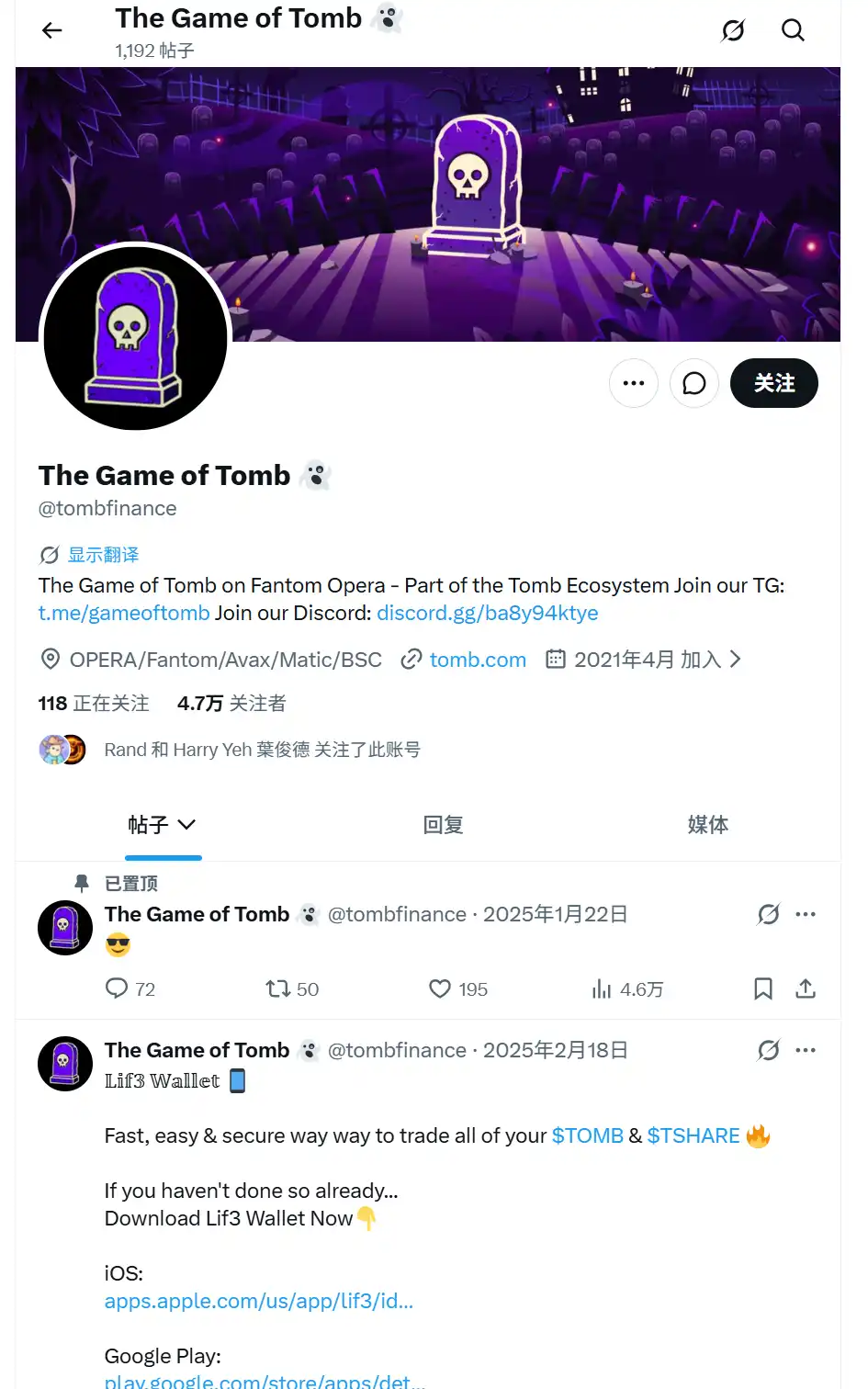
Concurrently, he was a significant early supporter and promoter of the Fantom ecosystem, frequently expressing public optimism for FTM and sharing views at related conferences.

From 2022 onward, he began promoting LIF3. The project was positioned as an improvement and extension of Tomb, emphasizing accessibility and security, offering functions like trading, yield farming, liquidity provision, and derivatives. His X social media account was long tagged with identifiers for tokens like LIF3, TOMB, FTM, TSHARE, and L3 USD.
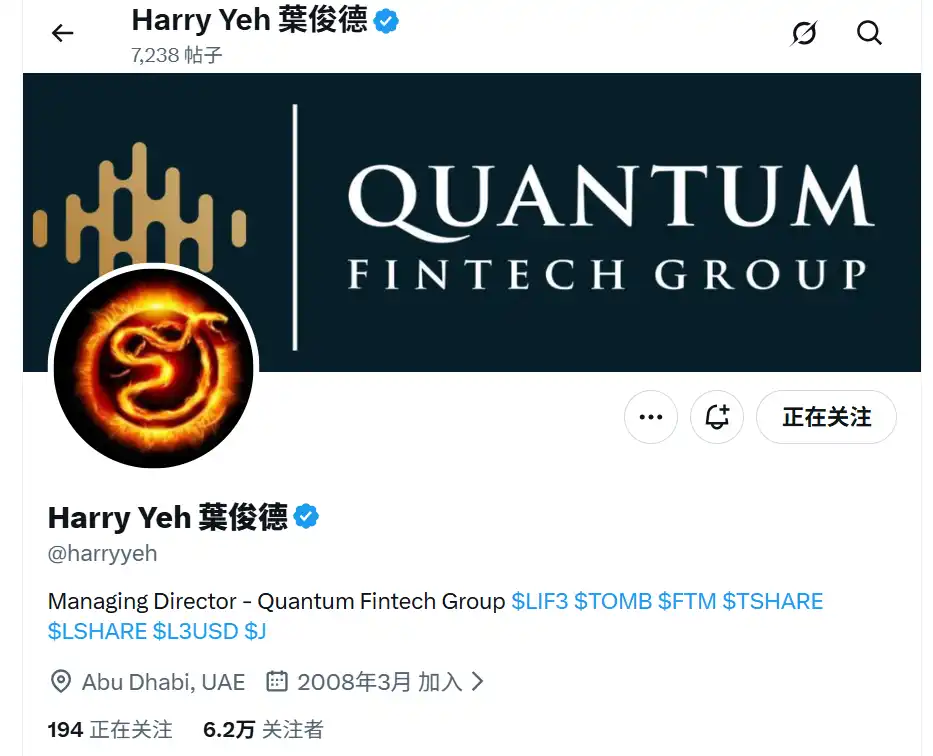
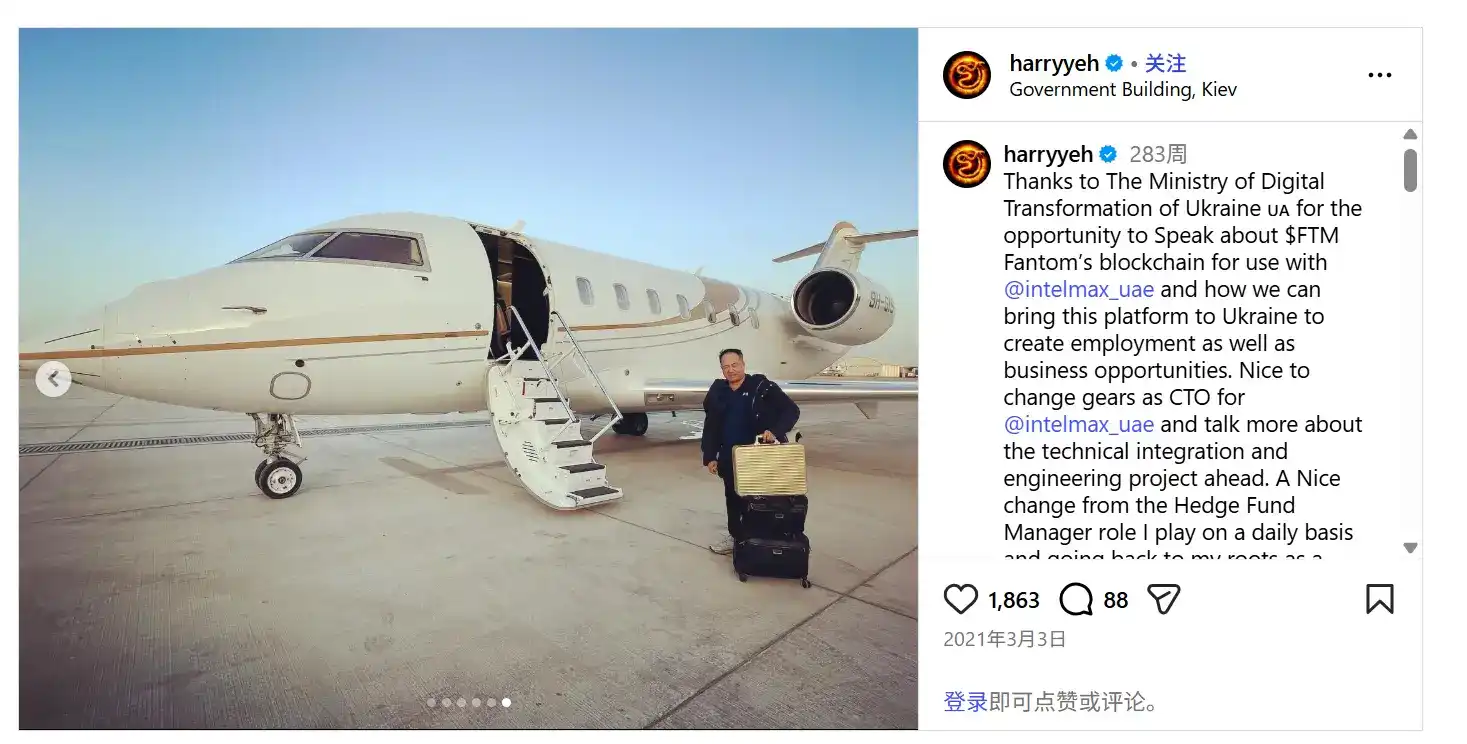
His public persona was relatively high-profile. While he didn't flaunt a lavish lifestyle on X, on Instagram, he frequently showcased private jets and luxury yachts. His reputation in the crypto community was divided. Early on, some saw him as an OG helping the ecosystem expand rapidly, while later, many voices questioned the sustainability and team transparency of his projects.
The crypto industry is no stranger to high-net-worth participants meeting unnatural deaths.

In 2025, Faruk Fatih Özer, founder of the defunct Turkish exchange Thodex, died in prison. His lawyer stated he had recently isolated himself and refused to see family, with preliminary judicial findings leaning towards suicide. The same year, Ukrainian crypto-related figure Konstantin Galish (Kostya Kudo) was found shot to death in his own car in Kyiv. Police mentioned suicidal tendencies and a farewell message, coinciding with a major market downturn. In early 2026, a Hong Kong man fell from his residence after reportedly losing about $1.2 million in crypto investments, with police classifying it as a fall from height.

In these cases, official conclusions and community speculation often coexist. The Harry Yeh incident remains in its early investigative stages. The scene details (naked, plastic bag, apartment in disarray) indeed raise questions about a simple accident or straightforward suicide, but any definitive characterization is premature before autopsy results and more evidence are released.

On-chain wealth can accumulate quickly, but off-chain security, privacy, and mental health are matters requiring greater attention from every crypto participant.


Perguntas relacionadas

QWho was Harry Chun Tak Yeh (Harry Yeh) and what was his role in the cryptocurrency space?

AHarry Chun Tak Yeh (叶俊德) was the founder and managing partner of Quantum Fintech Group, a firm focused on investment management in crypto, blockchain, and digital assets. He was a key early supporter and promoter of the Fantom ecosystem and was known for taking over and managing the Tomb Finance protocol on Fantom. He also founded and was a seed investor in the LIF3 DeFi ecosystem and the L3 Reserve stable asset project.

QWhat is Tomb Finance, and what was Harry Yeh's involvement with it in 2021?

ATomb Finance was an algorithmic stablecoin-like project deployed on the Fantom blockchain, involving TOMB, TSHARE, and TBOND tokens. In September 2021, it experienced a panic due to a social engineering exploit related to its Gatekeeper Tax. Harry Yeh announced that he and his team would take over the protocol, and through leverage and PR efforts, they pushed its Total Value Locked (TVL) to a historical high of $1.6 billion by January 2022. The project's tokens have since declined significantly in value.

QWhat were the unusual circumstances surrounding Harry Yeh's death according to the police report?

AAccording to the police report, Harry Yeh's body was found outside the Jade Park luxury apartment building in Asunción, Paraguay, on August 7, 2026. The preliminary assessment was that he fell from the 30th floor. The body was found completely naked and covered with a black plastic bag. His apartment on the 30th floor was found with the door open and in severe disarray, and another apartment on the 27th floor linked to him was also examined by forensics. His Brazilian girlfriend, living on a lower floor, stated she knew nothing about the incident.

QWhat are some other recent cases mentioned in the article where individuals in the crypto space died under tragic or suspicious circumstances?

AThe article mentions several other cases: In 2025, Faruk Fatih Özer, the founder of the collapsed Turkish exchange Thodex, died in prison, with his lawyer suggesting suicide. In the same year, Ukrainian crypto figure Konstantin Galish (Kostya Kudo) was found shot dead in his car in Kyiv, with police indicating suicide tendencies and a farewell note following a market downturn. In early 2026, a man in Hong Kong died from a fall after reportedly losing around $1.2 million in crypto investments, with police attributing it to a fall from height.

QWhat contrasting public personas did Harry Yeh present, and how did the crypto community view him?

AHarry Yeh presented contrasting public personas. On platform X, he maintained a professional focus, often tagging tokens related to his projects. However, on Instagram, he frequently showcased a luxurious lifestyle involving private jets and yachts. The crypto community's perception of him was divided. In his early involvement, some viewed him as an OG who helped expand the ecosystem rapidly. Later, a significant number of voices raised concerns about the sustainability of his projects and the transparency of his teams.

Leituras Relacionadas

New Job in the Robotics Industry: A 'Bone Doctor' Earning 6,000 Yuan Monthly, Specializing in Treating Broken Limbs

A new job has emerged in the robotics sector: the "orthopedic surgeon" for robots, earning around 6,000 RMB per month by specializing in repairing robots and robotic dogs. As the number of robots explodes, with IDC projecting 18,000 humanoid robots shipped globally in 2025 and China's MIIT predicting over 100,000 units produced domestically in 2026, demand for maintenance and repair is rising. The repair process, as demonstrated by Zhao Xin, a former service industry worker turned self-taught repairman, involves diagnosing issues like joint noises, disassembly, and part replacement. The technical barrier is relatively low, often simpler than repairing drones, with basics learnable in a month. The real challenge is obtaining proprietary parts, which are monopolized by manufacturers, lack public schematics, and are expensive. Currently, third-party repair shops, like those run by Zhao Xin or Nanjing Kaogong Yunji's Fang Jinghua, offer cheaper (10-15% of robot price, 20-50% cheaper than OEM) and faster (one week vs. over a month) service, mainly for out-of-warranty units used in entertainment performances. However, repair volume remains low—just 1-3 robots/month for some shops—making it unsustainable as a primary business. Most repair shops rely on other revenue streams like training, drone repair, or leasing. Training programs are emerging, with courses from 8 to 40 days and fees from 5,000 to 30,000 RMB. Graduates often enter sales or operations roles. For pure repair jobs, salaries range from 6,000-8,000 RMB/month for beginners to over 10,000 RMB for experienced technicians. While companies like JD.com plan large-scale technician training, the robot repair market still awaits broader industry growth to become a fully viable standalone profession.

marsbitHá 8m

New Job in the Robotics Industry: A 'Bone Doctor' Earning 6,000 Yuan Monthly, Specializing in Treating Broken Limbs

marsbitHá 8m

Shenzhen Is Leading the Entire Nation in 'Getting Rich'

Shenzhen, emerging as a leader in China's innovation economy, is pioneering a novel model of regional development by creating and sharing significant capital wealth with cities across the country. In 2026, Shenzhen leads major Chinese cities in new IPOs, adding 26 listed companies. Notably, a substantial portion of these successful firms, operating in strategic sectors like semiconductors (e.g., Dapu Micro, HKC), industrial AI, and new energy materials, feature state-backed investment funds from various cities in their shareholder lists. These external investors, from Nanjing, Mianyang, Changsha, Gui'an, and others, are reaping enormous financial returns from early-stage investments. This trend stems from nationwide confidence in Shenzhen's unparalleled ecosystem for nurturing high-tech firms, supported by massive government-guided funds, a complete industrial chain, and mature capital markets. For other cities, particularly smaller ones, investing in Shenzhen's proven innovators offers a strategic alternative to costly and uncertain local cultivation of industries. Beyond capital gains, these investments often secure agreements for manufacturing bases to be established in the investor cities, fostering local industrial clusters—a "double benefit" of equity appreciation and industrial upgrading. This collaborative model, where Shenzhen focuses on R&D and headquarters functions while sharing growth via equity and decentralizing production, moves beyond traditional zero-sum regional competition. It replaces subsidy-based rivalry with market-driven, mutually beneficial partnerships. This logic of open collaboration and shared prosperity aligns with the core principles of APEC, whose 33rd Leaders' Meeting will be held in Shenzhen, highlighting the city's role as a microcosm of regional cooperation and innovation-led growth.

marsbitHá 18m

Shenzhen Is Leading the Entire Nation in 'Getting Rich'

marsbitHá 18m

Wall Street Morning Brief: Dismal Nonfarm Sparks Rate Cut Trading, Optical Interconnects Begin to Outshine Storage, 'Short Storage, Long Optics' Becomes New Battlefield

Wall Street Morning Report: Key takeaways from market movements and upcoming events. Weak U.S. July non-farm payrolls (-23K vs. +80K expected) significantly reduced expectations for a September Fed rate hike, boosting equities. All eyes are on Wednesday's CPI data for further direction. Geopolitical tensions in the Middle East pushed oil prices higher, while gold surged over 7% weekly. A notable sector rotation emerged within AI infrastructure, with a "short memory, long optics" trade gaining traction. Optical communication stocks like Coherent and Lumentum outperformed, while memory stocks (Seagate, Western Digital, SK Hynix) faced pressure amid concerns over peak pricing and ETF outflows. Software also rallied strongly (Palantir, Atlassian). Key stock moves: SpaceX surged ~23% over two days post-lockup expiration. Palantir jumped nearly 40% weekly on strong U.S. commercial growth. Nvidia rose over 11% weekly, with a reported major investment in AI data center power. Apple is testing ChangXin Memory chips for potential use in China-sold devices. Berkshire Hathaway resumed net stock buying, with Alphabet becoming its top holding. Upcoming focus: Key earnings from Lumentum, CoreWeave, Supermicro (Aug 12), Cisco, and Coherent (Aug 13) to test AI infrastructure demand. U.S. CPI and PPI data (Aug 12 & 14) crucial for Fed policy outlook. Major events include Tencent's earnings, Google's Pixel launch, and the SEC 13F filing deadline.

marsbitHá 33m

Wall Street Morning Brief: Dismal Nonfarm Sparks Rate Cut Trading, Optical Interconnects Begin to Outshine Storage, 'Short Storage, Long Optics' Becomes New Battlefield

marsbitHá 33m

Trading

Spot
活动图片