
From 100% Rebate to 20%: The Game Theory Behind Polymarket's Fee Adjustment

marsbitPublicado em 2026-01-14Última atualização em 2026-01-14

Resumo

Polymarket recently adjusted its fee structure for 15-minute cryptocurrency prediction markets, moving from a 100% fee rebate to a 20% rebate for market makers. This change aims to combat "latency arbitrage" bots that exploited tiny time delays between exchange price updates and Polymarket’s price adjustments, harming market makers and reducing liquidity. Initially, full rebates were introduced to incentivize market makers to stay despite bot activity. After data showed a significant drop in fee volume—indicating reduced bot activity—the platform reduced rebates to 20% for a trial period. This reflects an ongoing effort to balance fairness among market makers, automated traders, and regular users. The article also references ongoing "money printer" strategies used by some successful traders and emphasizes Polymarket’s role in providing a competitive, strategy-driven environment.

Author: DFarm

First, let's sort out the recent timeline of events related to Polymarket's transaction fees.

  1. Polymarket suddenly announced that it would charge a transaction fee for 15-minute cryptocurrency price prediction markets, but all fees collected would be rebated to market makers (those placing limit orders).

  2. The fee rebate was changed from a 100% rebate to a partial rebate.

  3. Until the 11th, the 100% fee rebate stopped. From the 12th to the 18th, 20% of the fees are being rebated.

Why Charge a Fee?

We all know that Polymarket previously did not charge any fees for basic transactions. Why did it specifically start charging fees on the 15-minute cryptocurrency markets this time?

This requires explaining what "latency arbitrage" bots are.

In very short-cycle markets like 15-minute intervals, outcomes are determined based on prices from major exchanges.

In the absence of fees, high-frequency trading bots exploit millisecond-level time delays to place orders on Polymarket before its price has had a chance to update, thereby securing profits.

For example, suppose the current probability for BTC going UP in the next 15 minutes on Polymarket is 90%. Suddenly, the BTC price on exchanges drops by 5%. A bot detects this and immediately buys the cheap DOWN shares. After it finishes buying, subsequent bots or traders come in to buy and drive the price, allowing the initial bot to profit and exit.

What is the consequence of this behavior? Market makers consistently get exploited by these high-frequency bots. Naturally, market makers become unwilling to continue providing liquidity by placing orders in these markets, ultimately leading to poorer liquidity in the 15-minute cryptocurrency markets.
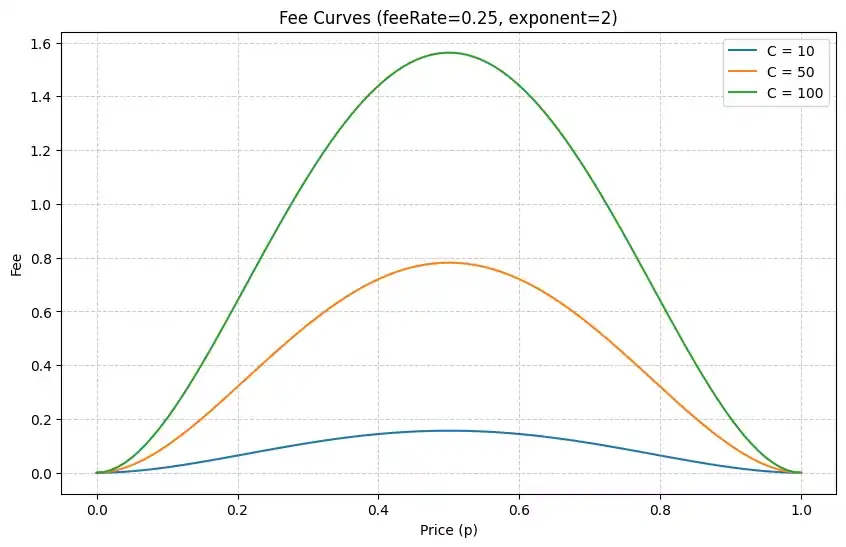
Therefore, the platform introduced a fee mechanism, with the highest fees specifically applied when the odds are 50:50 (as shown in the image). This directly makes the arbitrage cost for many bots higher than their potential profit, so these bots naturally shut down.

Why Subsidize Market Makers?

As mentioned earlier, market makers had too much capital extracted from them previously. To retain market makers, the platform distributes the collected fees to those placing limit orders (market makers).

So why was the rebate reduced from 100% to 20%?

The detail is in this phrase: "From the 12th to the 18th, 20% of fees are rebated." This tells us that the rebate percentage after the 18th is to be determined.

When fees were first introduced, market makers were actually uncertain—they didn't know if the fees would effectively block the bots. The platform initially rebated 100% of the fees to market makers to cover their risks and retain liquidity.

Why only 20% now? Let's look at the data first:
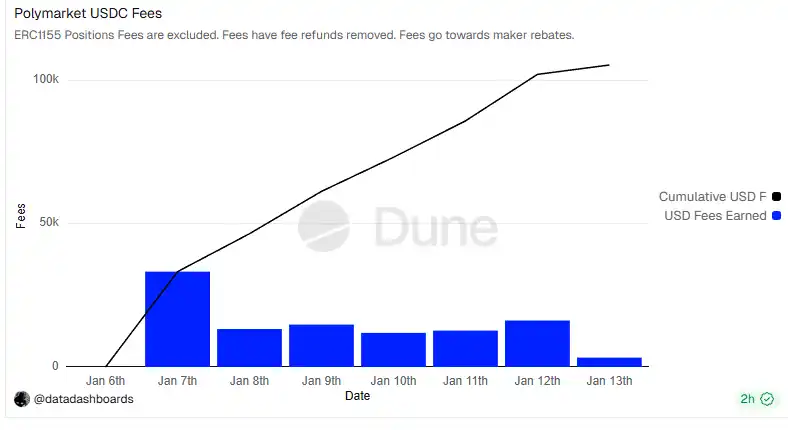
After fees were enabled, the total fee volume halved. What does this indicate? It confirms that many high-frequency bots indeed shut down.

Seeing that the bots are gone and the risk for market makers has decreased, the platform likely concluded that a 100% fee rebate is no longer necessary. They are trying 20% first to see the data performance.

This is why they are trialing a 20% fee rebate for one week first, to observe the data before deciding on the subsequent rebate ratio.

Ultimately, all this is about balancing the interests of market makers, bots, and regular traders.

The "Money Printer" Bots

There are many "money printer" entities present across various markets on Polymarket. Very few people in the market truly understand how they operate.

A very popular example is a post by X user: @the_smart_ape:
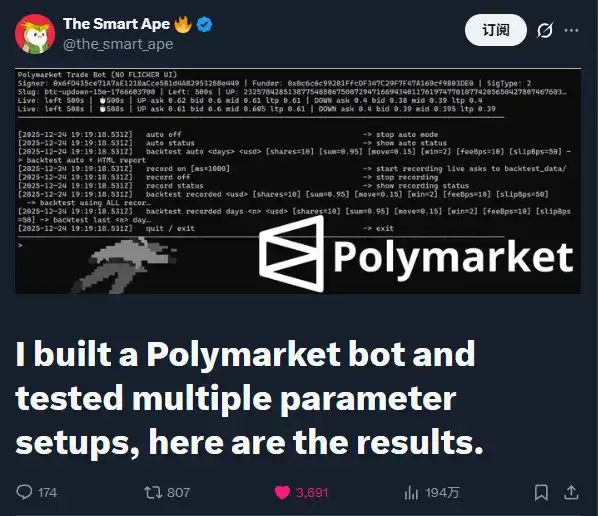
This post has nearly 2 million views. Many friends have tried the strategy described in the article, and indeed some have made profits.

But just a few days later, the fees were introduced, and many friends could no longer profit...

So have the "money printers" disappeared? Not entirely. Interested friends can check out these "money printers":

https://polymarket.com/@gabagool22?via=dfarm

https://polymarket.com/@distinct-baguette?via=dfarm

https://polymarket.com/@livebreathevolatility?via=dfarm

If you can decipher their strategies, your "money printer" isn't far away. But remember, don't tell anyone else—though you can secretly tell me.

Finally

Actually, on Polymarket, since there are no third-party commissions or fees, we are essentially betting against each other. Therefore, the platform's responsibility is to provide a fair playing field for both sides.

Players who enjoy PVP games also know that absolute fairness doesn't exist; it can only be approached through iterative version updates, striving for relative fairness.

This situation also shows us that "money printers" do exist on Polymarket, and it's all about competing on technology and strategy.

If this article was helpful to you, please help share it. Thank you.

If you are a newbie to Polymarket, be sure to check out this article → 《Beginner's Tutorial: Hand-Holding Guide to Getting Started with Polymarket from Scratch (Includes Anti-Ban + Low-Friction Deposit/Withdrawal Strategies)》


Perguntas relacionadas

QWhy did Polymarket introduce fees specifically for the 15-minute cryptocurrency price prediction markets?

APolymarket introduced fees to combat 'latency arbitrage' bots that exploited millisecond delays in price updates to profit at the expense of market makers, which was degrading liquidity in these short-term markets.

QWhat was the initial fee rebate policy, and how did it change?

AInitially, Polymarket implemented a 100% fee rebate to market makers (those placing limit orders). This was later reduced to a 20% rebate for a trial period from the 12th to the 18th.

QWhat effect did the introduction of fees have on the trading activity of arbitrage bots?

AThe total amount of fees collected dropped by half after their introduction, indicating that a significant number of high-frequency arbitrage bots were no longer profitable and stopped operating.

QWhat is the purpose of the fee rebate given to market makers?

AThe rebate is an incentive to compensate market makers for the risks they faced from arbitrage bots and to encourage them to continue providing liquidity (placing limit orders) on the platform.

QAccording to the article, what is the ultimate goal of Polymarket's fee policy adjustments?

AThe goal is to balance the interests of market makers, arbitrage bots, and regular traders to create a fairer trading environment, akin to how game developers balance PVP games through iterative updates.

Leituras Relacionadas

Goldman Sachs: July Smashes Through Crowded Trades, U.S. Stock Bull Market Not Broken but Harder to Navigate

Goldman Sachs: July Sees Crowded Trades Unwound, U.S. Bull Market Intact but Getting Tougher. The U.S. stock market in July did not see an index-level crash, but rather a significant unwinding of speculative positions. While the S&P 500 remained stable—trading within a narrow 3.5% range and staying within 2% of its high—underlying market dynamics were volatile. Heavily crowded trades, particularly in high-momentum tech, AI-linked stocks, and Asian strategies, faced severe pressure and forced deleveraging. Data indicates this was a meaningful cleanse, not a minor adjustment. Global tech exposure saw its largest sell-off in over five years, leverage in Korean equity ETFs plummeted, and Goldman's prime brokerage recorded the largest gross exposure reduction since late 2022. Leverage on momentum factors among fundamental long/short clients fell to the 28th percentile of its one-year range. The AI trade narrative shifted from pure potential to a focus on tangible returns. While Meta failed to show clear AI monetization, Microsoft and Amazon provided evidence that massive capital expenditure is translating into scalable revenue and product growth, preventing a blanket sell-off of the AI sector. The Federal Reserve's more opaque communication style and volatility in long-end Treasury yields have introduced new friction, particularly for rate-sensitive growth and tech stocks. The broader outlook for U.S. equities remains favorable, supported by a strong economy, robust earnings, and substantial AI capital expenditure. However, risk/reward is no longer cheap, and the market's upward elasticity has weakened. The Nasdaq 100's trajectory—up 12% year-to-date despite significant pullbacks—illustrates that the bull trend persists but the path is becoming more difficult. The key lesson from July is that the market no longer rewards crowded, highly leveraged trades, requiring more disciplined and liquid portfolio approaches.

marsbitHá 1h

Goldman Sachs: July Smashes Through Crowded Trades, U.S. Stock Bull Market Not Broken but Harder to Navigate

marsbitHá 1h

Interview with Robinhood Executive: Meme + Tokenized US Stocks as "Barbell" Customer Acquisition Strategy, All Business Lines Achieve Hundreds of Millions in Revenue

Interview with Robinhood executive Johann Kerbrat reveals the company's "barbell" customer acquisition strategy for its new Robinhood Chain, combining meme tokens with tokenized stocks. Three weeks after mainnet launch, the chain has seen over $3B in weekly DEX volume and 105M transactions. Kerbrat explains the logic behind the permissionless chain: meme tokens attract DeFi users, while tokenized real-world assets (RWA), currently over 90 US stocks and ETFs accessible in 120+ countries, serve global users. The goal is to bring Robinhood's 27 million funded accounts on-chain by simplifying DeFi with a user-friendly interface, exemplified by features like Robinhood Earn which offers yield without requiring wallet management. Built on Arbitrum's technology stack for its speed, low cost, and Ethereum's security, the chain focuses on financial products like Earn, spot trading, and perpetuals. Kerbrat downplays direct competition with platforms like Base, emphasizing the goal of expanding the overall market for on-chain assets. He details selective partnerships (e.g., Morpho, Lighter) based on compliance, unique UX, and differentiation. While regulatory clarity is pending for US perpetuals, the expansion continues via Bitstamp in Europe. Finally, Kerbrat positions Robinhood as a "super app" integrating stocks, options, crypto, banking, and AI trading, with all major business lines generating hundreds of millions in revenue. For the chain, current priority is driving adoption over maximizing gas fee revenue.

marsbitHá 3h

Interview with Robinhood Executive: Meme + Tokenized US Stocks as "Barbell" Customer Acquisition Strategy, All Business Lines Achieve Hundreds of Millions in Revenue

marsbitHá 3h

Fidelity Q3 Report: BTC, ETH, and SOL Continue to Build Bottoms; How Much Further Will This Crypto Bear Market Go?

Fidelity's Q3 Crypto Signal Report analyzes the current bear market, noting Bitcoin (BTC), Ethereum (ETH), and Solana (SOL) are in a prolonged bottoming phase. Key indicators like the weighted Net Unrealized Profit/Loss (NUPL) have turned negative (-0.01), signaling the market is slightly below its aggregate cost basis, with BTC acting as the primary stabilizing asset. BTC's dominance has risen to 68%, indicating a lack of capital rotation to other digital assets. Performance has been weak across the board, with BTC, ETH, and SOL down significantly year-to-date. Market sentiment is depressed, exacerbated by substantial outflows from spot ETPs and a challenging macro environment. The report compares the current ~203-day downtrend to historical ~300-day bottoming cycles, suggesting the process may be two-thirds complete, with late 2026 as a potential timeframe to monitor. For Bitcoin, NUPL at 0.09 indicates cautious sentiment, while momentum signals remain negative. The Yardstick metric points to potential undervaluation relative to network security (hashrate). Ethereum's NUPL is deep in the "capitulation" zone at -0.43, a historically positive signal for future returns, though its momentum and network fee revenue are negative. Solana shows the deepest NUPL at -0.72 but demonstrates relative resilience in on-chain activity and stablecoin transfer volume. The report concludes that while several metrics are near historical capitulation levels, a definitive market bottom has not yet been established. The path forward likely involves continued consolidation, with BTC's relative strength and fundamental on-chain usage for ETH and SOL providing key areas for investor observation.

marsbitHá 3h

Fidelity Q3 Report: BTC, ETH, and SOL Continue to Build Bottoms; How Much Further Will This Crypto Bear Market Go?

marsbitHá 3h

Trading

Spot
活动图片




