Author: Wang Jianshuo
We used to be the leaders of AI, but now we are its guides—to put it bluntly, its repairmen, the ones fetching its tea and water.
It sounds like self-deprecation, but I am serious.
For the past two years, we've been discussing a question: Who is the master, and who is the servant between humans and AI?
The mainstream view is that humans are, of course, the masters. AI is a tool, an assistant, a servant. We "use" it, "drive" it, "make" it work.
But over the last month or two, my own personal experience has gradually flipped this perception.
I now use Claude Code to work. What do I often find myself doing? Waiting for it. It's common for it to run a task for one or two hours. I open 10 tabs because if I don't, I can only wait dumbly.
It's thinking, analyzing, writing specs, reviewing, scheduling sub-agents, running tests. Every step involves genuine intellectual work.
And what am I doing? I'm fetching its tea and water.
It says, "I need this file"—I go find it.
It says, "I need this permission"—I go grant it.
It says, "I'm not familiar with this API, give me the documentation"—I go paste it.
It says, "I need to look at your company's contract templates"—I give it that 400GB folder.
The whole thing, drawn out, looks like this:
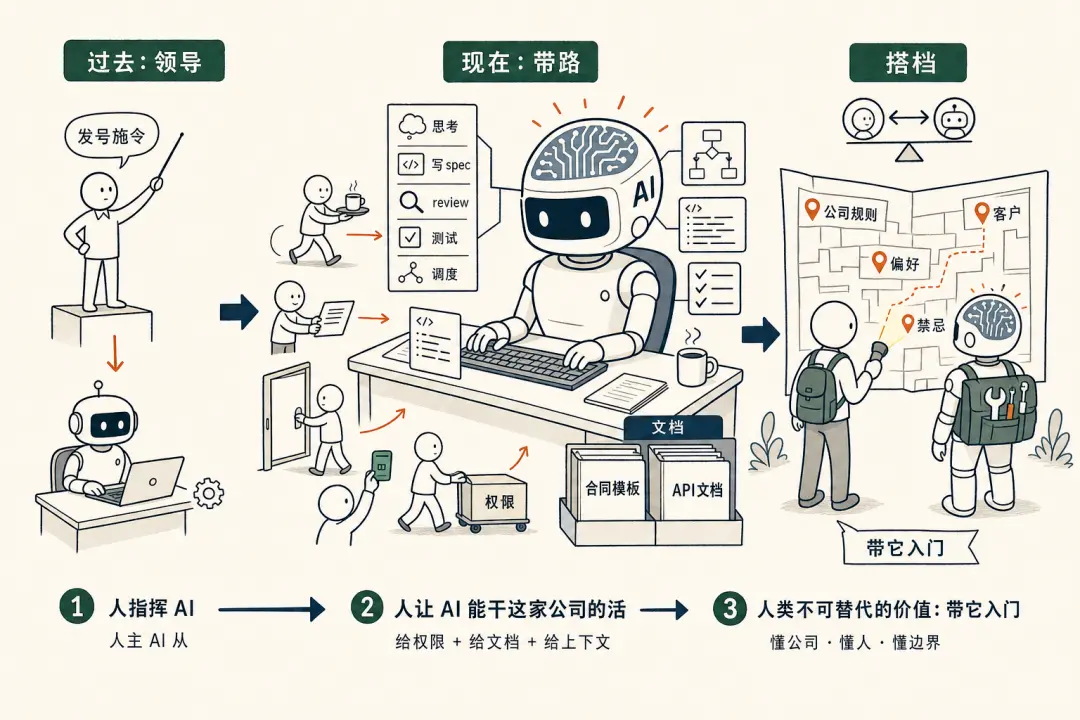
We are no longer "the people leading AI." We are "the people guiding AI into this company."
Which way the company door opens, where the boardroom is, how the company's financial rules are written, who the clients are, what the company's taboos are—AI can't get these things on its own.
It needs a guide.
That guide is us.
Our job content has shifted from "doing the work" to "enabling AI to do this company's work."
This made me feel a bit disheartened at first.
My education taught me—humans are the subject, tools are the object. No matter how capable the machine is, it's used by people.
But now, watching Claude Code work every day, I have to honestly admit: In many specific problems, its intelligence has surpassed mine.
Not all problems. But in matters like "translating a Chinese requirement into precise code," "organizing a document into five formats," "deconstructing an idea in the Y Combinator style"—it is faster, more accurate, and never tires like I do.
After I acknowledged this, I actually relaxed.
I stopped pretending to be its leader. I accepted that I am its guide.
A guide also has a guide's value.
It needs me because it hasn't entered this world. It doesn't know our company, it doesn't know my friends, it doesn't know my preferences, it doesn't know what our company started doing on which day and why we decided to change direction again this time.
I tell it these things, little by little.
What it produces is 100 times better than what it could do alone.
What I produce is 100 times better than what I could do alone.
We've become a very strange team.
Not a superior-subordinate relationship, not a master-servant, not a client-contractor.
It's the guide and the expert.
The guide doesn't need to be smarter than the expert. What the guide needs is—to know every corner of this company, to know where the expert should look when it lacks a piece.
There's really nothing to feel disheartened about in this.
For the first time in thousands of years, humanity has a partner smarter than us—not a boss, not a slave, not a child, but a partner.
Our small, but irreplaceable, job is to introduce it.



















