Original | Odaily Planet Daily (@OdailyChina)
Author | Golem (@web3_golem)
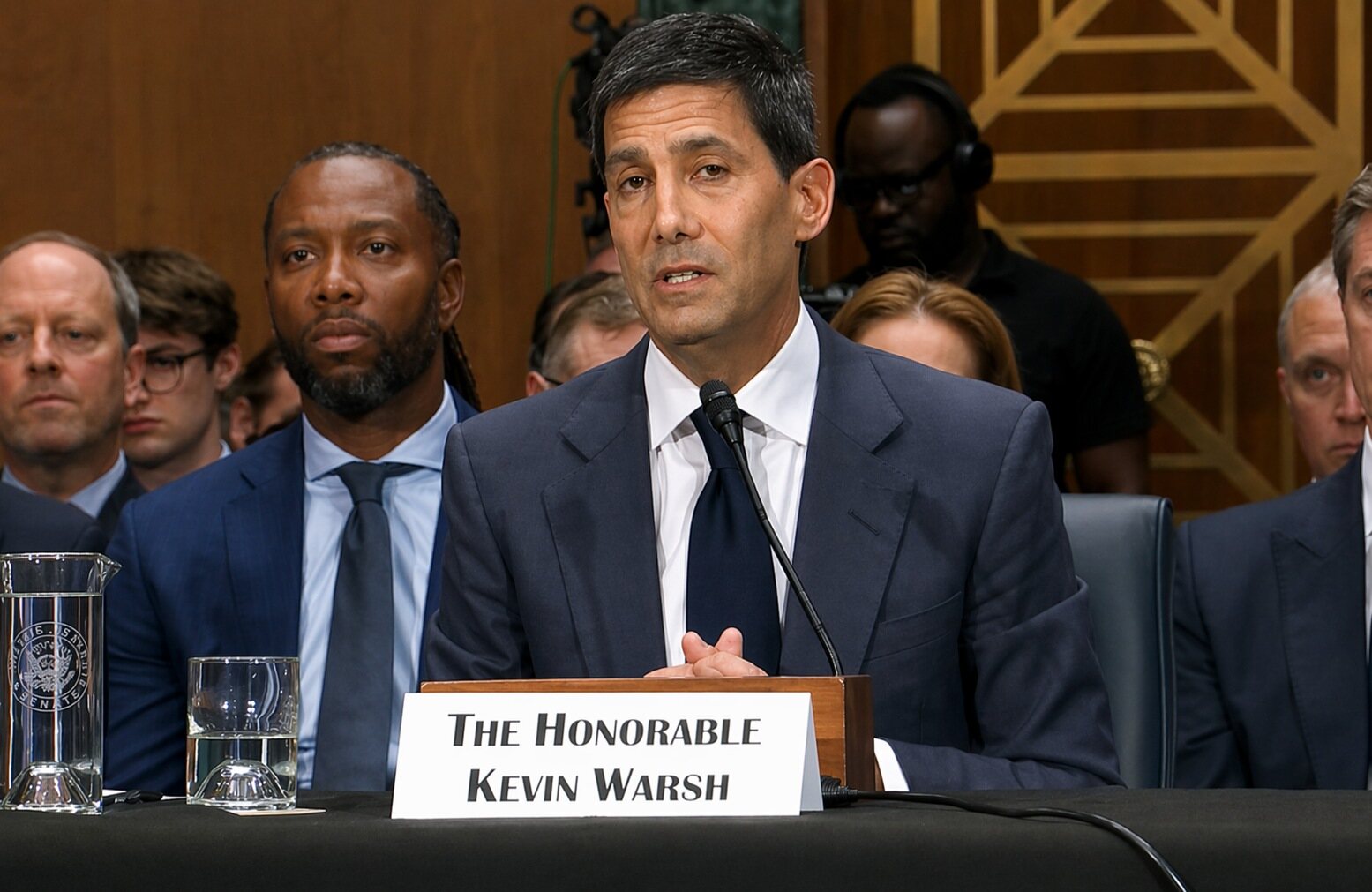
At 10 PM Beijing time on April 21, Federal Reserve Chair nominee Kevin Warsh attended a confirmation hearing before the Senate Banking Committee, where he faced questioning on his commitment to monetary policy and the Fed's independence, according to The Wall Street Journal.
During the hearing, when addressing the issue of the Fed's independence, Warsh stated that he would be independent of Trump, and that Trump had never asked him to commit to any specific interest rate decisions. He further argued that even if Trump had asked, he would never have agreed. Beyond such statements, Warsh largely avoided answering questions related to Trump. On monetary policy, Warsh heavily criticized the Federal Reserve's institutions, arguing that the Fed needs institutional changes in its decision-making processes. However, he made very few specific statements on monetary policy itself, mentioning only that the Fed needs to gradually and cautiously reduce its balance sheet, with no clear statements indicating interest rate cuts.
This might have been intentional on Warsh's part. According to his opening statement obtained in advance by Bloomberg, although Warsh's prepared testimony was nearly 2000 words long—far exceeding the approximately 850 to 900 words of Powell's and former Chair Yellen's initial hearings—it contained very little substantive discussion on the direction of monetary policy. This move by Warsh is consistent with his long-held stance that Fed officials should not pre-commit to interest rate positions.
But for investors following this hearing, regardless of their expectations, the outcome was likely disappointing. In terms of both content and results, the substantive significance of this hearing was minimal. Bloomberg columnist John Authers even characterized it as a political performance of "form over substance" before the hearing began. Ultimately, whether Warsh's nomination is successfully confirmed by the Senate depends on off-stage political maneuvering, not on anything Warsh says at the podium.
The Stubborn Trump and the Innocent Warsh
As previously analyzed by Odaily Planet Daily, the importance of this hearing lay in its potential to decide whether Powell would stay or go after his term ends on May 15. If Warsh's nomination was not confirmed by the Senate this time, Powell would very likely remain as interim Fed Chair after his term expires. (Related reading:Powell's Chance of Staying Soars to 98%, Is Trump's "Firing Order" Just Bluster?)
However, after this hearing, the market still cannot determine whether Warsh's nomination for Fed Chair will be confirmed by the Senate as scheduled, because the main figure obstructing Warsh's nomination, Thom Tillis, didn't even engage in effective dialogue with Warsh.
Thom Tillis had previously stated publicly that he would not support moving Warsh's nomination process to a full Senate vote unless Trump dropped his investigation into Powell. During the April 21 hearing, Thom Tillis did not even question Warsh. Instead, he used a set of slides to justify the cost overruns in the Fed building renovation project. Finally, he stated that his dissatisfaction was not directed at Warsh, whom he called "exceptionally qualified, impeccable," but that he needed this investigation to end before he could support Warsh's confirmation.
Therefore, the content of the hearing could no longer decide the outcome. Whether Trump can finally get rid of Powell on schedule now hinges on whether the Senate confirms Warsh's nomination in time, and whether Warsh's nomination proceeds smoothly again depends on whether Trump is willing to drop the investigation into Powell.
On April 21, Trump also discussed the Fed and interest rates in a new interview. He said he would be disappointed if the new Fed Chair (Warsh) did not cut rates quickly, but he also must get to the bottom of the Fed building cost overruns. Pressuring the new Fed Chair Warsh to cut rates and investigating Powell are parallel actions; Trump shows no sign of backing down.
As John Authers said, the real game is happening outside the hearing room, and Warsh is even "collateral damage." The impasse will be broken either if Thom Tillis concedes, or if Warsh uses the prospect of rate cuts as leverage to persuade Trump to drop the investigation into Powell, allowing Warsh to take charge of the Fed sooner. Warsh's relationship with Trump is not ordinary. Warsh's father-in-law, Ronald Steven Lauder, is the sole heir to the international cosmetics giant Estée Lauder Companies, and he is also a Republican donor and Trump's college classmate. Therefore, if Warsh truly wants to take charge of the Fed soon, he might be able to persuade Trump to drop the investigation.
Otherwise, if this stalemate continues until Powell's term expires and Trump chooses to fire Powell to resolve it, as Odaily Planet Daily previously analyzed, the result would probably be in Powell's favor. It is worth mentioning that, according to monitoring by the Odaily Seer channel, the probability of Powell stepping down as Fed Chair after his term expires on Polymarket remains at 2%. However, upon closer inspection of the settlement rules for this event contract, if Powell's resignation/removal is announced before the market end date, the market will immediately settle to "Yes" regardless of when the announced resignation/removal takes effect.
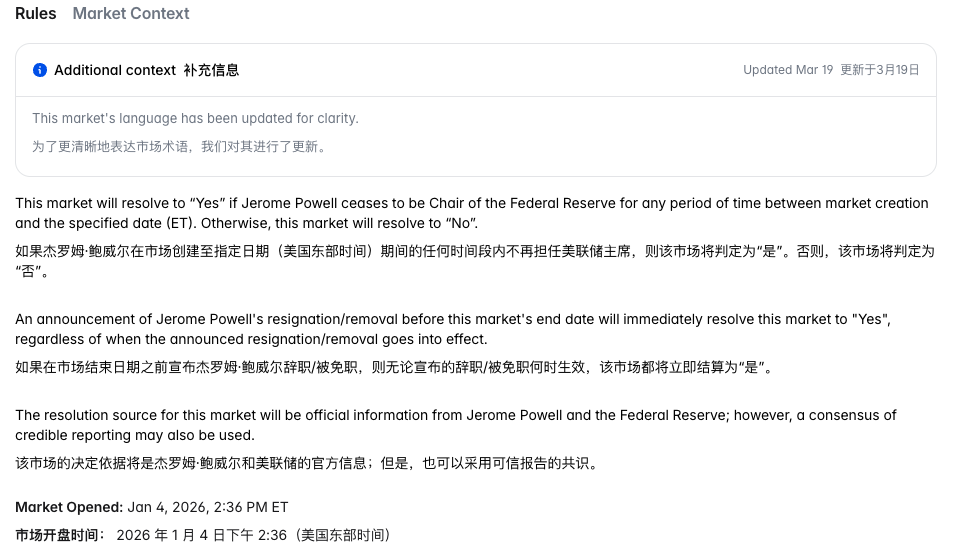
Settlement rules for the market on whether Powell will step down as Fed Chair after his term expires
This means that as soon as Trump announces the firing of Powell, the event would be settled. Although Powell could file a lawsuit to challenge the legal effect of the President's removal during the litigation process, litigation is a lengthy process. Therefore, the rule stating "the market is immediately settled to Yes regardless of when the announced resignation/removal takes effect" becomes a potential loophole. (Odaily Note: The above is only the author's personal judgment and does not constitute any advice)
Warsh: Digital Assets Are Part of the US Financial Services Industry
But for the crypto industry, there was some substance in this hearing. It was previously disclosed that Warsh holds a series of assets including cryptocurrency, Polymarket, and SpaceX stock, which was seen as a sign of his friendly attitude towards the crypto industry.
During the hearing, when questioned about his financial disclosures exceeding $100 million and potential conflicts of interest, Warsh promised to divest related assets before taking office if his nomination is approved. But he further stated that digital assets are part of the US financial services industry, affirming the legitimacy and importance of the crypto industry in the United States. Although it was only briefly mentioned, having someone poised to take one of the most powerful positions in the global economy indicate that they are crypto-friendly is definitely good news.







