For the First Time, Pure Human Video Pretrained VLA for Dexterous Manipulation: Deployable with Minimal Fine-Tuning Data

marsbitPublicado em 2026-06-08Última atualização em 2026-06-08

Resumo

For the first time, a purely human-video-pretrained Vision-Language-Action (VLA) model for dexterous manipulation requires only a small amount of data for fine-tuning to achieve successful real-world deployment. Achieving human-level dexterous manipulation remains a core challenge in robotics. While multi-fingered hands offer hardware potential, Visual-Language-Action (VLA) models lag behind due to the high cost of collecting diverse, high-quality robot data. A novel framework, VITRA, developed by Microsoft Research Asia and Tsinghua University, addresses this by automatically transforming massive, unlabeled real-world human activity videos into a structured V-L-A training dataset. Key innovations include precise 3D hand motion annotation from monocular video, atomic action segmentation based on hand-speed minima, and automated instruction generation using VLMs combined with 3D trajectory visualization. This process created a massive dataset of 1 million clips. Pretrained exclusively on this human video data, the VLA model (combining a VLM backbone with a Diffusion Transformer action expert) demonstrates strong zero-shot hand motion prediction in unseen environments. Crucially, it requires minimal fine-tuning (~1.2k demonstrations) on real robot data to achieve high-success-rate dexterous manipulation tasks like grasping, placing, pouring, and sweeping on hardware like the Realman robot with the XHAND1 dexterous hand. The model shows exceptional generalization to novel obje...

Achieving human-level dexterous manipulation capability has long been a core challenge in the field of robotics.

Although multi-fingered dexterous hands possess hardware potential similar to humans, due to the high cost of acquiring high-quality robotic action data, existing Vision-Language-Action (VLA) models lag far behind large language models (LLMs) and vision-language models (VLMs) in terms of data scale and diversity, making it difficult to meet the demands of complex tasks in the real world.

A recent research paper titled "Scalable Vision-Language-Action Model Pretraining for Robotic Manipulation with Real-Life Human Activity Videos" from Microsoft Research Asia (MSRA) in collaboration with Tsinghua University addresses this critical issue by proposing an innovative pre-training framework called VITRA.
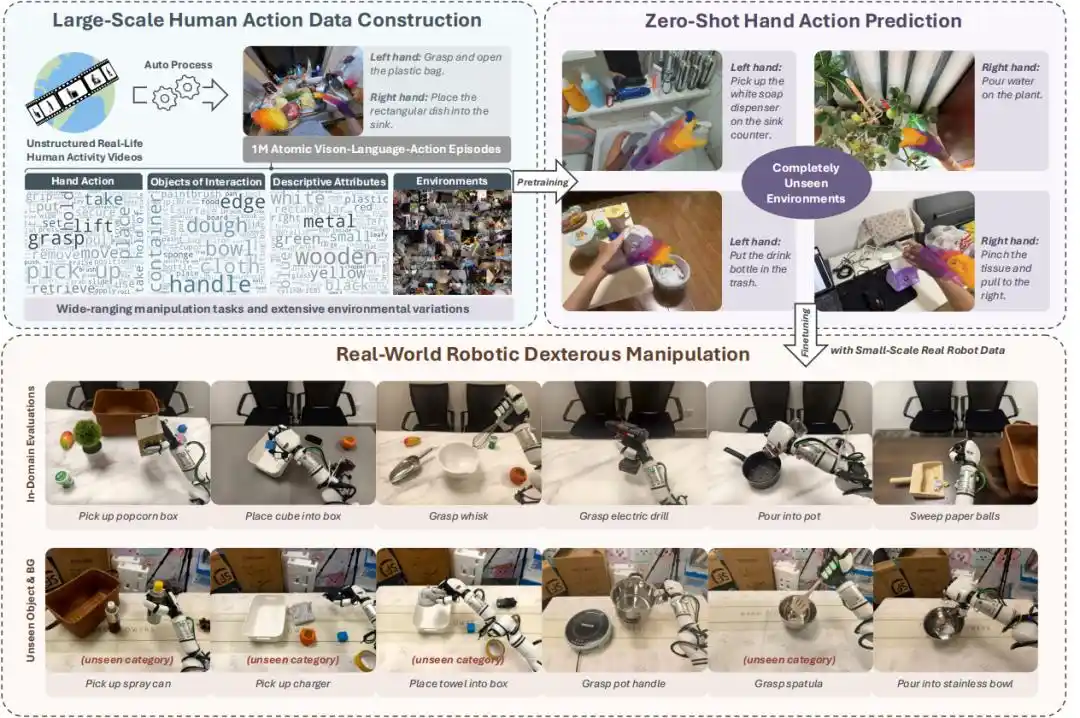
The core contribution of this research lies in proposing a fully automated solution that converts massive amounts of unlabeled real-world human activity videos into data perfectly aligned with the existing V-L-A training data format for robots.

By extracting 3D hand motion trajectories from videos, performing atomic-level action segmentation, and automatically generating language instructions, the research team constructed a large-scale hand V-L-A dataset containing 1 million clips and 26 million frames.

After pre-training solely on human video data, the model demonstrated powerful zero-shot hand action prediction capabilities in completely unseen real-world environments.

With only a small amount of fine-tuning using real robot data, it achieved high success rates in dexterous manipulation on real robots and exhibited strong generalization ability to new objects and environments.

More details follow below.

Bridging the Gap from Human Videos to Robot Data

The central challenge of the paper is how to overcome the vast difference between unstructured human videos and structured robot data, thereby extracting high-quality action labels and language instructions usable for VLA model pre-training.

This research built a complete system consisting of three core technologies, achieving seamless transformation from raw video to V-L-A data.
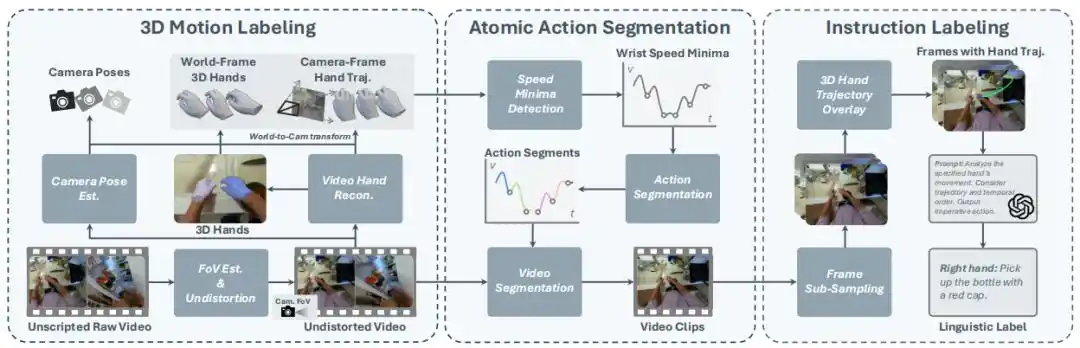
3D Motion Annotation: Accurately Recovering Hand and Camera Trajectories

Recovering precise 3D hand motion from monocular, uncalibrated, and potentially moving camera videos is an extremely challenging task.

This research proposes a monocular camera and hand pose tracking method based on the latest 3D vision technology:

First, it determines the camera state via background optical flow and estimates camera intrinsics.

Subsequently, it tracks camera pose using a visual SLAM method and a depth estimation model, and extracts the camera-space 3D hand pose per frame (including wrist 6D pose and full joint angles) using a hand reconstruction model.

Finally, by combining this information, it obtains the 3D hand motion trajectory in world space.

This method not only provides high-precision action labels but also lays the foundation for subsequent action segmentation and instruction annotation.

Atomic-Level Action Segmentation: Natural Segmentation Based on Velocity Minima

Existing robot V-L-A data typically consists of simple, short-horizon atomic-level tasks. Accurately segmenting these atomic actions from long videos is a difficult problem.

Inspired by the natural rhythm of human movements, the research team proposed a simple yet efficient segmentation algorithm: segmenting based on the minima of hand movement speed in 3D space.

During action transitions, human hands typically exhibit changes in speed, and speed minima often mark the switching of actions.

By detecting the speed minima of the 3D wrist trajectory in world space, this method can efficiently segment long videos into short clips containing a single atomic action, without requiring any additional manual annotation or model inference.


Instruction Annotation: Precise Action Description Combining 3D Trajectories

To generate accurate language instructions for the segmented video clips, the research team cleverly combined a Vision-Language Model (VLM) with 3D hand trajectories.

For each video clip, the system uniformly samples 8 frames and projects and overlays the palm's 3D trajectory onto these images.

Then, these images with trajectory highlighting are input into GPT-4, prompting it to describe the specified hand's action in an imperative sentence form, combining image content and trajectory information.

Experiments proved that providing atomic-level video clips overlaid with 3D hand trajectories significantly improves the accuracy of GPT-generated action descriptions.

Achieving Powerful Zero-Shot Prediction and Real-World Generalization

Based on the automatically constructed large-scale human hand V-L-A dataset, the research team designed and trained a VLA model specifically tailored for dexterous manipulation.
1. Model Architecture: Combining VLM and Diffusion Action Experts

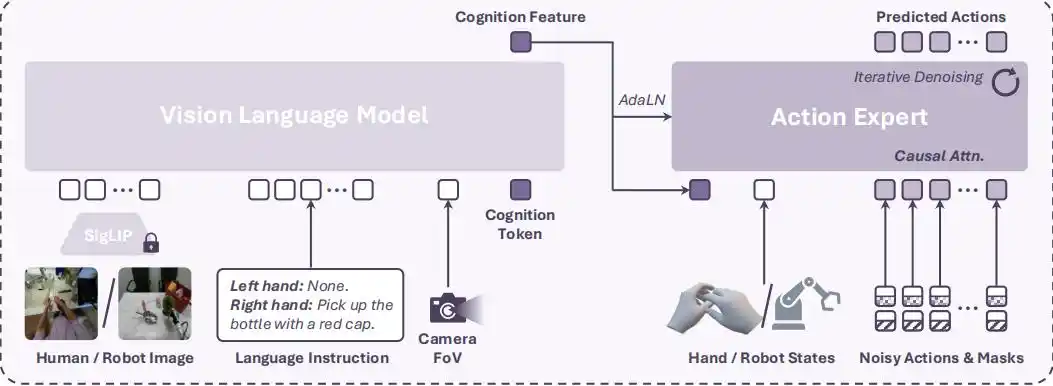
This VLA model consists of a VLM backbone network (PaliGemma-2) and a diffusion action expert (Diffusion Transformer, DiT).

The VLM receives visual observations, language instructions, and camera field-of-view (FoV) information, outputting a "Cognition Feature".

The diffusion action expert receives this cognition feature, the current hand state, and a noisy action block with masking, iteratively denoising to predict future hand action sequences.

To handle fast-moving human hand actions and adapt to short-clip data, the model employs a Causal Attention mechanism for action denoising, ensuring each action step's prediction depends only on previous actions, effectively mitigating negative impacts from zero-padding.

2. Zero-Shot Hand Action Prediction: Demonstrating Remarkable Ability in Unseen Environments

In completely unseen real-life environments, the pre-trained model demonstrated powerful zero-shot hand action prediction capabilities.
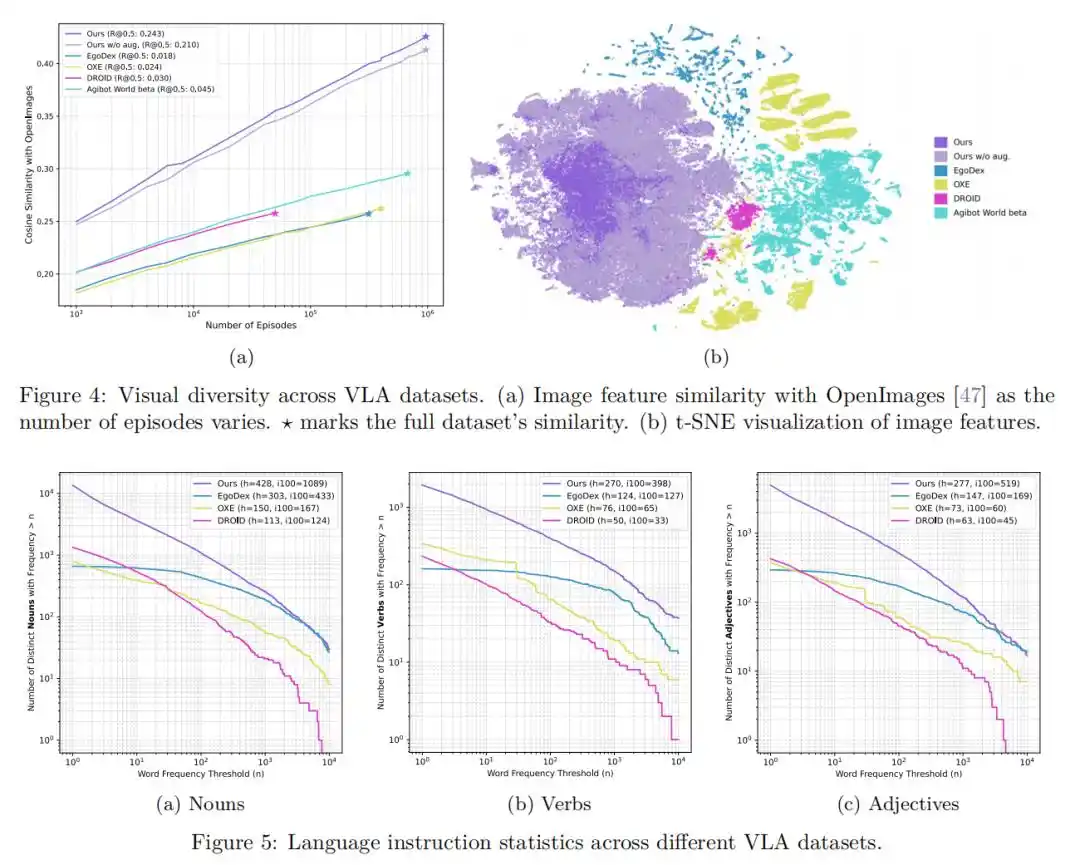
In evaluations for grasping tasks and general action prediction tasks, this model significantly outperformed models trained on data collected in lab environments (like EgoDex), and also outperformed models trained using raw human-annotated data.

This fully demonstrates that pre-training with massive, diverse real-life videos can greatly enhance the model's generalization ability for complex environments and unknown objects.

3. Real-Robot Dexterous Manipulation: Efficient Deployment with Minimal Fine-Tuning Data

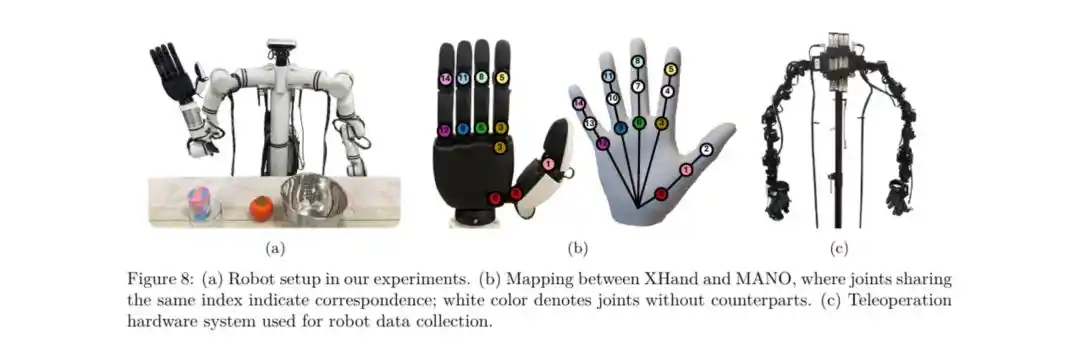
To deploy on real robots, the research team aligned the human hand's action space with that of the robot dexterous hand (e.g., Realman robot equipped with StarXHand1).
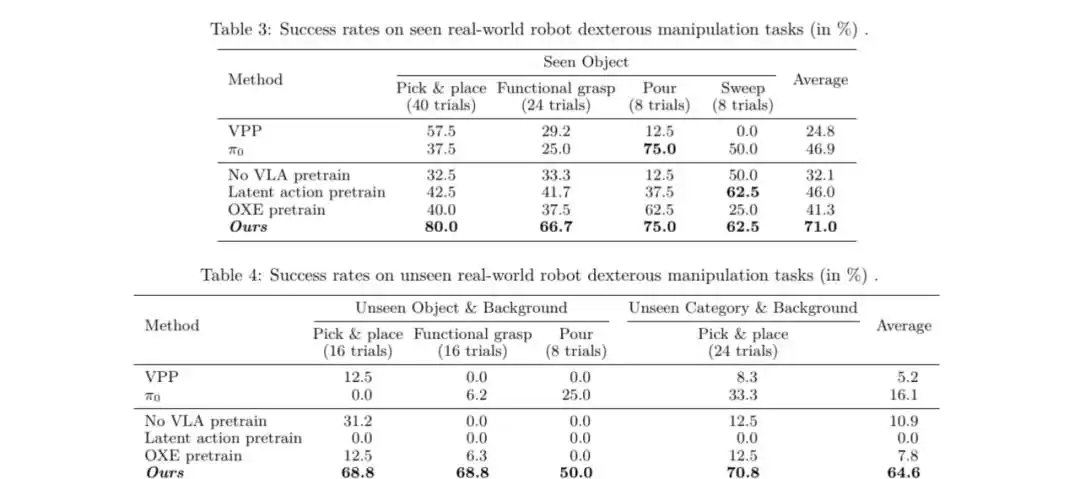
With only a small amount (about 1.2K instances) of fine-tuning using real robot teleoperation data on the pre-trained model, it could execute various dexterous manipulation tasks in the real world, including grasping, placing, pouring, and sweeping.

Experimental results show that compared to models not pre-trained on human VLA data or pre-trained on other datasets (like OXE, EgoDex), this method achieved significant improvement in task success rate, especially demonstrating remarkable robustness when facing unseen objects and backgrounds.

The Hardware Core Supporting VITRA's Real-World Deployment

The reason the VITRA framework can achieve stunning generalization on real robots relies not only on algorithmic innovations but also on the powerful support of the underlying hardware—

the domestically pioneered, fully direct-drive five-fingered dexterous hand StarXHand1 developed by StarX Robotics.

This framework forms a perfect "software-hardware synergy" with the hardware characteristics of StarXHand1, demonstrating irreplaceable deployment advantages in practical application scenarios.
High-Precision URDF and Seamless Connection to Human Hand Action Space

The core breakthrough of the VITRA framework lies in aligning the human hand action space with the robot dexterous hand's action space.
StarXHand1 officially provides an extremely high-precision URDF model, which not only accurately describes motion and dynamics parameters but also perfectly maps the spatial distribution of human hand joints.

This "digital twin"-level model support enables VITRA to precisely map human joint angles to the corresponding joints of StarXHand1 during the fine-tuning phase, thereby significantly reducing the reality gap from human videos to real hardware and ensuring the efficient deployment of pre-trained strategies on real hardware.

Fully Direct-Drive Architecture and High-Frequency Response: Perfect Execution of Complex Dexterous Operations

When performing complex dexterous operations such as pouring and sweeping, robots require extremely high dynamic response capability.

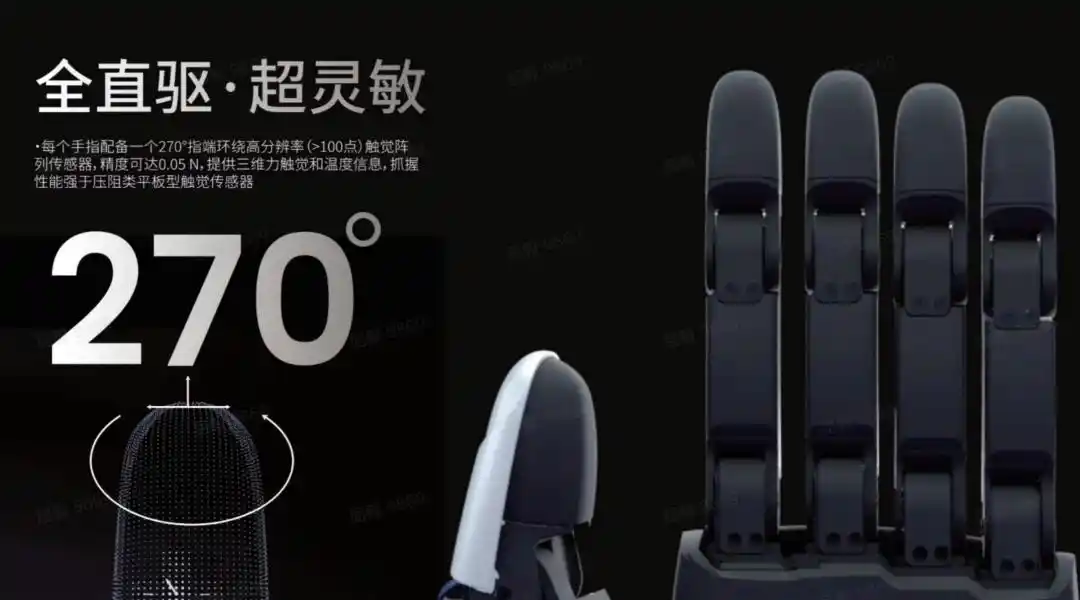
The fully direct-drive motor architecture adopted by StarXHand1 provides the most ideal hardware foundation for this algorithm.

The fully direct-drive design fundamentally eliminates the significant friction, hysteresis, and nonlinear interference brought by traditional reducers, endowing the dexterous hand with super-sensitive dynamic response capabilities. This enables StarXHand1 to instantly and precisely execute the action commands output by the VITRA model, safely manipulating various unknown objects.

Rich Sensor Array: Reserving Space for Future Multimodal Perception

Although the current VITRA model primarily relies on visual input, the rich sensor array equipped on StarXHand1 (such as high-resolution tactile arrays) reserves vast space for future multimodal perception.

Combined with StarXHand1's powerful hardware perception capabilities, future VLA models are expected to further integrate tactile feedback, handling more delicate and complex "Finger Gaits" tasks.

The Scaling Law of Data Size

This research also explored the impact of pre-training data scale on model performance.
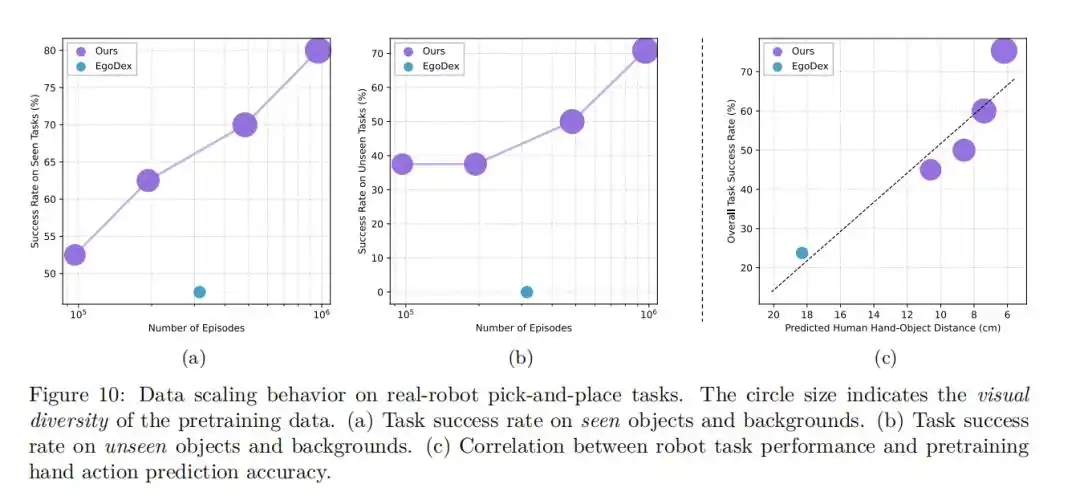
Experiments found that as the amount of pre-training data increased, the model's error in zero-shot hand action prediction tasks steadily decreased, and its success rate in real robot manipulation tasks continuously rose.

This clear scaling behavior indicates that by further expanding the scale of human video data, the performance of VLA models is expected to continuously improve.

This achievement marks a key breakthrough in utilizing unstructured human videos for robotic VLA model pre-training.

By providing a fully automated data conversion solution, this research significantly lowers the barrier to acquiring high-quality robot training data, paving the way for the application of multi-fingered dexterous hands in broader, more complex real-world scenarios, and laying a solid foundation for moving towards truly generalized embodied intelligence.

Paper link: https://arxiv.org/abs/2510.21571

This article is from WeChat Official Account "QbitAI", author: VITRA Team

Criptomoedas em alta

Perguntas relacionadas

QWhat is the main contribution of the VITRA framework introduced in the article?

AThe main contribution of VITRA is a fully automated framework that converts massive amounts of unlabeled real-world human activity videos into data perfectly aligned with robot VLA training data formats. It creates a large-scale hand V-L-A dataset (1M clips, 26M frames) for pre-training, enabling models to achieve strong zero-shot prediction and, after minimal robot data fine-tuning, high success in real robot dexterous manipulation.

QWhat are the three core technical components for converting human videos into V-L-A data in the VITRA framework?

AThe three core technical components are: 1) 3D motion annotation for recovering precise hand and camera trajectories from monocular videos, 2) Atomic-level action segmentation based on velocity minima in 3D hand trajectories, and 3) Instruction annotation using VLM (like GPT-4) prompted with images and overlaid 3D hand trajectory to generate accurate action descriptions.

QHow does the pre-trained VLA model achieve zero-shot hand action prediction in unseen environments?

AThe VLA model, pre-trained on the large-scale human video dataset, shows strong zero-shot hand action prediction capabilities in completely unseen real-world environments. Its architecture combines a VLM backbone for processing visual input and instructions to output a cognition feature, and a diffusion action expert to predict future hand action sequences through iterative denoising, outperforming models trained on lab data or human-annotated datasets.

QHow is the VITRA framework deployed on a real robot for dexterous manipulation tasks?

ATo deploy on a real robot, the VITRA framework aligns the human hand action space with the robot hand's action space. After pre-training on human videos, the model is fine-tuned using a small amount of real robot teleoperation data (e.g., ~1.2K demos). This fine-tuned model can then execute various dexterous tasks like grasping, placing, pouring, and sweeping on the real robot with high success rates and strong generalization to new objects and backgrounds.

QWhat role does the Xingdong XHAND1 dexterous hand hardware play in the successful deployment of VITRA?

AThe Xingdong XHAND1 dexterous hand provides crucial hardware support for VITRA's deployment. Its high-precision URDF model enables seamless alignment between human and robot action spaces. Its full direct-drive architecture offers high-frequency dynamic response, perfectly executing complex VITRA commands. Its rich sensor array also leaves space for future multi-modal perception integration, forming a powerful 'software-hardware synergy' for real-world application.

Leituras Relacionadas

Must-Watch Events Next Week|CLARITY Act Could Face Senate Vote; SpaceX, Circle to Report Earnings (8.3-8.9)

**Summary: Key Events and Developments to Watch (August 3-9)** The upcoming week is marked by significant financial disclosures, key legislative deadlines, and notable product updates. **Major Financial Events:** Several companies are scheduled to release their Q2 2026 earnings. American Bitcoin (ABTC) will report on August 3, followed by SpaceX and Hut 8 Mining Corp. on August 4, and Circle on August 5. Notably, a significant portion of SpaceX shares (up to 12% of total shares) will be unlocked on August 6 following their earnings release. **Key Legislative Deadline:** The U.S. Senate faces an August 7 deadline to secure 60 votes for the CLARITY Act, a bipartisan bill aiming to establish a federal regulatory framework for cryptocurrencies. The Senate may hold a full vote on the bill during the week. **Economic Data:** The U.S. July Non-Farm Payrolls report will be released on August 7, providing crucial labor market data. **Technology & Product Updates:** * **Shutdowns:** DeFi portfolio tracker Zapper and wallet app Ctrl Wallet will cease operations on August 3. * **Upgrades:** LayerZero will deprecate its v1 relayers on August 3. XRP Ledger's new version 3.3.0, featuring five new functions, is expected next week. * **AI:** Elon Musk announced that the advanced Grok 4.6 AI model is set for release around August 7. * **Bitcoin:** The BIP-110 forced signaling for a potential Bitcoin network change is scheduled to begin around August 8. **Other Notable Events:** Chinese robotics firm Unitree Tech has set its preliminary price inquiry for its IPO for August 5. South Korean exchange Upbit will delist AQT and AERGO tokens on August 3.

marsbitHá 1h

Must-Watch Events Next Week|CLARITY Act Could Face Senate Vote; SpaceX, Circle to Report Earnings (8.3-8.9)

marsbitHá 1h

Stocks Are Plummeting More Sharply Than Cryptocurrencies. Where Has the Money Gone?

Stock Markets Plunge Deeper Than Cryptocurrencies: Where Did the Money Go? In late July, Seoul's Kospi index triggered circuit breakers for two consecutive days, plummeting over 40% from its June high. The collapse was led by heavyweight stocks like SK Hynix, whose record profits still disappointed investors, and devastating leveraged ETFs, with one major product losing over 83% of its value. This signaled a global, forced deleveraging targeting the most crowded trades. Interestingly, while stocks exhibited extreme volatility akin to crypto markets, Bitcoin rose nearly 15% in July after a prior steep drop. Analysis shows the money fleeing equities did not flow into Bitcoin. Instead, Bitcoin had already absorbed its sell-off in May-June, when U.S. spot Bitcoin ETFs saw historic outflows. The true safe-haven beneficiary was gold, whose price rose over 20% year-on-year, highlighting a decoupling between Bitcoin and gold as "digital gold." The sell-off was a targeted unwinding of leveraged positions in tech and semiconductors, accelerated by broker-dealer risk management and shifts in the AI narrative, including new competition from Chinese memory chipmakers. The retreat path was clear: from high-valuation tech stocks to cash and U.S. Treasuries, then to gold. For Bitcoin to attract sustained institutional inflows, conditions like eased global liquidity pressure, a "soft-landing" Fed rate cut, and U.S. regulatory clarity via legislation like the stalled CLARITY Act are needed. Currently, Bitcoin is not a safe haven but an already-cleared asset. Its low correlation with tech stocks, however, makes it a potential diversification play for institutional portfolios once the storm passes. The money isn't here yet, but the positioning is underway.

marsbitHá 1h

Stocks Are Plummeting More Sharply Than Cryptocurrencies. Where Has the Money Gone?

marsbitHá 1h

In Conversation with Ray Dalio: We Are Currently in an AI Bubble, with 1% of My Portfolio in Bitcoin

Ray Dalio, founder of Bridgewater Associates, warns in an interview that the current AI boom shows classic bubble characteristics, which could lead to significant economic downturns as seen in past cycles like 1929 or 2000. He explains that speculative enthusiasm, fueled by debt and overvaluation, often precedes a crash when rising rates or taxation force asset sales, causing widespread losses and recession. Dalio also outlines his "Big Cycle" theory, describing an approximate 80-year pattern where widening wealth gaps, massive government deficits, and shifting geopolitical power (like China's rise) create internal conflict and global instability. He emphasizes that we are in a late-cycle, transitional phase where traditional powers like the US and UK face decline. For personal wealth protection, Dalio advises diversification beyond cash into assets like stocks, bonds, real estate, and particularly gold, which he prefers over Bitcoin. While he holds about 1% of his portfolio in Bitcoin as a non-printable hard asset, he views gold as more secure from technological or governmental threats. Regarding AI's impact, Dalio believes it will disproportionately benefit capital owners, worsening inequality by replacing both physical and cognitive labor. He suggests that human intuition and emotional intelligence, combined with AI, will be key for future workers. On taxation, Dalio argues that wealth taxes are impractical and risk triggering asset sell-offs, reducing productive investment. He points to the UK as a cautionary example of debt, low productivity, and political strife. Geopolitically, Dalio foresees a more regionalized world, with the US showing weakness in prolonged conflicts like with Iran, akin to past imperial declines. The ideal outcome, he suggests, is coexisting powerful blocs (e.g., Americas, China-Asia Pacific) without major war.

marsbitHá 5h

In Conversation with Ray Dalio: We Are Currently in an AI Bubble, with 1% of My Portfolio in Bitcoin

marsbitHá 5h

Trading

Spot

Artigos em Destaque

Como comprar CORE

Bem-vindo à HTX.com!Tornámos a compra de CORE (CORE) simples e conveniente.Segue o nosso guia passo a passo para iniciar a tua jornada no mundo das criptos.Passo 1: cria a tua conta HTXUtiliza o teu e-mail ou número de telefone para te inscreveres numa conta gratuita na HTX.Desfruta de um processo de inscrição sem complicações e desbloqueia todas as funcionalidades.Obter a minha contaPasso 2: vai para Comprar Cripto e escolhe o teu método de pagamentoCartão de crédito/débito: usa o teu visa ou mastercard para comprar CORE (CORE) instantaneamente.Saldo: usa os fundos da tua conta HTX para transacionar sem problemas.Terceiros: adicionamos métodos de pagamento populares, como Google Pay e Apple Pay, para aumentar a conveniência.P2P: transaciona diretamente com outros utilizadores na HTX.Mercado de balcão (OTC): oferecemos serviços personalizados e taxas de câmbio competitivas para os traders.Passo 3: armazena teu CORE (CORE)Depois de comprar o teu CORE (CORE), armazena-o na tua conta HTX.Alternativamente, podes enviá-lo para outro lugar através de transferência blockchain ou usá-lo para transacionar outras criptomoedas.Passo 4: transaciona CORE (CORE)Transaciona facilmente CORE (CORE) no mercado à vista da HTX.Acede simplesmente à tua conta, seleciona o teu par de trading, executa as tuas transações e monitoriza em tempo real.Oferecemos uma experiência de fácil utilização tanto para principiantes como para traders experientes.

377 Visualizações TotaisPublicado em {updateTime}Atualizado em 2026.06.02

Como comprar CORE

Discussões

Bem-vindo à Comunidade HTX. Aqui, pode manter-se informado sobre os mais recentes desenvolvimentos da plataforma e obter acesso a análises profissionais de mercado. As opiniões dos utilizadores sobre o preço de CORE (CORE) são apresentadas abaixo.

活动图片













