Five Years Later, Vitalik Overturns the Future He Set for Ethereum

marsbitPublicado em 2026-02-04Última atualização em 2026-02-04

Resumo

Five years after championing Layer 2 (L2) scaling as Ethereum's future, Vitalik Buterin has dramatically reversed his position, declaring that L2s have largely failed to fulfill their original vision of "branded sharding." In a pivotal post, he argued that most L2 solutions remain highly centralized, reliant on multi-signature bridges and sequencers, and thus are not truly extending Ethereum's security or decentralization. The initial push for L2s was a survival response to Ethereum's cripplingly high fees and congestion during the 2021 DeFi and NFT boom, when competitors like Solana gained traction. However, despite massive venture funding—with projects like Arbitrum, Optimism, and Starknet raising billions—progress toward full decentralization (Stage 2) has been slow. Many operate more like centralized databases, prioritizing control and regulatory compliance over Ethereum's core values. Meanwhile, Ethereum itself has scaled significantly. Through upgrades like EIP-4844 and increased gas limits, L1 transaction fees have plummeted by over 99%, often costing just cents. This reduces L2's cost advantage and exposes their drawbacks: bridge vulnerabilities, fragmented liquidity, and complex user experiences. Vitalik now urges L2s to pivot from mere scaling to providing unique functional value—like privacy, ultra-fast finality, or application-specific optimizations—that L1 cannot easily offer. He reframes L2s as a spectrum of specialized "plugins" rather than essential scaling...

On February 3, 2026, Vitalik Buterin said something on X.

The shockwaves this statement sent through the Ethereum community were no less than those caused by his vigorous promotion of the "Rollup-centric" roadmap in 2020. In that post, Vitalik admitted: "The initial vision of Layer2 as 'Branded Sharding' to solve Ethereum's scalability is no longer valid."

One sentence, almost declaring the end of Ethereum's mainstream narrative of the past five years. The Layer2 camp, once seen as the lifeline and savior of Ethereum, is facing its biggest legitimacy crisis since its birth. More direct criticism followed. Vitalik wrote mercilessly in the post: "If you create an EVM that handles 10,000 transactions per second, but its connection to L1 is through a multi-signature bridge, then you are not scaling Ethereum."

Why has the former lifeline become the burden to be discarded today? This is not just a shift in technical路线, but a brutal game of power, profit, and ideals. The story begins five years ago.

How Did Layer2 Become Ethereum's Lifeline?

The answer is simple: it wasn't a technical choice, but a survival strategy. Let's go back to 2021. Ethereum was then mired in the quagmire of being a "noble chain".

The data doesn't lie: On May 10, 2021, Ethereum's average transaction fee reached a historical peak of $53.16. During the craziest period of the NFT boom, Gas prices once soared above 500 gwei. What does this mean? A simple ERC-20 token transfer could cost tens of dollars, and a token swap on Uniswap could cost $150 or even more.

The DeFi Summer of 2020 brought unprecedented prosperity to Ethereum, with the Total Value Locked (TVL) skyrocketing from $700 million at the beginning of the year to $15 billion by the end of the year, an increase of over 2100%. But the price of this prosperity was extreme network congestion. By 2021, when the NFT wave hit, the minting and trading of blue-chip projects like Bored Ape Yacht Club made the network worse. The Gas fee for a single NFT transaction often amounted to hundreds of dollars. A collector was once offered over 1000 ETH for a Bored Ape in 2021 but ultimately gave up due to the high Gas fees and complex transaction process.

At the same time, a challenger named Solana emerged. Its data was staggering: tens of thousands of transactions per second throughput, transaction fees as low as $0.00025. The Solana community not only mocked Ethereum's performance but also directly attacked its bloated and inefficient architecture. The rhetoric that "Ethereum is dead" was rampant, and the community was filled with anxiety.

It was against this backdrop that in October 2020, Vitalik formally proposed a concept in "A Rollup-Centric Ethereum Roadmap": positioning Layer2 as Ethereum's "Branded Sharding". The core of this idea was that Layer2 would process massive transactions off-chain, then package and send the compressed results back to the mainnet, theoretically achieving infinite scaling while inheriting the security and censorship resistance of the Ethereum mainnet.

At that point in time, the entire future of the Ethereum ecosystem was almost entirely bet on the success of Layer2. From the Dencun upgrade in March 2024 introducing EIP-4844 (Proto-Danksharding), specifically providing cheaper data availability space for Layer2, to various core developer meetings, everything was paving the way for Layer2. After the Dencun upgrade, Layer2 data publishing costs dropped by at least 90%, and Arbitrum's transaction fees plummeted from about $0.37 to $0.012. Ethereum tried to gradually push L1 into the background, making it a quiet "settlement layer".

But why didn't this bet pay off?

Those "Centralized Databases" with $1.2 Billion Valuations

If Layer2 had truly realized its initial vision, it wouldn't be falling out of favor today. But the problem is, what exactly did they do wrong?

Vitalik pointed out the fatal flaw in his article: the progress towards decentralization is too slow. The vast majority of Layer2s have not yet reached Stage 2—having a fully decentralized fraud or validity proof system and allowing users to withdraw assets permissionlessly in emergencies. They are still controlled by centralized sequencers that manage the packaging and ordering of transactions. In essence, they are closer to centralized databases disguised as blockchains.

The conflict between commercial reality and technological ideals is exposed here. Take Arbitrum as an example. Its development company, Offchain Labs, received a $120 million investment in its Series B round in 2021, valuing the company at $1.2 billion, with investors including top-tier firms like Lightspeed Venture Partners. But until today, this behemoth with over $15 billion in locked funds, holding about 41% of the Layer2 market share, remains at Stage 1.

Optimism's story is equally intriguing. This project, led by Paradigm and Andreessen Horowitz (a16z), completed a $150 million Series B round in March 2022, with total funding reaching $268.5 million. In April 2024, a16z privately purchased $90 million worth of OP tokens. But even with such strong capital support, Optimism also only reached Stage 1.

The rise of Base reveals another dimension of the problem. As a Layer2 launched by Coinbase, Base quickly became a market darling after its mainnet launch in August 2023. By the end of 2025, Base's TVL reached $4.63 billion, capturing 46% of the entire Layer2 market share, surpassing Arbitrum to become the Layer2 with the highest DeFi TVL. But Base is even less decentralized, as it is entirely controlled by Coinbase, making its technical architecture closer to a centralized sidechain.

Starknet's story is even more ironic. This Layer2 using ZK-Rollup technology, developed by Matter Labs, has raised a total of $458 million, including a $200 million Series C round led by Blockchain Capital and Dragonfly in November 2022. But its token STRK price has shrunk by 98% compared to its historical high, with a market cap of about $283 million. According to on-chain data, the protocol revenue it generates daily is not even enough to cover the operating costs of a few servers, and its core nodes remain highly centralized, only reaching Stage 1 by mid-2025.

Some project teams have even privately admitted that they may never fully decentralize. Vitalik cited a case in his post: a certain project argued that they would never further decentralize because "the regulatory needs of their clients require them to have ultimate control." This彻底激怒了Vitalik, and he responded毫不客气地:

"This might be the right thing for your clients. But it's clear that if you do this, then you are not 'scaling Ethereum.'"

This comment almost sentences to death all projects that fly the Ethereum L2 flag but refuse to decentralize. Ethereum wants a分身 that can extend decentralization and security to a broader space, not a group of附庸 that wear the skin of Ethereum but practice centralization.

The deeper problem is that there is an irreconcilable conflict between decentralization and commercial interests. Centralized sequencers mean project parties can control MEV (Maximal Extractable Value) income, respond more flexibly to regulatory requirements, and iterate products faster. Full decentralization means giving up this control and handing power over to the community and the validator network. For those with venture capital funding and growth pressure, this is a difficult choice.

If Layer2 had truly achieved full decentralization, would they still fall out of favor? The answer might still be yes. Because, Ethereum itself has changed.

When the Mainnet is Faster and Cheaper than Sidechains

Why does Ethereum no longer need Layer2 for scaling as much?

As early as February 14, 2025, Vitalik released a key signal. He published an article titled "Even in an L2-heavy Ethereum, there are reasons to have a higher L1 Gas limit," clearly stating that "L1 is scaling." This sounded more like comfort for mainnet fundamentalists at the time, but looking back now, it was actually the charge for the Ethereum mainnet to start competing with Layer2 again.
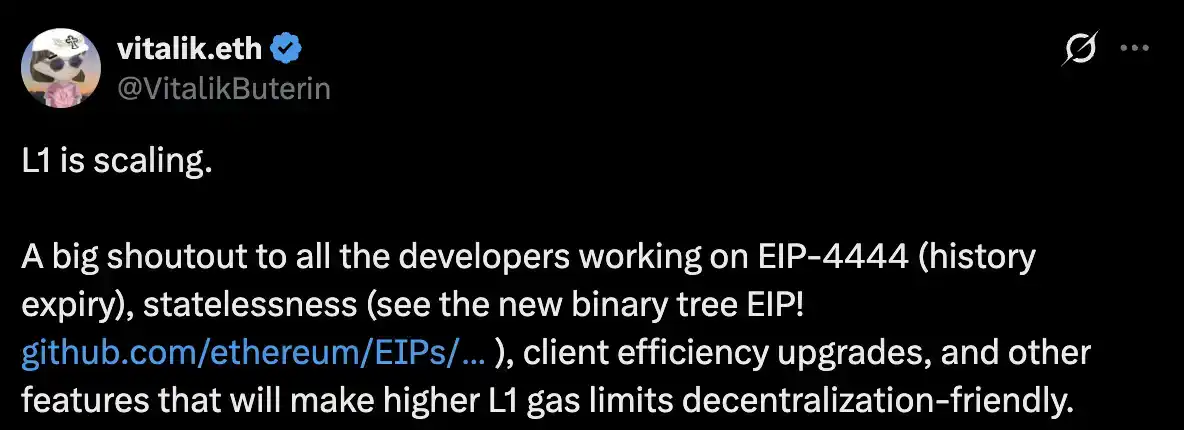
Over the past year, the scaling speed of Ethereum L1 has far exceeded everyone's expectations. Technological breakthroughs came from multiple dimensions: EIP-4444 reduced the storage需求 for historical data, stateless client technology made node operation lighter, and most critically, the continuous increase in the Gas Limit. At the beginning of 2025, Ethereum's Gas Limit was still 30 million; by mid-year, it had increased to 36 million, a 20% growth. This was the first significant increase in Ethereum's Gas Limit since 2021.

But this was just the beginning. According to the plans of Ethereum core developers, there will be two major hard fork upgrades in 2026. The Glamsterdam upgrade will introduce perfect parallel processing capabilities, and the Gas Limit will soar from 60 million to 200 million, an increase of over 3 times. The Heze-Bogota fork will add the FOCIL (Fork-Choice Enforced Inclusion Lists) mechanism, further improving block construction efficiency and censorship resistance.

The Fusaka upgrade completed on December 3, 2025, already allowed the market to witness the power of L1 scaling. After the upgrade, Ethereum's daily transaction volume increased by about 50%, the number of active addresses rose by about 60%, and the 7-day moving average of daily transaction volume reached a historical high of 1.87 million, surpassing the records of the 2021 DeFi peak period.

The results are astounding: Ethereum mainnet transaction fees have dropped to extremely low levels. In January 2026, the average transaction fee on Ethereum dropped to $0.44, a decrease of over 99% compared to the peak of $53.16 in May 2021. During off-peak hours, the cost of a transaction is often below $0.1, sometimes even as low as $0.01, with Gas prices as low as 0.119 gwei. This number is already close to Solana's level, and Layer2's biggest cost advantage is being quickly erased.

Vitalik did a detailed calculation in that February article. He assumed an ETH price of $2500, a Gas price of 15 gwei (long-term average), and a demand elasticity close to 1 (i.e., doubling the Gas Limit would halve the price). Under this assumption:

Censorship resistance demand: Currently, enforcing a transaction censored by L2 through L1 requires about 120,000 gas, costing $4.5. To reduce the cost to below $1, L1 needs to scale 4.5 times.

Cross-L2 asset transfer: Currently, withdrawing from one L2 to L1 requires about 250,000 gas, and depositing into another L2 requires 120,000 gas, totaling $13.87. With an ideal optimized design, it would only require 7,500 gas, costing $0.28. To reach the target of $0.05, it needs to scale 5.5 times.

Mass exit scenario: Taking Sony's Soneium as an example, PlayStation has about 116 million monthly active users. Using an efficient exit protocol (7,500 gas per user), the current Ethereum can just support the emergency exit of 121 million users within a week. But to support multiple applications of this scale, L1 needs to scale about 9 times.

And these scaling goals are being realized step by step in 2026. Technological progress has彻底改变了the rules of the game. When L1 itself can become fast and cheap, why should users still endure the cumbersome cross-chain bridging, complex interaction experience, and potential security risks of Layer2?

The security issues of cross-chain bridges are not unfounded fears. In 2022, cross-chain bridges became a major target for hacker attacks. In February, the Wormhole bridge was hacked for $325 million; in March, the Ronin bridge suffered the largest DeFi attack in history, losing $540 million; and bridge protocols like Meter and Qubit were successively breached. According to Chainalysis statistics, in 2022 alone, the total amount of cryptocurrency stolen from cross-chain bridges reached $2 billion, accounting for the majority of all DeFi attack losses that year.

Liquidity fragmentation is another pain point. With the surge in the number of Layer2s, the liquidity of DeFi protocols is分散到dozens of different chains, leading to increased transaction slippage, reduced capital efficiency, and worsened user experience. A user wanting to move assets between different Layer2s needs to go through a complex bridging process, wait for long confirmation times, and bear additional costs and risks.

This leads to the next, and most brutal, question: what should those Layer2 projects that raised huge funds and issued tokens do now?

Valuation Bubbles and Ghost Towns

Where did all the Layer2 money go?

In the past few years, the Layer2 track has been more like a huge financial game than a technological revolution. Venture capital firms waved checks, pushing the valuations of L2 projects to staggering heights. zkSync raised a total of $458 million, Arbitrum's背后的Offchain Labs was valued at $1.2 billion, Optimism raised $268.5 million, Starknet raised $458 million. Behind these numbers are top VCs like Paradigm, a16z, Lightspeed, Blockchain Capital.

Developers were keen on "套娃" (nesting) across different L2s, building complex DeFi legos to attract more liquidity and airdrop hunters. But real users were worn out by the tedious cross-chain operations and high hidden costs.

A残酷的现实is that the market is highly concentrated towards the top. According to data from crypto research firm 21Shares, the three major L2s—Base, Arbitrum, and Optimism—already control nearly 90% of the transaction volume. Base, leveraging Coinbase's traffic advantage and user base, achieved explosive growth in 2025, its TVL soaring from $1 billion at the beginning of the year to $4.63 billion by the end of the year, with quarterly transaction volume reaching $59 billion, a 37% increase quarter-on-quarter. Arbitrum followed closely with about $19 billion TVL, and Optimism after that.

But outside the top tier, most L2 projects, after losing the drive of airdrop expectations, saw their real user numbers quickly drop to freezing point, becoming名副其实的"ghost towns". Starknet is the most typical example. Although its token price has fallen 98% from its high, its price-to-earnings ratio is still in a very high bubble range relative to its extremely low daily active users and fee income. This means there is a huge gap between the market's expectations for its future and its current ability to create real value.

More ironically, when Layer2 fees dropped significantly due to EIP-4844, the data availability fees they paid to L1 also plummeted, which in turn reduced the fee income of Ethereum L1. In January 2026, an analysis pointed out that the Dencun upgrade caused a large number of transactions to shift from L1 to cheaper L2s, which was one of the main reasons for Ethereum network fees dropping to their lowest level since 2017. While Layer2 was reducing its own costs, it was also "emptying" the economic value of L1.

21Shares predicted in its 2026 Layer2 Outlook report that most Ethereum Layer2s may not survive 2026, the market will experience a残酷的整合, and ultimately only those projects with high performance, true decentralization, and unique value propositions will prevail.

This is the real intention behind Vitalik's recent "challenge". He wants to burst this "infrastructure circle-jerk" bubble and pour a bucket of cold water on this sick market. If a Layer2 cannot provide functions more interesting and valuable than L1, then it will ultimately become just an expensive transitional product in Ethereum's development history.

Ethereum is Taking Back Its Sovereignty

Vitalik's latest suggestion points out a new way out for Layer2: abandon "scaling" as the only selling point, and instead explore functional additional value that L1 cannot or is unwilling to provide in the short term. He specifically listed several directions: privacy protection (achieving on-chain private transactions through zero-knowledge proof technology), application-specific efficiency optimization (such as games, social networks, AI computing), ultra-fast transaction confirmation (millisecond level instead of second level), and exploration of non-financial use cases.

In other words, the role of Layer2 will change from Ethereum's "分身" (avatar) to functional "plugins". They are no longer the only savior for scaling, but a functional extension layer in the Ethereum ecosystem. This is a fundamental shift in positioning and a return of power—Ethereum's core value and sovereignty will be re-anchored on L1.

Vitalik also proposed a new framework: view Layer2 as a spectrum, not a binary classification. Different L2s can have different trade-offs in terms of decentralization degree, security guarantees, and functional characteristics. The key is to clearly explain to users what guarantees they provide, rather than all claiming to be "scaling Ethereum".

This清算has already begun. Those Layer2s that rely on expensive valuations but have no real daily activity are facing their final judgment. Those that can find their unique value positioning and truly achieve decentralization may survive in the new landscape. Base may continue to lead依靠Coinbase's traffic advantage and Web2 user onboarding ability, but it needs to face questions about its lack of decentralization. Arbitrum and Optimism need to accelerate the process towards Stage 2 to prove they are more than just centralized databases. ZK-Rollup projects like zkSync and Starknet need to prove the unique value of their zero-knowledge proof technology while significantly improving user experience and ecological prosperity.

Layer2 has not disappeared, but their era as Ethereum's only hope is彻底结束了. Five years ago, when cornered by competitors like Solana, Ethereum handed the hope of scaling to Layer2 and重构ed the entire technical roadmap for it. Five years later, it found that the best scaling solution is to make itself stronger.

This is not betrayal, but growth. And those Layer2s that cannot adapt to this evolution will become the cost. When the Gas Limit冲向200 million at the end of 2026, when Ethereum L1 transaction fees stabilize at a few cents or even lower, when users find they no longer need to endure the complexity and risks of cross-chain bridges, the market will vote with its feet. Those projects that once had sky-high valuations but did not create real value for users will be forgotten by history in this great浪淘沙.

Perguntas relacionadas

QWhat was the core reason behind Vitalik Buterin's statement that Layer2 solutions are no longer fulfilling their original vision for Ethereum scaling?

AVitalik stated that Layer2 solutions have failed to achieve sufficient decentralization, with most remaining at Stage 1 (lacking fully decentralized fraud or validity proof systems and permissionless user exits), making them more like centralized databases rather than true extensions of Ethereum's security and decentralization.

QHow has Ethereum's Layer1 scalability improved to the point where it competes with Layer2 solutions?

AEthereum L1 scalability improved through technical breakthroughs like EIP-4444 reducing historical data storage, stateless clients, and significant Gas Limit increases (from 30 million to 36 million in 2025, with plans to reach 200 million by end of 2026). This reduced average transaction fees by over 99%, from $53.16 in 2021 to $0.44 in January 2026, making L1 nearly as cheap and fast as many Layer2s.

QWhat are the major criticisms Vitalik raised against current Layer2 projects regarding their business models and decentralization?

AVitalik criticized Layer2 projects for prioritizing commercial interests over decentralization, citing examples like projects refusing further decentralization due to 'client regulatory demands,' controlling MEV revenue through centralized sequencers, and relying on venture capital funding that pressures them to maintain control rather than cede it to the community.

QWhat new role does Vitalik propose for Layer2 solutions in Ethereum's future, instead of mere scaling?

AVitalik proposes that Layer2 should shift from being primarily scaling solutions to providing functional additive value that L1 cannot easily offer, such as privacy features via zero-knowledge proofs, application-specific optimizations (e.g., for gaming or AI), ultra-fast transaction confirmations, and exploration of non-financial use cases, acting as 'plugins' rather than 'scaling layers'.

QAccording to the article, what is the predicted outcome for most Layer2 projects in 2026 due to market consolidation and L1 scalability?

AThe article predicts a brutal market consolidation where most Layer2 projects will not survive in 2026, as they lack real user activity and value proposition beyond speculation. Only high-performance, truly decentralized projects with unique value (e.g., Base with Coinbase's user base, or those achieving Stage 2 decentralization) may endure, while others become 'ghost towns' or are forgotten.

Leituras Relacionadas

From Theft to Re-entry: How Was $292 Million "Laundered"?

A sophisticated crypto laundering operation was executed following the $292 million hack of Kelp DAO on April 18. The attack, attributed to the North Korean Lazarus group, began with anonymous infrastructure preparation using Tornado Cash to fund wallets untraceably. The hacker exploited a vulnerability in Kelp’s cross-chain bridge, stealing 116,500 rsETH. To avoid crashing the market, the attacker used Aave and Compound as laundering tools—depositing the stolen rsETH as collateral to borrow $190 million in clean, liquid ETH. This move triggered a bank run on Aave, causing an $8 billion drop in TVL. After consolidating funds, the attacker fragmented them across hundreds of wallets to evade detection. A major breakpoint was THORChain, where over $460 million in volume—30 times its usual activity—was processed in 24 hours, converting ETH into Bitcoin. This shift to Bitcoin’s UTXO model exponentially increased tracing complexity by shattering funds into countless untraceable fragments. The final destination was Tron-based USDT, the primary channel for illicit crypto flows. From there, funds were cashed out via OTC brokers in China and Southeast Asia, using unlicensed underground banks and UnionPay networks outside Western sanctions scope. Ultimately, the laundered money supports North Korea’s weapons programs, which rely heavily on crypto hacking for foreign currency. The incident underscores structural challenges in DeFi: its openness, composability, and lack of central control make such laundering not just possible, but inherently difficult to prevent.

marsbitHá 3h

From Theft to Re-entry: How Was $292 Million "Laundered"?

marsbitHá 3h

Trading

Spot
Futuros

Artigos em Destaque

O que é ETH 2.0

ETH 2.0: Uma Nova Era para o Ethereum Introdução ETH 2.0, amplamente conhecido como Ethereum 2.0, marca uma atualização monumental à blockchain do Ethereum. Esta transição não é meramente uma mudança estética; visa melhorar fundamentalmente a escalabilidade, segurança e sustentabilidade da rede. Com uma mudança do mecanismo de consenso em Proof of Work (PoW), intensivo em energia, para um Proof of Stake (PoS) mais eficiente, o ETH 2.0 promete uma abordagem transformadora ao ecossistema blockchain. O que é ETH 2.0? ETH 2.0 é um conjunto de atualizações distintas e interconectadas focadas na otimização das capacidades e desempenho do Ethereum. Esta reformulação foi projetada para abordar desafios críticos que o mecanismo atual do Ethereum enfrentou, particularmente em relação à velocidade das transações e à congestão da rede. Objetivos do ETH 2.0 Os principais objetivos do ETH 2.0 giram em torno da melhoria de três aspectos centrais: Escalabilidade: Com o objetivo de melhorar significativamente o número de transações que a rede pode manejar por segundo, o ETH 2.0 procura ultrapassar a limitação atual de aproximadamente 15 transações por segundo, alcançando potencialmente milhares. Segurança: Medidas de segurança melhoradas são integrais ao ETH 2.0, especialmente através da resistência aprimorada contra ciberataques e da preservação do ethos descentralizado do Ethereum. Sustentabilidade: O novo mecanismo PoS foi projetado não apenas para melhorar a eficiência, mas também para reduzir drasticamente o consumo de energia, alinhando a estrutura operacional do Ethereum com considerações ambientais. Quem é o Criador do ETH 2.0? A criação do ETH 2.0 pode ser atribuída à Ethereum Foundation. Esta organização sem fins lucrativos, que desempenha um papel crucial no apoio ao desenvolvimento do Ethereum, é liderada pelo co-fundador notável Vitalik Buterin. A sua visão de um Ethereum mais escalável e sustentável tem sido a força motriz por trás desta atualização, envolvendo contribuições de uma comunidade global de desenvolvedores e entusiastas dedicados a melhorar o protocolo. Quem são os Investidores do ETH 2.0? Embora os detalhes sobre os investidores do ETH 2.0 não tenham sido tornados públicos, é sabido que a Ethereum Foundation recebe apoio de várias organizações e indivíduos no espaço da blockchain e tecnologia. Esses parceiros incluem firmas de capital de risco, empresas de tecnologia e organizações filantrópicas que compartilham um interesse mútuo em apoiar o desenvolvimento de tecnologias descentralizadas e infraestrutura de blockchain. Como Funciona o ETH 2.0? ETH 2.0 é notável por introduzir uma série de características chave que o diferenciam do seu predecessor. Proof of Stake (PoS) A transição para um mecanismo de consenso PoS é uma das mudanças de destaque do ETH 2.0. Ao contrário do PoW, que depende da mineração intensiva em energia para a verificação de transações, o PoS permite que os utilizadores validem transações e criem novos blocos de acordo com a quantidade de ETH que apostam na rede. Isso leva a uma maior eficiência energética, reduzindo o consumo em aproximadamente 99,95%, tornando o Ethereum 2.0 uma alternativa consideravelmente mais ecológica. Shard Chains As shard chains são outra inovação crítica do ETH 2.0. Estas cadeias menores operam em paralelo com a cadeia principal do Ethereum, permitindo que várias transações sejam processadas simultaneamente. Esta abordagem melhora a capacidade geral da rede, abordando preocupações de escalabilidade que têm atormentado o Ethereum. Beacon Chain No coração do ETH 2.0 está a Beacon Chain, que coordena a rede e gere o protocolo PoS. Ela atua como uma espécie de organizador: supervisiona os validadores, garante que as shards permaneçam conectadas à rede e monitora a saúde geral do ecossistema blockchain. Linha do Tempo do ETH 2.0 A jornada do ETH 2.0 tem sido marcada por vários marcos chave que traçam a evolução desta atualização significativa: Dezembro de 2020: O lançamento da Beacon Chain marcou a introdução do PoS, preparando o caminho para a migração para o ETH 2.0. Setembro de 2022: A conclusão de “The Merge” representa um momento crucial em que a rede Ethereum fez a transição com sucesso de um quadro PoW para um PoS, anunciando uma nova era para o Ethereum. 2023: O lançamento esperado das shard chains visa melhorar ainda mais a escalabilidade da rede Ethereum, solidificando o ETH 2.0 como uma plataforma robusta para aplicações e serviços descentralizados. Características Chave e Benefícios Escalabilidade Melhorada Uma das vantagens mais significativas do ETH 2.0 é a sua escalabilidade melhorada. A combinação de PoS e shard chains permite que a rede expanda a sua capacidade, permitindo que acomode um volume de transações muito maior em comparação com o sistema legado. Eficiência Energética A implementação do PoS representa um enorme passo em direção à eficiência energética na tecnologia blockchain. Ao reduzir drasticamente o consumo de energia, o ETH 2.0 não só reduz os custos operacionais, mas também se alinha mais estreitamente com os objetivos globais de sustentabilidade. Segurança Aprimorada Os mecanismos atualizados do ETH 2.0 contribuem para uma segurança melhorada em toda a rede. O uso do PoS, juntamente com medidas de controle inovadoras estabelecidas através das shard chains e da Beacon Chain, assegura um maior grau de proteção contra potenciais ameaças. Custos Mais Baixos para os Utilizadores À medida que a escalabilidade melhora, os efeitos sobre os custos de transação também serão evidentes. Aumentada a capacidade e reduzida a congestão, espera-se que isso se traduza em taxas mais baixas para os utilizadores, tornando o Ethereum mais acessível para transações do dia a dia. Conclusão ETH 2.0 marca uma evolução significativa no ecossistema da blockchain do Ethereum. Ao abordar questões fundamentais como a escalabilidade, o consumo de energia, a eficiência das transações e a segurança geral, a importância desta atualização não pode ser subestimada. A transição para o Proof of Stake, a introdução das shard chains e o trabalho fundamental da Beacon Chain são indicativos de um futuro em que o Ethereum pode atender à crescente demanda do mercado descentralizado. Em uma indústria movida pela inovação e progresso, o ETH 2.0 representa um testemunho das capacidades da tecnologia blockchain em pavimentar o caminho para uma economia digital mais sustentável e eficiente.

100 Visualizações TotaisPublicado em {updateTime}Atualizado em 2024.12.03

O que é ETH 2.0

O que é ETH 3.0

ETH3.0 e $eth 3.0: Uma Análise Profunda do Futuro do Ethereum Introdução No ambiente em rápida evolução da criptomoeda e da tecnologia blockchain, o ETH3.0, frequentemente denotado como $eth 3.0, emergiu como um tema de considerável interesse e especulação. O termo abrange dois conceitos principais que merecem esclarecimento: Ethereum 3.0: Esta representa uma potencial atualização futura destinada a aumentar as capacidades da atual blockchain do Ethereum, focando especialmente na melhoria da escalabilidade e desempenho. ETH3.0 Meme Token: Este distinto projeto de criptomoeda procura aproveitar a blockchain do Ethereum na criação de um ecossistema centrado em memes, promovendo o envolvimento na comunidade de criptomoedas. Compreender esses aspectos do ETH3.0 é essencial não apenas para entusiastas de criptomoedas, mas também para aqueles que observam as tendências tecnológicas mais amplas no espaço digital. O que é ETH3.0? Ethereum 3.0 Ethereum 3.0 é promovido como uma atualização proposta para a rede Ethereum já estabelecida, que tem sido a espinha dorsal de muitas aplicações descentralizadas (dApps) e contratos inteligentes desde a sua criação. As melhorias vislumbradas concentram-se principalmente na escalabilidade—integrando tecnologias avançadas como sharding e provas de conhecimento zero (zk-proofs). Essas inovações tecnológicas visam facilitar um número sem precedentes de transações por segundo (TPS), potencialmente alcançando milhões, abordando assim uma das limitações mais significativas enfrentadas pela tecnologia blockchain atual. A melhoria não é meramente técnica, mas também estratégica; visa preparar a rede Ethereum para uma adoção generalizada e utilidade em um futuro marcado por uma maior demanda por soluções descentralizadas. ETH3.0 Meme Token Em contraste com o Ethereum 3.0, o ETH3.0 Meme Token aventura-se por um domínio mais leve e divertido, combinando a cultura dos memes da internet com a dinâmica das criptomoedas. Este projeto permite que os usuários comprem, vendam e negociem memes na blockchain do Ethereum, proporcionando uma plataforma que fomenta o envolvimento da comunidade através da criatividade e interesses compartilhados. O ETH3.0 Meme Token visa demonstrar como a tecnologia blockchain pode interseccionar com a cultura digital, criando casos de uso que são tanto divertidos quanto financeiramente viáveis. Quem é o Criador do ETH3.0? Ethereum 3.0 A iniciativa em direção ao Ethereum 3.0 é impulsionada principalmente por um consórcio de desenvolvedores e pesquisadores dentro da comunidade Ethereum, notavelmente incluindo Justin Drake. Conhecido por suas percepções e contribuições para a evolução do Ethereum, Drake tem sido uma figura proeminente nas discussões sobre a transição do Ethereum para uma nova camada de consenso, referida como “Beam Chain”. Esta abordagem colaborativa ao desenvolvimento significa que o Ethereum 3.0 não é fruto de um único criador, mas sim uma manifestação da engenhosidade coletiva focada no avanço da tecnologia blockchain. ETH3.0 Meme Token Os detalhes sobre o criador do ETH3.0 Meme Token são atualmente indetectáveis. A natureza dos tokens de meme frequentemente leva a uma estrutura mais descentralizada e impulsionada pela comunidade, o que poderia explicar a falta de atribuição específica. Isso alinha-se com a ethos da comunidade de criptomoedas mais ampla, onde a inovação geralmente surge de esforços colaborativos em vez de esforços individuais. Quem são os Investidores do ETH3.0? Ethereum 3.0 O apoio ao Ethereum 3.0 provém principalmente da Fundação Ethereum, juntamente com uma comunidade entusiástica de desenvolvedores e investidores. Esta associação fundacional proporciona um grau significativo de legitimidade e melhora as perspectivas de uma implementação bem-sucedida, uma vez que aproveita a confiança e credibilidade construída ao longo de anos de operações de rede. Em um clima em rápida mudança no mundo das criptomoedas, o apoio da comunidade desempenha um papel crucial no impulso ao desenvolvimento e adoção, posicionando o Ethereum 3.0 como um sério candidato a futuros avanços na blockchain. ETH3.0 Meme Token Embora as fontes atualmente disponíveis não forneçam informações explícitas sobre as fundações ou organizações de investimento que apoiam o ETH3.0 Meme Token, é indicativo do modelo típico de financiamento para tokens de meme, que frequentemente depende de apoio base e engajamento da comunidade. Os investidores em tais projetos costumam consistir em indivíduos motivados pelo potencial de inovação impulsionada pela comunidade e pelo espírito de cooperação encontrado dentro da comunidade cripto. Como Funciona o ETH3.0? Ethereum 3.0 As características distintivas do Ethereum 3.0 residem em sua proposta de implementação de sharding e tecnologia zk-proof. Sharding é um método de partição da blockchain em partes menores e gerenciáveis ou “shards”, que podem processar transações simultaneamente em vez de sequencialmente. Esta descentralização do processamento ajuda a prevenir congestionamentos e garante que a rede permaneça responsiva mesmo sob carga pesada. A tecnologia de prova de conhecimento zero (zk-proof) contribui com outra camada de sofisticação ao permitir a validação de transações sem revelar os dados subjacentes envolvidos. Este aspecto não apenas melhora a privacidade, mas também aumenta a eficiência geral da rede. Há também conversas sobre a incorporação de uma Máquina Virtual Ethereum de conhecimento zero (zkEVM) nesta atualização, amplificando ainda mais as capacidades e utilidade da rede. ETH3.0 Meme Token O ETH3.0 Meme Token distingue-se ao capitalizar sobre a popularidade da cultura dos memes. Estabelece um mercado para que os usuários participem da negociação de memes, não apenas para entretenimento, mas também para potencial ganho econômico. Ao integrar recursos como staking, provisão de liquidez e mecanismos de governança, o projeto fomenta um ambiente que incentiva a interação e participação da comunidade. Ao oferecer uma mistura única de entretenimento e oportunidade econômica, o ETH3.0 Meme Token visa atrair um público diversificado, variando de entusiastas de criptomoedas a conhecedores casuais de memes. Cronologia do ETH3.0 Ethereum 3.0 11 de novembro de 2024: Justin Drake sugere a próxima atualização do ETH 3.0, centrada nas melhorias de escalabilidade. Este anúncio sinaliza o início de discussões formais sobre a futura arquitetura do Ethereum. 12 de novembro de 2024: A proposta antecipada para Ethereum 3.0 deve ser revelada no Devcon em Bangkok, preparando o cenário para um feedback mais amplo da comunidade e potenciais próximos passos no desenvolvimento. ETH3.0 Meme Token 21 de março de 2024: O ETH3.0 Meme Token é oficialmente listado no CoinMarketCap, marcando sua entrada no domínio público das criptomoedas e aumentando a visibilidade de seu ecossistema baseado em memes. Pontos Chave Em conclusão, Ethereum 3.0 representa uma evolução significativa dentro da rede Ethereum, focando em superar limitações quanto à escalabilidade e desempenho através de tecnologias avançadas. As atualizações propostas refletem uma abordagem proativa às futuras demandas e usabilidade. Por outro lado, o ETH3.0 Meme Token encapsula a essência da cultura impulsionada pela comunidade no espaço das criptomoedas, aproveitando a cultura dos memes para criar plataformas envolventes que incentivam a criatividade e participação dos usuários. Compreender os distintos propósitos e funcionalidades do ETH3.0 e $eth 3.0 é fundamental para qualquer pessoa interessada nos desenvolvimentos contínuos dentro do espaço cripto. Com ambas as iniciativas a pavimentar caminhos únicos, elas sublinham coletivamente a natureza dinâmica e multifacetada da inovação em blockchain.

98 Visualizações TotaisPublicado em {updateTime}Atualizado em 2024.12.03

O que é ETH 3.0

Como comprar ETH

Bem-vindo à HTX.com!Tornámos a compra de Ethereum (ETH) simples e conveniente.Segue o nosso guia passo a passo para iniciar a tua jornada no mundo das criptos.Passo 1: cria a tua conta HTXUtiliza o teu e-mail ou número de telefone para te inscreveres numa conta gratuita na HTX.Desfruta de um processo de inscrição sem complicações e desbloqueia todas as funcionalidades.Obter a minha contaPasso 2: vai para Comprar Cripto e escolhe o teu método de pagamentoCartão de crédito/débito: usa o teu visa ou mastercard para comprar Ethereum (ETH) instantaneamente.Saldo: usa os fundos da tua conta HTX para transacionar sem problemas.Terceiros: adicionamos métodos de pagamento populares, como Google Pay e Apple Pay, para aumentar a conveniência.P2P: transaciona diretamente com outros utilizadores na HTX.Mercado de balcão (OTC): oferecemos serviços personalizados e taxas de câmbio competitivas para os traders.Passo 3: armazena teu Ethereum (ETH)Depois de comprar o teu Ethereum (ETH), armazena-o na tua conta HTX.Alternativamente, podes enviá-lo para outro lugar através de transferência blockchain ou usá-lo para transacionar outras criptomoedas.Passo 4: transaciona Ethereum (ETH)Transaciona facilmente Ethereum (ETH) no mercado à vista da HTX.Acede simplesmente à tua conta, seleciona o teu par de trading, executa as tuas transações e monitoriza em tempo real.Oferecemos uma experiência de fácil utilização tanto para principiantes como para traders experientes.

3.0k Visualizações TotaisPublicado em {updateTime}Atualizado em 2025.03.21

Como comprar ETH

Discussões

Bem-vindo à Comunidade HTX. Aqui, pode manter-se informado sobre os mais recentes desenvolvimentos da plataforma e obter acesso a análises profissionais de mercado. As opiniões dos utilizadores sobre o preço de ETH (ETH) são apresentadas abaixo.

活动图片