First Predictive Markets ETFs Delayed, Wall Street Eyes the New Business

Odaily星球日报Publicado em 2026-05-18Última atualização em 2026-05-18

Resumo

The launch of the first U.S. prediction market ETFs has been delayed following SEC intervention for further review. These novel ETFs, proposed by firms like Roundhill Investments, Bitwise, and GraniteShares, allow investors to trade on the probability of real-world events—such as election outcomes, economic recessions, or industry trends—through traditional brokerage accounts. Instead of holding assets like stocks, these ETFs are based on binary event contracts, meaning investors could face significant, even total, losses if their predictions are incorrect. The SEC's pause is seen not as an outright rejection but as a request for more detailed disclosures. Regulators are seeking clarity on how the products track events, manage settlement risks, and communicate potential extreme losses to retail investors. Analysts suggest the delay represents a careful regulatory review to set a precedent for such innovative products. While the timeline is pushed back, the industry remains optimistic. The focus is now on whether the SEC's concerns are primarily about disclosure or the fundamental nature of the product. Regardless, Wall Street is actively exploring the prediction market space, signaling a broader interest in trading future events as a new asset class.

Original | Odaily Planet Daily (@OdailyChina)

Author | Asher (@Asher_ 0210)

The first predictive markets ETFs have not launched in the US market as originally scheduled.

Earlier this month, the first ETF products related to predictive markets failed to become effective on schedule, with their listing time postponed due to further review by the US SEC. The SEC requested issuers to supplement details regarding the product mechanism and disclosures, particularly how these products track event contracts, handle settlement risks, and explain potential extreme losses to ordinary investors.

Near Effective Date, US SEC Hits Pause Button

Predictive markets ETFs are not a new product category that suddenly emerged this month. Back in February, Roundhill Investments took the lead in filing relevant documents, followed subsequently by Bitwise Asset Management and GraniteShares. The approach of these issuers was similar—packaging real-world event outcomes into ETF products, allowing investors to trade event probabilities through traditional securities accounts.

The initial products were primarily focused on US political events, including whether the Democratic or Republican party would win the 2028 presidential election and which party would control the Senate and House of Representatives in the 2026 midterm elections. Subsequently, the scope of applications expanded further to include event-driven targets such as economic recessions, tech industry layoffs, and commodity prices, with over 20 products awaiting review.

According to relevant rules, such ETFs can typically become effective automatically 75 days after submission, unless the SEC intervenes for further review. Precisely because multiple issuers filed documents back in February, early May became the critical timeframe for the first predictive markets ETFs. Roundhill had previously submitted updated filings, planning for its six predictive markets ETFs focused on US presidential and congressional elections to become effective on May 5. The market initially expected Roundhill might be the first issuer to launch predictive markets ETFs, with similar products from Bitwise and GraniteShares likely to follow.

However, ultimately, due to further review by the US SEC, the first batch of products did not achieve automatic effectiveness.

Delay "Not a Fatal Issue," But Entry into a More Detailed Review Stage

Judging from the current actions of the US SEC, predictive markets ETFs seem more like being required to provide supplementary explanations rather than being directly rejected.

If regulators believed such products should not exist at all, the market might have seen clearer signals of rejection. But the SEC's current actions appear more like asking issuers to clarify several issues, including how the products obtain exposure to event contracts, how the underlying price is formed, how event outcomes are settled, what level of loss investors might bear, and whether the disclosure documents are sufficiently straightforward.

Bloomberg ETF analyst Eric Balchunas posted on platform X, stating that the US SEC's decision to further review predictive markets ETFs currently seems more like regulators wanting to conduct additional checks on the disclosure documents. Given the pioneering significance of such products, once approved, they would set an important regulatory precedent for predictive markets ETFs, so it's understandable that the SEC is taking more time for review.

The SEC's caution stems from the fact that predictive markets ETFs and traditional ETFs are not the same type of product. Ordinary sector ETFs buy a basket of stocks, thematic ETFs buy into a sector narrative, and Bitcoin ETFs track the price of an asset. But predictive markets ETFs do not buy assets; they buy into whether a specific event will occur. Whether the Democratic Party wins the 2028 presidential election, whether the Republican Party controls the Senate, whether the US enters an economic recession, whether the tech industry sees large-scale layoffs—these are not traditional assets but real-world events.

The unique aspect of predictive markets ETFs is that they look like ETFs but their underlying structure is closer to binary event contracts. Ordinary investors seeing them in their brokerage accounts might mistake them for regular thematic funds, but they are not trading baskets of stocks or asset prices; they are trading whether an event ultimately occurs or not. A wrong judgment could lead to very direct losses, potentially near total loss. The SEC's request for additional disclosures might be to confirm whether issuers can clearly explain this structure and its risks.

Launch Window Remains, Rules Are Key

Although the launch timeline for predictive markets ETFs has been delayed, the market currently tends to interpret this delay as a supplementary review rather than a regulatory shift towards rejection. Nate Geraci, President of The ETF Store, offered a relatively optimistic assessment. He mentioned that US SEC Commissioner Hester Peirce recently stated in a speech that regulators are trying to strike a balance between regulation and innovation. Nate Geraci believes this statement might relate to predictive markets ETFs and suggested such products could launch soon.

Currently, institutions might need to focus on whether the SEC categorizes this delay as a disclosure issue or a product attribute issue. However, regardless of which review path the SEC ultimately leans towards, the trajectory of predictive markets ETFs is unlikely to disappear due to one delay.

If the issue remains at the disclosure level, the first products might just launch a bit later; if regulators continue questioning the product's nature, the pace will slow, but it will also push the industry towards forming clearer rules. For issuers, as disclosure standards, settlement requirements, and investor protection boundaries gradually become clear, subsequent products will actually be easier to replicate.

More importantly, institutions have already begun designing products at different levels around predictive markets. Directly tracking event outcomes like elections, recessions, and layoffs is one line; investing in predictive market platforms, trading infrastructure, market makers, and data service providers is another. Even if the review cycle for event-outcome ETFs lengthens, predictive markets, as a financial theme, have already been incorporated into ETF issuers' product libraries. In other words, Wall Street is not just waiting for a few election ETFs to be approved; it is placing early bets on the new business of "future events being tradable."


Perguntas relacionadas

QWhy have the first batch of prediction market ETFs been delayed from launching in the U.S. market?

AThe U.S. SEC intervened for further review, requesting that issuers supplement details on product mechanisms and disclosures. Specifically, the SEC sought more information on how these products track event contracts, handle settlement risks, and explain potential extreme losses to retail investors.

QAccording to the article, what is the core difference between a prediction market ETF and a traditional ETF?

ATraditional ETFs typically track a basket of assets like stocks or an asset's price (e.g., Bitcoin). In contrast, prediction market ETFs are based on whether specific real-world events occur (e.g., an election outcome or economic recession). Their underlying structure is closer to binary event contracts, where an incorrect prediction can lead to significant or total loss.

QWhat is the typical automatic effectiveness timeline for such ETFs after filing, and what was the expected key date for the first batch?

AAccording to the relevant rules, such ETFs typically become effective automatically 75 days after filing unless the SEC intervenes. The key expected date for the first batch was around May 5th, as Roundhill Investments had filed updated documents targeting that date for the effectiveness of its six prediction market ETFs focused on U.S. elections.

QWhat is the market's general interpretation of the SEC's delay regarding prediction market ETFs?

AThe market generally interprets the delay as the SEC requiring supplementary review and clearer disclosures rather than an outright rejection or negative signal. Analysts believe the SEC is being cautious due to the novel and precedent-setting nature of these products, wanting to ensure risks are adequately explained to investors.

QBeyond ETFs that track event outcomes directly, what other product strategies are institutions exploring within the prediction market theme?

AInstitutions are exploring different layers of product design. Beyond ETFs that directly track event outcomes (like elections), other strategies include investing in prediction market platforms, trading infrastructure, market makers, and data service providers. This indicates Wall Street is betting on the broader theme of 'trading future events' as a new business opportunity.

Leituras Relacionadas

ByteDance Adopts Arm CPUs, Jensen Huang: So Sad I Didn't Buy Arm

**Summary:** At Computex 2026, Arm CEO Rene Haas announced that ByteDance and Oracle have adopted Arm's self-designed Arm AGI data center CPU. The company expects significant revenue growth from this product, projecting $20 billion in demand for the 2027/2028 fiscal years. Haas noted that restricting AI-capable CPUs from the US to China is nearly impossible due to their widespread applications. Arm's stock has surged dramatically this year, notably rising 16% after NVIDIA's Arm-based Vera CPU and RTX Spark announcements. A highlight was the informal, humorous on-stage conversation between Haas and NVIDIA CEO Jensen Huang. Huang joked about NVIDIA's failed attempt to acquire Arm and playfully lamented selling his Arm shares. Both executives showed a clear sense of camaraderie and shared regret over the missed merger. Key technical topics were discussed: 1. **AI PC Design:** Huang explained NVIDIA's RTX Spark superchip (with a 20-core Arm CPU) is designed for future AI agents that will autonomously run and use tools on PCs, blending local and cloud processing. 2. **Agent vs. OS:** Huang emphasized the operating system remains crucial, as AI agents rely on its APIs and tools to function. 3. **Growth Constraints:** He identified the shift to "useful AI" that generates profitable tokens as a primary driver for immense, almost limitless, computational demand. Haas outlined Arm's strategy across PC and data centers. For PCs, Arm collaborates with partners like NVIDIA and MediaTek, offering its compute subsystem (CSS) for custom SoCs. In data centers, its Arm AGI CPU (built on TSMC's 3nm process) has gained major partners including OpenAI, Meta, and now ByteDance and Oracle. Arm presented a multi-year roadmap for its in-house CPU line. The article concludes that while GPUs dominated the AI training race, the explosion of AI agents is shifting significant focus to CPUs for inference, state management, and tool orchestration. The industry is trending towards vertical integration, with companies like cloud providers designing chips and chip/IP firms offering full solutions, all competing to deliver more efficient computing per watt.

marsbitHá 16m

ByteDance Adopts Arm CPUs, Jensen Huang: So Sad I Didn't Buy Arm

marsbitHá 16m

New Wall Street Play: Yen Shorts Still Adding, But Japan Stocks Don't Rely on Carry Trade Unwinding

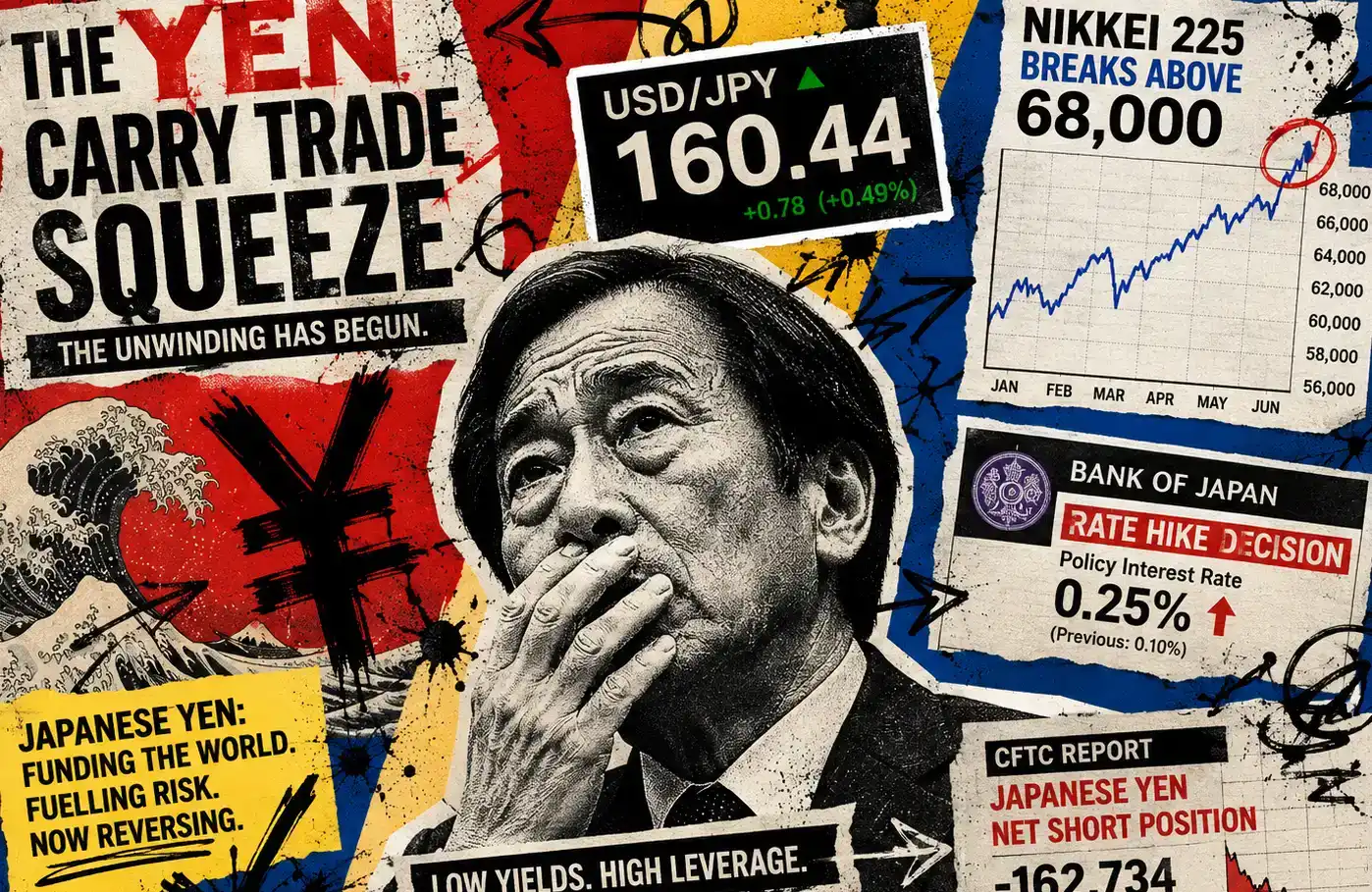
On June 3rd, USD/JPY hit 160.44, its highest level since July 2024, while the Nikkei 225 surged past 68,000 points. Contrary to popular narratives of an imminent "carry trade unwind" akin to August 2024, data reveals a more complex picture. Speculative net short positions in yen futures have actually increased, reaching -114,667 contracts by late May, suggesting traders are doubling down rather than retreating. Meanwhile, Japan's Finance Ministry conducted its largest-ever single-round FX intervention (11.73 trillion yen) in April-May but failed to hold the 160 yen line. The Nikkei's rally is not driven by carry trade dynamics. Foreign investors are aggressively buying Japanese stocks, with net purchases in 2026 running nearly 16 times higher than 2025 levels. This inflow is concentrated in AI and semiconductor-related stocks like SoftBank and Socionext, fueled by positive sector outlooks, rather than being a flight from unwinding yen shorts. Furthermore, the Nikkei has continued climbing despite the Bank of Japan's (BOJ) rate hikes to 0.75%. This disconnect exists because the current equity boom is fueled by AI-driven foreign investment, not reliant on cheap yen funding. However, this relationship remains fragile. Should the BOJ hike rates further (e.g., to 1.0%) while dollar weakness increases carry trade costs, the trajectories of the yen and Japanese stocks could reconverge, potentially triggering volatility.

marsbitHá 21m

New Wall Street Play: Yen Shorts Still Adding, But Japan Stocks Don't Rely on Carry Trade Unwinding

marsbitHá 21m

Broadcom's Q3 Guidance Misses Expectations by $12 Billion, After-Hours Trading Plummets Over 13%, AI Narrative "Cooling"?

On June 3, Broadcom released record Q2 FY26 results with revenue of $22.19B, up 48% YoY, and AI chip sales of $10.8B, up 143%. Adjusted EPS of $2.44 beat estimates. However, its Q3 AI semiconductor revenue guidance of $16B, while up over 200% YoY, fell roughly $1.2B (7%) short of analyst consensus expectations of $17.2B. This miss, coupled with slightly weaker-than-expected software revenue, triggered a severe market reaction. CEO Hock Tan maintained the FY26 AI revenue outlook of over $100B but did not raise it, disappointing investors who had priced in more robust growth. The stock plummeted over 13% in after-hours trading, erasing roughly $270B in market cap. The sell-off extended to peers like Marvell. A key concern for markets, particularly for Chinese optical module suppliers, was Tan's comment that the contribution of AI networking (e.g., Ethernet switches, optical interconnect chips) to AI revenue, currently near 40%, is expected to normalize to around 30% over time, signaling a potential peak in growth for that segment. Despite the guidance shortfall, Tan reiterated that AI demand remains "insatiable" and reaffirmed the long-term target of exceeding $100B in AI revenue by FY27. The reaction highlights the heightened sensitivity and premium valuation placed on AI-exposed stocks, where anything less than stellar guidance can prompt significant profit-taking. The broader question is whether this represents a cooling AI narrative or a correction in overstretched valuations.

marsbitHá 21m

Broadcom's Q3 Guidance Misses Expectations by $12 Billion, After-Hours Trading Plummets Over 13%, AI Narrative "Cooling"?

marsbitHá 21m

Trading

Spot
Futuros
活动图片