Firestorm erupts in Aave governance forum over CoW Swap fees

cointelegraphPublicado em 2025-12-14Última atualização em 2025-12-14

Resumo

A dispute has erupted in the Aave governance forum regarding fee distribution from the protocol’s recent integration with CoW Swap. Aave DAO member EzR3aL raised concerns that swap fees—estimated at $200,000 weekly in ETH—are being sent to a private address controlled by Aave Labs rather than to the DAO treasury. They argue the DAO should receive this revenue, estimated at $10 million annually. Aave Labs responded that front-end components have always been under its control, while protocol-level changes remain under DAO oversight. It also claimed it funded the development of the integration adapters. However, several community members, including Aave-Chan Initiative founder Marc Zeller, criticized the move, arguing that the DAO funded the original adapter technology and that redirecting fees away from the treasury is unacceptable. The conflict underscores ongoing challenges in DAO governance and revenue distribution.

A dispute between the Aave decentralized autonomous organization (DAO), which governs the Aave decentralized finance (DeFi) protocol, and Aave Labs, the main development company for Aave products, over fees from the recently announced integration with decentralized exchange aggregator CoW Swap, continues to flare up.

The issue was raised by pseudonymous Aave DAO member EzR3aL, who said that the fees generated by crypto asset swaps using CoW Swap were going to a different onchain address, not the treasury of the Aave decentralized autonomous organization.

Instead, the fees are going to a private address controlled by Aave Labs. EzR3aL raised several questions, including why the DAO was not consulted before the fees were routed, and argued that the fees belong to the DAO.
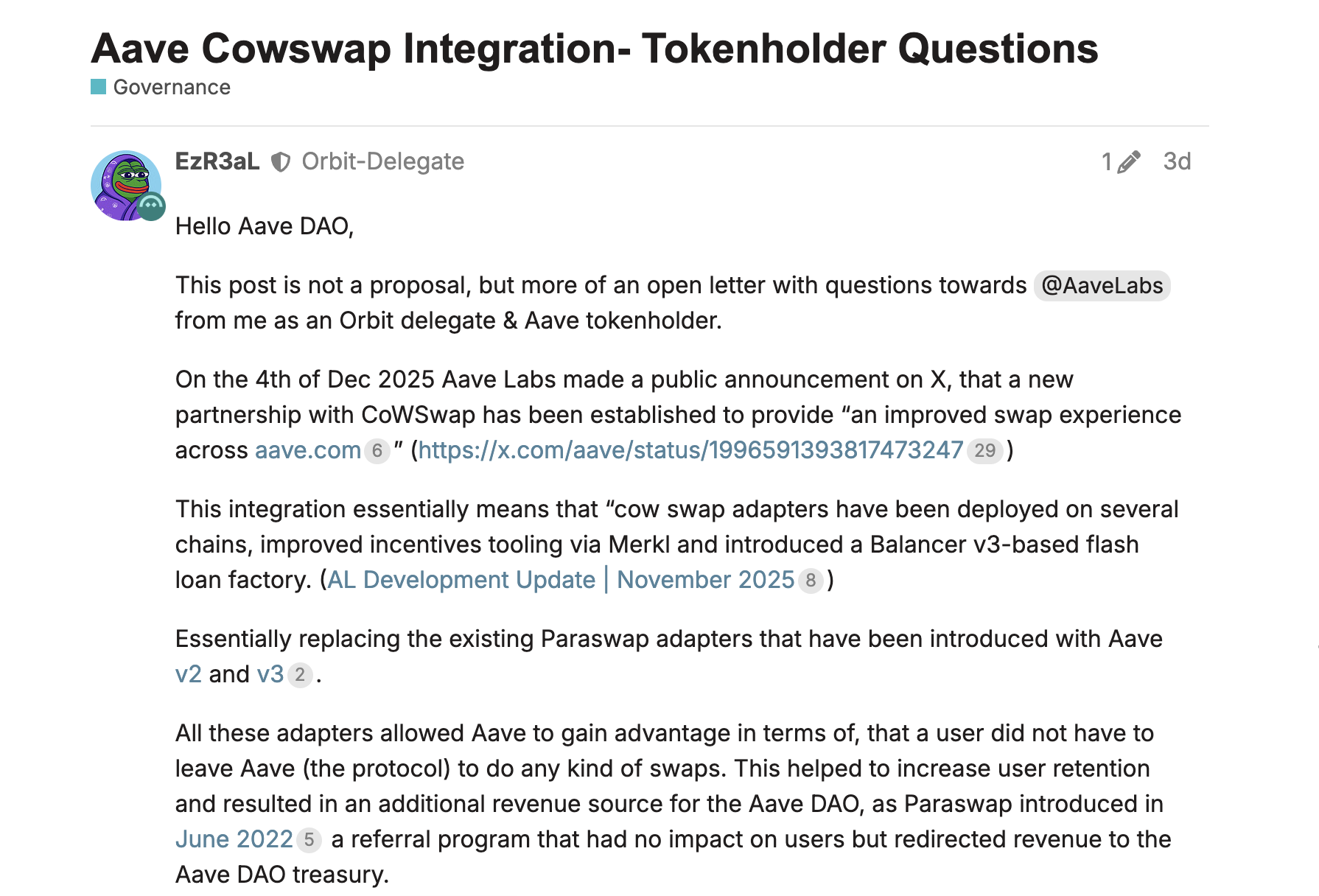
The governance forum post that sparked the debate. Source: Aave Governance

“Another entity, rather than the Aave DAO, is receiving at least $200,000 per week worth of Ether,” EzR3aL said, adding that this amounts to $10 million of potential annual revenue kept from the DAO.

Aave Labs responded that the front-end components for the website and application interfaces have always been the rightful purview of Aave Labs.

Related: Aave launches retail savings app with up to 9% APY to compete with banks

Protocol-level changes, like interest rate policies and approving changes to smart contract code, have always been subject to the DAO’s stewardship, Aave Labs said.

Aave Labs also claimed that it was the entity that funded the development of the “adapters,” the lines of code that allow swaps and other integrations to work.
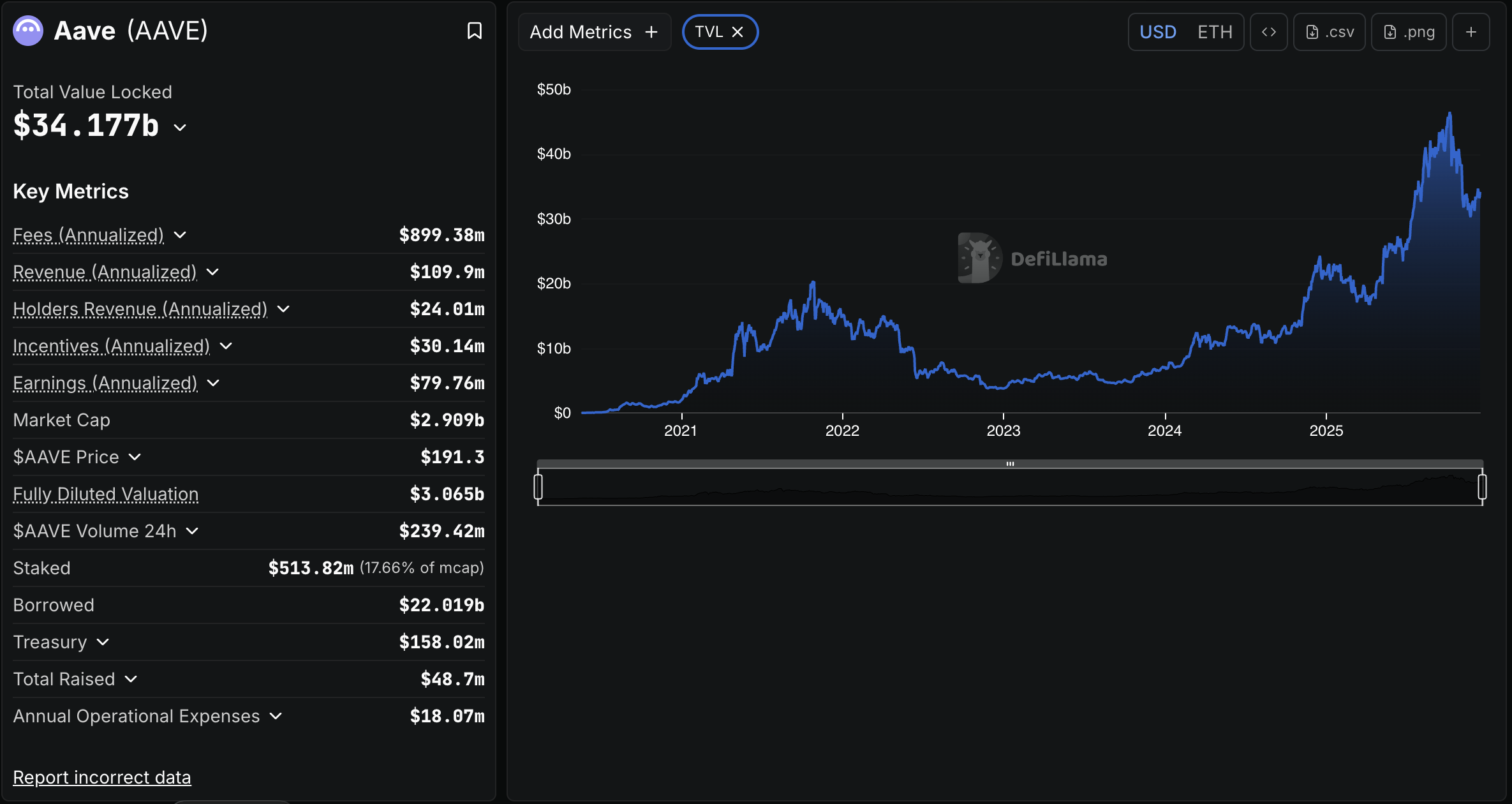
The total value locked in the Aave protocol and a financial overview of the DeFi platform. Source: DeFiLlama

However, the response did little to curb the tension, with several DAO members saying that the Aave DAO funded the development of the original adapter technology; therefore, the revenue from the integration should flow back to the DAO.

Marc Zeller, the founder of the Aave-Chan Initiative, a delegate platform serving the Aave governance community, said the decision to route the fees exclusively to Aave Labs is “extremely concerning.”

“Aave Labs, in the pursuit of their own monetization, redirected Aave user volume towards competition. This is unacceptable,” Zeller said.

Cointelegraph reached out to Aave Labs but did not obtain an immediate response by the time of publication.

The conflict highlights the complexities of running a DAO, which is a novel form of governance and organization that has benefits over traditional business structures but also brings its own unique challenges.

Magazine: The one thing these 6 global crypto hubs all have in common...

Criptomoedas em alta

Leituras Relacionadas

Bitcoin Withdrawals Continue: 8 Years of Storage in a Coldcard Cold Wallet Ended in Zero

Coldcard Hardware Wallet Hacked: Losses Mount Due to Vulnerable Seed Generation A critical vulnerability in Coldcard hardware wallets has led to a continued wave of fund thefts. According to Galaxy Research, the total stolen has reached 1,367.05 BTC (approx. $88.6 million) from 4,585 addresses, a significant increase from the initial 594.5 BTC reported on July 30, 2026. Most of the stolen funds remain on the attackers' addresses. The issue is not with the current firmware, which Coinkite has updated, but with seed phrases generated on vulnerable devices between March 2021 and the release of fixed firmware versions. Due to a programmer error, devices switched from using a hardware random number generator to the software-based Yasmarang generator, which was initialized with publicly accessible data like the chip's serial number. This made the seed phrases predictable through offline brute-force attacks, meaning wallets remain at risk until funds are moved to a new wallet generated with the patched firmware. Affected devices include Mk2/Mk3 with firmware 4.0.1–4.1.9 (and up to 5.0.3), Mk4/Mk5 up to version 5.6.0, and Q models up to 1.5.0Q. The only exceptions are seeds created with a high-entropy method like at least 50 independent dice rolls or a strong unique BIP-39 passphrase. All other owners must generate a new seed on the fixed firmware and transfer their assets. A case highlighting the human impact involves a 39-year-old long-term investor who lost 2 BTC (approx. $130,000) in minutes. He had accumulated the Bitcoin over eight years through physical labor, viewing it as a financial lifeline and a retirement plan in a country suffering from hyperinflation. His story underscores that even conservative "buy and hold in cold storage" strategies can be compromised by such underlying technical flaws. From a technical perspective, this incident echoes historical failures where weak random number generators undermined cryptographic security, challenging the assumption that offline storage is automatically foolproof.

cryptonews.ruHá 2h

Bitcoin Withdrawals Continue: 8 Years of Storage in a Coldcard Cold Wallet Ended in Zero

cryptonews.ruHá 2h

Trading

Spot

Artigos em Destaque

Como comprar AAVE

Bem-vindo à HTX.com!Tornámos a compra de Aave Protocol (AAVE) simples e conveniente.Segue o nosso guia passo a passo para iniciar a tua jornada no mundo das criptos.Passo 1: cria a tua conta HTXUtiliza o teu e-mail ou número de telefone para te inscreveres numa conta gratuita na HTX.Desfruta de um processo de inscrição sem complicações e desbloqueia todas as funcionalidades.Obter a minha contaPasso 2: vai para Comprar Cripto e escolhe o teu método de pagamentoCartão de crédito/débito: usa o teu visa ou mastercard para comprar Aave Protocol (AAVE) instantaneamente.Saldo: usa os fundos da tua conta HTX para transacionar sem problemas.Terceiros: adicionamos métodos de pagamento populares, como Google Pay e Apple Pay, para aumentar a conveniência.P2P: transaciona diretamente com outros utilizadores na HTX.Mercado de balcão (OTC): oferecemos serviços personalizados e taxas de câmbio competitivas para os traders.Passo 3: armazena teu Aave Protocol (AAVE)Depois de comprar o teu Aave Protocol (AAVE), armazena-o na tua conta HTX.Alternativamente, podes enviá-lo para outro lugar através de transferência blockchain ou usá-lo para transacionar outras criptomoedas.Passo 4: transaciona Aave Protocol (AAVE)Transaciona facilmente Aave Protocol (AAVE) no mercado à vista da HTX.Acede simplesmente à tua conta, seleciona o teu par de trading, executa as tuas transações e monitoriza em tempo real.Oferecemos uma experiência de fácil utilização tanto para principiantes como para traders experientes.

468 Visualizações TotaisPublicado em {updateTime}Atualizado em 2026.06.02

Como comprar AAVE

Discussões

Bem-vindo à Comunidade HTX. Aqui, pode manter-se informado sobre os mais recentes desenvolvimentos da plataforma e obter acesso a análises profissionais de mercado. As opiniões dos utilizadores sobre o preço de AAVE (AAVE) são apresentadas abaixo.

活动图片













