Give AI a mathematical conjecture, and the first thing it ponders is: How to overturn it and find a counterexample!!
This judgment, which sounds somewhat rebellious in the mathematical world, comes from Timothy Gowers, the 1998 Fields Medalist and British mathematician.
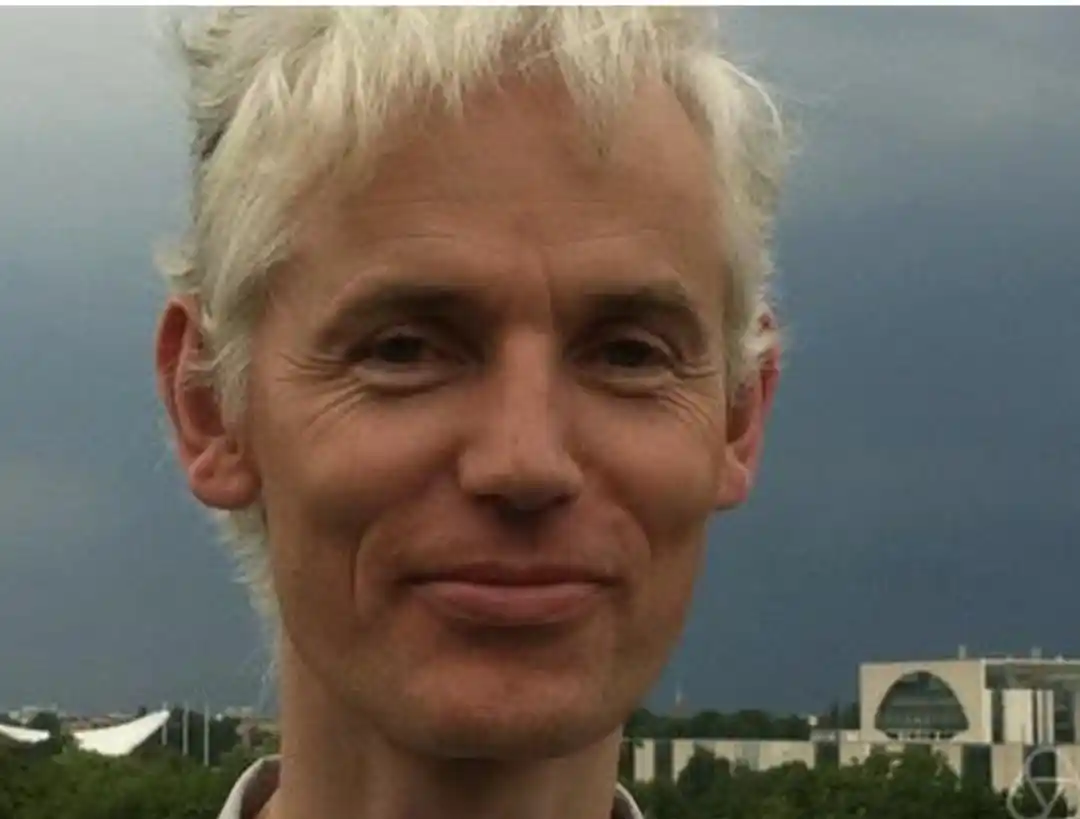
Recently, Gowers laid out the most sensational mathematical achievements of AI over the past few months and noticed a very consistent pattern—
Jacobian Conjecture, find a counterexample.
Erdős unit distance conjecture, find a counterexample.
Non-sofic group problem, construct an example that no one had found before.
Multicolor Ramsey numbers problem, the core remains constructing new objects that meet the requirements.
Human mathematicians: Why exactly does this conclusion hold?
AI: Hold on a second, does this conclusion... really hold? (full of rebellious spirit.jpg)
So, the question arises.
Why do AIs, upon encountering mathematical conjectures, so love to dive into finding counterexamples!?
AI's Most High-Profile Mathematical Breakthroughs Recently Are All "Finding Counterexamples"
First, let's clarify a point people often confuse.
The "finding counterexamples" mentioned by Gowers here and the "proof by contradiction" learned in school are actually quite different.
The proof by contradiction we learned in school is a proof technique: first assume the conclusion is false, then derive step by step until a contradiction is reached, thereby proving the original proposition true.
The "finding counterexamples" Gowers talks about is much more straightforward—
For example, someone proposes: All objects satisfying A have property B.
Then AI just needs to pull out one object from a huge pile that clearly satisfies A but precisely lacks B.
Done.
The entire conjecture is instantly invalidated.

It's no wonder Gowers noticed this pattern.
The main reason is, several of AI's most sensational mathematical breakthroughs lately have indeed been achieved this way.
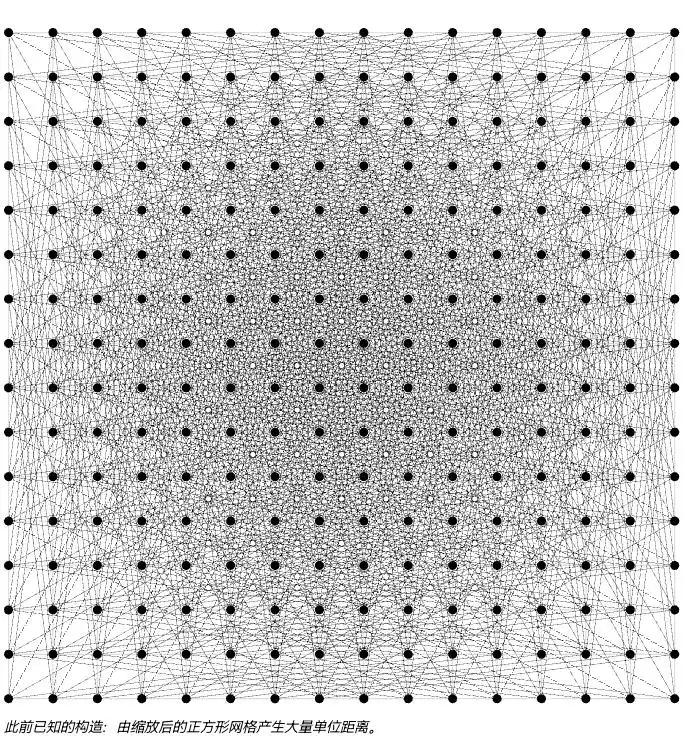
Take the Erdős unit distance problem solved by an internal OpenAI model last month.
For nearly 80 years, the mathematical community formed a widely believed growth judgment around it, and many research efforts were directed towards proving this judgment.
But AI came in and took a sharp 180-degree turn in approach.
It wasn't in a hurry to push forward along the human decades-long line of thinking. Instead, it spent a significant portion of its reasoning budget pondering another thing—
Is it possible to directly find a counterexample to this judgment?
In the end, it actually found one. The model imported a set of tools originally from algebraic number theory into discrete geometry, using more complex number fields to construct a whole family of point sets, making the number of unit distance pairs grow at a rate unexpected before.
A judgment that had circulated for decades was thus directly pierced by a specific construction.
What's more interesting is that when mathematicians later examined its reasoning trace, they found it really did spend a lot of time trying various constructions and searching for counterexamples. (doge)
Not long after this, Claude delivered another solid blow to the notion that "AI is particularly good at dismantling conjectures."
Mathematician Levent Alpöge, with the help of Claude, found a counterexample related to the Jacobian Conjecture.
The most contrasting aspect of such achievements lies here: AI doesn't need to lay out a grand, sweeping positive proof in the end. It just needs to present that special object and then check item by item—
Premise, satisfied.
Conclusion, fails.
Then that conjecture can basically be wrapped up.
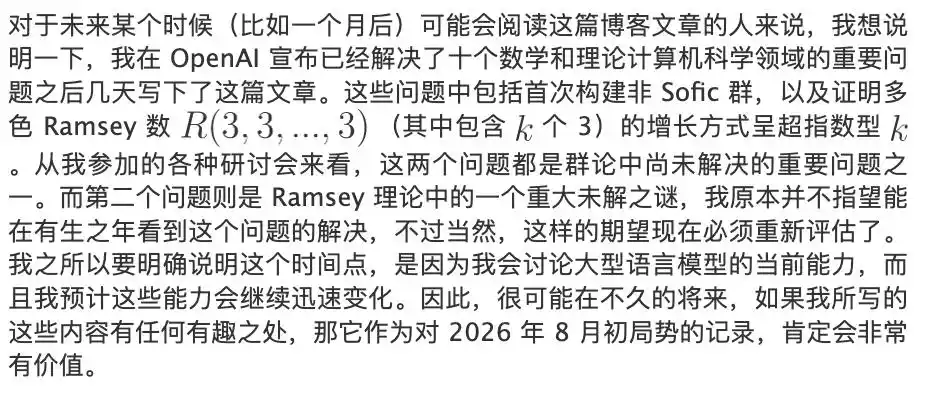
When Gowers looked back at the 10 mathematical achievements recently announced by OpenAI, he also detected a similar flavor.
For example, the long-standing "Are all groups sofic groups?" problem, the breakthrough AI provided was directly constructing a non-sofic group.
Another example is the progress on multicolor Ramsey numbers. Although the final presentation is a strict lower bound proof, the entire breakthrough process still carries a very strong constructive flavor:
You first need to find those sufficiently special, sufficiently tricky combinatorial objects, then the subsequent proof has a place to land.
Thus, an increasingly obvious pattern emerges.
Many of the mathematical problems where AI currently makes the biggest splash can actually be compressed into a very machine-friendly statement—
"Does such a thing exist?"
If the answer really is yes, then the model's most adept tactics start to work.
Frantically searching, borrowing tools across fields, recombining existing techniques, repeatedly trying constructions, and finally yanking that thing out from the enormous space of mathematical objects.
So, what AI is truly good at is not just proof by contradiction as literally understood.
More accurately, it is currently especially adept at a type of mathematical task: finding, within a space so vast that humans could never exhaustively search, the specific object that does exist but has remained unfound.
Why Does AI Like to Find Counterexamples in Such Problems?
The question then is, why is AI so keen on finding fault with mathematical conjectures???
The explanation Gowers provides is actually quite straightforward; large models currently have at least two visible advantages.
First, they know a lot. (doge)
If the key to a problem lies hidden in some existing mathematical tool, some adjacent field, or some combination of techniques that humans rarely put together, large models have a good chance of directly digging them out from their knowledge repository.
The unit distance problem is a very typical example.
This problem long belonged to the context of discrete geometry and combinatorics, yet the breakthrough AI found borrowed tools more from algebraic number theory.
For humans, this kind of cross-domain leap sometimes requires a researcher who happens to understand both sides.
For a model, both domains are already sitting in its context and training knowledge, so the combination cost is inherently much lower...
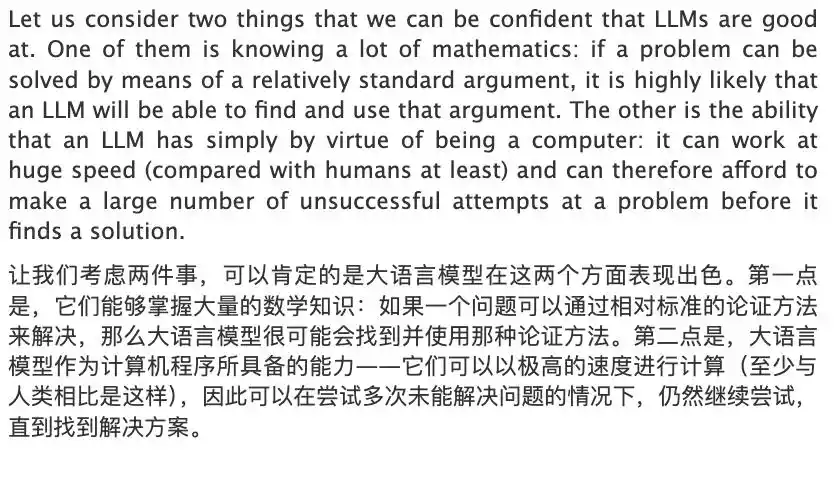
Second, they can afford to experiment.
Regarding OpenAI's recently announced 10 achievements in mathematics and theoretical computer science, finding some counterexamples by AI consumed a total of only "thousands" of dollars worth of Tokens when converted at API prices.
In other words, many avenues that have too low a success rate for human mathematicians to spend months on, AI can just go all out and try!!
Gowers also specifically reviewed in his article how mathematicians usually search for examples or counterexamples—
The simplest kind is to first test those "heirloom" classic objects one by one.
For example, if you propose a conjecture about Boolean functions, first test it with a few heirloom test samples:
Dictatorship function, majority function, parity function, tribes function... If all these pass, then consider others.
The second is assembly, starting from basic objects, taking products, quotients, limits, changing the construction method, and then seeing if the desired properties can be obtained.
There's also the random method, where explicit construction is too hard, so randomly pick objects from some distribution, proving they satisfy your condition with high probability.
Another is the step-by-step approximation method, first writing down a candidate answer that probably isn't quite right, not because you think it will work, but to observe exactly where it goes wrong. Fix one defect, get version two; fix again, get version three...

The earlier strategies involving lots of trying objects, changing constructions, and random searches are all very suitable for large models—large enough knowledge base, fast enough speed, and low cost of failure—making it possible to brute-force the answer through massive attempts.
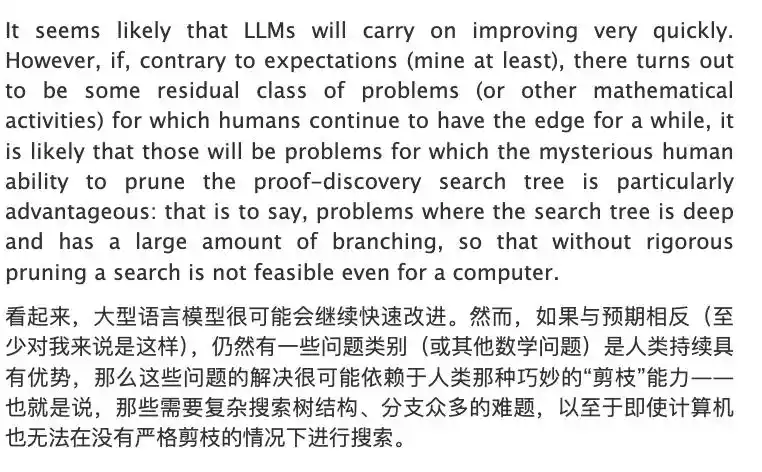
But the further you go, the more it tests a kind of ability hard to write into formulas: halfway down a path, can you smell whether this path is promising or not.
Gowers calls this the mathematician's "nose".
A truly outstanding researcher isn't one who never takes a wrong turn, but one who can quickly prune away 99% of the branches when the search tree first sprouts many forks, keeping only the few most worth investing in.
It's precisely this thing that AI currently often handles in a somewhat amusing way. For example, when Gowers discusses open problems with AI, he often encounters an awkward experience—
AI will propose solutions that sound promising, but upon closer thought, aren't so reliable. AI also loves to say: Although I didn't solve the original problem, I narrowed it down to a more precise subproblem~
The first time you hear it, it's indeed exciting.
But by the fifth time, still stuck on different versions of "more precise subproblems," human mathematicians probably start to wonder: Is this actually approaching the answer, or just describing being lost more and more elegantly?
This is also why Gowers doesn't deify AI.
He doesn't think humans will forever retain this advantage. On the contrary, he explicitly expects models to continue improving rapidly, possibly even developing a stronger "nose" within a year or two.
Just for now, AI's strength seems more like breadth-first: widely invoking existing knowledge, broadly exploring possible paths, stumbling upon solutions through massive attempts.
Finally, and more interestingly, Gowers sets a rather romantic acceptance criterion for AI truly entering the stage of top-tier mathematical creation—
The day AI provides a solution that not only solves the problem but also comes up with a new method no one had thought of before.
Even better, looking back, this method feels particularly natural and straightforward, even to the point where other mathematicians can pick it up and produce a series of new results.
At that point, what AI accomplishes would far exceed just yanking the answer out from a vast search space.
AI's identity in the mathematical world might truly change.
Reference links:
[1]https://gowers.wordpress.com/2026/08/12/what-sort-of-maths-are-llms-good-at/
This article is from the WeChat public account "QbitAI", author: Focus on Frontier Technology