Farewell to the Copper Era: Understanding the Logic of the AI Silicon Photonics Industry Chain and Key US Stock Players

marsbitPublicado em 2026-05-19Última atualização em 2026-05-19

Resumo

**Summary: The Era of Silicon Photonics and Key AI Infrastructure Stocks** The article delves into the transition from copper-based interconnects to silicon photonics (SiPh) as a critical enabler for next-generation AI data centers. It explains that copper faces fundamental physical limits—the bandwidth wall, density wall, and power wall—at high data rates (1.6T+), making a material shift essential. Silicon photonics, which integrates components like lasers, modulators, and detectors onto a silicon chip, offers a solution by leveraging mature CMOS manufacturing for cost-effective, high-volume production. A key challenge is that silicon itself is not an efficient light source, making Indium Phosphide (InP) lasers a critical and supply-constrained component. A major industry catalyst was NVIDIA's 2025 GTC announcement, declaring optical interconnects a "standard" from its Rubin platform onward, followed by strategic investments to secure the supply chain. The industry is structured in four key layers: 1. **Foundries:** TSMC leads with its COUPE platform, while Tower Semiconductor (specialized SiPh foundry) and GlobalFoundries are major players. 2. **Core Component Suppliers:** Lumentum is highlighted as the sole volume manufacturer of the crucial 200G/lane EML laser, with orders locked by NVIDIA through 2027. 3. **Module & System Manufacturers:** Coherent holds significant market share, with Chinese manufacturers like InnoLight also noted for scale. 4. **System Integrato...

Author: Godot

The two hottest sectors in AI are storage and photonics. Previously, I wrote a framework on storage (Understanding the Profit Pools and Industry Landscape of AI Storage Tiers). This article focuses on photonics.

Silicon photonics (Silicon Photonics) is used for communication between computing chips, replacing traditional copper wires, as clearly shown in the diagram below.

Terms you might come across but find confusing, such as LPO (Linear-drive Pluggable Optics), CPO (Co-packaged Optics), OCS (Optical Circuit Switching), and Optical I/O (Optical Input/Output), represent different technical approaches to implementing silicon photonics.
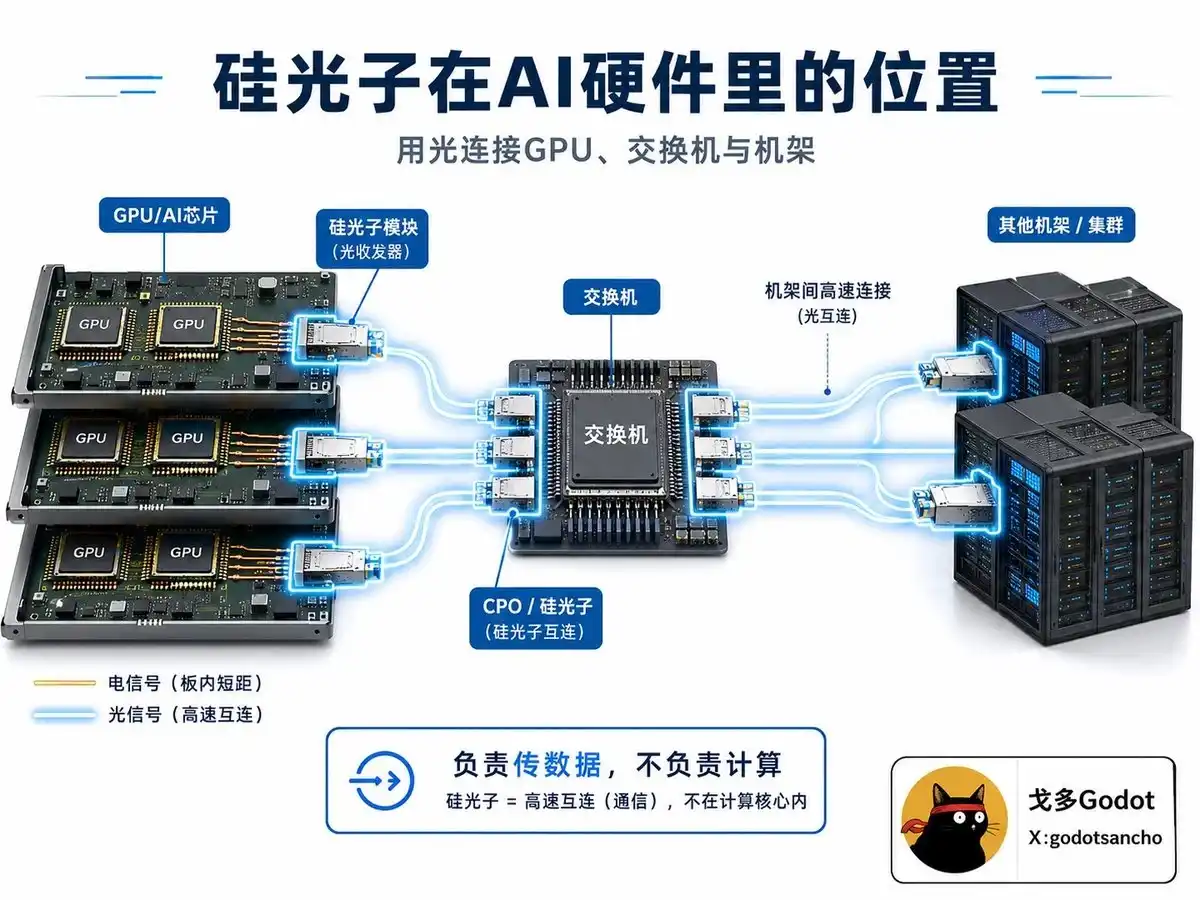
Typically, chips communicate using copper wires. Silicon photonic chips integrate components like lasers (which generate light), modulators (which "modulate" light), and *detectors* (which "receive" light) directly onto silicon wafers, enabling communication via photons.

So, why replace copper? And why use silicon photonics instead of other alternatives?

First, copper wires nearly reach their physical limits when transmitting signals above 1.6T, leading to signal degradation. Switching materials becomes imperative. This is the most critical issue and a necessary change. The technical term is the "bandwidth wall."

Second, copper is a tangible physical entity. As GPU clusters expand, there simply isn't enough space for all the copper wiring. This is another compelling reason to replace copper. Photonics are different; optical interfaces can be soldered directly next to switch chips, eliminating the need for extensive cabling. The term for this is the "scale wall."

Third, copper consumes too much power. In facilities consuming hundreds of megawatts, silicon photonics can save tens of thousands of kilowatt-hours daily—energy otherwise wasted on copper wire communication. After switching to photonics, this power can be redirected to GPUs for actual computation. This is termed the "power wall."

More interestingly, silicon photonics can leverage the mature CMOS manufacturing processes of the existing semiconductor industry, eliminating the need to build entirely new factories from scratch, thus enabling low-cost, high-volume production.

Of course, silicon photonics also has a drawback: silicon itself cannot emit light efficiently and must rely on Indium Phosphide (InP) materials. This has become the most critical bottleneck in the entire supply chain.

The Evolution of Silicon Photonics Technology

The most significant watershed moment was in March 2025 when NVIDIA, at its GTC conference, launched the Quantum-X and Spectrum-X photonic switches. Jensen Huang announced that starting from the next-generation Rubin architecture, "optical interconnect is not an option, it's a requirement."

A week later, NVIDIA announced a combined $4 billion investment in Coherent and Lumentum to secure key supply chains.

The paper on the silicon-based photoelectric effect was published in the 1980s. From 2004 to 2014, Intel and IBM manufactured silicon-based optical modulators.

In the previous decade, hyperscale cloud service providers like AWS, Google, and Meta adopted silicon photonics, though at the time it was only a part of fiber optic communication.

Current Industry Landscape

1) The Foundation: Foundries

They manufacture photonic chips. TSMC $TSM leads with its COUPE process. Tower Semiconductor $TSEM specializes in silicon photonics foundry services, with its silicon photonics revenue growing 70% year-over-year in 2025. GlobalFoundries $GFS, through its acquisition of Singapore's AMF, has become the world's largest dedicated silicon photonics foundry.

2) The Second Tier: Core Component Suppliers

They provide components like lasers and modulators, primarily Indium Phosphide (InP) lasers. Globally, fewer than five companies can manufacture high-speed EML lasers.

Lumentum $LITE is the only manufacturer capable of mass-producing 200G/lane EML lasers, a core component for 1.6T optical modules. To lock in its capacity, NVIDIA has secured orders extending beyond 2027.

3) The Third Tier: Module and System Manufacturers

They assemble components into finished products. Coherent holds about 25% of the global optical transceiver market share. Chinese companies like InnoLight, Eoptolink, and Accelink are significant contenders in terms of manufacturing scale and cost competitiveness.

4) The Top Tier: System Integrators

This layer includes NVIDIA, Cisco, Broadcom $AVGO, and Marvell $MRVL.

In summary,

NVIDIA $NVDA

Holds a dominant position, deciding the interconnect standards for AI data centers and securing supply chains through strategic investments.

Broadcom $AVGO

The absolute leader in networking switch chips, commanding nearly 80% market share in Ethernet switches. The Tomahawk 6-Davisson is the world's first 102.4 Tbps CPO switch.

Marvell $MRVL

Broadcom's strongest challenger, dominating the PAM4 optical DSP market with a 60-70% share. Recently acquired Celestial AI to enter the chip-to-chip optical interconnect space.

Lumentum $LITE

The most critical supplier of EML lasers. The world's only manufacturer capable of mass-producing 200G/lane EML lasers. NVIDIA has locked in orders until after 2027.

Coherent $COHR

An integrated player across the entire supply chain, with a presence from materials and lasers to modules. FY2025 revenue was $5.8 billion, making it the market leader in optical transceiver share.

TSMC $TSM

The process standard-setter. Its 65nm silicon photonics process is in mass production. The COUPE platform is currently the most advanced 3D heterogeneous integration solution, and NVIDIA's CPO roadmap is deeply tied to it.

Tower Semiconductor $TSEM

The purest beneficiary of the silicon photonics foundry trend. Its silicon photonics revenue grew 70% year-over-year in 2025. It is investing $650 million to triple its capacity. It has the highest potential for valuation elasticity among all the mentioned players.

Lightmatter / Ayar Labs (Unlisted · IPO Candidates)

Lightmatter, valued at $4.4 billion, focuses on 3D photonic interconnects. Ayar Labs has received investments from AMD, Intel, and NVIDIA, working on optical I/O chiplets. Both are potential major IPO candidates.

Valuation Logic Shift Driven by the Silicon Photonics Boom

Take an example. Previously, Wall Street valued Tower Semiconductor as a regular analog foundry, with a Price-to-Sales (P/S) ratio of around 2-3x.

But when its silicon photonics business grew from 5% to 30%-40% of total revenue, the market began to revalue it as a scarce asset within AI infrastructure, potentially lifting its P/S ratio to 6-10x.

Lumentum and Coherent, once viewed as telecom component suppliers, are now being redefined as indispensable providers of AI interconnect components. BofA analyst Vivek Arya raised Marvell's target price to $200, underpinned by valuing Marvell as an AI infrastructure platform rather than a communications chipmaker.

Evercore ISI's assessment of Cisco is similar. As silicon photonics products penetrate hyperscale data centers, Cisco's core AI-related revenue could potentially explode from $3 billion to $12-$15 billion over the next 3-4 years.

The Moat of the Silicon Photonics Industry

The silicon photonics industry exhibits clear winner-take-most characteristics, as every single process has been refined over a long period *before* the AI boom.

InP lasers: Globally, fewer than five companies can mass-produce high-end EML lasers, with a capacity expansion cycle of 3-5 years. This is the most critical bottleneck in the entire supply chain.

TSMC's COUPE process: The technological barrier of 3D heterogeneous integration puts competitors at least two generations behind, requiring years of yield experience accumulation.

Foundry PDK ecosystem: Once a customer designs with a specific foundry's Process Design Kit (PDK), the switching cost is extremely high—redesigning and recertification can take 12-18 months.

Thermal management and packaging: CPO requires managing the coupling of electrical, thermal, and optical domains within a few millimeters of space, which cannot be achieved without years of system integration experience.

The supplier certification process for giants like AWS and Google typically takes 12-24 months. Once certified, customer stickiness is extremely strong.

Risks and Cold-headed Considerations

The growth of the entire industry chain is highly dependent on the capital expenditures of the five hyperscale cloud giants: Microsoft, Google, Meta, Amazon, and Oracle.

There is substitutability among technical paths like LPO, CPO, OCS, and Optical I/O. If one route is disrupted by another, previously invested capital may face depreciation or write-downs.

Research firms like LightCounting judge that truly large-scale CPO deployment will not arrive until after 2028. Before that, transitional solutions like LPO will dominate volumes.

Therefore, betting on the success of the *industry* is safer than betting on the success of a *single company*.


Perguntas relacionadas

QAccording to the article, what are the three major limitations (or 'walls') of using copper interconnects in high-performance AI systems that silicon photonics aims to overcome?

AThe article outlines three major limitations of copper: 1) The Bandwidth Wall: Copper wires hit a physical limit for transmitting signals above 1.6T, leading to signal degradation. 2) The Scale Wall: As GPU clusters grow, physical copper wiring takes up too much space, whereas optical interfaces can be placed directly next to switch chips. 3) The Power Wall: Copper interconnects consume significant power, with silicon photonics potentially saving tens of thousands of kilowatt-hours per day in large facilities, freeing up power for GPUs to compute.

QWhy is Indium Phosphide (InP) a critical 'chokepoint' in the silicon photonics supply chain?

AInP is a critical chokepoint because silicon itself is not an efficient light emitter. High-performance lasers, particularly the essential Electro-absorption Modulated Lasers (EML) needed for high-speed data transmission, are made from Indium Phosphide. The article states there are fewer than five companies globally capable of manufacturing high-end EML lasers, and capacity expansion takes 3-5 years.

QName two companies positioned in the 'Core Components Supplier' layer of the silicon photonics industry chain as described in the article and explain their key advantage.

ATwo companies in the core components layer are Lumentum (LITE) and Coherent (COHR). Lumentum's key advantage is being the world's only company capable of mass-producing the 200G/lane EML laser, a core component for 1.6T optical modules, with NVIDIA having locked in its capacity through 2027. Coherent, as a full-industry-chain integrator, holds about 25% of the global optical transceiver market share, with a strong position from materials to modules.

QHow is the valuation logic changing for companies like Tower Semiconductor due to the rise of AI silicon photonics?

APreviously, Tower Semiconductor (TSEM) was valued as an ordinary analog foundry with a price-to-sales ratio of 2-3x. As its silicon photonics business is forecasted to grow from 5% to potentially 30-40% of revenue, the market is beginning to revalue it as a scarce AI infrastructure asset. This could push its price-to-sales ratio to a range of 6-10x.

QWhat is one major risk factor highlighted for the silicon photonics industry's growth, aside from dependence on hyperscaler capital expenditure?

AA major risk factor is technological substitution. Different technical paths like LPO, CPO, OCS, and Optical I/O are competing. If one technology path is ultimately displaced by another, the capital invested in the former could face depreciation and impairment risks.

Leituras Relacionadas

"Water Scarcity": The Hidden Fatal Flaw of AI Infrastructure

“Water Scarcity: The Hidden Vulnerability of AI Infrastructure” In June 2026, SpaceX revised its IPO prospectus to highlight a core resource constraint alongside power and processors: water. This move signals a pivotal shift where water scarcity has transformed from an operational cost to a major, uncontrollable investment risk, directly threatening AI data center expansion. The scale of the problem is immense. U.S. data centers consumed an estimated 17 billion gallons of water for direct cooling in 2023, with indirect water use for power generation exceeding 211 billion gallons. Giants like Google alone use billions of gallons annually, with single sites consuming volumes equivalent to a medium-sized city. This water is largely “consumptive,” evaporated into the atmosphere and lost. This massive demand is colliding with scarcity. Tech companies are building “water tigers” in arid regions, sparking community protests in places like Mexico and Arizona, where data centers can legally use millions of gallons daily—enough for tens of thousands of residents. These conflicts are not about illegality, but about a mismatch between historic water allocation frameworks and new, colossal demand. The consequences are real. Community opposition, largely centered on water, has reportedly stalled or canceled $64 billion in U.S. data center projects over two years. Simultaneously, investors are pressuring companies for greater water footprint transparency, viewing it as a financial risk, not just an ESG metric. Technological solutions like air or liquid cooling involve trade-offs between water and electricity use, with final choices dictated by local constraints. The irony is stark: while industry leaders envision AI as a utility “like water,” its physical infrastructure is straining real-world water supplies. The race for AI supremacy may ultimately be governed not by the fastest chip, but by the slowest water meter.

marsbitHá 32m

"Water Scarcity": The Hidden Fatal Flaw of AI Infrastructure

marsbitHá 32m

Global Card Issuance Enters a Compliance-Driven Era: WasabiCard is Building the Next-Generation Payment Infrastructure

Global card issuance is entering a compliance-driven era, with WasabiCard building next-generation payment infrastructure. The platform asserts that as stablecoins increasingly enter cross-border payments, corporate settlements, and global commerce, the industry is shifting focus from "availability" and "growth-driven" models to long-term, compliant operation under global frameworks. Competition will center on sustainable compliance and global infrastructure capabilities. Stablecoins are evolving from on-chain assets into key payment tools in global business, with card issuance acting as critical infrastructure connecting digital assets to traditional payment networks like Visa and Mastercard. This expansion has revealed structural issues, including cross-regional issuance, BIN resource management, and insufficient AML and risk controls. In response, the industry is moving away from reliance on "grey efficiency" towards prioritizing compliance, risk management, and long-term operational stability. WasabiCard outlines its strategy: collaborating with licensed principals and local partners for localized operations, building robust KYC/AML systems, strictly separating commercial and consumer BIN usage, and enhancing global issuance, payment, and cross-border fund flow infrastructure. The goal is to build stable, scalable payment infrastructure amid evolving global regulations, shifting industry competition from scale to infrastructure capability. As stablecoins integrate further with global commerce, payment infrastructure will become a fundamental, embedded component of internet business. WasabiCard will continue to develop capabilities in global card issuance, stablecoin payments, cross-border fund flows, and API-driven financial workflows.

marsbitHá 42m

Global Card Issuance Enters a Compliance-Driven Era: WasabiCard is Building the Next-Generation Payment Infrastructure

marsbitHá 42m

Zhou Hang: How Much Is SpaceX Really Worth?

**Zhou Hang: How Much is SpaceX Really Worth?** SpaceX, arguably one of the greatest industrial companies of the past 50 years, is reportedly targeting a staggering $1.75 trillion valuation in its potential IPO. However, the author argues this figure is inflated by approximately $1.25 trillion when assessed through standard financial metrics. The analysis begins by acknowledging SpaceX's undeniable success: drastically reducing launch costs, achieving near-monopoly in commercial launches, and building the strategic Starlink network. Its achievement surpasses even Tesla's, given it disrupted a state-monopolized industry. Despite this greatness, a $1.75 trillion valuation places SpaceX above the combined market cap of Boeing, Lockheed Martin, Northrop Grumman, RTX, and General Dynamics. Projecting optimistic 2030 revenues of $50-80 billion and applying generous tech-sector multiples yields a "reasonable" valuation range of $500 billion to $1.2 trillion. The $1.25 trillion gap is attributed to three non-financial premiums: 1. **Long-term vision premium** for future Starship-enabled markets (e.g., space-based computing). 2. **Sovereign asset/strategic premium**, as SpaceX is deeply integrated into U.S. national security. 3. **Retail narrative/Musk cult premium**, driven by a heroic story and personal following. Post-IPO, three scenarios are outlined: valuation solidifying (25% probability), sideways volatility as narrative outpaces reality (50%), or a re-rating down to $800B-$1.2T if execution falters or Musk-related risks emerge (25%). The probability-weighted expected value is $1.3-1.5 trillion, suggesting negative expected returns for those buying at the IPO price. The conclusion advises investors to separate the company's excellence from its stock price. Buying at the IPO likely prices in excessive optimism. A more prudent strategy would be to wait for key milestones (e.g., Starship V3 stability) or a significant price correction before investing, or to treat an early purchase as a long-term, high-conviction hold with limited position size, not a short-term bet.

链捕手Há 47m

Zhou Hang: How Much Is SpaceX Really Worth?

链捕手Há 47m

Trading

Spot
Futuros

Artigos em Destaque

Como comprar ERA

Bem-vindo à HTX.com!Tornámos a compra de Caldera (ERA) simples e conveniente.Segue o nosso guia passo a passo para iniciar a tua jornada no mundo das criptos.Passo 1: cria a tua conta HTXUtiliza o teu e-mail ou número de telefone para te inscreveres numa conta gratuita na HTX.Desfruta de um processo de inscrição sem complicações e desbloqueia todas as funcionalidades.Obter a minha contaPasso 2: vai para Comprar Cripto e escolhe o teu método de pagamentoCartão de crédito/débito: usa o teu visa ou mastercard para comprar Caldera (ERA) instantaneamente.Saldo: usa os fundos da tua conta HTX para transacionar sem problemas.Terceiros: adicionamos métodos de pagamento populares, como Google Pay e Apple Pay, para aumentar a conveniência.P2P: transaciona diretamente com outros utilizadores na HTX.Mercado de balcão (OTC): oferecemos serviços personalizados e taxas de câmbio competitivas para os traders.Passo 3: armazena teu Caldera (ERA)Depois de comprar o teu Caldera (ERA), armazena-o na tua conta HTX.Alternativamente, podes enviá-lo para outro lugar através de transferência blockchain ou usá-lo para transacionar outras criptomoedas.Passo 4: transaciona Caldera (ERA)Transaciona facilmente Caldera (ERA) no mercado à vista da HTX.Acede simplesmente à tua conta, seleciona o teu par de trading, executa as tuas transações e monitoriza em tempo real.Oferecemos uma experiência de fácil utilização tanto para principiantes como para traders experientes.

468 Visualizações TotaisPublicado em {updateTime}Atualizado em 2026.06.02

Como comprar ERA

Discussões

Bem-vindo à Comunidade HTX. Aqui, pode manter-se informado sobre os mais recentes desenvolvimentos da plataforma e obter acesso a análises profissionais de mercado. As opiniões dos utilizadores sobre o preço de ERA (ERA) são apresentadas abaixo.

活动图片












