Fact Check: How Much Money Did the University of Chicago Really Lose in Cryptocurrency Trading?

marsbitPublicado em 2026-01-15Última atualização em 2026-01-15

Resumo

Fact Check: Did the University of Chicago Lose Billions in Cryptocurrency Investments? A claim by Professor Zhao Dingxin suggested the University of Chicago lost over $6 billion in cryptocurrency investments, leading to budget cuts. However, the university’s official statement denies significant crypto losses, describing its crypto investments as "relatively small" and having doubled over five years. Financial reports show the university’s endowment ranged between $10.9–11.6 billion in recent years. A loss of $6 billion would require an implausibly large and risky allocation. More reliable sources, including the Stanford Daily, report actual crypto losses in the tens of millions—not billions. The university’s 2022 financial report indicated a drop in crypto holdings from $64 million to $45 million within a year, suggesting a loss of around $19 million. The university did experience a $1.5 billion total investment loss in FY2022, though it is unclear how much was related to crypto. Critics point to other major financial pressures, including $9.2 billion in debt from aggressive expansion and infrastructure projects. Administrative salaries also rose significantly during this period. In response to financial strain, the university is implementing budget cuts and plans to enroll more undergraduate students to increase revenue. The claim of a $6 billion crypto loss appears exaggerated and unsupported by official data.

Author: Darren Terminator

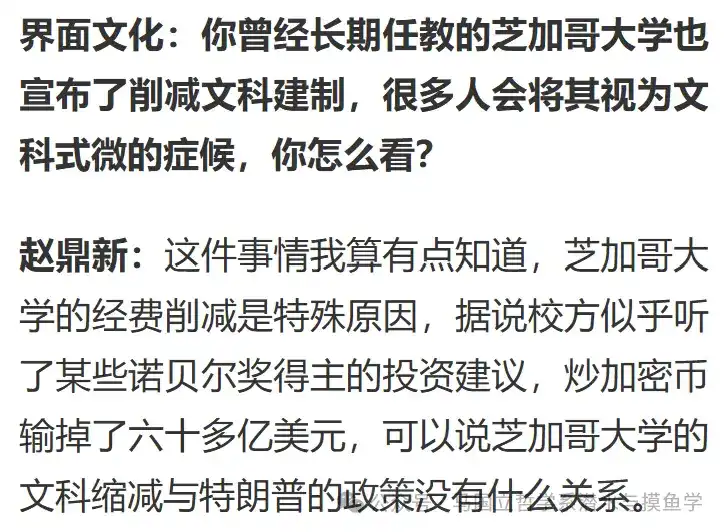
Recently, Jiemian News interviewed Professor Zhao Dingxin on the occasion of the third edition of his book "Lectures on Social and Political Movements" (the second edition was truly an excellent book). During the interview, Professor Zhao mentioned that the recent budget-cutting measures at the University of Chicago were because, "It is said that the university administration apparently took investment advice from some Nobel laureates, lost over six billion dollars trading cryptocurrency, so it can be said that the reduction in humanities at the University of Chicago has little to do with Trump's policies."

So, did the University of Chicago really lose over six billion dollars trading cryptocurrency?
Coincidentally, the University of Chicago's updated Q&A from December 2025 [1] mentioned the cryptocurrency trading issue. According to the official statement: "Contrary to claims in a certain news report, the University of Chicago has not suffered losses on cryptocurrency investments. The University's investments in cryptocurrency are relatively modest but have more than doubled over the past five years. The University's investment goals are to provide a stable source of income to support the University's programs long-term and secure its future."
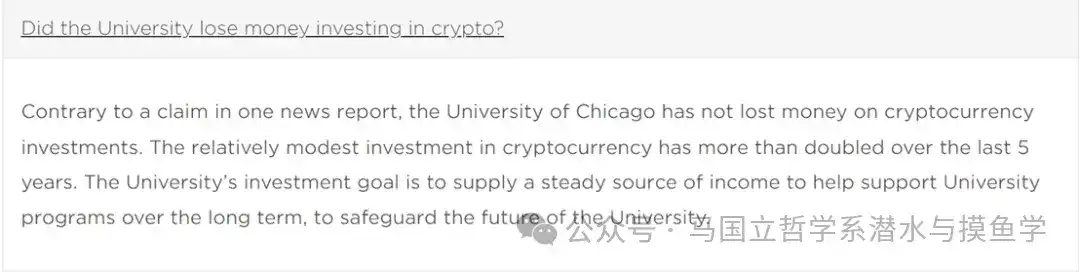

Is the University of Chicago Provost necessarily telling the truth?

Hard to say. But intuitively, the total endowment of the University of Chicago has been around $10 billion in recent years (peaking at about $11.6 billion in FY2021; approximately $10.9 billion in FY2025 [2]). Unless the University of Chicago was truly疯狂 enough to invest at least 60% of its endowment in cryptocurrency (which显然 violates various regulations), or misappropriated a large amount of operational funds for crypto trading and lost it all, it should not have lost as much as six billion dollars.


So how much was actually lost? Or did they actually make a fortune as the Q&A suggests?

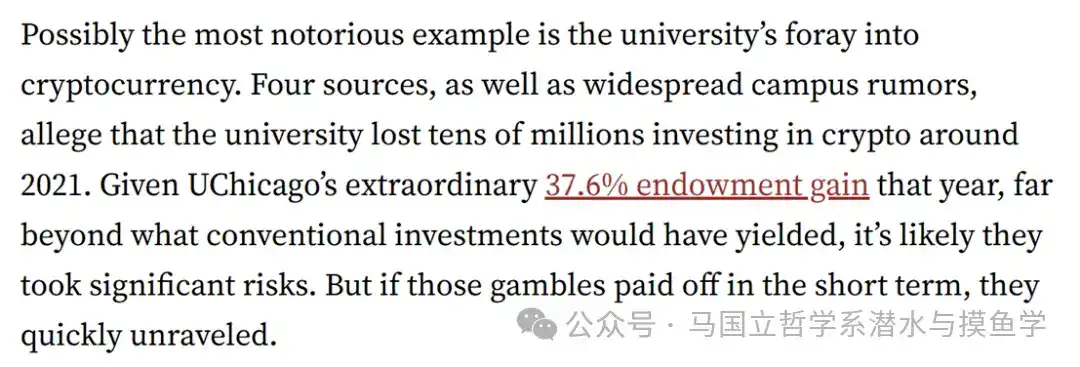
The Stanford University student newspaper [3], the Financial Times [4], and Investopedia [5] reported on this matter last year. According to the Stanford paper, their four sources indicated: "The University of Chicago lost tens of millions of dollars on cryptocurrency investments around 2021."

What do the University of Chicago's financial reports [6] say?

Unfortunately, the financial reports do not directly tell us exactly how much was lost on cryptocurrency trading. However, in the FY2022 financial report, the University of Chicago disclosed its cryptocurrency investments (fair market value): As of the end of June 2021, it was approximately $64 million, and as of the end of June 2022, it was approximately $45 million (a difference of about $19 million). In subsequent financial reports, perhaps because they made a fortune or lost a fortune, the University of Chicago changed its reporting method and no longer discloses its cryptocurrency investments. However, according to the 2025 Q&A statement, the University of Chicago is still investing in cryptocurrency relatively cautiously.

It is worth noting that the 2022 financial report showed that as of the end of June that year, the total investment loss of the University of Chicago's endowment fund was surprisingly high, at about $1.5 billion. The 2023 financial report then showed that the University's investments only incurred a small loss. In the following two years, the University of Chicago returned to profitability.
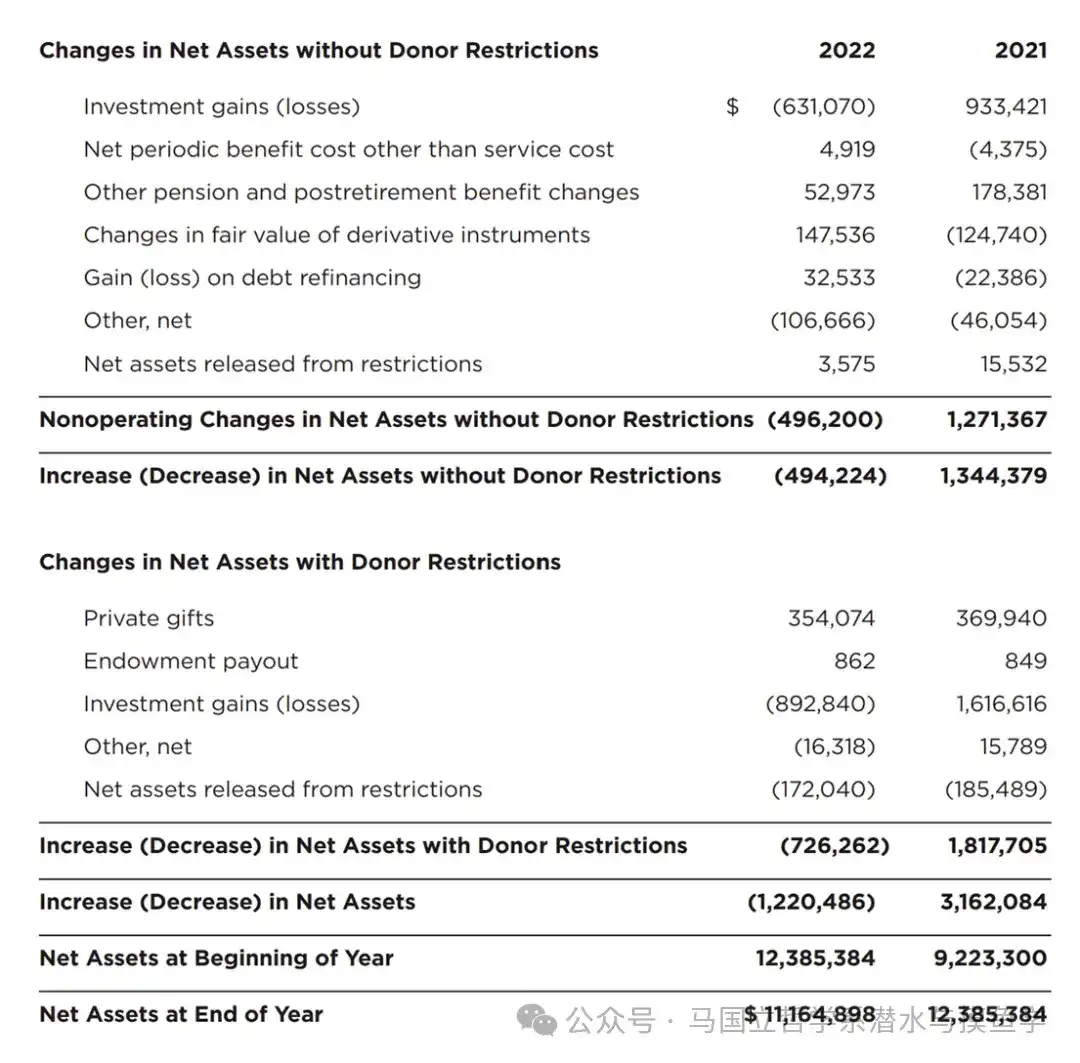
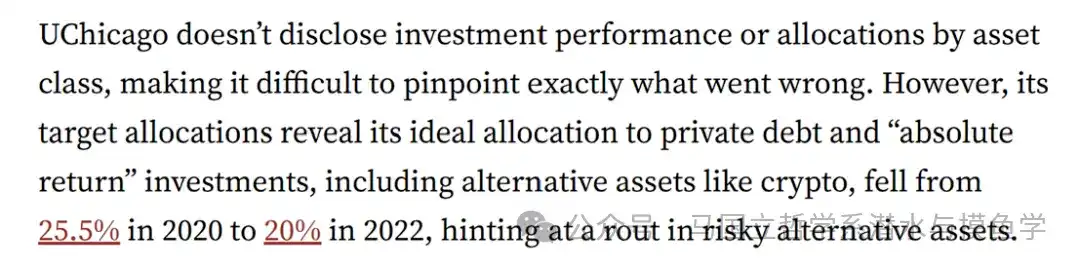
However, we do not know how much of these losses and gains came from cryptocurrency trading. The Stanford University student paper provided a less reliable clue: "[The University of Chicago's] target asset allocation shows that the ideal allocation for private debt and 'absolute return' investments (which include alternative assets such as cryptocurrency) has decreased from 25.5% in 2020 to 20% in 2022,暗示 a significant withdrawal (or downturn) in high-risk alternative assets."
However, the Stanford paper also made an interesting observation: "Between 2013 and 2023, the University of Chicago endowment's annualized return was only 7.48%, while the stock market's annualized return during the same period was 12.8%, and the average for Ivy League schools was 10.8%. If the University of Chicago had simply followed market performance, its endowment would now be $6.5 billion larger. And this (dream) fund would be more than enough to pay off the university's entire debt. Of course, universities cannot simply replicate market indices, as they must hedge during economic downturns to maintain financial stability. But even if the University of Chicago had only reached the average of its approximate peer group, the Ivy League, its endowment would still be $3.69 billion larger today. This would be enough to cover the university's current budget deficit for the next 15 years."


However, besides cryptocurrency trading and investment losses, what other reasons can explain the University of Chicago's budget cuts?

Common explanations, besides Trump being a scoundrel, often emphasize the University of Chicago's own strategic mistakes: taking on debt and leverage, massive infrastructure construction, and aggressive expansion. [7][8] As of the end of June 2025, the University of Chicago's debt was approximately $9.2 billion [9], about 90% of its endowment. Although the financing cost of this debt is relatively low, unlike on the other side of the ocean, the interest the university needs to pay this fiscal year still amounts to over $200 million.

Such high debt did not come out of nowhere. Since the new century, in order to enhance its reputation and enrollment, and compete with various established prestigious schools, the University of Chicago has spent huge sums on new laboratories, libraries, dormitories, technology, etc., and this expansion has been largely supported by heavy borrowing. However, new infrastructure brings持续 operating costs, and the school did not plan how to sustain them long-term.

The University of Chicago student newspaper [10] quoted Professor Clifford Ando as saying that any parent wanting to send their child to the University of Chicago needs to think about whether the tuition they painstakingly pay is for their child's education or for paying off the school's debt. The疯狂 expansion and the ensuing debt problem are clearly the responsibility of the school's management for being impulsive and overly ambitious. More ironically, the base salary of the president increased by 285% between 2006 and 2022. Now encountering some economic problems, the management is passing the difficulties on to students and general faculty: even in years of selling assets, layoffs, and暂停招生, executive compensation continues to rise.


So what should the University of Chicago do next?

Besides continuing to cut costs, it must, of course, increase revenue. Obviously, a common trick for American universities to make more money is to enroll more undergraduates. The University of Chicago is also going to do this, though the理由 will certainly be stated冠冕堂皇.


[1]https://provost.uchicago.edu/actions-budget

[2]In this article, the budget, endowment, and debt of the University of Chicago are consolidated calculations for the University proper, the Medical Center, and the Marine Biological Laboratory. Common news reports (especially the University of Chicago's own publicity materials) usually consolidate the endowment but only calculate the debt for the University proper.

[3]https://stanfordreview.org/uchicago-lost-money-on-crypto-then-froze-research-when-federal-funding-was-cut/

[4]https://www.ft.com/content/4501240f-58b7-4433-9a3f-77eff18d0898?utm_source=chatgpt.com

<极速em>[5]https://www.msn.com/en-us/money/careersandeducation/university-s-investment-losses-spark-outrage-resulting-in-drastic-program-cuts/ar-AA1Nxhgx

[6]https://intranet.uchicago.edu/en/tools-and-resources/financial-resources/accounting-and-financial-reporting/financial-statements

[7]https://www.wsj.com/us-news/education/colleges-face-a-financial-reckoning-the-university-of-chicago-is-exhibit-a-8918b2b0

[8]https://www.ft.com/barrier/corporate/d5c7c0f4-abf1-4469-8dca-87ff01cbebf6

[9]The debt of the University proper is approximately $6 billion. Perhaps this is the source of Professor Zhao's $6 billion figure.

[10]https://chicagomaroon.com/40486/news/uchicago-professor-sounds-alarm-over-troubling-university-finances/


Perguntas relacionadas

QDid the University of Chicago lose over $6 billion in cryptocurrency investments, as claimed by Professor Zhao Dingxin?

ANo. The university's official statement and financial data refute this claim. The university stated it 'did not suffer losses on cryptocurrency investments' and that its investment in this area was 'relatively modest.' Financial reports show its cryptocurrency holdings were valued at approximately $64 million in 2021 and $45 million in 2022, a difference of about $19 million, not billions.

QWhat is the more accurate estimate of the University of Chicago's losses from cryptocurrency investments according to the Stanford University newspaper?

AAccording to the Stanford University newspaper, which cited four sources, the University of Chicago lost 'tens of millions of dollars' on cryptocurrency investments around 2021.

QWhat were the main financial reasons cited for the University of Chicago's budget cuts and financial difficulties?

AThe primary reasons were aggressive expansion, high debt, and subpar investment returns. The university took on significant debt (around $9.2 billion for the consolidated entity) to fund new infrastructure like labs and dorms. Furthermore, its endowment's 7.48% annualized return from 2013-2023 underperformed compared to the market (12.8%) and Ivy League peers (10.8%), representing a massive opportunity cost.

QHow did the University of Chicago's official statement characterize its cryptocurrency investment strategy?

AThe university's official statement characterized its strategy as cautious and long-term. It stated the investment was 'relatively modest' but had 'more than doubled over the past five years.' The goal was to 'provide a steady source of income to support the University’s programs in the long term and secure its future.'

QWhat potential source might have led to the mistaken $6 billion loss figure mentioned in the article?

AThe article's footnote [9] suggests the $6 billion figure might be a confusion with the size of the university's core debt, which was approximately $6 billion (as opposed to the $9.2 billion for the consolidated institution including the medical center).

Leituras Relacionadas

If the AI Bubble Is Already Bursting, Who Will Truly Remain?

**Summary: If the AI Bubble is Bursting, What Will Remain?** The debate around an AI bubble is intensifying, with figures like Ray Dalio warning of high valuations while Jensen Huang sees immense opportunity. This echoes the dot-com bubble, which saw massive wealth destruction but ultimately left behind critical infrastructure like undersea cables and broadband, enabling future giants like Amazon and Netflix. Similarly, today's AI boom involves trillions invested in data centers, power, cooling, and GPUs, while application-layer revenue remains comparatively modest. This investment-disparity signals a bubble. However, the core technological progress is real and accelerating. AI inference costs have plummeted by over 99.7% since 2023, making intelligence increasingly cheap and accessible. This cost collapse is unlocking vast new demand. Instead of reducing spending, enterprises are tripling their AI cloud expenditure. Cheap "tokens" enable AI to move beyond simple chatbots into complex workflows—automating code writing, legal document review, financial analysis, and scientific research. This follows "Jevons's paradox": improved efficiency leads to greater total consumption. The market is now undergoing a necessary purification, weeding out "API-wrapper" startups with no real moat. The deeper evolution involves a shift from capital expenditure (CapEx) on infrastructure to operational expenditure (OpEx) on value-creation in applications. While hardware vendors currently profit most, long-term value will migrate to AI-native firms solving vertical industry problems. Ultimately, a market correction will cleanse speculative excess but will not reverse the AI+ trend. The massive physical and algorithmic infrastructure being built will endure, becoming a cheap, utility-like foundation. Just as the internet became indispensable to all industries post-2000, AI is poised to empower and redefine every sector, moving society irreversibly toward an intelligence-augmented era. The bubble may burst, but the underlying productive momentum is solid.

链捕手Há 6m

If the AI Bubble Is Already Bursting, Who Will Truly Remain?

链捕手Há 6m

Microsoft CEO: In the AI Era, How Do You Define a Company's Moat?

Microsoft CEO Satya Nadella argues that in the AI era, a company's true competitive edge, or "moat," is not determined by choosing the single most powerful model, but by its ability to build a continuous "learning loop." This system integrates and evolves by connecting human workflows, domain expertise, organizational judgment, and employee experience. He posits that future companies will accumulate two types of capital: Human Capital (employee knowledge, judgment, creativity) and "Token Capital" (a firm's own built and owned AI capabilities). Importantly, AI amplifies rather than devalues human capital. Human direction is essential to guide progress, as computational power alone is aimless. The core opportunity lies in creating a closed-loop system where human and token capital reinforce each other in a compound, self-improving cycle. A company must be able to preserve its unique institutional knowledge—its "company veteran" expertise—even if it switches underlying general-purpose AI models. This requires private evaluation benchmarks, reinforcement learning environments based on internal data, and queryable knowledge bases. Nadella warns against a future where economic value is concentrated by a few dominant models that commoditize entire industries' knowledge. Instead, the priority should be building a broad "frontier ecosystem" where every company, industry, and nation can own its learning loop. This allows organizations to retain control of their intellectual property, amplify employee capabilities, and ensure the economic value created by AI is captured within their own businesses and communities. True corporate sovereignty in the AI age comes from turning organizational knowledge into a compounding system that creates enduring, defensible value.

marsbitHá 41m

Microsoft CEO: In the AI Era, How Do You Define a Company's Moat?

marsbitHá 41m

ETFs Are Just the Ticket: The True Institutionalization of Bitcoin Is Happening Where You Can't See It

Beyond the Bitcoin ETF spotlight, a deeper institutionalization is underway, leveraging Bitcoin as a foundational financial primitive. Institutions are using Bitcoin for purposes long reserved for assets like U.S. Treasuries and gold: as collateral for loans, insurance reserves, and the backbone of rated bonds. Examples include a Barbados-based insurer capitalizing with $40M in Bitcoin reserves and Ledn's $188M securitization of Bitcoin-backed loans, which received the first-ever investment-grade rating (BBB-) from S&P for a digital asset-backed security. This structure was stress-tested during a 27% price drop in early 2026, triggering automatic liquidations that functioned as designed but revealed the systemic risk of synchronized selling across leveraged positions. Infrastructure is evolving to support this, with platforms like Anchorage Digital's Atlas network enabling secure, institutional-grade settlement and collateral management. Strategies like basis trades and corporate treasuries (exemplified by companies like MicroStrategy issuing billions in equity and debt to fund Bitcoin acquisitions) further integrate Bitcoin into financial mechanics. While ETFs solved "how to own" Bitcoin, these developments answer "what to do with it," embedding the asset into the working machinery of finance—as collateral upon which loans, derivatives, and structured products are built. The real, enduring institutional shift is happening in these largely invisible plumbing and financing systems.

marsbitHá 48m

ETFs Are Just the Ticket: The True Institutionalization of Bitcoin Is Happening Where You Can't See It

marsbitHá 48m

ZEC Co-Founder Responds to Orchard Vulnerability: No Signs of Theft, Orchard Pool to Be Sealed

ZEC Co-Founder Addresses Orchard Vulnerability: No Signs of Theft, Plans to Sunset Orchard Pool A security vulnerability was recently discovered in Zcash's Orchard shielded pool, raising key concerns. The primary questions are whether the flaw was exploited, if user funds are safe, whether users can verify the total ZEC supply, and if other similar vulnerabilities exist. Analysis suggests the vulnerability was likely not exploited prior to its discovery. It was found proactively by a researcher using specialized tools, not due to an active breach. The development team and mining pools acted quickly to contain the issue. Typical financially-motivated attacks would likely have left visible on-chain evidence, which has not been observed. User funds in Orchard are considered safe and should be recoverable, assuming no prior exploitation. If the flaw was never used, all legitimate funds can be withdrawn. The article outlines risks associated with moving funds to transparent addresses or other pools, but concludes that leaving assets in place is a reasonable option. Currently, users cannot independently verify that the total ZEC supply hasn't been inflated due to this bug. However, the planned Ironwood network upgrade is designed to resolve this. It will permanently close the Orchard pool to new deposits and internal transfers, allowing only withdrawals. This mechanism will cap total withdrawals at the amount of legitimately deposited funds, enabling anyone to cryptographically verify the supply post-upgrade. Multiple teams, including Shielded Labs, have conducted extensive audits focused on counterfeiting vulnerabilities, assisted by advanced AI tools. No additional flaws of this type have been found so far, increasing confidence that no other similar undisclosed vulnerabilities exist. In summary, evidence indicates the Orchard bug was probably not used, user funds are secure, and no other counterfeiting flaws are currently known. The upcoming Ironwood upgrade will restore users' ability to independently verify the total ZEC supply, closing this chapter.

Foresight NewsHá 53m

ZEC Co-Founder Responds to Orchard Vulnerability: No Signs of Theft, Orchard Pool to Be Sealed

Foresight NewsHá 53m

Trading

Spot
Futuros
活动图片




